
After the divorce, my ex-mother-in-law brought the whole family to laugh at my poverty at Easter. But when they crossed my private gate, they understood too late. Without my son, you won't even be able to pay your electricity bill. Dona Terresa Cortez said it outside the courthouse at 11:43 in the morning in a voice calibrated to Carrie. Not whispered, not muttered, projected. The way a woman projects when she wants an audience and has one. The lawyer heard it. The court clerk stepping out for a cigarette heard it. Rodrigo's sister Paula heard it and bit down on a smile. A stranger walking past with a coffee heard it and had the decency to look embarrassed on my behalf. I was holding a small suitcase. I was wearing a simple gray dress. I had $17 in the wallet in my purse. I knew the exact amount because I had counted it that morning in a way that I hadn't needed to count money since I was 19 years old. I said nothing. That was the part they would never understand. The nothing. They read it as defeat, as smallness, as confirmation of everything they had always believed about me.
They were reading the wrong book entirely. I should explain Mariana Cortez because she was a person I inhabited for 5 years. the way you inhabit a costume carefully with constant awareness that it didn't fit, that the seams were wrong, that sooner or later someone was going to notice the zipper. I had been Mariana Varela for 29 years before that. My mother, Luciana Varela, built a financial consulting firm from a two-esk office in Guadalajara when I was 11 years old. By the time I was 18, it had offices in three cities. By the time I graduated with an economics degree from Universad Ibero Americana and came to work for her at 22, it had six. My mother was a quiet woman who moved through the world like water, softly, without drama, finding her way around every obstacle until the obstacle was simply no longer in the way. She taught me everything she knew about money. How it moves, where it hides, what it costs people to pretend they have more of it than they do. I met Rodrigo Cortez at a charity gala in 2018. He was 34, attractive in the specific way that men are attractive when they've grown up being told they're exceptional. Broad shoulders, easy confidence, the kind of laugh that fills a room. The Cortez group was an old money real estate and development company. Four generations of family name, a headquarters building with the family crest on the door. He was charming. I was, I'll admit, dazzled. The first red flag came 3 weeks in, and I rationalized it the way you do when you're new to someone and optimistic. We were at dinner with his parents, my first time meeting them, and Dona Teresa asked me what I did for work. I told her about my mother's firm, about the consulting, the investment portfolios, the six city operation. She nodded exactly the way people nod when they're waiting for you to finish. Lovely, she said. a working girl. She said it with a smile, like it was a compliment. Rodrigo squeezed my hand under the table. I told myself it was generational, a language thing, that she meant it warmly. I was wrong, but I had 5 years left to figure that out. We got married in the spring of 2019. The Cortez family planned the wedding. I want to be precise about that. They planned it, funded it, and curated the guest list, and my role was to appear, smile, and be grateful. My mother attended with quiet dignity and left early. She told me the next day that family loves their name more than they love each other. Be careful, Miha. I told her she was being protective. I was wrong about that, too. The first year of marriage was fine. The second year, I started noticing the architecture of how they saw me. At every family dinner, and the Cortez family had family dinners the way other families have obligations. I sat at the end of the table, not formally assigned there, just organically placed week after week, as if by gravity. Rodrigo sat near his father, Eduardo, who presided from the head like a man chairing a board meeting. Dona Teresa ran the other end. Paola and her husband sat in the middle. The cousins filled in. I sat at the end refilling water glasses, complimenting the food, listening to extended conversations about land deals and development projects and the Cortez legacy that I was never directly addressed about. When I mentioned my own work, I was still consulting, still running portfolios. Rodrigo had started to redirect the conversation with a smooth pivot that I told myself was protective. Mariana handles a few small projects, he'd say. Nothing too complicated, small projects. I was managing at that point $14 million in client assets across four cities. I said nothing. The third year, I stopped talking about my work entirely at family dinners. The fourth year, I started paying closer attention to the Cortez group's financial statements because Rodrigo had started sleeping less and snapping more and leaving the room when certain numbers came up on his phone. What I found quietly, without telling anyone, the way my mother had taught me, made my stomach go cold. The Cortez group was bleeding, not catastrophically, not yet, but steadily, consistently, with the particular rhythm of an organization that has been mismanaged for years by people who confused their grandfather's success with their own competence. They had overextended on a coastal development project in 2020. The contractor defaulted, insurance disputes dragged into 2021. Three commercial tenants had broken leases, and the Cortez group's lawyer, a man named Gerardo, who had been with the family for decades and whose primary qualification appeared to be loyalty, had failed to enforce the penalty clauses. In March of 2021, I pulled their quarterly filing and found they were 4 months from a bank review that would trigger default on their primary line of credit. Rodrigo didn't know I had seen it. He also didn't know that I had 3 years earlier incorporated a holding company called VL Capital through a law firm in Mterrey. VL Capital's managing director was a woman named Carmen Solis, a corporate attorney with 18 years of experience and a preference for anonymity on behalf of her clients. Carmen called me the night I found the quarterly filing. You want to move forward? She said, I looked out the window of the bedroom I shared with my husband who was in the next room watching football and didn't know his company was 4 months from collapse. Yes, I said. The board won't know the source. The board will never know. VL Capital purchased 23% of the Cortez group's secondary debt instruments at market rate and negotiated a 12-month forbearance agreement with the bank. Rodrigo announced at the next family dinner that they'd secured favorable refinancing. Dona Teresa poured champagne. Eduardo raised a toast to Cortez resilience. I sipped my water at the end of the table and said nothing. The fifth year, Rodrigo fell in love with someone else. I knew before he told me because the signs were the specific kind you can't rationalize once you know what you're looking at. the locked phone, the late arrivals, the sudden interest in his appearance. Three months of it before he sat me down in the kitchen one morning and told me he needed space to find himself. He said it like I should respect the journey. I respected the lawyer instead. Her name was Dr. Sophia Esla, 14 years in family law with a reputation for precision and a documented win rate that her firm listed on their website. I found her through a colleague called her on a Tuesday and sat in her office the following Thursday with a complete financial inventory of the Cortez marriage assets that I had assembled over the previous 3 months. She looked at it over her reading glasses and said, "You've done this before. My mother taught me." I said, "We filed the divorce petition in October." Rodrigo's family lawyers responded within 48 hours, which told me they'd been prepared. They offered a settlement, a lump sum I won't name because it was embarrassing. A studio apartment arrangement and a non-disclosure agreement. I declined. The courthouse meeting was in November. So, back to the parking lot. Back to Dona Teresa's voice cutting through the cold morning air like a blade that's very sure of itself. Rodrigo stood beside his mother, hands in his jacket pockets, smiling. His sister Paola stood slightly behind, the way she always did, close enough to participate, far enough to deny involvement. Two cousins lurked near the cars. Their lawyer, Gerardo, pretended to check his phone. "You were never meant for this level," Rodrigo said, straightening his jacket. "I hope you land somewhere appropriate." His tone implied something between a bus stop and a cousin's spare room. "Dr. Escamilla beside me, was silent. I had asked her before the meeting not to respond to anything the family said in the parking lot. She'd looked at me with the expression of a lawyer who doesn't usually take instructions about her own professional conduct, and then nodded once. The settlement we'd reached inside was not what they'd offered. They hadn't been happy. But Gerardo in the end had understood what Dr. Al Esa's documentation represented. And the alternative to the settlement was a discovery process that would have required the Cortez group to open its books. They didn't want that. I looked at Rodrigo at his mother at all of them assembled in the pale November light like a family portrait of people who had never doubted themselves for a single day and considered that certainty a virtue. Come to Easter dinner, I said. My voice was completely level. Come see how I live without your money. Dona Teresa's smile was venom in a silk dress. Which little restaurant, or are you renting a place just to pretend? I'll send the address, I said. I turned.
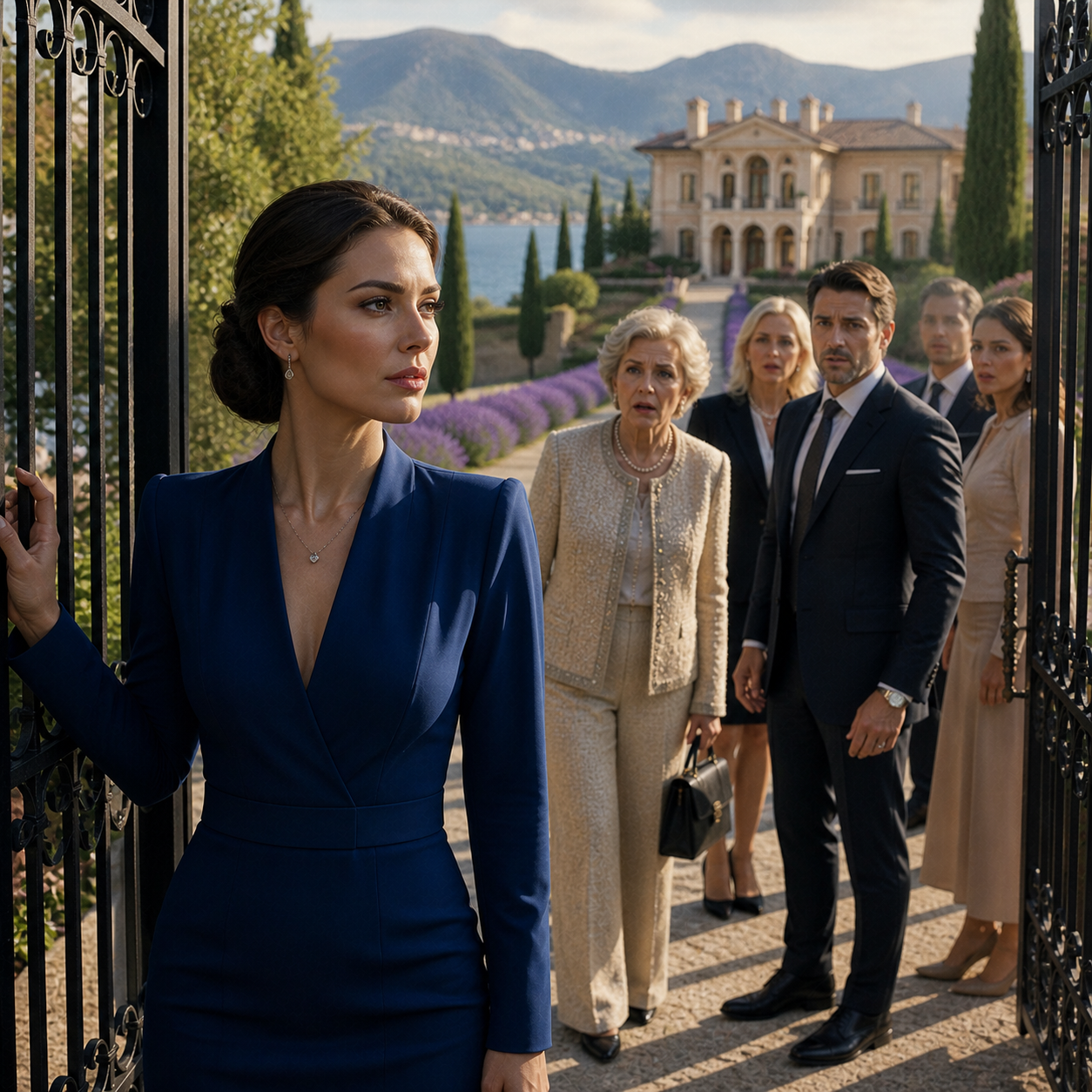
A black car was waiting at the curb. A Mercedes S-Class, which I had not mentioned to Rodrigo or anyone in his family because there had never been a reason to. The driver opened my door. Mrs. Varela, he said. Shall we head to Valet? I got in. Behind me, I heard the silence that happens when people are recalibrating something they thought they understood. Mariana Cortez was dead. Mariana Varela had come home. Baya de Bravo was 2 hours from the city, which was exactly far enough. The property had been my mother's, a six- hectare estate on the lake that she purchased in 2012 and that I had inherited in full when she died 2 years ago. It sat behind black iron gates at the end of a private road lined with lavender that bloomed in April. I had not told Rodrigo it existed. This requires explanation. The property was held in my personal name, predating our marriage, and was therefore not a marital asset. Rodrigo's lawyers had looked for undisclosed assets and found my consulting income and my portfolio accounts, which I had disclosed. They had not looked for inherited real estate in Val de Bravo because the idea that I had real estate in Val de Bravo was outside the boundaries of what they thought was possible for me. The house had a live-in manager named Forino who had managed it for my mother and stayed on for me. It had a caretaking staff of four stables with three horses, a dock on the lake, gardens my mother had planted herself over 20 years, and original art on the walls that she had collected methodically and that had appreciated in ways that would have impressed even the most skeptical appraiser. I moved back in on a Wednesday. On Thursday, I called my executive assistant, Valentina, who had been running my consulting operations out of our Guadalajara office throughout the entire marriage. Valentina Reyes had worked for my mother for 6 years before she worked for me. She was 38, relentlessly competent, and had the communication style of someone who was never once sent an email that could be misunderstood. "Are we ready?" I said, "The firm has been ready," she said. "Were you waiting for something specific?" "I was waiting for Easter," I said. 3 weeks later, ivory envelopes with gold lettering, our firm stationery, the goodstock, the kind you use for serious invitations, arrived at the Cortez residence. Inside, a card in my handwriting. Easter Sunday, Valet de Bravo. I look forward to hosting you. An address, a time, nothing else. Valentina had suggested we include a map because the property was hard to find. I told her the drive was part of it. Dona Terresa, I was told by a cousin who still occasionally texted me with the specific guilty warmth of someone who has watched a wrongdoing and never found the right moment to say something. called an emergency family assembly after receiving the invitation. "If she wants to embarrass herself," she told them, "we'll all be there to watch." All 32 of them showed up on Easter Sunday. They dressed for it, not casually, for performance. Sharp blazers, heels, the Cortez family at its most assembled, ready to witness something small, and come back with a story. I watched them arrive on the security monitors from the house. Watched the convoy of three luxury SUVs and four additional cars pull up to the black iron gate. Watched the gate guard, a man named Cesar, who had worked security for my mother for 9 years, approached the lead car window. Rodrigo's window rolled down. Cesar's face was professional. He was not smiling. Welcome to the private residence of Mrs. Mariana Varela, he said. Please follow the drive to the main house. Staff will meet you at the entrance. He pressed the gate release. The drive from the gate to the house was approximately 800 m. I had not staged it. I had simply not shortened it. The lavender was in full April bloom. The lake was visible through the pines on the right side. The stables were visible on the left with two horses moving in the morning light. I watched on the monitor as the cars slowed, which is what cars do when people inside them are processing something they weren't expecting. I watched Paola's window roll down. I watched her look out at the gardens. I put down the monitor and went to get dressed. I wore deep blue, not flashy. That would have been too easy to dismiss. structured, expensive in the way that only people who know fabric understand, and a pair of earrings my mother had given me for my 30th birthday. Valentina was already in the house at a desk in the study with a laptop and two phones. Carmen Solis had joined on video from Mterrey. She was on a secure call with the board representatives positioned to wait for my signal.
For supervised the kitchen, the table on the terrace was set for 32 because I had extended a genuine invitation and I believe in completing what you begin. I walked out onto the terrace at 12:07 p.m. They were all there standing because no one had told them to sit. 32 people in their Easter best looking at the lake view and the stone floors and the original art on the walls through the open terrace doors and none of them were laughing. I want to be precise about that. The laughter they had brought from the city. The anticipatory laughter, the kind assembled for a spectacle of someone else's diminishment. It had not survived the drive. Rodrigo stepped forward first because he was always the one who stepped forward. Who lent you this place, Mariana? He said it with the confidence of a man who was absolutely certain there must be an explanation that puts him back on solid ground. No one, I said. Stop the games. Dona Teresa's voice had a hairline fracture in it that I had never heard before. You could never afford this. I want to know whose property this is. Mine, I said. My mother bought it in 2012. I inherited it. It was never a marital asset, so your lawyers never found it. Silence. Then Valentina appeared at my shoulder perfectly on Q because we had worked together for 4 years and timing was one of our professional fluencies. Miss Varela, the transfer documents are ready. The Cortez group board also needs you before Monday's announcement. The air left Rodrigo's lungs so audibly that the cousin standing next to him visibly flinched. "What board?" he said. I walked to the table and set a folder on it. A document folder. Our firm's branding on the cover. Your family's board, I said. I have replayed this moment in my mind many times since, and I want to describe it accurately because accuracy is the thing I owe myself here. It was not triumphant in the way movies make these moments look triumphant. There was no swelling music. My hands were not raised. I was standing very still at the head of my own table on the terrace of my mother's house in the sunlight coming off the lake and 32 people were looking at me with expressions that covered the full spectrum from confusion to dawning horror for 2 years. I said the Cortez group has had an anonymous investor, someone who purchased your secondary debt and negotiated your forbearance agreement with the bank. Someone who funded the operational bridge loan that got you through the contractor default on the coastal project.
Rodrigo took a step forward, slow, like a man walking towards something he has already decided he doesn't want to be true. Someone who attended your family dinners, I continued, and sat at the end of the table and refilled water glasses and was told she was good at decorating. I let that sit for exactly 3 seconds. Was it you? Rodrigo said his voice was barely functional. I opened the folder, turned it toward them. The VL capital documents, the board correspondence, the forbearance agreement with the bank on one page, cleanly summarized with Dr. Esila's certification at the bottom, admissible, documented, real. The screen on the terrace wall lit up behind me. Carmen Solis on the left, flanked by two associates, two board members on the right, Eduardo Garza, who chaired the independent audit committee, and Lords Mendietta, external director, who had been appointed 18 months ago at VL Capital's request and who had always been careful to say nothing about her sponsor. Dona Teresa whispered, "And I want to record this because I had never in 5 years heard Teresa Cortez whisper anything that wasn't a strategy." She whispered, "Tell me this isn't real. It's real." I said, "The next part I'll condense because some of it was legal and procedural. And while I find financial mechanics deeply satisfying, I understand they lose the room. I had not built this to destroy the Cortez group." I want to be clear about that because in the years since, people have sometimes assumed a revenge architecture that was simpler and colder than what it actually was. I had built it because the company was in trouble and the people running it did not have the competence to see it. And because it employed 347 people in four cities who had nothing to do with how Rodrigo's family treated women at their dinner table. What I had built was leverage and what leverage gives you at the right moment is a choice. I explained this to them on the terrace calmly the way my mother would have explained it. VL Capital's financial support would withdraw at midnight. This was not a punishment. It was a scheduled transition. We had structured it so that the operational components of the business, the ones that affected employees and contractors and tenants, would continue without interruption under a restructured management agreement. What would end was the Cortez family's majority control of the board. What would end was the fiction that the company's survival had been due to Cortez resilience, Cortez name, Cortez legacy. We can fix this, Rodrigo said. We were married. There has to be a Rodrigo. I said his name the way you say something when you want it to land without further elaboration. You loved feeling superior to me. You never loved me. Those aren't the same thing. And I think somewhere you've always known that he had nothing. His mother stepped forward. Her eyes were wet, which I noted with something not quite like sympathy, but adjacent to it. Dona Teresa Cortez was not a monster. She was a woman who had been given a map of the world that put her family at the center. And she had followed it faithfully. And now she was standing on her daughter-in-law's terrace, discovering that the map was wrong. "I was only protecting my family," she said. "You were teaching them cruelty and calling it class." I said, "That's not the same thing either." From the screen, Eduardo Garza's voice came through clearly. Ms. Varela, the restructuring documentation is ready for your signature. Financial support formally withdraws at midnight tonight. Cortez group enters independent board review at 9:00 a.m. Monday. Rodrigo grabbed the edge of the table with both hands. People work there. People have families. I know, I said. I protected them. Employment contracts are ringing fenced. Operational accounts are firewalled. The restructuring has been designed by Dr. Carmen Solis specifically to prevent workforce disruption. I signaled to Forino. The food will be donated to the shelter in town. The kitchen will begin packaging shortly. You're throwing us out. Dona Terresa's voice had gone from wet to shrill. I looked at her. I looked at all of them. 32 people who had come to Valia de Bravo to watch me fail. Who had dressed for a spectacle and gotten a revelation instead. The food was always going to be donated. I said, I planned that from the beginning. This was never about feeding you. I walked to the edge of the terrace and gestured toward the gate. Garbage collection is on Tuesdays. I said, is Sunday, but I'll make the call. They left in silence. all 32 of them. No argument, no parting shot. Rodrigo walked past me without looking at me, which was the most honest thing he'd done in 5 years. Paula walked past without the smile she'd arrived with. Dona Teresa walked past last, and she paused just for a moment and looked at me with an expression I don't have a perfect word for. Not remorse, exactly, something younger than that. Something that looked like the first moment of understanding. The gate closed with a sound like a chapter ending. I stood on the terrace for a long time after they left. Valentina brought me coffee and didn't say anything, which is one of the reasons she is excellent at her job. The lake was the same color as the sky in the early afternoon. The horses were still moving in the paddic. Everything smelled like lavender and cut grass, and the particular freshness that arrives in Via de Bravo after winter is completely finished. My mother had loved this place most in April. I thought about her, about her two-es office in Guadalajara, about the way she used to spread documents across the kitchen table in the evenings and work through numbers with a quiet intensity that I had mistaken as a child for worry and that I understood now was concentration, was joy, was a woman fully inhabiting her own competence. She had known from the moment she met the Cortez family what I was getting into. She had told me gently, and I had told her she was being protective, and she had smiled in the specific way she smiled when she knew something I hadn't learned yet. I wish she had been there on Easter Sunday. I think she would have stood very still and said very little and been extremely satisfied. The restructuring closed in June. Eduardo Garza came on as interim board chair. The Cortez group under independent management stabilized within 18 months. The underlying business had always been fundamentally sound. It just needed to be run by people who knew what they were doing. Rodrigo resigned from the board voluntarily after a quiet conversation with Carmen Solless in which she outlined the alternative. He relocated to Mterrey, which I understand he chose for reasons unrelated to me, but which felt appropriately poetic regardless. Dona Teresa sent me a letter in August, handwritten, three pages on the family's good stationary. It was not an apology in the clean, simple sense. It was a complex document of a woman trying to reconcile her self-image with something she couldn't fully deny, and I respected the effort more than I expected to. I did not respond, not because I was unkind, but because I had nothing to say that would have been more useful than my silence. That night when the gates closed and Valentina had gone and Forino had locked up, I sat on the dock with my coffee and my phone. It buzzed. A number I didn't recognize, but the contact name associated with it automatically populated from a database I hadn't updated in 2 years made the breath go out of me in a way nothing on Easter Sunday had. The name was Luciana, my mother's name. My mother, who had been dead for 2 years. My mother, whose phone I had canceled and whose accounts I had closed, and whose digital life I had carefully and painfully archived in the months after her death. my mother's name on a number I didn't recognize. I stared at the screen for a long time. Then I opened the message. There are things I didn't tell you about the firm, about VL Capital, about where it really came from. We need to talk, Miha. Not who you think I am, but someone who knew her. I set the phone face down on the dock. The lake was very still. My mother had always said, "The most important deals happen when everyone else thinks the room is empty."
![[FULL STORY] When My Wife Came Home, I Was Gone. I Left Only An Envelope, A Photo, And My Wedding Ring Years...](https://social.rabedo.com/storage/thumbnails/1776411947_0d4c72f0-c629-46e3-85cd-b8bde427fe50.png)
![[FULL STORY] My Wife Said I Should Cook For Myself And She Wasn’t A Restaurant. So I Did—And Quietly Restructured](https://social.rabedo.com/storage/thumbnails/1777217055_C4.png)
![[FULL STORY] My Wife Said I Was Holding Her Back — So I Let Her Fall Without Me](https://social.rabedo.com/storage/thumbnails/1777448885_[FULL STORY] My Wife Said I Was Holding Her Back — So I Let Her Fall Without Me.png)
![[FULL STORY] The Hospital Called About My Wife, But the Nurse Told Me She Wasn’t Alone](https://social.rabedo.com/storage/thumbnails/1777816055_686397305_994200566465479_8301463892132172016_n.jpg)
![[FULL STORY] She Told Me Her Male Best Friend Was More Important Than Me, So I Walked Away Without Saying a Word](https://social.rabedo.com/storage/thumbnails/1777446545_ChatGPT Image 11_35_08 29 thg 4, 2026.png)