
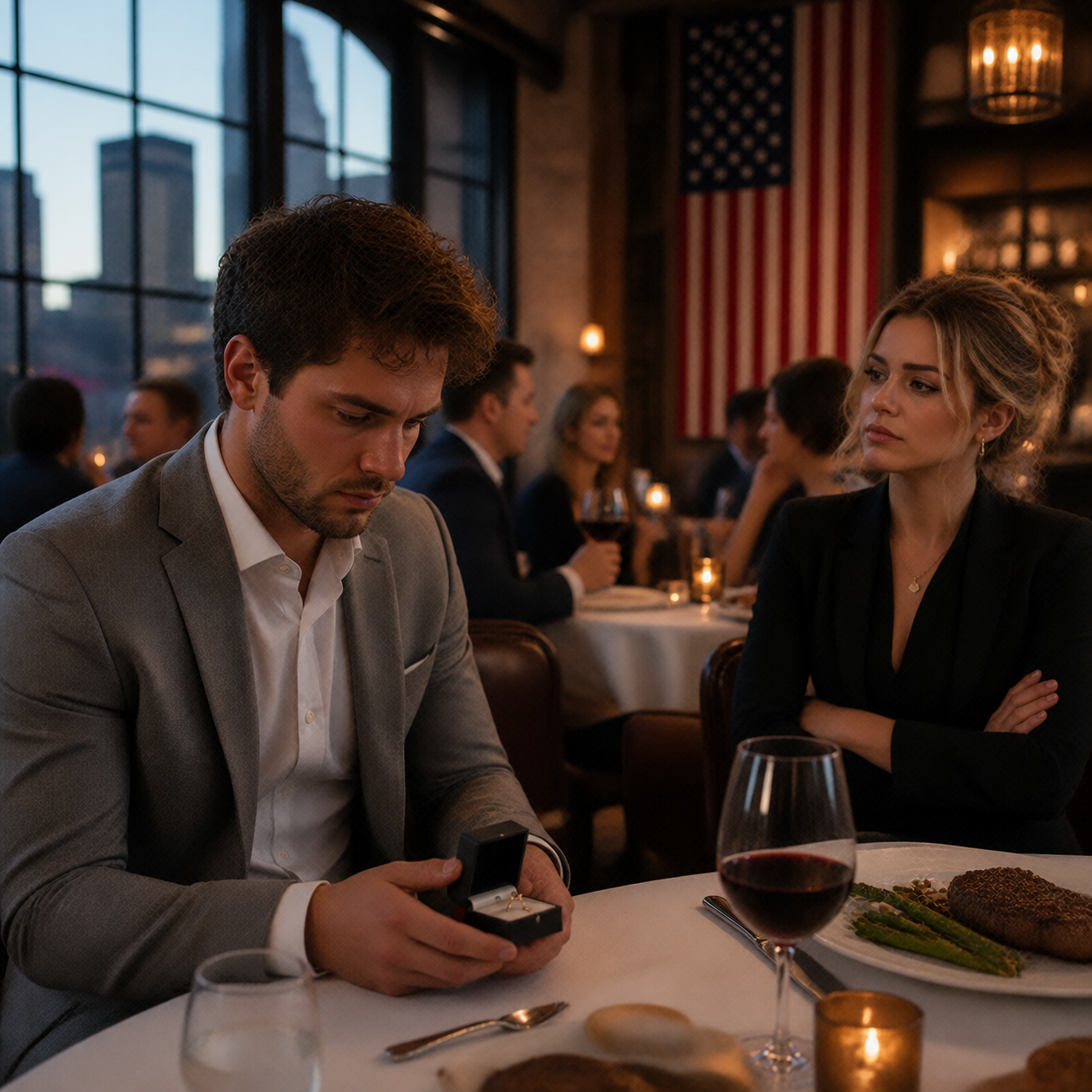
"I can’t marry you, Marcus. Not because I don’t love you, but because a ring on my finger is a liability I can’t afford right now."
Those were the words that killed three years of my life in under ten seconds. We were sitting at The Foundry, a steakhouse that smelled of aged oak and expensive Cabernet. It was the place where we celebrated our first anniversary and where I thought we’d celebrate the start of our forever. I was 31, a high school history teacher and football coach, and I thought I had found the one. Sarah was 29, a rising star at a prestigious Boston law firm.
I still had my grandmother’s ring in my hand—a modest, vintage diamond that had survived the Great Depression and two World Wars. It felt heavy, like a lead weight pulling my arm toward the floor. The restaurant, which had gone silent in anticipation of a "Yes," was now vibrating with the awkward energy of a dozen strangers watching a man’s soul exit his body.
"A liability?" I repeated, my voice flatter than I expected. I didn’t shout. I didn’t cry. I just sat back down, the velvet box clicking shut in my pocket with a sound like a gavel. "Is that what we are, Sarah? An insurance policy you’re letting expire?"
Sarah didn't flinch. She leaned forward, her eyes clinical, the same way she looked when she was dismantling a witness in a deposition. "Don't be emotional, Marcus. Be logical. The partnership board meets in three months. They’re looking for 'total commitment.' They want someone who lives, breathes, and sleeps the firm. If I show up with a fiancé, they see a woman who’s going to want a wedding, then a honeymoon, then maternity leave. I need to be a shark, not a bride."
"I told you I’d wait," I said, trying to find a crack in her armor. "Five years. Ten. I don’t care about the wedding, Sarah. I care about us."
She shook her head, marking up my plea with invisible red ink. "A long engagement is just a slow distraction. If I say yes, my focus shifts. I’ve already rehearsed this, Marcus. I’ve made my choice."
That was the moment the floor dropped out. She hadn't just reacted to the proposal; she had anticipated it. She had prepared a defense strategy against my love. I paid the bill—the full $300 for a meal I could no longer taste—and walked her to her car. I was raised with manners, even when my heart was being shredded.
"Is that it?" she asked as she reached for her car door. she looked almost disappointed that I wasn't begging. "You’re just going to let me go?"
"If I have to convince you that I'm worth more than a corner office, Sarah," I said quietly, "then I’ve already lost. I hope the partnership is everything you think it is."
I watched her taillights fade into the Boston fog, thinking that was the hardest part. I was wrong. Three days later, I got a call from her paralegal, a kid named Leo who was clearly overworked and had accidentally hit 'redial' on a shared office line.
"Hey, Sarah, just wanted to confirm—I've scrubbed your social media of the photos with that teacher guy like you asked. The Senior Partner was really impressed with your 'no entanglements' speech this morning. He said you're a shoe-in for the merger case now."
My blood didn't just run cold; it turned to ice. She hadn't just rejected me at the restaurant. She had deleted me from her life before I even asked the question. I wasn't a partner; I was a loose end she’d already snipped.
But as I sat in my empty apartment that night, staring at the ring box, I realized Sarah had made one major mistake. She thought she was the only one who could play the long game.
Because what I found out next about her 'merger case' made me realize that her climb to the top was about to hit a very personal glass ceiling... and I was the one holding the hammer.
![[FULL STORY] My girlfriend called me a "suffocating stalker" for worrying about her at 3 AM, so I gave her the ultimate space by vanishing forever.](https://social.rabedo.com/storage/thumbnails/1776926767_21.png)
![[FULL STORY] I Caught My Wife Spending Hours on LinkedIn, Yet She Never Discussed Her Job One Evening, I](https://social.rabedo.com/storage/thumbnails/1777342366_T3.png)
![[FULL STORY] She Scoffed: “There You Go With Your Jealousy Again” When I Mentioned Her “Male Classmate.I Said...](https://social.rabedo.com/storage/thumbnails/1776398181_d4476f42-341b-4b03-9d99-48e57a44acfe.png)
![[FULL STORY] She Said Her Ex Was “Like a Brother” — Then I Found His Boxers in Her Gym Bag](https://social.rabedo.com/storage/thumbnails/1776657507_10e7c505-612d-4819-afaf-2012ab66caf5.png)