
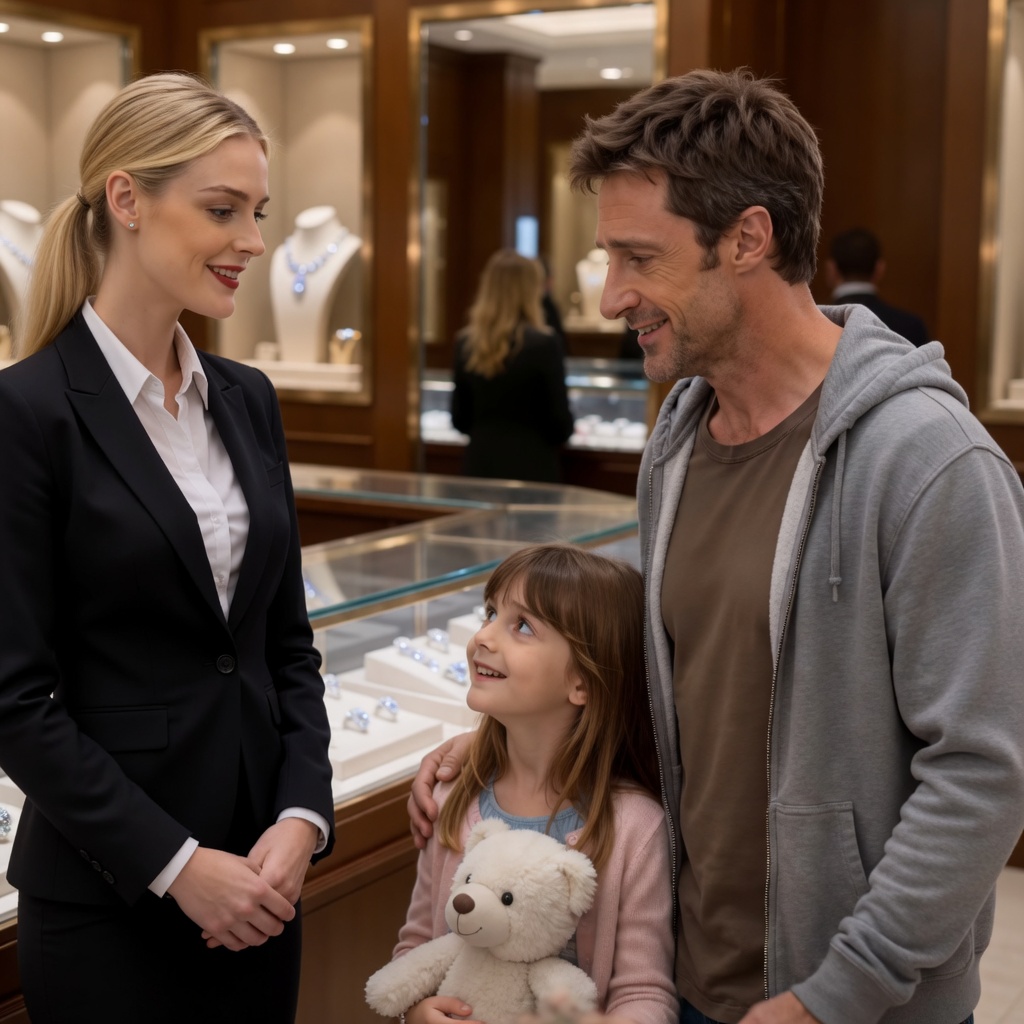
The store was called Harrison & Callahan Fine Jewelry, and everything inside seemed designed to make ordinary people lower their voices. Diamonds shimmered behind spotless glass cases. Necklaces rested on velvet displays as if they belonged to another world. Rings caught the light from crystal fixtures overhead and scattered it across the polished floor. Even the air smelled expensive — perfume, leather, fresh flowers, and the faint metallic scent of locked safes.
A little girl in a light blue dress walked in first. Her pink cardigan was buttoned wrong at the top because she had insisted on doing it herself. In both arms, she clutched a tiny white plush rabbit with one floppy ear. Her name was Lily Callahan, and the moment she saw the displays, her eyes widened.
“Daddy…” she whispered. “Look…”
Her father smiled softly.
Daniel Callahan looked tired, but gentle. He wore a gray hoodie, worn jeans, and scuffed shoes. His beard had not been trimmed as neatly as it usually was. There were faint shadows under his eyes from too many early mornings and too many late-night calls. To anyone who did not know him, he looked like the kind of man who had wandered into the wrong store by mistake.
But he held his daughter’s hand carefully, like this moment mattered more than anything else in the world.
“We’re just looking for your birthday, okay?” he said, squeezing her hand.
Lily nodded so seriously that he almost laughed. “I know. Looking is free.”
Daniel’s smile softened. “That’s what I told you.”
“But if looking is free,” she said, leaning toward a glass case, “can I look at everything?”
“You can look at the whole universe if you want.”
Her face lit up, and for a few seconds, Daniel forgot everything else. He forgot the board meeting waiting on Monday. He forgot the expansion problems in Chicago. He forgot the investors who wanted numbers, the managers who wanted approvals, the suppliers who wanted answers, and the endless pressure of owning a business large enough that people assumed success meant peace.
There, beside a case full of diamonds, with his daughter’s small hand in his, Daniel was only a father.
That was all he wanted to be.
Lily’s birthday was the next day. She was turning seven, and for nearly a month she had been asking for “a grown-up necklace, but not too grown-up.” Daniel had offered to order something privately, the way his staff usually handled gifts. He could have had ten necklaces sent to the house before breakfast. But Lily had asked to go to a real jewelry store, to choose one herself, to see the sparkle “in person.” She did not know much about the business her father owned. Daniel had never wanted her childhood buried under wealth, entitlement, or the cold arrogance he had seen in too many people with money.
So he dressed simply. He drove himself. He brought her to one of the stores without warning the staff.
Not as a test.
At least, that was what he told himself.
But deep down, Daniel always watched his stores. He watched how employees treated customers who looked rich, and more importantly, how they treated customers who did not. His father had started the company with one small repair counter and a belief Daniel never forgot: jewelry was not valuable because rich people wore it. Jewelry was valuable because people gave it meaning. A twenty-dollar locket bought by a tired mother could matter more than a diamond necklace purchased without thought.
Daniel had built the chain around that belief.
Or he thought he had.
Then heels clicked across the floor.
A saleswoman in a sharp black suit stepped in front of them with a perfect smile and cold eyes. Her name tag read: Vanessa Reed, Senior Sales Consultant. Her hair was pinned back smoothly, her makeup flawless, her posture polished into professional elegance. She looked exactly like the kind of employee luxury stores liked to place near the front: refined, controlled, and capable of making wealthy customers feel seen before they even opened their wallets.
“Can I help you?” she asked.
Daniel answered politely. “We’re looking for my daughter’s birthday gift.”
Lily lifted her plush rabbit slightly, as if the rabbit were part of the conversation. “I’m turning seven.”
Vanessa’s smile did not reach her eyes. “How lovely.”
Lily leaned toward the glass case, already captured by a delicate necklace resting on pale blue velvet. It was simple: a tiny silver star with one small diamond at the center. Not the most expensive piece in the case. Not even close. But to Lily, it looked like treasure.
“That one,” she breathed.
Daniel looked down. “You like the star?”
“It looks like it fell from the sky and got tiny.”
“That’s a very professional jewelry review.”
Lily nodded. “The bunny agrees.”
Daniel chuckled.
But Vanessa was not looking at the child anymore.
Her eyes had moved down to Daniel’s hoodie, his jeans, his scuffed shoes. The perfect smile stayed on her lips, but something inside it changed. Just slightly. Enough for Daniel to notice. Enough for the warmth around Lily’s birthday moment to dim.
“We don’t really have anything in your price range,” Vanessa said.
The words were quiet.
Polite, almost.
But they cut deep.
Daniel did not answer right away. His jaw tightened, but he stayed still because his daughter was beside him. Lily looked up in confusion, trying to understand why the air had suddenly changed. She hugged her plush rabbit tighter.
“Daddy,” she whispered, “did we do something bad?”
Daniel’s face changed for one second.
Pain flashed through his eyes, followed by something colder. But he swallowed it down for her. He crouched slightly so he could meet her eyes.
“No, sweetheart,” he said gently. “You did nothing wrong.”
Lily looked at Vanessa, then back at the necklace. The wonder in her eyes had faded into uncertainty.
That was what made Daniel’s chest tighten.
Not the insult to him. He had been underestimated before. He had grown up with less money than the people who now begged for meetings with him. He knew what it felt like to be judged by shoes, by accent, by the kind of coat you could afford. But Lily did not know that yet. She was still young enough to believe beautiful places welcomed anyone who admired beautiful things.
Vanessa had taken that from her in one sentence.
Daniel stood slowly. “What makes you say that?”
Vanessa folded her hands in front of her. “Sir, our entry-level pieces begin at a certain price point. I would hate for you and your daughter to waste time looking at items that may not be suitable.”
Suitable.
The word sat between them like a locked door.
Lily pressed closer to Daniel’s leg.
He felt it.
Vanessa continued, her voice smooth. “There are other stores in the shopping center that offer more accessible options. Perhaps something costume-style would be more appropriate for a child.”
Daniel looked at the star necklace again. “She likes that one.”
Vanessa’s smile tightened. “That piece is part of our Celestial Petite collection.”
“I can read the label.”
“It starts at eight hundred dollars.”
Lily’s eyes widened, not because she fully understood money, but because Vanessa had said the number like a warning.
Daniel put a hand lightly on Lily’s shoulder. “And?”
Vanessa blinked.
Then her expression cooled further.
“And most customers prefer to browse within a realistic range.”
A woman at a nearby case glanced over. A young couple pretending to look at engagement rings stopped speaking. Another employee behind the counter looked uncomfortable but did not step in.
Daniel saw all of it.
The silence.
The watching.
The decision everyone made not to interfere.
He took a slow breath.
When he spoke, his voice remained calm. “Do you treat all customers this way?”
Vanessa’s eyebrows lifted slightly, as if offended by the question. “I treat customers honestly.”
“No,” Daniel said. “You judged us before you showed us anything.”
Color rose faintly in her cheeks. “Sir, I am simply trying to avoid embarrassment.”
“For whom?”
She opened her mouth, then closed it.
Lily looked up at him. “Daddy, we can go.”
That nearly broke him.
She said it softly, trying to help. Trying to make herself smaller so the adult situation would stop being uncomfortable. A seven-year-old child had walked into a store excited about a birthday necklace, and within minutes she was willing to leave because someone had taught her she did not belong there.
Daniel looked down at her. “Do you still like the star?”
She hesitated.
He saw the answer in her face before she spoke.
“Yes,” she whispered. “But maybe it’s not for me.”
Vanessa looked satisfied, as if the child had finally understood.
Daniel turned back to her.
“That,” he said quietly, “was the damage.”
Vanessa frowned. “Excuse me?”
“You didn’t just refuse to show us a necklace. You made my daughter question whether something beautiful could be for her.”
The other employee behind the counter shifted, clearly uncomfortable now.
Vanessa’s composure cracked into irritation. “Sir, with all due respect, this is a luxury store. We have to maintain a certain standard.”
Daniel’s eyes sharpened. “A standard of what?”
Before she could answer, fast footsteps came from behind them.
A man in a blue suit entered through the private rear entrance. Silver hair. Calm face. The kind of quiet authority that made employees straighten before they even knew why. His name was Arthur Harrison, co-founder of the original company and now chairman of the board. He had been in the back office reviewing quarterly reports when a junior associate, pale and panicked, whispered that something was happening on the sales floor.
The moment Vanessa saw him, her posture changed completely.
“Mr. Harrison—”
But Arthur did not look at her.
He stopped beside Daniel and lowered his head slightly.
Respectful.
Serious.
“Sorry, sir,” he said.
Then he paused, and the air in the store shifted.
“They don’t know who you really are.”
Vanessa froze.
Daniel slowly turned his head toward Arthur.
He did not look surprised.
He looked disappointed that the moment had reached this point.
Lily looked between them, confused, still clutching her plush rabbit.
Arthur finally looked at Vanessa. His voice remained calm, but it carried through the store.
“This is Mr. Callahan,” he said. “Daniel Callahan. The owner of this entire chain.”
All color drained from Vanessa’s face.
The nearby customers went still. The young couple at the engagement rings turned fully toward them. The other employee behind the counter covered her mouth. Somewhere near the back, a display door clicked shut as another staff member stopped moving.
Lily blinked.
“Daddy owns this store?”
Daniel looked down at her, and his expression softened.
“Yes,” he said quietly. “But today I only wanted to buy my daughter a birthday gift.”
No one moved.
Vanessa opened her mouth, but nothing came out.
Daniel looked at her again. Not angry. Not shouting. That would have been easier for her. Anger gives people something to defend against. His disappointment offered no escape.
“You didn’t just insult me,” he said. “You made my daughter feel like she didn’t belong in a place I built.”
Vanessa swallowed. “Mr. Callahan, I am so sorry. I had no idea—”
“That I was the owner?”
Her mouth closed.
Daniel let the silence sit.
“That is the problem,” he said. “Your apology begins with who you discovered I am, not what you did to her.”
Vanessa’s eyes flicked to Lily, but she could not seem to look at the child for more than a second.
“I apologize to your daughter as well,” she said quickly.
Daniel’s voice grew colder. “Do not perform remorse because you are afraid of consequences. She deserves better than that.”
Lily squeezed his hand. “Daddy…”
He looked down.
Her face was worried now. She did not like conflict. She did not understand all the words, but she understood tension. Daniel forced himself to breathe.
Arthur stepped closer. “Lily, that necklace you liked is one of my favorites.”
She looked at him cautiously. “The star?”
“The star,” he said. “A very serious choice.”
Lily studied him. “Are you Daddy’s boss?”
Arthur chuckled softly. “Sometimes I try to be.”
Daniel gave him a look.
Arthur winked at Lily. “It doesn’t always work.”
That got the smallest smile from her.
Daniel turned toward the display. “Bring out the one she was looking at.”
Another employee, a young woman named Maya, moved quickly. “Of course, sir.”
Vanessa stepped forward automatically. “I can—”
“No,” Daniel said.
She stopped.
Maya unlocked the case with trembling hands and lifted out the delicate star necklace. She placed it on a velvet tray and brought it to Lily, then knelt slightly so the child did not have to reach too high.
“It’s okay to look closely,” Maya said gently.
Lily glanced at her father.
He nodded.
She leaned forward. Her eyes softened again, but not fully. The wonder was trying to return, cautious now, like a bird unsure whether the window was open or a trap.
“It’s very sparkly,” she whispered.
Maya smiled. “It is.”
“Is it too grown-up?”
“I think it is just grown-up enough for seven.”
Lily looked at Daniel. “Can the bunny see?”
Maya did not laugh. She angled the tray toward the plush rabbit. “Of course.”
Daniel watched that small act with gratitude sharp enough to hurt.
Arthur watched him watching.
He knew Daniel well enough to understand the moment had become about far more than a necklace.
Vanessa remained near the counter, pale and rigid. Finally, she managed to speak. “Mr. Callahan, please, if I could explain—”
Daniel turned to her. “Explain what?”
She clasped her hands tightly. “We get people who come in only to look. Sometimes they damage pieces. Sometimes they waste consultants’ time. I was trying to be efficient.”
“Efficient,” Arthur repeated softly, not kindly.
Vanessa looked at him, then back at Daniel. “I made a poor assumption.”
“You made a cruel assumption,” Daniel said. “There is a difference.”
Her eyes reddened. “I have worked here for six years.”
“I know.”
“I have excellent numbers.”
“I know that too.”
For the first time, fear truly entered her face.
Daniel continued, “Your sales record is why complaints about your attitude were dismissed as misunderstandings. Customers who didn’t buy were blamed for being too sensitive. Junior staff who raised concerns were told they needed thicker skin. I allowed performance to cover character.”
Arthur looked down, troubled.
Daniel’s jaw tightened. “That ends today.”
Vanessa whispered, “Please.”
Daniel looked toward Lily.
She was still examining the necklace, but her shoulders were small and tense beneath her cardigan.
He thought of his father.
Patrick Callahan had opened the first shop in a neighborhood where most customers were not wealthy. He repaired watches, resized rings, polished old wedding bands, and treated every object as if it carried a story. Daniel remembered being ten years old, watching a construction worker come in with a cracked locket he could barely afford to fix. Patrick had repaired it free and told Daniel, “Never look at a man’s shoes and decide what his love is worth.”
Daniel had built the business from that sentence.
Somewhere along the way, parts of it had forgotten.
He faced Vanessa again.
“Clear your desk.”
Her lips parted. “You’re firing me?”
“Yes.”
“Over one mistake?”
“No,” he said. “Over the kind of person you revealed yourself to be when you thought there would be no cost.”
The words struck harder than shouting.
Vanessa looked around, perhaps hoping someone would intervene. No one did.
Arthur said quietly, “I’ll have HR meet you in the office.”
Her expression crumpled into anger and humiliation. “After everything I’ve done for this store?”
Daniel’s answer was calm. “You sold jewelry. You failed people.”
She stared at him.
Then, with shaking hands, she removed her name tag and placed it on the counter. Her heels clicked sharply as she walked toward the back office, but the sound no longer carried power. Only defeat.
Lily watched her go.
“Daddy,” she whispered, “is she in trouble because of me?”
Daniel crouched immediately. “No, sweetheart. She is responsible for her own choices.”
“But if I didn’t like the necklace…”
“Then she still would have treated someone else that way.”
Lily looked down at the plush rabbit. “She made me feel poor.”
Daniel’s throat tightened.
He chose his words carefully.
“There is nothing wrong with not having money,” he said. “There is something wrong with treating people badly because you think they don’t.”
Lily considered that.
“Were we pretending to be poor?”
“No.”
“But you own the store.”
“Yes.”
“Then why wear old shoes?”
Arthur coughed softly, hiding a smile.
Daniel glanced down at his scuffed shoes. “Because they’re comfortable.”
Lily looked serious. “They are ugly.”
Maya turned away to hide her laugh.
Daniel sighed. “That is also true.”
The tension broke slightly.
Lily smiled, and the room seemed to breathe again.
Daniel stood and looked at Maya. “Would you help my daughter try it on?”
Maya nodded. “Of course.”
She carefully lifted the necklace and fastened it around Lily’s neck. The tiny star rested just below the collar of her dress. Lily looked down at it, then up at the mirror behind the case.
For a second, the magic returned.
Not all at once.
But enough.
“I look like I have a birthday star,” she whispered.
Daniel smiled. “You do.”
Arthur stepped beside him. “Patrick would have liked that one.”
Daniel’s expression changed.
Lily looked up. “Who’s Patrick?”
“My father,” Daniel said. “Your grandfather.”
“The one in the picture?”
“Yes.”
“The one who made jewelry?”
Daniel nodded.
Lily touched the star. “Would he think I belong here?”
Daniel’s chest ached.
He crouched in front of her again, uncaring that customers and staff were watching.
“Lily, listen to me. You belong anywhere you walk in with kindness and curiosity. A store does not decide your worth. A person behind a counter does not decide your worth. Money does not decide your worth. Do you understand?”
She nodded slowly.
“And if anyone ever makes you feel small because of what you wear or what you have, that tells you something about them, not you.”
She looked toward the back office where Vanessa had gone.
“She was out of place,” Lily said softly.
Daniel looked at her.
Then he smiled faintly.
“Yes,” he said. “She was.”
They bought the necklace.
Daniel insisted on paying for it from his own wallet, though Arthur rolled his eyes and said that seemed symbolic to the point of absurdity. Daniel ignored him. Lily received a small box wrapped in pale blue ribbon, even though she was already wearing the necklace. Maya added a tiny velvet pouch “for the bunny’s approval papers,” which delighted Lily completely.
Before leaving, Daniel turned to the staff gathered at a careful distance.
“This store will close early today,” he said. “Tomorrow morning, everyone reports for training. Not sales training. Human training.”
No one spoke.
Daniel continued, “If someone comes in wearing diamonds, you treat them with respect. If someone comes in wearing work boots, you treat them with respect. If someone comes in only to look because they cannot afford a piece today, you treat them with respect. If a child presses their nose to the glass because something sparkles, you let them wonder. That is not wasted time. That is why this business exists.”
Maya’s eyes shone.
Arthur nodded once, proud and sad at the same time.
Daniel took Lily’s hand. “Come on, birthday girl.”
As they stepped toward the door, Lily paused and turned back to Maya.
“Thank you for showing the bunny.”
Maya smiled. “Anytime.”
Outside, the afternoon had turned colder. Daniel zipped Lily’s cardigan and tucked the necklace beneath it so she would not feel the chill of the metal. They walked to the car slowly.
“Daddy?” she asked.
“Yes?”
“Do rich people always know they’re rich?”
He laughed softly. “What do you mean?”
“Like, do they feel it?”
Daniel thought about that.
“Some people do. Some people think about it all the time. Some people forget. Some people use it to help. Some use it to make others feel small.”
“What do you do?”
He looked at her.
Children ask questions like doors suddenly opening.
“I try to use it well,” he said. “But sometimes I make mistakes.”
“Like hiring mean ladies?”
He winced. “Yes. Like hiring mean ladies.”
She nodded. “You should not do that anymore.”
“I agree.”
“And you should get better shoes.”
Arthur, walking behind them, laughed out loud.
Daniel looked back at him. “You are enjoying this too much.”
“I have waited years for someone to address the shoes.”
Lily smiled proudly.
That night, after Lily fell asleep with the necklace box on her bedside table and the plush rabbit tucked under her arm, Daniel sat alone in his study. He took out an old photograph of his father standing in front of the first Callahan repair shop. Patrick wore a short-sleeved shirt, suspenders, and a grin full of stubborn hope. The sign above him was crooked. The window display held three watches, two rings, and a handwritten card that said: Repairs done with care.
Daniel placed the photo beside the complaint reports Arthur had sent him.
There were more than he wanted to admit.
A young couple ignored because they looked too casual.
An older woman rushed away from a case after asking for a lower-priced chain.
A man in construction clothes told to come back after work, as if labor made him dirty.
A teenager laughed at for asking if rings could be paid in installments.
Vanessa’s name appeared again and again. Not always directly. Sometimes as “the blonde senior consultant.” Sometimes as “the woman near the front.” Sometimes no name at all, just the shape of her disdain left behind in other people’s words.
Daniel read every complaint.
By the end, shame sat heavy in his chest.
He had been so focused on expansion that he had trusted numbers over culture. Sales looked good. Stores looked beautiful. Customer satisfaction among high spenders remained strong. But hidden underneath were people quietly turned away, people who never complained because embarrassment rarely fills out forms, people who left believing luxury meant exclusion.
The next morning, Daniel called every regional manager.
“This is not a branding issue,” he said. “This is a values issue. And values that only exist in the founder’s story but not on the sales floor are decoration.”
Changes came quickly.
Mystery shoppers from different backgrounds were sent to every location. Staff compensation was adjusted so consultants were not rewarded only for high-ticket clients. Every employee attended mandatory training on bias, customer dignity, and service ethics. A new policy allowed children to safely view selected pieces with supervision, because Daniel could not stop thinking of Lily’s whisper: Maybe it’s not for me.
He created a lower-priced birthday collection inspired by Lily’s star necklace. Not cheap, not disposable, but carefully made and accessible. Each piece came with a small card bearing Patrick Callahan’s old words:
Never look at someone’s shoes and decide what their love is worth.
When Arthur saw the card, he was quiet for a long time.
Then he said, “Your father would be proud.”
Daniel looked away.
“I hope so.”
A week later, Daniel took Lily to the original Callahan shop, the first one his father opened. It was no longer active, but Daniel had preserved it as a small company museum. The display windows were old. The wooden counter still had scratches from decades of repairs. The back room smelled faintly of dust and metal polish.
Lily wandered through it slowly, holding her plush rabbit.
“This is smaller than the other store,” she said.
“Much smaller.”
“Grandpa worked here?”
“Every day.”
“Was he rich?”
Daniel smiled. “No.”
“Was he poor?”
“Sometimes.”
She turned to him. “Did people make him feel bad?”
Daniel leaned against the counter. “Yes. When he tried to buy an engagement ring for my mother, a salesman told him to come back when he had real money.”
Lily’s eyes widened. “That’s mean.”
“It was.”
“What did Grandpa do?”
“He saved for six more months. Then he bought a broken ring from a pawn shop, fixed it himself, and gave it to her.”
“Did she like it?”
“She loved it.”
“Then he made a store?”
“Yes. Because he wanted a place where no one would be treated that way.”
Lily was quiet for a moment.
Then she touched the star necklace at her throat.
“But someone was treated that way.”
Daniel looked at her.
“Yes,” he said. “And that means I have work to do.”
She nodded, satisfied by the honesty.
Children can forgive imperfection when adults tell the truth about it.
Months passed.
The birthday collection launched quietly at first, then became one of the company’s most meaningful lines. Parents came in with children. Grandparents came in with folded bills. Teenagers came in to buy gifts for friends. Some customers still bought diamonds worth more than cars, but now they stood beside people choosing modest silver charms, and staff were expected to treat both purchases as equally human.
Maya became the manager of the flagship store.
Daniel promoted her not because she had been kind to Lily, but because she had continued being kind when no one powerful was watching. Under her leadership, the store changed. It still glowed with gold light and crystal cases, but the air felt less cold. Children were offered small stools so they could see displays. Customers were greeted before being assessed. Staff learned to ask, “What story are you shopping for?” instead of “What budget are you working with?” The difference mattered.
One afternoon, Daniel stopped by unexpectedly again.
This time, he wore the same gray hoodie and the same ugly shoes.
Arthur saw him and groaned. “You’re doing this on purpose now.”
Daniel smiled. “They’re comfortable.”
Maya greeted him warmly, then turned to a man standing near a case in a paint-stained jacket. “I’ll be right back with that locket option we discussed.”
Daniel watched.
The man looked nervous, twisting his cap in both hands. A little boy stood beside him, peering at the display. Maya returned with three lockets on a tray, explaining each one without rushing. The man apologized twice for asking questions. Maya smiled and said, “That’s what I’m here for.”
Daniel felt something in his chest loosen.
Later, Lily came in after school with her nanny, wearing sneakers, a messy ponytail, and the star necklace. She ran straight to the children’s display and inspected it like a tiny executive.
“This one is too pokey,” she announced.
Maya took notes solemnly.
“This heart is good.”
“Excellent.”
“The bunny thinks you need more moons.”
“I’ll inform design.”
Daniel stood with Arthur near the back and watched his daughter move through the store without hesitation. No shrinking. No shame. No question of belonging.
That mattered more than any quarterly report.
A year after the incident, Harrison & Callahan held an anniversary event for the birthday collection. Daniel did not want it to be flashy, but Arthur insisted on “at least decent lighting.” Families were invited. Some were wealthy. Many were not. A wall near the entrance displayed stories customers had shared: a necklace for a daughter finishing chemotherapy, a bracelet for a grandmother turning ninety, a tiny moon charm for a child who loved space, a simple ring replacing one lost after forty years of marriage.
Daniel stood before the crowd with Lily beside him.
She wore the blue dress again, now a little too short, and the pink cardigan, buttoned correctly this time after three attempts. The star necklace rested at her throat.
Daniel looked at the guests, then down at his daughter.
“A year ago,” he said, “my daughter walked into one of our stores excited about her birthday. Someone made her feel like she did not belong there. That happened in a place carrying my family’s name. I cannot undo that moment. But I can make sure it teaches us something.”
The room was quiet.
He continued, “This company was not built for diamonds. It was built for meaning. A gift does not matter because of its price. It matters because someone chose it with love. If we ever forget that, we do not deserve to sell jewelry at all.”
Lily tugged his sleeve.
He looked down. “Yes?”
She whispered loudly, “Tell them about the shoes.”
The crowd laughed.
Daniel sighed. “My daughter would also like me to mention that shoes are not a reliable indicator of character.”
More laughter.
Arthur clapped proudly.
Lily beamed.
After the event, a woman approached Daniel quietly. She wore a plain coat and held the hand of a teenage daughter. “I came into one of your stores two years ago,” she said. “Not this one. Another location. I wanted to buy my daughter something after her father died. We were treated…” She stopped, swallowing. “Badly.”
Daniel’s face sobered. “I’m sorry.”
The woman nodded. “I couldn’t afford much anyway. But I just wanted to say, today felt different.”
Her daughter lifted a small bag. “We got a moon.”
Lily, overhearing, leaned around Daniel. “The moons were my idea.”
The teenager smiled. “Good idea.”
Lily looked pleased.
Daniel thanked the woman, but after she walked away, the apology stayed with him. Change did not erase old harm. Some people would never return. Some birthday moments, anniversary gifts, and quiet hopes had already been spoiled. The best he could do was carry the responsibility forward.
That evening, Daniel and Lily returned home. She fell asleep in the car, plush rabbit in her lap, star necklace catching the passing streetlights. Daniel carried her upstairs and tucked her into bed.
As he turned to leave, she stirred.
“Daddy?”
“I’m here.”
“Did I belong there today?”
He sat on the edge of the bed. “Yes.”
“Did the moon girl belong too?”
“Yes.”
“Did the paint man?”
“Yes.”
“Did the mean lady?”
Daniel paused.
Lily opened one eye. “That’s hard.”
“It is.”
He thought carefully.
“She belonged as a person,” he said. “Everyone does. But she did not belong in a job where she made others feel small.”
Lily considered that, then nodded sleepily.
“Good answer.”
“Thank you.”
“You still need shoes.”
He laughed softly. “Go to sleep.”
She smiled and drifted off.
Daniel sat there a moment longer, looking at the tiny star at her throat. He thought about how close he had come to missing the wound. If Arthur had not walked in, if Lily had not asked that small heartbreaking question, if Daniel had chosen pride over attention, he might have treated the incident as an insult to himself instead of harm done to his child and to every customer like him.
Power, he realized, was not proven by revealing who you were after someone insulted you.
Power was what you changed afterward.
Years later, Lily would not remember every detail of that day. She would remember the lights, the star necklace, the woman’s cold voice, her father kneeling in front of her and saying she had done nothing wrong. She would remember learning that sometimes adults made people feel small for reasons that were not true. She would remember that her father owned the store, but more importantly, that he did not let the store stay the same.
And Daniel would remember the exact moment that mattered most.
Not Vanessa’s face when she learned his name.
Not Arthur’s announcement.
Not the silence of the customers.
He would remember Lily holding her plush rabbit tighter and asking, “Daddy… did we do something bad?”
That question became a promise.
No child should feel that way in a place built for love.
No father should have to prove wealth before being treated with dignity.
No person should be measured by worn shoes before anyone asks what brought them through the door.
And in every Harrison & Callahan store, beneath the polished glass and golden light, a small engraved plaque was eventually placed near the entrance.
It did not mention Daniel.
It did not mention Lily.
It did not mention the saleswoman who had judged them.
It simply read:
Everyone belongs before they buy.
Lily liked that.
But whenever she passed the plaque, she would still look up at her father and whisper, “Especially people with ugly shoes.”
And Daniel, owner of the entire chain, would look down at his scuffed old sneakers, take his daughter’s hand, and say, “Especially them.”
![[FULL STORY] She Told Me: "You're The Problem!" Without Explaining Why. I Said: "Problem Solved. "When I Left](https://social.rabedo.com/storage/thumbnails/1776746877_2.png)
![[FULL STORY] A white deputy shoved the Black ring bearer into the cake table because he said the family 'looked like staff.'](https://social.rabedo.com/storage/thumbnails/1776934884_2_2-Tight-dramatic-shot-of-the-ring-pillow-face-down_grok-image-e36a26b5-2309-43d3-bf07-1c76aabebfff.png)

![[FULL STORY] She Laughed With Her Friends, "He's So Obsessed With Me. No Matter How Much I Push Him Away, He](https://social.rabedo.com/storage/thumbnails/1777365195_13.png)
![[FULL STORY] My girlfriend claimed monogamy was a "patriarchal prison" and invited her guru into our bed, so I quietly vacated her life and handed the keys](https://social.rabedo.com/storage/thumbnails/1777346368_M4.png)