
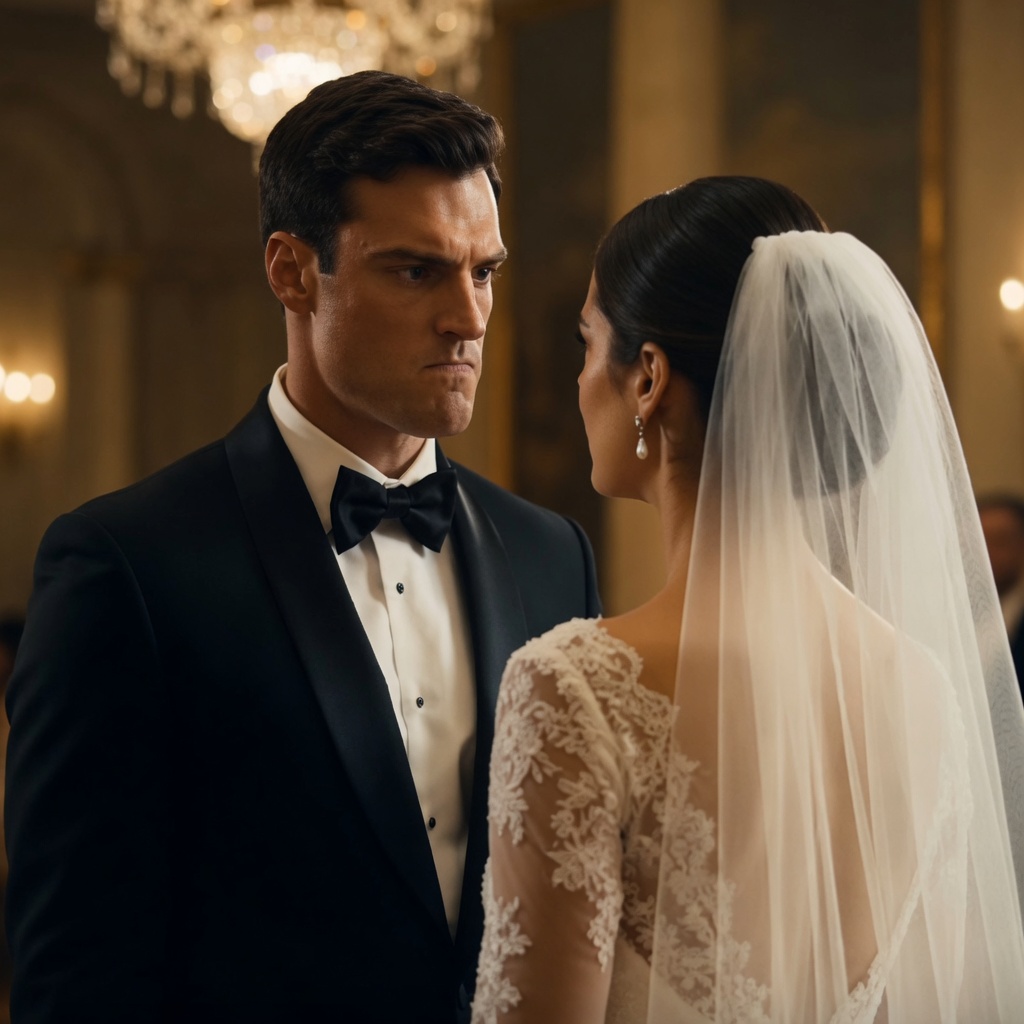
Then the groom shoved the bride.
It happened so suddenly that, for one breath, nobody understood what they had seen. One moment, Amelia Hart stood before the altar in her white lace gown, veil trembling softly around her shoulders, hands folded around a bouquet of ivory roses. The next, her fiancé’s hands struck her hard enough to send her backward. Her heel caught against the hem of her dress. Her bouquet fell. Her body hit the rose-covered aisle with a dull, humiliating sound that seemed far louder than it should have been.
A sharp gasp swept through the hall.
Amelia lay frozen among the petals. Her veil had slipped to one side, exposing the stunned pallor of her face. One hand pressed against the floor as she tried to steady herself, but her fingers were shaking so badly the petals stuck to her skin. For a few seconds, she could not breathe. She could only look up at the man she had been about to marry.
Ethan Vale stood above her, jaw tight, chest rising too fast beneath his black tuxedo. His face was pale, but his eyes were hard, as if he had already decided she deserved the shame he had just given her. This was the same man who had once held her hand in coffee shops, walked her home in the rain, kissed her forehead, and promised her that after everything she had lost, she would never feel unwanted again.
Now he looked at her as if she were an obstacle.
Beside him stood an older woman in white.
Cecilia Vale.
Ethan’s mother.
She had insisted on wearing white despite Amelia’s quiet discomfort. She had called it “champagne ivory,” then laughed as if Amelia were childish for noticing. From the moment Amelia met her, Cecilia had carried herself like someone who believed love was a family asset and sons were property. She never shouted. She never needed to. Her cruelty came dressed in manners, pearls, and soft smiles.
Now, as Amelia lay on the floor, Cecilia did not step forward. She did not gasp. She did not look concerned.
She smiled.
Small. Cold. Satisfied.
As if this was not an accident, not a misunderstanding, not a moment of panic, but the very scene she had been waiting for.
Ethan leaned over Amelia, his voice low enough to sound private but sharp enough for the front rows to hear. “I only did this for her.”
His eyes flicked toward Cecilia.
The meaning struck Amelia harder than the fall.
For her.
For his mother.
This wedding, this relationship, this entire beautiful lie had not been built on love. It had been built around Cecilia’s control, Ethan’s weakness, and Amelia’s desperate hope that if she loved patiently enough, she could be chosen.
Her lips parted, but no words came.
The guests shifted uncomfortably. Someone whispered her name. A woman in the second row covered her mouth. One of Ethan’s cousins looked down at his shoes. Amelia’s bridesmaids stood frozen near the flowers, caught between shock and fear of causing a scene. No one moved.
That hurt almost as much as the shove.
The room was full of people who had watched her smile all morning. People who had hugged her, praised her dress, taken photographs beside her, called her beautiful. Now they watched her struggle on the floor and waited for someone else to decide whether she deserved help.
Amelia pressed one trembling hand into the petals and tried to push herself up. Her ribs ached. Her knee burned beneath the layers of lace. But the true pain was hotter, deeper, humiliating. It rose in her throat until she could hardly swallow.
She heard Cecilia’s voice, smooth as polished glass.
“Get up, dear. Don’t make this uglier than it needs to be.”
A few guests inhaled sharply.
Amelia looked at the older woman through a blur of tears.
Don’t make this uglier.
As if she had done this.
As if being shoved at her own wedding were another failure of etiquette.
Ethan straightened, still breathing hard. “You should have listened,” he muttered.
Amelia found her voice, though it came out broken. “Listened to what?”
His eyes flashed. “To me. To us. You knew what was expected.”
Us.
That one word opened every wound she had spent months trying to ignore.
Us had always meant Ethan and Cecilia. Not Ethan and Amelia. Not husband and wife. Mother and son. A closed circle she had been invited to decorate, not enter. Cecilia chose the venue. Cecilia chose the guest list. Cecilia rejected Amelia’s flowers. Cecilia changed the seating chart. Cecilia said Amelia’s late mother’s necklace looked “too sentimental” and suggested something “less tragic.” Ethan had apologized each time, kissed Amelia’s temple, and whispered, “She just needs time.”
Amelia had believed him because she wanted to.
Because love makes excuses before it admits danger.
Because she had been alone for too long.
Her mother had died when she was sixteen. Her father, Colonel Richard Hart, had disappeared from her life not long after, swallowed by military duty, grief, silence, and a mission that no one would explain. People told Amelia he was cold. People told her not to wait for a man who chose service over family. She grew up missing him and resenting him at the same time, carrying the ache of an abandoned daughter beneath every achievement, every smile, every attempt to build a life that looked whole from the outside.
So when Ethan arrived with warmth, certainty, and a family name that opened doors, Amelia had mistaken possession for devotion.
Now she was on the floor of her own wedding hall, and the truth was finally too public to deny.
Ethan looked down at her. “This marriage was supposed to secure both families. You knew that.”
Amelia stared at him. “Both families?”
Cecilia’s mouth tightened.
Ethan seemed to realize he had said too much, but anger pushed him forward. “Don’t act innocent. You think you came into this with nothing? You think I didn’t know about your father’s accounts? The military trust? The land?”
The hall fell quieter.
Amelia’s blood turned cold.
“What are you talking about?”
Cecilia stepped in smoothly. “Ethan, enough.”
But Ethan was unraveling. “No, she wants to play betrayed? Let her hear it. She was supposed to sign the transfer before the vows. That was the agreement.”
Amelia’s mind struggled to catch up.
Transfer.
Agreement.
Before the vows.
The prenuptial documents Cecilia’s lawyer had brought that morning. The papers Ethan said were only routine. The forms Cecilia insisted had to be signed before the ceremony because “wealth attracts complications.” Amelia had refused to sign without reading them fully. Not because she distrusted Ethan completely, but because something in her stomach had twisted when Cecilia stood too close, watching the pen in her hand.
That refusal had started the argument behind the altar.
That refusal had made Ethan’s face change.
And then he had shoved her.
Amelia whispered, “You wanted me to sign away my inheritance.”
Ethan’s jaw clenched.
Cecilia’s smile vanished.
Before either could answer, the double doors at the far end of the hall burst open.
Bright daylight flooded the aisle.
Every head turned.
Heavy footsteps followed.
A man entered the wedding hall in a dark navy formal military uniform, decorated with medals that caught the chandelier light. He was tall, broad-shouldered, older now, with silver at his temples and a face cut by years of command, sacrifice, and weathered silence. Three officers walked behind him in perfect formation. Their boots struck the floor in rhythm, steady and controlled, and the sound transformed the room.
The murmurs died instantly.
The music stopped.
No one seemed to breathe.
Colonel Richard Hart walked down the aisle.
Amelia saw him through tears and thought, for one impossible second, that grief had finally broken her mind.
Her father.
The man she had not seen in years.
The man she had loved, hated, missed, and mourned while he was still alive.
He did not look at the guests. He did not pause for Ethan. He walked straight toward Amelia, his face controlled but his eyes burning with something deeper than anger.
He stopped beside her and dropped to one knee.
The sight of that alone shook the room. A decorated commander, a man whose name had appeared in military reports and ceremonies, kneeling on rose petals before a bride everyone else had left on the floor.
His hands settled gently on her shoulders.
Not as a soldier.
As a father.
“Amelia,” he said.
Her name in his voice destroyed what little strength she had left.
She looked up through tears, barely able to believe he was real. “Father?”
His expression softened, and for the first time in years, she saw pain move openly across his face.
“I’m here.”
The words were simple.
They arrived too late.
They were still everything.
With careful strength, he helped her to her feet. Amelia swayed, and he steadied her, one hand at her elbow, the other near her shoulder, as if he had arrived just in time to pull her back from breaking completely. Her veil hung crooked. Rose petals clung to her gown. Her cheek was wet. But when her father stood beside her, something shifted in the hall.
She no longer looked abandoned.
Richard looked at his daughter and spoke quietly, but every person in the room heard him.
“Stand up. Your honor returns today.”
The words moved through Amelia like breath returning to a body that had forgotten how to live.
Ethan went pale.
Cecilia’s face hardened.
“Colonel Hart,” she said, recovering first. “This is a private family matter.”
Richard turned his head slowly toward her.
The warmth in his face disappeared.
“Private?” he repeated.
The single word made Cecilia’s confidence flicker.
Richard looked at the rose petals crushed beneath Amelia’s shoes, then at Ethan. “A man lays hands on my daughter in front of two hundred witnesses, and you call it private?”
Ethan swallowed. “Sir, you don’t understand.”
Richard’s eyes settled on him. Cold. Steady. Merciless.
“I understand more than you think.”
Ethan looked suddenly less like a groom and more like a boy caught in a lie.
“Her father…?” he whispered, as if the title itself were impossible.
Cecilia stepped forward. “Richard, perhaps emotions are high. Amelia has always been sensitive, and Ethan—”
“Do not finish that sentence,” Richard said.
Cecilia stopped.
The three officers behind him stepped forward at once, not dramatically, not aggressively, but with a precision that made the air tighten. One carried a leather document case. Another held a sealed folder. The third stood with a tablet in hand, recording quietly.
Richard raised one hand.
The officers halted.
Then he spoke, calm and devastating.
“Now tell her what you signed.”
The hall went still.
Amelia turned toward Ethan, her breath shaking.
For the first time that day, it was not she who looked exposed.
It was him.
Ethan opened his mouth. “I don’t know what you mean.”
Richard did not blink. “You signed a statement three days ago confirming that your marriage to my daughter was part of a financial arrangement negotiated by your mother.”
Cecilia’s face went white.
A wave of whispers spread through the hall.
Amelia felt the floor tilt beneath her.
“No,” Ethan said quickly. “That’s not—”
The officer with the leather case stepped forward and placed a document in Richard’s hand. Richard did not open it yet. He simply held it where Ethan could see the seal.
“You also signed a preliminary agreement to transfer control of Amelia’s inheritance into a joint trust managed by Vale Holdings after the wedding.”
Amelia stared at Ethan.
Vale Holdings.
Cecilia’s company.
Her hands went cold.
Ethan’s eyes darted from the document to his mother. “Mom…”
Cecilia’s lips barely moved. “Say nothing.”
That confirmed more than any confession could have.
Richard looked at Amelia, and his voice lowered. “I tried to reach you before the ceremony. Your phone was taken.”
Amelia turned slowly toward Cecilia.
The older woman lifted her chin.
That morning, Cecilia had taken Amelia’s phone “for the photographs,” saying brides should not be distracted. Amelia had thought it annoying but harmless. Now she remembered how her bridesmaid had searched for it and been told by Cecilia’s assistant not to disturb the bride.
Richard continued, “Your maid of honor called my office from the restroom after she overheard them discussing the transfer documents.”
Amelia looked toward the bridesmaid row.
Her best friend, Nora, stood there with tears running down her face. “I’m sorry,” Nora mouthed. “I tried.”
Amelia’s chest tightened. Someone had tried to help. Someone had seen.
Richard turned back to Ethan. “Tell her.”
Ethan shook his head. “It wasn’t like that.”
“Then explain it.”
“I loved her.”
Richard’s expression did not change. “Loved her?”
Ethan’s voice grew desperate. “I did. At first, I did. But my family has debt. My mother said Amelia’s trust was tied up in military land and old accounts, and if we married, everything could be stabilized. She said Amelia would benefit too.”
Amelia could barely speak. “Benefit?”
Ethan looked at her, and for a moment, something like guilt passed through his face. “You don’t understand pressure. You don’t know what it’s like to have everyone depending on you.”
A bitter laugh escaped her.
She thought of growing up alone. Of birthdays with her father absent. Of learning to sign school papers herself. Of sitting beside her mother’s hospital bed at sixteen, watching machines breathe for the woman who had been her whole world. Of becoming a woman before anyone taught her how to remain a girl.
“You’re right,” she said softly. “I know nothing about pressure.”
Ethan flinched.
Cecilia stepped forward. “Enough. This entire display is absurd. Colonel, you have no right to storm into my son’s wedding with military theatrics and accusations.”
Richard turned to her.
“My daughter was pushed to the floor because she refused to sign a fraudulent financial transfer. I have every right.”
“Fraudulent?” Cecilia snapped. “Those documents were prepared by attorneys.”
“Attorneys now under investigation.”
The words landed like thunder.
Cecilia’s face stiffened.
Richard nodded to the officer holding the tablet. “The financial crimes unit received the file this morning. Your company is being reviewed for coercion, forged disclosures, and attempted misappropriation of protected inheritance assets.”
Guests began whispering louder now. Several of Cecilia’s wealthy friends looked at one another with sudden fear, as if distance itself might protect them from scandal.
Cecilia’s mask cracked for the first time. “You can’t prove coercion.”
Richard looked at Ethan.
The groom’s face turned gray.
“Perhaps not from the documents alone,” Richard said. “But then your son sent messages.”
Ethan whispered, “No.”
The officer opened the sealed folder and removed printed screenshots.
Richard read aloud, his voice cutting through the hall.
“If she refuses again, do I cancel or force it?”
A shocked murmur moved through the room.
Richard turned a page.
“She’s too sentimental about her father. Once the vows are done, she’ll have no choice.”
Amelia pressed a hand to her stomach.
Another page.
“Mom, I don’t want to hurt her.”
Richard looked up at Ethan. “And Cecilia’s response?”
The officer handed him the next page.
Richard’s voice became colder.
“Then stop being weak.”
The hall erupted in whispers.
Ethan looked as if he might be sick.
Amelia stared at him, tears sliding silently down her face. “You knew.”
He stepped toward her. “Amelia, please—”
Richard moved slightly between them.
Ethan stopped.
“I was trapped,” Ethan said. “She controls everything. The company. The accounts. My future. She told me if I didn’t go through with it, she would cut me off.”
Amelia looked at him with unbearable sadness. “So you decided to sell me instead.”
“No,” he said, voice breaking. “I was going to make it right later.”
“Later?” she whispered. “After I signed? After the vows? After you had control?”
He had no answer.
Cecilia’s face sharpened. “Do not let them twist this, Ethan. She is emotional. She always has been. You saw how quickly she refused reason.”
Richard’s eyes flashed.
“There it is,” he said.
Cecilia looked at him.
“The same language predators always use. Emotional. Difficult. Sensitive. Unreasonable. Anything to make a woman’s refusal sound like a defect.”
The words struck Amelia so deeply that her tears stopped.
For years, Cecilia had called her sensitive. Too sentimental. Too delicate. Too dramatic. Ethan had laughed softly and told her not to take it personally. Amelia had slowly learned to distrust her own discomfort.
Now her father had named it.
Richard faced the room.
“All of you saw my daughter shoved to the floor,” he said. “You saw her left there. You saw people hesitate because the groom’s family has money and power. Let this be remembered clearly. Silence is not neutrality when someone is being humiliated. Silence serves the person standing over the victim.”
Several guests lowered their eyes.
Then Richard turned back to Amelia.
His expression softened again.
“Amelia, nothing signed today binds you. No vow has been spoken. No transfer has been completed. You owe this family nothing.”
Cecilia laughed sharply. “That is not your decision.”
Amelia slowly turned toward her.
For most of the engagement, Cecilia’s voice had controlled the temperature of every room. If Cecilia approved, everyone relaxed. If Cecilia frowned, everyone adjusted. Amelia had spent months trying to be gracious, patient, mature, acceptable. She had swallowed insults disguised as advice. She had laughed at comments that wounded her. She had let Ethan convince her that marriage required compromise, even when compromise always meant surrender.
But something had changed when her father lifted her from the floor.
Not because he saved her.
Because, for the first time that day, she remembered she was worth saving.
Amelia took one step forward.
Her gown dragged over crushed rose petals.
“No,” she said.
Cecilia blinked. “Excuse me?”
Amelia’s voice trembled, but it did not break. “No. You don’t speak for me anymore.”
Ethan looked at her desperately. “Amelia—”
She turned to him. “And neither do you.”
The hall fell silent again.
Amelia reached up and removed her veil. Slowly. Deliberately. The lace slipped from her hair and fell into her hands like a shed skin.
She placed it on the altar rail.
Then she removed the engagement ring.
Ethan stared. “Please don’t.”
Amelia looked at the ring in her palm. It was beautiful. A family diamond, Cecilia had said proudly. Old. Rare. Valuable.
But now all Amelia could see was a chain polished until it looked like a promise.
She placed the ring beside the veil.
“I came here to marry a man who loved me,” she said. “Not a man who needed my signature.”
Ethan’s face crumpled.
“I did love you,” he whispered.
Amelia’s eyes filled again, but her voice remained steady. “Maybe. But not enough to protect me from your weakness.”
That hurt him. She saw it.
But she did not take the words back.
Richard stood beside her, silent now, letting her speak for herself.
Cecilia’s composure finally broke into anger. “You ungrateful girl. Do you think you can humiliate this family and walk away?”
Amelia looked around the hall. At the chandeliers. The roses. The guests. The place where she had fallen. Then she looked back at Cecilia.
“You humiliated your family when you taught your son to betray someone for money.”
Gasps moved through the room.
Cecilia stepped forward, but one of the officers moved too, and she stopped.
Richard spoke quietly. “Careful.”
The warning was not loud.
It did not need to be.
Cecilia drew herself up, trying to gather whatever dignity remained. “You will regret this.”
Amelia shook her head.
“No. I would have regretted marrying him.”
The sentence ended the wedding more completely than any announcement could have.
Nora rushed forward then, finally free of whatever shock had held her in place. She wrapped Amelia in her arms and whispered, “I’m sorry. I’m so sorry. I tried to get to you.”
Amelia held her tightly. “I know.”
Behind them, the officers moved toward Ethan and Cecilia. There was no dramatic arrest in that moment, no handcuffs beneath the chandeliers. The investigation would proceed through documents, statements, messages, and financial trails. But the power in the room had changed. Cecilia could feel it. Ethan could feel it. Every guest could feel it.
The bride was no longer on the floor.
The groom’s family no longer controlled the story.
Richard removed his formal jacket and draped it around Amelia’s shoulders. The gesture was gentle, but Amelia nearly broke under it. She remembered being a little girl at military ceremonies, falling asleep in her father’s coat while her mother laughed. She remembered his hand steady on her back when she was afraid of thunderstorms. She remembered waiting for him after her mother’s funeral, waiting for words that never came.
Now he stood beside her, late but present.
She looked up at him. “Why now?”
The question cut through him.
He did not pretend not to understand.
“Because I failed you before,” he said. “And when Nora called, I understood that if I was late again, I might lose you in a way I could never repair.”
Amelia’s face tightened.
“You disappeared.”
“I know.”
“After Mom died, I needed you.”
His eyes shone. “I know.”
“You left me with lawyers and letters and bank managers.”
“I know.”
“You sent money when I needed a father.”
Each sentence struck him, and he accepted each one.
“Yes,” he said.
That answer was not enough.
But it was honest.
Amelia looked away. “I don’t know how to forgive that.”
Richard’s voice broke softly. “I’m not asking you to do it today.”
For a moment, they stood amid the ruins of the wedding, father and daughter surrounded by petals, whispers, and the ashes of a life that almost trapped her.
Then he said, “But let me take you home.”
Home.
Amelia almost laughed.
Which home?
The apartment she had packed up to move into Ethan’s house? The childhood house that had been empty of warmth for years? The military residence where her father lived between assignments? The word felt strange, like something beautiful in a language she no longer spoke.
Richard seemed to read the pain on her face.
“Not a place,” he said. “Just away from here.”
That, she could accept.
Nora and the bridesmaids helped Amelia change out of the gown in a private room. No one spoke much. The dress that had felt magical that morning now felt heavy, almost suffocating. When the zipper came down, Amelia exhaled as if she had been holding her breath for months. She changed into the simple cream suit she had planned to wear for the reception exit. Nora carefully folded the wedding dress, then paused.
“What do you want to do with it?”
Amelia looked at the gown.
For a second, she saw herself walking down the aisle, full of hope.
Then she saw herself on the floor.
“Donate it,” she said.
Nora nodded.
“To someone who will be loved properly in it.”
Outside the dressing room, Richard waited. He did not rush her. When she emerged, he straightened, as if seeing not a rescued child but a woman who had survived something ugly in public and was still standing.
The hall was nearly empty now. Guests had begun leaving in clusters, whispering into phones, avoiding Cecilia’s side of the aisle. Ethan stood near the altar, staring at the ring Amelia had left behind. Cecilia spoke sharply to a lawyer, her face pale with fury.
Amelia did not look back for long.
At the doors, she paused.
Richard stood beside her.
“You don’t have to say anything,” he said.
But Amelia wanted to.
She turned toward the hall one last time. Her voice carried without needing to shout.
“To everyone who came here for a wedding, I’m sorry there won’t be one. But I’m not sorry it ended before it began.”
No one spoke.
Then, from somewhere near the back, an older woman stood and clapped once.
Then again.
Nora joined.
Then a bridesmaid.
Then another guest.
Soon the sound grew, not loud like celebration, but steady like recognition. Amelia did not smile. This was not triumph. But it was witness. And after being left on the floor, witness mattered.
She walked out beside her father.
Outside, the afternoon light was bright enough to hurt. The officers moved ahead, securing the path. A black military car waited near the entrance. Amelia stopped before getting in and looked down at her hands. They were still shaking.
Richard noticed.
“May I?” he asked.
He did not reach for her without permission.
That almost made her cry again.
She nodded.
He took her hands carefully, as if they were bruised.
“You are safe,” he said.
Amelia closed her eyes.
“I don’t feel safe.”
“I know.”
“I feel stupid.”
“You are not.”
“I feel like everyone saw me get fooled.”
“They saw you stand up.”
She opened her eyes, tears burning. “After you came.”
Richard’s face tightened with pain. “Then next time, you’ll know how before I arrive.”
The words settled between them.
Not a promise to control her.
A promise that she would never again be taught helplessness.
In the days that followed, the wedding became a scandal. Videos spread online, though Richard’s team quickly worked to protect Amelia’s privacy. Headlines twisted the story in every possible direction. Some called Ethan a victim of his mother. Some called Amelia fortunate. Some speculated about her inheritance, her father’s power, Cecilia’s debts. Amelia hated all of it.
But beneath the noise, truth moved steadily.
The investigation uncovered what Cecilia had tried to hide: Vale Holdings was drowning. Loans. Failed investments. Hidden debts. Cecilia had planned to use Amelia’s protected assets as collateral, then fold them into company recovery accounts after the wedding. Ethan’s messages showed hesitation, but also cooperation. He had known enough to stop. He had chosen not to.
That was the part Amelia returned to whenever her heart tried to soften.
He had known enough.
A week after the ruined wedding, Ethan came to her apartment.
Richard’s security called first. Amelia could have refused. Part of her wanted to. Another part needed to see him without the altar, without Cecilia, without the flowers, without the costume of groom and bride.
She agreed to meet him in the lobby.
He looked terrible. Unshaven. Pale. Eyes red. Without the tuxedo, without the ceremony, he seemed smaller.
“Amelia,” he said.
She stood several feet away. “Say what you came to say.”
He swallowed. “I’m sorry.”
She waited.
“I know that isn’t enough.”
“It isn’t.”
“I should never have touched you.”
“No.”
“I should have told you about the company.”
“Yes.”
“I should have stood up to my mother.”
Amelia looked at him for a long moment. “Why didn’t you?”
He gave a broken laugh. “Because I was afraid.”
She nodded slowly.
That was the answer she had expected.
Not love. Not confusion. Fear.
“And you made me pay for your fear,” she said.
His eyes filled. “I hate myself for it.”
“That may be true. But it doesn’t repair what you did.”
He looked down.
“I did love you,” he whispered.
Amelia’s heart twisted, because some part of her believed him. That was the cruelest thing. He had loved her in the shallow way weak people love — warmly when it cost nothing, desperately when it was too late, never bravely enough when love required a spine.
“I know,” she said softly. “But love that cannot protect becomes another kind of danger.”
Ethan began to cry.
She did not comfort him.
That was the final boundary.
After he left, Amelia went upstairs and found her father waiting in the hallway outside her apartment, not entering, not intruding. Just there.
“Did he hurt you?” Richard asked.
“No.”
“Did seeing him hurt?”
“Yes.”
He nodded.
“Then I’ll wait.”
So he did.
Healing did not come cleanly. Amelia had nightmares of falling, though Ethan had only shoved her once. In the dream, the aisle stretched forever, rose petals turning to red stains beneath her hands. Sometimes she woke furious. Sometimes humiliated. Sometimes missing the man she thought Ethan was. That shame was complicated, and she hated it most. How could she grieve someone who had betrayed her? How could her heart still search for tenderness in memories now poisoned by truth?
Her therapist told her grief does not obey pride.
Amelia did not like that.
But she began to understand it.
Richard attended therapy too, separately at first. He had his own reckoning. Years of military discipline had taught him to survive by compartmentalizing pain. After his wife died, he had mistaken silence for strength. He had provided, protected assets, arranged schooling, secured the future — and missed the child standing in front of him asking to be held.
One evening, months later, Amelia visited the old family house. She had avoided it for years. Too many ghosts lived there: her mother’s garden gloves, the piano no one played, the dining room where Richard used to sit silently after the funeral, unable to speak grief in a language his daughter could understand.
This time, Richard opened the door himself.
No staff. No officers.
Just her father, older than she remembered.
They walked through the house slowly. In the living room, he had placed a box on the coffee table.
“What is that?” she asked.
“Letters.”
She stiffened.
“Mine,” he said. “The ones I wrote and never sent.”
Amelia stared at him.
He opened the box. Inside were dozens of envelopes, all addressed to her, all sealed, all dated across the years.
“I didn’t know how to speak to you,” he said. “So I wrote. Then I thought sending them would make things worse. Or expose how little I knew how to be what you needed.”
Amelia picked up one envelope.
The date was two weeks after her mother’s funeral.
Her hands trembled.
“You could have tried,” she said.
“I know.”
“I was a child.”
“I know.”
She looked at the box, anger and grief tangling in her chest. “Do you know how many times I thought you didn’t care?”
His eyes filled. “Yes.”
“No, you don’t.”
“You’re right,” he whispered. “I don’t. Not fully.”
That stopped her.
Richard sat across from her, hands clasped, shoulders bowed not by age but by remorse.
“I cannot undo being absent,” he said. “I cannot demand a place in your life because I arrived dramatically on the worst day of yours. Saving you once does not erase the years I failed to stay. I know that.”
Amelia held the letter against her lap.
“Then what do you want?”
“To be present now,” he said. “In whatever way you allow.”
She looked at him for a long time.
Then she opened the first letter.
It began badly. Stiff. Formal. Dear Amelia, I hope this finds you well. She almost laughed through her tears. Her father had written to his grieving daughter like a military report. But halfway down the page, the words changed. The handwriting grew uneven.
I heard you crying last night. I stood outside your door for twenty minutes and did not go in because I was afraid I would make it worse. That was cowardice. Your mother would have known what to do. I do not. But I love you. I am sorry I have made my grief heavier than yours.
Amelia covered her mouth.
Richard looked away, ashamed.
She read another.
Then another.
By the fifth, she was crying too hard to continue.
“I needed these,” she said.
“I know.”
“You kept them from me.”
“Yes.”
She wiped her face. “You’re an idiot.”
A startled sound escaped him, almost a laugh, almost a sob.
“Yes,” he said. “I am.”
That was not forgiveness.
But it was a door opening.
Life moved forward, slowly and unevenly. Amelia returned to work. She changed her number. She sold the apartment she had chosen with Ethan and moved into a quiet townhouse near her mother’s old garden. Nora came often, bringing wine, soup, terrible movies, and the kind of loyalty that did not demand Amelia be healed on schedule.
The wedding hall sent an apology and offered a refund. Amelia donated it to a foundation supporting women leaving financial abuse. The wedding dress went to a small bridal charity. Months later, Amelia received a letter from the woman who wore it. She wrote that she had married a kind man in a courthouse garden and felt beautiful. Amelia cried reading it, but not from pain. From release.
Cecilia’s empire collapsed publicly. Investigators uncovered falsified reports, hidden debts, and coercive contracts involving other families. Ethan avoided prison by cooperating, but his reputation was destroyed. He left the city. Amelia heard this from Nora, who heard it from someone else. She did not ask where he went.
On the first anniversary of the ruined wedding, Amelia woke before dawn.
For a while, she lay still, waiting for grief to crush her.
It did not.
There was sadness, yes. A memory of rose petals. A flash of falling. But there was also sunlight on the wall, the soft hum of her own home, and a message from Richard already waiting on her phone.
Breakfast? No pressure. I made coffee badly.
She smiled despite herself.
Then she typed back:
I’ll bring decent coffee.
They met at her mother’s garden.
Richard had restored it over the past year, not perfectly, not professionally, but with stubborn devotion. White roses bloomed near the stone path. Amelia touched one gently.
“Mom would have mocked your pruning,” she said.
Richard nodded. “She has been doing so in my head all morning.”
Amelia laughed.
They sat on a bench with coffee between them.
After a while, Richard said, “I have something for you.”
Amelia raised an eyebrow. “That sentence worries me.”
“It is not a military escort.”
“Good.”
He handed her a small velvet box.
She stiffened.
“Not jewelry,” he said quickly.
She opened it.
Inside was a single rose petal preserved in glass.
Amelia stared.
“I had one of the officers collect it from the aisle,” Richard said quietly. “I was not sure whether I should keep it. It came from a terrible day.”
Amelia lifted the glass carefully.
The petal was pale pink, delicate, suspended forever.
Richard continued, “But I thought perhaps one day it might mean something else. Not the fall. The standing.”
Amelia looked at him.
Her throat tightened, but she did not cry.
Not this time.
She held the glass petal in her palm and thought of the wedding hall, the shove, the silence, the doors opening, her father’s hand on her shoulder, his voice saying, Stand up. Your honor returns today.
For months, she had thought those words meant he had returned her dignity to her.
Now she understood.
Her dignity had never left.
The room had forgotten it.
Ethan had betrayed it.
Cecilia had tried to bargain with it.
The guests had failed to defend it.
But it had remained hers, even on the floor.
What returned that day was not her honor.
It was her sight of herself.
Amelia closed the box gently.
“Thank you,” she said.
Richard nodded.
Then, after a long pause, she reached over and took his hand.
He went very still.
She did not say she forgave him completely. Life was rarely that simple. But she held his hand in the garden where her mother’s roses bloomed, and for both of them, it was enough.
Years later, people still told the story of the wedding that never happened. Some told it as scandal. Some as justice. Some as a dramatic rescue, with a military commander bursting through the doors at the perfect moment. But Amelia never liked that version. It made her sound like a helpless bride waiting to be saved, and that was not the truth.
The truth was that she had already begun saving herself the moment she refused to sign.
The truth was that her fall exposed the violence hidden beneath polished vows.
The truth was that her father did not give her honor back. He reminded the room it had no right to take it.
And the truth was that the most important step she took that day was not down the aisle toward a groom. It was the step she took away from him.
Away from the ring.
Away from the lie.
Away from a family that saw her as an asset before they saw her as a person.
The wedding hall eventually hosted other ceremonies. New flowers covered the aisle. New brides walked beneath the chandeliers. New guests smiled and cried and clapped. But among the staff, there remained a quiet rule born from that day: if anyone fell, someone helped before asking questions.
And Amelia carried her own rule too.
Love without courage was not enough.
A promise without respect was a trap.
And no woman should ever have to stay on the floor just because the room is too afraid to stand with her.
So whenever someone asked what she remembered most about that day, she did not mention Ethan’s shove, Cecilia’s smile, or the gasps of the guests.
She remembered the sound of doors opening.
She remembered standing up.
And she remembered the moment she looked at the man who had betrayed her and realized, with a calm that felt like freedom, that the wedding was over before the vows began.
Not because she had lost love.
But because she had finally chosen herself.


![[ FULL STORY ] My Husband Tried To Humiliate Me At My Promotion Party… So I Exposed The Truth He Hid](https://social.rabedo.com/storage/thumbnails/1777610343_ab59ffaa-7aa2-4b56-b1fe-5dcaaea08b38.png)
![[FULL STORTY] He Took Everything After 30 Years—She Bought a Ruined Restaurant With Her Last $21K and Found What He Missed](https://social.rabedo.com/storage/thumbnails/1776766140_D81.jpeg)