
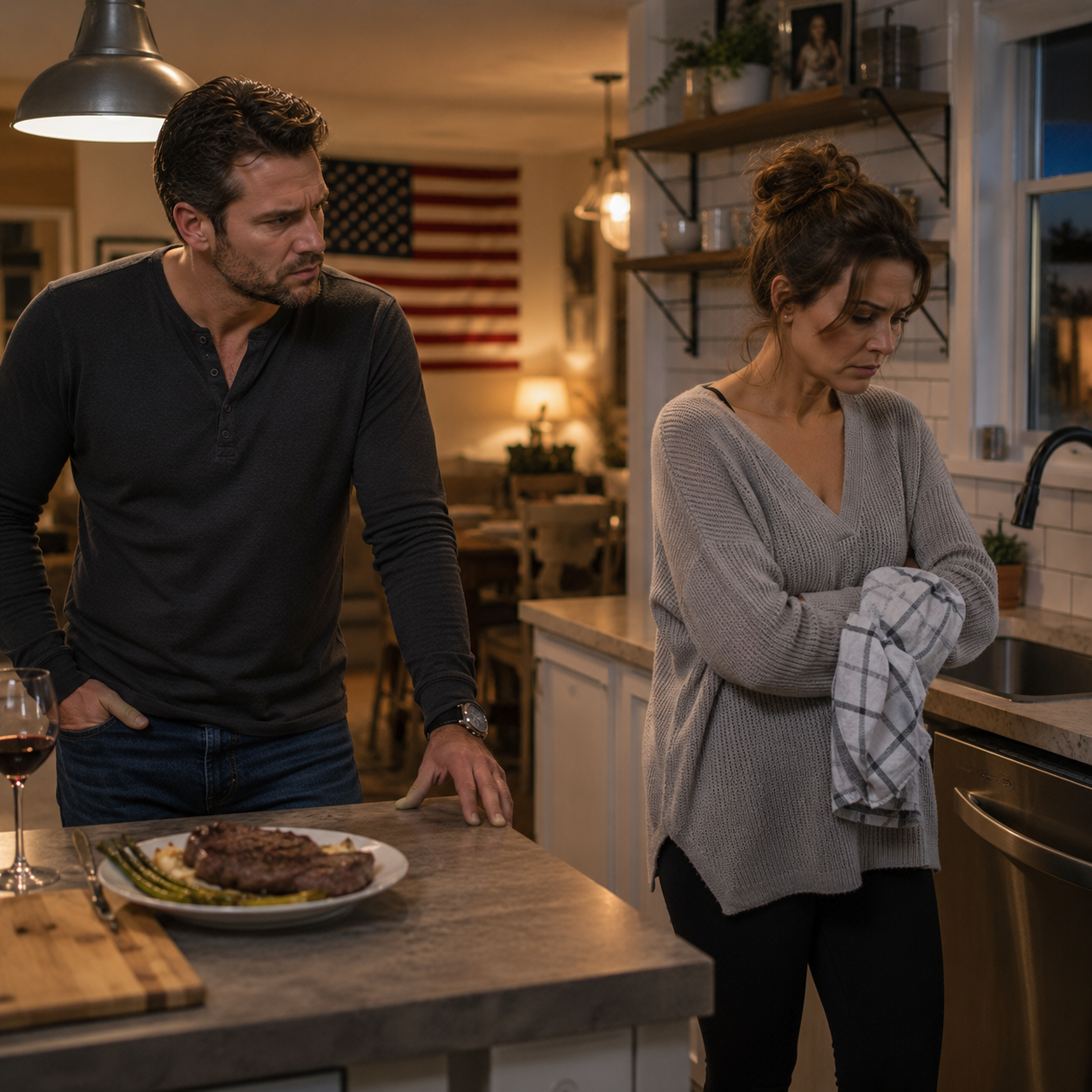
"I’m not in the mood, Elias. Stop making everything so heavy."
Those were the words that officially ended my marriage, though it took me another month to realize the paperwork just hadn’t caught up yet. We were in the kitchen. The dishwasher was humming a low, rhythmic tune that usually felt like home, but that night, it sounded like a countdown. I had reached for Sarah’s shoulders—not for sex, not even for a long embrace, just a simple touch to say ‘I see you.’
She flinched.
It wasn't a big, dramatic scene. There was no screaming. She just did this small, sharp twist away from my hands like my skin was made of glowing embers. She stood there holding a dish towel she didn't even need, her eyes fixed on the stainless steel sink like it held the secrets of the universe.
"Hasn’t been your mood for a while, Sarah," I said, leaning back against the counter. I didn't raise my voice. In my line of work—logistics and supply chain management—raising your voice means you’ve lost control of the data. I prefer to look at the data.
"I’ve just been busy. Work is a lot. The house is a lot," she snapped, finally looking at me. But she wasn't looking at me. She was looking through me, searching for a way out of the conversation. She started folding that towel. Once. Twice. Tight, neat squares. She looked like she was packing a parachute for a jump she hadn't told me about yet.
"You're checked out," I told her plainly. "I’m standing right here, and you’re somewhere else. You want to tell me where that is? Or should I keep guessing?"
"Oh my god, Elias! This is exactly why I’m 'checked out'! You interrogate me. You turn every quiet evening into a courtroom drama. I have stuff to do. Just... leave it alone."
She set the towel down on the counter with a finality that felt like a period at the end of a sentence. Then she walked out.
I stayed in the kitchen for a long time after that. I’m a man who believes in systems. If a system is failing, you don't keep pouring resources into it; you find the leak. I grabbed a notepad from the junk drawer and wrote one sentence: No more reaching for someone who is already halfway out the door. I underlined it twice. It felt like a contract with myself.
The next few days were a masterclass in "Polite Silence." We were like two ghosts haunting the same hallways. I stopped asking how her day was because I knew the answer would be a curated lie. I stopped suggesting movies. I started watching.
Sarah started "running errands" at 7:00 PM. Grocery runs that used to take twenty minutes now took two hours. She’d come home with a single bag of salad and a bottle of water, smelling like cold air and expensive perfume she hadn't worn for me in years.
On Friday, I decided to test the system one last time. I made a nice dinner—nothing fancy, just steak and asparagus. When she walked in, I didn't ask where she’d been. I just pointed to the plate.
"Date night Friday," I said. "No phones. Just us. There’s a place by the lake with live music and decent burgers. Let's go."
She didn't even take her coat off. "I can't Friday. I told you, I have to catch up on the laundry and I promised my mom I’d look over some tax stuff for her."
"You need three hours for groceries and a whole night for laundry?" I asked, my voice flat.
"Don't do that," she shot back, her face flushing. "Don't interrogate me. It’s exhausting. You make me feel cornered in my own home."
"Sarah, you’re never home long enough to be cornered. I handle the yard, the cars, the insurance, and the water heater you forgot to mention was leaking until the basement flooded. If asking for a burger with my wife is interrogation, then we have a very different dictionary."
She laughed. It was a dry, hollow sound that made my skin crawl. "Maybe I’m busy because someone has to keep the spirit of this place alive. You're just a machine, Elias. You think because you pay the bills, you own my time."
"I don't want to own your time," I said, pulling out my phone and opening our shared calendar. "I want to stop wasting mine. So, here’s the new update. I’m removing myself from any 'errands' where I’m just an accessory with a wallet. If you want my time, you ask for a slot. Don't give me a shrug."
I saw her eyes flicker with something—fear, maybe? Or just annoyance that I was changing the rules.
"And one more thing," I added, picking up my glass of water. "I’m moving into the guest room. We’ve been pretending the couch divide is an accident for months. I’m making it a plan. It keeps things clear."
"That's dramatic," she hissed.
"No, it’s organized. I’m splitting the budget, too. Your expenses, my expenses, and a shared list for the house. I'll email the spreadsheet on Monday. I'm done putting skin in a game I’m not allowed to play."
I walked toward the stairs, but I stopped at the landing. "There’s a cookout at Julian and Elena’s house tomorrow. We are either going as a couple and acting like one, or I’m not going. If you choose the first, I’ll be ready at five. If you choose the second... well, call a ride."
I went into the guest room and closed the door. I didn't slam it. I don't believe in noise as a message. Silence is much more precise.
I lay on that twin mattress, staring at the ceiling. My heart wasn't racing. I didn't feel like crying. I felt like a man who had just seen the first crack in a dam and was calmly deciding which valuables to move to higher ground.
The next day, Saturday, was the cookout. Sarah spent the whole morning acting like she was the victim of a great injustice. She sighed loudly while making coffee. She slammed cupboard doors. She waited until 4:59 PM to come downstairs, dressed in a sundress that screamed ‘Look at me, but don’t touch me.’
"Fine," she said. "Let’s go play house."
The drive to Julian and Elena’s was silent. When we arrived, the backyard was full of laughter, the smell of charcoal, and the clinking of bottles. Sarah transformed the moment her feet hit the grass. She was the "Perfect Wife" again. She smiled, she touched my arm in front of Julian, she laughed at jokes that weren't even funny.
I grabbed a beer and stood by the grill with Julian. He’s a good guy, an architect who thinks in straight lines just like me.
"You guys okay, Elias?" he asked, flipping a burger. "You look a little... disconnected."
"We’re in a transition phase, Julian. Checking the inventory," I replied.
Across the yard, I heard Sarah’s voice carry over the music. She was sitting with a group of women, including Elena. She didn't see me standing nearby.
"Oh, Elias is just in one of his 'phases,'" she said, her voice dripping with a condescending sweetness. "He reads these productivity articles and then he tries to 'life coach' our marriage. He actually moved into the guest room because I didn't want to go to a burger joint on a Tuesday. It’s kind of cute, honestly. He’s like a little drill sergeant with his spreadsheets."
The women laughed. Elena looked uncomfortable, her eyes darting toward me. Sarah followed her gaze and saw me standing there. She didn't look guilty. She smiled at me like I was part of the bit.
"Right, honey? Tell them about your guest room 'logistics'!"
I set my beer down on the side of the grill. I didn't feel embarrassment. I felt a cold, sharp clarity.
"Elena, Julian, thanks for the invite," I said, my voice carrying just enough to command the space. "But I think I’m going to head out. I’m not in the mood to be a punchline tonight."
I looked at Sarah. "The truck leaves in five minutes, Sarah. Five becomes four in sixty seconds."
Her smile faltered. "Seriously, Elias? You're overreacting in front of people. Don't be that guy."
"I’m reacting exactly the same amount in front of people as you did," I said. "Four minutes."
I walked toward the gate. I didn't look back. I knew she wouldn't follow. She was too addicted to the audience to leave the stage. I got into my truck, started the engine, and looked at the clock. At exactly five minutes, I backed out of the driveway.
As I drove away, I saw Julian standing on the porch, looking confused. But I also saw something else. I saw Sarah in the rearview mirror, her face twisted in a look of pure, unadulterated rage.
But as I pulled onto the main road, I realized I had forgotten one very important detail. A detail that would make everything Sarah said in that backyard look like a fairy tale. I hadn't told anyone about the sedan I had followed into a quiet cul-de-sac two nights ago.
And as I pulled into my driveway alone, I saw a notification on my phone that changed the entire math of the situation.
![[FULL STORY] He Told Me No One Would Believe Me—So I Made Sure Everyone Saw the Truth](https://social.rabedo.com/storage/thumbnails/1777621174_fc1b69bf-f607-4583-afda-73b72ee21ffa.png)

![[FULL STORY] My Wife Asked For A "Break" To Test-Drive Her New Lover, So I Handed Her Divorce Papers At His Front Door.](https://social.rabedo.com/storage/thumbnails/1776850130_13.png)
![[FULL STORY] Before Stepping Into My Car, She Quipped, 'Is This a Rental? If So, I'm Not Bothered ' I Grinned](https://social.rabedo.com/storage/thumbnails/1777343737_S6.png)
![[FULL STORY] My fiancée told me, "Don't expect any gift from me this Christmas."I calmly replied, "Fair](https://social.rabedo.com/storage/thumbnails/1776959918_48.png)