
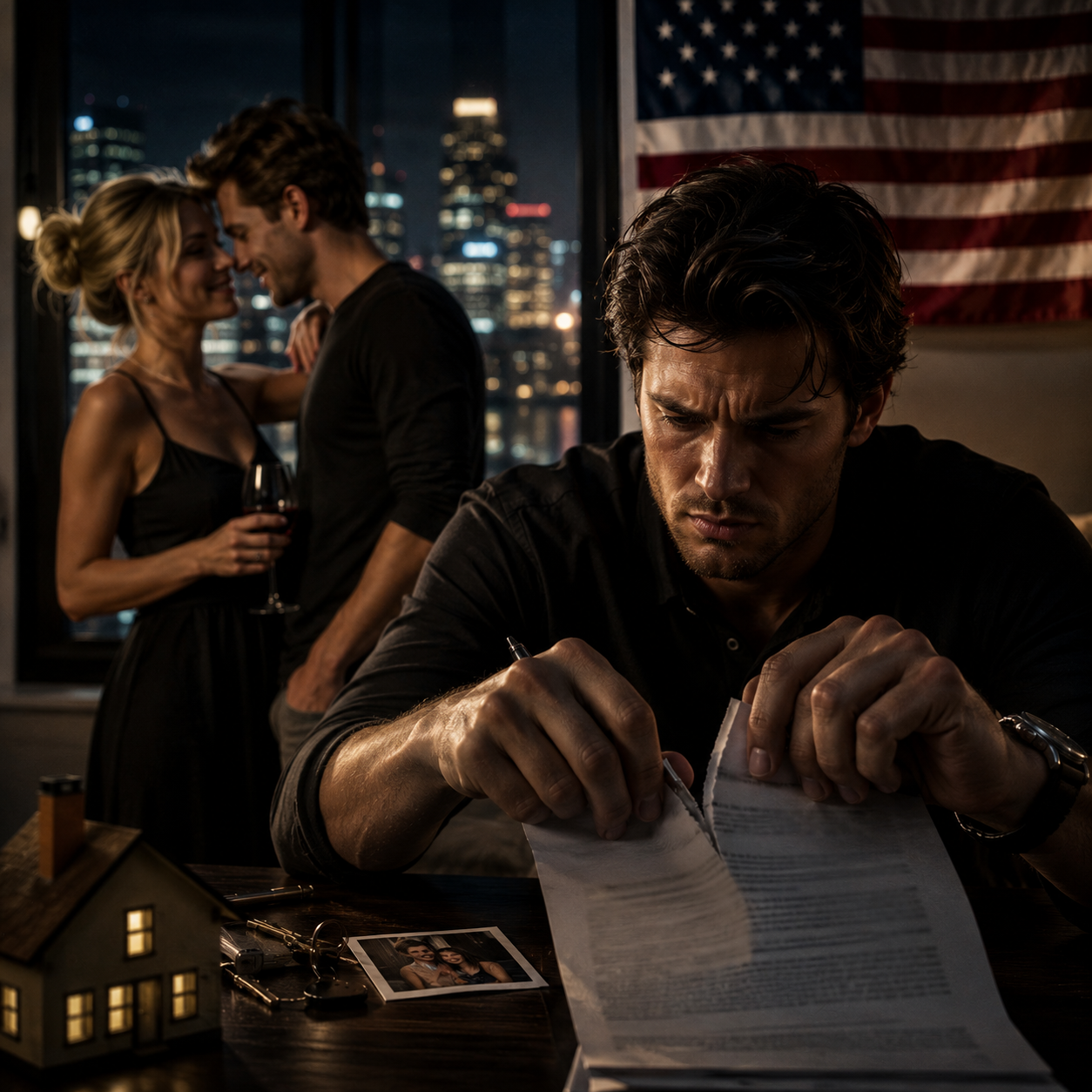
My name is Andrew Hale. I am thirty-four years old, and for most of my life, I have been the kind of man people describe with safe words: dependable, hardworking, practical, decent. I did not grow up with money. My father was a mechanic, my mother cleaned houses, and both of them believed in work so strongly that rest always felt suspicious in our home. We were not poor enough for tragedy, but we were never comfortable enough to stop counting.
I learned early how to stretch a dollar, how to repair things instead of replacing them, how to pretend I was not hungry when my mother looked tired and there was only one serving left. By the time I was twenty-five, I had started a small logistics software company with two college friends. By thirty-two, after years of sleeping under my desk, missing holidays, and eating convenience-store dinners, the company was doing better than I ever imagined. Not billionaire money. Not private-island money. But enough that my mother cried the first time I paid off the remaining balance on her mortgage.
That was the version of me Vanessa met: not flashy, not arrogant, not polished, but stable. We met at a charity gala I almost skipped. My company had sponsored a table because one of our clients was on the board, and I showed up in a suit that fit well but still made me feel like a child wearing his father’s clothes. Vanessa was working the room like she had been born under chandeliers.
She wore a dark green dress, her hair pinned up loosely, laughing with a group of people whose watches probably cost more than my first car. She was beautiful, yes, but what caught me was how alive she seemed. She spoke with her hands. She tilted her head when she listened. She could make a donor feel like a hero and a waiter feel seen in the same minute. When she came to our table and introduced herself as part of the event committee, I stood too fast and nearly knocked over my water glass. She smiled, not cruelly, and said, “Don’t worry. These events are mostly people pretending they know which fork to use.”
That line made me like her immediately. It made me think she saw through the performance of wealth, that she understood how silly it all was. Later, when I found her on the terrace escaping the noise, we talked for almost forty minutes. She told me she worked in brand consulting, that she had grown up around money but hated how people in her circle measured worth by addresses and last names. I told her I had grown up counting coins in the grocery store parking lot. She said, “Honestly, that sounds more real than half the men in there pretending their fathers didn’t buy them everything.” I remember feeling seen. I remember thinking, this woman understands both worlds and chooses character over shine. That was my first mistake. I mistook charm for depth.
For the first year, Vanessa loved the parts of me I had always felt insecure about. She said she liked that I was grounded. She liked that I did not name-drop, did not need attention, did not act as if money made me superior. She loved my little house in the older part of the city, the one I had bought before the company took off. She said it had soul.
She loved that I cooked, that I remembered details, that I treated restaurant staff politely, that I sent flowers to her mother after surgery without being asked. When her friends teased her for dating “a self-made software guy from nowhere,” she would squeeze my hand and say, “At least he actually made himself.” I believed she was defending me. Maybe, in the beginning, she was.
Things changed slowly, which is how people lose themselves without noticing. Vanessa’s world was expensive in a way that did not always look expensive. It was not just designer bags and five-star restaurants; it was expectations. Weekend trips to vineyards. Birthday dinners where splitting the bill meant everyone casually paid four hundred dollars without blinking. Engagement parties for friends held at country clubs. Ski trips where people discussed investment properties while I tried not to calculate the cost of renting equipment.
I could afford to go, eventually, but affording something and belonging inside it are different things. Vanessa began correcting me in small ways. Not cruelly at first. She would adjust my tie before dinners and say, “This knot looks a little business conference.” She would whisper, “Don’t mention that you drove yourself; everyone uses the valet here.” She would laugh after I told a story about my father’s repair shop and say later, “It’s sweet, but maybe not every story has to be so working-class nostalgic.”
I told myself she was helping me navigate her world. I told myself everyone compromises. If she could spend Sunday afternoons in my mother’s kitchen eating pot roast and listening to my father talk about carburetors, then I could learn not to say “rich people” in front of her friends. But compromise becomes corrosion when only one person is being reshaped. By our second year together, I noticed that Vanessa introduced me differently depending on the room.
Around my friends, I was “Andrew, the love of my life.” Around her professional circles, I was “Andrew, he runs a tech company.” Around her wealthiest friends, I became “Andrew, he’s done really well for himself,” delivered in a tone that tried to translate me into something acceptable. If someone asked where I went to school, she answered before I could. If someone asked about my family, she redirected the conversation. Once, at a dinner party, a man named Pierce asked if my parents still lived in “that little blue-collar town.”
I opened my mouth to answer, but Vanessa touched my arm and said, “They’re very private people.” My parents are not private. My father will tell a stranger his entire medical history while waiting for coffee.
The proposal happened on a beach in Maine. I had planned it for months. Vanessa loved the coast, and I rented a small cottage overlooking the water, hired a private chef, and arranged for her favorite white peonies to be delivered. I proposed at sunset, my knees shaking more than I expected.
She cried, said yes, and held my face as if I were the only man in the world. For a little while, I forgot the corrections, the social translations, the way she sometimes looked nervous when I spoke too honestly around her friends. I believed engagement would ground us. I believed a wedding would make us a team.
Instead, the wedding became a stage, and I became the sponsor.
At first, we talked about something intimate. Maybe eighty guests, a garden ceremony, good food, live music, no unnecessary spectacle. Vanessa agreed. She said she hated “performative weddings.” Two weeks later, her mother invited us to lunch and brought a binder. Not a folder, not notes, a binder. Inside were venue suggestions, floral concepts, seating charts, dress designers, photographer recommendations, and a guest list that already had two hundred names. Vanessa laughed nervously and said, “Mom, we haven’t decided anything yet.” Her mother, Celeste, smiled without warmth and said, “Darling, people will expect a proper wedding.” People. That invisible jury that ruled Vanessa’s world. People would expect. People would notice. People would talk.
I should have pushed back then. Instead, I tried to be generous. My company had just landed a major contract, and I was in the best financial position of my life. Vanessa’s father had passed away years earlier, and although her family still had status, their money was thinner than they pretended. I knew this because Vanessa told me late one night after too much wine. The house was mortgaged. Her mother lived off appearances and carefully managed investments. Her younger brother had burned through a trust fund. “People think we’re richer than we are,” Vanessa admitted. “It’s exhausting.” I held her and said we did not have to impress anyone. She nodded into my chest. Then, the next morning, she asked if I would be comfortable covering more of the wedding costs so her mother would not feel embarrassed.
More became most. Most became almost everything.
The venue was a historic estate outside the city with stone terraces, imported gardens, and a ballroom that looked like old money had married a museum. The rental alone made my stomach tighten, but Vanessa’s face lit up when she saw it. “It’s perfect,” she whispered. “Can you imagine the photos?” I could imagine the invoice, but I said yes. Then came the dress, custom-made by a designer Celeste insisted was “essential.” The flowers cost more than my first year of college. The band was flown in from New York. There was a champagne tower, a five-course dinner, late-night espresso martinis, custom welcome baskets, handwritten place cards, vintage cars, a videographer with a drone, and a cake so elaborate it required structural planning. Every time I questioned something, Vanessa reminded me that this was the only wedding we would have. “I know it’s a lot,” she would say, slipping her arms around my neck, “but it means so much to my mom, and honestly, I want one day where no one can look down on us.”
Us. That word softened me every time. I did not realize she was using it to disguise a difference. No one was looking down on us. They were looking down on me, and she wanted my money to build a staircase high enough to stand above them.
The first major crack came at our engagement dinner. Celeste hosted it at her club, which had portraits of dead men on the walls and rules about jackets after six. My parents arrived early, nervous but proud. My mother wore a navy dress she had bought after visiting three stores. My father wore his best suit, the one he used for funerals and weddings, and polished his shoes twice before leaving home. I saw them standing by the entrance, my mother clutching her purse with both hands, my father looking around as if afraid to touch something expensive. Vanessa kissed them hello, but I noticed Celeste’s eyes sweep over my father’s suit, my mother’s shoes, the small gift bag they had brought. It was quick, but I saw it.
During dinner, my father told a story about me taking apart our toaster when I was nine and failing to put it back together. He was laughing, proud in his own way, saying, “That’s how we knew the boy was either going to fix things or destroy them.” My mother laughed too. I laughed. Then I saw Vanessa’s smile tighten. Across the table, her friend Margot raised an eyebrow at Pierce, and Pierce smirked into his wine. Later that night, in the car, Vanessa was quiet.
“What’s wrong?” I asked.
She looked out the window. “Nothing.”
“Vanessa.”
She sighed. “Your dad is sweet.”
I waited.
“But sometimes he doesn’t read the room.”
“He was telling a harmless story.”
“I know. It’s just… my mother’s friends were there. Some of my clients were there. That crowd is different.”
“He embarrassed you?”
She rubbed her forehead. “I didn’t say that.”
“You didn’t have to.”
She turned to me, irritated. “Andrew, please don’t make this into some class war. I love your parents. I just wish sometimes they understood that not every setting is the same.”
I drove the rest of the way home in silence. She apologized later, or what looked like an apology. She said she was stressed. She said weddings made everyone sensitive. She said she loved my father’s story, really, she just worried people would misunderstand us. Again, us. Again, I let it pass.
The second crack was worse. It happened three months before the wedding, at a weekend trip with her friends in the Hamptons. Vanessa wanted me to come because, as she put it, “Everyone’s excited to get to know you better before the wedding.”
Everyone included Pierce, Margot, a hedge fund guy named William, two sisters who seemed to communicate mostly through brand names, and Ryan—not her ex, just another man from her circle who wore linen shirts and spoke as if everyone should be grateful for his opinions.
They were not openly cruel. That might have been easier. They were casually dismissive in the way people can be when they have never needed to wonder whether they are welcome.
One afternoon, while we sat near the pool, William asked how my company started. I told the truth: three guys, one borrowed office, maxed-out credit cards, a failed first product, a second product that barely worked, and a client who took a chance on us. My story made a few people laugh in the right places.
Then Ryan said, “That’s actually impressive. Very bootstrap.” He said bootstrap like he was complimenting a dog for learning a trick. Pierce added, “See, Vanessa? You found a capitalist fairytale.” Everyone laughed. I smiled because I had learned to smile in rooms where anger would be called insecurity.
That evening, Vanessa pulled me aside near the guesthouse. “Can you not get into those long origin stories tomorrow?” she asked.
I stared at her. “My origin stories?”
“You know what I mean.”
“No, I don’t.”
She lowered her voice. “Sometimes when you talk about how hard things were, it makes people uncomfortable.”
“People asked me a question.”
“I know, but there’s a way to answer without making it sound so…” She searched for the word and hated that she could not find a polite one.
“Poor?” I offered.
She looked away.
I laughed, but there was no humor in it. “I was poor, Vanessa.”
“Lower-middle-class,” she said quickly.
I shook my head. “Don’t rebrand my childhood.”
She crossed her arms. “I’m trying to help you.”
“No. You’re trying to make me easier to present.”
Her eyes hardened. “That’s unfair.”
“Is it?”
She stepped closer, voice tight. “These people are my world too, Andrew. I know you don’t care what they think, but I do. I have to live with them.”
“And what am I supposed to do? Edit myself until I fit?”
“Just don’t embarrass me.”
There it was, the sentence that would return later wearing a wedding dress.
Just don’t embarrass me.
She said it like a tired request, not a weapon. But something in me recoiled. I looked at the woman I was supposed to marry, the woman whose wedding I was financing down to the monogrammed napkins, and for the first time I wondered whether she wanted me beside her or behind her, quietly holding the bill.
We fought that night. Quietly, because the walls were thin and her friends were nearby. She cried, said I was twisting things, said she was under pressure, said I had no idea what it was like to be judged by people who had known her since childhood. I said she had no idea what it was like to be treated like an impressive exception instead of a person. By morning, we were exhausted. She apologized. I accepted. We returned to wedding planning.
That is how people walk toward disaster: one accepted apology at a time.
The final insult came four days before the wedding.
We were at the estate for a walkthrough. The planner, a woman named Elise, moved through the schedule with military precision. Ceremony at four. Cocktail hour on the west terrace. Dinner at six. Toasts at seven-thirty. First dance at eight-fifteen. Cake at nine. Fireworks at ten. Yes, fireworks. Vanessa had insisted they would be “tasteful.” I had paid the deposit with the dead expression of a man watching financial common sense leave his body.
My parents came to the walkthrough because they wanted to know where to sit and when to arrive for photos. My mother brought homemade cookies for the staff because that is who she is. Elise looked surprised but touched. Vanessa looked mortified. She laughed too brightly and said, “Oh, Linda, you didn’t have to do that.” My mother smiled. “I know, honey. I wanted to.” One of the venue coordinators accepted the container gratefully. I saw my mother relax.
Then Celeste arrived.
She was wearing cream, which felt intentional, though not technically bridal enough to confront. She kissed Vanessa, air-kissed me, nodded at my parents, and immediately began discussing the floral arch. For nearly an hour, we moved through the estate. My father asked practical questions. Would there be signs for parking? Was the ground uneven near the ceremony chairs? Should elderly guests be dropped near the entrance? Each question was reasonable. Each one made Vanessa’s posture tighten.
At the ballroom, my father noticed the stage for the band and joked, “Looks sturdy enough. Good. I’ve been known to dance dangerously after two beers.” My mother laughed. I smiled. Celeste did not. Margot, who had joined the walkthrough as a bridesmaid, exchanged a look with another bridesmaid. Vanessa saw it.
After everyone left, she asked me to stay behind.
We stood in the empty ballroom beneath crystal chandeliers. Sunlight poured through tall windows. Staff moved in the distance, setting tables that I had paid for, arranging flowers I had paid for, preparing a wedding that had grown so large it barely had room for me.
Vanessa looked tired, but her voice was sharp. “I need you to talk to your parents before Saturday.”
“About what?”
“About keeping things appropriate.”
I stared at her. “Appropriate?”
“You know what I mean.”
“I really don’t.”
She took a breath. “My friends will be there. My mother’s circle will be there. Some very important people are attending. I just don’t want any awkward speeches or embarrassing stories or jokes about beer and repair shops.”
I felt something inside me go very cold. “My father is giving a toast.”
“I know. That’s what I’m worried about.”
“He wrote it weeks ago.”
“Can you review it?”
“No.”
“Andrew.”
“No, Vanessa. I’m not reviewing my father’s toast like he’s a liability.”
She closed her eyes. “You’re making this harder than it needs to be.”
“Am I?”
“Yes. I am asking for one day. One day where everything feels elegant and normal and no one has to cringe.”
I heard the word before she realized she had said it.
Cringe.
I looked around the ballroom. The estate. The chandeliers. The imported flowers. The custom dance floor. The orchestra setup. The wedding I had funded because she said she wanted one day where no one could look down on us. And standing there, I finally saw the truth clearly: she was not afraid people would look down on us. She was afraid they would look down on her for choosing me.
“Do I embarrass you?” I asked.
Her face shifted. “That’s not what I said.”
“Do my parents embarrass you?”
She rubbed her temples. “Andrew, please.”
“Answer me.”
She snapped then. “Sometimes, yes. Sometimes you don’t understand how things look. Sometimes your parents don’t understand how things look. And I am tired of managing it.”
The room went silent except for the distant scrape of chairs.
I nodded slowly.
She seemed to realize she had gone too far. Her expression softened, and she reached for my hand. “I didn’t mean it like that.”
I pulled my hand back.
“How did you mean it?”
She swallowed. “I’m stressed.”
“No. You’re honest.”
“Andrew—”
“Don’t.”
I walked out of the ballroom, past the staff, past the florist unloading boxes, past the planner calling after me about final payment confirmation. I got into my car and sat there for a long time, gripping the steering wheel until my knuckles hurt.
My phone buzzed.
Vanessa: “Please don’t leave like this.”
Then: “I’m sorry. I’m just overwhelmed.”
Then: “Can we talk tonight?”
I did not answer. I drove to my parents’ house.
My mother opened the door with flour on her shirt because she was baking again, probably more cookies for people who would smile at her and then whisper about her shoes. She saw my face and immediately said, “What happened?”
I sat at their kitchen table, the same table where I had done homework as a child, where my father had taught me how to budget, where my mother had cried when I told her I could pay off their house. I told them everything. Not all at once. It came out broken and embarrassed. The engagement dinner. The Hamptons trip. The corrections. The way Vanessa introduced me. The request to review Dad’s toast. The word cringe.
My father sat very still.
My mother cried quietly, not because she was offended for herself, but because mothers feel the humiliation their children try to hide.
When I finished, my father leaned back and looked at me with the kind of sadness that makes a man feel twelve years old again.
“Son,” he said, “do you want to marry her?”
I opened my mouth.
No sound came out.
That was the answer.
My mother reached across the table and covered my hand. “You don’t have to earn a place in your own marriage.”
I looked down.
I had spent years proving I belonged in rooms that would never love me. Worse, I had mistaken Vanessa’s approval for love so many times that I no longer knew the difference.
My father asked, “Who’s paying the remaining balances?”
“I am.”
“How much is left?”
I told him.
He whistled softly. “And if you cancel?”
“I’ll lose a lot.”
“How much of yourself do you lose if you don’t?”
That question stayed with me.
Over the next two days, I did not disappear. Not yet. I made calls. Quiet, precise calls. I spoke to my attorney, then to my accountant, then to the planner. I reviewed contracts. Some deposits were nonrefundable. Some final payments had not yet been processed. Some vendors were due to charge my card the morning of the wedding. I cancelled the fireworks. I cancelled the late-night cocktail service. I froze the card attached to vendor balances. I instructed my attorney to notify the venue that I would not be responsible for additional charges without my written authorization. I paid what I was legally obligated to pay and stopped everything else.
Then I did something that still makes people argue when they hear the story.
I did not tell Vanessa.
Not immediately.
Some will say that was cruel. Maybe it was. But cruelty had been arriving in small packages for years, wrapped in etiquette and social pressure and “I’m just trying to help.” I did not want revenge. I did not want to humiliate her. But I also refused to spend the days before my wedding negotiating my dignity with a woman who thought my father needed editing.
The night before the wedding, Vanessa came to my house. She looked beautiful and exhausted, wearing leggings, an oversized sweater, and no makeup. For a moment, I saw the woman from the terrace at the charity gala, the woman who told me fancy people were just pretending to know which fork to use. I almost forgot everything.
Almost.
She stood in my doorway and said, “Can I come in?”
I let her.
We sat in the living room. She looked around the house she used to say had soul. Lately, she had called it “your starter place.”
“I hate how we left things,” she said.
“So do I.”
She took a shaky breath. “I’m sorry for what I said about your parents. I really am. I was stressed, and my mother has been in my head, and I panicked about everything being judged.”
I listened.
“I love you,” she continued. “I know I can be controlling. I know this wedding became bigger than us. But tomorrow, when I walk down that aisle, I want to see you. Not the flowers, not my mother, not my friends. You.”
There was a time when those words would have saved us.
But something about the timing hurt. Tomorrow. Now, when the guests were flying in, when the dress was steamed, when the photos were scheduled, when the performance was already built. Now she wanted to see me.
“Why did you ask me to review my father’s toast?” I asked.
She looked pained. “Andrew…”
“Answer.”
“Because I was afraid he’d say something people would laugh at.”
“People laughing at my father scares you more than hurting him?”
“No. That’s not fair.”
“Fairness left a while ago.”
She wiped her eyes. “What do you want from me?”
“The truth.”
“I gave you the truth.”
“No. You gave me the version that still gets you to the altar.”
Her face went pale.
We sat in silence.
Finally, she whispered, “Are you going to be there tomorrow?”
I looked at her. I loved her. God help me, I loved her even then. But love had become a room where I could not breathe.
“I don’t know,” I said.
She stared at me, horrified. “You don’t know?”
“No.”
“But everyone is coming.”
“Yes.”
“My mother will be destroyed.”
“Yes.”
“I’ll be humiliated.”
I nodded slowly. “That’s what you’re afraid of.”
She recoiled as if I had slapped her.
I stood. “I think you should go.”
She cried then. She said my name. She said we could fix it. She said we were tired and emotional. She said I was punishing her. She said she loved me. Maybe she did, in the way she understood love. Maybe she loved the way I made life easier. Maybe she loved the stability, the problem-solving, the financial rescue, the calm presence. Maybe she even loved me somewhere underneath all the fear and vanity. But I no longer trusted that love enough to build a life on it.
When she left, I locked the door and sat in the dark until morning.
On the day of my wedding, I woke at six.
My suit hung on the wardrobe door, pressed and waiting. My phone already had messages from groomsmen, vendors, the planner, Vanessa. I made coffee. I drank it standing in the kitchen. Then I showered, shaved, and put on jeans and a gray sweater instead of the suit.
At eight, my best man, Jason, arrived.
He took one look at me and said, “You’re not going.”
“No.”
He nodded once. “Okay.”
That is why he is my best friend. He did not ask stupid questions. He did not make it about optics. He simply sat at my kitchen table while I handed him an envelope.
“What’s this?” he asked.
“A letter for Vanessa. Give it to her before the ceremony time. Not in front of everyone. Privately.”
He looked at the envelope. “You sure?”
“No. But I’m doing it.”
“What about everyone else?”
“My attorney has notified the planner. The remaining charges are frozen. The ceremony can still happen if she wants to pay for it. The reception too. I’ve covered what I owed contractually. Nothing more.”
Jason let out a low breath. “That’s going to explode.”
“I know.”
“Where will you be?”
I looked toward the window. “Gone.”
At nine, I turned off my phone. At nine-thirty, I left my house through the back door because I did not want to risk someone arriving to talk me into performing one last act of obedience. I drove north with no real plan beyond distance. The sky was clear, offensively beautiful. Somewhere, florists were arranging flowers. Hair stylists were spraying Vanessa’s hair into place. Guests were putting on suits and dresses. My mother was at home, not attending, because I had told her the night before that there would be no wedding. She cried, then hugged me so hard I felt something in my chest finally crack open.
By noon, I reached a small lakeside town two hours away. I parked near the water and walked until I found a bench. I sat there as the man paying for everything disappeared.
At the estate, I learned later, the day began with confusion. The planner received the legal notice first. Then vendors began asking about final payment authorization. The fireworks company packed up. The cocktail vendor refused to unload without payment. The band manager demanded confirmation. Celeste, apparently, went from confusion to rage in under sixty seconds. Vanessa was upstairs in the bridal suite, surrounded by bridesmaids, champagne, silk robes, and cameras waiting to capture joy.
Jason arrived at one-thirty and asked to speak to her privately.
She thought he had come with a message from me saying I was running late.
Instead, he gave her the letter.
I know what it said because I wrote it three times before I sealed it.
Vanessa,
I wanted to write this instead of turning our wedding day into a public argument. I am sorry for the pain this causes you, but I cannot marry you. I cannot stand at the altar and promise to build a life with someone who is ashamed of where I come from, ashamed of the people who raised me, and afraid that my family will embarrass her in front of her friends.
For a long time, I thought love meant being patient while you corrected me into someone more acceptable. I thought generosity meant paying for a wedding that made you feel safe in a world that judges you. But somewhere along the way, I stopped being your partner and became your proof. Proof that you could still have the grand wedding, the perfect image, the approval of people who do not know me and do not care about us.
I have paid everything I am legally obligated to pay. I will not continue funding an event built around people you were afraid I might embarrass. I hope you understand someday that I did not leave because I wanted to humiliate you. I left because I finally understood that marrying you would mean humiliating myself for the rest of my life.
I loved you. I still do. But I will not enter a marriage where I have to apologize for my father’s toast, my mother’s kindness, or my own history.
Andrew
Vanessa did not scream when she read it. That surprised me when Jason told me later. She sat down slowly in her wedding dress and went completely silent. Celeste screamed enough for both of them. She demanded that Jason tell her where I was. He refused. She called me selfish, low-class, vindictive, exactly the kind of man she always feared I was. Jason said Vanessa looked up at that and whispered, “Mom, stop.”
The guests had already begun arriving.
The estate staff did what staff always do in disasters involving rich people: they smiled professionally and waited for instructions. Rumors spread faster than facts. Some people heard I had fled. Some heard I had discovered an affair. Some heard my company had gone bankrupt. Some heard there was a payment issue. That last one, apparently, caused visible panic among Celeste’s friends, which I admit gave me a small, ugly satisfaction I am not proud of.
At three-fifteen, Vanessa came downstairs.
Not to walk down the aisle. To face the guests.
She did not wear the veil. She held it in one hand. According to my sister, who heard from a cousin who stayed long enough to witness it, Vanessa stood at the entrance to the ballroom and told everyone the wedding would not be happening. Her voice shook, but she did not cry. Celeste tried to intervene, but Vanessa raised a hand and said, “Please don’t.” Then she said, “Andrew is not here because I gave him reasons not to be. I’m sorry you all came for nothing.”
That sentence traveled back to me days later.
I did not know what to do with it.
Part of me wanted to dismiss it as damage control. Part of me knew it had cost her something to say. Vanessa cared deeply about how people saw her. For her to stand in front of that crowd and accept even a fraction of blame was not nothing.
But it was still too late to be enough.
The fallout was brutal. Celeste called me twenty-seven times before I blocked her. Vanessa called once, the next day. I did not answer. She sent one message: “I read your letter again. I don’t know how to apologize for becoming someone who made you feel that way. I’m sorry, Andrew.” I did not respond immediately. I needed silence more than closure.
The financial mess took weeks to untangle. I lost a painful amount of money in nonrefundable deposits, but far less than I would have lost by letting the whole spectacle continue. Vendors threatened, negotiated, settled. The venue kept most of the rental fee. The fireworks company kept their deposit. The band found another event and refunded part of the balance. Celeste tried to claim I had humiliated their family and should reimburse “emotional damages,” which my attorney enjoyed more than he should have.
The emotional mess took longer.
People love a dramatic story, especially when it happens to someone else. Some painted me as a hero of self-respect. Others called me cruel. A few said I should have ended it before the wedding day. They were right. I should have. But people who say that often have not lived inside the slow confusion of loving someone who hurts you politely. They imagine there is a clear moment when you know. Sometimes there is not. Sometimes you only know when the suit is hanging on the door and your entire body refuses to put it on.
My parents handled it with more grace than anyone. My father never said, “I told you so.” My mother never insulted Vanessa. One Sunday, about a month after everything happened, I found my father in his garage working on an old motorcycle. I stood beside him in silence for a while.
Finally, he said, “You miss her?”
“Yes.”
He nodded. “Missing someone doesn’t mean you made the wrong decision.”
“I know.”
“No, you don’t. Not yet. But you will.”
He was right.
For months, I missed Vanessa in strange ways. I missed her laugh when something genuinely caught her off guard. I missed the way she stole fries from my plate after insisting she did not want any. I missed her cold feet against my legs at night. I missed the woman she had been on the terrace, or the woman I thought she had been. Grief is complicated when the person you lose is still alive and partly imaginary.
Then winter came. My company grew. I bought my parents a new car, not because they asked, but because my father’s truck finally died in a grocery store parking lot and he tried to revive it like a fallen soldier. I spent holidays quietly. I went to therapy, which I had once thought was for people who had time to name their feelings. My therapist asked me why I had stayed so long with someone who made me feel small. I gave practical answers at first. Love. History. Engagement. Hope. Money. Then, one day, I said the real answer: “Because part of me thought if someone like her chose me, it proved I had made it.”
There it was.
Vanessa had not been the only one worshipping approval.
I had wanted entrance into her world too, even while resenting it. I had wanted to be the man who proved everyone wrong, the mechanic’s son who could walk into the ballroom and belong. I had paid for that wedding partly because I loved her, partly because I wanted to show them I could. That truth humbled me. It also freed me. Once I saw my own hunger clearly, it stopped controlling me.
Six months after the wedding that never happened, Vanessa asked to meet.
I almost said no. Then I said yes, because avoidance is not the same as healing.
We met in a quiet park, not a restaurant, not a place with waiters or social performance. She arrived alone, wearing jeans, a wool coat, and no jewelry except the small gold bracelet she had worn before everything became about appearances. She looked different. Not worse. Less polished, maybe. More human.
“Thank you for coming,” she said.
I nodded. “How are you?”
She smiled faintly. “That question has had several answers this year.”
“Fair.”
We walked instead of sitting. Fallen leaves moved under our shoes. For a while, neither of us spoke.
Finally, she said, “My mother isn’t speaking to me.”
“I’m sorry.”
“I’m not sure I am.” She looked ahead. “After the wedding, or whatever that day was, she kept saying you ruined us. Ruined the family, ruined my reputation, ruined everything. And I kept waiting to feel that way too. But mostly I kept hearing your letter.”
I said nothing.
“She was furious that you mentioned your parents. She said you were manipulating me with guilt. Then I realized she had never once asked whether what I said about them was wrong. Only whether it was embarrassing that people might find out.”
“That sounds like Celeste.”
Vanessa laughed sadly. “Yes. It does.”
We reached a bench near a pond. She sat, and I sat beside her with enough space between us to mark the life that no longer existed.
“I need to apologize properly,” she said. “Not to get you back. Not to make myself feel better. Just because I owe you the truth. I was ashamed. Not of you exactly, but of what choosing you revealed about me. I wanted to believe I was better than my world, but I still needed its approval. You were kind and generous and real, and instead of protecting that, I tried to dress it up so people like Pierce and Margot would approve. That was ugly. I was ugly.”
I looked at the pond.
She continued, voice shaking. “Your mother brought cookies, and I acted like kindness was a social mistake. Your father wanted to give a toast, and I treated him like a risk. You paid for a wedding I turned into a performance for people who would never love us. I don’t know how to forgive myself for that.”
“Forgiving yourself is not my job,” I said quietly.
“I know.”
“But I appreciate the apology.”
She nodded, tears in her eyes. “Did you hate me?”
I thought about it. “No. Sometimes I wanted to. It would have been easier.”
“Do you still love me?”
The question sat between us like an old photograph.
I answered honestly. “A part of me loves who I thought we could be.”
She closed her eyes. “That’s fair.”
“But I don’t want to go back.”
“I know.”
We sat there for a long time, watching ducks move across the water with ridiculous seriousness.
Before we parted, Vanessa said, “Your father’s toast. Did you ever read it?”
“No.”
She reached into her coat pocket and pulled out folded papers. “Jason gave me a copy. Your dad sent it to him for safekeeping, I guess. I read it after everything.”
My throat tightened. “What did it say?”
She smiled through tears. “It was beautiful. He wrote about teaching you to fix things, but also about learning that not everything broken should be repaired. He said marriage wasn’t about never embarrassing each other, but about becoming the safest place for each other to be fully known.” She swallowed. “That line destroyed me.”
It nearly destroyed me too.
I took the papers from her.
“Thank you,” I said.
We hugged goodbye. It was brief, careful, and final.
A year later, I stood in my parents’ backyard at a much smaller wedding.
Not mine.
My sister’s.
There were folding chairs, string lights, barbecue, children running through the grass, and my father threatening everyone with his dangerous dancing after two beers. My mother made half the desserts herself. No one cringed. No one needed to be edited. My sister married a kind man who cried openly during his vows and accidentally dropped the ring, causing everyone to laugh with him, not at him.
During the reception, my father gave a toast. It was funny, rambling, too long, and perfect. At one point, he looked at me, just for a second, and raised his glass.
I raised mine back.
Later that night, after helping stack chairs, I found myself thinking about the estate wedding. The chandeliers, the flowers, the frozen payments, the guests whispering, Vanessa standing in her dress telling everyone I had reasons not to come. It no longer felt like an open wound. It felt like a road I had almost taken, one that would have led me far from myself.
I did not become a man who abandoned his bride.
I became a man who finally stopped abandoning himself.
People still ask what happened, though less often now. The story has become polished in other mouths. Some say I vanished because my fiancée insulted my parents. Some say I left because of money. Some say rich friends ruined the wedding. None of those summaries are wrong, but none are complete.
The truth is this: Vanessa told me not to embarrass her in front of her rich friends, and I realized she had been embarrassed for a long time. Embarrassed by my history, my family, my lack of polish, my refusal to pretend I came from somewhere softer. She wanted the benefits of my love without the burden of fully claiming me. She wanted the wedding I could pay for, the stability I could provide, the devotion I offered, but not the inconvenient truth of who I was and where I came from.
So on our wedding day, the man paying for everything disappeared.
Not because he was cruel.
Not because he was afraid.
Because the most expensive thing at that wedding was not the venue, the flowers, the band, or the champagne.
It was the cost of staying.
![[FULL STORY] My Girlfriend Shared on Facebook for All Our Friends: 'I Was Unfaithful Because You're Dull in](https://social.rabedo.com/storage/thumbnails/1777020271_S2.png)
![[FULL STORY] She Said “It’s Just Dinner With My Ex” — Then Saw Me There With Another Woman and Lost Everything](https://social.rabedo.com/storage/thumbnails/1776585949_025e5c0a-ce5d-446f-badb-59d700fd9214.png)
![[FULL STORY] My Girlfriend Broke Up After Two Years Saying She Wasn’t Ready For Something Serious. I Started ...](https://social.rabedo.com/storage/thumbnails/1777186194_C12.png)
![[FULL STORY] She Said, “Let’s Just Be Friends” After Four Years Together. I Agreed—and Treated Her Exactly Like a Friend. That’s When She Lost Her Mind.](https://social.rabedo.com/storage/thumbnails/1777014893_M8.png)
![[FULL STORY] My greedy wife tried to sell my late grandmother’s estate to fund her brother’s failing lifestyle, so I served her divorce papers at her family’s dinner party.](https://social.rabedo.com/storage/thumbnails/1777352384_B18.png)