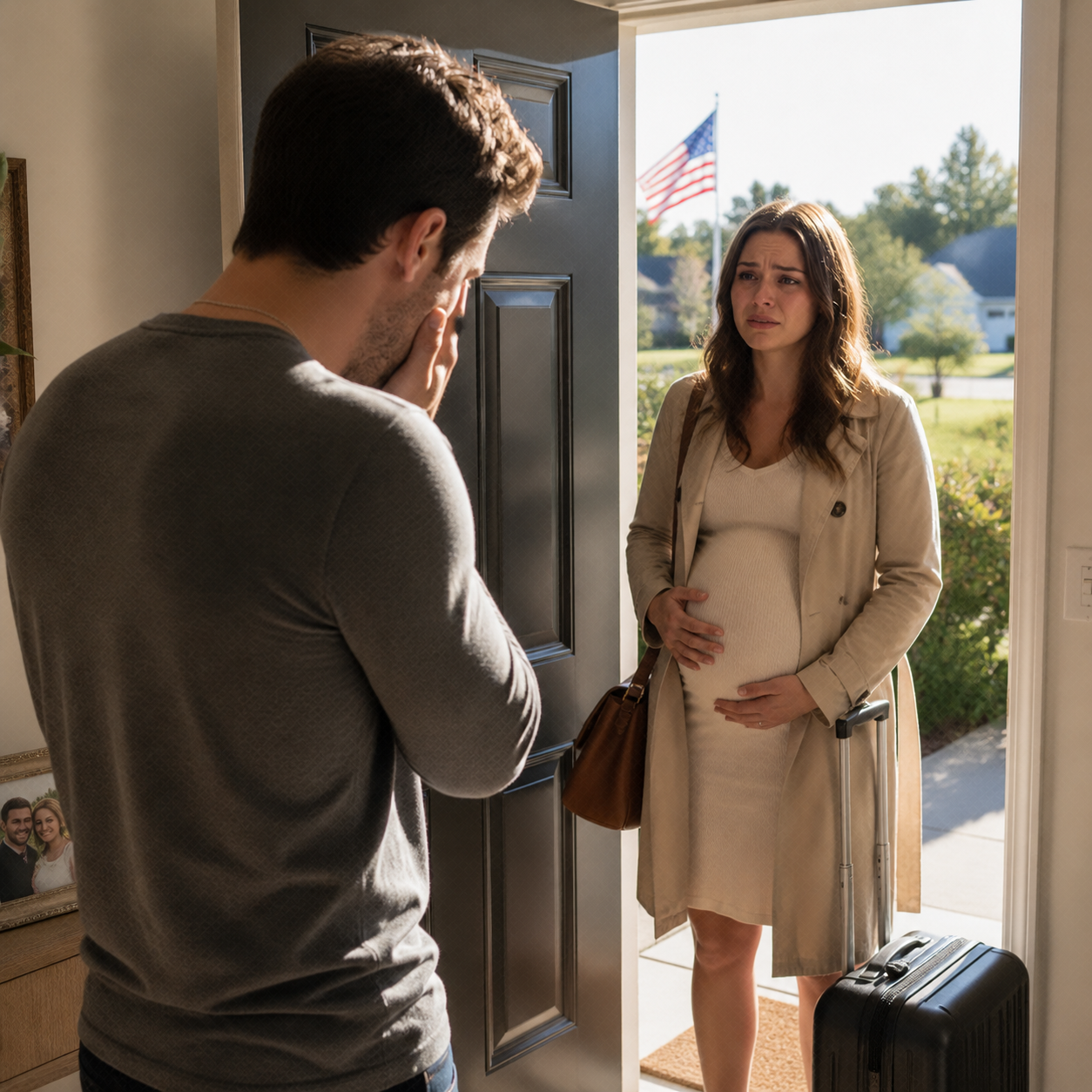
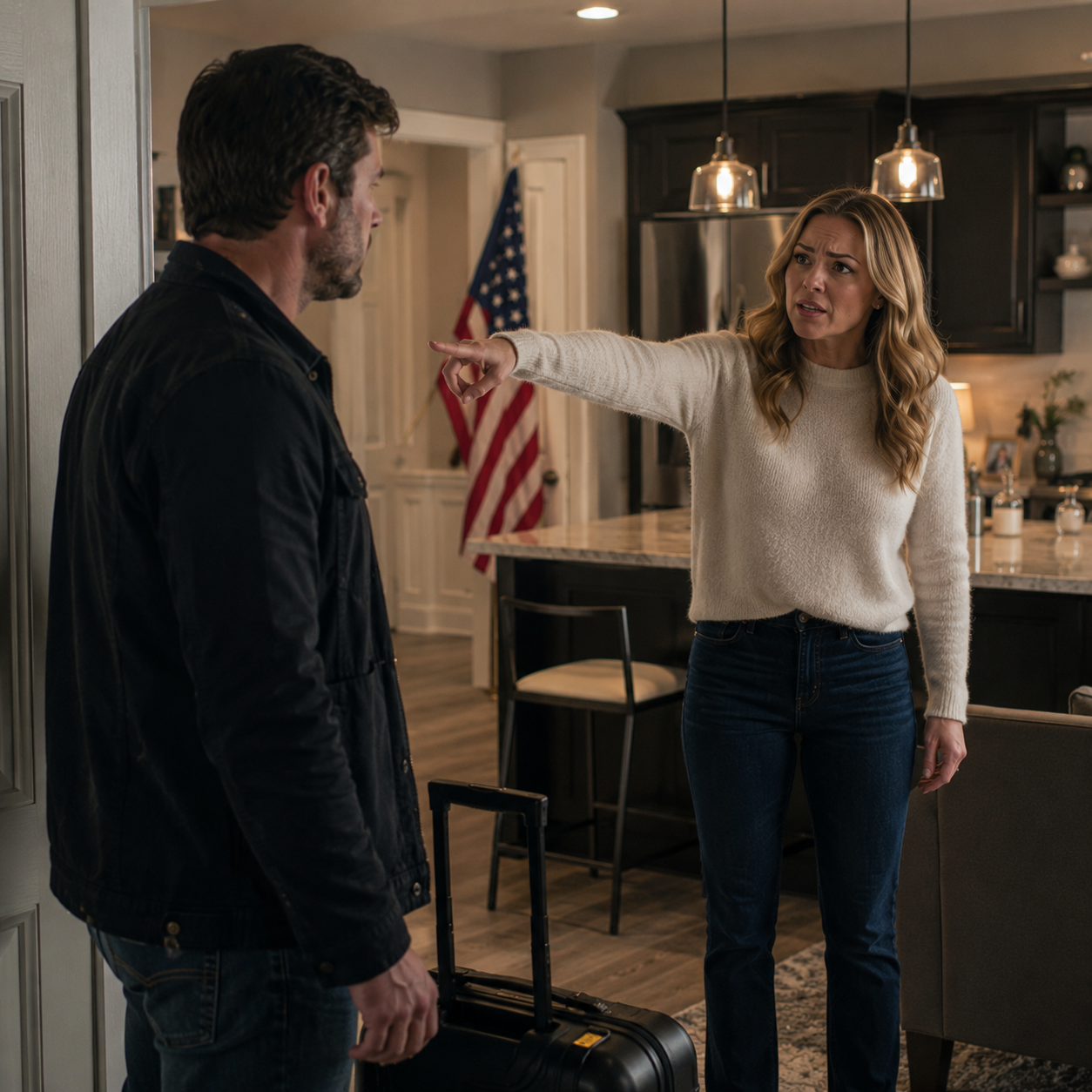
"I think you should leave, David. For Leo’s safety, and for mine."
Those words didn't just break my heart; they shattered the very reality I had spent the last four years building. I stood in the kitchen of the home I had paid for, looking at Lauren—the woman I had promised to protect for the rest of my life. Her eyes, once full of warmth and laughter, were now cold glass, reflecting a version of me I didn’t recognize. A monster. A man who would strike a child.
"Lauren, look at me," I said, my voice eerily calm despite the tectonic plates of my life shifting beneath my feet. "In four years, have I ever raised my voice at you? Have I ever even slammed a door in this house?"
"People change, David," she whispered, her voice trembling. "And Leo doesn't lie. Why would he make this up? Look at his arm!"
Behind her, standing in the shadows of the hallway, was Leo. He was seventeen, athletic, and at that moment, a master of the stage. He held his forearm as if it were made of porcelain, his face a mask of practiced trauma. For a split second, our eyes met. There was no fear in his gaze. There was victory. It was the look of a predator who had finally cornered its prey.
"I didn't touch him, Lauren," I said, realizing as I spoke that the words were useless. The trial was over. The verdict had been reached before I even walked through the door.
"Just go," she said, pointing to the door. "Please. Before I call the police."
I didn't argue. I didn't scream. I went to the bedroom, packed a single suitcase of essentials, and walked out of my own life. As I pulled out of the driveway, I saw them in the upstairs window. Leo had his arm around his mother, comforting her. The "devoted son" protecting his mother from the "evil stepfather." It was a perfect picture, except for one thing: I knew the truth.
To understand how I ended up in a motel room with nothing but a suitcase and a burning sense of injustice, you have to understand who we were. I met Lauren five years ago. She was a manager at a local firm, a widow who had lost her husband to a sudden illness. She was resilient, beautiful, and deeply devoted to her then thirteen-year-old son, Leo.
I fell for her hard. I was a structural engineer, a man who lived by blueprints and logic. Lauren was the color in my grayscale world. When we married a year later, I made a vow to both of them. I told Leo, "I’m not here to replace your father. I’m here to be another person in your corner. Always."
For the first two years, it worked. Or so I thought. I paid for the private school, the vacations, the high-end electronics. I bought us a large, five-bedroom house in a quiet suburb—a house I bought with the proceeds from my previous home and my savings. It was my house, legally, but I never treated it that way. I wanted them to feel like it was ours.
But as Leo hit sixteen, the shift began. It started with small things. He wanted a $45,000 car for his seventeenth birthday. I told him no. I explained that we could get him something safe and reliable, but a luxury vehicle for a new driver was a liability.
"My dad would have gotten it for me," he snapped during dinner one night.
Lauren looked at me, her expression pained. "David, he’s been through so much. Maybe we could look into a lease?"
"It’s not about the money, Lauren," I countered. "It’s about the principle. He needs to understand the value of things."
Leo didn't speak to me for a week after that. But he spoke to Lauren. Oh, how he spoke to her. I started noticing the "whisper campaign." I’d walk into the living room and they would fall silent. Lauren started asking me odd questions. "David, did you tell Leo he was a burden yesterday?"
"What? No, I haven't even seen him since breakfast," I’d answer, baffled.
"He said you told him he was lucky we let him live here."
"Lauren, that’s insane. Why would I say that?"
She would sigh, her brow furrowed. "I don't know. He just seems so... intimidated by you lately."
The "intimidation" turned into "fear." Leo began flinching when I walked by. He would stop eating if I sat at the table. He was building a narrative, brick by brick, and I was too busy working sixty-hour weeks to realize he was building my coffin.
The final straw came the night before the eviction. I had discovered that $2,000 was missing from our joint emergency fund. When I confronted Leo about it—calmly, I might add—he denied everything.
"I don't need your money," he sneered. "I wish you’d just disappear."
"We’re going to talk about this when your mother gets home," I said, turning to walk away. I didn't touch him. I didn't even get within three feet of him.
But when Lauren came home two hours later, Leo was sobbing. He showed her a deep, purple bruise on his forearm. He told her I had grabbed him in a rage, shaking him and screaming that he was a "thieving brat."
And Lauren believed him. She didn't ask if there was another explanation. She didn't look at my hands. She looked at his tears.
Sitting in that motel room on the first night, the silence was deafening. I felt a mixture of profound grief and a cold, rising anger. I am a man of logic. If a bridge is failing, you don't just pray it stays up; you find the structural defect and you fix it—or you tear it down.
I realized then that my marriage had a structural defect I had ignored for too long: Lauren’s inability to see her son as anything other than a victim.
I opened my laptop and started a spreadsheet. I labeled it: The Audit. If they wanted to treat me like a criminal, I was going to investigate this case like a professional. I started by looking at our bank statements. I had been so trusting, so blinded by love, that I hadn't looked at the line items in months.
What I found in those digital records made my blood run cold. It wasn't just the $2,000. It was hundreds of dollars every week. DoorDash, luxury clothing brands, gaming credits. All of it coming from our joint account. And all of it hidden behind transfers from Lauren’s personal savings.
She wasn't just believing his lies; she was subsidizing his lifestyle and hiding it from me.
I realized I couldn't fight this alone. I needed someone who could see through the smoke and mirrors. I needed someone who didn't care about "teenage trauma" or "motherly instincts."
I picked up the phone and called a man I had worked with years ago on a construction fraud case. A private investigator named Marcus.
"Marcus," I said when he picked up. "It’s David. I need you to find the truth about someone. And I need you to be invisible."
"Who’s the target?" Marcus asked.
"My seventeen-year-old stepson," I replied. "And I think he’s been planning my downfall for a long time."
As I hung up the phone, a strange sense of calm washed over me. The man who loved Lauren was mourning, but the engineer was now in charge. I was going to find out exactly how deep the poison went.
But as I looked at the photos of us on my phone—the wedding, the vacations, the smiles—I couldn't help but wonder: if I found the truth and showed it to her, would she even care? Or had I already lost her to a ghost and a lie?
I didn't have to wait long for the first sign that things were about to get much, much worse. My phone buzzed with a text from Lauren’s sister, Sarah.
“How could you, David? We all trusted you. Don’t ever try to contact my sister again. We know what you are.”
The flying monkeys had been released. The narrative was spreading. And as I stared at the message, I realized that proving my innocence wasn't going to be enough. I was going to have to dismantle their entire world.
![[FULL STORY] My Family Booked A Luxury Vacation To Italy Using My Credit Card And Deleted Me From The Itinerary, So I Remotely Shut Down Their Entire Lives.](https://social.rabedo.com/storage/thumbnails/1777188096_C17.png)
![[FULL STORY] She Called Me “Scaffolding” — So I Let the Structure Stand on Its Own](https://social.rabedo.com/storage/thumbnails/1777446166_[FULL STORY] She Called Me “Scaffolding” — So I Let the Structure Stand on Its Own.png)

![[FULL STORY] While I Was Away On A Business Trip, My Wife Secretly Invited Her Ex To A Family Dinner Behind My](https://social.rabedo.com/storage/thumbnails/1776395333_f1d7f98d-42dd-44d5-953c-80ac3552e68c.png)