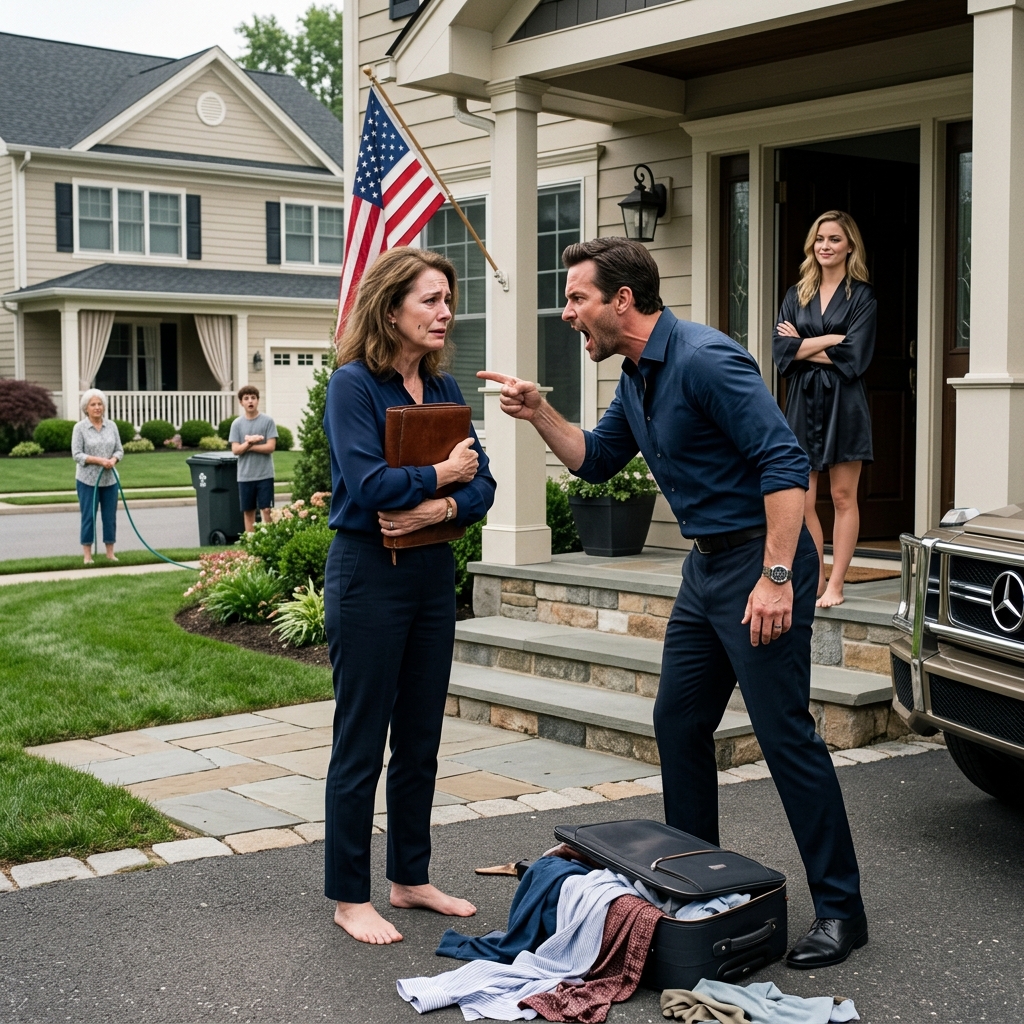
By Saturday morning, the house felt like a fortress under siege. Carlos had slept on the sofa to ensure Margot didn't "accidentally" walk out with the flat-screen TV, and I had stayed in my office, fueled by black coffee and the cold satisfaction of a plan well-executed.
But at 10 AM, the doorbell didn't just ring—it pounded.
I checked the front door camera. Standing there was Jean-Pierre Beaumont. Celine’s father. Unlike Margot, Jean-Pierre was the real deal. He was a retired textile magnate with connections that spanned from Lyon to D.C. He and Margot had been divorced for fifteen years, and while he barely spoke to his ex-wife, he absolutely doted on Celine.
I opened the door. Jean-Pierre didn't wait to be invited. He pushed past me, his tailored suit smelling of expensive tobacco and old power.
"David," he said, his voice a low growl. "What is this nonsense? My daughter calls me in the middle of the night, hysterical, saying you are throwing her onto the street like a beggar? Have you lost your mind?"
"Hello, Jean-Pierre," I said, closing the door calmly. "I assume Celine didn't mention the hundred and thirty thousand dollars she stole from me? Or the fact that she and her mother spent the last three weeks mocking me in French right to my face?"
Jean-Pierre paused, his eyes flickering toward the dining room where Celine was currently "packing"—which mostly involved throwing expensive shoes into a suitcase and crying.
"Money?" Jean-Pierre waved a hand dismissively. "If she needed money, she should have asked me. But that is no reason to humiliate her. You are her husband. You provide. That is the contract."
"The contract was the prenup, Jean-Pierre. The one Margot made me sign. It says what’s mine is mine. And I’m not humiliating her; I’m divorcing her. There’s a difference."
"We will see about that," he snapped. He walked into the living room and saw Carlos. "Who is this? A bodyguard? Get him out of here."
"He’s my brother, and he’s staying," I said. "And unless you’re here to pay back the money your daughter siphoned out of my accounts, you’re just a spectator."
For the next six hours, it was a war of attrition. Jean-Pierre brought in his own legal team—two guys in shark-skin suits who tried to intimidate Patricia in my own kitchen. They talked about "marital contributions," "emotional distress," and "loss of lifestyle."
They tried every manipulation tactic in the book.
"David, think of your reputation," one of the lawyers said, leaning against my counter. "A messy divorce involving allegations of theft and wire fraud? It won't look good for a tax attorney. Your clients want stability. We can settle this quietly. Give Celine the house, a modest alimony, and we drop the counter-claims for emotional abuse."
"Emotional abuse?" I laughed. "I have three weeks of video of them calling me a 'dull tool' and a 'pig' while they drank my wine. If anyone is being abused here, it’s my cellar. And as for my reputation? I’ve already informed my managing partner. He’s the one who recommended Patricia. He hates thieves even more than I do."
Celine came downstairs then, her eyes red and puffy. She looked at her father, then at me. She tried one last time to play the victim.
"David, please," she whispered, stepping close enough that I could smell her perfume—the one I’d bought her for our anniversary. "My father will pay you back. Everything. Just... don't do this. Don't end it like this. We can go to therapy. I’ll send Maman away. We can be what we were."
"What were we, Celine?" I asked, looking her straight in the eye. "Were we a couple? Or was I just a convenient way for you to stay in the U.S. and keep your mother from going to debtor's prison? Tell me, in French—since that’s your language of truth—did you ever actually love me? Or was I just 'acceptable'?"
She hesitated. That hesitation was my answer.
"That’s what I thought," I said.
Jean-Pierre realized then that I wasn't going to budge. He turned to Margot, who was sitting on her suitcases in the hallway, looking like a disgraced queen.
"Margot," he said, his voice full of loathing. "You are a fool. You always were. You’ve ruined her life with your greed. I will pay for a hotel for Celine for one week. After that, she is your problem. But I am not paying for a lawyer to defend you against the FBI. You are on your own."
Margot let out a strangled cry. "Jean-Pierre! You can't! I am the mother of your child!"
"And you are the woman who turned my child into a thief," he retorted. He looked at me, a glimmer of grudging respect in his eyes. "You have a spine, David. I underestimated you. Most men would have just paid to keep the peace."
"I don't pay for peace," I said. "I earn it."
By 8 PM, the house was empty. The silence that followed their departure was heavy, vibrating with the echoes of the last ten years. Carlos helped me carry the last of their "forgotten" items to the curb—mostly cheap trinkets Margot had tried to claim were heirlooms.
I sat on the front porch with Carlos, watching the taillights of Jean-Pierre’s car disappear around the corner.
"You okay, bro?" Carlos asked, handing me a beer.
"I feel like I just finished a ten-year marathon," I said. "I’m tired, Carlos. But for the first time in a long time, I don't feel like I’m being watched."
"It’s not over yet," he warned. "Margot’s still got that wire fraud hang-over coming. And Celine isn't going to just vanish. She’s got her father’s lawyers now."
He was right. Two days later, the "negotiations" began. Celine’s team stopped trying to save the marriage and started trying to bleed me. They filed for "emergency support," claiming Celine had no means to feed herself. They tried to contest the prenup, claiming she signed it under "duress" because she didn't fully understand English ten years ago.
It was a desperate, messy, and expensive play.
But then, Patricia called me with a piece of news that changed the entire landscape.
"David, you’re not going to believe this," she said, her voice crackling with excitement. "We were doing the deep dive into the 'art gallery' purchases Celine made. We found a paper trail that doesn't just lead to Margot. It leads to a shell company in the Cayman Islands."
"And?" I asked, my heart starting to race.
"And that shell company isn't registered to Margot. It’s registered to Celine. She wasn't just helping her mother, David. She was building her own exit strategy. She has nearly four hundred thousand dollars stashed away in an offshore account. Money she’s been skimming from you and her father for years."
I sat back in my chair, a cold smile spreading across my face. Celine hadn't just been a victim of her mother’s greed. She was the architect.
"Patricia," I said. "Does her father know about this?"
"Not yet."
"Good," I said. "Call a meeting. Tell them we have a counter-offer. And tell Jean-Pierre he’ll want to be there for this one. It’s time to show him who his 'little girl' really is."
I hung up the phone and looked out the window. The sun was setting over Philadelphia, casting long, golden shadows across my office. I realized then that I wasn't just getting a divorce. I was about to dismantle an entire empire of lies.
And the best part? I was going to do it all in a language she finally couldn't ignore.
![[FULL STORY] I Walked Into My Wedding Bruised — Then Told Everyone the Truth at the Altar](https://social.rabedo.com/storage/thumbnails/1777446626_[FULL STORY] I Walked Into My Wedding Bruised — Then Told Everyone the Truth at the Altar.png)


![[FULL STORY] My Girlfriend Shared Secret Photos Of Me To Her "Assessment Group" To Mock My Body, So I Systematically Deleted Her From My Life.](https://social.rabedo.com/storage/thumbnails/1777344833_d4.png)