
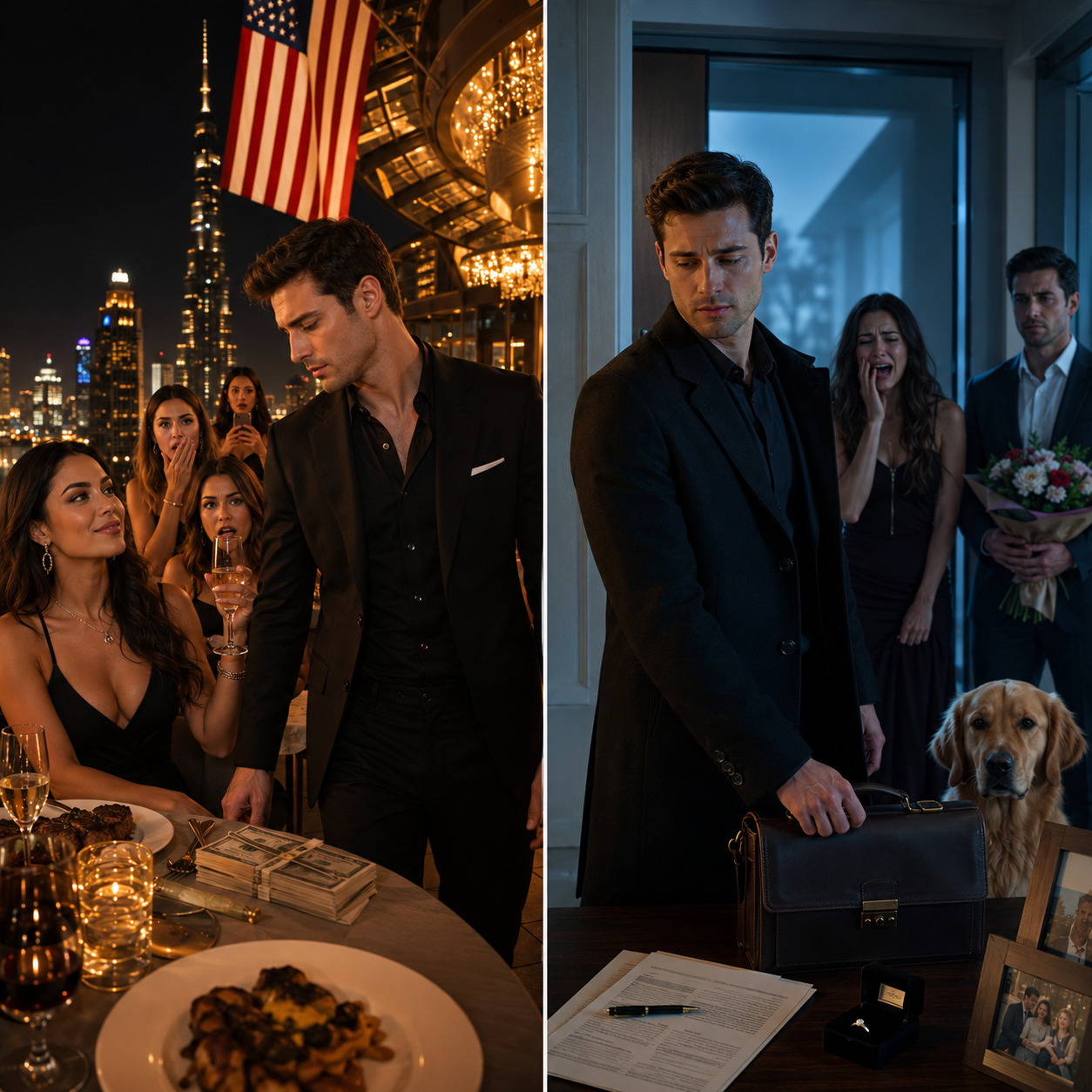
Nolan had already bought the ring.
That was the detail Brielle did not know when she decided to turn their five-year relationship into a public ultimatum at a rooftop birthday dinner in Charlotte.
The ring was hidden in the safe inside Nolan’s townhouse closet. It had cost seven thousand eight hundred dollars, white gold with a simple oval diamond, elegant but not flashy. He had saved for eighteen months and paid cash because he did not want to begin an engagement with credit card debt. He had also booked a quiet cabin near Boone for their anniversary weekend, planning to propose at the same overlook where he and Brielle had taken their first trip together.
Only his brother Carter and his mother Denise knew.
Nolan wanted the proposal to be private, meaningful, and real.
Brielle wanted proof.
For almost five years, Nolan and Brielle had been together. For the last fourteen months, they had lived in Nolan’s townhouse. The mortgage was his. Most of the furniture was his. The dog had been his before Brielle moved in, though she called him “our son” whenever she wanted sympathy online.
Nolan worked as a logistics coordinator for a regional medical supply company. His life was steady, practical, and calm. Brielle worked as a social media manager for a bridal boutique, which meant her entire day revolved around proposal videos, engagement rings, dress fittings, wedding captions, and women crying under chandeliers.
At first, Nolan thought her job made her romantic.
Later, he realized it made her competitive.
Every proposal she saw became a comparison. Every ring became a silent accusation. Every client’s wedding became proof that Nolan was “dragging his feet.” Dinner at home was no longer cozy; it was evidence that he was not trying. Quiet weekends were no longer peaceful; they were boring. A stable relationship was no longer enough unless it looked impressive to everyone watching.
Then came Paige’s birthday dinner.
There were twelve people at the table, loud music, drinks, candles, photos, and enough phones out to make the whole night feel like content instead of a celebration. Halfway through dessert, Paige joked that Brielle would probably be next.
Brielle looked straight at Nolan and said, “Only if he stops dragging his feet.”
Everyone laughed.
Nolan smiled once and stayed quiet.
But Brielle did not stop.
She tapped her glass with a spoon like she was about to make a toast.
“Actually, let’s make this simple,” she said. “Nolan, propose tonight or I’m saying yes to someone else.”
The table went silent.
Nolan looked at her calmly.
“Someone else?”
Brielle smiled like she had just played a winning card.
He asked, “Are you serious?”
She said, “Dead serious.”
So Nolan said, “Say yes to him.”
Then he stood up, left cash for his meal, and walked out.
By the time he reached the parking garage, his phone was lighting up. Brielle texted that he was embarrassing her. Then she told him to turn around. Then she said he knew she was only making a point. Finally, she wrote, “If you leave, don’t come home.”
Nolan went home anyway.
He opened the safe, took out the ring box, and sat on the edge of the bed staring at it. That little velvet box no longer felt like a promise. It felt like evidence of how close he had come to making the biggest mistake of his life.
Then he drove to Carter’s house.
When Carter opened the door and saw his face, he asked, “What happened?”
Nolan handed him the ring box.
“Hold this for me so I don’t do something stupid like forgive her tonight.”
The next morning, Brielle was sitting on the couch in Nolan’s old Panthers sweatshirt. Her eyes were puffy, but her voice was sharp.
“Where were you?”
“Carter’s.”
“Did you think about what you did?”
“Yes.”
“Good. Then apologize.”
Nolan laughed once because the shock had finally worn off.
“The relationship is over.”
Brielle stared at him like she did not understand the words.
“Over a joke?”
“No,” Nolan said. “Over an ultimatum with a backup man attached.”
She started crying then. She said she only wanted him to prove he loved her. She said she had waited five years. She said women sometimes said dramatic things when they felt insecure.
Nolan listened, then said, “Love does not respond well to threats.”
When he told her she needed to start looking for another place, the tears stopped just long enough for calculation to appear.
“You can’t evict me. I live here.”
“Your name is not on the mortgage,” Nolan said. “I’m not throwing your things outside. I’m giving you until the end of the month.”
“My mail comes here.”
“I’ll forward it.”
“My dog is here.”
“He was mine before you.”
That was the first time she looked truly scared.
After that, Brielle tried to control the story.
She told her friends Nolan had humiliated her publicly and abandoned her because she wanted commitment. Paige texted him first, saying Brielle was devastated and that women sometimes said dramatic things when they needed reassurance.
Nolan replied once.
“She threatened to say yes to someone else in front of twelve people. I accepted her terms. Please do not contact me about this again.”
Paige wrote, “That’s not the whole story.”
Nolan answered, “It’s the only part that matters.”
Then he blocked her.
Next came Austin, Brielle’s coworker from the bridal boutique. He messaged Nolan saying Brielle had only been trying to get him to step up.
Nolan replied, “If she wants someone who steps up under threats, you can propose.”
Austin did not answer.
Brielle stayed in the townhouse that week, but the atmosphere changed completely. Cabinet doors slammed. Phone calls happened behind closed doors. She cried loudly enough for Nolan to hear, then went silent when he did not come comfort her. Nolan slept in the guest room with the dog.
On the third day, she left a wedding venue brochure on the kitchen counter. The starting package was thirty-two thousand dollars, circled in pink marker.
Nolan put it in the recycling.
The next morning, he called a real estate attorney named Dana. She told him to document everything, avoid changing locks while Brielle still had belongings inside, and communicate only in writing.
So he sent Brielle a simple notice.
They were no longer together. She had until May thirty-first to remove her belongings. Communication should remain about logistics only.
Brielle responded with seventeen messages. She called him heartless, accused him of wasting her best years, said he had used her, and then texted his mother.
That was a mistake.
Denise called Nolan and asked what happened. Nolan told her everything: the ring, the cabin, the public ultimatum, and the “other man.”
Denise went silent for five seconds.
“She did this while you had a ring?”
“Yes.”
“Oh, honey,” his mother said, “don’t you dare give it to her now.”
Brielle expected Denise to pressure him. Instead, Denise texted Brielle and told her that threatening her son in public was cruel and that they both needed space.
Brielle forwarded Nolan the message with one word.
“Unbelievable.”
Nolan saved it in the evidence folder Dana told him to create.
The proposal folder had become an evidence folder.
Poetic in the worst way.
Three weeks later, Brielle posted a crying video in her car. She did not name Nolan, but she gave enough details for everyone to know. She said some men waste your fertile years, let you build a home with them, and then discard you when you ask for a future.
The comments filled with people calling Nolan a coward, a man-child, and commitment-phobic.
Then one mutual friend, Lacy, commented, “Didn’t she threaten him with another guy at dinner?”
The video disappeared within an hour.
Then Brielle tried a pregnancy scare.
At 1:17 a.m., she texted, “I might be pregnant.”
Nolan replied, “If that is true, send me the appointment information, and I will communicate through writing.”
No appointment information ever came.
Two days later, she claimed her grandmother’s diamond earrings were missing and hinted Nolan had taken them. When he asked for proof, she said it was disgusting that he needed a receipt. Then Nolan reminded her about the hallway camera.
The earrings appeared in her makeup bag that evening.
No apology.
Then she showed up at his office and told reception she was his fiancée. Nolan corrected them immediately.
“Ex-girlfriend. Please do not send her back.”
Brielle left a white gift bag at the front desk. Inside was a framed photo of them from Charleston, the Asheville venue brochure, and a ring-size card she had once left on his nightstand as a hint.
On the card, she had written, “You already know the answer. Stop punishing me.”
Nolan photographed everything and sent it to Dana.
Dana replied, “This is not about marriage anymore. This is pressure.”
That sentence stayed with him.
A ring under pressure. A future under pressure. A public proposal under pressure.
That weekend, Nolan went to the cabin alone. He drove to Boone, sat on the porch, watched fog move through the trees, and hiked to the overlook where he had planned to propose. He stood there with no ring and no speech, and he let himself feel the sadness.
Walking away did not mean he had never loved Brielle.
It meant he finally believed her when she showed him what love had become to her.
On the way home, he got a voicemail from a man named Travis.
Travis said Brielle had given him Nolan’s number and claimed Nolan was refusing to return a ring that belonged to her family.
There it was.
The other man.
Nolan called Travis back with Carter listening on another line. He explained the ring was his, bought by him, never given to Brielle, and never part of her family. Then he sent Travis the receipt, the cabin booking, and the screenshot where Brielle admitted she had been “making a point.”
Ten minutes later, Travis texted back.
“I’m out. Sorry, man.”
That should have embarrassed Brielle into silence.
It did not.
She came home furious, screaming that Nolan had ruined her chance at happiness. Nolan stood in the kitchen and said, “You involved Travis. I corrected Travis.”
She said he made her look crazy.
Nolan replied, “No, Brielle. You lied to a man about a ring.”
Then she threw a coffee mug at the sink. It shattered, and a piece cut Nolan’s hand.
He took a photo.
Then he called the police.
When officers arrived, Brielle switched into a soft, shaky voice and said Nolan was criminalizing her feelings. Nolan showed them the cut, the broken mug, the messages, the office incident, and the documentation.
The officers told Brielle to leave for the night.
Dana filed for a temporary protective order the next morning.
Two months later, the townhouse was quiet again.
Because of the protective order, Brielle could only collect her belongings with a police escort. Dana arranged two pickup windows. Carter came over for both with a clipboard because he had watched too many crime documentaries and decided inventory mattered.
It did.
Brielle arrived with Paige and her mother, Marsha. She tried to take Nolan’s espresso machine. Carter checked the receipt and stopped her. She tried to take the living room rug. Carter checked the receipt again. She tried to take the dog’s bed while the dog was lying on it.
Even Marsha finally said, “Brielle, stop.”
Then Marsha asked why everything had gone so far.
Brielle started saying Nolan had led her on for years and never planned to propose.
Nolan went upstairs, got the cabin reservation, and showed Marsha the ring receipt.
Marsha stared at it.
“You bought a ring?”
“Yes,” Nolan said. “Before the birthday dinner. I saved for eighteen months. The cabin was booked for our anniversary.”
Marsha looked at Brielle like she had watched something delicate fall and shatter.
Brielle said, “He’s only showing you that to make me look bad.”
Marsha answered, “No, sweetheart. You did that part.”
After that, Brielle’s narrative lost power.
The final hearing happened three weeks later. Brielle argued the protective order was excessive and that she had been emotionally overwhelmed. Dana presented the texts, office visit, Travis’s statement, missing earrings accusation, pregnancy scare, broken mug photos, and police report.
The judge looked tired in the way adults get tired when other adults turn consequences into emergencies.
He extended the protective order for one year.
No contact. No third-party messages. No coming within three hundred feet of Nolan’s home, workplace, or immediate family’s homes. Communication only through attorneys if necessary.
Brielle cried.
Nolan felt done.
The ring was returned. He lost money on the cabin, legal fees, and repairs. He also lost five years.
But he kept his peace.
And the dog.
The house sounded different without Brielle’s things. Bigger. Not happy immediately, but less tense. No slammed drawers. No late-night sighing. No hidden test inside an ordinary question.
Silence used to scare him.
Now it felt like proof he had survived the noise.
Nolan still believed in marriage. He still believed in proposals. He still believed there was something beautiful about choosing one person and saying yes to the uncertain future together.
But he no longer believed a proposal should be dragged out of someone like a confession.
It should not be a trap.
It should not be a deadline.
It should not be a public test.
A ring given under threat is not romance.
It is surrender with jewelry.
Brielle wanted the proposal more than she wanted the partnership. She wanted the photo, the caption, the applause, and the public proof that she had been chosen.
But being chosen is not the same as being ready to choose back with patience, respect, and care.
Nolan had been ready to propose.
Then Brielle showed him why he should not.
Sometimes the best proposal is the one you never make.
![[FULL STORY] She Said “Let’s Just Be Friends” – So I Stopped Being Her Boyfriend | The Day I Took My Life Back](https://social.rabedo.com/storage/thumbnails/1776416698_670407530_1914235489529617_2962536863866413998_n.jpg)
![[FULL STORY] I Found My Wife’s Secret Group About Mediocre Husbands… And I Was Her Favorite Story](https://social.rabedo.com/storage/thumbnails/1777667481_f7562297-cd6f-42a7-b01e-a6cd578f7ecc.png)
![[FULL STORY] She Said She Was “Too Evolved” for Monogamy — So I Asked Her Father for Permission to Date Her Sister](https://social.rabedo.com/storage/thumbnails/1777132614_20ab7fe5-27d7-48f6-99b2-c55be5d8bada.png)
![[FULL STORY] She Said, "I Want To Try Dating Other People Before Getting Married." I Nodded. "Then Go Ahead,](https://social.rabedo.com/storage/thumbnails/1777869810_C2 (1).jpg)