
My girlfriend Amber quit her job to become a stay-at-home girlfriend.
Not a wife. Not a stay-at-home mom. Not someone managing a house full of children, appointments, meals, laundry, and chaos.
A stay-at-home girlfriend.
Her words, not mine.
And according to her, the arrangement was simple.
“I bring vibes to the table,” she told me. “You bring the money. That’s balance.”
I looked at her for a long moment, trying to decide if she was joking.
She was not.
So I said, “Deal.”
Then I canceled the maid service, stopped paying for meal prep, stopped eating out, and told her that since she was home now, the cooking and cleaning were officially her job.
That was when Amber learned that “vibes” do not scrub toilets.
My name is Nate. I am thirty-one years old, and I work as an electrician. I make decent money, around seventy-five thousand a year. Not rich, not struggling, just stable enough to live comfortably if I do not do anything stupid.
Amber and I had been together for two years.
When we first met, she worked as a receptionist at a dental office. She made about thirty-five thousand a year, which was fine. She was responsible with money, or at least responsible enough. She paid her own bills, bought her own things, and never acted like I was supposed to fund her life.
After a year together, we moved in.
The apartment was nothing fancy. Nine hundred square feet, one bedroom, decent kitchen, small balcony, and a living room big enough for a couch, a TV, and a coffee table that always seemed to collect random mail. We split rent sixty-forty because I made more. Utilities and groceries were fifty-fifty. We hired a maid twice a month and split that too. Neither of us loved cleaning, and seventy-five dollars each was worth not fighting about bathrooms.
It worked.
Neither of us cooked much either. I had a meal prep service that delivered lunches for work, and we ate out for dinner a few nights a week. Sometimes we ordered takeout. Sometimes we made sandwiches and pretended that counted as dinner. It was not glamorous, but it was honest. We both worked. We both paid. We both contributed.
Then TikTok happened.
About three months before everything blew up, Amber discovered the stay-at-home girlfriend trend.
You probably know the kind of videos I mean. Soft music. Morning sunlight. A woman waking up at ten, stretching in matching pajamas, pouring green juice into a glass with a bamboo straw, lighting a candle, doing yoga, organizing fruit in clear containers, making a beautiful dinner, and captioning everything with phrases like “feminine energy,” “soft life,” “creating peace,” and “my man provides so I can pour into our home.”
Amber became obsessed.
She sent me videos constantly.
“Look how cute this is.”
“Doesn’t this seem peaceful?”
“She’s literally living the dream.”
At first, I just said things like, “Yeah, looks relaxing,” and went back to work.
I did not take it seriously.
That was my mistake.
Two months later, she started dropping hints.
“You know, I’m really stressed at work.”
“So find a different job,” I said.
“I don’t think this job is good for my mental health.”
“Then apply somewhere else.”
She would sigh dramatically.
“Or I could just stay home.”
I would look over at her.
“Stay home and do what?”
“Take care of the apartment. Take care of you. Focus on us.”
I thought it was just talk. People complain about work. People daydream about quitting. I had my own fantasies about walking away from a difficult job site and spending the rest of my life fishing, but I was not about to stop paying rent because a fantasy looked nice online.
Then one Tuesday night, Amber came home with a huge smile and a cardboard box of desk items in her arms.
“I did it,” she said.
I was eating dinner at the table.
“Did what?”
“I quit.”
I put my fork down.
“You quit what?”
“My job. I gave my two weeks’ notice today.”
For a second, I thought I had misheard her.
“You quit your job?”
She nodded, glowing like she had just announced a promotion.
“I’m going to be a stay-at-home girlfriend. Isn’t that exciting?”
I stared at her.
“Did you ask me about this?”
Her smile faltered.
“I didn’t think I needed to. We’re partners. You support me, right?”
“Amber, you pay eight hundred dollars a month in rent and half the utilities. How are you planning to do that without a job?”
She sat beside me and grabbed my hand like she was about to explain something beautiful to someone very slow.
“That’s the thing. You’ll cover it. I’ll take care of the home. You take care of the finances. That’s how it works.”
“That is not how anything works.”
She looked offended.
“I’ll be contributing. Just in a different way.”
“What way?”
“I’ll clean. Cook. Make sure you come home to a peaceful environment.”
Then she said the sentence that still lives in my head rent-free.
“I bring vibes to the table. You bring the money. That’s balance.”
I slowly repeated, “Vibes.”
“Yes. Feminine energy. Peace. A clean home.”
“We have a maid.”
“But I’ll be doing that now.”
“The maid costs us seventy-five dollars each twice a month.”
“Exactly,” she said brightly. “So you’ll save money.”
I did the math in my head.
Amber contributed around eight hundred dollars toward rent, about a hundred toward utilities, around two hundred toward groceries, and seventy-five toward the maid. Roughly eleven hundred dollars a month, give or take.
If she stayed home, I would save seventy-five dollars.
I would pay over a thousand more.
For vibes.
“No,” I said.
Her face changed.
“What?”
“No. If you quit your job, you are not staying here rent-free.”
“That’s not very supportive.”
“That’s reality.”
Her eyes filled with tears.
“You don’t value what I bring to this relationship.”
“I value you paying your rent.”
She went to bed angry.
I assumed that would be the end of it. I thought she would calm down, retract the notice, or at least start applying for another job.
She did not.
Two weeks later, her last day at the dental office arrived.
That Friday evening, she walked through the door carrying a small box of desk things and wearing the happiest smile I had seen on her in months.
“I’m officially free,” she said.
I looked at the box.
“Do you have interviews lined up?”
“No.”
“No?”
“I told you. I’m staying home.”
“Amber, we talked about this.”
“I know,” she said. “And I thought about it. This is what I want. What I need. For my mental health.”
“And I told you I’m not paying for you to sit home all day.”
She crossed her arms.
“So you’re saying that if I’m home, I’m not contributing unless I’m paying rent?”
“No. I’m saying you cannot quit your job, contribute nothing, and expect me to fund your lifestyle.”
“What if I do everything a stay-at-home girlfriend does?”
I paused.
“Everything?”
“All the cleaning. All the cooking. All the home management.”
I looked around our small apartment. The dishes in the sink. The laundry basket near the bedroom. The bathroom neither of us wanted to clean. The floors that needed vacuuming.
Then I looked back at her.
“Everything?”
She lifted her chin.
“Everything.”
I nodded.
“Deal.”
She smiled because she thought she had won.
Monday morning, I woke up at five-thirty like always. Amber was still asleep, tangled in blankets, peaceful and unemployed. I made coffee, packed my work bag, and sent her a text before leaving.
“Since you’re the stay-at-home girlfriend now, I canceled the maid service. You’ll handle all the cleaning. I’m also stopping my meal prep service, and we’re not eating out anymore. You’re cooking breakfast, lunch, and dinner. I’ll be home at six. Have dinner ready.”
By seven-fifteen, my phone rang.
I answered while sitting in my truck outside a job site.
“You canceled the maid?” she demanded.
“You said you’d do all the cleaning.”
“I meant tidying up. Keeping things neat.”
“The maid deep cleans the bathroom, kitchen, floors, dusting, vacuuming, all of it. That’s your job now.”
“That’s too much.”
“That’s staying home. They don’t just bring vibes. They work.”
“What about meals?”
“You said you’d cook.”
“I don’t know how to cook full meals.”
“You’re about to learn. I’ll be home at six.”
Then I hung up.
She sent seventeen texts over the next hour.
I ignored them because I was working.
That evening, I came home at six sharp.
The apartment looked exactly the same as when I left.
Amber was on the couch in pajamas, watching TikTok.
I stood in the doorway.
“Where’s dinner?”
She looked up.
“I didn’t have time.”
“You were home for nine hours.”
“I was busy.”
“Busy doing what?”
She looked genuinely serious when she said, “Processing this new arrangement. It’s a lot of pressure.”
I stared at her.
“Right. I’m ordering pizza. That’ll be twenty dollars. You owe me ten.”
“I don’t have ten.”
“You’re unemployed by choice. Not my problem. You’ll owe me.”
We ate pizza in silence.
Tuesday morning, I left another text.
“Reminder: dinner at six. Also, the bathroom needs cleaning. Shower, toilet, sink, floor. Supplies are under the sink.”
At two in the afternoon, she texted me.
“How do you clean a toilet?”
I replied, “YouTube it.”
“There are chemicals. I don’t know which ones to use.”
“Read the labels. That’s your job now.”
When I came home at six, the apartment smelled like bleach.
Strong bleach.
Too strong.
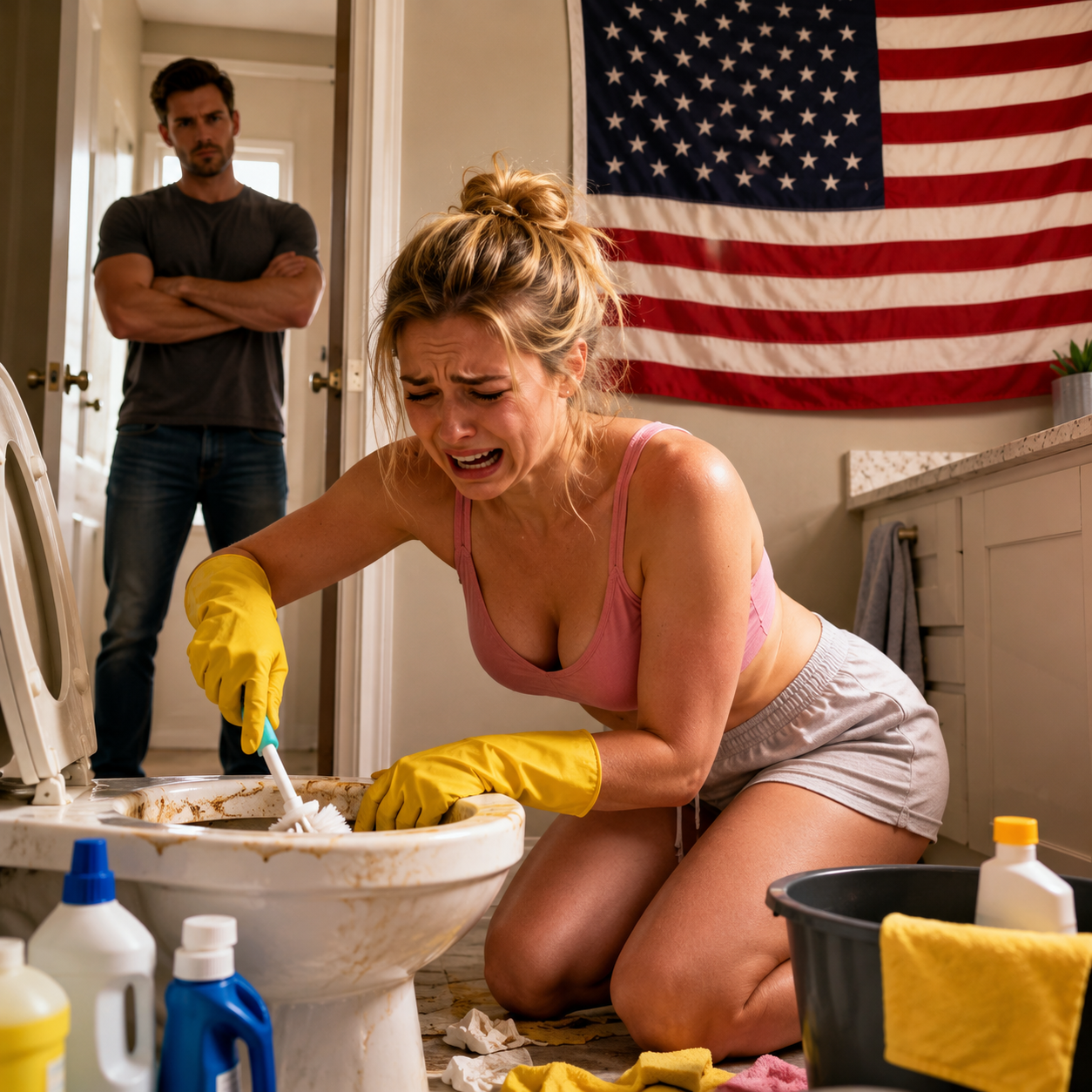
The bathroom door was open, and Amber was sitting on the floor crying.
I walked in slowly.
“What happened?”
“I cleaned the toilet,” she said through tears. “It was disgusting. And I got bleach on my hands. And I think I mixed two chemicals because the smell made me dizzy.”
I looked under the sink.
She had mixed bleach and ammonia-based cleaner.
Not enough to seriously hurt herself, thankfully, but enough to make the room unsafe.
“Did you not read the labels?” I asked. “They say not to mix them.”
“I was trying to make it extra clean.”
“You almost made toxic gas.”
Her eyes widened.
“What?”
“Bleach and ammonia create dangerous fumes.”
She stared at me in horror.
“This is dangerous. You expect me to risk my life cleaning?”
“I expect you to read instructions.”
Then I looked toward the kitchen.
“What about dinner?”
She wiped her face.
“I was too upset to cook after the toilet incident.”
“So no dinner again.”
“I’m sorry,” she whispered. “This is harder than I thought.”
“It’s day two.”
Wednesday, I wrote instructions and left them on the counter.
Vacuum living room and bedroom.
Wipe kitchen counters and stove.
Make spaghetti for dinner.
Pasta in pantry. Sauce in fridge. Instructions on box.
When I came home, the vacuum was in the middle of the living room, plugged in but unused. The kitchen counters were sticky. A pot sat on the stove filled with cold water. No pasta.
Amber was on the couch in different pajamas, crying again.
“I can’t do this,” she said.
“Can’t do what? You didn’t do anything.”
“I tried to vacuum, but it’s loud and heavy. Then I looked at the spaghetti box, but there are so many steps.”
I picked up the box.
“Boil water. Add pasta. Cook eleven minutes. Drain.”
“You’re oversimplifying.”
“You are overcomplicating. It’s water, salt, pasta, sauce.”
“I’m not good at this.”
“Then get a job.”
“No. I just need time to adjust.”
Thursday, I simplified it even more.
“Just make the bed and order Chinese food for dinner. I’ll pay. You only have to order it and have it here by six.”
I came home at six-fifteen.
No food smell.
No takeout bags.
Amber was asleep on the unmade bed.
I woke her gently.
“Where’s the food?”
She blinked.
“What food?”
“The Chinese food you were supposed to order.”
Her face fell.
“Oh no. I forgot. I took a nap and lost track of time.”
I looked at the unmade bed.
“It’s six-fifteen. What did you do all day?”
“I was tired. This staying-home thing is exhausting.”
“You have done almost nothing for four days.”
“I’m adjusting to a new routine.”
By Friday, I realized we needed a real conversation.
I came home with a notebook, sat across from her at the table, and said, “Let’s talk about what a stay-at-home girlfriend actually does.”
She folded her arms.
“Okay.”
“The women you watch online are not just bringing vibes. If they are actually managing a home, they cook. They clean. They do laundry, dishes, grocery shopping, meal planning, budgeting, errands, organizing, scheduling. That is a full-time job.”
“That seems like a lot.”
“It is.”
“I thought it would be more aesthetic.”
I paused.
“Aesthetic?”
“You know. Making smoothies in cute glasses. Doing yoga. Organizing the pantry with matching containers. Lighting candles. Stuff that looks good.”
“That is content creation. Not housework.”
“What’s the difference?”
“Content creation is for followers. Housework is for the person you live with. In this case, me, the person you expect to pay all your bills.”
She looked down.
I softened my tone slightly.
“Tomorrow is Saturday. I’m off work. We’re going to spend the day teaching you basic life skills.”
“Like what?”
“Cooking eggs. Doing laundry. Cleaning a bathroom properly without creating chemical weapons. Vacuuming.”
“That sounds terrible.”
“That is your job if you want to stay home and not pay rent.”
Saturday morning, I woke her at eight.
She groaned.
“It’s Saturday.”
“Stay-at-home girlfriends don’t get weekends. The house doesn’t clean itself Monday through Friday only.”
We started with laundry.
I showed her how to sort clothes, choose settings, measure detergent, and not wash red towels with white shirts. She looked bored within five minutes.
“This is so boring.”
“This is your career now.”
Next came scrambled eggs.
The most basic breakfast possible.
She cracked three eggs directly into a dry pan, turned the heat to high, and watched them stick and burn almost instantly.
“Why isn’t this working?”
“Did you watch any of the videos I sent you?”
“No. I thought it would be intuitive.”
“Cooking is learned.”
We tried again. I walked her through butter, low heat, whisking, stirring. The eggs came out edible. Barely.
She looked exhausted.
“That took forever.”
“It took twenty minutes.”
Then came bathroom cleaning.
This time, I gave her gloves.
Watching Amber clean the toilet was like watching someone defuse a bomb. She stood as far back as her arms allowed, face turned away, barely touching the brush to the bowl.
“You have to actually scrub.”
“It’s gross.”
“It’s a toilet. Of course it’s gross.”
“I can’t believe people do this.”
“People do this every week.”
“It shouldn’t be normal.”
“What’s your alternative? Never clean it?”
“Hire someone.”
“With what money? You’re unemployed.”
She threw the brush into the toilet.
“This is impossible. You’re setting me up to fail.”
“I’m teaching you what you signed up for.”
“I signed up to be a stay-at-home girlfriend, not a maid.”
I asked the obvious question.
“What’s the difference?”
She had no answer.
By Sunday night, she had successfully made scrambled eggs once, cleaned the bathroom badly, and done one load of laundry that she forgot in the washer until I reminded her to move it to the dryer.
On Monday morning, the second week began.
I left her a schedule.
Eight a.m. wake up.
Nine a.m. breakfast prep.
Ten a.m. clean kitchen.
Eleven a.m. vacuum.
Noon lunch prep.
Two p.m. bathroom cleaning.
Four p.m. dinner prep.
Six p.m. dinner ready.
When I came home, she had made breakfast. I could tell because the pan was still in the sink with egg residue drying on it.
Nothing else was done.
“What happened to the schedule?”
She avoided my eyes.
“I got distracted.”
“By what?”
“TikTok.”
I stared at her.
“So you spent eight hours watching videos about stay-at-home girlfriends instead of being one?”
“I was doing research.”
“Research?”
“Seeing what other girls do.”
“And what do they do?”
She hesitated.
“They make really aesthetic content.”
“Do they clean toilets?”
“They don’t show that part.”
“Exactly.”
Tuesday, I took her phone before I left for work.
She grabbed for it.
“Hey, I need that.”
“For what?”
“What if there’s an emergency?”
“You have your laptop. You can contact me if there’s an actual emergency. But you do not need TikTok to clean the apartment.”
When I came home that evening, she was sitting on the couch staring at the wall like a prisoner of war.
“No phone was torture,” she said.
“Did you do your tasks?”
“Some.”
The kitchen was cleaner. Dinner had been attempted: hot dogs and boxed mac and cheese. Not impressive, but edible.
“See?” I said. “When you actually try, things get done.”
“I hate this.”
“Then get a job.”
“I can’t go back now,” she said. “I already told everyone I’m a stay-at-home girlfriend. It’s embarrassing.”
“More embarrassing than burning scrambled eggs four times?”
She did not answer.
Wednesday, she had a breakthrough.
Kind of.
I came home to an actual cooked dinner: chicken, rice, and steamed broccoli. The chicken was slightly burnt. The rice was clumpy. The broccoli had given up on life. But it was food.
Real food.
“You did it,” I said.
She looked like she had fought a war.
“It took me three hours. I had to restart the rice twice. I didn’t know you were supposed to rinse it.”
“But you figured it out.”
“I watched seven YouTube videos on your laptop.”
“That is learning.”
“I’m so tired,” she whispered. “How do people do this every day?”
“Practice. It gets faster.”
“I don’t want to get faster. I want to stop.”
Thursday was her breaking point.
I came home and found her sitting on the kitchen floor surrounded by cleaning supplies, crying. The floor was wet and sticky. The trash can was open. Something smelled burnt.
“What happened?”
“I tried to mop,” she said. “I spilled the bucket. Then the floor got sticky, so I tried to fix it and made it worse. And I burned dinner. The smoke alarm went off. The neighbors knocked to check if we were okay.”
Her mascara had run down her face.
“I’m done.”
I sat across from her on the floor.
“What did you think this would be?”
She sniffed.
“I thought I’d wake up late, do some light tidying, make a nice dinner, and you’d come home and appreciate me. Like in the videos.”
“The videos do not show the work.”
“I can’t do three hours of work every day.”
“Most stay-at-home partners do six to eight hours.”
“That’s insane.”
“That’s why it is a full-time job.”
She was quiet for a long time.
Then she said, “I want to get a job.”
“Okay.”
Her eyes snapped to mine.
“Really?”
“Yeah. If you can’t handle staying home, go back to work.”
“You’re not mad?”
“I’ve been waiting for you to figure this out.”
“You could have just told me it would be hard.”
“I did. You did not believe me.”
The next day, she spent hours applying to jobs online.
I gave her phone back that evening because she had actually done something productive.
She got three interviews the following week.
Two weeks later, Amber started as a receptionist at a doctor’s office, making thirty-eight thousand a year. A little more than before. Not life-changing, but stable.
On her first day back, she came home, dropped her bag by the door, and collapsed onto the couch.
“I forgot how tiring real jobs are.”
“Real jobs?”
She looked at me.
“You know what I mean. Jobs outside the house.”
“So staying home wasn’t a real job?”
She sighed.
“It was. But it was worse.”
I laughed.
“At least at work, I get lunch breaks and coworkers and nobody expects me to clean a toilet.”
“That’s an interesting perspective shift.”
She turned toward me.
“I’m sorry I put us through that.”
“Did you learn something?”
“Yes,” she said. “TikTok is a highlight reel. Nobody shows the part where you’re scrubbing burnt rice off a pot for forty-five minutes. And I am not cut out for housework. I’m barely cut out for regular work, but at least regular work pays me.”
We went back to splitting rent sixty-forty.
She paid on time.
She never mentioned becoming a stay-at-home girlfriend again.
A month later, I caught her watching one of those videos.
A woman in a matching lounge set was pouring pink juice into a glass while a caption said, “My man provides so I can create peace.”
I raised an eyebrow.
“Missing it?”
Amber looked at me seriously.
“Not even a little bit.”
Then she glanced back at the video.
“But the aesthetic is still nice.”
“You know what else is nice?”
“What?”
“Having money to pay rent.”
She nodded.
“Facts.”
Around that same time, one of the stay-at-home girlfriend influencers Amber used to watch got exposed. Turned out she had a full-time nanny, a housekeeper, and a meal prep service. She was filming the pretty parts and outsourcing everything else.
Amber sent me the link with one word.
“Lies.”
A few weeks later, her friend Madison came over and started talking about quitting her job to “focus on her relationship.”
Amber interrupted her immediately.
“Don’t.”
Madison blinked.
“What?”
“Do not quit your job.”
“But you did it for two weeks.”
“Worst two weeks of my life.”
Madison laughed, thinking she was joking.
Amber leaned forward.
“Do you know how to clean a toilet?”
“Uh, yeah.”
“No. I mean really clean one.”
“I guess.”
“You don’t,” Amber said. “Nobody knows until they have to. Then you’re sitting on the bathroom floor at two in the afternoon crying because you mixed chemicals and almost gassed yourself, and you haven’t showered in three days because you’re too busy failing at spaghetti.”
Madison stared at her.
“That sounds specific.”
“It was all of it. Stay at your job. Split your bills. Keep your dignity.”
I had never been prouder of her.
Amber still is not much of a cook. She can make eggs now, boxed pasta, hot dogs, and exactly one chicken-rice-broccoli meal that she calls “the trauma special.” She still hates cleaning, though she does clean more than she used to. She complains about her boss, pays her rent, and uses her days off to do anything except pretend housework is an aesthetic.
And honestly, that is fine.
Because the problem was never that Amber did not want to scrub toilets for the rest of her life. Most people do not.
The problem was that she thought she could quit her job, stop contributing financially, and replace real labor with an online fantasy.
She thought staying home meant soft music, smoothies, matching containers, and being appreciated for existing beautifully in a clean apartment.
She learned that staying home means dishes, laundry, grocery lists, burned pans, sticky floors, dust, toilets, and meals that still need to happen even when you are tired.
One evening months later, we were sitting on the couch after work. She was scrolling through TikTok when another stay-at-home girlfriend video popped up. A woman in perfect makeup was arranging flowers in a spotless kitchen.
Amber watched for a few seconds, then shook her head.
“That kitchen is fake.”
I laughed.
“Maybe she cleaned it.”
“No,” Amber said firmly. “She cleaned one corner, filmed it, and left the rest a disaster.”
“Cynical.”
“Realistic.”
That is when I knew the lesson had stuck.
Being a stay-at-home partner is real work when someone actually does it.
It is not vibes.
It is not aesthetic.
It is not a caption under a smoothie video.
It is labor.
And if someone wants to trade paid work for home work, they need to understand what they are actually signing up for.
Amber signed up for the fantasy.
The toilet introduced her to reality.
And in the end, that was the best lesson I never had to pay eleven hundred dollars a month to teach.
![[FULL STORY] My Wife Decided To Be A Surrogate For Her Ex. I Smiled, Froze Accounts, And Removed Her From ...](https://social.rabedo.com/storage/thumbnails/1776659230_c6675962-964c-4b3e-afbf-3dd322469b06.png)
![[FULL STORY] I Gave My Brother a Paid-Off Credit Card Receipt for Christmas—Then Took It Back](https://social.rabedo.com/storage/thumbnails/1777457490_508d2b0c-d72b-4736-bc0d-0b44a5dc843f.png)

![[FULL STORY] My Girlfriend and Her Friends Staged a Fake Breakup to Humiliate Me, So I Exposed Her Four-Month Affair in Front of Everyone.](https://social.rabedo.com/storage/thumbnails/1777002127_C17.png)
![[FULL STORY] At Dinner, My Fiancée's Friends Demanded I Prove My Worth By Paying Their $800 Tab](https://social.rabedo.com/storage/thumbnails/1777870567_18-.jpg)
![[FULL STORY] He Divorced Me The Day After My Father’s Funeral… He Didn’t Know I Inherited a $5 Billion Empire](https://social.rabedo.com/storage/thumbnails/1776734403_D58.jpeg)