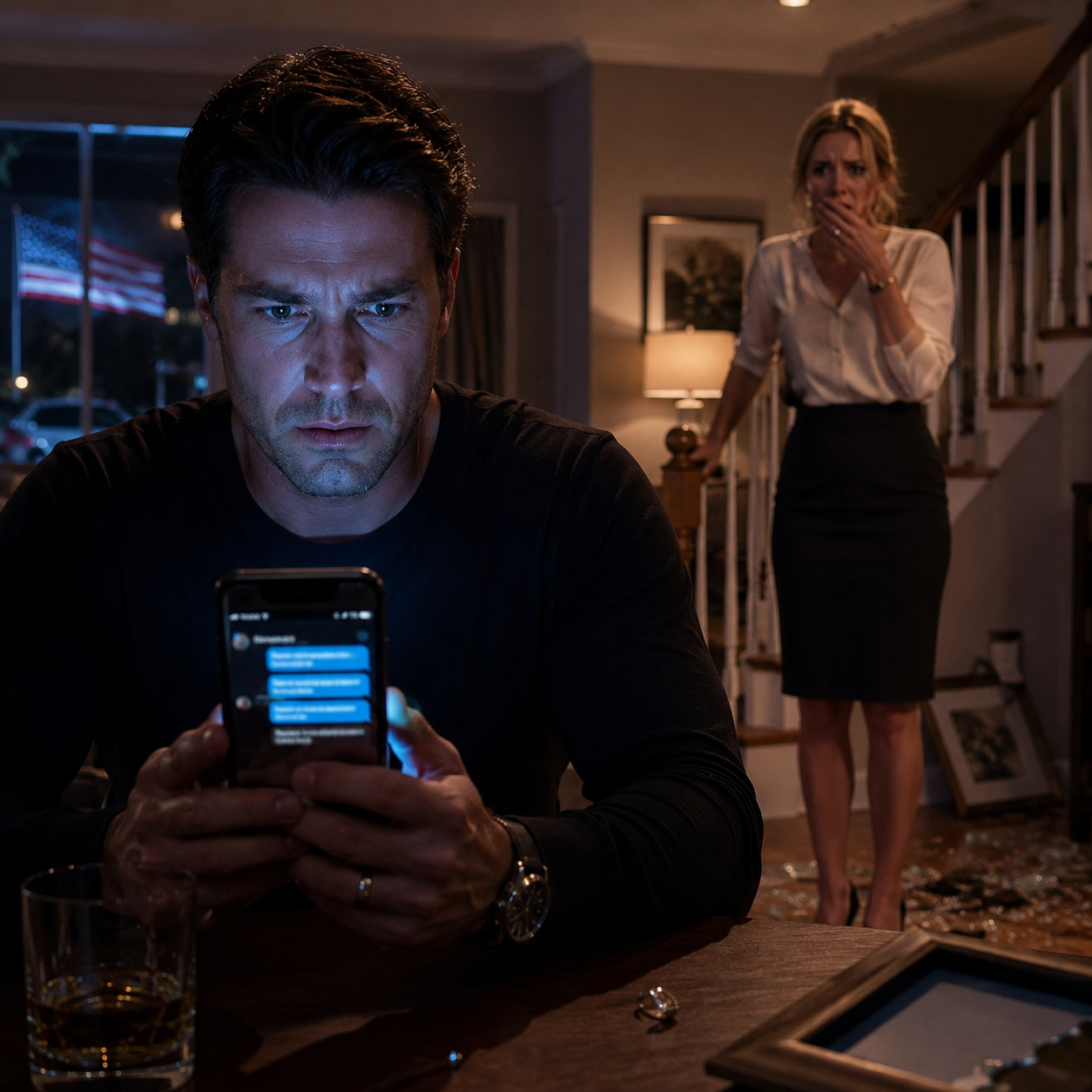
Location sharing had never been my idea. It was Lauren’s.
Six months into our relationship, she brought it up one night while we were eating takeout on her couch. She said it made her feel safe. She said it was not about control, but about trust. She liked knowing I had made it home from work. She liked knowing where I was if something happened. I did not care much either way, so I agreed. We downloaded Life360, shared locations, and moved on like it was just another normal couple thing.
For a year and a half, it was never an issue. She could see when I was at my metal fabrication shop, at the hardware store, or grabbing a beer with friends. I could see when she was at work, at the gym, or at Monica’s apartment. We were not obsessed with it. It was just there in the background, a quiet little digital promise that neither of us had anything to hide.
Then Thursday morning came.
I woke up, checked my phone out of habit, and saw that Lauren’s location was unavailable.
At first, I did not panic. Phones die. Apps glitch. People forget to charge things. I texted her, “Hey, your location is off. Phone die?”
No response.
An hour later, I texted again. “Everything okay?”
Still nothing.
I called her. Straight to voicemail.
That was when the uneasiness started crawling up the back of my neck. Lauren and I texted every day. Even when she was busy, even when she was annoyed, even when work was chaotic, she would send something. A heart. A complaint. A picture of her coffee. Anything.
I called her office. The receptionist told me Lauren had called in sick that morning.
That should have made me feel better. It did not.
If she was sick enough to call work, why had she not sent me one message? Why was her location turned off for the first time in almost two years? Why was her phone going straight to voicemail?
By Friday morning, I was no longer worried in a normal way. I was worried in the kind of way that makes your chest feel tight and your thoughts move too fast. Her location was still off. Calls still went to voicemail. Texts still sat unanswered.
I messaged her friend Monica and asked if she had heard from Lauren.
Monica replied, “No, not this week. Maybe she went out of town.”
Out of town?
Lauren had not mentioned any trip. She had not packed anything when I saw her earlier that week. She had not hinted at needing time away. And Monica’s answer felt too casual, too clean, like someone trying not to say the wrong thing.
That afternoon, I drove to Lauren’s apartment. Her car was not there. I knocked on her door anyway. No answer.
Standing outside her empty apartment, I finally accepted what my gut had been trying to tell me. Either something bad had happened to her, or she was avoiding me on purpose.
And deep down, I already knew which one it was.
I could have kept calling. I could have posted online asking if anyone had seen her. I could have driven around town like a desperate idiot. Instead, I did something practical.
I hired a private investigator.
His name was Rick. Former cop. Calm voice. No nonsense. He asked me the right questions first. Had I checked hospitals? Did I believe she was in danger? Did she have a history of disappearing? I told him I did not think she was in danger. I thought she was hiding.
He said he could help.
I gave him her full name, her address, her car make and model, her plate number, and a recent photo. He told me weekend surveillance would not be cheap. Probably at least a thousand dollars, maybe more depending on how long it took.
I did not even hesitate.
By Saturday afternoon, Rick called.
He had found her car.
It was parked outside an apartment complex across town. Not her apartment. Not Monica’s place. Not any location I recognized.
By Sunday morning, he called again, and his voice had that careful tone people use when they are about to tell you something that will hurt.
He had photos.
Lauren had been staying at that apartment since Thursday night. Security logs confirmed her car arrived around nine in the evening and had not moved. Rick had spoken with a neighbor who had seen her coming and going with a man. Rick had also photographed them together over the weekend.
Then he gave me the man’s name.
Derek Matthews.
Lauren’s ex-boyfriend.
The same ex she said she no longer spoke to. The same ex she said had moved out of state. The same ex she always described as “ancient history.”
Rick emailed me twenty-three photos. Lauren and Derek leaving his apartment. Lauren and Derek at lunch. Lauren and Derek walking through a park with coffee. Lauren and Derek grocery shopping. Lauren and Derek returning to his apartment. Time stamps. Clear angles. No confusion. No room for imagination.
For three days, while I had been worried sick, Lauren had been “isolating” at her ex-boyfriend’s apartment.
Sunday evening, Lauren finally texted me.
“Hey, I’m so sorry. I’ve been dealing with a mental health crisis. I needed to isolate. I’m coming over. We need to talk.”
She arrived at my place around eight. She looked fine. Not exhausted. Not shaken. Not like someone who had spent three days spiraling alone in a dark hotel room. Her hair was done. Her makeup was on. She looked refreshed, almost smug, like she had already rehearsed the conversation and expected me to play my part.
She put her purse down and gave me a soft little smile.
“I know I worried you,” she said. “I’m sorry. I just really needed time to myself to work through some things.”
I looked at her and asked, “Where were you?”
Her smile faded.
“I told you. I needed to isolate. I was dealing with anxiety.”
“Where were you?”
That was when her whole expression changed. She took a breath, straightened her shoulders, and attacked.
“I had a panic attack,” she snapped. “I needed space. You were triggering me.”
I watched her perform. That was the only word for it. Perform.
She said my texts made her anxiety worse. She said my calls felt like pressure. She said I did not respect boundaries. She said I could never understand what it was like to be overwhelmed and unsafe inside her own mind.
I asked her where she isolated.
“A hotel,” she said.
“Which hotel?”
“That is not important.”
And there it was. The lie sitting between us like a loaded gun.
I walked to the kitchen counter, picked up the folder Rick had given me, and came back.
“My mistake,” I said.
Her face softened. She thought she had won. “Thank you. I just need you to understand that when I say I need space, I need you to trust me.”
“I do trust evidence,” I said.
Then I handed her the folder.
She opened it and went still.
The first photo showed her and Derek leaving his apartment. The second showed them at lunch. The third showed them walking through the park. Her fingers moved slower with every page. By the time she reached the last photo, all the anger had drained from her face.
“You hired someone to follow me?” she whispered.
“I hired someone to find you.”
She tried every excuse after that. Derek was going through something. They were just friends. She needed support. She had anxiety about our relationship. She needed perspective from someone who knew her.
I asked why she had lied.
She had no answer.
Then she started crying. Not because she was sorry. Because she had been caught.
“You violated my privacy,” she said. “You had someone stalk me. This is illegal. I could sue you.”
“Licensed investigator. Public places. Legal surveillance. Try whatever you want.”
“You are insane. You are controlling. This is exactly why I needed space.”
I let her yell for a few more seconds.
Then I said, “I already sent the photos to your parents.”
She stopped mid-sentence.
All the color left her face.
“What?”
“I sent them the full set. All twenty-three photos. Time stamps included. I also sent the investigator’s report.”
“Why would you do that?”
“Because you were going to make me the villain. You were going to tell them I tracked you, pressured you, and triggered you. I wanted them to know where you actually were before you started lying.”
For the first time that night, Lauren had nothing to say.
The fight left her body. She looked at the folder, then at me, and her voice dropped.
“I cannot be with someone who does not trust me.”
“I cannot be with someone who disappears for three days, lies about a panic attack, and sleeps over at her ex’s apartment.”
“So we are breaking up?”
“Yes.”
She grabbed her purse and walked to the door. Before leaving, she said, “You are going to regret this.”
I looked at the photos on the table and said, “I doubt it.”
The next morning, her mother called. She was angry at first, but not for long. Lauren had already told her parents I had been harassing her while she was trying to recover from a mental health crisis. Then they received the photos.
Her mother went quiet when I explained everything.
“She lied to us too,” she finally said.
“Yes,” I replied. “That is why I sent them.”
There was a long pause before she said, “I am sorry. You did not deserve that.”
That apology mattered more than I expected. Not because it fixed anything, but because it meant Lauren had not succeeded in rewriting reality before I could defend myself.
Lauren blocked me later that day.
For once, the silence felt good.
A week later, she posted a long speech online about toxic relationships, controlling partners, boundaries, and healing. She wrote about being tracked and monitored. She wrote about escaping for her mental health. She did not mention Derek. She did not mention turning off her location. She did not mention lying to everyone.
People who did not know the truth praised her. People who did know the truth stayed quiet.
I let her have her fake applause. I had the truth, and that was enough.
Two weeks later, Monica told me Lauren and Derek were officially dating.
I was not surprised.
Apparently, the “just friends” phase lasted about as long as her honesty.
A few months later, Derek called me. His voice was different from the first time we had spoken. Stressed. Uneasy.
He asked if Lauren had ever disappeared on me. If she had ever turned off her phone, gone dark for days, then come back saying she had needed space for her mental health.
I almost laughed.
Instead, I told him the truth. “That is exactly what she did to me. That is how you ended up in the middle of my breakup.”
He went quiet.
Lauren had done it to him too.
Same pattern. Same excuse. Same guilt trip. Different man.
He asked what he should do.
I told him the same thing I had learned the hard way. “Either get proof, or accept that this is who she is.”
I never found out whether he hired Rick. I never asked. That part of Lauren’s life was no longer my problem.
Six months later, I had moved on. I met Rachel at a metalworking expo. She was a sculptor who worked with steel and copper, and our first conversation was about welding techniques, not relationship trauma. She was honest in a way that felt almost strange after Lauren. No games. No disappearing. No weaponized boundaries. No location sharing. Just communication.
I told her about Lauren on our second date because I did not want to carry secrets into something new.
Rachel listened carefully and said, “So she lied, gaslit you, made herself the victim, and you got proof before she could destroy your reputation?”
“Pretty much,” I said.
Rachel nodded. “Honestly, that sounds rational.”
That was when I realized how much peace I had been missing.
Not excitement. Not drama. Peace.
Eventually, I saw that Lauren and Derek had broken up. She posted another long message online about toxic relationships, dishonesty, and red flags she ignored. The irony seemed completely lost on her.
But by then, I did not feel anger anymore. I did not even feel satisfaction.
I just felt free.
The private investigator cost me $1,460. At the time, it felt like a lot of money. Looking back, it was the cheapest lesson I ever paid for. It did not just prove where Lauren had been. It proved that I was not crazy. It proved my instincts were right. It proved that evidence can cut through manipulation faster than any argument ever could.
Lauren wanted me confused. She wanted me apologizing. She wanted me to feel guilty for questioning a lie.
Instead, she opened a folder and saw the truth staring back at her.
That was the moment I stopped begging for honesty from someone who had already chosen deception.
Some people do not change. They only change their audience. They repeat the same story with a new victim, a new excuse, and a new speech about healing.
But I am no longer in her story.
I am in my shop, building things with my own hands, dating someone who speaks plainly, sleeping peacefully, and living without the constant fear that love is supposed to feel like a mystery you have to investigate.
Lauren wanted space.
In the end, I gave her all of it.


![[FULL STORY] The Moment My Girlfriend Called Me Needy And Told Me She Would Call Whenever She Felt Like It Was The Day I Finally Set Myself Free](https://social.rabedo.com/storage/thumbnails/1777877049_C3.JPG)
![[FULL STORY] She Left Me for an “Alpha” — Then Walked Into Work and Found Out I Was Her New Boss](https://social.rabedo.com/storage/thumbnails/1777399249_1b3b2183-e7ae-4783-bbaf-f5e74a6bb6e4.png)