

“Have fun in jail, loser.”
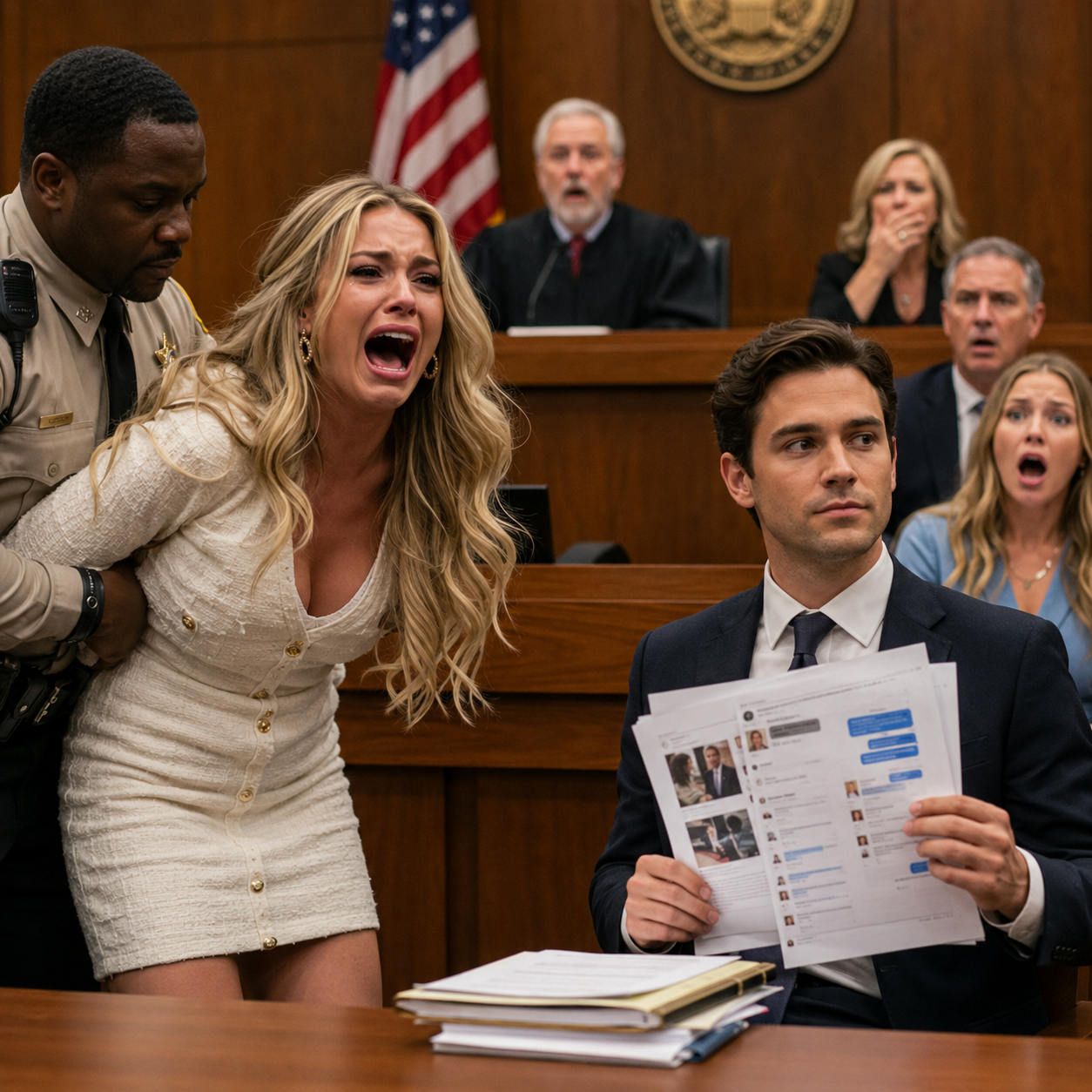
Those were the last words my fiancée, Jessica, whispered to me as the handcuffs clicked shut around my wrists. She didn’t say it with anger. She said it with a smile—the kind of smile a person wears when they’ve just won a long-awaited prize. She stood on the porch of the house I bought, clutching her arm where she had just scratched herself, watching as two police officers guided me toward the back of a cruiser.
I didn’t fight. I didn’t scream. As a firefighter, I’ve learned that when a structure is collapsing, you don’t stand under the main beam and shout at it to stop. You move. You find the exit. You survive.
But as I sat in the back of that car, smelling the stale upholstery and feeling the cold steel against my skin, I realized that the woman I had shared a bed with for three years wasn’t just a stranger. She was a predator. And I had been the prey she’d been fattening up for the kill.
My name is Matt Carter. I’m thirty-three years old. For the last decade, I’ve spent my life running into burning buildings. I’ve pulled people out of car wrecks and administered CPR on living room floors while families wailed in the background. My job requires a level of discipline that most people don’t understand. You have to be able to turn off your panic and turn on your logic. You have to trust your equipment, and more importantly, you have to trust the person holding the other end of the hose.
I thought Jessica was that person.
She was beautiful, sharp, and had this energy that made everything feel more alive. We met at a charity event four years ago, and for a long time, things were good. Or at least, I told myself they were. Looking back, the red flags weren’t just waving; they were screaming. But when you’re wearing rose-colored glasses, red flags just look like flags.
The real trouble started six months ago when we got engaged. Suddenly, "our" future started looking a lot like "her" lifestyle. Jessica worked in marketing, making a decent living, but she had a champagne appetite on a craft beer budget.
The week leading up to the arrest, the tension had reached a boiling point. The cause? A 2026 luxury SUV.
“It’s about my brand, Matt,” she told me over dinner, poking at a salad she barely touched. “I’m meeting high-end clients now. I can’t keep showing up in a five-year-old sedan. It looks… desperate.”
I took a sip of my water and looked at her. “Jess, the payments on that car are more than half your take-home pay. It doesn’t make financial sense.”
“That’s why I need you to co-sign,” she said, as if it were the most obvious solution in the world. “Your credit score is perfect. With you on the loan, the interest rate drops, and it’s basically an investment in my career.”
“It’s not an investment,” I said calmly. “It’s a liability. And I’m not co-signing for something you can’t afford on your own. I’ve seen too many guys at the station lose everything because they put their names on papers they shouldn't have.”
She slammed her fork down. “You’re so stifling! You have this… this scarcity mindset. You’re a hero in a uniform, but at home, you’re just a bean counter who’s afraid to live.”
“I’m not afraid to live, Jess. I’m afraid of being broke because I wanted to look rich.”
That argument lasted three days. It was a cold war of silence and sharp glances. Then came Tuesday night.
I came home from a twenty-four-hour shift, exhausted, smelling like soot and exhaustion. I just wanted a shower and a bed. But Jessica was waiting in the living room. She had the brochures for the car on the coffee table.
“I went to the dealership today,” she said, her voice eerily calm. “They’re holding the white one with the cognac interior. We just need to go down there tomorrow and sign.”
I dropped my bag by the door. “I haven’t changed my mind, Jessica.”
The calm vanished. She stood up, her face contorting into something I didn’t recognize. “You are ruining this for me! You’re keeping me small because you’re small!”
“I’m done talking about the car,” I said, turning to walk toward the stairs.
“Don’t you walk away from me!” she shrieked.
I stopped near the side table. On that table sat a blue glass vase. It was heavy, handmade, and it was the only thing I had left from my grandmother. She had survived the Great Depression, and that vase had been her one luxury. She gave it to me because she said I was the only one who knew how to take care of things.
Jessica knew what that vase meant. She’d seen me clean it. She’d seen me put fresh flowers in it every Sunday.
She walked over to the table, her eyes locked onto mine. “You care more about this piece of junk than you do about my happiness?”
“Jess, leave the vase alone,” I said, my voice dropping an octave.
She didn’t hesitate. She grabbed the blue glass and hurled it against the far wall.
The sound was like a gunshot. Shards of blue glass exploded everywhere, skittering across the hardwood like frozen sparks. I felt a physical pain in my chest. Something inside me—the part of me that loved her—simply died in that moment.
“Are you happy now?” I asked, my voice terrifyingly quiet.
She didn’t answer. Instead, she looked at the mess, then looked at her own hands. She took her right hand, positioned her long, manicured nails against her left forearm, and dragged them down. Hard.
Three red welts appeared instantly, beads of blood blooming along the tracks.
“What are you doing?” I whispered.
She looked at me, and for the first time, I saw the true Jessica. There was no love there. Just calculation. She picked up her phone and dialed three digits.
“Help!” she screamed into the phone, her voice instantly transitioning into a sob. “Please! My fiancé… he’s losing it! He’s breaking things! He hit me! Please, I’m scared for my life! 1422 Maple Drive! Hurry!”
She hung up and looked at me. The tears were streaming down her face, but her eyes were dry. “Get ready, Matt. You’re about to lose everything.”
I stood there, paralyzed by the sheer audacity of the lie. Within six minutes, the flashing blue and red lights were dancing against the living room walls. The police didn't ask many questions. They saw the broken glass. They saw the bleeding scratches on her arm. They saw a six-foot-two firefighter and a crying, five-foot-five woman.
They put me in the car. Jessica followed us out, leaning in as they closed the door to give me that final, poisonous send-off.
“Have fun in jail, loser.”
As the cruiser pulled away, I watched her through the back window. She was already talking to one of the younger officers, tucking a strand of hair behind her ear, looking like the picture of a victim.
She thought she had won. She thought I was a simple man with a simple job and no way to fight back against a system that, by design, protects people who look like her.
But as we pulled into the station, I felt a strange sense of clarity. Jessica knew I was a firefighter. She knew I was "Matt Carter." But in our three years together, she had never bothered to ask why I used my mother’s maiden name. She’d never bothered to look into the family I’d distanced myself from to build my own path.
She thought I was alone in that cell. She didn't realize that I was about to make the one call I had promised myself I would never make.
Because Jessica didn't know that the man who ran this city’s police force didn’t just know my name—he was the reason I had it.
![[FULL STORY] Girlfriend Chooses Her Ex Over Me — So I Chose Myself and Left Everything Behind](https://social.rabedo.com/storage/thumbnails/1776417805_672159366_1912339959719170_1554259774463521146_n.jpg)
![[FULL STORY] Security Guard Showed Me My Husband Kissing Another Woman — Then I Took Back Everything He Tried to Steal](https://social.rabedo.com/storage/thumbnails/1777012195_82598907-c1d1-4c85-921e-9bdd56643baa.png)
![[FULL STORY] My Fiancée Ran Away To Marry The Man Of Her Dreams Just One Week Before Our Wedding. Three Years ...](https://social.rabedo.com/storage/thumbnails/1777221037_R13.png)
![[FULL STORY] While I was watching a movie with my fiancée on her phone,a voice message suddenly started playing](https://social.rabedo.com/storage/thumbnails/1777363481_3.png)