
For three years, I lived like a ghost in my own life.
I was still breathing. Still working. Still paying rent. Still showing up to court-ordered supervised visits where my own children looked at me like they were trying to remember whether they were allowed to love me. But the man I had been before Sarah destroyed everything was gone. He had been buried under accusations, court orders, whispered rumors, unpaid bills, and the kind of shame that follows you even when you know you are innocent.
My name is Daniel Carter. I am thirty-four years old now, but when this all began, I was thirty-one, married, and completely convinced I had a good life.
I had a wife named Sarah, two children I adored, and a steady job as a project manager at a construction firm. We were not rich, but we were comfortable. We had a small house with a backyard where my daughter Emily used to draw chalk castles on the patio, and my son Jake would chase bubbles until he tripped over his own feet laughing. Emily was eight then, serious and bright, always carrying a book bigger than her arms. Jake was five, sticky-fingered, loud, fearless, and convinced every cardboard box was secretly a spaceship.
I thought I was a lucky man.
That is the painful part to admit now.
When a life collapses, you do not only mourn what you lost. You mourn the version of yourself who did not know it was coming.
Sarah was a nurse. Her job was hard, and in the beginning, I told myself that explained the changes in her. She started coming home late. She kept her phone face down. She became short with me over nothing. If I asked how her shift went, she snapped that I was interrogating her. If I asked why she was suddenly taking calls in the garage, she said I was suffocating her.
At first, I blamed stress.
Marriage has seasons, I told myself. People get tired. People get overwhelmed. You do not throw away a family because your wife is irritable after a twelve-hour hospital shift.
Then the accusations started.
Out of nowhere, Sarah accused me of cheating.
The first time, I actually laughed because I thought she was joking. I had never cheated on her. I had never come close. Since the day we got married, I had not so much as flirted with another woman. My life was work, home, kids, grocery runs, soccer practice, bedtime stories, and trying to keep the mortgage paid.
But Sarah was not joking.
She cried. She screamed. She told me she knew I was hiding something. She said she could feel it. She said men like me always played innocent until they were caught. I tried to reassure her. I showed her my phone. I told her where I had been. I let her look through messages, emails, call logs, anything she wanted.
It did not help.
Because truth does not matter to someone who needs a lie to survive.
The accusations became part of our household weather. Some nights she would be fine. Other nights she would explode because a female coworker texted me about a schedule change or because I got home fifteen minutes later than usual. She would storm out of the house and leave me standing in the kitchen with Emily and Jake staring up at me, frightened and confused.
“Why is Mommy mad?” Jake asked once.
I knelt down and forced a smile.
“Mommy is just tired, buddy.”
Even then, I was protecting her.
Then came the night she ended my life as I knew it.
Sarah came home with a black eye.
I remember the moment clearly because I had been making grilled cheese for the kids. Emily was at the table doing homework. Jake was watching cartoons too loudly in the living room. Sarah walked in, and the left side of her face was bruised.
I dropped the spatula.
“What happened?”
She looked at me with tears already in her eyes.
Then she said, “How could you do this to me?”
I froze.
“What?”
Emily looked up from her homework.
Sarah’s voice rose. “Don’t act like you don’t remember.”
I stared at her, my mind refusing to understand.
“I didn’t touch you.”
She stepped backward, shaking.
“Stay away from me.”
Within an hour, the police were at our door.
Sarah told them I had hit her during an argument. She said I had been angry, jealous, unstable. She said she had been afraid of me for months. She cried in exactly the right places. She held an ice pack to her eye. She looked like the kind of victim people want to protect.
I was arrested in front of my children.
Emily screamed.
Jake cried so hard he vomited on his pajamas.
I kept saying, “I didn’t do this. I didn’t do this.”
Nobody listened.
That was the beginning of the fall.
The domestic abuse charge destroyed my reputation almost overnight. My company put me on leave, then quietly let me go. Friends stopped calling. Neighbors who used to wave from their driveways suddenly found reasons to look away. Sarah filed for a restraining order and emergency custody.
The court gave her full custody.
I was allowed supervised visits once a month.
Once a month.
With my own children.
I will never forget the first visit. We sat in a community center room with a social worker watching from a corner, writing notes like I was some dangerous animal being evaluated for release. Emily would not hug me at first. Jake hid behind her chair. When I reached out, he flinched.
That broke something in me I still do not know how to fully describe.
I hired a lawyer, but Sarah’s case was strong on paper. She had photos of her injuries. She had friends who claimed I had been flirting with other women. She had a neighbor who said she had once heard me shouting and that she had “always felt uneasy” around me. There was even a statement suggesting I had been violent before, though nothing about it was true.
I learned then that lies do not need to be perfect.
They only need to be louder than the truth at the right moment.
The judge believed her.
I lost the house. I lost my job. I lost my reputation. Worst of all, I lost the daily life of being a father. No more school drop-offs. No more bedtime stories. No more Saturday pancakes. No more Jake climbing into my lap during movies. No more Emily asking me to help her build impossible science fair projects the night before they were due.
Just supervised visits in a room that smelled like stale coffee and government carpet.
For months, I lived in a fog.
I moved into a tiny apartment above a laundromat. The pipes rattled at night. The heat barely worked. I took odd jobs wherever I could: warehouse shifts, delivery work, small project consulting, anything that paid enough to keep me from drowning. I sold my truck and bought a used sedan with a cracked dashboard. I ate cheap food and slept badly.
But I kept going.
Not because I was strong.
Because my kids still existed.
Every month, I showed up clean, calm, and sober for those supervised visits. I brought books for Emily and little dinosaur figures for Jake. At first, they were distant. Emily watched me with guarded eyes. Jake asked once, “Did you hurt Mommy?”
I wanted to scream.
Instead, I swallowed the pain and said, “No, buddy. I never hurt your mom. I love you and Emily more than anything.”
He looked confused.
That was the worst part. Sarah had not only taken them from me. She had planted fear between us.
For three years, I rebuilt one inch at a time.
I found steady work again, not at the level I had before, but enough. A smaller construction company hired me after my new boss looked me in the eye and said, “I believe people deserve second chances.” I did not correct him by saying I had never deserved to lose the first one. I just took the job and worked harder than anyone else there.
Eventually, I saved enough to buy a small house. Nothing fancy. Two bedrooms, old kitchen, uneven fence, but it was mine. More importantly, it had a room for Emily and Jake. I painted it myself, half blue and half pale yellow because they could not agree on a color. I kept clothes there for them, books, toys, toothbrushes, even though they only visited under supervision at first.
I wanted the house to say something I was not always allowed to say.
You belong here.
Your father never stopped waiting.
Then the lottery happened.
It sounds absurd even now.
I bought the ticket at a gas station on a Friday after work. I almost never played. That day, I had five dollars in cash after buying coffee, and the guy ahead of me was taking forever, so I grabbed a ticket just to kill time.
The jackpot was fifty million dollars.
I did not check it until Sunday night.
When the numbers matched, I stared at the ticket for so long I thought I might be having some kind of breakdown. I checked the website again. Then again. Then I called the lottery office the next morning, hands shaking so badly I could barely hold the phone.
It was real.
Fifty million dollars.
Life-changing does not even cover it.
For a few minutes, I sat on the floor of my kitchen and cried. Not because I wanted luxury. Not because I dreamed of sports cars or mansions. I cried because for the first time in three years, I felt like I might have the resources to fight back properly.
I hired financial advisors. Paid off every debt. Bought a reliable new car. Set aside money for taxes and investments. Created college funds for Emily and Jake. Started the process of building a legal fund and charity for fathers who had been falsely accused or financially destroyed in custody battles.
I did not announce it publicly.
But lottery wins do not stay secret forever.
Sarah found out.
She showed up at my door one evening wearing a face I had not seen in years: soft, tearful, wounded. It was the face she had worn in court. The face that had convinced strangers I was a monster.
“Daniel,” she whispered when I opened the door. “Can we talk?”
I almost shut the door in her face.
But curiosity stopped me.
She stood on my porch, tears streaming down her cheeks, saying she had made a terrible mistake. She said she had been manipulated by her boss at the hospital. She said he convinced her I was cheating. She said he made her believe she needed to frame me to protect the children. She said she had been vulnerable, confused, scared.
Then she said he had left her.
She was struggling financially.
She wanted to make things right.
She wanted us to be a family again.
For one dangerous second, some broken part of me wanted to believe her. Not because I loved her anymore, but because I missed the idea of my family being whole. I missed waking up under the same roof as my children. I missed being called Dad without a social worker sitting nearby.
Then Sarah wiped her eyes and said the sentence that revealed why she was really there.
“I know about the lottery.”
My whole body went still.
She took a step closer.
“I deserve half. We’re still legally connected through unresolved support issues, and if you don’t give me what I’m owed, I’ll take you to court.”
There it was.
Not remorse.
Not love.
Not family.
Money.
I looked at her and finally understood that Sarah had not come to confess. She had come to collect.
I told her I would think about it and closed the door.
The next morning, I called my lawyer, Greg.
Greg had been with me through the original divorce and custody nightmare. He knew the entire history. When I told him Sarah was threatening to claim part of the lottery winnings and seek alimony, he let out a low whistle.
“She may try,” he said. “Whether she has a real claim depends on timing, filings, and how the previous orders were structured. But if she can create enough pressure, she may think you’ll settle.”
“I’m not settling.”
“Then we need everything,” Greg said. “Not just about the lottery. About her. The original accusations. Her motives. Any proof that the foundation of her claims was false.”
For years, I had suspected Sarah had lied. But suspicion was not enough. I needed proof.
This time, I could afford to find it.
I hired a private investigator.
What he uncovered made me sick.
Sarah had been having an affair with her boss at the hospital around the time she accused me of cheating. His name was Martin Keller. He had later been fired for embezzling from a hospital charity fund. Sarah had been involved too. Not as deeply as him, but enough. She had helped him move money, falsify small records, and cover irregularities. When he got caught, he threw her under the bus. She had avoided criminal charges by quietly agreeing to repay part of the money and cooperate internally.
That explained why she was struggling financially.
But the real discovery was worse.
The investigator found old messages between Sarah and Martin from the months before my arrest. They discussed creating a story that would make me look unstable. They discussed how custody would be easier if I had a domestic violence record. They discussed how Sarah could move in with Martin after the divorce if she had the kids and the house.
And there were texts about the black eye.
Not exactly a confession at first. More hints. Then one message from Sarah that made my hands go numb when I read it.
He believed it. Police believed it. Kids cried, but that helps the story.
I had to put the phone down.
For three years, I had carried the weight of people thinking I was violent. For three years, my children had been afraid of a lie. For three years, Sarah had let me lose everything because it helped her run to another man.
Greg read the file and became very quiet.
“This changes everything,” he said.
A few days later, I was served.
Sarah sued for a portion of the lottery winnings, claiming I had concealed marital assets and that she deserved support because she had sacrificed her career to raise our children. She also demanded an increase in child-related payments and hinted that if I did not cooperate, she would remind the court of my “history of abuse.”
It was bold.
It was also stupid.
Before filing our full response, I asked to meet Sarah one last time.
We met at a coffee shop. She arrived wearing a modest sweater and no makeup, clearly trying to look fragile. She kept touching her cup but not drinking from it.
“I’ll give you one chance,” I said. “Drop the lawsuit. Walk away. Stop using the kids. And I won’t expose everything I know.”
She laughed.
It was bitter and hollow.
“You don’t know anything.”
I slid a folder across the table.
Inside were copies of the texts, the hospital investigation records, and a statement from Martin admitting the affair and the plan to frame me.
Sarah opened the folder.
Her face went pale.
For a moment, I thought she might finally break. I thought maybe the weight of what she had done would appear on her face.
Instead, she closed the folder and leaned back.
“You think this changes anything?” she snapped. “I’ll say you forged it. I’ll say you paid him. No one will believe you.”
That was the last chance I gave her.
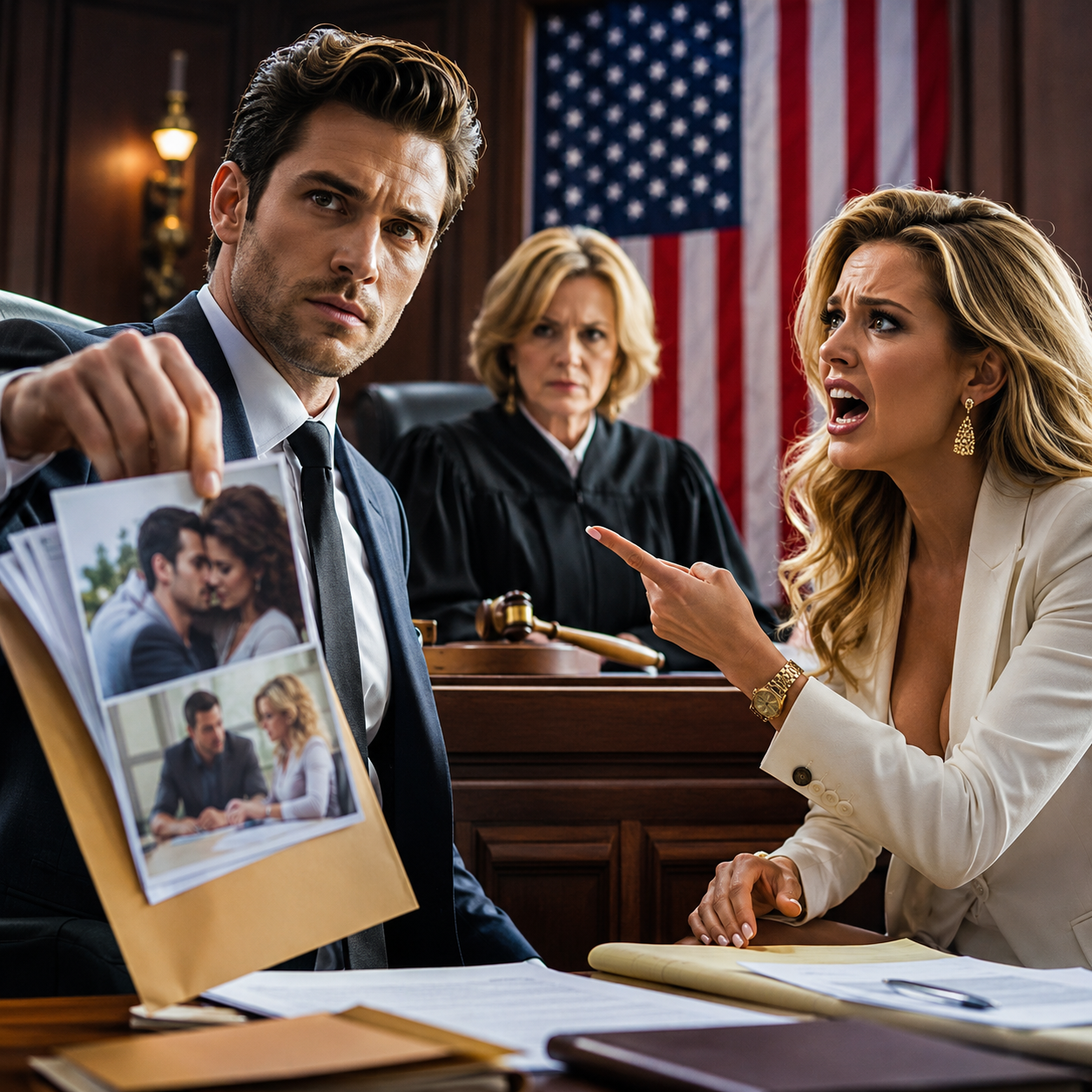
The hearing was packed.
Sarah had made sure of that.
She arrived in a modest dress, face carefully made up to look tired and worn. She brought Emily and Jake and sat them in the front row like props. My stomach twisted when I saw them. Emily was older now, eleven, tall and watchful. Jake was eight, quiet in a way he had never been before. They looked confused and uncomfortable, as if they knew they were being used but did not know how to escape it.
Sarah’s lawyer went first.
He painted me as a neglectful husband who had abandoned his family and was now hoarding millions while his ex-wife struggled. He brought up the old domestic abuse accusations. He described Sarah as a devoted mother who had sacrificed everything. He suggested my lottery win should be used to “repair the damage” my selfishness had caused.
I sat still.
I had learned the hard way that truth sometimes needs patience before it gets its turn.
Then Greg stood.
He did not shout. He did not dramatize. He simply built the truth piece by piece.
The affair with Martin.
The embezzlement investigation.
The messages about framing me.
The financial motive.
The inconsistencies in Sarah’s old statements.
The witnesses who had supported her story and later admitted they had repeated what Sarah told them rather than witnessed anything themselves.
With every document, the judge’s expression grew darker.
Sarah shifted in her seat.
Then her lawyer called her to the stand.
She cried beautifully.
She said she had been terrified of me. She said she had only accused me of cheating because she feared I would leave. She said Martin had manipulated her. She said the texts were fake. She said I was using my lottery money to destroy her because I resented paying support.
For a moment, I felt the old fear return.
The fear that tears would beat truth again.
Then Greg called Martin Keller.
He looked older than I expected. Nervous. Defeated. A man who had already lost enough that lying for Sarah no longer benefited him.
Under oath, he admitted the affair.
He admitted the embezzlement.
Then, after several careful questions, he admitted Sarah had helped plan the false accusations against me.
“She wanted full custody,” he said, voice low. “She said if Daniel looked dangerous, the court would give her the kids and the house.”
The courtroom erupted in murmurs.
Sarah looked like she might be sick.
Greg continued.
“Did Mrs. Carter ever discuss fabricating evidence?”
Martin swallowed.
“Yes.”
“What evidence?”
“Messages. Statements from friends. The neighbor complaint. And the injury.”
The judge leaned forward slightly.
“What injury?” Greg asked.
Martin looked down.
“The black eye.”
Sarah’s lawyer objected, but the damage was already done.
Then Greg introduced the final recording.
It was not from Sarah and her lawyer. It was a recorded conversation between Sarah and Martin after he had been fired, a conversation Martin had kept because he was afraid she would blame everything on him. In it, Sarah admitted she needed money from me because her repayment obligations from the hospital scandal were crushing her. She said if I had fifty million, she deserved enough to “fix the mess” and start over with the new man she had been seeing.
Her voice filled the courtroom.
I don’t care what Daniel lost. He’ll pay. He always plays the victim, but now he has money, and I’m not walking away broke.
Emily started crying.
That nearly broke me.
The judge called a recess.
When we returned, her ruling was clear.
Sarah’s claim to the lottery winnings was dismissed. Her alimony request was denied. She was ordered to pay my legal fees. More importantly, the judge reopened the custody matter, citing evidence of fraud, manipulation, and serious concerns about Sarah’s fitness and honesty.
Sarah tried to confront me outside the courtroom.
“You think you’ve won?” she hissed. “This isn’t over.”
For the first time in three years, I looked at her without fear.
“You’re right,” I said. “It’s not over. Now I get my children back.”
The custody hearing came weeks later.
Sarah arrived with her new boyfriend, a slick-looking man who wore arrogance like cologne. She dressed Emily and Jake in old, ill-fitting clothes, clearly trying to make herself look like a struggling single mother barely surviving against my wealth.
It might have worked once.
Not anymore.
This time, I had a plan.
I showed the court my home. The children’s rooms. The school district. The support system I had built with my sister, who had agreed to help with childcare. I showed the college funds I had created for Emily and Jake. I showed therapy plans, tutoring options, medical coverage, routines, everything.
I did not present myself as perfect.
I presented myself as prepared.
Sarah had excuses.
She could not explain the lies. She could not explain the manipulation. She could not explain why the children had been told I was dangerous when evidence now showed she had fabricated the foundation of that fear. Her new boyfriend’s past did not help either. Prior arrests. Unstable employment. Nothing violent, but enough to make the judge’s mouth tighten.
The decision came faster than I expected.
I was awarded full custody.
Sarah received supervised visitation, contingent on counseling, parenting classes, and compliance with court orders.
It should have felt like victory.
Instead, I sat in my car afterward and cried.
Because yes, I had won.
But my kids had lost three years.
Three years of bedtime stories. Three years of school mornings. Three years of birthdays where I sat in a supervised room pretending it did not destroy me to leave them again. Three years where their mother taught them to fear a father who loved them.
No ruling could give that time back.
Emily and Jake moved in with me slowly at first. The transition was not simple. Emily was angry. Not just at Sarah. At me too. Part of her believed I should have fought harder sooner. Part of her did not know what to believe. Jake had nightmares. He asked if police would come take me away again.
So we got help.
Family therapy. Individual therapy. Patience. Structure. No pressure to forgive anyone before they were ready. I told them the truth in age-appropriate ways. I never called their mother names in front of them, even when I wanted to. I told them adults had made painful mistakes and that my job now was to keep them safe and loved.
Over time, they came back to me.
Not all at once.
In small moments.
Emily asking if I could help her with a school project.
Jake falling asleep on the couch with his head against my shoulder.
The first time Emily said, “Dad, can we make pancakes like we used to?” I had to turn away so she would not see my eyes fill.
Sarah tried to appeal the custody ruling, but she no longer had the money or credibility to keep fighting forever. Her new boyfriend left shortly after the custody decision. I heard she moved out of state to live with a relative.
I did not feel sorry for her.
But I did not celebrate either.
Hating Sarah would have kept her too close. I wanted her out of my life, not living rent-free inside my head.
The lottery money became something different from what Sarah thought it was.
It was not revenge money.
It became protection.
I secured Emily and Jake’s future. I donated to organizations helping parents falsely accused in custody battles. I funded legal grants for people who could not afford investigators or proper representation. I started a small consulting business that let me work from home and be there when the kids got out of school.
The life I have now is not the life I imagined when I first became a husband.
But it is good.
It is peaceful.
It is honest.
One evening, about a year after the custody ruling, Emily found an old photo album in a closet. Pictures from before everything. Family beach trip. Jake covered in sunscreen. Sarah smiling beside me like nothing was wrong. Emily sat on the floor with the album open across her lap for a long time.
Finally, she looked up and asked, “Was any of it real?”
That question hurt more than anything Sarah’s lawyer ever said.
I sat beside her.
“Some of it was,” I said carefully. “You and Jake were real. My love for you was real. The good days we had together were real. But sometimes people hide things. Sometimes they make choices that hurt everyone.”
Emily nodded, but her eyes stayed on the photo.
“Do you hate Mom?”
I thought about lying.
Then I chose honesty.
“I hate what she did,” I said. “But I’m trying not to carry hate around, because it gets heavy. And I don’t want it taking up space that belongs to you and Jake.”
She leaned against me then.
Not fully. Just enough.
But enough was everything.
People often ask if winning the lottery was the best thing that ever happened to me.
It was not.
Getting my children back was.
The money helped. I will never pretend it did not. Money bought legal help, stability, time, therapy, safety. Money gave me tools I should have had when the lies first started. But money did not heal my family.
Showing up did.
Telling the truth did.
Not becoming the monster Sarah claimed I was did.
Sarah once thought she had taken everything from me. My home. My job. My reputation. My children. She thought if she cried convincingly enough, the world would always choose her version.
For a while, it did.
But lies are expensive to maintain. Eventually, someone forgets which version they told. Someone keeps a message. Someone records a conversation. Someone follows the money.
And truth, even when it arrives late, still knows where to land.
The last time I heard from Sarah, it was through her lawyer. She wanted to modify visitation, wanted more access, said she had changed. Maybe someday, if she does the work and the kids want it, that door can open a little wider. I will not stand in the way of a healthy relationship between them and their mother.
But I will never again let her use them as weapons.
As for me, I wake up in a house where my children’s shoes are by the door. Emily’s books are stacked on the kitchen table. Jake’s toy dinosaurs appear in places they do not belong. The walls are loud again. The mornings are chaotic again. The fridge empties faster than I can fill it.
And every night, before I go to bed, I walk past their rooms and remind myself that this is what winning really looks like.
Not the jackpot.
Not the court ruling.
Not Sarah losing.
This.
My children safe under my roof.
My name cleared.
My life rebuilt from ashes into something stronger than what was burned.
Sarah came back for half my lottery winnings.
Instead, she gave me the evidence I needed to take back everything that actually mattered.
![[FULL STORY] The Morning I Was Going to Propose, I Read a Message Where She Called Me Her “Safe Harbor.” I Closed the Ring Box. That Night She Asked for “a Break,”](https://social.rabedo.com/storage/thumbnails/1777880073_C5.jpg)

![[FULL STORY] She Introduced Me as Her Driver at a Party I Helped Pay For, So I Let Her Humiliate Herself](https://social.rabedo.com/storage/thumbnails/1777372038_daeabe0a-70da-4e24-b345-1806863f4231.png)

![[FULL STORY] She Called My House “Our Home” While Breaking Up With Me and Demanded to Stay. I Showed Her the Deed and Said, “We’re Over. The House Isn’t.”](https://social.rabedo.com/storage/thumbnails/1777308293_M2.png)