
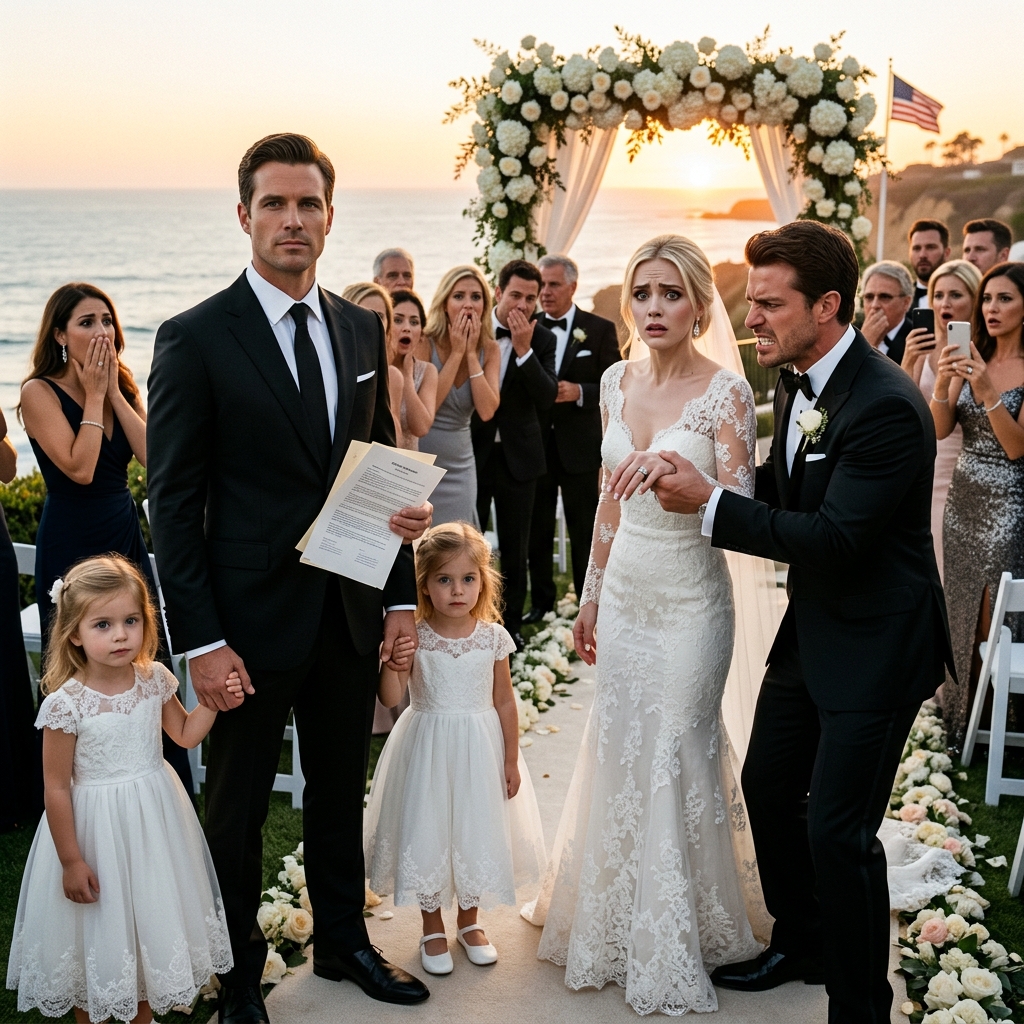
My ex-wife invited me to her wedding, so she could humiliate me in front of 300 guests. She even paid for the travel. Covered everything. Said she didn't want cost to be the reason I missed the chance to witness what she called a real life finally beginning. What she didn't know was that I wouldn't be arriving the way she imagined. I wasn't coming alone. And I wasn't coming as the man she thought she left behind. I arrived in a black Bentley with two people in the backseat who would end her wedding, her engagement, and quite possibly her freedom. In under 4 minutes, the invitation came on a Tuesday. Heavy cardstock, embossed lettering, the kind of paper that doesn't get printed unless someone wants you to feel the price of it in your hands. I stood in my kitchen looking out over the water I now owned the right to wake up to and read her name at the top, Vanessa Hale, my ex-wife, getting married. And she had made sure I would be there to see it. I set the card down, poured myself a black coffee, and opened the handwritten note tucked inside. Her handwriting hadn't changed, still sharp, still controlled, still precise enough to cut. I hope you'll come, Ethan. You deserve to see what it looks like when someone finally marries at the level I was always meant for.
Don't worry about the travel. I've taken care of it. I know events like this aren't usually within reach for you. I read it once, then again, and I smiled. Not because it was funny, not because it hurt, but because in that moment, Vanessa Hale had just made the most expensive mistake of her life. And she had personally made sure I'd be there to collect it. I didn't respond to the invitation, not immediately. That would have been too easy, too expected. Vanessa always preferred reactions she could predict, shock, silence, maybe a polite decline dressed up as dignity. I gave her none of that. I let the envelope sit on the counter for 2 days, moved it once when I needed the space, didn't open it again, didn't text, didn't call, but I thought about it. Not the wedding, the intent. Because Vanessa didn't do anything halfway. Not relationships, not exits, and definitely not statements. This wasn't an invitation, it was a performance, and I had been cast in a very specific role. The man who got left behind, the man who wasn't enough, the man she could point to without ever naming and say, "That's what failure looks like when you choose wrong." The note confirmed it, not loud, not vulgar. Vanessa was too polished for that. She didn't insult you directly. She positioned herself higher and let gravity do the rest. You deserve to see what it looks like. That line wasn't about generosity. It was about distance between where she believed she had risen and where she assumed I had stayed. I picked the card up again on Thursday morning, ran my thumb over the gold lettering, felt the edges. It was expensive, intentionally so. Everything about it said the same thing her voice used to say when she'd walk into a room full of people who mattered, "I belong here." And underneath that, "You don't." I took a slow sip of coffee and read her name again, Vanessa Hale, in gold, next to a man I didn't know. Didn't need to. Men like him were interchangeable in her world. Access, capital, network, trajectory, she didn't marry people, she merged with them. I set the card down carefully this time, aligned it with the edge of the marble like it mattered, because now it did. Not for the reason she thought, but because that single piece of paper had just done something she never intended. It gave me timing. It gave me a stage, and more importantly, it gave me permission. I smiled again, same way as before, no warmth, no hesitation, because Vanessa Hale hadn't just invited me to her wedding. She had invited the only person in the world who could dismantle it, and she had paid for him to be there. The last time Vanessa saw me as her husband was 5 years ago.
Thursday night, late enough that the city had gone quiet, but not late enough to hide what was happening. I remember the sound first, not her voice, not the door, the zipper, her suitcase already packed, sitting by the wall like it had been waiting longer than I had. That was the moment something inside me understood before she said a single word that this wasn't an argument, it was an exit. I was standing in the kitchen when she walked in, no hesitation, no build-up, no performance. Vanessa never needed theatrics. She preferred precision. "We need to talk," she said. I didn't move, didn't ask why, because something in her tone had already closed the conversation before it started. She stepped past me, set her phone down, straightened her sleeve like she was about to walk into a meeting. "I'm leaving." Just like that. No anger, no apology, a decision already made. I remember gripping the edge of the counter, not hard, just enough to feel something solid. "Since when?" I asked. "Long enough," she said. Then she looked at me properly, not like a wife looks at her husband, like an investor reviewing a position she was about to cut. "You're a good man, Ethan," she said. And that was when I knew it was going to be worse than anger. "Decent, reliable. You care about things that matter to you." A pause, measured, calculated. "But you're not a man who builds anything that lasts at scale." I didn't respond, didn't interrupt, because I could feel it coming, the part she had been rehearsing. "You don't have the instincts," she continued. "You don't move fast enough. You don't take risks when they actually matter." She picked up her bag, calm, controlled. "I can't build a future attached to someone the world doesn't take seriously." That one landed, not loud, not explosive, just final. "You think this is about money?" I asked. She tilted her head slightly, like I had missed something obvious. "It's not about money," she said. "It's about proximity to power, to momentum, to people who don't plateau." Then softer, almost reflective, "You plateaued, Ethan." Silence filled the room, not empty, heavy, like the air had shifted and neither of us could breathe it the same way anymore. I waited. She added, "Longer than I should have." I let that sit, felt it settle somewhere deeper than anger. "What about us?" I asked. She didn't answer immediately, and that hesitation told me everything. "There is no hus that moves forward," she said. Then she walked to the door, no looking back, no second thoughts, just motion. I followed her halfway across the room, then stopped, because something in me, something I didn't understand yet, refused to chase her. Not out of pride, out of clarity. She opened the door, paused just long enough to say the one thing she knew would stay. "You were never going to become the man this life requires." Then she left. The door closed, and the sound of it didn't echo. It settled, like something permanent had just been installed in the room. I stood there for a long time, long enough for the silence to stop feeling like absence and start feeling like structure, like this was what my life sounded like now. No noise, no direction, just space, and the understanding slow, quiet, undeniable that I had just been measured and found irrelevant. Vanessa walked out of my life that night like she had already rehearsed every step. What I didn't know then was that she hadn't walked out alone. I found out 6 weeks later, not from her, never from her. It came through a legal notice, clinical, cold, filed through an attorney, a document informing me that Vanessa Hale had given birth to twins, twin daughters, and that due to personal circumstances and long-term travel commitments, she was relinquishing full custodial responsibility.
No call, no explanation, just paperwork. I remember sitting at my kitchen table, same one we used to eat at, reading that document over and over, like the words might rearrange themselves into something that made sense. They didn't. There were signatures, dates, hospital records, everything was real. Everything had already happened. I didn't even know she had been pregnant, not when she left, not in the weeks after, nothing. She had carried two lives and decided I didn't need to know. I went to the hospital that afternoon, signed forms I didn't fully read, answered questions I wasn't prepared for, and then they brought them in, two of them, wrapped in identical blankets, sleeping, small in a way that didn't feel fragile, just unfinished, like something that hadn't decided what it was yet. I stood there longer than I should have, longer than the nurse expected, because nothing in my life had prepared me for the moment where everything collapses and something else begins at the exact same time. "Do you want to hold them?" she asked. I nodded, didn't trust my voice. They handed me the first one, then the second, and just like that, everything shifted. Not gradually, completely. Whatever Vanessa had said about me, whatever she believed I lacked, none of it mattered in that room, because those two girls didn't need a man with status, they needed someone who stayed. I took them home 3 days later. Two car seats in the back of a car I could barely afford, an apartment that suddenly felt too small, too quiet, too unprepared. I didn't have help, no family nearby, no partner, no road map, just two newborns in a version of my life that had been erased and rewritten without asking me. The first 6 months weren't hard in the way people describe hard, they were mechanical. Feed, clean, hold, repeat. Sleep in pieces, think in fragments, exist in a loop where time stops meaning anything.
There were nights I stood in the kitchen at 3:00 a.m., one of them on each shoulder, and just stood there, because sitting felt like giving up, and I wasn't sure I was allowed to do that anymore. Money was tight, tighter than I had ever experienced. I sold what I could, cut everything down to what was necessary, learned quickly that necessity is a smaller category than most people think. I started cooking again out of survival, not passion, not ambition, function. Simple meals at first, then better ones, then more than I needed. I posted in a neighborhood group, said I had extra food. People bought it, not many, Enough. 14 orders the first week. I remember the number because it felt impossible. 14 people who didn't know me, didn't care about my past, and still chose to pay for something I made. That mattered more than I let myself admit at the time. Because it was the first thing in months that moved forward. Everything else had been reaction, survival, endurance. This This was direction. I didn't say it out loud, didn't frame it as a turning point, but standing there in that small kitchen, two newborns asleep in the next room, counting 14 orders like they were something sacred, I understood something clearly for the first time since Vanessa left. I wasn't building a life anymore. I was rebuilding one. And this time, I wasn't doing it for me. The first 14 orders turned into 22 the next week, not because I marketed, not because I had a strategy, because people talked. Food does that when it's real. I didn't have branding, I didn't have packaging that looked like anything more than what it was containers I bought in bulk and stacked next to the sink. What I had was consistency and a refusal to waste the opportunity. I cooked at night after they slept, after the apartment finally went quiet enough that I could hear my own thoughts again. The kitchen light stayed on until 2:00, sometimes 3:00 in the morning, measuring, prepping, cleaning as I went because there was no one else to do it. Then, I'd sleep in pieces, up every few hours, feed one, then the other, learn their patterns, learn the difference between a cry that needed action and one that just needed time. Then back to the kitchen. It wasn't sustainable. That's what people would say if they saw it from the outside. They'd be right. But sustainability wasn't the goal. Survival was. By the third month, I had a list, names, regulars, people who didn't ask what I was making, they just ordered. That changed something. It meant I wasn't guessing anymore. I was expected. I expanded the menu slowly, proteins that held heat, sides that scaled, things I could prep in volume without losing quality. I stopped thinking like someone cooking for a few people and started thinking like someone feeding a system. By month six, I had my first catering request, a small office, 28 people, lunch. They paid up front. I remember looking at the transfer notification on my phone and just staring at it. Not because of the amount, because of what it represented. Someone trusted me with something larger than a single order. I showed up early, too early, set everything up twice, checked temperatures more times than necessary, watched people eat, watched their reactions, not for praise, for data. What they went back for, what they ignored, what disappeared first. I adjusted everything after that. That was the pattern.
Cook, observe, refine, repeat. Year one ended at just over 40,000.
Every dollar went back in. Better equipment, bulk ingredients, time. Year two was when it shifted, not dramatically, but enough. I found a shared commercial kitchen, old, functional, available at hours most people didn't want, which meant I could afford it. I moved production there, kept the apartment for everything else. The girls were walking by then, talking, learning the world in a way that made everything feel sharper, more real. I'd bring them with me sometimes, set them up in the corner with toys while I worked. They'd watch, ask questions, point at things like they understood more than they should. I hired my first employee that year, part-time, 3 days a week, someone to help prep. Not because I was ready, because I had to be. Demand had outpaced what I could physically produce alone. That was the first time I felt something close to control, not over my life, over the direction it was moving. We hit 180,000 that year. Still lean, still tight, but moving. Year three was the risk, the first real one, a lease, 900 square feet, not in the best location, not the worst, but mine. I remember standing inside the empty space the day I signed. Concrete floors, bare walls, no equipment yet, just potential. And a number attached to it that would break me if I was wrong. I signed anyway. Buildout took 3 months. Every decision was a calculation. What mattered, what didn't, where to spend, where to hold. We opened on a Thursday, quiet, expected. I didn't need a crowd, I needed consistency. The first week covered costs. The second week exceeded them. By the end of the first month, we had lines, not long, not dramatic, but steady. The kind that tells you something is working. Local coverage came next, a small food blog, then a larger one, then a feature. Nothing overnight, nothing viral, just accumulation. People came, then came back, then brought others. Year four, I opened a second location, then a third. Different neighborhoods, same system, same standards. I stopped cooking every dish myself, had to. That was harder than anything before. Letting go of control isn't natural when you build something from nothing, but growth demands it.
So I built processes instead, training systems, quality checks, redundancies. I stopped being the one who made everything and became the one who made sure everything was made right. Investors started calling, not many, the right ones, people who didn't ask if it could scale. They asked how far. I took meetings, listened more than I spoke, turned down the first two offers. They weren't wrong, they just weren't aligned. The third one was. We expanded carefully, not fast, not reckless, deliberate. By year five, Mercer Smoke & Table had nine locations, a wholesale line in regional stores, distribution contracts that extended beyond anything I had imagined in that apartment kitchen, revenue that didn't feel real when I said it out loud. But I didn't say it out loud, not often. I kept things quiet, on purpose. No press photos, no interviews, no personal branding. The company had a presence, I didn't. Not in the circles Vanessa moved in. That wasn't accidental. I knew where she was, what she valued, who she surrounded herself with, and I understood something early. If she ever found out what I had built, it needed to happen all at once, not in pieces, not in updates, all at once, like a switch. So I lived simply, drove a car that didn't draw attention, wore what I always wore, dropped my daughters off at school like any other parent, picked them up the same way. No signals, no hints, just work and time. Five years of it, but then the invitation arrived. Cream cardstock, gold lettering, her name at the top, and suddenly timing wasn't something I had to wait for anymore. It had come to me, packaged, delivered, and paid for. I picked up my phone the next morning, called Naomi Chen, my attorney. Tell me everything you can find on Vanessa Hale and her fiance, I said. There was a pause on the other end, not confusion, recognition. The kind that happens when someone understands exactly what kind of conversation they've just stepped into. Give me 72 hours, she said. I'll give you 48, I replied. She didn't argue. She never did when she knew I was serious. I hung up, looked at the invitation one more time, and for the first time since it arrived, I wasn't thinking about the past. I was thinking about execution. Naomi called me back in 48 hours, not with questions, with answers. Clear your afternoon, she said, and bring whatever you have. This is bigger than I expected. Naomi Chen didn't exaggerate. In 5 years, I had never heard her use that tone unless something was already proven. I was in her office in Century City by 3:00. Glass walls, clean lines, everything intentional. She had someone with her, mid-40s, precise posture, no wasted movement. This is Marcus Reed, she said.
Forensic accounting, former SEC. Marcus nodded once, already opening a folder. No small talk, no setup, just information. Your former spouse, he began, has been involved in a series of vendor side transactions tied to multiple entities, two of which have active supply contracts with your company. I didn't interrupt. On the surface, the billing structures are legitimate, he continued. Layered vendors, clean invoices, nothing that triggers immediate flags. He slid three documents across the table. Columns, dates, transfers. But when you align the timelines, he said, tapping the page lightly, the services don't exist. I leaned forward. Meaning? Meaning money was billed for work that was never performed, Marcus said, and then routed through intermediary accounts before being absorbed into personal expenditure. Naomi stepped in. Billing fraud, she said. Clean enough to pass casual review, not clean enough to survive a forensic audit. How much, I asked. Marcus didn't hesitate. Over an 18-month period, approximately $410,000. He said it flat, like a measurement. But the number didn't land flat. It hit with weight. 410,000 taken from contracts tied indirectly, but undeniably to my company, my work, my systems, built over 5 years without her ever knowing. I sat back slightly, not reacting, just placing it. Where did it go, I asked. Marcus flipped to the next page. Lifestyle expansion, he said. High-value purchases, event deposits, jewelry. Naomi's eyes met mine. The engagement ring alone, she said, was just under 50,000. Marcus nodded.
And the wedding venue deposit, coastal property, premium tier, significantly higher. For a second, the room went quiet, not heavy, just exact, because the picture had already formed. She hadn't just moved on, she had funded her next life using money that was never hers to take, money tied to the company she believed I was incapable of building. The irony didn't feel poetic, it felt efficient. What are our options, I asked. Naomi folded her hands. Civil action is immediate, she said. Recovery of funds, damages, legal fees. That part is straightforward. And criminal, I asked. Marcus answered that. If we refer this to the DA, he said, and they pursue it, which they likely will given the documentation you're looking at, charges that carry real consequences. Naomi finished the thought. Financial fraud at this level doesn't resolve quietly. I nodded once. Processing. Not emotionally. Structurally. Because this wasn't about anger. This was about timing. The question, Naomi said carefully, is when we move. I reached into my bag, pulled out the invitation, set it on the table between us. Naomi looked at it, then back at me. No confusion. Just understanding. I need 2 weeks, I said. Marcus didn't react. Naomi studied me for a moment longer than usual. Ethan, she said, once we file, this becomes public record. There's no controlling the exposure after that. I'm not trying to control it, I replied. I'm choosing where it happens. Silence. Then a slow exhale. 2 weeks, she said. After that, we proceed. I nodded. Prepare everything, I said. Full documentation, clean summary, no room for interpretation. Marcus closed the folder. You'll have it, he said. I stood, picked up the invitation, looked at Vanessa's name one more time. Gold lettering. Carefully chosen, carefully presented. Funded by money she never should have touched. She wanted a perfect wedding, I said quietly. Naomi didn't respond. She didn't need to. Because we all understood the same thing at the same time. It was going to be perfect, just not in the way she expected. I spent the next 2 weeks turning intent into execution. Not emotion, not impulse. Execution. The first call I made wasn't to Naomi. It was to the legal team representing Vanessa's fiance. I didn't go through assistants, didn't leave messages. I called directly, identified myself, and said exactly what needed to be said. I have documentation regarding Vanessa Hale's financial conduct that your client will want to review before entering a legally binding marriage. There was a pause. Short, measured. Send it, the voice on the other end said. I won't, I replied. Not yet. This deserves a conversation. Silence again. Then, when can you come in tomorrow? I said. The meeting lasted 90 minutes. Conference room, neutral space, no theatrics. I brought Marcus's executive summary. Two pages, clean, precise, enough to establish fact without overwhelming detail. I didn't frame it as revenge, didn't frame it as personal. This isn't about me, I said. This is about informed consent. They read it carefully, asked four questions. All technical, all answered, no wasted time. At the end, the lead counsel, a woman who had spent too many years around power to be easily surprised, closed the folder and looked at me. We'll handle this internally, she said. I'm sure you will, I replied. I stood, shook hands, and left. No follow-up, no pressure. Because the seed had already been placed, and people like that don't ignore risk. The second thing I did was call the girls' school, told them they'd be out for 2 days. Family obligation, I said. It wasn't a lie, just not the version most people would imagine. I told Ivy and Elise we were going somewhere special. A formal event, by the water. They didn't ask why. Children don't always need explanations when they trust the person giving instructions. Do we get to dress up? Elise asked. Yes, I said. Then I'm in, Ivy added, like she was negotiating terms. That was them. Direct, certain, uncomplicated in a way the world eventually teaches you not to be. The third call was to Diane.
She answered on the second ring. Ethan, if this is about what I think it is, I need the Bentley. I said. She laughed. Not surprised, not even curious, just amused in the way people are when they recognize a moment before it happens. Black Flying Spur or silver? She asked. Black, I said. Of course, she replied. When Saturday? Late afternoon. It'll be there. No more questions, no hesitation. That's what 5 years of showing up consistently buys you. People who trust your decisions without needing the explanation. The rest was detail. Clothes, timing, coordination. Naomi finalized the filings, held them ready. Marcus prepared a distilled version of the financials. Two pages, no excess, no confusion, just fact. I reviewed everything once, then stopped because over-preparation turns into doubt if you let it, and I wasn't doubting anything. Not anymore. Saturday came with clear skies, the kind that make everything look cleaner than it is. I dressed slowly, not out of nerves, out of control. Every movement deliberate, every choice intentional. I checked on the girls. They were ready before I was.
Of course they were. Ivy adjusting something that didn't need adjusting. Elise already at the door. Are we late? She asked. No, I said. We're right on time. The car arrived at 3:40. Black, polished to the point it didn't reflect light, it absorbed it. The driver stepped out, opened the door without a word. Professional, discreet. I helped them in first, watched them settle, then got in beside them. The door closed. Soft, final. As the car pulled away, I looked out at the road ahead, not thinking about what had happened, not thinking about what she said 5 years ago. Just the sequence, the timing, the precision of it. Because this wasn't about showing up, it was about arriving at exactly the right moment, with exactly the right truth, and letting it do the rest. The resort sat above the coastline like it had something to prove. Glass, stone, open air framed to look effortless and cost more than it should. The ceremony was set for 4:00. We arrived at 3:52. Not early, not late, exact. The Bentley rolled up the private drive slowly enough to be noticed. Not staged, not exaggerated, just undeniable. Two black SUVs followed behind at a distance that suggested structure without drawing attention. Security or wealth. Most people couldn't tell the difference. That was the point. The conversations outside shifted before the car even stopped. You can feel it when a room recalibrates. When people who are used to being certain about who belongs aren't certain anymore. The driver stepped out, opened my door. I got out first, straightened my jacket, didn't rush, didn't hesitate. Then, I turned back to the car. Come on, I said. Ivy stepped out first. Careful, composed, the way she had practiced without being asked. Elise followed, taking her sister's hand like it was instinct, not instruction. And then the silence changed. Not social silence, not polite, real. Because recognition doesn't need introduction. They looked like her. There's no way around it. The eyes, the shape of their faces, the way they held themselves without realizing they were doing it. Even at 5 years old, there was something unmistakable. People saw it. And once you see it, you can't unsee it. We started walking. Straight path, no deviation. The entrance to the ceremony space was framed with white florals. Expensive ones. The kind that get replaced if a single petal isn't perfect. Vanessa was standing near the front, surrounded. Exactly where she wanted to be. She saw me first. Of course she did. Her expression shifted quickly. Recognition, amusement, then something sharper. Expectation. She thought she knew how this would go. She thought she had already written this scene. Then, she saw the girls. And everything stopped. Not gradually, all at once. Her posture changed, just slightly, but enough. Confusion moved first, then calculation, then something closer to fear.
Ethan, she said. My name didn't sound the way it used to. It didn't carry control anymore. It carried uncertainty. I didn't answer her. Not yet. I looked past her, to the man standing beside her. Julian Sterling. Tailored suit, confident stance. The kind of man who had never been publicly wrong about anything that mattered, until now. Julian, I said evenly. He looked at me, then at the girls, then back at Vanessa. Fast, smart, already processing. I'm sorry to do this here, I continued, but it's better you hear it now than after you sign anything. Vanessa stepped forward. This isn't I didn't raise my voice, didn't need to. This isn't about you, I said. And that was the first time I saw it land. Because for once, she wasn't the center of the moment. I turned fully to Julian. The ring, I said, nodding toward her hand. And a portion of this wedding was funded using money diverted from contractual obligations tied to my company. Silence. No movement. Just attention. We've already filed civil action this morning, I added. And a criminal referral is under review. Julian didn't speak immediately. He extended his hand. Do you have documentation? I reached into my jacket, pulled out the summary Marcus had prepared. Two pages, clean, precise, enough. I handed it to him. He read fast, not rushed, focused. You can tell when someone understands numbers. His eyes didn't wander. They tracked. Structure first, then detail, then implication. Vanessa tried again. This is a misunderstanding. Is it true? Julian asked. No anger, no volume, just a question that only needed one answer. She hesitated. That was all it took. He looked back down at the paper, then up at her again. Is it true? He repeated. Her voice came out wrong. Too quick, too layered. Not in the way it sounds. These are business. His hand moved. The sound cut through the space clean. Not dramatic, not exaggerated, just final. The kind of sound that doesn't echo because everyone absorbs it at once. He reached for her hand, removed the ring, didn't look at it, didn't hesitate. This is over, he said. Simple, irreversible. Vanessa stood there, still, processing. Not the loss of the wedding, not yet. The loss of control. that's what hit first.
Security shifted. Not mine, not his, theirs. People who had already been briefed without her knowing. Positioning, exits, containment. Because events like this don't collapse quietly. They get managed. Vanessa turned to me, really looked at me now, for the first time since I arrived. "What did you do?" she said. I held her gaze. Nothing in it moved. "You asked me to come," I said. "That's all I did." Behind me, Ivy and Elise stood close. Not afraid. Just watching. Taking in a moment they didn't fully understand, but would remember. Vanessa's eyes dropped to them.
And something broke. Not publicly, not loudly, internally. "My girls," she said. The words came out like she was trying them on, testing if they still belonged to her. Elise shifted slightly. Ivy didn't. She just looked. Clear. Unreadable. I stepped forward. One step. Enough. "No," I said quietly. Vanessa looked at me. I didn't raise my voice, didn't need to. You don't get to do that now. Silence. "You walked away before they had names," I continued. "You don't get to come back and use the title like it means something." She didn't respond, couldn't, because there wasn't anything left to say. I took my daughters' hands, turned, and walked. No rush. No hesitation. Just movement. Behind us, 300 people stood in a space designed for a ceremony that no longer existed. Flowers arranged for a moment that wouldn't happen. Music waiting for a cue that would never come. A wedding built on an image, collapsed by reality. We stepped outside. The air felt different. Not lighter. Just clearer. The driver opened the door. Elise climbed in first, already looking around for something to eat. Ivy paused, looked back once at the entrance, at the place where everything had just shifted. "That was her?" she asked. "Yes," I said. She considered that. Then nodded once, like she had filed it somewhere and was done. I closed the door behind them. Got in. The Bentley pulled away from the resort, down the drive, back toward the road. No one followed. No one stopped us. Because there was nothing left to stop. It was already over, and it had taken less than 4 minutes. The civil case settled 8 months later. 410,000 recovered. Full restitution, legal fees covered. No negotiation on that part. Naomi handled it the way she handled everything, clean, precise, without unnecessary conversation. "The funds are in," she told me over the phone. "Everything tied to your claim has been resolved." She say we won. She didn't need to. There was a separate resolution involving Julian's family. I wasn't part of it. Didn't ask to be. But in certain circles, information doesn't stay contained for long. What I heard consistently from people who knew what they were talking about was simple. Career ending. Not dramatic. Not public in a way that trends online. But final. Vanessa didn't go to prison, but she lost access. And in her world, that's the same thing. The firm she had been attached to dissolved within the year. Partnerships withdrew. Contracts disappeared. The kind of disappearance that doesn't make noise, but leaves nothing behind. I didn't follow it closely, didn't track updates, didn't need to, because what happened at that wedding wasn't a moment. It was a correction. And corrections like that don't reverse. They settle. Permanently. Two weeks after the wedding, I got a message from a number I didn't recognize. "This is Julian. I wanted to thank you." I read it once, didn't respond immediately. Then another message came through. "You could have handled that quietly. You didn't have to do it the way you did." I looked at the screen for a while before typing back. "You deserve to know before you signed anything. I didn't have that option." There was a pause. Then, "Your daughters are remarkable." I set the phone down after that. Didn't need to continue the conversation. Some things don't require closure. They just end. I walked into the kitchen. Ivy was explaining something to Elise with complete confidence and absolutely no consistency in the rules. Elise was arguing back, loudly, wrong, certain she was right. That was normal. That was life. The kind I had built without asking for permission. The evening light came through the windows the way it always does this time of year. Low. Warm. Turning everything it touched into something quieter. More real. Vanessa once told me I wasn't the man this life required, that I didn't have the instinct, the reach, the weight. Maybe she believed that. Maybe she needed to. But what she never understood was that her judgment wasn't a verdict. It was a starting line. And I never stopped moving after that. If you made it this far, you already know some endings aren't about revenge. They're about becoming someone the past can't recognize. Subscribe for more stories like this. This story was created by the Fish Tells Stories team for entertainment purposes only. Do not replicate or apply these actions in real life.
![[FULL STORY] My Wife Told Me To Never Come Back If I Left, So I Sent Divorce Papers To Her Hotel Suite Via Room Service.](https://social.rabedo.com/storage/thumbnails/1777364916_12.png)
![[FULL STORY] At Dinner, She Announced: “This Is the Longest I’ve Stayed True ” The Room Burst into Laughter](https://social.rabedo.com/storage/thumbnails/1776920856_24.png)
![[FULL STORY] My Fiancée Texted Moments Before Our Wedding: 'I Can’t Go Through With This I’m Done ' I Told](https://social.rabedo.com/storage/thumbnails/1776763613_6.png)
![[FULL STORY] She Chose a “Spiritual Journey”… So I Built My Own Reality Without Her](https://social.rabedo.com/storage/thumbnails/1776762176_be803838-9c70-49f8-9554-879f2b64a2c4.png)