
For months, that picture had kept him alive. Through the long shifts. Through the cold hotel rooms. Through the nights when he ate dinner alone from plastic containers because every decent restaurant was already closed by the time he finished work. Through the pressure, the deadlines, the missed holidays, the video calls that always ended too quickly because he was exhausted and his wife was irritated and his mother kept saying she was fine in that too-fast way that never sounded fine at all. He had told himself it was worth it.
Every sacrifice. Every sleepless night. Every dollar saved. Every ache in his back and every call he had missed from people who wanted more from him than he had left to give. It was all for them. For his wife, Clara, who had once held his hand in a tiny rented apartment and promised she did not need luxury, only him. For his mother, Evelyn, who had raised him alone after his father died, who had cleaned houses until her hands cracked, who had skipped meals and called it dieting so he could eat enough before school. For the home he had bought after ten years of work, the home he had once hoped would hold everyone he loved under one roof.
That was why he had come back early. He had not told Clara. He wanted to surprise her. His project had ended three days ahead of schedule, and instead of staying to rest, he booked the first flight home. He bought his mother a soft blue shawl from the airport because she always felt cold in the evenings. He bought Clara the perfume she had once admired in a store window but refused to buy because it was too expensive. He even smiled like a fool in the taxi, holding the gifts in his lap, imagining how good it would feel to finally step back into his own life.
When the taxi stopped outside his house, Michael sat for one second before getting out. The house looked the same. White walls. Dark roof. Porch light glowing though the sun had not fully gone down. His mother’s rose bushes lined the path, trimmed neatly, though winter had left them bare. He remembered planting those with her two summers ago. She had laughed when he dug the holes too deep, then scolded him like he was still twelve. A warmth rose in his chest. Home.
He pulled his suitcase from the trunk, thanked the driver, and walked up the path. With every step, the picture in his mind became brighter. Clara’s surprise. His mother’s tears. Dinner. Laughter. The three of them at the table. Maybe tonight they would finally feel like a family again. Then he reached the door. Before he could use his key, he heard something from inside.
A sharp voice. Clara’s voice. Not loud enough to be called screaming, but cold enough to stop him where he stood. “I told you not to touch it.” Michael’s hand froze near the doorknob. Then came his mother’s voice, small and unsteady. “I’m sorry. I was only trying to clean—” “You’re always only trying,” Clara snapped. “Trying to help. Trying to cook. Trying to clean. And somehow you make everything worse.”
Michael’s breath shortened. For months, he had heard pieces of tension through phone calls. Clara saying his mother was “too sensitive.” His mother saying, “It’s nothing, son, don’t worry.” Clara complaining that Evelyn moved too slowly, forgot things, asked too many questions, needed too much attention. He had told himself they were adjusting. Two women from different generations, different habits, living together while he was away. It could not be easy. He had wanted to believe that.
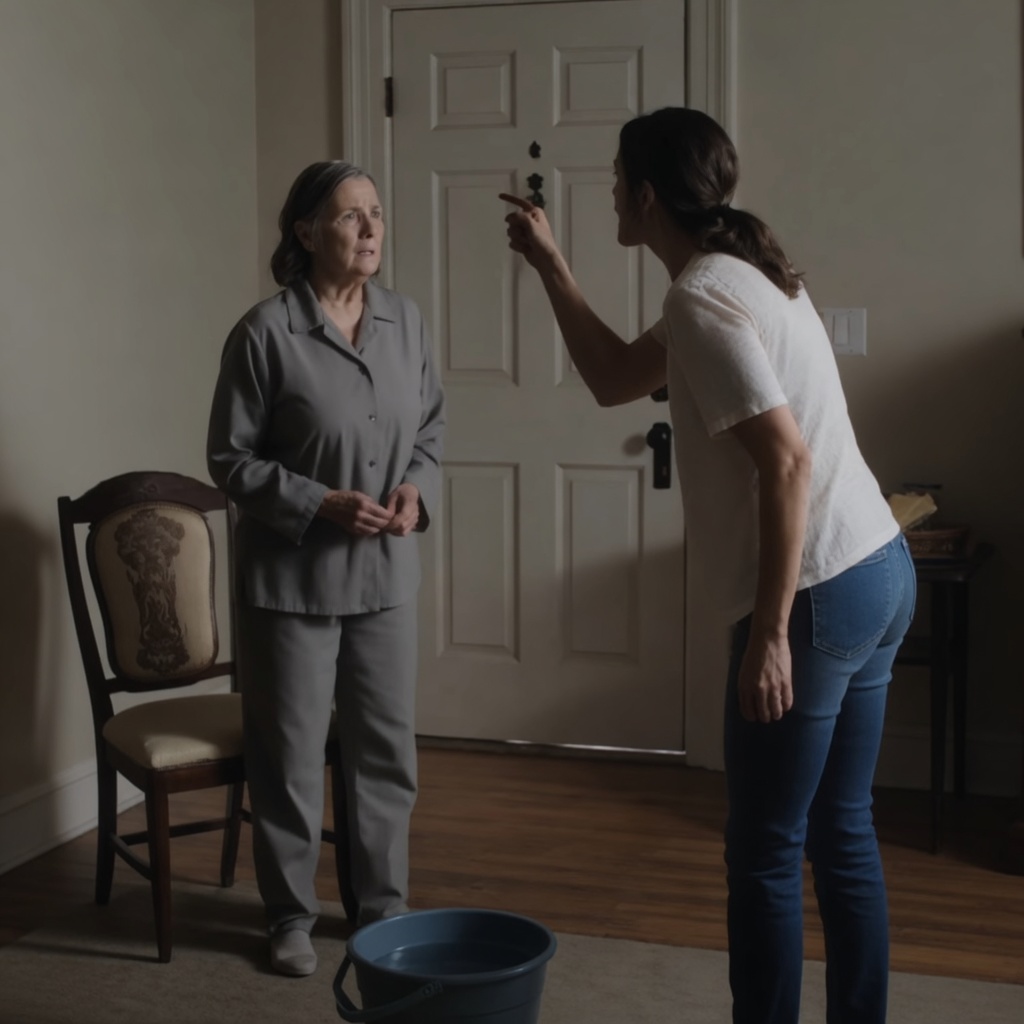
Then came the sound. A splash. Water hitting the floor. A startled gasp. Michael opened the door. And the picture in his mind shattered. Water spread across the hallway tiles in a glittering, cruel puddle. His mother stood in the middle of it, soaked from her gray hair down to the front of her faded cardigan. Droplets ran from her sleeves and fell from her trembling fingers. Her slippers were wet. Her lips shook. Her hands were raised slightly, not in anger, not even in defense, but in that small helpless way people raise their hands when they are bracing for more. Clara stood a few feet away, holding an empty glass pitcher.
For one suspended second, nobody moved. Then Evelyn flinched. Not because anyone touched her. Not because Clara raised her hand again. She flinched because Michael’s suitcase bumped softly against the doorframe. Small. Automatic. Familiar. Like this had happened before.
That was the moment something inside Michael went still. Not cold. Not angry yet. Still. A terrible, deep stillness. His mother turned her head slowly. When she saw him, her face changed in a way that broke him. Relief came first, then fear, then shame. Shame, as if she had been caught doing something wrong. Shame, as if being humiliated in her own son’s home was somehow her failure.
“Michael,” she whispered. Clara turned sharply. The color drained from her face. “You’re back—?” He did not answer. Not yet. He stepped inside and closed the door behind him. The click of the latch sounded too loud in the silent hallway. His suitcase remained in his hand, but he no longer felt its weight. His eyes moved from the water on the floor to his mother’s soaked clothes, to the pitcher in Clara’s hand, to the fear Evelyn was trying and failing to hide.
Everything he had built, everything he had endured, every dream he had carried home in that taxi, collapsed into one unbearable truth. His mother had not been living in his home. She had been surviving in it.
“Mom,” he said softly. Evelyn immediately shook her head. “It’s nothing. It was an accident. I slipped, and Clara was just—” “Don’t,” he said. One word. Not harsh. Not loud. But Evelyn stopped. Because she knew her son. She had raised him. She knew the difference between his anger and his heartbreak. This was worse than anger.
Clara put the pitcher down on the console table too quickly. “You don’t understand what happened.” Michael finally looked at her. For years, he had loved that face. He had memorized it in soft light, in morning sleepiness, in the early days when they had nothing but cheap furniture and impossible plans. He had believed he knew her. He had defended her when his friends said she seemed impatient. He had excused her sharpness as stress, her coldness as honesty, her resentment as loneliness from his long absences. Now he looked at her and wondered how much of his marriage had been built on what he wanted to see.
His voice came out quiet. Too quiet. “Say that again.” Clara blinked. “Michael, listen to me. Your mother has been impossible all day. She keeps touching things, moving things, acting like this is still her house—” “It is her house,” Michael said. Clara’s mouth tightened. “It is our house.”
Michael looked at the water again. Then at his mother. Evelyn was trembling harder now. Not from the cold alone. She kept glancing between them like she wanted to disappear before she caused more trouble. That hurt him more than Clara’s cruelty. His mother, who had once fought landlords, bill collectors, illness, grief, and hunger to keep him safe, now looked afraid to occupy space in the home he had bought with her in mind.
Clara inhaled sharply, trying to regain control. “You’re tired. You just got home. We can talk after you calm down.” Michael gave a short, humorless laugh. Calm down. He had been calm for months. Calm when Clara complained about his mother. Calm when Evelyn stopped joining video calls unless he begged. Calm when he noticed his mother had lost weight. Calm when she said she ate earlier but could never tell him what. Calm when Clara said Evelyn was dramatic. Calm when his instincts told him something was wrong and his guilt told him he was being unfair to his wife. He had been calm long enough.
“No,” he said. “I understand perfectly.” The room went still. Clara’s eyes narrowed. “What does that mean?” Michael set the suitcase upright beside him, but he did not let go of the handle yet. He looked at his mother again. “How many times?” Evelyn’s eyes filled. “Michael…” “How many times has something like this happened?” She shook her head. “Please don’t.” That answer was enough.
Michael closed his eyes briefly. There are moments in life when truth does not arrive as a surprise. It arrives as confirmation. It comes with the sickening weight of all the small signs you ignored because believing them would have demanded action. He remembered his mother’s voice two months earlier: “Clara is just tired, sweetheart.” He remembered Clara laughing coldly in the background once when Evelyn dropped a cup. He remembered calling at dinner time and seeing his mother in a bedroom instead of at the table. He remembered asking, “Did you eat?” and his mother smiling too fast. “Of course.” He remembered sending money for groceries and Clara saying the bills were higher because “your mother has special needs now.” Your mother. Not Mom. Not Evelyn. Not family. Your mother.
Michael opened his eyes. His suitcase dropped from his hand. The sound echoed through the hallway louder than any scream. Clara flinched this time. Evelyn whispered, “Michael, please.” But he was already bending down. He unzipped the front pocket of the suitcase and pulled out a folder. It was thick, organized, sealed with a rubber band. He had packed it carefully before leaving the hotel that morning, thinking he would speak with Clara later in the week, gently, responsibly. He had not known he would need it before he even took off his coat.
Clara stared at the folder. “What is that?” Michael removed the rubber band and placed the papers on the table. His movements were slow, controlled. That control terrified Clara more than shouting would have. “Before I came home,” he said, “I was going to tell you about the final payment.” Clara’s expression flickered. “What final payment?” “The mortgage.”
For the first time since he walked in, something other than fear crossed her face. Interest. He saw it. And something in him hardened. “I paid off the house,” he said. Clara’s lips parted. “You… what?” “I paid off the house. The work contract came with a completion bonus. I used it, plus the savings from the last year.” Clara looked at the papers, then at him. “Michael, that’s wonderful. Why didn’t you tell me?” “Because I wanted it to be a surprise.”
Her face softened too quickly. “It is. It’s amazing. This is what we wanted. No more mortgage. No more pressure. We can finally—” “No,” he said. She stopped. Michael placed one hand on the folder. “Everything I earned was for this family. Every hour. Every trip. Every night I spent away. Every meal I skipped. Every time I told myself to keep going when I wanted to quit.” His voice remained steady, but something beneath it was breaking. “I thought I was building a safe home.”
Evelyn covered her mouth with a trembling hand. Michael looked directly at Clara. “But not for someone who treats my mother like this.” Clara’s face changed. “What are you saying?” Michael pulled one document from the folder and slid it across the table. “You’re leaving.”
Silence fell. Not ordinary silence. The kind that changes the shape of a life. Clara stared at him as if she had misunderstood the language he was speaking. “Excuse me?” “You heard me.” “This is my house too.” “No,” Michael said. “It isn’t.” Her face flushed. “We’re married.” “The house is in my name. It was purchased before our marriage. The payments came from my separate account. And as of this morning, it is fully paid.” He looked at the wet floor. “It was never yours to turn into a place where my mother had to be afraid.”
Clara’s hands began to shake, but anger quickly came to rescue her pride. “So that’s it? You walk in after months away, see one little argument, and decide to throw away our marriage?” “One little argument?” “You have no idea what it’s been like here.” Michael’s jaw tightened. “Then tell me.”
Clara gestured toward Evelyn, who seemed to shrink under her attention. “She needs help with everything. She forgets where things go. She leaves the stove on low. She asks the same questions. She moves too slowly. She acts helpless when she wants sympathy.” Evelyn whispered, “I’m sorry.” Michael turned to her. “Mom, stop apologizing.” Clara laughed bitterly. “See? This is exactly what I mean. She plays fragile and you fall for it.”
Michael looked back at his wife. “She is seventy-two years old.” “She is manipulative.” “She is my mother.” “And I’m your wife!” The shout rang through the hallway. For the first time, Michael’s anger flashed openly.
“Yes,” he said. “You are my wife. That is why I trusted you. That is why I left this home believing the two people I loved would care for each other. That is why I ignored my own worry every time my mother sounded scared on the phone. Because I thought, ‘Clara is there. Clara would never let anything happen to her.’” Clara’s expression faltered. Michael took one step closer. “I was wrong.”
Evelyn began to cry quietly. The sound was small, almost silent, but Michael heard it like a knife. Clara looked from him to the papers. “You can’t just make me leave.” “I can ask you to leave tonight. Legally, we’ll handle the rest.” “You’re choosing her over me.”
Michael stared at her. For years, he had heard that sentence in different forms. Your mother needs to stop depending on you. Your mother has to understand you have a wife now. Your mother makes me feel like an outsider. Your mother, your mother, your mother. As if love were a competition. As if the woman who gave him life had to be diminished for his marriage to feel important.
“No,” he said slowly. “You chose cruelty over this family. I’m choosing to stop allowing it.” Clara’s eyes filled, but the tears did not move him the way they once might have. Maybe because he could still see water dripping from his mother’s sleeve. “Michael,” Clara said, softer now. “I was overwhelmed. I lost my temper. I shouldn’t have thrown the water, but she provoked me.”
The word provoked landed like poison. His mother had spent her whole life trying not to be a burden. She apologized when the weather changed. She apologized when her knees hurt. She apologized when she needed a ride to the doctor. She apologized for aging, as if time itself were bad manners. And Clara called that provocation.
Michael took out his phone. Clara’s eyes widened. “What are you doing?” He did not answer her. He found the contact and pressed call. The lawyer picked up on the third ring. “Mr. Harris? I didn’t expect—” “Start the divorce paperwork,” Michael said. Clara went pale. His lawyer paused. “Are you sure?” Michael looked at his mother, still soaked and trembling in the hallway. “Yes,” he said. “I’m sure.”
He ended the call. For a moment, nobody moved. Then Clara whispered, “You’ll regret this.” Michael placed the phone on the table. “Maybe I’ll regret not seeing it sooner. I won’t regret protecting my mother.”
Clara grabbed her purse from the chair. “Fine. You want me gone? I’ll go. But don’t think this makes you noble. You’re just a weak man who never cut the cord.” Michael’s face did not change. Evelyn flinched at the insult. That was enough.
Michael stepped toward Clara, not aggressively, but with finality. “Pack what you need for the night. I’ll arrange for the rest of your things to be collected later. You will not speak to my mother again tonight.” Clara looked as though she might argue, but something in his voice stopped her. She turned sharply and walked upstairs.
Only when her footsteps disappeared did Michael move toward his mother. Evelyn immediately tried to wipe her face. “I’m all right.” “No, you’re not.” “I didn’t want you to come home to this.” “I know.” “I tried to keep peace.” “I know.” “She’s your wife. I didn’t want to be the reason—” “Mom.”
His voice broke. Evelyn stopped. Michael took off his coat and wrapped it gently around her shoulders. She was so small beneath it. Smaller than he remembered. When had that happened? When had the woman who once seemed unbreakable become so thin, so careful, so apologetic in his own home?
“I’m sorry,” he whispered. She shook her head quickly. “No, no. You were working. You were doing everything for us.” “I should have known.” “You couldn’t.” “I heard it in your voice.” She closed her eyes. “I should have come home sooner,” he said. Evelyn reached up with wet fingers and touched his cheek. “You came home today.”
That simple mercy nearly undid him. Michael lowered his forehead to her hands, and for a few seconds he was not a husband, not a provider, not a man carrying documents and decisions and rage. He was a son. A little boy again, held together by the woman who had held him first.
“I thought I was giving you a better life,” he said. “You did.” He pulled back, anguished. “Not if you were afraid here.” She looked toward the stairs, then back at him. Her voice was barely audible. “I didn’t want to be alone.”
The confession broke through the last wall in him. Because he understood. After his father died, Evelyn had been alone for years. She never complained. She never asked to move in. Michael had begged her after her fall the previous winter. “Come stay with us,” he had said. “There’s room. I don’t want you by yourself.” Clara had smiled then and said, “Of course, Mom can come.” Mom. She had said it sweetly. Michael now wondered when that sweetness ended. The day he left for the contract? The first time Evelyn forgot a pot on the stove? The first time Clara realized kindness was work when nobody was watching?
He guided his mother toward the downstairs bathroom. “Let’s get you dry.” She resisted weakly. “The floor—” “I’ll clean it.” “But Clara—” “Clara is not your concern.”
Evelyn looked at him then, really looked, as if she was seeing not the boy she raised but the man he had become. Her eyes filled again, but this time there was something else inside them. Relief. He helped her change into dry clothes. He brought towels. He made tea. He cleaned the hallway himself, kneeling where the water had spread. With every stroke of the towel across the tiles, his anger settled deeper. Not hotter. Deeper. This hallway had seen his mother humiliated. This house had heard things he had not been there to stop. He would not let it happen again.
Upstairs, drawers opened and slammed. Clara moved loudly, making sure they could hear her anger. Michael ignored it. He sat his mother at the kitchen table, placed the blue shawl from his suitcase around her shoulders, and set a mug of tea in front of her. Evelyn touched the shawl. “You bought this for me?” He nodded. “I saw it at the airport.” “It’s beautiful.” She tried to smile. “I must look awful.” “You look like my mother.” Her face crumpled, and she cried again.
This time he let her. He sat beside her and held her hand as the tears came. Not dramatic tears. Not loud ones. The quiet, exhausted tears of someone who had swallowed too much pain for too long and finally found a safe place to release it.
When Clara came downstairs with a suitcase, she paused at the kitchen entrance. Her eyes fell on the shawl, the tea, Michael’s hand covering his mother’s. Something bitter crossed her face. “So this is the scene now?” she said. “Poor Evelyn. Evil Clara.” Michael looked up. “Leave.”
Clara laughed, but it shook. “You really are serious.” “Yes.” “You’ll hear from my lawyer.” “I expect to.” “And when everyone asks what happened?” Michael stood. “Tell them the truth.” She scoffed. “That I threw water during an argument?” “That you abused an elderly woman in her own home while her son was away.”
Clara’s face twisted. “Abused? Don’t be ridiculous.” Evelyn lowered her eyes. Michael saw it. “Mom,” he said gently, “look at me.” She did. “Did she ever lock food away from you?” Evelyn’s face went white. Clara snapped, “Michael.” He did not look away from his mother. “Did she?”
Tears gathered in Evelyn’s eyes again. “It was only because she said I ate at the wrong times,” she whispered. “She said the kitchen had to stay organized.” Michael felt something cold move through him. “Did she stop you from using the phone?” Clara stepped forward. “This is insane.” Evelyn’s lips trembled. “Only when she said you were busy. She said I was making you feel guilty.”
Michael’s breathing grew slow and dangerous. “Did she shout at you often?” Evelyn did not answer. She did not need to. Clara’s suitcase handle creaked under her grip. “I am not staying here to be interrogated.” “No,” Michael said. “You’re not.”
For once, Clara seemed to understand there was no way back into the role she had performed for him. No soft voice would undo this. No tears would erase his mother’s fear. No accusation would turn his guilt into surrender. She opened the front door. Cold air entered the house. Before stepping out, she looked back. “You’ll be alone after she’s gone.” Michael’s answer came without hesitation. “I’d rather be alone than share my life with someone cruel.”
Clara’s face hardened. Then she left. The door closed behind her. For a long time, Michael and Evelyn sat in silence. The house felt different. Not peaceful yet. Too much had happened. Too much truth had surfaced. But the air had shifted. The danger had left.
Evelyn stared into her tea. “I’m sorry.” Michael sighed softly. “Mom.” “I know. I know. But I am. I should have told you.” “You were scared.” “I was ashamed.” “Why?” She gave him a heartbreaking smile. “Because I raised you to build a good life. And then I became the trouble inside it.”
Michael’s eyes burned. “You were never trouble.” “I felt like it.” He leaned forward. “Listen to me. This house exists because of you. Because you worked when you were sick. Because you walked to work when you couldn’t afford bus fare. Because you made sure I studied instead of quitting school. Because you gave me every chance you never had.” His voice shook. “No one gets to make you feel unwanted here.”
Evelyn pressed the shawl to her chest. “She was different when you were home,” she whispered. “I know.” “When you called, she would stand nearby sometimes. I didn’t want to make things worse.” Michael nodded slowly. Each sentence was another piece of the truth, and each piece cut.
That night, he slept on the couch outside his mother’s room. Evelyn protested, of course. She said he was tired. She said his bed was upstairs. She said she was fine. He brought a blanket and said, “I know.” Then he stayed anyway.
In the dark, Michael stared at the ceiling and listened to the house settle around him. He thought about marriage. About trust. About how cruelty rarely shows itself all at once. It enters through small doors. A joke. An eye roll. A complaint. A sigh when someone needs help. A locked cabinet. A sharp word. A glass of water thrown not in anger alone, but in contempt.
He wondered how many times his mother had cried quietly while he was in another city, convincing himself he was doing the right thing by working harder. Near midnight, he heard her voice through the door. “Michael?” He sat up immediately. “Yes?” “Are you still there?” His throat tightened. “I’m here.” A pause. Then, softer: “Thank you.” He closed his eyes. “You don’t have to thank me for being your son.”
The next morning, sunlight entered the house cautiously, as if unsure it was welcome. Michael made breakfast. Not because he was good at it — he burned the toast and oversalted the eggs — but because he wanted his mother to sit and be served for once. Evelyn laughed for the first time when she tasted the eggs. “You cook like your father.” “Is that good?” “No.” He smiled, and the sound of her laughter, fragile but real, filled a corner of the kitchen that had been too silent.
After breakfast, Michael began making calls. The lawyer. A locksmith. A counselor specializing in elder abuse. His mother’s doctor. A cleaning service. A moving company to arrange Clara’s belongings through legal channels. He documented everything. Took photos of the wet hallway, saved messages, asked his mother gently about dates and incidents, never pushing when she became overwhelmed. By afternoon, new locks were installed. By evening, Clara’s access to the house was gone.
Over the next days, truth unfolded slowly. Clara had mocked Evelyn’s shaking hands. She had rationed food under the excuse of “meal planning.” She had told Evelyn not to call Michael because he was under pressure and she would be selfish to bother him. She had moved Evelyn’s room from the sunny guest room to the smaller back room because she wanted the better one for “storage.” She had thrown away some of Evelyn’s old clothes, calling them depressing. She had invited friends over and introduced Evelyn as “Michael’s mother who lives with us for now,” as if Evelyn were temporary clutter.
Michael listened to all of it with a face so still Evelyn sometimes stopped talking. But whenever she stopped, he would say, “I believe you.” Those three words became a bridge. I believe you. Every time he said it, Evelyn sat a little straighter.
A week after Clara left, Michael found his mother in the garden. She was standing beside the rose bushes, wrapped in the blue shawl, touching the dry branches. “I thought they died,” she said when he joined her. “They’ll come back in spring.” She smiled faintly. “You always say that.” “Because you taught me.” She looked at him then. “You used to hate gardening.” “I still do.” “No, you don’t.” He laughed softly.
They stood there together in the cold. After a while, Evelyn said, “Do you hate her?” Michael looked toward the street. He considered lying. Saying no. Saying he was above that. But his mother deserved honesty. “Some days, yes.” “She was your wife.” “I know.” “You loved her.” “I loved who I thought she was.” Evelyn nodded, tears glistening in her eyes. “I’m sorry that truth hurt you.” Michael turned to her. “I’m sorry it hurt you first.”
She looked down. He took her hand. “We’re going to heal,” he said. She gave a small, uncertain smile. “At my age?” “At any age.”
The divorce was not simple. Clara fought. She accused Michael of abandoning the marriage. She claimed Evelyn had exaggerated. She said stress had made her act out of character. She sent messages one night saying she missed him, then the next morning through her lawyer demanded financial concessions. But Michael did not bend. Not because he was cruel. Because he had already seen what bending had cost his mother.
Months passed. The house changed slowly. The back room became a reading room for Evelyn, with a comfortable chair by the window and shelves for her old books. The sunny guest room became hers again. Michael installed railings near the stairs, better lights in the hallway, and a small garden bench outside. He reduced his travel schedule and took work closer to home.
At first, Evelyn apologized for every change. Then less. Then one morning, Michael heard her singing softly in the kitchen while making tea. He stood in the hallway and listened, his hand resting against the wall. It was the same song she used to hum when he was a child. For the first time in months, the house sounded like home.
One evening in spring, the rose bushes bloomed. Evelyn called him outside like there was an emergency. Michael ran out half-panicked, only to find her pointing proudly at the first red rose. “See?” she said. “They came back.” He looked at the flower, then at her. “Yes,” he said softly. “They did.” She knew what he meant. Tears filled her eyes, but she smiled.
Later that night, they ate dinner at the table. Nothing fancy. Soup, bread, salad. Michael’s phone buzzed with an email from his lawyer: the divorce was finalized. He stared at the screen for a long moment. Evelyn noticed. “Is it done?” He nodded. She reached across the table and covered his hand with hers. “Are you all right?”
Michael looked around the kitchen. At the warm light. At the clean hallway. At his mother sitting across from him, safe, dry, no longer afraid to meet his eyes. Then he thought of the night he came home. The water on the floor. The way she had flinched. The suitcase falling. The folder on the table. The sentence that had changed everything. You’re safe now. I’m home.
He squeezed her hand. “I will be,” he said.
Evelyn smiled. For months, Michael had thought coming home meant returning to the life he had left behind. But that life had been an illusion, held together by distance, denial, and the hope that love could exist without respect. Now he understood something harder and truer.
A home is not proven by walls, furniture, mortgage papers, or the person waiting at the door with a practiced smile. A home is proven by what happens to the most vulnerable person inside it. If they are afraid, it is not a home. If they are humiliated, it is not a home. If they must shrink to survive, it is not a home.
So Michael rebuilt his. Not with money this time. With attention. With truth. With locked doors against cruelty and open doors for healing. And every night, before going upstairs, he would pause near his mother’s room and listen just long enough to hear her moving peacefully inside. Sometimes she would call out, “Michael?” And he would answer, every time. “I’m here.”
Because once, he had come home expecting smiles and found his mother soaked, trembling, and ashamed in the hallway. He could not undo those months. He could not take back every lonely night she had endured while he was away. But he could make sure she never again had to wonder whether anyone would come when she called.
He was home now.
And this time, he was staying.
![[FULL STORY] Her Best Friend Mocked Me at Dinner—Then She Chose Him Over Me](https://social.rabedo.com/storage/thumbnails/1777351852_c08df6a4-4f96-498d-9fe0-5872a6864442.png)

![[FULL STORY] He Left Me at a Bus Stop With Our Baby—7 Years Later, He Walked Into My Office Begging](https://social.rabedo.com/storage/thumbnails/1776764062_D78.jpeg)
![[FULL STORY] My Fiancée Plotted to Leave Me Post Wedding and Claim Half My Assets 'He’s Just a Short Term…](https://social.rabedo.com/storage/thumbnails/1777303517_S2.png)