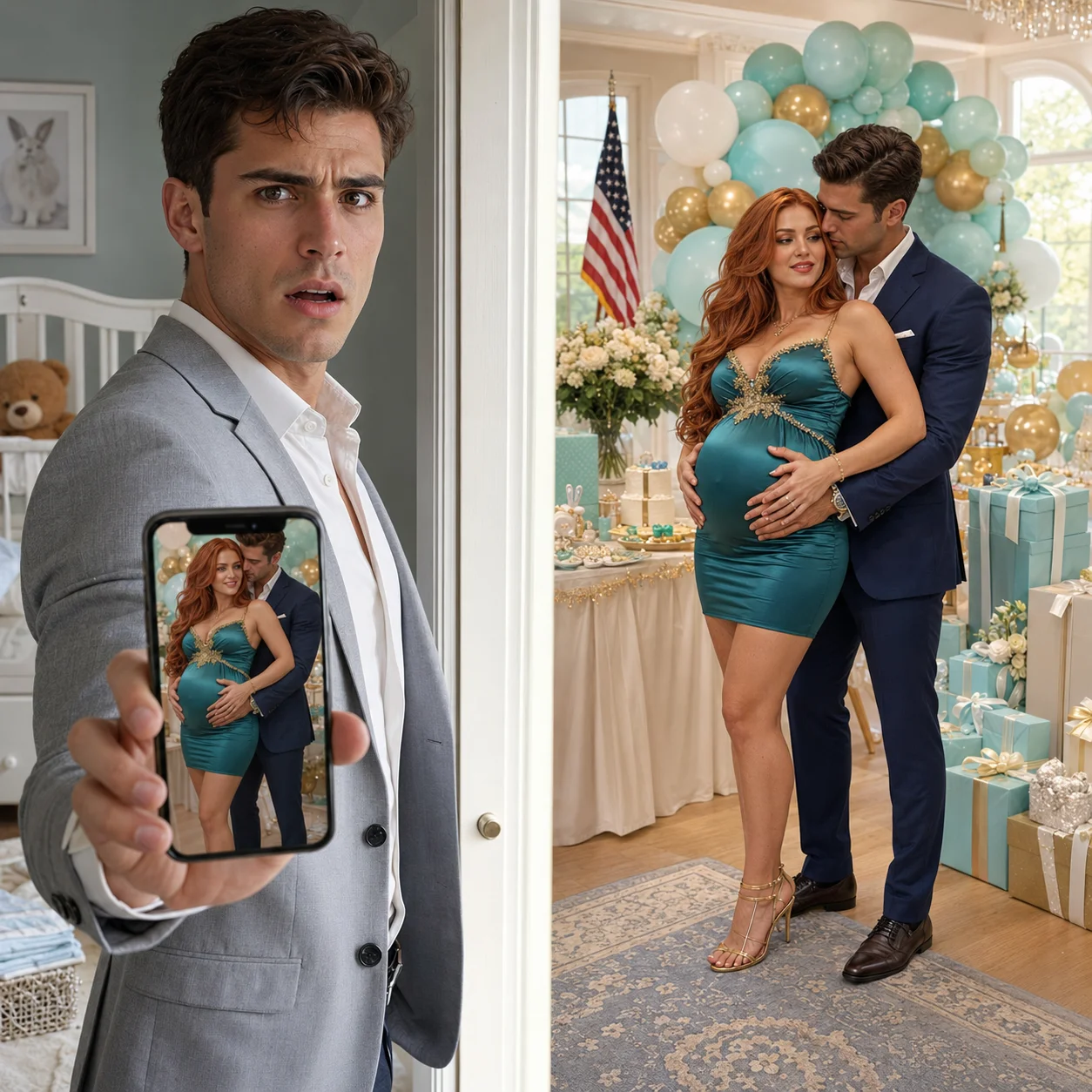
WELCOME BABY OLIVER.
I stared at the photo for so long that the screen dimmed in my hand.
The man was not a stranger.
His name was Caleb Ross.
He was the operations manager at The Willow Room. Marissa had mentioned him a hundred times. Caleb fixed everything. Caleb handled difficult clients. Caleb stayed late when events ran overtime. Caleb was “like a brother” because he had helped her through stressful workdays during the first trimester.
I had shaken his hand at a Christmas party eight months earlier.
He had looked me in the eye and told me I was a lucky man.
I zoomed in on the photo with fingers that didn’t feel connected to my body. Caleb’s left thumb rested just below Marissa’s ribs. Her hand was over his. Not removing it. Not uncomfortable. Not surprised.
Claiming it.
Before I could respond, three dots appeared under Dana’s name. Then disappeared. Then appeared again.
A second message came.
Oh my God. I sent that to you by mistake.
Then another.
Ryan, please don’t react until I explain.
My name is not Ryan.
My name is Nathan.
That was when I realized Dana had not meant to send the picture to me. She had meant to send it to someone else, maybe her boyfriend, maybe someone who already knew the truth.
And just like that, the world divided into before and after.
CHAPTER 2 — THE PHOTO WAS ONLY THE FIRST RECEIPT
I didn’t call Marissa right away.
That is the part people later told me they didn’t understand. They said if it had been them, they would have driven straight to the baby shower and exploded in front of everyone. They would have dragged Caleb outside. They would have demanded answers in front of the balloon arch and the pastel cupcakes.
Maybe they would have.
I didn’t.
I sat down on the floor of the nursery because my knees stopped being reliable. Miller came in and laid his head on my thigh. I remember his fur under my hand. I remember the smell of fresh paint. I remember the baby monitor blinking blue on the dresser.
I looked at the photo again.
Then I saved it.
I screenshotted the message thread. I forwarded the photo to my personal email, my work email, and a cloud folder I had used only for tax documents until that day. My hands were shaking so badly that I mistyped my own password twice.
Dana called me seven times in five minutes.
I didn’t answer.
Then she texted:
Nathan, I messed up. Please don’t do anything crazy. It’s complicated.
Complicated.
That word made something in me go very still.
I typed back:
How long?
She didn’t respond for almost three minutes.
Then:
You need to talk to Marissa.
I wrote:
No. You sent me the photo. Now you can tell me why another man is holding my pregnant wife’s belly at the baby shower I was told not to attend.
Another pause.
Then Dana sent one sentence.
I thought you already knew Caleb was involved.
Involved.
Not “there.” Not “helping.” Not “being inappropriate.”
Involved.
I stood up and walked out of the nursery because suddenly the room felt like a cruel little stage set. The tiny sweater, the crib, the name on the wall — all of it looked like evidence from a life someone else had written for me.
I called my sister, Erin.
She answered cheerfully, “Hey, Dad-to-be.”
I couldn’t speak.
Her tone changed immediately. “Nathan?”
I said, “I need you to come over.”
She lived 18 minutes away. She made it in 12.
By the time Erin arrived, Dana had sent three more messages, each worse than the last.
Nathan, I swear I thought she told you.
I didn’t know she made you stay home.
Caleb told people they were “figuring it out after the birth.”
Erin read them standing in my kitchen, one hand over her mouth.
“Who is Caleb?” she asked.
“Her coworker.”
“Is he the father?”
The question hit the room like a thrown glass.
“I don’t know,” I said.
But I did know. Or at least my body knew before my mind was ready.
Erin made me sit. She poured me water I didn’t drink. She told me not to call Marissa yet. Not because Marissa deserved calm, but because I deserved information.
“Do not give her time to rewrite everything,” Erin said. “Get facts first.”
My sister is a family law paralegal. Not an attorney, but close enough to know panic makes people stupid. She called her boss, an attorney named Paula Merrick, who agreed to speak with me the next morning. Erin told me to preserve every message and not move money recklessly. She also told me not to put anything in writing that sounded threatening.
At 5:28 p.m., Marissa finally texted.
Shower went great. Exhausted. Dana is taking me home soon.
I stared at those words.
Not a single photo.
Not one mention of Caleb.
I replied:
Okay.
That was all.
When she came home, she was glowing in the way people glow after getting away with something. She walked in carrying flowers and gift bags, wearing that white dress, her makeup still perfect. Dana did not come inside. She barely slowed the SUV before Marissa got out.
Marissa kissed me lightly.
“You okay?” she asked.
“Yeah,” I said. “Tired.”
She laughed. “You’re tired? I was the pregnant one being social for four hours.”
I wanted to ask her if Caleb had been tired too. I wanted to ask if his hands hurt from holding my son. I wanted to hold up the photo and watch her face collapse.
Instead, I helped carry the gifts inside.
For the next hour, she performed the version of the day she had prepared for me. She said the games were silly. Her mother cried during the toast. Dana made everyone guess baby food flavors. A coworker brought cupcakes shaped like rattles. She showed me carefully selected pictures from her phone: her with Dana, her with her mom, a table of gifts, the cake, the decorations.
No Caleb.
Not even in the background.
When she went upstairs to shower, I checked the metadata on the photo Dana sent. I’m not a tech genius, but I know enough. The photo had been taken at 3:37 p.m. at The Willow Room. I opened Marissa’s shared family calendar. The shower had supposedly ended at 3:30.
At 7:12, while Marissa was still upstairs, Dana texted again.
I can’t be in the middle of this.
I wrote back:
You already are.
She replied:
I didn’t want this. She said she was going to tell you after Oliver was born.
I stared at that until the words blurred.
After Oliver was born.
My son’s name. Or maybe not my son. Maybe a baby I had been loving on borrowed information.
I asked:
Tell me exactly what you know.
Dana didn’t answer until 9:03 p.m.
By then Marissa was asleep beside me, one hand on her stomach, breathing softly like a person with nothing to fear.
Dana’s message came in pieces.
She and Caleb got close during the spring fundraiser last year.
She told me it ended.
Then she got pregnant.
She said timing was confusing but she was “choosing her marriage.”
Caleb knew about the pregnancy.
He wanted to be at the shower.
She told people you were too overwhelmed and preferred not to attend.
I’m sorry.
I didn’t sleep.
At 6:30 a.m., I got up, made coffee, and sat at the kitchen table until Marissa came downstairs.
She looked at me and stopped.
“What’s wrong?” she asked.
I turned my phone around and showed her the photo.
Every bit of color left her face.
She didn’t ask where I got it. She didn’t say it wasn’t what it looked like. She didn’t act confused.
She sat down slowly.
“Nathan,” she whispered.
I said, “Is Caleb the father?”
She started crying.
That was her first answer.
I asked again.
“Is Caleb the father?”
“I don’t know,” she said.
Somehow that was worse than yes.
She reached for my hand. I pulled it back.
“It was a mistake,” she said. “It was a horrible, stupid, emotional mistake.”
“How long?”
She shut her eyes.
“On and off.”
“That’s not an answer.”
“Almost a year.”
The kitchen went silent except for the refrigerator humming.
Almost a year.
While I was repainting the nursery. While I was scheduling fertility appointments. While I was rubbing her feet. While I was telling friends we were finally going to be parents.
I asked, “Were you sleeping with him when we were trying?”
She covered her mouth and sobbed.
I stood up so fast the chair scraped across the floor.
“Were you sleeping with him when we were trying to have a baby?”
“Yes,” she said.
It came out small. Almost annoyed. Like the truth had inconvenienced her.
I walked to the sink because I thought I might throw up.
Behind me, she started talking quickly. Too quickly.
She said she had been lonely. She said I had become obsessed with getting pregnant and made intimacy feel clinical. She said Caleb made her feel desirable when she felt like a failed woman. She said when the test came back positive, she panicked. She said the dates were close. She said she chose me because I was stable, because I was her husband, because I would be a better father.
“Better father than who?” I asked.
She didn’t answer.
“Better father than the real one?”
“Nathan, please.”
I laughed once. It didn’t sound human.
She said, “I was going to tell you.”
“When?”
“After the birth.”
“After I signed the birth certificate?”
She flinched.
That told me enough.
I left the house with my laptop, the photo, and a gym bag of clothes. Marissa followed me onto the porch crying, one hand on her belly, begging me not to abandon her.
That word did something to me.
Abandon.
As if I was the one walking away from truth.
I turned around and said, “I’m not abandoning you. I’m refusing to be trapped.”
Then I drove to Erin’s house and met with Paula Merrick at 9:15 a.m.
That was when the emotional disaster became a legal one.
CHAPTER 3 — MARISSA WANTED A HUSBAND UNTIL SHE NEEDED A FALL GUY
Paula Merrick was a small woman with silver hair and the calmest voice I had ever heard. She listened without interrupting while I explained the photo, Dana’s messages, Marissa’s confession, and the timing. Erin sat beside me taking notes like she was afraid I would forget my own life.
When I finished, Paula folded her hands.
“I’m going to be very clear,” she said. “Do not sign anything at the hospital without legal advice. Do not acknowledge paternity in writing. Do not let anyone pressure you into being placed on the birth certificate if there is a serious question of biological paternity.”
That sentence broke something in me all over again.
Because until then, some stupid part of me had still been thinking emotionally. Maybe the baby was mine. Maybe the affair was awful, but the child was innocent. Maybe there was a path where I could love him anyway. Maybe biology didn’t have to matter.
Paula was not cruel. She was practical.
“In North Carolina,” she said, “marriage creates presumptions, but you need to protect yourself. If you are named legally as the father, undoing that later can become difficult, expensive, and emotionally brutal. Especially if the mother benefits from keeping you responsible.”
The mother.
Not “your wife.”
Not “Marissa.”
The mother.
I asked what I should do.
She told me to document everything. She told me to save communications. She told me to request a prenatal noninvasive paternity test if Marissa agreed, or pursue legal testing after birth if she refused. She told me to separate finances carefully, not vindictively. She told me to avoid dramatic confrontations with Caleb. She told me to communicate through text as much as possible.
Then she said, “People panic when control slips. Expect her to change the story.”
She was right.
By noon, Marissa had sent me 46 messages.
At first, they were apologies.
I’m so sorry.
I love you.
I never meant to hurt you.
Please come home.
Then they became emotional.
You can’t leave me like this.
Stress is bad for the baby.
Whatever happened between us, Oliver needs you.
Then they became strategic.
You’re the only father he knows.
Biology doesn’t make a dad.
Are you really going to punish an innocent baby because I made a mistake?
I stared at that one for a long time.
I typed back:
I am willing to discuss next steps through attorneys. I want a paternity test.
Her response came less than a minute later.
Absolutely not.
Then:
I will not have my baby treated like evidence.
My baby.
Not our baby.
I screenshotted it.
That evening, Caleb called me from a blocked number. I didn’t answer. He left a voicemail.
“Hey Nathan, this is Caleb. I know you’re upset, man, but this doesn’t need to get ugly. Marissa is in a vulnerable condition. Whatever you think you know, there are adult ways to handle this. I care about her, and I care about the baby. Let’s not make this about ego.”
I forwarded the voicemail to Paula.
She replied with one sentence:
Do not respond.
The next day, Marissa’s mother, Linda, called me crying.
She said Marissa was devastated. She said marriages survived worse. She said men had raised children who were not biologically theirs for centuries. She said I was being cold.
I asked her, “Did you know Caleb was at the shower?”
Silence.
“Linda?”
She said, “I knew he stopped by.”
“Did you know he posed for photos holding her belly?”
“That was inappropriate,” she said.
“Did you know there was a chance he was the father?”
She started crying harder.
That was another answer.
By the end of the week, I understood something that made me feel stupid in a way pain alone couldn’t. I had not just been betrayed by my wife. I had been managed by a committee.
Dana knew. Linda suspected. Caleb knew. Some of Marissa’s coworkers knew. People had stood under a banner with the name I helped choose and watched another man publicly act like a father while I sat at home installing a baby monitor.
And they had let me.
On Friday, I went back to the house with Erin and a police standby to collect clothes, work files, and personal documents. Paula recommended it after Marissa became increasingly unstable over text. Marissa opened the door wearing one of my old sweatshirts, belly prominent, eyes swollen.
When she saw the officer, her face hardened.
“You brought police to our home?”
“I brought a witness,” I said.
“Our home,” she repeated bitterly. “You mean the house you’re going to kick your pregnant wife out of?”
The officer shifted, already recognizing the kind of domestic situation where every sentence is bait.
I said, “I’m here for my things.”
Marissa followed me from room to room. Erin recorded on her phone openly. Marissa cried, then whispered, then snapped. She said I was humiliating her. She said I was making her blood pressure rise. She said if anything happened to Oliver, it would be my fault.
I stopped packing and looked at her.
“Don’t use that baby as a weapon against me.”
She slapped me.
Not hard enough to injure me, but hard enough that the officer stepped forward immediately.
Erin said, “That’s on video.”
Marissa’s expression changed from rage to fear in one second.
“I didn’t mean—”
The officer told her to step back.
I finished packing with my cheek burning and my hands steady.
Two days later, Marissa posted on Facebook.
I never thought I’d be facing the hardest weeks of pregnancy alone. Please pray for me and my son. Some people show their true colors when life gets real.
She didn’t name me.
She didn’t have to.
Comments poured in.
Stay strong mama.
Real men don’t abandon pregnant wives.
That baby will know who was there.
I said nothing publicly.
Instead, I sent the post to Paula.
By Monday morning, Paula filed for legal separation and sent Marissa a formal letter requesting paternity testing, preservation of relevant communications, and all communications through counsel. The letter also made clear I was not consenting to be listed as the father without confirmation.
Marissa called me 19 times after receiving it.
Then Caleb texted me from his real number.
You’re making this harder than it needs to be. The baby needs stability. If you cared about Marissa, you’d stop attacking her.
I finally responded with Paula copied by screenshot.
Do not contact me again. All communication goes through attorneys.
He replied:
You think a lawyer makes you a man?
I saved that too.
The real turning point came from Dana.
She asked to meet me at a coffee shop. Paula said I could, as long as Erin came and I didn’t promise anything. Dana looked terrible when she arrived. No makeup, hair in a messy bun, fingers wrapped around a coffee she never drank.
“I didn’t sleep after I sent that picture,” she said.
“Good,” Erin muttered.
Dana flinched.
She told us the truth in pieces.
Marissa and Caleb’s affair started during a spring wedding expo. It became physical after a work trip to Asheville. Marissa ended it twice, then restarted it. When she got pregnant, she told Caleb first because she was scared the timing matched him better. Caleb wanted her to leave me. Marissa refused because, according to Dana, “Nathan is stable. Caleb is exciting, but Nathan is safe.”
Safe.
That word made me feel less like a husband than a mortgage plan.
Dana said Marissa didn’t want me at the shower because Caleb insisted he deserved one public moment. Dana said she argued against it. Marissa said it would look like a coworker being supportive. But the private photos were different. Caleb held her belly. Caleb kissed her forehead. Caleb gave a toast after most guests left, saying he would “always protect them.”
Them.
Dana slid her phone across the table.
“I saved things,” she said.
There were screenshots. Messages from Marissa. Voice notes. A photo of Caleb assembling a small bassinet in what looked like his apartment. A text from Marissa saying:
Nathan wants the nursery woodland themed. Caleb thinks navy and gold looks more masculine. I hate that I care what both of them think.
Another message:
If the baby comes out looking like Caleb, I’m dead.
And another:
I just need Nathan to sign at the hospital. After that, we can figure out feelings.
I had to stand up and walk outside.
The sun was too bright. Cars moved normally. People carried iced coffee and complained about traffic. The world kept acting like mine had not just been legally reduced to a trap someone hoped I would walk into out of love.
Erin came outside and stood beside me.
“You okay?”
“No.”
“Good answer.”
Dana gave a statement to Paula that afternoon.
When Marissa found out, she lost her mind.
She sent Dana a message calling her a jealous, bitter traitor. Then she sent me a long email with the subject line: YOU ARE DESTROYING OUR FAMILY.
In it, she admitted almost everything while trying to make it sound like my fault.
She wrote that I had “emotionally abandoned” her during fertility struggles by making conception “a project.” She wrote that Caleb saw her as a woman, not just a future mother. She wrote that she had planned to tell me the truth “when it was emotionally safe.” She wrote that my demand for paternity testing proved I only loved the baby when I could own him.
Then, near the end, she wrote:
Even if Caleb is biologically involved, you are still the man who prepared to be his father. Please don’t make me choose between the man who loves me and the man who can provide for us.
I read that sentence three times.
The man who loves me.
The man who can provide for us.
At least she was finally honest about my role.
CHAPTER 4 — THE TRUTH DIDN’T NEED A SPEECH
Marissa refused prenatal paternity testing.
Her attorney sent a letter saying the request was invasive, emotionally abusive, and medically unnecessary. Paula responded by saying we would seek testing immediately after birth and contest any attempt to list me as the legal father without consent. She also warned that any false statements about abandonment or abuse would be addressed through proper channels.
For six weeks, everything became paperwork.
Bank statements. Mortgage documents. Insurance forms. Text logs. Screenshots. My life turned into folders labeled by date. I stayed with Erin for a while, then rented a small apartment fifteen minutes from work. The nursery at the house remained untouched, according to what neighbors told me. Marissa stayed there because Paula said forcing a pregnant spouse out would look bad and create unnecessary conflict. I paid the mortgage because my name was on it. I stopped paying for her personal credit card.
That was when her tone changed again.
She needed money.
The baby needed things.
Caleb was “helping emotionally” but not financially.
I didn’t respond directly. Paula arranged temporary support parameters that protected me without making me look punitive. I paid household necessities tied to the property and documented every dollar. I did not pay for her new maternity photoshoot, her private doula, or the “postpartum wellness retreat” she tried to charge to our joint account.
Caleb disappeared from social media.
Marissa’s Facebook posts became softer. Less aggressive. More victim-coded.
Some wounds are invisible.
Protect your peace, even when people misunderstand your silence.
My son and I are surrounded by love.
I wondered if Caleb saw them and felt proud or trapped.
Oliver was born on a rainy Tuesday at 2:08 a.m.
I found out from Linda, not Marissa.
Linda texted:
He’s here. 7 lbs 4 oz. Healthy. Marissa is asking for you.
I sat on the edge of my bed in the dark and stared at the message until dawn.
There is no clean way to describe what I felt. I was relieved the baby was healthy. I was devastated I wasn’t there. I was angry that I had been robbed of a moment I had wanted for years. I was terrified of seeing him and loving him before the truth was confirmed.
Paula had already prepared me.
“Do not go alone,” she said. “Do not sign anything. Do not allow emotional pressure to override legal reality.”
I went to the hospital with Erin.
Marissa looked smaller in the hospital bed. Pale, exhausted, hair messy, eyes red. For a moment, I saw the woman I married. Not the affair, not the lies, not the trap. Just Marissa, tired and human, holding a newborn wrapped in a striped blanket.
My chest hurt.
“He’s beautiful,” I said.
Her face crumpled.
“Do you want to hold him?”
I wanted to say yes.
God help me, I wanted to say yes.
But Erin’s hand touched my elbow gently.
I said, “Not until the test.”
Marissa looked like I had struck her.
“How can you be so cruel?”
I looked at the baby. Tiny nose. Dark hair. Closed eyes. A person who had asked for none of this.
“I’m not being cruel to him,” I said. “I’m being honest because you weren’t.”
A hospital administrator came in later with forms. Marissa tried once.
“Nathan, please. We can fix this. Just sign as his father. We don’t have to decide everything today.”
I said, “No.”
Her mother started crying. Caleb was not there.
That surprised me until it didn’t.
The paternity test was done two days later by court-approved process.
The results came back eight business days after that.
I was at work when Paula called.
She didn’t soften it.
“Nathan, you are excluded as the biological father.”
Excluded.
Such a clean word for something that gutted me.
I closed my office door and sat down. On the other side of the wall, someone laughed about a delayed shipment. A printer jammed. Phones rang. Normal life, again, being offensive with its continuity.
I said, “Okay.”
Paula said gently, “I’m sorry.”
I had thought knowing would make it easier.
It didn’t.
But it made it clear.
The court process moved faster after that. Marissa’s attorney stopped using words like “father” and started using words like “marital presumption” and “best interest.” Paula pushed back with evidence of fraud, documented intent, and Marissa’s own messages about needing me to sign before figuring out feelings. Dana’s statement mattered. The hospital records mattered. The test mattered most.
Caleb, once legally notified, suddenly became very visible.
He hired an attorney. He claimed he had always wanted to be involved. Marissa claimed she had been “confused.” Caleb claimed I had intimidated her into silence. Then Paula produced the baby shower photo, Caleb’s voicemail, his text about lawyers and manhood, and Dana’s screenshots of him insisting on a public moment.
The judge did not look amused.
The hearing was not dramatic in the way movies are dramatic. No one screamed. No one confessed on the stand while thunder cracked outside. It was fluorescent lighting, wooden benches, shuffling papers, and a judge with reading glasses asking direct questions no one could romanticize.
Marissa cried quietly when her messages were read aloud.
Especially the one that said:
I just need Nathan to sign at the hospital. After that, we can figure out feelings.
The judge paused after that.
Then she looked at Marissa and said, “Mrs. Hale, that is not confusion. That is planning.”
I will remember that sentence for the rest of my life.
The court determined I was not Oliver’s legal father. Caleb’s paternity was established. Child support proceedings shifted to him. My separation from Marissa moved toward divorce. The house issue was handled separately because we had bought it during the marriage, but Paula made sure the financial settlement reflected the documented circumstances, the misuse of marital funds, and the attempted deception.
Marissa tried one last time outside the courthouse.
She caught me near the elevators while Erin was pulling the car around. She looked exhausted in a navy dress, holding Oliver’s carrier. Caleb was down the hallway arguing with his attorney on the phone.
“Nathan,” she said.
I stopped.
She looked down at the baby, then back at me.
“He misses you.”
I felt something twist inside me.
“He doesn’t know me, Marissa.”
“He could,” she whispered.
I shook my head.
“Don’t do that.”
Tears filled her eyes. “You loved him before he was born.”
“I loved the child you told me was mine.”
Her mouth trembled.
“That love was real,” she said.
“Yes,” I said. “And that’s why what you did was so cruel.”
She started crying harder.
“I was scared.”
“I know.”
“I didn’t want to lose you.”
I looked at Caleb down the hall. Then at Oliver. Then at the woman I had once believed would be beside me for the rest of my life.
“You didn’t want to lose what I provided,” I said. “There’s a difference.”
She had no answer.
The divorce was finalized seven months later.
Marissa moved into a townhouse with help from her parents. Caleb did not move in with her. That part got back to me through Dana, who still occasionally apologized even though I stopped needing her to. Caleb wanted “shared parenting” but not a relationship with Marissa. Apparently, the romance looked different when it came with daycare bills, legal fees, and a crying infant.
I sold the house.
I couldn’t live in the place where I had built a nursery for another man’s child under my wife’s direction. Before closing, I stood in that room one final time. The walls were still soft green. The crib was gone. The baby monitor was packed away in a donation box.
I thought I would feel rage.
Instead, I felt grief.
Not just for the marriage. For the version of me who had stood there on the day of the shower, innocent enough to believe exclusion was love if it was requested gently.
A year after the baby shower, I received an email from Marissa.
No subject.
It said:
I know I don’t deserve a response. I’m not writing to ask for anything. I just need you to know I understand now that I didn’t just cheat. I tried to steal your choice. I told myself it was because you would be a better father, but the truth is I wanted your stability without giving you honesty. Oliver is healthy. Caleb is involved but inconsistent. I hope someday you have the family you deserved with someone who doesn’t make love feel like a trap. I’m sorry, Nathan. For all of it.
I read it twice.
Then I archived it.
I didn’t reply.
Not because I hated her. Hate would have been easier to carry than the strange emptiness that remained. I didn’t reply because some doors don’t need to be slammed. Some just need to stay closed.
Two months after that, I started therapy. Not because I was falling apart, but because I was tired of being praised for holding together. Everyone kept saying I was strong. My sister. My friends. My attorney. Even my boss, who gave me extra flexibility without making it awkward.
But strength, I learned, can become another room you get trapped in.
Therapy helped me admit the ugliest truth: part of me missed the baby. Not Caleb’s baby as a concept. Oliver. The little human I had imagined rocking at 3 a.m. The name I had whispered while painting walls. The future I had rehearsed in my head until it felt like memory.
My therapist told me grief does not require ownership.
That helped.
Eventually, I bought a smaller house with no nursery. Just a guest room, an office, and a backyard Miller immediately claimed as his kingdom. Erin helped me move. On the first night, we ate pizza on the floor because my table had not arrived yet.
She raised a paper cup of soda and said, “To no more traps.”
I laughed for the first time in a long time.
“To no more traps.”
I’m not going to pretend everything became perfect. It didn’t. Betrayal changes the shape of your trust. For a while, every kind woman felt suspicious. Every delayed text felt like a clue. Every happy pregnancy announcement from friends hit me in a place I didn’t know how to protect.
But slowly, life got bigger than what happened.
I got promoted. I took Miller on weekend hikes. I rebuilt old friendships I had neglected during the marriage. I learned to sleep through the night again. I stopped checking Marissa’s social media. I stopped wondering whether Caleb was stepping up or disappointing her. Their consequences were no longer my assignment.
The last time I saw Marissa was at a grocery store almost two years after the shower.
She was in the cereal aisle with Oliver sitting in the cart. He had Caleb’s eyes. There was no question anymore, no cruel maybe, no haunting uncertainty. He was a beautiful little boy with dark curls and a serious expression, holding a box of Cheerios like it contained state secrets.
Marissa saw me first.
For a second, fear crossed her face. Then shame. Then something softer.
“Hi,” she said.
“Hi.”
Oliver looked at me and smiled because children smile at strangers when the world has not taught them caution yet.
I smiled back.
Marissa said, “He’s doing well.”
“I’m glad.”
And I meant it.
That surprised me. But I did. He had been innocent from the beginning. My anger had never belonged to him.
She looked like she wanted to say more. Maybe apologize again. Maybe tell me about Caleb. Maybe ask if I was seeing someone. But she didn’t.
For once, she let silence be honest.
I nodded, walked past her, and kept going.
In the checkout line, my phone buzzed. It was a message from a woman named Hannah I had been dating for a few months. We had met through a hiking group. She knew the outline of my divorce, not every detail. She never pushed. She never used my past as a performance of how patient she could be.
Her text said:
Dinner still good for 7? Also, I bought that ridiculous mango sorbet you said you hate because apparently I like hearing you complain.
I laughed in the grocery store like an idiot.
Then I typed:
Dinner is good. And peach is not close enough.
I paid for my groceries, walked out into the warm evening, and realized something quietly important.
The life I lost had been built on a lie.
But the life after it did not have to be built on fear.
Sometimes the truth doesn’t arrive with mercy. Sometimes it comes through the wrong text, the wrong photo, the one mistake a liar’s friend didn’t mean to make. Sometimes it destroys everything you thought you wanted.
But it also hands you back the one thing deception tries hardest to steal.
Your choice.
![[FULL STORY] He Mocked Me for Sleeping on an Air Mattress—So I Exposed His $214,000 Secret at My Sister’s Engagement Dinner](https://social-media.rabedo.com/thumbnails/1776940057_2e13e57c-c9d4-40e5-99f0-977be01930c1.png)


![[FULL STORY] My Girlfriend Said She Wouldn’t Speak Until I Learned My Lesson — So I Let the Silence End Us](https://social-media.rabedo.com/thumbnails/1777883886_5afeb185-6861-40fe-b8cd-f8f1726e2de5.png)