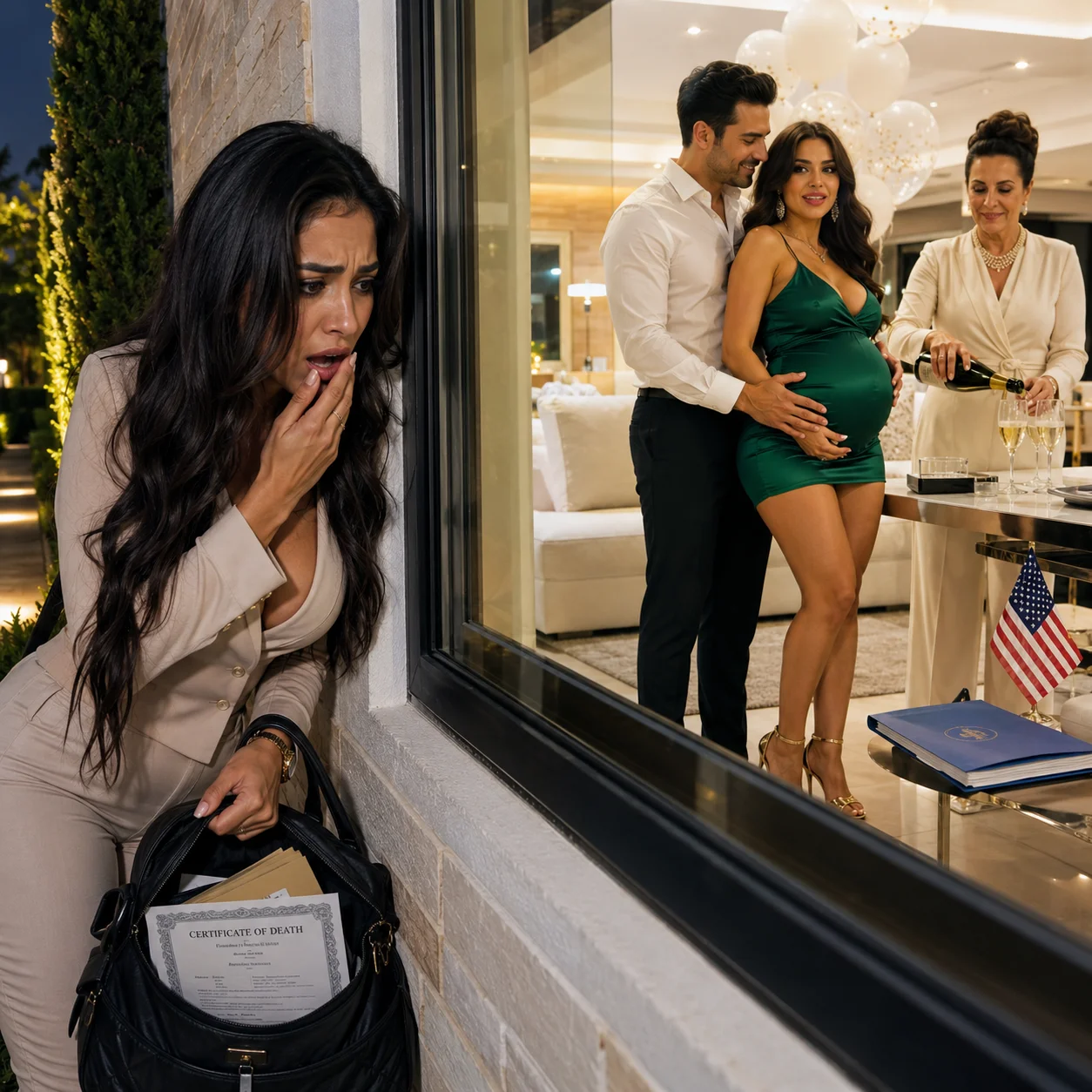
“Señora Valeria,” she whispered. “Don’t go inside.”
“Why?”
She looked toward the living room and swallowed hard.
“Because those papers are not the worst part.”
She opened the bag.
Inside was a copy of my death certificate.
Dated for tomorrow.
Under it was a handwritten note from Andrés.
“After the accident, nobody should find…”
The sentence stopped there.
It did not need to continue.
The blood seemed to drain from my hands. The black bag slipped, and Mariana caught it before it hit the wet grass.
“They don’t want you to leave,” she whispered. “They want it to look like you left.”
I looked back through the window. Andrés was laughing with the pregnant woman. Elvia was holding champagne. The white balloons looked less like a celebration now and more like funeral flowers.
“What accident?” I asked.
Mariana’s lips shook.
“I heard them talking. Tomorrow they were going to move your SUV. They were going to make it look like you regretted leaving and drove back from the airport upset. Something was supposed to happen on the highway to Saltillo.”
I covered my mouth again.
Not from fear this time.
From disgust.
The man who had kissed me on our wedding day was celebrating the process of turning my death into paperwork.
“Why are you helping me?” I asked.
Mariana looked down.
“Because my sister disappeared nine years ago,” she said. “Nobody believed her when she said her husband was threatening her. I will not stay silent again.”
Inside the house, Elvia opened another bottle.
“Tomorrow morning, I want everything ready,” she said. “The abandonment complaint, the transfer documents, and the certificate.”
The pregnant woman’s voice trembled.
“But doesn’t a death certificate need more proof?”
Elvia laughed.
“Everything needs more proof for ordinary people.”
That was when I understood.
This was not just Andrés being cruel. This was not even just a rich family trying to steal from me.
They had help.
Connections.
People who could make false papers move through real systems.
“Mariana,” I said quietly, “I need to get inside.”
Her face went white.
“No. They’ll see you.”
“I’m not going through the door.”
I knew my house better than they did. I knew the low wall beside the laundry room. I knew the study window that never latched properly. I knew the camera by the garden had been useless for months. I also knew the safe in Andrés’s office.
If that blue folder existed, the rest of the evidence had to exist too.
I moved through the side garden, crouched low. The grass was damp, and the smell of wet earth mixed with the distant scent of grilled meat from a neighbor’s terrace. Somewhere in Cumbres, families were eating dinner. Dogs were barking. Cars were pulling into driveways. Life was going on normally.
While my husband toasted my disappearance.
I climbed through the study window.
My heart beat so loudly I was sure they would hear it over the music. Andrés was playing an old Luis Miguel song, one of the romantic ones he used to play when he wanted to make me dance in the kitchen. It is amazing how cruel a song can become when you hear it from the other side of betrayal.
The safe was behind a painting Elvia had given us when we bought the house. Andrés thought I did not know the code.
Poor Andrés.
It was our anniversary date.
Arrogant men rarely change passwords because they cannot imagine the women beside them are paying attention.
The safe opened.
Inside were passports, property documents, an envelope of dollars, a USB drive, and a red folder. I opened the folder with shaking fingers.
Photos of me.
Photos of my SUV.
Screenshots of my location.
A fake ticket to Madrid.
A letter with my forged signature saying I was leaving my marriage because I needed to start over.
And a life insurance policy.
My life insurance policy.
Beneficiary: Andrés Mauricio Landa.
Amount: forty million pesos.
I did not cry.
Some betrayals do not produce tears. They produce precision.
I pulled out my phone and photographed everything. Every document. Every signature. Every page. Then I took the USB drive and slipped it into the lining of my purse.
That was when I heard footsteps.
I ducked behind the sofa just as the study door opened.
Andrés came in with the pregnant woman.
Her name was Paulina. I learned that because he said it in a tone that once belonged to me.
“Don’t get nervous, Pau.”
“What if Valeria suspected something?”
“Valeria suspects everything,” he said. “But she never acts. That’s her problem. She thinks too much.”
I almost laughed.
He continued, lowering his voice.
“Tomorrow my mother sends Saúl for the SUV. He handles the rest. When they find the burned vehicle on the curve, everyone will think she came back unstable.”
Paulina touched her stomach.
“And the body?”
Andrés was silent.
I stopped breathing.
“There doesn’t need to be a body,” he said at last. “Just enough blood, her documents, and the certificate in process. If anyone asks, they’ll say the fire consumed everything.”
Paulina stepped back.
“That’s not fraud anymore, Andrés.”
“Don’t pretend you’re innocent. You wanted this house.”
“I wanted you to divorce her.”
“A divorce gives her half,” he snapped. “A widow can’t claim anything.”
The room went still.
Widow.
The word sounded absurd. I was alive, hiding three meters away from him, listening to him discuss me as if I were already ash.
Paulina started crying.
“I don’t want this.”
Andrés grabbed her arm.
“It’s too late to develop morals.”
She whimpered in pain, and that was when I understood something important.
Not every monster in that house had the same shape.
Paulina knew. But Paulina was afraid too.
When they left the study, I waited ten seconds, then ran back to the window.
Mariana was still outside.
“Call 911,” I whispered. “Tell them there is a woman at risk of homicide, forged documents, and possible illegal confinement. Use my full name.”
“What about you?”
“I’m calling someone Andrés can’t buy.”
I called my brother Daniel.
He was not a lawyer.
He was worse for them.
He was a substitute notary in San Pedro, and he had spent years telling me my marriage smelled like a badly reviewed contract.
He answered half-asleep.
“Vale? What happened?”
“Andrés forged my signature, has a fake death certificate, and is planning to kill me tomorrow.”
Silence.
Then his voice changed completely.
“Send me your location. Do not hang up. I’m coming with Licenciado Treviño and a patrol car if I have to drag one there myself.”
“Bring a handwriting expert if you can.”
“Are you insane?”
“I’m alive,” I said. “That’s different.”
I hung up and moved back toward the living room window.
Elvia was alone now, seated on the white sofa, reading through the blue folder. The woman who had given me two million pesos “to rest” did not look like a worried mother-in-law.
She looked like an administrator of death.
The doorbell rang.
Everyone froze.
Andrés turned off the music.
“Who is it?”
A male voice answered from outside.
“Private security, sir. Someone reported noise in the garden.”
Elvia cursed under her breath.
Andrés walked toward the entrance.
I used the distraction.
I opened the voice recorder app on my phone and placed it inside a planter near the cracked-open window. Then I moved toward the garage.
My SUV was there.
The same SUV that was supposed to burn tomorrow.
Under the driver’s seat, I found a plastic bag containing gloves, a bottle of solvent, and one of my bracelets that had been missing for weeks.
It was no longer a suspicion.
It was a map.
Then I heard shouting.
“Valeria!”
Andrés had seen my reflection in the garage window.
I ran.
Not toward the street.
Toward the security gate.
I had my suitcase in one hand, the documents in the other, and fear biting at my heels. Behind me, Andrés shouted my name with a rage he had never once used to defend our marriage.
“Valeria, stop!”
I did not stop.
The streets of Cumbres rise and dip as if the city is leaning against the mountains. I ran barefoot over the cold pavement, past lit windows and barking dogs, past houses full of people who had no idea a woman was running for her life outside their gates.
The guardhouse was half a block away.
Before I reached it, a black SUV blocked the road.
Saúl.
Elvia’s driver.
The same man who had driven me to supermarkets, doctor appointments, family lunches, and that very airport.
He stepped out slowly.
“Señora, get in,” he said. “Señora Elvia wants to talk.”
“Stay away from me.”
“Don’t make this difficult.”
Then red and blue lights flashed at the end of the street.
One patrol car.
Then another.
Saúl turned his head.
That second saved me.
I threw my suitcase at his legs and ran toward the guardhouse.
The security guard, a young man named Kevin, came out with wide eyes.
“Señora Valeria?”
“Close the gate,” I gasped. “Don’t let anyone leave.”
“What happened?”
“They tried to kill me.”
He did not ask another question.
Sometimes a stranger shows more loyalty than a husband.
The police arrived first. My brother arrived five minutes later in a gray truck, his hair a mess, a folder under one arm. With him was Licenciado Treviño, his mentor, a white-mustached man with the exhausted eyes of someone who had spent decades watching rich people believe consequences were optional.
Daniel hugged me so hard I could barely breathe.
“I told you I didn’t like that bastard.”
“This is not the time to brag.”
“It is,” he said. “But I’ll save it for later.”
The officers entered the house.
Andrés came out with his hands raised, pretending to be confused.
“This is a misunderstanding,” he said. “My wife is unstable. She was supposed to travel, then she came back without warning. She’s paranoid.”
Elvia appeared behind him.
“My daughter-in-law needs psychiatric help,” she said calmly.
I smiled.
Not because it was funny.
Because they had used the exact sentence I expected.
Daniel lifted my phone.
“Then you won’t mind explaining this recording.”
He pressed play.
Andrés’s voice came out clear.
“A divorce gives her half. A widow can’t claim anything.”
Paulina sobbed from the doorway.
Elvia closed her eyes.
Andrés went pale.
The officer in charge looked at him differently after that.
Not like a concerned husband.
Like a suspect.
“Señor Landa,” the officer said, “come with us.”
“You don’t have a warrant.”
Licenciado Treviño cleared his throat.
“They have a present victim, forged documents, a direct recorded threat, and evidence of an active plan. I would not recommend giving a law lecture right now.”
Paulina stepped forward unsteadily.
“I can testify.”
Andrés whipped around.
“Don’t you dare.”
She held her stomach.
“You told me you were only going to scare her. You told me she would sign the divorce. You didn’t say you were going to burn a vehicle.”
Elvia slapped her.
It was quick.
Dry.
Everyone saw it.
Paulina did not hit back.
She simply said, “I recorded too.”
Then she pulled out her phone.
For the first time since I had known her, my mother-in-law stopped looking elegant.
She looked old.
Old with fear.
By three in the morning, we were at the prosecutor’s office. I smelled like wet grass, sweat, and ruined expensive perfume. Someone gave me a paper cup of water in a cold office where the air conditioner hummed like insects.
I gave my statement.
The money.
The trip.
The blue folder.
The life insurance policy.
The forged signature.
The planned accident.
The driver.
The SUV.
The fake death certificate.
Daniel submitted certified copies of my real documents. A handwriting expert reviewed the supposed asset transfer. Licenciado Treviño requested immediate notice to the property registry to block any movement involving the house. He also demanded preservation of security footage from the neighborhood, the airport drop-off, and the private street entrance.
My brother never left my side.
“Where are the two million pesos?” he asked quietly.
“In my suitcase.”
“Perfect. That goes in as evidence.”
“I wanted to throw it in her face.”
“You can,” he said. “But with chain of custody.”
For the first time that night, I laughed.
Not much.
A broken little sound.
But I laughed.
At dawn, Monterrey turned pink behind the mountains. From the window of the prosecutor’s office, I watched the city wake up as if nothing had happened. Buses moved through traffic. Office workers bought coffee. Women stopped for breakfast before work. Somewhere, somebody was making tortillas. The world had the audacity to continue.
At eight, Elvia asked to see me.
I refused.
At nine, Andrés asked to see me.
I refused again.
At ten, Paulina came in.
She looked pale, without makeup, with a jacket pulled over her shoulders. She sat across from me and did not cry.
“I’m not here to ask forgiveness,” she said. “That would insult you.”
I said nothing.
“I’m here to tell you where the rest is.”
She placed a USB drive on the table.
“There are emails, audio files, names. Your mother-in-law has done this before.”
Something cold pressed into my chest.
“What?”
Paulina looked down.
“Elvia’s first husband died in a highway accident. She collected insurance money. Andrés knew. He learned from her.”
The room seemed to shrink.
This was not a desperate plan.
It was inheritance.
A family tradition dressed in good clothes.
Paulina touched her stomach.
“I don’t want my child born into that family.”
I stared at her for a long time.
I did not forgive her.
But I believed her.
Sometimes the truth arrives in dirty hands. You still have to take it.
Three weeks later, the house in Cumbres was sealed. There were no white balloons anymore. No champagne. No music. Just official tape, empty rooms, and the cold silence of a place that had almost become my grave.
I moved into a small apartment near San Pedro with a distant view of Cerro de la Silla and a bed where I could finally sleep without listening for footsteps.
My mother wanted me to live with her.
Daniel wanted to hire guards.
I wanted something simpler.
I wanted to eat breakfast without feeling grateful I had survived the night.
One Sunday, I drove alone to Santiago. I took the road slowly, windows down, mountain air moving through the car. At a small restaurant, I ordered machacado con huevo, warm flour tortillas, and café de olla.
When the waitress asked if I was waiting for someone, I said, “No. Just myself.”
That answer made me cry.
Not loudly.
Just enough to say goodbye to the Valeria who had almost boarded a plane thinking she was escaping a sad marriage, never realizing she was being pushed toward an administrative grave.
Months later, Andrés was formally charged.
So was Elvia.
Saúl testified.
Paulina handed over everything.
The fake death certificate was never used. The forged transfer of assets was voided. The life insurance policy became evidence. The enormous house in Cumbres, the same house where they had toasted my absence, was eventually sold after a long legal process.
I did not keep the walls.
I kept the lesson.
The money Elvia gave me went back into the case file. But before I handed it over, I took a photo of the envelope.
Not because I wanted to remember her.
Because I wanted to remember the exact moment someone put a price on my disappearance.
Two million pesos.
That was what they believed my silence was worth.
How cheap of them to imagine I was stupid.
The last time I saw Andrés was at a hearing. He had grown a rough beard, and his suit was wrinkled. He looked at me as if he were still searching for a crack in my face, some soft place where his old voice might enter.
“Valeria,” he said, “I loved you.”
I looked at him without anger.
Anger had already done its work.
“No, Andrés,” I said. “You loved what you could take from me.”
He looked down.
I did not.
Outside the courthouse, Daniel was waiting with two coffees and a tired smile.
“Where to, sister?”
I looked up at the northern sky, washed clean after rain.
“The airport.”
He froze.
“What?”
I smiled.
“This time, I really am going to Europe.”
“Alone?”
I breathed in slowly.
I remembered Elvia’s champagne glass. Andrés’s laughter. The black bag. The fake certificate. My SUV waiting to burn on a curve. Then I thought of Paris. Madrid. Walking without anyone measuring my steps.
“Yes,” I said. “Alone.”
But this time, I was not going to disappear.
I was going to find myself.
And when the plane took off, I looked through the window at the lights of Monterrey shrinking beneath the night.
I did not feel afraid.
I felt something stranger.
Freedom.
The same freedom they tried to forge with my signature.
The same freedom they could not burn.
The same freedom that carried my real name, written by my own hand.
![[FULL STORY] My girlfriend claimed monogamy was a "patriarchal prison" and invited her guru into our bed, so I quietly vacated her life and handed the keys](https://social-media.rabedo.com/thumbnails/1777346368_M4.png)
![[FULL STORY] My girlfriend’s best friend shocked me with a phone call at the exact moment when I had finished all](https://social-media.rabedo.com/thumbnails/1776929710_27.png)