“She killed me off because it was convenient.”
Nobody spoke.
Outside, a combi honked, and a man passed by shouting that he was selling tamales de rajas and mole. Life continued in the street as if another lie hadn’t just shattered inside our house.
Doña Mercedes pulled out another photograph.
In it, my mother was holding newborn Lucía. Doña Mercedes stood beside her, younger, her eyes swollen from crying, her hands resting on her daughter’s shoulders.
“Rosa left my house when she was seventeen,” she said. “She fell in love with a man who worked unloading boxes at the Central de Abasto. I begged her not to go. She told me I only wanted to control her life.”
Lucía stared at the picture like she was looking at her own birth certificate.
“When you were born, she came back to me for two months. I changed you, bathed you, rocked you to sleep. Then one day she went out to buy milk and never came back.”
“And you didn’t look for her?” Lucía asked, anger cracking through her voice.
“I looked for years. I went to the police, to hospitals, to the Civil Registry, to San Lucas parish, to the streets around Cerro de la Estrella. I asked in markets, in tenements, in repair shops. Then one day I saw her here in Iztapalapa, holding your hand, with Diego in her belly.”
My chest tightened.
“Then why didn’t you tell us?”
Doña Mercedes looked at me with a shame that seemed decades old.
“Because Rosa swore that if I said one word, she would take all of you far away. She told me, ‘If you come near them as their grandmother, you will never see them again.’ So I rented the house across the street. I swallowed my name. I became the neighbor.”
Lucía covered her face with both hands.
I wanted to be angry. But then I remembered every time Doña Mercedes gave us rice, sewed a button, lent us money for school copies, cleaned our scraped knees with peroxide, and called us mijo before anyone else did.
She wasn’t our neighbor.
She had been our grandmother in silence.
The social worker picked up the documents more carefully now.
“Can you prove the relationship?”
“Yes,” Doña Mercedes said. “Rosa’s birth certificate. My identification. Photographs. Reports. And there’s more. I also have vaccine receipts, school records, and notes from every time Rosa left the children alone.”
Lucía raised her head.
“You reported her?”
“Three days ago.”
The air turned heavy.
“Is that why she left?” I asked.
Doña Mercedes nodded.
“I confronted her when I saw the man she was with. He isn’t a stranger, Diego. His name is Efraín Salgado. I saw him years ago at the Central de Abasto, involved in trouble, collecting debts, threatening vendors. I told your mother I would not let her bring that man near this house.”
Lucía swallowed.
“She said he was going to help us.”
“That man doesn’t help,” Doña Mercedes said. “That man takes whatever he can sell.”
Ana started crying quietly.
Mateo covered Sofi’s ears, even though he was shaking too.
The social worker stood.
“This changes the situation. I can’t promise anything right now, but if you are the maternal grandmother and there is a support network, we can request an urgent evaluation. The goal is not to separate children just for the sake of separating them.”
Lucía wiped her tears with the back of her hand.
“Then don’t take them.”
The woman looked at her differently then. Not with pity. With respect.
“I’m not taking anyone today,” she said. “But you need to understand something. From this moment on, the home must be supervised. Señora Mercedes must appear tomorrow at the Child Protection Office. So must you, Lucía. And if your mother returns, you do not hand over any child without notifying us.”
Lucía nodded.
For the first time in weeks, I felt air come through the window.
But Doña Mercedes did not look relieved.
That night, we ate broth with rice and lime. Steam fogged the windows, and Samuel fell asleep against Lucía’s chest with his little mouth open.
It almost felt peaceful.
But in Iztapalapa, you learn early that peace is sometimes just the street taking a breath before the next blow.
Around eleven, someone knocked on the door.
Three hard knocks.
Lucía stood up.
Doña Mercedes set her cup on the table without making a sound.
“Nobody opens,” she whispered.
The knocking came again.
“Lucía!” my mother shouted from outside. “Open the door. I came for my children.”
Ana clung to my arm.
Doña Mercedes walked to the door but didn’t unlock it.
“Rosa, leave. We’ll talk tomorrow at the DIF.”
“Don’t call me Rosa!” my mother screamed. “And stay out of this, old woman.”
Then a man’s voice sounded behind her.
“Tell them to open before I make them.”
Lucía hugged Samuel tighter.
I crept toward the window and lifted the curtain just enough to see.
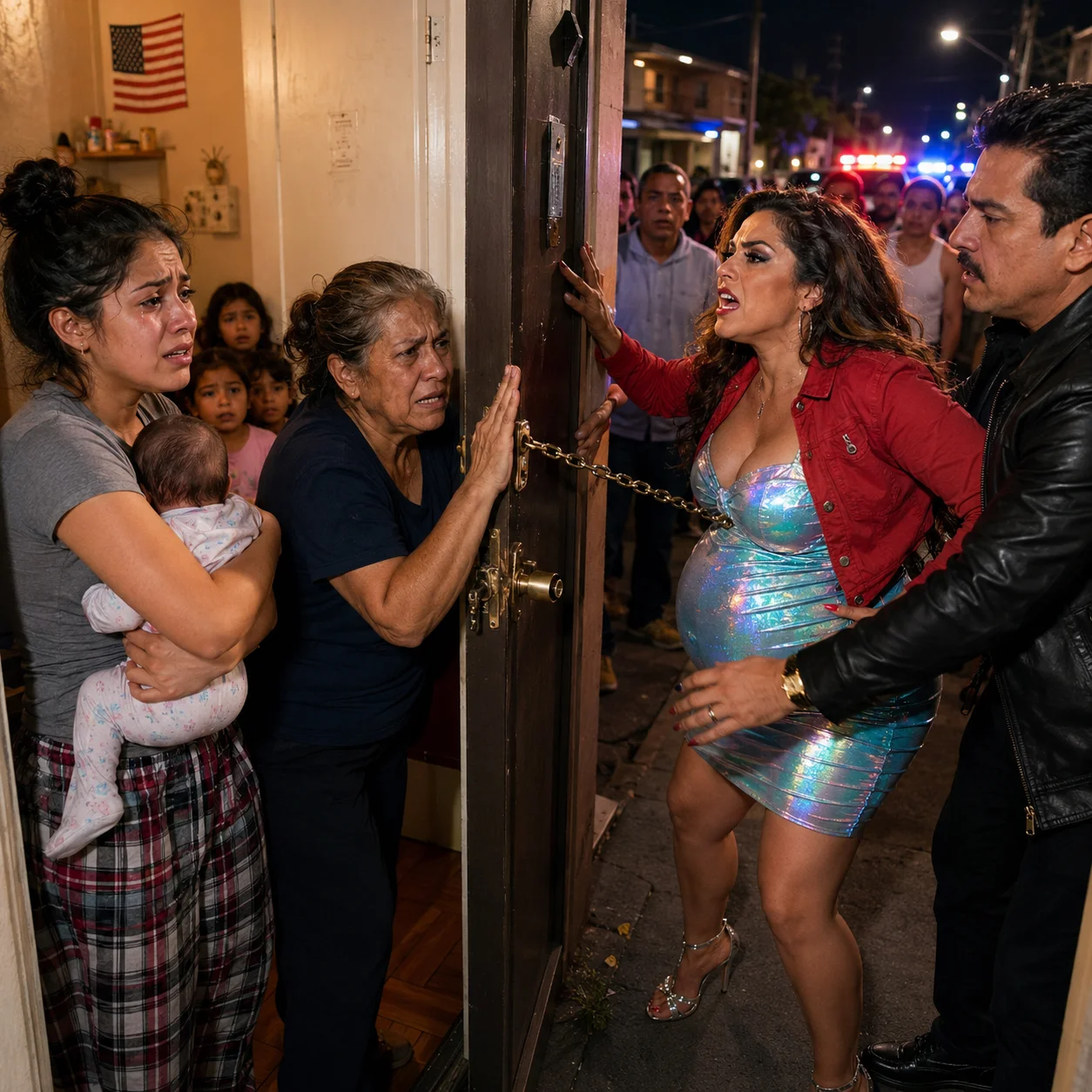
There was my mother, disheveled, wearing a red jacket, her pregnancy showing beneath her blouse. Beside her stood a tall man with a mustache, looking at our house as if it already belonged to him.
“I need the baby’s birth certificate,” my mother said. “And the vaccination cards. We’re leaving.”
Doña Mercedes went pale.
“Why do you need their papers?”
The man struck the metal gate.
“For whatever we need them for, señora. Don’t ask so many questions.”
Lucía stepped forward.
“Samuel is not leaving this house.”
My mother laughed.
“You don’t decide that. You’re not his mother.”
Lucía opened the door before we could stop her, but she kept the chain on.
Her face no longer looked like that of an exhausted girl. It looked like the face of someone who had carried fever, hunger, homework, diapers, and fear.
“I’m not his mother,” she said. “But I’m the one who stayed.”
My mother went silent for one second.
That silence hurt more than her yelling.
“Move,” Efraín ordered.
He shoved his hand through the opening and yanked at the chain. Doña Mercedes threw her whole body against the door.
“Diego, call 911!”
My fingers shook so badly I almost dropped the phone. I dialed as fast as I could. When the operator asked what the emergency was, I spoke all at once, stumbling over my words, crying without realizing it.
“My mother is trying to take my brothers and sisters. She’s with a man. We’re in Iztapalapa. There are children. There’s a baby.”
The man kicked the door.
The twins screamed.
Then something happened that I still remember like a scene from Holy Week at Cerro de la Estrella, when the whole neighborhood comes out and nobody walks alone.
A neighbor whistled from a rooftop.
Then another neighbor came out holding a flashlight.
Then Don Beto from the corner store lifted his metal shutter halfway.
“Everything okay, Mercedes?” he shouted.
Efraín turned, irritated.
In less than two minutes, the street filled with eyes. Women in shawls. Boys in flip-flops. A man still wearing his taquería apron. Two students coming down from the Cablebús with backpacks over their shoulders.
Nobody attacked.
But nobody left.
Doña Mercedes’s support network wasn’t just written in her notebook.
It was alive.
My mother looked around nervously.
“Let’s go,” she told Efraín.
But he didn’t want to leave empty-handed. He stepped toward the door again and spoke low, his voice full of poison.
“Rosa, either you get those papers, or you remember what you owe.”
Doña Mercedes heard him.
So did Lucía.
My mother broke right there.
She grabbed her belly and started crying with an ugly sound, like a wounded animal.
“I can’t,” she said. “I can’t handle all of them.”
Lucía didn’t cry.
She only looked at her.
“We already knew that.”
My mother lifted her face.
“You don’t understand. They were going to kill me if I didn’t pay. Efraín said with the papers we could leave, get support, start over in Puebla, I don’t know…”
Doña Mercedes opened the door as far as the chain allowed.
“Children are not currency, Rosa.”
My mother looked at Samuel.
For one instant, I saw something like love in her eyes. But it was weak love. Tired love. Love defeated by her own selfishness.
“Let me hold him,” she begged.
Lucía stepped back.
“No.”
It was a small word.
But it held the whole house together.
The patrol car arrived with red and blue lights painting the peeling walls. Behind it came a DIF vehicle. The same social worker climbed out, her hair tied back in a hurry, the same folder from earlier tucked against her chest.
Efraín tried to walk away casually.
Don Beto stepped in front of him.
“Hold on, jefe. The authorities are here.”
Efraín shoved him.
That was enough.
The police detained him beside the newspaper stand while he shouted that he hadn’t done anything. My mother stayed in the middle of the sidewalk, hugging herself, not running, not defending him.
The social worker approached Lucía.
“Is everyone okay?”
Lucía nodded, but then her knees gave out.
I caught her.
It was the first time I realized my sister—the wall—could collapse too.
That night, we went to the prosecutor’s office.
Doña Mercedes carried her yellow folder like someone carrying a candle through a storm.
The waiting room smelled like burnt coffee, sweat, and old papers. Samuel slept on a blanket. Ana rested her head on my shoulder. The twins held each other the way they used to when they were smaller.
My mother gave a statement.
She didn’t make a beautiful apology. She didn’t give a speech. She only admitted that she had left, that she had abandoned seven minors under Lucía’s care, that Efraín was pressuring her, and that she had no way to care for us.
Lucía’s chin trembled when she heard it.
Not because it was a surprise.
But because sometimes the truth hurts more when someone finally signs it.
By morning, the city began to wake up. Buses passed. Vendors sold atole. Women hurried toward Metro Constitución de 1917. Students walked by with wrinkled uniforms. From the window of the building, I could see the stubborn gray June sky over the rooftops of Iztapalapa.
The social worker explained that there would be hearings, home studies, visits, paperwork, and many signatures. She used difficult words: provisional care, family network, psychological follow-up, protection measures.
I understood only one thing.
They were not separating us that morning.
When we returned home, Doña Mercedes made café de olla with cinnamon. Lucía sat in a chair and stared at her hands.
“I’m scared,” she finally said.
Doña Mercedes tucked a strand of hair behind her ear.
“Of course you’re scared, mija. Brave girls get tired too.”
“I don’t know how to be a mother.”
“Then don’t be a mother,” Doña Mercedes said. “Be their sister. I’ll be their grandmother. And together we’ll do whatever is missing.”
Lucía cried like I had never seen her cry before.
Not hidden in the bathroom.
Not with the faucet running.
Not swallowing the sound.
And that time, nobody asked her to be strong.
Months passed.
The DIF came back many times, but they no longer arrived like a threat. They came to check that there was food, school attendance, vaccines, beds, schedules. Doña Mercedes had everything written in her notebook: who took Ana to primary school, who picked up the twins, when Samuel had his medical appointment, which neighbor could help when Lucía had to work.
The woman from the quesadilla stand saved tortillas for us.
Don Beto let us buy milk on credit and then pretended to forget what we owed.
A teacher found used uniforms.
At Utopía Meyehualco, Ana joined a drawing workshop and Jorge started playing soccer.
Lucía learned to use the community washing machines without feeling that asking for help was a defeat.
I began working Saturdays stacking boxes at a shop near the Central de Abasto. It wasn’t much, but I came home with ripe bananas, bruised tomatoes, and mangoes nobody bought because they were too sweet.
Doña Mercedes turned those things into miracles.
Jam.
Agua fresca.
Soup.
Life.
My mother never came back to live with us.
We saw her a few times in offices, with dark circles under her eyes and her belly growing. Sometimes she cried. Sometimes she got angry. Sometimes she promised things none of us dared to believe anymore.
When her baby was born, she did not bring him to us to raise.
That was the first decent decision I ever saw her make.
She entered a support program and signed papers allowing us to remain under the provisional care of Doña Mercedes, with Lucía as the adult responsible inside the home. It wasn’t a soap-opera happy ending. It was slower, harder, more complicated, more real.
But it was ours.
One year later, the judge authorized us to stay together permanently.
I remember walking out of the building and seeing Lucía stop on the sidewalk, staring at the paper as if it weighed more than Samuel.
“Is it done?” Ana asked.
Doña Mercedes smiled.
“It’s done.”
The twins shouted.
Jorge threw his arms into the air.
I didn’t say anything because there was a knot in my throat. I only hugged Lucía, and she hugged me the way she had when I was little, even though by then both of us had grown up too fast.
That night, we didn’t have a big party.
We had mole de olla, red rice, warm tortillas, and soda in mismatched cups. Doña Mercedes placed the yellow folder in the middle of the table, no longer tied with the red ribbon.
“We don’t keep this to suffer,” she said. “We keep it to remember that the truth can also protect.”
Lucía looked at her.
“Can I call you Grandma?”
Doña Mercedes covered her mouth.
Samuel, who had learned to walk by holding onto chairs, tugged at her skirt and said the closest thing he could manage.
“Bela.”
Something broke inside all of us then.
But this time, it wasn’t pain.
It was roots.
Sometimes I think about my mother.
Not with hatred every day. Hatred is exhausting, and we had already lived tired for too long.
I think of her the way someone thinks of an abandoned house—with sadness, with caution, and with no desire to sleep there again.
And I think about Doña Mercedes, sitting down that afternoon with her hot pot of soup and her yellow folder. She could have stayed a neighbor. She could have closed her door. She could have said it wasn’t her problem.
But in Mexico, in neighborhoods where the sun hits hard and life is earned peso by peso, family does not always arrive first through blood.
Sometimes it arrives by knocking on the door.
With broth.
With papers.
With the courage to tell the truth when everyone else would rather hide it.
I was twelve when my mother left.
I was also twelve when I learned that not every abandonment is an ending.
Sometimes it is the exact place where someone else walks in, sits at your table, holds the crying baby, and says:
“These children are not alone.”
And then, even when the world tries to separate you with a pen, a signature, or a lie, an old wrinkled hand appears holding a yellow folder.
And somehow, that hand is enough to begin again.
![[FULL STORY] She Cheated With Her Ex “To Test Her Feelings” — Then Came Home to Changed Locks and Packed Bags](https://social-media.rabedo.com/thumbnails/1777130363_132ada15-d2b4-4648-9b01-869029cca635.png)
![[FULL STORY] My Fiancée Posted Photos From Her "Secret Weekend Getaway" Wearing An Engagement Ring I Didn't](https://social-media.rabedo.com/thumbnails/1777365603_15.png)
![[FULL STORY] My Wife Said She Needed “Girls’ Nights” Every Weekend — So I Followed Her and Found Her Ex Waiting at a Hotel](https://social-media.rabedo.com/thumbnails/1776420749_5bb60e6f-4512-40e7-8148-47d3036df143.png)