
No answer.
I walked toward the patio.
And there she was.
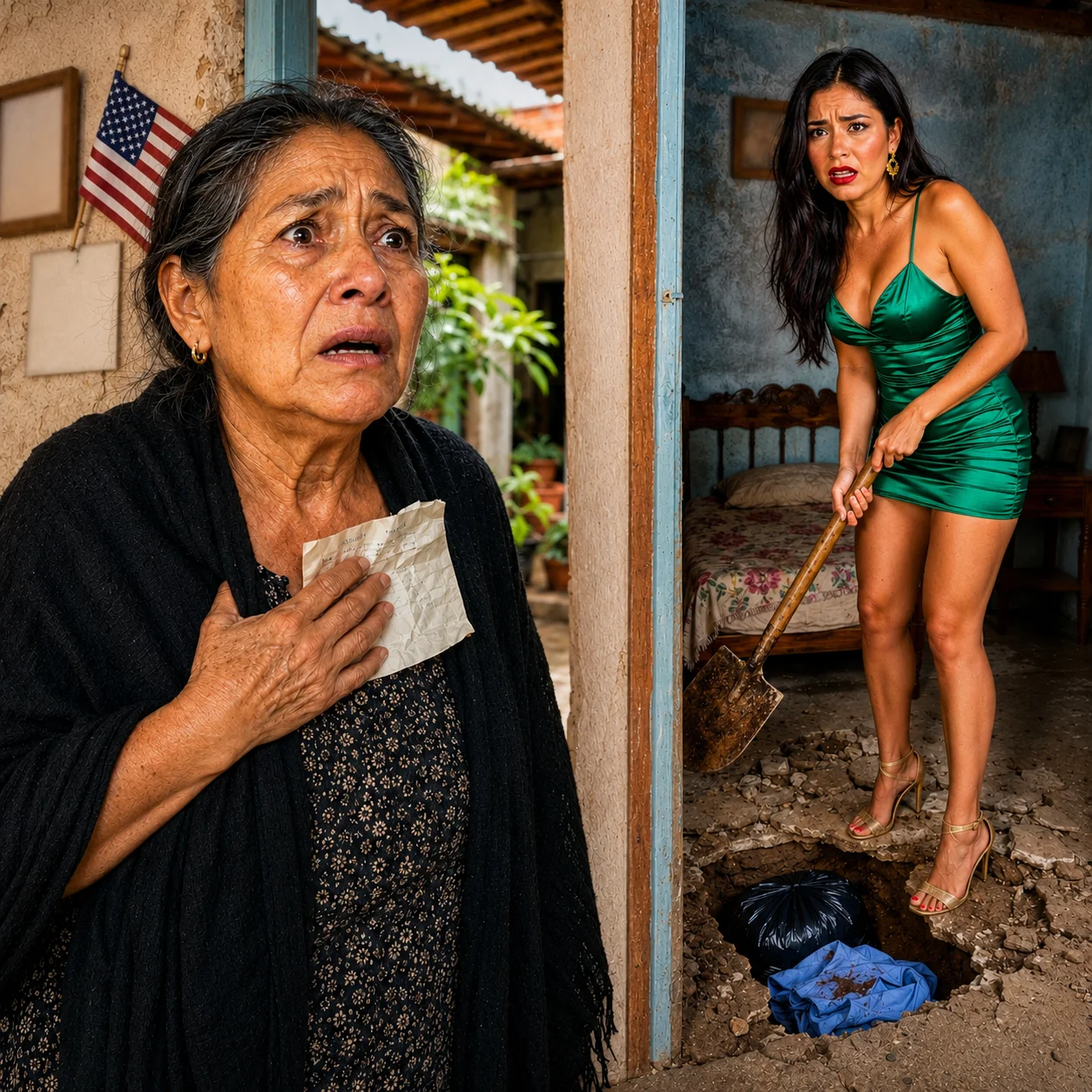
My daughter-in-law stood outside Julián’s old room, her hair tied up in a hurry, both hands gripping a rusty shovel against her chest.
That room had been locked since the day he left. I kept it that way because some foolish part of me believed that preserving his shirts was the same as preserving his life.
Maribel froze when she saw me. Her red-painted mouth trembled like a candle flame at a funeral.
“What are you doing?” I asked.
My voice came out so low it frightened even me.
She tried to hide the shovel behind her skirt, as if I were blind.
“Nothing, Teresa. I was looking for a metal rod to fix the washing machine.”
“With a shovel?”
She did not answer.
Then I saw something that chilled me more than the bank paper ever could.
On the floor inside Julián’s room was an open black plastic bag. A blue shirt stuck out from it, stained with old brown marks.
The same blue shirt my son had been wearing the last day I saw him.
I stepped toward the room.
Maribel blocked me.
“Don’t go in,” she said.
“Move.”
“You don’t know what you’re doing.”
“What I don’t know,” I said, “is what you did to my son.”
The word son struck her across the face harder than any slap.
For the first time in six years, I saw her eyes break.
“Julián is alive,” she whispered.
But she said it the way people say lies when there is nowhere left for them to hide.
I lifted the bank paper, damp from my sweat.
“Then explain why my son has been sending me money from Fresno Street, Maribel.”
She looked at the paper.
And little by little, her body seemed to crumble, like wet adobe in the rain.
The shovel slipped from her hands and hit the floor with a dry metallic crack that made the neighbor’s dogs start barking.
“It wasn’t my fault,” she said.
Those five words opened a hole beneath my feet deeper than any grave.
“Where is Julián?”
Maribel covered her mouth.
But it was too late.
The silence of the house answered before she did.
A smell drifted out of the room. Not bleach. Not dampness.
Something old.
Something rotten with secrecy and disturbed earth.
I shoved Maribel aside with a strength I did not know I still had and stepped into my son’s room.
The walls still held the stickers Julián had put up as a boy — wrestlers, a calendar with pickup trucks, a Virgin of Guadalupe darkened by dust.
But the bed was gone.
In its place, floorboards had been lifted, and beneath them was a rectangular patch of broken cement.
I fell to my knees. I ran my fingers along the edge of the cracked floor and found a small piece of blue fabric caught in the dirt.
I did not cry.
Some pain does not leave through the eyes. It enters the bones and stays there, scratching.
“Teresa,” Maribel whispered behind me. “Let me explain.”
I turned slowly.
“You are going to tell me everything,” I said. “And if you forget one single thing, I swear on my husband’s cross I will scream until all of Zamora comes running.”
Maribel closed the patio door, not to trap me, but to keep the neighbors from hearing her confession.
Then she sat in Julián’s old chair — the one where he used to polish his boots on Sundays — and finally took off the mask she had worn for six years.
“Julián never made it to Houston.”
The room tilted.
“That night, he really was going to leave,” she said. “But before he did, he came here to say goodbye to me.”
I remembered that night like people remember an illness. Julián kissed my forehead early in the evening and told me he was going to buy tortillas.
He never came back.
“He told me he didn’t want to cross anymore,” Maribel continued. “He said he was scared. He said you needed a living son more than dead dollars.”
For one second, I wanted to cling to those words like a branch in a river.
But Maribel kept talking, and the branch broke in my hands.
“I got angry because I had borrowed money from some men to pay the coyote. Men who don’t forgive debts.”
“What men?”
Her eyes dropped to her freshly painted nails.
“The Riveras.”
That was when I understood.
18 Fresno Street.
Servicios Rivera was not a real business. It was a front for Don Ramiro Rivera, the man who lent money, collected favors, and smiled at mass with hands full of sins.
“I owed him too much,” Maribel said. “Julián didn’t know all of it.”
“All of what?”
She hugged her stomach, even though Mateo was six years old now and asleep at a neighbor’s house.
“Mateo wasn’t on the way yet.”
I stared at her.
“When I told you I was pregnant, I wasn’t sure.”
“But Julián…”
“Julián wanted to leave because he thought I had betrayed him.”
The room began filling with things spoken too late, invisible blows, truths with teeth.
“He found old messages from Ramiro on my phone,” she confessed. “From before I married Julián. But he didn’t believe they were old.”
I knew my son.
He was noble, but he carried his father’s pride — the kind of pride that does not know how to ask questions without wounding.
“That night, he came here for clothes,” Maribel said. “I begged him not to leave. Then Ramiro showed up behind me.”
“Ramiro was in my house?”
“Yes.”
I stood so fast the chair struck the wall.
“And you let him in?”
She cried without sound.
“I didn’t know he was armed.”
The air turned to stone.
Maribel said Julián tried to throw Ramiro out. Ramiro laughed at him and told him no man kept a woman in debt without expecting payment. Julián hit him first. Ramiro fell against the dresser.
Then he pulled out a small gun, the kind that could fit inside a grocery bag.
The shot exploded inside that room.
I looked at the cracked floor and, for the first time, heard in my head the echo of the gunshot I had never heard.
“He killed him here?”
Maribel shook her head desperately.
“He didn’t die right away, Teresa. I swear.”
“Do not swear to me.”
“Julián grabbed my hand and told me to take him to you.”
That was when a sound tore out of me.
Not a sob.
Something animal. Something wounded living in my throat.
“Then why didn’t you bring him to me?”
“Because Ramiro said if we went out, he would kill both of us. And if you opened your mouth, he would kill you too.”
She told me they wrapped Julián in a blanket. Ramiro called two men, and together they lifted the floor in that room while I slept only six steps away in the front bedroom, feverish from a throat infection.
I had slept six steps from my dying son.
Six steps.
My entire life fit inside those six steps I did not walk.
“At dawn, Ramiro told me what would happen,” Maribel said. “He said Julián had crossed the border. He said you had to believe it. Every month, he would send money so no one would ask questions.”
“And you accepted?”
“I was afraid.”
“No, Maribel. I have been afraid for six years, and still I did not bury anyone under my own house.”
She pressed both hands to her face.
“Then Mateo was born.”
“Is he Julián’s son?”
Maribel took too long to answer.
That silence burned worse than any word.
“I don’t know.”
It bent me.
But it did not break me.
A mother learns to stay standing even after the floor has been ripped out from under her.
I turned back toward the broken cement and began pulling pieces loose with my bare hands.
Maribel tried to stop me.
“No, Teresa, please. Ramiro is coming today.”
I went still.
“Why?”
“To take what’s left.”
I looked at the shovel.
“That’s why you had it.”
She nodded, shaking.
“The bank teller is his niece. I think she panicked after you asked too many questions.”
Then I understood the hurry.
The bleach.
The black bag.
The shovel.
The fear.
Ramiro was coming to erase my son for a second time.
I did not think like an old woman. I did not think like a broken mother or a woman who sold gorditas for a living.
I thought like Teresa Aguilar, daughter of a farmer who once taught me that when a snake enters your home, you do not step on its tail.
You cut off its head.
“What time does he arrive?”
“At night.”
I looked toward the window. The sun was setting orange over the water tanks.
I had only a few hours to unbury a truth that had been breathing under my house for six years.
I went to the kitchen, washed my hands, put on the black shawl I used for funerals, and tucked the bank paper inside my bra.
Then I called Doña Chayo, the neighbor who saw everything and forgave very little.
“Chayo,” I said, “I need you to come with your phone charged. Do not ask questions.”
I also called Father Anselmo, not because I trusted priests more than anyone else, but because in a town like ours, the presence of a priest makes even cowards lower their voices.
Then I went to get Mateo.
He was playing marbles on the sidewalk, knees scraped, Julián’s smile planted on his face.
When he saw me, he ran into my arms.
“Abu, did money come from my dad?”
That question split me in places I did not know were still whole.
I knelt in front of him and smoothed his hair.
“Your father sent you something more important, mijo.”
“What?”
“The truth.”
He did not understand.
But he hugged me tighter, as if his blood did.
I left him with Doña Chayo and told her not to let him go even if the sky caught fire.
By nine that night, the house was dark.
But it was not empty.
Father Anselmo hid in the kitchen with his phone recording. Doña Chayo waited behind the patio curtain. I sat in Julián’s old chair.
Maribel stood near the door, pale, holding the shovel like it was her own sentence.
At nine-thirty, three knocks struck the door.
Not visitor knocks.
Owner knocks.
Maribel opened it.
Ramiro Rivera entered wearing a white hat, an ironed shirt, and the calm smile of a man who believed the world belonged to him. Two men followed — one heavy with a mustache, the other thin with a scar on his cheek.
“Good evening, Teresita,” Ramiro said, as if he had come to buy gorditas on credit.
“Don Ramiro.”
He looked around and sniffed the air.
“I heard you were asking questions where you shouldn’t.”
“Asking about a son is never wrong.”
He laughed softly.
“Oh, mothers. Always thinking giving birth gives them rights over the dead.”
Maribel stepped back.
I stood up.
“So you admit he is dead.”
His smile vanished.
“Do not play with me.”
“I am not playing. I have spent six years mourning without a grave.”
Ramiro came close enough for me to smell his expensive cologne mixed with tobacco.
“Your son was stubborn, Teresa. Stubborn men die young.”
The whole world seemed to go silent to hear that confession.
“Repeat that.”
“What for, old woman?”
“So God can hear it clearly too.”
Ramiro raised his hand to strike me.
Before he could touch my face, Maribel stepped between us.
“Enough, Ramiro.”
He shoved her against the wall.
“You shut your mouth. We are here because of you.”
Then the thin man saw a shadow move in the kitchen.
“Boss.”
Everything happened in a blink.
Father Anselmo stepped out with his phone raised. Doña Chayo threw open the front door and screamed with the cracked-bell voice she had carried since youth.
“Neighbors! Come! The murderer of Julián Aguilar is here!”
Lights along the street flickered on one by one.
Ramiro pulled out his gun.
I did not run.
Maybe because I had already been killed six years ago and was only now learning it.
“Lower that,” Father Anselmo said.
Ramiro aimed at him.
But Maribel grabbed the shovel with both hands and struck Ramiro’s wrist.
The gun went off into the ceiling, sending dust and a metallic shriek through the room.
The two men rushed forward, but Doña Chayo came from the kitchen with a pot of boiling beans and the aim of a miracle. She threw it at the heavy one.
He fell screaming.
The thin one ran into the street and found half the block filming with their phones.
Ramiro dropped to his knees, clutching his broken hand.
I picked up the gun with more disgust than fear.
“Where did you bury what was left of my son?”
He spat near my feet.
“Under you, old woman.”
I needed nothing else.
The neighbors flooded into the house, but no one touched the floor until the municipal police arrived. I did not trust them, but by then the video had already been posted in every group chat in town.
Even people who used to look away arrived pretending to be shocked saints.
At midnight, they broke the cement.
I stood there without blinking.
First they pulled out the rotten blanket.
Then a leather belt.
Then the buckle with J.A. on it, the one I had given Julián when he turned twenty.
When the first bone appeared, Maribel fainted.
I did not.
I knelt and pressed my forehead to the earth.
“Forgive me, hijo,” I whispered. “For sleeping so close and so far away.”
No one spoke.
Even the police lowered their heads.
By dawn, they took Ramiro away in handcuffs, though he kept saying he had powerful friends and that an old woman who sold gorditas would never destroy him.
He did not understand.
Old women from small towns do not destroy.
We bury.
Maribel woke in the patio with Mateo crying beside her.
The boy did not understand why everyone was staring at his father’s room as if it were a broken church.
“Abu,” he asked me, “was my dad there?”
I pulled him against my chest.
I wanted to lie. I wanted to invent another Houston, another north, another sky filled with dollars and missed phone calls.
But lies feed monsters.
“Yes, mijo,” I said. “He was there.”
Mateo cried in the small confused way children cry when they do not yet understand the size of a loss.
“Why didn’t he come out?”
Maribel broke when she heard that.
I closed my eyes.
“Because bad men wouldn’t let him. But we found him now.”
The boy looked at his mother.
“Did you know?”
Maribel reached for him.
Mateo stepped behind my skirt.
That was her hardest sentence.
Not prison.
Not the neighbors.
Not the cameras.
The small back of her own child turning away from her.
In the days that followed, my house filled with investigators, forensic workers, praying women, and curious people who had once called me dramatic for refusing to stop talking about Julián.
The bank teller, Lucía, gave a statement.
She admitted she had noticed strange movements because Servicios Rivera deposited money every month with the exact same reference phrase. Ramiro had dictated the message himself to keep a dead man alive just enough that no one would search for him.
She said she took the risk because her own mother had taught her that no amount of money was worth more than an unmarked grave.
Because of Lucía, we learned that Ramiro had not sent the money out of guilt.
He had sent it as a leash.
As long as I believed Julián was in America, my house stayed quiet. Maribel obeyed. Mateo grew under his shadow. No one asked about the gunshot.
The money was a gag.
Every deposit said, “Don’t break.”
But what it really meant was, “Don’t look.”
I put every receipt in a shoebox and carried them to the prosecutor’s office.
They tried to exhaust me with forms, stamps, delays, and bored faces.
But every morning I returned with my bag of gorditas, my black shawl, and Julián’s photo pinned to my chest.
“I will be here,” I told them, “until my son weighs more than your papers.”
The news spread.
Mothers from other towns came to my stand.
One had been searching for her boy for ten years.
Another carried one of her son’s shirts in a plastic bag, still smelling faintly of soap.
Another did not speak at all. She only held my hand.
That was when I understood my grief was not one lonely house.
It was a whole street.
A whole country.
Rooms full of people waiting beside locked doors.
Julián’s funeral was on Sunday.
We could not bury a complete body, but we laid out his blue shirt, his belt buckle, one blessed bone, and the truth that finally had a name.
It seemed like all of Zamora passed before that small coffin.
Some cried from sorrow.
Others from shame.
Maribel came at the end, dressed in black, her face bare, her hands empty.
No one threw her out.
Neither did I.
She knelt before the coffin and said something only I heard.
“Forgive me, Julián. I was a coward.”
I stepped close.
“Yes,” I said. “You were.”
She lifted her face, waiting perhaps for me to slap her.
“But you are going to live long enough to pay your son with truth for what you stole from him with fear.”
Maribel agreed to testify against Ramiro.
She gave names, dates, debts, threats, and the place where they burned Julián’s wallet.
She did not do it because she was brave.
She did it because Mateo did not call her mamá for three weeks.
Sometimes love arrives late.
But it arrives bleeding.
Ramiro tried to use his influence.
One commander came to my food stand and suggested I should let things rest.
I handed him a hot gordita and said, “If you come here to threaten me again, the next sign I hold outside the prosecutor’s office will have your name on it.”
He did not return.
A month later, Servicios Rivera closed.
Someone hung a white banner with red letters across the door.
“Here, the truth of Julián Aguilar was buried.”
No one knew who put it there.
I did.
But women in my neighborhood also know how to keep quiet when justice needs a little help.
The house changed after that.
I had the entire floor of Julián’s room removed. Then I planted a lemon tree in the patio, exactly where the hole had been.
Father Anselmo said it was not customary to plant trees in places of death.
I told him worse customs existed, like leaving the dead without flowers.
Mateo helped me with the soil.
Every afternoon, he watered the lemon tree and told his father things about school, as if roots were a telephone.
“Today I learned division, Papá.”
“Today I got into a fight, but I didn’t start it.”
“Today my grandma burned the gorditas.”
I listened from the kitchen and pretended not to cry.
Maribel moved in with her sister while the case continued. She came every Saturday to see Mateo, always in the living room, always with the door open.
The boy took a long time to approach her.
One day, he asked if Julián was really his father.
Maribel looked toward the lemon tree.
“Your father was the man who waited for you without knowing you,” she said. “The man who loved you before you were born. The man who died wanting to return to his mother.”
Mateo did not understand everything.
But he understood what mattered.
Blood matters, yes.
But some loves become a surname even when no paper writes them down.
That day, Mateo let Maribel touch his hair.
He did not forgive her.
Children do not forgive with speeches.
They forgive by staying a little longer.
The trial began when the lemon tree gave its first flowers.
I testified in front of Ramiro without lowering my eyes.
He looked older, thinner, without his white hat and without the men who once walked behind him.
When the judge asked what I wanted, everyone expected me to say justice.
But I said, “I want the whole truth.”
I told them about the deposits, the teller, the shovel, the room, the shirt, and those six steps that separated me from my son’s last breath.
Ramiro did not look at me.
Cowards only look directly at people when they are holding a gun.
He was convicted.
Not for as many years as he deserved, because the law sometimes measures with a teaspoon what a mother carries by the ton.
But he was convicted.
Maribel received less time because she testified and because the threats had been documented.
I did not clap.
I did not smile.
I did not feel relief.
Justice does not resurrect anyone. It only arranges the bones of the world a little straighter.
The night I came home from court, I sat beneath the lemon tree with Mateo asleep across my lap.
The air smelled like wet soil and new flowers.
For the first time in six years, I did not wait for a deposit.
I did not check my phone.
I did not calculate how much Julián would send or what message would appear in the reference line.
I took the Saint Jude medal from my apron and hung it on a branch.
“I won’t break anymore, hijo,” I whispered.
The lemon tree moved though there was no wind.
Maybe it was nothing.
Maybe it was Julián, finally settling into a place where his mother could find him without digging.
Since then, I still sell gorditas on the same corner.
People ask me how I stay standing.
I tell them I do not stand because I am strong.
I stand because Mateo watches me.
He is growing fast. He has Julián’s eyes, somebody else’s laugh, and a sadness that sometimes appears when he sees buses heading north.
When he asks about America, I tell him not every north is far away.
Sometimes a person’s north is the truth.
Sometimes crossing a border means opening a locked door in your own house.
And sometimes a son does not come back with a suitcase, dollars, or gifts.
Sometimes he returns as roots so his mother does not sink.
The last transfer arrived two weeks after the sentencing.
I never found out who sent it.
The reference line was different.
“It’s over now, jefa.”
I did not spend the money.
I used it to buy a simple stone plaque, made of the same quarry rock my husband used to work before dust stole his lungs.
I placed it beneath the lemon tree with my son’s full name engraved on it.
I did not put the date he died, because no one could tell me the exact day.
I put the date we found him.
Because some dead do not die when they stop breathing.
They die when everyone stops searching.
And my Julián — my stubborn boy, my son in the blue shirt — was born again the day his mother stopped believing lies and started digging.
![[FULL STORY] My Husband Threw Me Into a Storm at 52… Because My Sister’s Lie Destroyed Everything](https://social-media.rabedo.com/thumbnails/1777219346_ff2d8df9-6e34-4711-899f-4bbb5c06a16b.png)
![[FULL STORY] My Girlfriend Casually Said, “He Was Just Helping Me Put On Sunscreen. If You’re Jealous, You Can](https://social-media.rabedo.com/thumbnails/1777877360_C4.jpg)

![[FULL STORY] My Girlfriend Claimed My Life’s Work As Her Own To Impress Investors, So I Shut Down Her Entire Infrastructure In The Middle Of Her Biggest Meeting.](https://social-media.rabedo.com/thumbnails/1776935244_22.png)
![[FULL STORY] She Called Me Weak in Front of Everyone… Then I Let Her Believe It Until Her Empire Collapsed](https://social-media.rabedo.com/thumbnails/1777749585_685840179_1929451148008051_4017313761116189838_n.jpg)