
He gave me this wounded smile. “You know what I mean.”
Mom was at the sink and went very quiet.
Derek continued, “I could use one of the garage bays. I’ve been talking to a guy about equipment. Powder coating, custom metal, that kind of thing. You and I could do something together.”
Dad and I had talked about a fabrication business. Derek knew that. Hearing him say it like it was his idea made something cold move through me.
I said, “I’m not ready to make business plans.”
He looked over at Rachel, not me.
Rachel said, “Maybe you should at least hear him out.”
That was the first time I noticed it. Not suspicion exactly. More like a tiny crack in a wall I had always trusted.
Over the next month, pressure came from both sides. Rachel said Derek was “finally trying to grow up” and I was being judgmental. Derek said Rachel understood family better than I did. Rachel said I was letting old resentment cloud a good opportunity. Derek said Dad would have wanted us to work together.
The phrase “Dad would have wanted” became Derek’s favorite tool.
It worked for a while because grief makes you vulnerable to imagined wishes. I kept hearing my father’s voice, but I could not separate the real man from the guilt Derek was painting over him.
Then the first strange thing happened.
I got an email from a local contractor asking when he should begin preliminary work on the commercial building. He attached a rough estimate for interior demolition, electrical upgrades, office renovation, and garage conversion.
I had never contacted him.
I called immediately and asked who requested the estimate.
The contractor sounded embarrassed. He said, “A woman named Rachel reached out and said you were her husband. She said you two were preparing the building for a family business and wanted numbers.”
I thanked him, hung up, and sat in my truck outside work for fifteen minutes.
That night, I asked Rachel about it.
She did not deny it. She acted like I was overreacting.
“I was just gathering information.”
“About my property.”
“Our property, Mark.”
“No. Not legally.”
Her eyes flashed. “Wow.”
“What?”
“Listen to yourself.”
“I am listening.”
“No, you’re not. You sound like a man planning a divorce.”
I stared at her. “I sound like a man asking why his wife is calling contractors about a building he inherited without telling him.”
She crossed her arms. “Because you shut down every conversation. Someone has to move forward.”
“With Derek?”
“With the family.”
I asked if she and Derek had been discussing plans behind my back.
She said, “We have talked, yes, because he actually has ideas instead of just sitting in grief forever.”
That was the second time she used my grief as an accusation.
I slept in the guest room that night, not because I wanted space from the argument, but because I did not recognize the person in our bed.
The next day, I drove to the commercial building after work. I had not been there in two weeks. I just wanted to sit in the office, smell the dust and old wood, and feel close to Dad.
The side door was unlocked.
I knew I had locked it. I am obsessive about locks. Dad drilled that into me.
Inside, someone had moved things. Nothing huge, but enough. The old metal desk was pushed against the wall. A stack of Dad’s labeled boxes had been opened. One garage bay had chalk marks on the floor like someone had been measuring equipment placement.
On the office desk sat a coffee cup from the place Derek liked.
My hands started shaking.
I called Derek. He did not answer. I called Rachel. She answered on the fourth ring.
“Did you give Derek a key to Dad’s building?”
Silence.
“Rachel.”
“He needed to look at the space.”
I closed my eyes.
“You gave him a key?”
“He’s your brother.”
“That is not an answer.”
“He was excited, Mark. He wanted to see if his idea could work.”
“What idea?”
She exhaled like I was exhausting her. “The business plan.”
“There is no business plan.”
“There could be if you stopped acting like a paranoid gatekeeper.”
I told her to have Derek return the key that night.
She said, “You’re being cruel.”
I laughed once. It came out empty.
“No, Rachel. I’m being the owner.”
She hung up.
That night Derek came over, angry before he even reached my porch. Rachel opened the door before I could, which told me she knew he was coming.
He tossed the key on the kitchen island.
“There. Happy?”
I said, “Why were you in my building without asking?”
He scoffed. “Your building. That’s all you care about.”
“It was left to me.”
“Because Dad didn’t trust me, right? Is that what you want to say?”
I did not answer fast enough.
His face twisted.
“You always loved that he saw you as the responsible one. You ate that up.”
Rachel stepped between us and said, “Enough. Both of you.”
But she was facing me when she said it.
Derek pointed at me over her shoulder. “Dad promised me that building too.”
That made Mom’s silence from Sunday make sense.
I said, “If Dad wanted you to have it, he would have put it in the will.”
Derek’s mouth opened, then closed.
Rachel looked at me like I had slapped him.
After Derek left, she said, “That was disgusting.”
“What part? The part where I stated the legal reality?”
“The part where you enjoyed hurting him.”
I realized then that she had been absorbing Derek’s version of our family history. In his version, I was the golden child who hoarded approval. He was the wounded brother denied a chance. Dad was an unfair old man who needed to be corrected after death. And Rachel, somehow, had become the person chosen to help correct him.
I wish that had been enough for me to act.
It was not.
I still wanted to believe this was grief, greed, bad communication, anything other than betrayal. I wanted my wife back. I wanted my brother to be better. I wanted my father’s death not to have become the opening scene of a family war.
Then I found the contract.
It happened because Rachel asked me to print a return label from her laptop. Mine was updating. She was in the shower and shouted her password through the bathroom door, annoyed that I did not already remember it.
Her email was open.
I was not snooping at first. The file was sitting in the downloads bar at the bottom of the screen, named “Partnership_Agreement_Draft_Signed.pdf.”
Signed.
My body knew before my brain did.
I clicked it.
It was a contract between Rachel and Derek.
Not me.
Rachel and Derek.
The document said Rachel would “assist in securing marital access and operational control” of the inherited commercial property and associated funds. Derek would receive 40 percent ownership of the planned business entity once established. Rachel would receive 35 percent. I would be listed as “primary capital contributor and property holder” until transfer documents could be prepared.
There was a clause about “spousal influence strategy.”
Those exact words.
Another clause said Rachel would encourage me to refinance the commercial property or use inherited investment funds as startup capital. Derek would manage operations. Rachel would manage finances. I would remain “public-facing founder if necessary due to inheritance optics.”
Inheritance optics.
My father’s life’s work had been reduced to optics.
At the bottom were two signatures.
Derek’s.
Rachel’s.
Dated eleven days before she gave him the key.
I do not remember standing up. I remember the printer hum because I printed three copies. I remember my hands feeling numb. I remember putting the laptop exactly where I found it.
When Rachel came downstairs in her robe, I was sitting at the kitchen island with the contract in front of me.
She froze.
Not confused. Not surprised.
Caught.
That was the moment my marriage ended. Not legally. Not emotionally, maybe. But somewhere deep inside, something locked.
I asked, “What is this?”
She swallowed. “Where did you get that?”
“Your laptop.”
“So you went through my private files?”
I almost admired the instinct. The house was on fire, and she reached for a candle.
“What is this, Rachel?”
She walked closer slowly. “It’s not what you think.”
“It says spousal influence strategy.”
“That was Derek’s wording.”
“You signed it.”
“He was spiraling. I was trying to help.”
“You signed a contract to take control of my inheritance with my brother behind my back.”
Her face hardened. “Your inheritance has been destroying you.”
I looked at her then, really looked at her, and for the first time I saw not panic but resentment. Deep, bitter resentment that had probably been there long before my father died.
She said, “You got handed everything. Again. And you were going to sit on it because you’re scared.”
“My father left it to me.”
“Your father played favorites.”
I pushed the contract toward her. “So you and Derek decided to fix that?”
She did not answer.
I said, “Were you going to tell me?”
She looked away.
That was enough.
Update 1
I did not throw Rachel out that night. I wanted to. I wanted to pack every drawer, open the front door, and let the cold air do what my voice could not. But Dad had taught me one more thing: when people start using paperwork against you, emotion becomes expensive.
So I took one copy of the contract, got in my truck, and drove to my mother’s house.
It was 10:47 p.m. when I rang her doorbell.
Mom opened the door in a sweater and slippers. She looked terrified because no adult son shows up at almost eleven with that face unless something has broken.
I handed her the contract.
She read the first page standing in the hallway. Then she sat down before reading the second.
By the time she reached the signatures, her lips were pressed so tightly they had gone white.
She said, “Your father was afraid of this.”
Those words chilled me.
I asked, “Afraid of what?”
Mom closed her eyes for a moment, like she was deciding whether protecting the dead still mattered more than warning the living.
Then she told me something I had not known.
Two years before Dad died, Derek had tried to get him to sign over partial ownership of the commercial building as collateral for a business loan. Derek claimed it was temporary. Dad refused. Derek exploded, accused him of loving me more, and stopped speaking to him for almost four months.
During that time, Dad met privately with his attorney and updated his estate documents. He made sure the commercial property went directly to me as separate inheritance. He added language to protect it from creditors, forced sale pressure, and “family coercion,” which was apparently a phrase his attorney used after hearing Derek’s history.
Mom said Dad did not tell me because he did not want to poison my relationship with Derek.
That made me laugh in the ugliest way.
Even dead, my father was still trying to leave Derek a door open.
Mom got up, went to Dad’s old filing cabinet, and pulled out a folder labeled MARK - PROPERTY. Inside were copies of the deed, tax records, insurance papers, and a handwritten letter in Dad’s blocky handwriting.
She hesitated before giving it to me.
I read it in his living room chair, the one that still smelled faintly like sawdust and aftershave.
Mark,
If you are reading this, I am gone, and I hate that I cannot explain it face to face. The building is yours because you understand what work means. Not because you are my favorite. I do not have favorites. I have two sons I love and one son I trust with tools, keys, and promises.
Derek may tell you I cheated him. I did not. I helped him many times, more than he knows and more than I probably should have. But help is not the same as handing someone a weapon and hoping he does not point it at family.
Do not let guilt make decisions for you. Do not let anyone rush you. If you build something there, build it clean. If you sell it, sell it because you choose to. Not because someone makes grief sound like selfishness.
I am proud of you. Keep your head.
Dad
I cried harder reading that letter than I had at the funeral.
Mom sat beside me and did not say anything.
The next morning, I called Dad’s attorney, Mr. Callahan. He had handled the estate and was semi-retired, but when I told him I had found a signed agreement between my wife and brother involving inherited property, he told me to come in at noon and bring everything.
I called off work.
Rachel texted me seventeen times before 10 a.m.
At first, she tried calm concern.
Where are you?
Can we talk like adults?
You scared me last night.
Then guilt.
Your mom doesn’t need more stress.
I know you ran to her.
You’re letting grief turn you against your wife.
Then anger.
You had no right to print my private document.
You’re making this bigger than it is.
Derek was right about how controlling you get.
I did not respond.
Mr. Callahan read the contract twice. He wore reading glasses low on his nose and made small notes in the margin of a legal pad. He did not interrupt himself with emotional reactions. That somehow made the situation feel worse.
When he finished, he said, “This is poorly drafted but very revealing.”
“Is it enforceable?”
“Against you? No. You are not a party to it. Against each other? Possibly in limited ways, but that is not the main issue.”
“What is the main issue?”
“The main issue is intent.”
He explained that Rachel and Derek had created written evidence that they planned to influence me into transferring or using separate inherited assets for their benefit. The phrase “spousal influence strategy” was, in his words, “a gift from stupid people.”
He told me not to confront Derek further without documenting everything. He advised me to change locks at the commercial property immediately, notify insurance that no one else had authorization to enter, and move the inherited investment account into a more secure structure with additional access protections.
Then he asked the question I had been avoiding.
“Do you intend to remain married?”
I stared at the contract.
“I don’t know.”
He nodded. “Then you need a family law attorney, not just me.”
He referred me to a divorce attorney named Elise Monroe. She had an office downtown, a calm voice, and the kind of directness that made denial difficult.
I met her the next day.
She explained that inherited property can remain separate, but people accidentally convert parts of it into marital assets by commingling funds, putting spouses on titles, using joint accounts, or allowing marital money to improve the asset without documentation. Rachel might not understand all the legal details, but someone had clearly understood enough to push me toward refinancing, joint business formation, and shared control.
Elise told me, “Do not move out of the marital home without a plan. Do not empty joint accounts. Do not threaten. Do not negotiate verbally. Communicate in writing whenever possible.”
Then she said, “Your wife and brother are going to panic when they realize you got legal advice. Panic makes people sloppy. Let them be sloppy.”
She was right.
That Friday, I changed the locks and security codes at the commercial property. I installed cameras, too. Nothing dramatic, just legal, visible security cameras covering entrances. I sent Derek one text.
You are not authorized to enter Dad’s commercial property for any reason. Any prior access is revoked. Do not contact contractors, lenders, tenants, or agents regarding the property. All future communication about estate-related issues should go through counsel.
He called within two minutes.
I did not answer.
Then came texts.
You’re insane.
Dad would be ashamed.
Rachel told me everything.
You’re letting lawyers destroy this family.
I knew you’d do this.
Then he made the mistake Elise predicted.
He texted: You can’t cut us out when we already have an agreement.
Us.
I screenshotted it.
Rachel came home that evening acting strangely gentle. She had bought groceries. She made pasta. She lit the candle on the kitchen table, the one we usually saved for anniversaries or guests.
I watched her perform marriage like someone trying to stage a house before buyers arrived.
During dinner, she said, “I hate what this is doing to us.”
I said, “What is this?”
She put her fork down. “The money. The building. Your dad’s decisions. Derek’s pain. All of it.”
I said, “Interesting list.”
Her eyes flicked up. “What does that mean?”
“You listed money, building, Dad, Derek. You skipped the contract.”
Her mouth tightened.
“I made a mistake,” she said.
“What mistake?”
“Signing something without talking to you.”
That was the closest she had come to admitting wrongdoing, and even that was wrapped carefully. She did not say plotting. She did not say deception. She said signing something.
I asked, “What was the plan?”
“There was no plan.”
I slid my phone across the table with Derek’s text open.
You can’t cut us out when we already have an agreement.
Rachel read it, then looked away.
I said, “What was the plan?”
Her eyes filled with tears. Rachel cries quietly, beautifully, in a way that used to undo me. That night, I felt sad but not moved.
She whispered, “I thought if we could get momentum, you’d see it made sense.”
“Momentum?”
“You were frozen, Mark.”
“My father died.”
“I know.”
“No, you don’t. Because while I was grieving, you and Derek were writing business agreements about how to influence me.”
She stood up suddenly. “Because you never listen unless someone forces you to!”
There it was.
Not remorse. Frustration that the tactic had failed.
She said I had made her feel powerless in our marriage. She said every major financial decision went through my caution. She said she was tired of living in a house where I carried invisible veto power because I made more money. She said the inheritance just made obvious what had always been true: I did not see her as an equal.
Some of that may have had emotional truth. I am cautious. I do think slowly about money. I do not enjoy risk. Maybe there were conversations in our marriage where Rachel felt dismissed.
But none of that explained signing a secret contract with my brother.
I told her that.
She wiped her face and said, “Derek was the only person who understood.”
I said, “Understood what?”
“That your father’s money was going to turn you into him.”
That sentence ended the conversation.
I slept in the primary bedroom that night and locked the door. She slept in the guest room. The symbolism did not escape me.
The next morning, I found out Derek had gone to Mom.
He showed up at her house crying, claiming I was trying to steal his future. He told her Rachel and he had only been “brainstorming” and that I was weaponizing a draft agreement because I had always hated him. He said Dad had verbally promised him a chance at the building. He said if Mom loved both sons, she would tell me to “do the right thing.”
Mom listened.
Then she handed him a copy of Dad’s letter.
Derek read it and lost control.
He tore the copy in half, called Dad a manipulative bastard, and said, “Even dead, he’s making Mark the hero.”
Mom told him to leave.
He kicked one of her porch planters on the way out.
Unfortunately for Derek, Mom’s doorbell camera recorded everything.
Update 2
The next two weeks were the ugliest of my life.
Rachel changed tactics after I stopped engaging emotionally. She began sending long text messages that sounded like they had been written for a future judge.
I am deeply concerned about your emotional stability.
You have become increasingly paranoid since your father passed.
I have only tried to support a healthy family business opportunity.
You are isolating me from marital decisions.
Elise told me not to respond point by point. She said, “People write narratives when facts are not on their side. Do not help her edit the script.”
So I responded only when necessary, calmly and briefly.
I am willing to discuss marital matters with a counselor or attorneys present. I am not willing to discuss transferring inherited property or funds to Derek.
That made Rachel angrier.
Derek, meanwhile, started contacting people around town. He told one of my cousins I had “stolen Dad’s building.” He told an old family friend that I was trying to leave Rachel penniless. He told Mom’s neighbor that grief had made me unstable.
The worst part was how believable he sounded to people who only knew the surface.
Derek has always been good at making accountability look like cruelty. He can stand there with wet eyes and a shaking voice and turn a boundary into a wound. I used to hate myself for not being more patient with him. Now I was beginning to understand that patience had been the bridge he used to keep walking into places he had no right to enter.
Then Rachel made her biggest mistake.
She tried to access the inherited investment account.
The account had already been flagged with additional protections after I met with Mr. Callahan. Rachel did not have legal access, but she apparently called the financial institution pretending there had been a “marital emergency.” She claimed to be my wife and asked what documents were needed to transfer funds into a joint investment vehicle.
The representative could not give her access, but the institution notified me of the attempt.
When Elise heard that, her voice sharpened.
“Good,” she said.
“Good?”
“Not good morally. Good evidentiary.”
She filed for divorce the next week.
I did not want to be the person who filed first. That may sound stupid, but it felt like pressing a button I could never unpress. Even after the contract, part of me kept waiting for Rachel to collapse into real remorse. To say she had been wrong. To say Derek manipulated her. To say she was scared and greedy and ashamed and willing to repair what could be repaired.
Instead, when she was served, she called me forty-three times.
Then she sent one message.
You will regret humiliating me.
That was the first honest thing she had said in weeks.
Her attorney’s initial position was aggressive. They claimed my inherited assets had become part of our marital planning because Rachel had “substantially contributed” to discussions about their future use. They also argued that my refusal to use the inheritance for marital benefit showed financial control. They requested temporary support, exclusive use of the marital home, and a forensic review of inherited funds.
Elise read the filing and said, “They are throwing paint at a wall.”
I asked if I should be scared.
She said, “You should be prepared.”
Preparation became my life.
I gathered everything. The contract. Derek’s texts. The contractor email. The financial account notification. Camera footage showing Derek entering the property after being given a key. Photos of moved boxes and chalk marks. Mom’s doorbell video. Dad’s letter. Estate documents. The will language. Texts where Rachel called the inheritance “our money” and pushed for refinancing. Messages where she admitted Derek “needed to look at the space.”
Seeing it all together was surreal.
Each piece alone could be explained away. Together, they formed a map.
Rachel had not made one bad decision. She had joined a plan.
About a week after filing, I came home from work and found Rachel in the living room with her sister, Paige. Paige has never liked me much. She thinks all calm men are secretly controlling, which is convenient because it lets her interpret any lack of yelling as emotional manipulation.
Paige said, “We need to talk.”
I said, “No, we don’t.”
Rachel stood up. “Mark, please.”
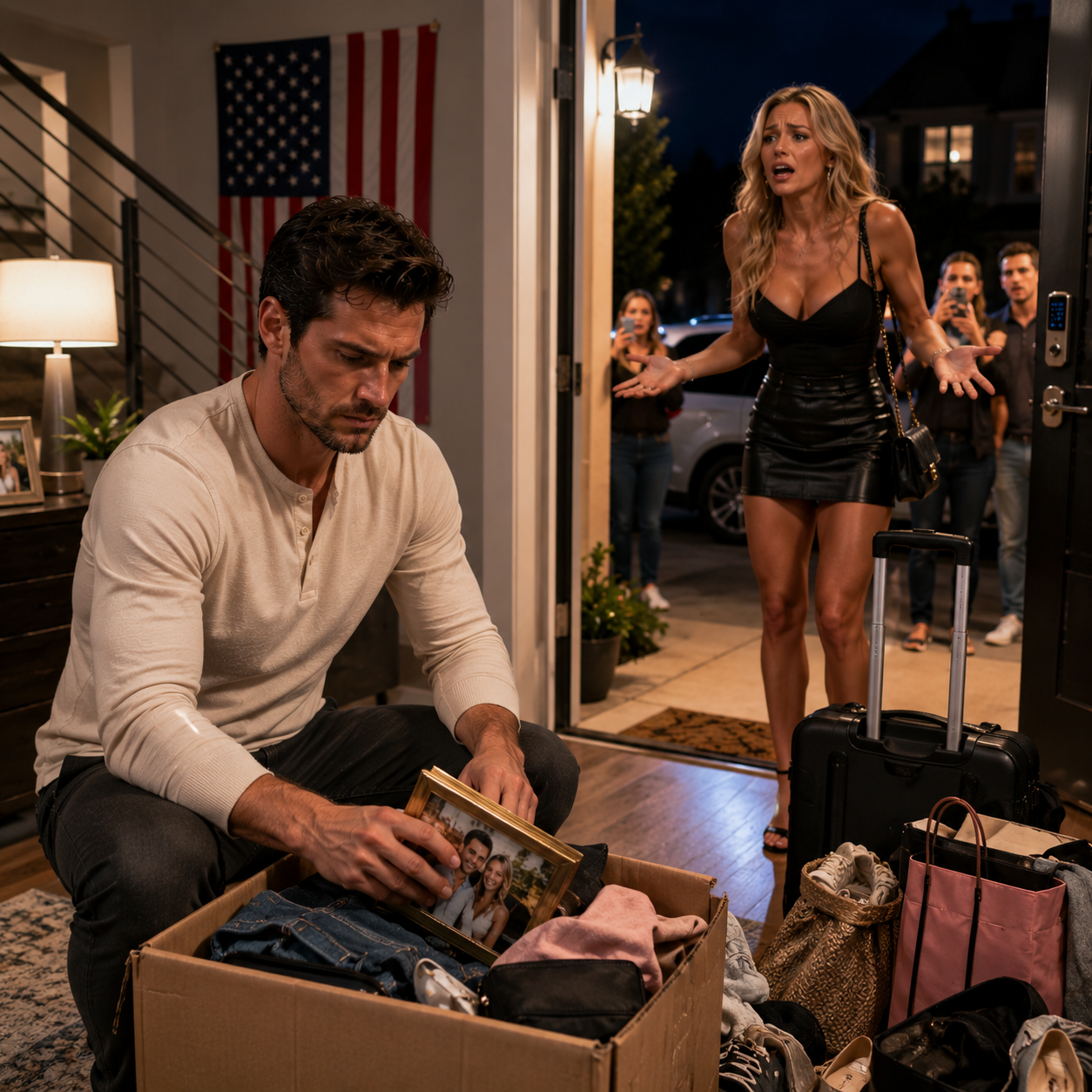
I noticed two suitcases by the stairs.
Rachel said she was going to stay with Paige “until I stopped making the house unsafe emotionally.”
That phrase sounded rehearsed.
I said, “Okay.”
She blinked. “Okay?”
“Yes. Send me a list of anything else you need. We can arrange pickup.”
Paige looked disappointed. I think they expected me to argue, maybe beg, maybe give them material.
Rachel walked toward me with tears in her eyes. “You’re really going to let me leave?”
I said, “You already left when you signed that contract.”
Her face hardened so fast Paige actually glanced at her.
Rachel said, “You are going to lose more than you think.”
I believed her. Not because she was right legally, but because she knew where to cut.
Two days later, I got messages from mutual friends. Rachel had told them I filed for divorce because she wanted “a say” in our future. She said I had become obsessed with keeping my father’s money away from her. She left out Derek. She left out the contract. She left out the key, the contractor, the account attempt.
One friend, Aaron, called me and said, “Man, I’m not taking sides, but it sounds like you’re being kind of cold.”
I sent him the contract.
He called back five minutes later and said, “What the hell?”
That became my policy. I did not argue with Rachel’s story. I showed documents to people whose opinions mattered enough to deserve the truth. Everyone else could believe whatever made them feel wise.
Derek disappeared for a while, which worried me more than his noise.
Then I found out why.
He had been trying to start the business without me.
He registered an LLC with a name painfully close to the one Dad and I had once discussed. He listed himself as managing member. Rachel was not listed publicly, but Elise found through discovery that Derek had emailed her revised “profit allocation” terms after the divorce filing, suggesting they delay formal involvement until “after settlement pressure forces Mark to negotiate.”
Settlement pressure.
That phrase became another exhibit.
Derek also contacted a hard-money lender and represented that he expected access to a commercial property as collateral pending “family estate resolution.” The lender, thankfully, did basic due diligence and contacted me through publicly available property records.
I sent the lender a letter through Mr. Callahan stating Derek had no ownership interest or authority.
Derek texted me that night.
You’re ruining my life over a building you don’t even use.
I wrote back one sentence.
You ruined your own life when you tried to steal it.
He replied: Rachel was right. You always think you’re better than us.
Us again.
By then, I had stopped feeling shocked. Pain was still there, but shock had burned off, leaving clarity behind.
The temporary hearing happened six weeks after filing.
I was nervous in a way I cannot describe. Not because I thought I had done something wrong, but because court turns your life into summaries, and summaries can be dangerous. A marriage becomes numbers. Betrayal becomes exhibits. Grief becomes background. You sit there while strangers decide which parts of your pain are legally relevant.
Rachel arrived in a navy dress I had bought her for a wedding two years earlier. Derek was with her.
That surprised even Elise.
Derek was not a party to the divorce. He had no reason to be there except intimidation or performance. He sat behind Rachel with his arms crossed, looking at me like I was the betrayer.
Elise leaned toward me and whispered, “Do not react.”
So I did not.
Rachel’s attorney argued that I had become financially punitive. He said I was using inherited assets as a shield while abandoning marital obligations. He suggested Rachel had merely explored family business options during a painful time and that the contract was an “aspirational draft.”
Then Elise stood up.
She did not give a dramatic speech. She simply walked the judge through the timeline.
Will read.
Rachel begins pressuring sale/refinance.
Rachel contacts contractor without authorization.
Rachel gives Derek key.
Signed agreement between Rachel and Derek referencing spousal influence strategy.
Derek text confirming “we already have an agreement.”
Rachel attempts to access inherited account information.
Derek registers LLC and contacts lender.
Each point landed quietly.
That was worse than drama. Drama gives people places to hide. Facts do not.
The judge read the contract for a long time. Too long. Long enough that Rachel stopped looking composed.
Then he asked Rachel’s attorney, “Your client signed this?”
Her attorney said, “Your Honor, it was not intended—”
The judge interrupted. “That was not my question.”
Rachel’s attorney said yes.
The judge then asked whether I had signed or agreed to any part of it.
No.
Whether Derek had any legal interest in the inherited property.
No.
Whether marital funds had been used to improve the commercial property.
No.
Whether the inherited investment account had been commingled.
No.
The judge denied Rachel’s request for temporary control of the marital home. He ordered standard temporary financial arrangements based on actual marital income, not inherited assets. He also specifically prohibited either party from attempting to encumber, transfer, or interfere with separately held inherited property until further order.
Then he looked at Rachel.
“Mrs. Harris, this court does not look favorably on attempts to manufacture leverage over property not belonging to you.”
Rachel’s face went red.
Derek stood up halfway like he wanted to say something. A bailiff shifted near the wall, and Derek sat down.
Outside the courtroom, Derek cornered me near the elevators.
“You happy now?” he said.
I kept walking.
He followed. “You got Dad’s lawyer, Mom’s sympathy, the judge eating out of your hand. Must feel good being the chosen son.”
I turned then.
For years, I had tried to explain myself to Derek. I had defended my love for him, defended Dad’s love for him, defended boundaries like they were accusations. That day, I felt no need.
I said, “Derek, Dad did not choose me because he loved you less. He chose me because he knew you would do exactly this.”
His face changed.
I do not mean he looked sad. I mean for one second, the performance fell away and I saw hatred.
Rachel heard it too. She was standing behind him, pale and furious.
She said, “You’re cruel.”
I looked at my wife, or the person who still legally held that title, and said, “No. I’m done translating consequences into cruelty so you both can understand yourselves.”
Then I left.
Final Update
The divorce took nine months.
People think the big moment is discovery, or court, or the confrontation where someone finally admits what they did. In reality, the ending of a marriage is mostly emails, forms, waiting rooms, invoices, and the slow humiliation of seeing your private life converted into documents with numbered paragraphs.
Rachel never fully admitted wrongdoing.
She came close once during mediation. Not because she was sorry, but because the evidence had made denial useless.
She said, “I should not have signed it.”
I waited.
She added, “But you have to understand how abandoned I felt.”
That was Rachel’s final position. Her betrayal was wrong, but my grief had made her feel abandoned, so the moral weight had to be shared.
I told her, “Feeling abandoned does not make my brother your business partner.”
The mediator looked down at her notes like she was trying not to react.
The settlement was cleaner than I expected. The inherited property remained mine. The inherited investment account remained mine. The marital home, which we had bought together before Dad died, was handled according to normal equity division. I refinanced and kept it, paying Rachel her share from marital savings and a structured payment plan. She kept her car. I kept mine. No dramatic financial destruction. No revenge fantasy. Just a legal untangling from someone who had mistaken access for ownership.
Derek’s consequences came from other places.
The lender he contacted backed away. The LLC went nowhere. The contractor he had quietly tried to line up refused to work with him after learning he had no authority. Word spread, not because I campaigned, but because Derek kept telling partial stories to people who eventually saw documents.
Mom changed her locks.
That hurt more than I expected.
She did not cut Derek off completely, but she stopped rescuing him. She told him she would meet for lunch in public, talk on the phone once a week, and help him find legitimate employment resources, but she would not give him money, keys, or access to family paperwork.
Derek called that abandonment.
Mom said, “No, Derek. This is what love looks like when it stops being afraid of your reaction.”
I was proud of her.
Three months after the divorce finalized, I finally started cleaning out Dad’s commercial building properly.
For a long time, I had avoided it. The place felt contaminated by what Rachel and Derek tried to do. Every corner reminded me of chalk marks, opened boxes, and the contract that turned my grief into a target.
But one Saturday morning, I unlocked the front door and stood inside with coffee in my hand while sunlight cut through dusty windows. The building was quiet. Not haunted. Just waiting.
My friend Aaron came by to help. Then my cousin Matt. Then, surprisingly, Mom showed up with sandwiches and Dad’s old radio.
We spent the day sorting boxes.
In one of them, I found old photos of Dad in the building when he first bought it. He was younger than I am now, standing in front of the garage bay with rolled-up sleeves and a grin like he had tricked the world into giving him a chance.
On the back of one photo, he had written: Needs work. Worth keeping.
I taped that photo above the office desk.
A month later, I leased one garage bay to a local electrician who needed storage and workspace. Nothing flashy. No giant business launch. No risky dream funded by grief. Just practical income and responsible use.
The other bay, I kept empty while I figured out what I wanted.
Eventually, I started spending evenings there after work, restoring small metal pieces and building custom shelving. Not a company yet. Not an empire. Just my hands doing something honest in a place my father trusted me to protect.
Rachel emailed me once after the divorce.
The subject line was: I hope someday you understand.
The message was long. She said she had been scared. She said Derek made her feel like she was not crazy for wanting security. She said she saw now that he had his own agenda, but she still believed I had shut her out emotionally. She said she hoped I would not let my father’s inheritance become “the reason I never trusted anyone again.”
I read it twice.
Then I wrote back:
Rachel,
I understand more than you think. I understand that fear can explain behavior without excusing it. I understand that marriage requires trust, and you responded to feeling unheard by making a secret agreement with the one person my father specifically warned me not to trust with paperwork.
I do not hate you. I am not trying to punish you. But I am no longer available to be blamed for the choices you made while calling them survival.
I hope you build a good life. Please do not contact me again unless it is related to remaining divorce obligations.
Mark
She did not respond.
Derek did, though, two weeks later.
He sent me a photo of himself outside a warehouse with a caption: Got a real job. Don’t worry, didn’t need your precious building.
For a moment, I almost replied with something sarcastic.
Instead, I wrote: Good. I hope it works out.
He sent back a thumbs-up emoji.
That was the most peaceful conversation we had had in years.
I do not know if Derek will change. I do not know if Rachel truly understands what she did or if she has simply found a version of the story where she can sleep at night. I do not know if I will ever marry again.
But I know this.
Inheritance is never just money.
Sometimes it is a test no one tells you you are taking. It reveals who sees your grief as sacred and who sees it as an opening. It reveals who can stand beside you when you receive something heavy, and who immediately starts calculating how to carry it away.
My father did not leave me that building because I was his favorite.
He left it to me because he knew love without boundaries becomes a door people kick open.
And every Saturday now, when I unlock that old brick building and turn on Dad’s radio, I feel the weight of his trust. Not as a burden anymore, but as a hand on my shoulder.
Keep your head.
So I am.


![[FULL STORY] She Whispered “Help Me” — And I Only Had 20 Minutes to Save Her](https://social-media.rabedo.com/thumbnails/1777451917_8479f7bd-3ca6-48e3-bcbd-e9429cb87c51.png)