I knew what I saw.
That should have been enough.
But the scariest part was not catching my girlfriend pressed against her coworker outside a bar, kissing him like I did not exist. The scariest part was how fast she made everyone believe I was the monster.
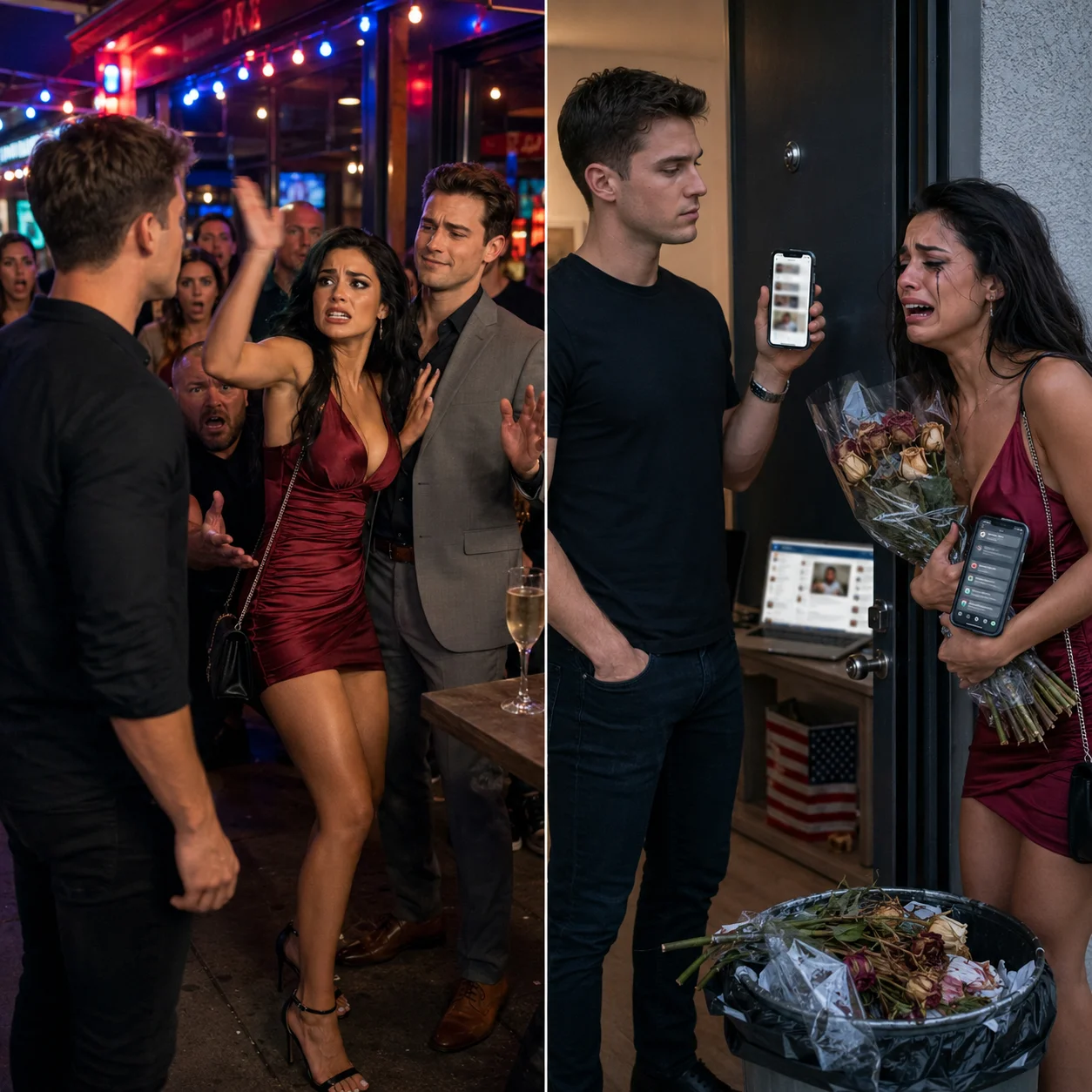
One minute, Tessa’s hands were on Brad’s chest, his body was angled into hers, and her mouth was on his in the smoking area outside O’Malley’s like they had been waiting all week for the chance. The next minute, her palm cracked across my face so loudly that people turned from the sidewalk, and she screamed, “Stop harassing me!” with tears already rising in her eyes.
By the time the bouncer stepped between us, my cheek was burning, Brad was standing beside her like some protective hero, and strangers were staring at me like I was the kind of man women warn each other about.
That was the moment I understood something that made my blood go cold.
Tessa was not panicking.
She was performing.
My name is Jake. I’m thirty. Tessa is twenty-eight. We had been together sixteen months, serious enough to talk about moving in together, serious enough that she had a toothbrush at my place and half my hoodies lived permanently in her laundry basket, serious enough that I had started imagining a real future with her even though I was trying not to rush the words.
We were not married. We did not have kids. We did not own property together. By some standards, maybe that should make this easier. People love saying things like “at least you found out before marriage” as if betrayal becomes painless when there is no mortgage attached.
It does not.
Tessa worked in client operations for a logistics software company. I worked as a claims analyst for an insurance carrier. Our lives were ordinary in the way I used to be grateful for. We had Friday-night routines, Sunday grocery runs, inside jokes, a shared weakness for late-night tacos, and a habit of watching crime documentaries while pretending we were better at solving the case than the detectives.
Friday nights were our thing.
Same sports bar near her office. Same casual dinner. Same chance to decompress after a long week. O’Malley’s was not fancy, but it was ours in that small, stupid way couples claim public places. She liked the buffalo chicken sliders. I liked the fact that the bartenders knew our orders and the booths had enough scratches in the wood to feel honest.
So when I arrived at 6:30 like always and saw her outside in the smoking area with Brad from work, I did not understand it at first.
My brain rejected the image before my eyes could process it.
Tessa’s hand was curled in the front of his shirt. Brad’s arm was low around her waist. Their faces were close, too close, then not close enough to pretend. He kissed her. She kissed him back. Not a drunk stumble. Not some accidental brush. Not a goodbye hug that missed its target. The kind of kiss that answers questions you did not know you had been asking.
Brad was the coworker she had mentioned for months.
The funny one.
The helpful one.
The one who stayed late with her on “projects.”
The one who “just got” how stressful her job was.
Suddenly, every casual mention of his name changed shape in my memory.
Brad said the client call was a disaster.
Brad brought donuts because everyone was dying.
Brad thinks I should apply for the senior role.
Brad says I’m too hard on myself.
I had swallowed all of it because I did not want to be that boyfriend. The insecure one. The controlling one. The guy who turns every male coworker into a threat and every late meeting into a trial.
But there is a difference between trust and volunteering to be lied to.
I walked closer, still hoping for some impossible explanation. Maybe she would pull away horrified. Maybe she would say Brad had kissed her and she froze. Maybe there would be some context so bizarre it would make sense if someone explained it slowly enough.
Then Tessa saw me.
She did not look ashamed.
She looked irritated.
Like I had interrupted something I had no right to interrupt.
“What is going on?” I asked.
My voice sounded strange. Too calm. Too far away from me.
Tessa stepped back from Brad and wiped her mouth with the back of her hand.
“Jake.”
“What is going on?”
Brad looked from her to me, suddenly fascinated by the sidewalk.
Tessa took a breath. “It’s not what it looks like.”
That sentence should be retired from human language.
“It looks like you’re cheating on me with your coworker.”
Her face changed.
Not guilt. Not fear.
Coldness.
Then the lies came one after another, so quickly it almost felt rehearsed.
“We were talking.”
“I saw you kissing him.”
“No, you saw what you wanted to see.”
“What I wanted to see?”
“You’ve been weird about Brad for weeks.”
“I just watched you make out with him.”
“He was upset. I was comforting him.”
“With your mouth?”
Brad finally spoke. “Man, don’t make this a thing.”
I turned to him. “You don’t get to talk right now.”
Tessa stepped in front of him. “See? This is exactly what I mean.”
“What you mean?”
“You’re being aggressive.”
“I’m asking why my girlfriend was kissing another man.”
Her eyes flicked toward the people near the entrance.
That was the first moment I realized she was aware of the audience.
Then she slapped me.
Hard.
Loud enough that conversations around us stopped.
My head snapped slightly to the side. The sting spread across my cheek, hot and sharp, but it was the sound that made everything freeze. For one stunned second, I could not move.
Before I could even react, Tessa screamed, “Stop harassing me!”
The whole street had a story before I could tell the truth.
The bouncer came out immediately. He was a large guy I recognized from previous Fridays but did not know by name. He stepped between us with one hand raised toward me.
“Sir, back up.”
“I’m not—”
Tessa’s tears appeared so fast it was almost impressive.
“He won’t leave me alone,” she said, voice trembling. “I broke up with him. He keeps following me.”
I stared at her.
“Tessa.”
She pointed at me like I was dangerous.
“Please, Jake, just go.”
Brad put a hand on her shoulder. “She told you, man. Leave her alone.”
“You’ve got to be kidding me.”
The bouncer looked at me like he had already decided how this worked. Man angry. Woman crying. Other man supporting her. Crowd watching. Public safety script engaged.
“Sir, you need to leave.”
“We had plans,” I said. “She texted me to meet her here. She’s my girlfriend.”
Tessa made this small broken sound. “No, I told you we were done.”
“You did not.”
Brad said, “She doesn’t feel safe.”
That was the sentence that did it.
Not because it was true.
Because everyone around us reacted to the words, not the situation.
I saw a woman near the entrance pull out her phone. I saw two guys at a high-top table staring at me like they were ready to intervene. I saw Tessa press herself closer to Brad, her hand still near her mouth, her eyes wet and terrified in exactly the right way.
I tried one more time.
“She was just kissing him. I walked up because we had plans. She slapped me.”
Tessa whispered, “Why are you doing this?”
It was so well-delivered that I almost questioned reality for half a second.
That scared me more than anything.
So I stopped talking.
I raised both hands slightly and stepped back.
“I’m leaving.”
The bouncer watched me all the way to the curb. I walked to my car with whatever dignity I had left, my cheek burning, my phone buzzing in my pocket, and the weight of strangers’ judgment pressing against my back.
When I got into the driver’s seat, I did not start the car immediately.
Through the windshield, I could still see Tessa near the entrance. Brad’s hand hovered near her waist. She was wiping under her eyes, nodding while the bouncer spoke to her. They looked like survivors of something.
Not the people who caused it.
I drove home in a silence so heavy it felt unreal.
Then I opened my phone.
There it was.
Her text from 3:06 p.m.
See you at O’Malley’s at 6:30. Don’t be late. I’m starving.
Another from 4:12 p.m.
Can’t wait to see you, babe. Rough week. Need fries and your face.
I stared at those messages until the shock cooled into something much cleaner.
She had lied to my face.
She had lied to the crowd.
She had done it so smoothly that I realized this was not just panic.
It was strategy.
Tessa cared about her image more than anything. Her respectable job. Her polished social media. Her professional reputation. The clean little life she performed for everyone around her. She was the woman who posted brunch photos with captions about gratitude. The coworker who organized birthday cards. The girlfriend who told everyone I was “so steady” while apparently using that steadiness as cover to make out with Brad behind a bar.
And when she got caught, she did not apologize.
She turned me into the threat.
That meant the breakup could not just be emotional.
It had to be factual.
Documented.
Undeniable.
I did not sleep much that night. At some point around midnight, Tessa texted me.
You scared me tonight.
I read it three times.
Then another came through.
I need space. Please respect that.
Then:
Don’t make this worse.
I did not reply.
Instead, I took screenshots.
All weekend, I built the timeline.
Not because I wanted to become obsessive. Not because I wanted to win some breakup trial in the court of mutual friends. But because I had watched her rewrite reality in real time, in front of strangers, with my cheek still burning from her hand. I knew that if I stayed silent, her version would become the version.
Screenshots of our texts from Friday.
Screenshots of recent messages where she called me her boyfriend.
Photos from the previous weekend at her cousin’s barbecue, her arm around me, captioned “my favorite person.”
Texts from Thursday night where she told me she loved me.
A calendar invite she had sent for a furniture store visit the following Saturday because we had been discussing moving in together.
A photo she had posted two weeks earlier of us at O’Malley’s with the caption, “Friday tradition with this one.”
I saved everything.
Then I made a simple timeline.
Friday, 3:06 p.m. — Tessa confirms dinner plans.
Friday, 4:12 p.m. — Tessa texts “Can’t wait to see you, babe.”
Friday, 6:30 p.m. — I arrive at O’Malley’s.
Friday, approximately 6:34 p.m. — I see Tessa kissing Brad in the smoking area.
Friday, approximately 6:36 p.m. — Tessa slaps me and tells the crowd I am harassing her.
By Sunday night, the story was no longer something she could twist.
It was evidence.
I thought about sending it privately to friends. I thought about texting her parents. I thought about calling Brad’s job, which felt satisfying for about thirty seconds and then felt messy and stupid. I thought about doing nothing and letting time sort it out.
Then I remembered the way those strangers had looked at me.
Not suspicious.
Certain.
Because Tessa cried first.
On Monday morning, while she was probably still hoping I would stay quiet out of shame, I wrote one public post.
No insults. No threats. No name-calling. No “she’s crazy.” No “Brad is a homewrecker.” I kept it colder than that.
It started with one sentence:
“When someone cheats on you and then plays victim, the truth needs to come out.”
Then I wrote what happened.
I explained that Tessa and I had been in a relationship, that we had plans to meet at O’Malley’s, that I arrived and found her kissing her coworker Brad outside the bar, and that when I confronted her, she slapped me and told the crowd I was harassing her. I attached the screenshots. The texts. The posts. The timeline. I blocked out phone numbers and anything unnecessary. I did not post her address. I did not tag her workplace. I did not ask anyone to contact her.
I ended with:
“I am not posting this because I want harassment. I am posting this because I will not let someone assault me, cheat on me, and then publicly turn me into a predator to protect her reputation.”
Then I hit publish.
Within an hour, my phone started buzzing.
At first, it was mutual friends asking if it was real.
Bro, is this true?
Jake, what happened?
Did she really slap you?
Then people from the bar began commenting.
One person wrote, “I was there. I saw them kissing before he walked up.”
Another said, “I thought something felt off. She started crying way too fast.”
Someone else wrote, “I was at the table near the door. She absolutely slapped him first.”
Every comment pulled another brick from the wall she had built around herself.
By lunch, Tessa had blocked me on every platform.
By two o’clock, Brad’s girlfriend messaged me.
I did not even know Brad had a girlfriend.
Her name was Maren. She was polite in a way that made me feel worse.
“Hi Jake. I’m sorry to message you. I saw your post. Are you saying Brad was the coworker Tessa was kissing?”
I stared at the message for a while.
Then I replied, “Yes. I’m sorry.”
She asked if I had proof.
I sent only what involved Brad directly. No commentary. No extra cruelty.
She responded twenty minutes later.
“Thank you. He told me he was staying late at work Friday.”
That was the first time I realized Tessa’s lie had not just been about me.
By Tuesday morning, the story had reached their office.
I know because Amy called me.
Amy was one of Tessa’s closest friends, the kind of friend who had smiled in my apartment, drank my beer, and once told me she was so glad Tessa had found “a good one.”
Her voice was tight with panic.
“You need to take the post down.”
“Good morning to you too.”
“Jake, I’m serious. Tessa’s reputation is getting destroyed.”
“She destroyed mine first.”
“She was confused.”
“No,” I said. “She was coordinated.”
“You don’t understand what this is doing to her.”
“What did she think it would do to me when she screamed that I was harassing her in public?”
Amy hesitated.
“She said you came at her aggressively.”
“I walked up and asked why she was kissing Brad.”
“She felt cornered.”
“She was caught.”
“That’s not the same thing.”
“It is when the person in the corner chooses to slap you and lie.”
Amy lowered her voice. “People at work are talking. HR knows.”
I leaned back in my chair.
“Then maybe Brad and Tessa should explain it to HR.”
“You’re being vindictive.”
“No. Vindictive would be tagging their company and telling people to call. I posted my side with receipts after she accused me publicly. There is a difference.”
Amy went quiet.
Then she said, softer, “Did she really text you to meet her there?”
“Yes.”
“And she told the bouncer you were following her?”
“Yes.”
Another silence.
When Amy spoke again, she sounded less certain.
“I didn’t know that part.”
“That’s why I posted the receipts.”
She hung up without saying goodbye.
By Wednesday, Brad messaged me.
I recognized the number because Maren had sent me a screenshot of his apology texts earlier that morning. Apparently, he was in damage-control mode everywhere.
Jake, we need to talk like men.
I almost laughed.
Men who text “like men” are usually trying to avoid consequences like children.
I replied, “No, we don’t.”
He wrote back immediately.
You’re blowing this out of proportion. Tessa and I made a mistake. You posting this publicly is affecting people’s jobs.
I stared at the word mistake.
A mistake is spilling a drink.
A mistake is forgetting a birthday.
A mistake is not pressing your coworker against a wall outside a bar, kissing her, backing up her lie when her boyfriend catches you, and then acting shocked when the evidence leaves the group chat.
I replied, “You helped her tell a crowd I was harassing her. Do not contact me again.”
He responded with a paragraph about how emotions were high and nobody wanted things to escalate.
I blocked him.
Then I did something I probably should have done on Friday.
I filed a police report.
Not because I expected Tessa to be dragged out of her office in handcuffs. Not because I wanted some dramatic arrest. But because she had assaulted me in public, and if she was already willing to frame me as the aggressor, I needed a record.
The officer who took the report was professional. I showed him the screenshots, the post, the witness comments, and the red mark photo Louis had made me take the night it happened. At the time I felt ridiculous photographing my own face, but Louis had said, “If she’s willing to lie in public, document everything.”
He was right.
The officer asked if I wanted to pursue charges. I said I wanted the incident documented and would cooperate if needed. He told me they might request footage from the bar.
The next day, O’Malley’s manager called me.
His name was Colin. He sounded uncomfortable.
“Jake, I wanted to reach out. The police asked about footage.”
“Okay.”
“I reviewed the outdoor camera.”
My grip tightened on the phone.
“And?”
He sighed.
“It shows what you described. It doesn’t have audio, but it shows them kissing. It shows you walking up. It shows an argument. It shows her hitting you. It shows you stepping back.”
I closed my eyes.
The relief was not clean. It was bitter.
“Thank you for telling me.”
“I’m sorry,” he said. “I was inside when it happened. My bouncer only saw the aftermath.”
“I know.”
“He feels bad.”
“He did what he thought he needed to do.”
Colin paused.
“Tessa called asking if we would confirm that you were removed for harassing her.”
There it was.
Even after the post.
Even after witnesses.
Even after the screenshots.
Still trying.
“What did you tell her?”
“That we wouldn’t be making statements without reviewing footage.”
“Smart.”
“She didn’t like that.”
“I bet.”
Later that day, Colin sent the footage to the officer. He did not send it to me, which was probably proper. But knowing it existed changed something in my body. For days, I had been carrying the fear that maybe my proof was not enough. That maybe everyone would still choose the story with the crying woman and the dangerous man.
Video does not care who cries first.
Friday night came exactly one week after everything exploded.
I was making dinner because therapy videos on the internet kept telling me routine helps, and apparently chopping onions is better than staring at the wall. My apartment smelled like garlic and olive oil. My phone was face down. For the first time all week, I felt almost quiet.
Then someone started pounding on my door.
Not knocking.
Pounding.
I froze with the knife in my hand.
Another round of pounding.
“Jake!”
Tessa.
I set the knife down carefully and walked to the peephole.
She was standing in the hallway wearing leggings, an oversized sweater, and no makeup. Her hair was messy. Her eyes were swollen. The polished victim mask was gone, but not because honesty had replaced it. It looked more like the mask had cracked under pressure.
“Jake, please,” she sobbed. “Open the door.”
I did not move.
“Jake, please. They put me on administrative leave.”
I stayed silent.
“Brad too. They’re investigating everything. HR saw the post. Maren called them. The bar has footage. Everyone thinks I’m some monster.”
I almost opened the door.
Not because I wanted her back.
Because sixteen months of habit still lived in my muscles. Tessa crying used to mean I comforted her. Tessa panicking used to mean I softened my voice, made tea, fixed things. It takes time for your body to understand that the person outside your door is the same person who hurt you.
Then she said the one thing that made my stomach tighten, because it proved she still thought this was about forgiveness and not consequences.
“I only lied because I knew no one would believe you.”
I stared through the peephole.
There it was.
Not “I was scared.”
Not “I was confused.”
Not “I’m sorry I hurt you.”
I only lied because I knew no one would believe you.
The sentence was so honest it felt almost accidental.
She did not lie because she believed I was dangerous.
She lied because she believed the lie would work.
My doorbell camera caught everything.
I had installed it six months earlier after package theft in the building. I had forgotten about it until that moment. A small blue ring of light blinked beside the door while Tessa stood in the hallway saying the quiet part out loud.
“Jake,” she whispered. “Please. I didn’t mean for it to get this bad.”
I finally spoke through the door.
“Leave.”
“Please open it.”
“No.”
“I’m sorry.”
“No, you’re sorry people found out.”
“That’s not fair.”
“Neither was slapping me and telling strangers I was harassing you.”
She started crying harder.
“I panicked.”
“You planned.”
“I didn’t.”
“You looked at the crowd before you slapped me.”
Silence.
That silence told me I was right.
“You need to leave,” I said. “If you don’t, I’m calling the police.”
Her voice changed then. The softness cracked.
“You’re really going to do this to me?”
I almost laughed.
Even now.
Even outside my door.
Even after everything.
To me.
“I’m not doing anything to you,” I said. “I’m not even opening the door.”
She stayed another thirty seconds.
Then she left.
I saved the doorbell footage and sent it to the officer handling the report, then to a lawyer Louis recommended. His name was Grant Keller, and after watching the clip, he rubbed his forehead and said, “She is either very arrogant or very bad at consequences.”
“Both?”
“Usually.”
Grant told me not to post the doorbell footage publicly. He said the original post was already enough and that continuing to share could make things messy. I listened. That was important. Anger makes people reckless, and I had no interest in giving Tessa a new story where she could claim I was harassing her online.
So I stayed quiet.
That turned out to be harder for her than another post would have been.
Because without me feeding the drama, her own choices kept surfacing.
The police report moved forward slowly. The bar footage supported my account. Two witnesses gave statements. Tessa was eventually cited for misdemeanor assault. Nothing dramatic. No cinematic arrest. No jailhouse confession. Just paperwork, a court date, and the first official document in her adult life that did not bend itself around her feelings.
The workplace investigation was worse for her.
Not because companies care about romance. They care about liability.
Tessa and Brad had both lied to HR at first. They said they were just coworkers. Then they said they had kissed once after drinks. Then Maren provided messages showing Brad had been secretly seeing Tessa for weeks. Then the bar footage surfaced. Then my post became part of the internal conversation because it involved an allegation of public false accusation tied to two employees and their conduct near a workplace hangout.
Apparently, Tessa had also told several coworkers on Monday that I was “an unstable ex” who had been stalking her.
That mattered.
Because at the time she said it, she had my texts confirming our date plans sitting on her phone.
By the second week, Brad resigned.
Maren left him. I know because she messaged me once more.
“Thank you for telling the truth. I’m sorry you had to be the one to do it.”
I replied, “I’m sorry too.”
That was the last time we spoke.
Tessa stayed on administrative leave longer than Brad. Her company reviewed the situation, interviewed people, and eventually terminated her. Officially, it was for misconduct and making false statements during an internal inquiry. Not for cheating. Not for being a bad girlfriend. For lying when the truth had professional consequences.
Amy called me again after that.
This time, she sounded tired.
“Tessa got fired.”
“I heard.”
“She’s not okay.”
“I’m sorry to hear that.”
“Are you?”
I thought about that.
“Yes,” I said. “But I’m not responsible.”
Amy exhaled slowly. “She keeps saying you ruined her life.”
“She tried to ruin mine in front of a crowd.”
“I know.”
That surprised me.
Amy continued, “I didn’t at first. But I saw the messages. And someone showed me the footage. She lied to me too.”
I leaned against the kitchen counter.
“I’m sorry.”
“I feel stupid.”
“Join the club.”
Amy gave a sad little laugh.
“She wants me to ask if you’ll make a statement saying it was a misunderstanding.”
“No.”
“I figured.”
“It wasn’t a misunderstanding.”
“I know.”
After we hung up, I sat down and felt something I had not expected.
Not victory.
Not satisfaction.
Exhaustion.
People talk about “exposing the truth” like it is one dramatic moment where everyone claps and the liar collapses under the weight of justice. The reality is uglier. Your phone becomes a battlefield. Mutual friends become witnesses. You start measuring every word because the person who lied about you once might do it again. You learn that being believed does not erase the part where you were betrayed.
But it does give you ground to stand on.
Tessa pleaded no contest to the assault citation two months later. She got a fine, community service, and a short anger-management requirement. Nothing that would satisfy the revenge fantasies some people wrote in my messages. But enough. Official. On paper. She had hit me. She had lied. The system did not fully shrug.
That mattered.
The public post eventually stopped spreading. I took it down after three weeks, not because Tessa asked, but because it had served its purpose and Grant advised that leaving it up forever would only keep me tied to the worst night of my life. Before deleting it, I saved the entire thread. Witness comments. Screenshots. Everything.
Not to revisit constantly.
To remember accurately.
Because memory softens dangerous things when you miss someone.
And yes, I missed her.
That is the part people do not like admitting in stories like this.
I missed the version of Tessa who made pancakes in my T-shirt and sang the wrong lyrics to every song. I missed the woman who sat on my kitchen floor helping me assemble a bookshelf and somehow turned it into a two-hour argument about whether Allen wrenches were proof of a cruel universe. I missed Friday nights before Brad’s name became a warning sign. I missed who I thought she was.
I did not miss who she became when caught.
Or maybe who she had been all along.
That question still follows me sometimes.
Was Tessa always capable of turning herself into the victim that quickly? Did she practice it in smaller ways before I recognized the pattern? Were there moments where I apologized just because she looked wounded first? How many times did I accept blame because it was easier than proving I had not done what she felt like accusing me of?
Therapy has been helpful, if annoying.
My therapist asked me once, “What hurt more, the cheating or the accusation?”
I answered too fast.
“The accusation.”
Then I felt guilty, like that meant the cheating had not mattered.
But she nodded.
“Being betrayed privately hurts. Being falsely cast as dangerous in public attacks your identity.”
That sentence stayed with me.
Because that was the part I could not explain to people who said, “At least you found out before moving in.”
Yes, I found out.
But I also found out how quickly a crowd could turn if someone cried convincingly enough. I found out that my calm voice did not matter once she chose the right script. I found out that being innocent does not always protect you in the moment.
Receipts protected me later.
Not then.
Later.
Six months after the bar incident, Tessa emailed me.
I had blocked her phone, her socials, and every obvious route, but email is stubborn.
Subject: I know I don’t deserve a response.
I almost deleted it.
Then I read it because healing is not the same as curiosity control.
She apologized.
Not perfectly. Not without self-pity. But more honestly than before.
She wrote that Brad made her feel exciting at a time when she felt stuck. She wrote that she had been flirting with him for weeks and telling herself it was harmless because she did not want to be the kind of person who cheated. She wrote that when I appeared outside the bar, she saw her entire image collapsing and reacted by grabbing the role she knew people would believe.
That line made me stop.
She admitted it.
Not as cleanly as I wanted, but clearly enough.
She wrote, “I knew if I looked scared, people would protect me.”
I sat with that sentence for a long time.
There are apologies that heal and apologies that simply confirm the injury was real.
This was the second kind.
She said she lost her job. Brad disappeared from her life after Maren left him. Amy barely spoke to her anymore. Her parents were disappointed. She had started therapy because the assault citation scared her, and because for the first time she could not explain herself out of what she had done.
Then she wrote:
I’m sorry I cheated. But I am more sorry I made you look dangerous when you were just hurt. You didn’t deserve that.
I did not respond.
I forwarded it to Grant for my records.
Then I sat quietly for a while.
I wanted the apology to make me feel free.
It did not.
Freedom came more slowly.
It came the first Friday night I went somewhere other than O’Malley’s. Louis dragged me to a different bar across town with terrible nachos and surprisingly good wings. I spent the first hour checking exits like I expected a crowd to form around me again. Then a game went into overtime, the whole place erupted, and for a few minutes I forgot to be afraid of being misunderstood.
It came when I stopped touching my cheek every time I thought about that night.
It came when I deleted the photo of the red mark from my camera roll and moved it to a records folder I never open.
It came when I could hear Brad’s name without feeling heat behind my eyes.
It came when a woman at work asked if I wanted to grab coffee sometime and I did not immediately imagine every possible way it could end badly.
I am not dating seriously yet.
I am not ready to turn someone new into a test they never asked to take.
But I am less angry.
That is something.
Tessa moved out of the city, according to Amy. Not far. Just far enough to start over somewhere people do not know the O’Malley’s story before they know her last name. She is working again, smaller company, lower role. Brad moved too. Maren is doing better, from what I heard through a mutual friend. She deserved better than being dragged into their mess.
As for me, I still have the receipts.
Not because I want revenge forever.
Because I never want to be talked out of reality again.
I keep one folder on my laptop labeled “O’Malley’s.” Inside are the screenshots, the saved post, the police report, and the lawyer’s notes. I do not open it much anymore. But knowing it exists helps. It is a reminder that the truth survived a very committed lie.
That is what I needed most.
Not for Tessa to suffer forever.
Not for Brad to be ruined.
Not for the internet to clap.
I needed reality to stay intact.
Because when someone cheats and then plays victim, they are not only protecting themselves. They are stealing your right to be believed. They are taking your pain and dressing it in their fear. They are asking the world to punish you for discovering what they did.
Tessa thought tears would outrun timestamps.
Brad thought silence would protect him.
Their workplace thought “personal matter” until the lies became liability.
And I learned something I wish I had not needed to learn:
If someone is willing to make you the villain to escape accountability, do not argue with the performance.
Document the truth.
Step back.
Let the receipts breathe.
That Friday night at O’Malley’s, Tessa slapped me and told a crowd I was harassing her because she believed no one would believe me.
For a few minutes, she was right.
But only for a few minutes.
Because facts are patient.
And unlike people performing for a crowd, they do not need tears to be convincing.

![[FULL STORY] They Laughed When I Signed the Contract — They Didn’t Realize I Had Already Rewritten the Ending](https://social-media.rabedo.com/thumbnails/1777867007_497cf7a2-8cc6-49e0-b7fb-0529e26ef288.png)

![[FULL STORY] She Hid Me for Four Years — So I Removed the Life She Built on My Back](https://social-media.rabedo.com/thumbnails/1777401186_2a85fe55-dc9d-4170-bd84-d3d0ecc0e56e.png)