
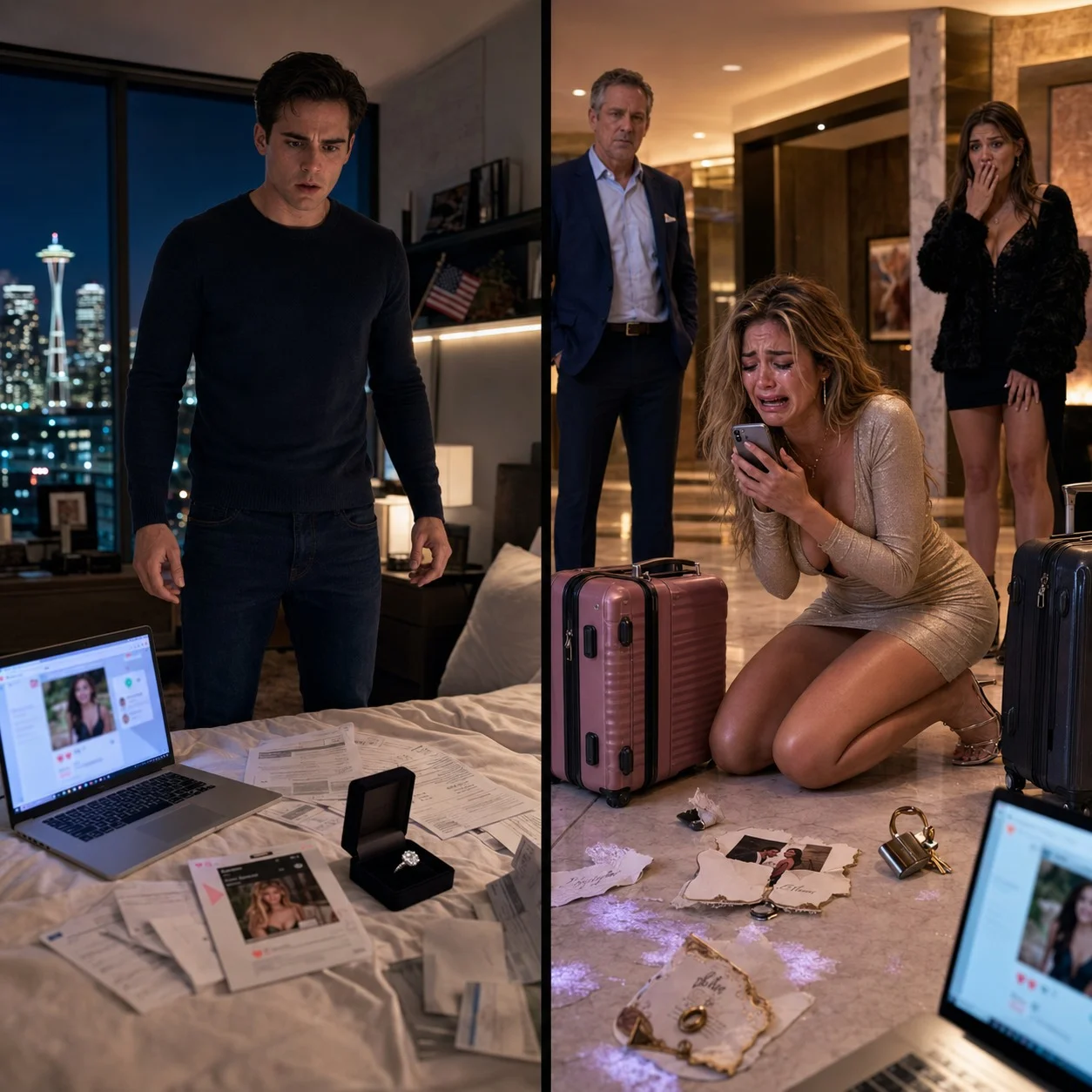
The laptop was open for less than a minute.
That was all it took for my entire future to die.
One sentence on a dating app told me the woman I was supposed to marry in two months had never really been planning a wedding. She had been planning an exit strategy.
Mia and I had been together for four years, engaged for one, and by then everything was already paid for. The venue. The caterer. The photographer. The flowers. The DJ. Every polished little detail that was supposed to turn our relationship into forever had an invoice attached to it, and most of those invoices had my name on them.
My savings had taken the hit. I knew that. I felt it every time I opened my banking app. But I had not cared because I believed that was what you did when you loved someone. You built the life first and worried about the receipts later.
That sounds noble until you realize you were the only one building.
Mia had always been beautiful in a way that made strangers kinder to her. She had that effortless charm people mistake for warmth until they stand close enough to feel the calculation underneath. When we met, she was funny, affectionate, impulsive, and full of plans. She made ordinary weekends feel like something worth photographing. I fell hard, and for a long time, I thought she had too.
When I proposed, she cried so convincingly that I cried too.
Looking back, I wonder whether she was moved by me or by the life she could see forming around me. The ring, the wedding, the shared apartment, the deposits, the promise of stability. Maybe she loved the shape of the future more than the person standing inside it.
The changes started quietly.
She began working late more often. Her phone was always face down. She stepped out for calls. She smiled at messages and locked the screen too quickly when I entered the room. Classic signs, yes, but trust makes people creative. I told myself she was stressed about the wedding. Maybe overwhelmed. Maybe tired. Maybe the new project at work really was demanding. Maybe I was being paranoid because marriage was getting close and the stakes felt bigger.
Anything was easier than admitting the person sleeping beside me might already be somewhere else in her mind.
The truth came on a Tuesday.
I came home early with a migraine, hoping to collapse on the couch in the dim quiet of our apartment. Mia was in the shower, water running behind the bathroom door, and her laptop sat open on the coffee table.
I was not trying to snoop.
I only meant to move it so I could lie down.
Then the screen caught my eye.
Bumble.
For a few seconds, I simply stared.
My chest tightened, but some desperate part of me still tried to save her. Maybe it was old. Maybe she had forgotten to delete it. Maybe there was an innocent explanation that would make me feel stupid for panicking.
Then I saw the timestamp.
Active twelve minutes ago.
The open conversation was with a man named Derek.
The messages were flirty, intimate, casual in a way that made my stomach turn. There were photos I had never seen. Jokes I was not part of. A version of Mia that felt both familiar and completely foreign, like someone wearing her face but speaking with a colder soul.
But the message that destroyed me was not a selfie.
It was not even the flirting.
It was her plan.
“Can’t wait to be single again after this wedding payday. Just two more months of playing house.”
Derek had answered like they were laughing over drinks.
“Get that bag, baby. How much is the idiot spending?”
And Mia had replied with the number.
Sixty thousand dollars.
Then she added that I had no idea she had already consulted a divorce lawyer about timelines. Six months married, then she could file and claim half of anything earned during the marriage because Washington was a community property state.
I stood there holding the laptop while the shower ran down the hall, feeling like the floor had quietly disappeared beneath me.
This was not cold feet.
This was not confusion.
This was not one stupid mistake before a wedding.
Mia was preparing to marry me, smile for the photos, take my vows, wear my ring, and then use the law like a trapdoor under my life.
The shower turned off.
I had maybe thirty seconds.
My hands shook as I photographed everything. Her Bumble profile. The message thread. Derek’s name. The timestamps. Other conversations. Screenshots of photos, dates, and every piece of proof I could capture before she came out.
Then I set the laptop exactly where it had been and went to the bedroom, pretending to be half-asleep.
Mia came out humming.
She kissed my forehead.
Asked if I wanted dinner.
And I lay there with my eyes half closed, realizing the woman touching me had been calling me an idiot to another man minutes earlier.
I did not confront her.
Not that night.
Instead, for three days, I became quiet and careful.
I backed up text history. Saved receipts. Downloaded vendor contracts. Took screenshots of payment confirmations. Built a folder on my hard drive and named it “evidence,” because calling it anything emotional would have made me break down.
The worst part was not seeing Mia on Bumble.
It was realizing she had been smiling at me across dinner tables, choosing cake flavors, approving floral arrangements, and pretending to count down to forever while secretly counting down to a payday.
I even tested the depth of the lie.
Using a Google Voice number, I texted her pretending to be a vendor confirming whether both parties were still committed to the wedding date.
Her reply came back fast.
“Yes, can’t wait.”
That was the moment my heart stopped negotiating with my brain.
She would really do it.
She would stand at the altar with me while already planning the divorce.
On Friday, Mia said she was going to her sister’s for a girls’ night. From the messages I had saved, I knew she was actually meeting Derek. That gave me two hours.
I moved fast.
First, I withdrew what I legally could from our joint account: the funds I had personally deposited and could document. Then I called every vendor who would answer. The caterer gave back most of the deposit. The photographer was kind. She listened quietly while I explained that the wedding was canceled due to fraud concerns, then said, “I’m so sorry,” in a voice that made me almost lose it. The DJ refunded everything. The florist gave me partial credit. The venue kept its money, but by then I did not care about the venue.
The venue was cheaper than marrying someone who had already scheduled the end.
Then I packed my car.
Only the essentials. Clothes. Documents. Sentimental things. My grandfather’s watch. My childhood photos. The hard drive with my business records. Anything that could not be replaced. I left the furniture. The dishes. The throw pillows she had chosen. All the props from the life she had been staging.
On Mia’s pillow, I placed the printed screenshot.
“Can’t wait to be single again after this wedding payday. Just two more months of playing house.”
Beside it, I set the ring box.
Then I added one sticky note.
“Your profile says you’re looking for something real. Who is Derek?”
By the time Mia called, I was already in a motel.
Twenty-three calls came in before I answered the twenty-fourth.
The first thing she said was not “I’m sorry.”
It was, “How dare you go through my things?”
That told me everything all over again.
I sat on the edge of the motel bed, listening as she raged first. Then cried. Then tried to soften the story into wedding jitters and fear. Derek meant nothing. She was confused. She had cold feet. She would never actually go through with it. She had only said those things because she was scared.
But I had her own words now.
Wedding payday.
Playing house.
Divorce lawyer.
Six months.
Half of everything.
So when she sobbed that I was ruining everything, I gave her the only congratulations she had earned.
“Congratulations,” I said. “You got what you wished for.”
Then I hung up.
I did not know then that Mia’s real performance was only just beginning.
By midnight, she was already rewriting the story.
By morning, I was the controlling fiancé. The emotional abuser. The man who abandoned her without warning. The man who canceled the wedding in a fit of jealousy and left her humiliated.
Her friends came first.
Then her mother.
Then a cousin I had met twice.
Each of them carried a different piece of the lie Mia had handed them.
“She said you threw her out.”
“She said you stole money from the wedding account.”
“She said you hacked her laptop.”
“She said you were always jealous and possessive.”
I wanted to post the screenshot so badly my fingers actually shook.
My friend Kevin is a lawyer. I called him before I did anything public. He listened to the whole story without interrupting. Then he said, “Do not post anything yet. Let her dig.”
So I did.
That is harder than it sounds.
Silence feels like losing when someone is lying loudly. But Kevin was right. People like Mia do not stop at one lie. They build entire houses out of them, and eventually the structure becomes too heavy for the foundation.
I removed her from my insurance. My phone plan. Streaming services. Every shared account I had been paying for while she planned to cash out. I changed passwords. Froze credit. Sent copies of the Bumble messages, vendor cancellations, and financial records to Kevin. Then I agreed to meet Mia at the Starbucks where we had our first date.
Part of me still needed to see if the woman I loved was hiding somewhere behind the performance.
She arrived in the sundress I had bought her for our engagement photos.
She was crying before she even sat down.
“Derek manipulated me,” she said.
I let her talk.
“Wedding stress confused me.”
I sipped my coffee.
“The lawyer thing was just fantasy. Like joking about winning the lottery. I was venting. You have to understand that.”
When I mentioned the consultation appointment scheduled two weeks after our honeymoon, her face changed for one second.
Cold.
Calculated.
Then the tears came back.
That one second was enough.
I asked her a question I already knew she would not answer honestly.
“When did love stop being enough?”
She looked at me for a long moment, mascara dark beneath her eyes, hands trembling around a paper cup she had not touched.
Then she said, “Love doesn’t pay for the life I want.”
There it was.
No apology could reach past that.
No memory could soften it.
No version of the woman I thought I loved survived that sentence.
I stood up.
She panicked.
“Wait. No. I didn’t mean it like that.”
“You did.”
“You’re twisting my words.”
“No, Mia. For the first time, I’m hearing them clearly.”
I walked out while she was still crying into her untouched latte.
That evening, her smear campaign escalated.
She posted a long statement on Instagram about “escaping a financially controlling relationship” and “choosing herself after years of manipulation.” She included a photo of her ringless hand on a steering wheel and a caption about freedom. The comments filled quickly.
“You’re so brave.”
“He never deserved you.”
“Proud of you for leaving.”
I sat there reading it with the calm numbness of someone watching a house burn after already removing everything valuable.
Kevin called me ten minutes later.
“She posted, didn’t she?”
“Yep.”
“Good,” he said.
“Good?”
“She made accusations. Now we respond selectively, privately, and factually.”
He helped me draft one message.
Not emotional.
Not cruel.
Just enough.
I sent it to five people: her parents, my parents, her sister, and two mutual friends who had already reached out with concern.
“I’m not interested in fighting publicly. Mia is telling people I canceled the wedding out of jealousy and control. Before you decide what to believe, please read her own words. These screenshots are from her Bumble account, active while we were engaged. They include her discussion with Derek about using the wedding as a payday, her mention of a divorce lawyer, and her timeline for filing after marriage. I have also documented all vendor cancellations and financial records. I will not be discussing this further outside legal channels.”
Then I attached the screenshots.
Within an hour, her sister called.
I almost did not answer.
When I did, her voice was small.
“I’m sorry,” she said.
That was all.
Then her father called.
He did not apologize at first. He was too shocked for that. He asked if the screenshots were real. I told him yes. He asked if I had altered anything. I told him no. He asked if Mia had really spoken to a divorce lawyer before the wedding.
I said, “Ask her.”
He went silent.
Then he said, “I will.”
Mia deleted her Instagram post by morning.
But not before enough people saw the shift in comments. Her sister had commented only one sentence before the post disappeared.
“Mia, stop lying before this gets worse.”
That was when the circle started turning.
Friends who had condemned me went quiet. A few sent awkward apologies. Others simply vanished, which was honestly preferable. Mia’s mother sent me a long message saying emotions were high and mistakes had been made on both sides. I did not answer because “both sides” is what people say when they want consequences to soften around the person who caused them.
Derek was the next domino.
I knew very little about him beyond the Bumble messages, but Kevin’s investigator found enough. Derek was not some wealthy escape plan. He worked in sales, drove a leased car he was behind on, and lived with a roommate while presenting himself online like a man one venture away from becoming rich. He had encouraged Mia’s plan because he thought she would walk away with money.
Once the wedding was canceled and the refunds were secured outside her reach, Derek’s interest cooled fast.
I know this because Mia, in a moment of panic, forwarded me one of his texts by accident before unsending it.
I saw the preview.
“Not my problem you fumbled the bag.”
That was poetry.
Two weeks later, I heard through a mutual friend that Derek had blocked her.
Mia tried one more time after that.
She came to the motel first, but I had already left. Then she found me at my brother’s house. He opened the door, saw her, and immediately called for me in the tone you use when something unpleasant has been delivered.
She looked smaller than before.
No perfect makeup. No rehearsed calm. Just panic.
“I made a mistake,” she said.
I stayed in the doorway.
“You made a plan.”
“I was scared.”
“You were strategic.”
“I didn’t know how to tell you I wanted out.”
“You didn’t want out. You wanted in long enough to profit.”
Her face crumpled.
“That’s not fair.”
“What part?”
She had no answer.
Then she said the thing I think she believed would hurt me most.
“You’re not as innocent as you think. You were always so proud of providing. You liked being needed.”
That one landed, but not the way she wanted.
Because she was partly right.
I had liked being needed. I had confused being useful with being loved. I had paid for things I could barely afford because it made me feel like I was building a future. I had ignored warning signs because responsibility felt like devotion.
But there is a difference between someone appreciating your care and someone converting it into a strategy.
I looked at her and said, “You’re right. I liked being needed. That’s why I almost became a mark instead of a husband.”
She started crying.
“I still love you.”
“No,” I said. “You loved the exit plan.”
I closed the door.
The wedding date came two months later.
I had expected that day to break me.
Instead, I woke up in my brother’s guest room, made coffee, and felt strangely peaceful. My mother called to check on me. My father invited me fishing. Kevin texted, “Congratulations on not getting married today.”
I laughed for the first time in weeks.
That evening, a few close friends came over. Nothing dramatic. Pizza, beer, bad movies. Nobody gave speeches. Nobody asked if I was okay every five minutes. They just sat with me through the day that was supposed to become my anniversary and let it become something else.
A survival date.
The final legal cleanup took a few more months.
Because I had documented everything early, the financial damage was manageable. I lost money on the venue. Some deposits never came back. The sixty-thousand-dollar wedding became closer to a twelve-thousand-dollar mistake, which still hurts, but not nearly as much as a six-month marriage to someone who had already calculated divorce.
Kevin helped me send a formal demand letter when Mia tried to claim half the refunded deposits. Her claim went nowhere. The refunds were tied to my payment records, my cards, my accounts. She had contributed almost nothing beyond opinions and Pinterest boards.
Her family eventually stopped contacting me.
Her father sent one final message.
“I’m sorry for what happened. I hope you find someone worthy of what you were trying to build.”
That one I answered.
“Thank you. I hope Mia learns from this.”
I meant it, though I no longer cared whether she did.
Months passed.
I moved into a smaller apartment across town. It had ugly floors, bad water pressure, and the best silence I had ever known. I started rebuilding my savings. Slowly. Painfully. Honestly. I sold the wedding decorations that had been delivered early. Donated the custom favors. Returned the suit. Deleted the honeymoon itinerary.
Every removed item felt like pulling a hook out of skin.
One night, while cleaning out a box of wedding papers, I found a copy of my vows.
I almost threw them away.
Instead, I read them.
They were good vows. Honest ones. Full of promises I had meant. Promises to build, protect, listen, stay, choose. For a moment, grief hit me so hard I had to sit down on the floor.
Not grief for Mia.
Grief for the man I had been when I wrote them.
He deserved better.
So I folded the vows and put them in an envelope. Not to keep as a shrine, but as evidence of something important: I had not been foolish for loving deeply. I had only loved the wrong person.
There is a difference.
The last time I heard from Mia was almost a year after the wedding that never happened.
It was an email.
No subject.
“I know you probably hate me. I don’t blame you. I was selfish and cruel and I convinced myself I was being practical. Derek disappeared as soon as there was no money. My friends don’t trust me. My parents barely speak to me. I keep thinking about what you asked me at Starbucks. When did love stop being enough? I don’t know. Maybe I never understood it. I’m sorry.”
I read it once.
Then I archived it.
I did not reply.
Some apologies are not bridges.
They are receipts.
A few weeks later, I met someone new. Not in a dramatic way. No cinematic spark. No instant certainty. Her name was Clara, and we met at a volunteer event Kevin dragged me to because he said I needed to stop treating my apartment like a bunker.
She was calm. Funny in a dry way. She asked real questions and listened to the answers. On our third date, I told her the whole story because I had learned not to build anything important on hidden damage.
When I finished, she said, “That must have made it hard to trust yourself.”
Not hard to trust women.
Not hard to date.
Hard to trust myself.
That was when I knew she understood the wound better than most people.
Because betrayal does not only teach you to doubt someone else. It makes you question your own judgment, your own memories, your own ability to tell love from performance.
Healing, for me, was not learning to trust someone new.
It was learning that I could trust myself to leave when the truth appeared.
Mia thought the wedding would be her payday.
She was wrong.
It became mine.
Not financially. I lost money.
But I gained back my future before she could turn it into a legal battlefield.
I gained back my name before she made me the idiot in a story she was already telling another man.
I gained back the part of myself that believed love should be chosen freely, not extracted like a settlement.
The laptop was open for less than a minute.
That minute saved my life.
And if there is one thing I know now, it is this: when someone shows you their plan for your pain, do not argue with the plan.
Document it.
Believe it.
And leave before they get the chance to call it love.
![[FULL STORY] She Said: "He's Just A Coworker. If You're Jealous Just Because He Drove Me Home At 2 A.M., Then We](https://social-media.rabedo.com/thumbnails/1777367256_25.png)
![[FULL STORY] I Gave My Brother a Paid-Off Credit Card Receipt for Christmas—Then Took It Back](https://social-media.rabedo.com/thumbnails/1777457490_508d2b0c-d72b-4736-bc0d-0b44a5dc843f.png)
![[FULL STORY] She Asked Me to Apologize to the Man Who Humiliated Me—So I Walked Away and Ended Everything](https://social-media.rabedo.com/thumbnails/1777346044_67b837cc-5212-4eee-a05c-ce8a0cbde578 (1).png)