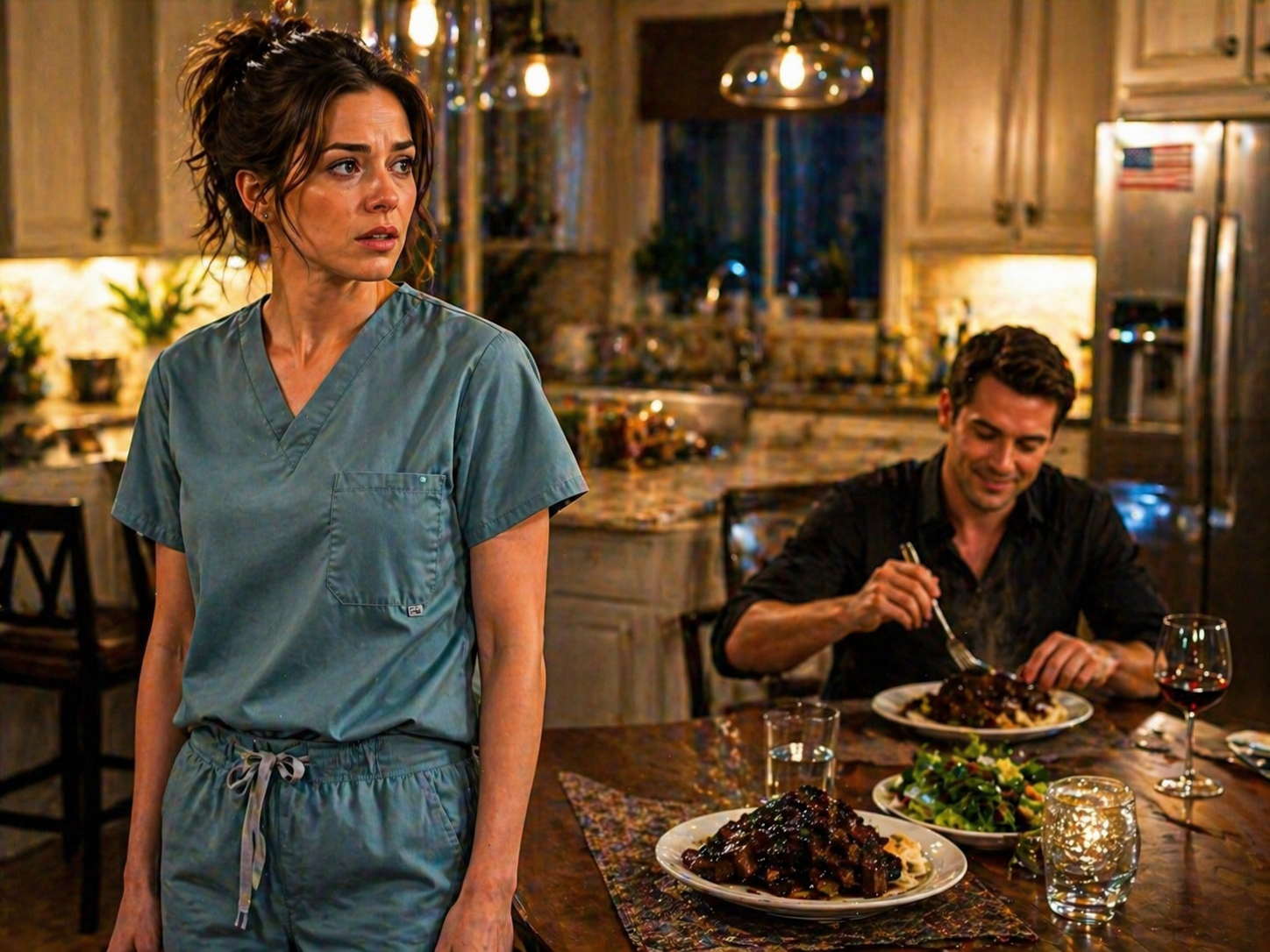

Sunday lunches became trials.
His cousins had babies. His sisters-in-law got pregnant. Family friends arrived with newborns wrapped in blankets and everyone watched me hold them with the expression people use around the terminally ill.
Poor Daniela.
Pretty girl.
Such a shame.
A woman without children makes a house feel like a tomb.
That last one came from Mauricio’s aunt, but Doña Graciela did not correct her.
Mauricio did not either.
He sat beside me, cutting his meat, pretending he had not heard.
That was when I began to understand that betrayal does not always start in another woman’s bed. Sometimes it begins at a family table, in the silence of the person who promised to protect you.
The first time Mauricio called me barren, he was drunk.
He came home smelling of whiskey and a perfume I did not own. It was past midnight. I was sitting on the couch with a fertility clinic folder on my lap, circling dates for another appointment he had already said he was too busy to attend.
He tossed his keys onto the table.
“You’re still awake?”
“I wanted to talk about the appointment next week.”
His face twisted.
“Of course you did.”
I closed the folder slowly.
“What does that mean?”
“It means I’m tired, Daniela.”
“So am I.”
“No.” He laughed, cruel and short. “You’re tired? From what? From failing?”
Something inside me went cold.
“Mauricio.”
He stepped closer, his eyes shiny and mean.
“Do you know what it feels like to be the only man in my family without a child? Do you know what people say?”
I stood.
“People say things because your mother lets them.”
“My mother wants what any mother wants. A grandson. A family that continues.”
“And I want a husband who doesn’t treat me like broken furniture.”
His hand hit the wall beside my head.
Not me.
The wall.
But close enough that I felt the air move.
“You don’t serve me as a wife,” he said, low and shaking. “You don’t give me peace. You don’t give me a child. What exactly do you give me?”
I remember looking at him and seeing, for one terrifying second, not the man I married, but the man his family had raised him to become.
Entitled.
Ashamed.
Cruel because cruelty was easier than fear.
The next morning, he apologized with flowers.
I threw them away after he left for work.
But I stayed.
That is the part people judge from a distance. They ask why women stay as if leaving a marriage were as simple as walking out of a bad restaurant. They do not count the shared accounts, the family pressure, the religious guilt, the years of hope, the way apologies can sound like proof when you are desperate to believe the person you love is still somewhere inside the person hurting you.
I stayed because I remembered who Mauricio had been.
I stayed because I thought pain could be survived if it eventually became a baby.
I stayed because I had been trained, by everyone around me, to believe that my worth was tied to fixing what they said was wrong with me.
Then I found Paola.
It was not dramatic at first.
No lipstick on collars. No secret hotel key. No phone call in the middle of the night.
Just his phone lighting up on the bathroom counter while he was in the shower.
A message preview.
Paola: I miss you already.
My hands went numb before my mind caught up.
I told myself it could be a colleague. A client. A stupid misunderstanding.
Then the phone lit up again.
Paola: Don’t be sad. Soon she’ll sign and our baby won’t be born without your last name.
Baby.
For a few seconds, the bathroom disappeared.
The mirror, the sink, the steam from Mauricio’s shower, the toothbrushes in the cup we bought on our honeymoon—all of it blurred into a single white noise inside my skull.
I knew his passcode. He had never bothered changing it because he had never believed I would look.
I looked.
Photos.
Paola in his office, sitting on his desk with her legs crossed.
Paola in his car, smiling at the camera.
Paola in a bed that was not ours, one hand covering her mouth like the whole thing was funny.
There were messages dating back months.
He complained about me.
She comforted him.
He called me cold.
She called him patient.
He called me useless.
She called him a man who deserved joy.
And then, the sentence that finished breaking what was left of my marriage:
Tell the barren one to sign quickly. My baby needs a real family.
I did not cry that night.
That surprises people when I tell them.
I sat on the closed toilet seat, holding his phone in my hand, listening to the shower run, and felt my marriage stop hurting.
Not heal.
Not disappear.
Stop hurting.
Because pain requires love to keep feeding it.
In that bathroom, disgust replaced love so quickly it felt almost merciful.
Mauricio asked for the divorce two days later.
Not in private. Not with shame. Not even with the decency of a quiet conversation between two people who had once whispered baby names in the dark.
He did it at his mother’s house during Sunday lunch.
The whole family was there.
His sister, his cousins, his aunt who thought childless homes were tombs. Plates of mole sat in the center of the table beside warm tortillas wrapped in cloth. Doña Graciela had set out her good china, which should have warned me that she was expecting a performance.
Paola was already there when I arrived.
She sat beside Mauricio in a white dress, red lipstick perfect, one hand resting lightly over her abdomen as though she were carrying a crown instead of a child.
For a second, I stopped in the doorway.
Mauricio did not stand.
Doña Graciela smiled.
“Daniela, come in. We were waiting for you.”
I looked at Paola.
Then at Mauricio.
Something in his expression was almost eager.
He wanted me to react. He wanted tears. He wanted proof that I was the unstable one, the desperate one, the woman who could not accept being replaced.
I sat down.
No one ate.
Mauricio cleared his throat.
“Paola is pregnant,” he said. “I’m going to do the right thing.”
The room hummed with satisfaction.
“The right thing?” I asked.
His mother put down her fork.
“The right thing is to give this family a child. You could not.”
There it was.
No mask. No softened edges.
I looked at Mauricio, waiting for even the ghost of embarrassment.
Nothing.
Paola leaned forward.
“I don’t want problems,” she said, voice sweet enough to rot teeth. “I just want my baby to be born in peace.”
“Then you chose an interesting way to attend lunch,” I said.
A few people shifted uncomfortably.
Mauricio’s eyes hardened.
“Don’t make this ugly, Daniela.”
I almost laughed.
Ugly had been living in our home for years. Ugly had sat beside me in clinics. Ugly had worn his mother’s pearls and called me dry. Ugly had crawled into another woman’s bed and returned home to criticize my body.
But now that ugly had witnesses, he wanted manners.
He pushed a folder across the table.
“Sign. I’ll make sure you’re taken care of.”
That was another insult.
Taken care of.
As though I were a problem to settle. A damaged appliance removed from a house before the new model arrived.
I opened the folder.
Divorce petition. Property division. A proposed settlement clearly written by an attorney who had heard only Mauricio’s version. It framed me as emotionally unstable, unwilling to continue fertility treatments, and responsible for the breakdown of the marriage.
I closed it.
“No.”
Doña Graciela’s face sharpened.
“No?”
“No.”
Mauricio leaned forward.
“Don’t be stupid.”
I stood.
“I’m not signing anything at this table.”
His cousin muttered something under his breath.
Paola touched her stomach more dramatically.
“Stress isn’t good for the baby.”
I looked directly at her.
“Then maybe you should leave rooms where you are not wanted.”
Mauricio slammed his hand on the table.
“You don’t get to talk to her like that.”
Something inside me smiled.
Not happily.
Recognizingly.
So this was him now. A protector. A defender. A man capable of public loyalty, just not to his wife.
I picked up my purse.
“Have your lawyer contact mine.”
I did not have a lawyer yet.
But they did not need to know that.
I walked out before my hands started shaking.
That same morning, before Sunday lunch, I had vomited my coffee into the kitchen sink.
I thought it was stress.
For three weeks, I had felt strange. Tired in a heavy, bone-deep way. Sensitive to smells. Dizzy on the metro. But my body had become such a place of disappointment that I had trained myself not to hope.
Hope had become dangerous.
Still, the vomiting scared me enough that the next day I went to a clinic in Roma.
I chose one far from Mauricio’s family doctor, far from the specialists his mother recommended, far from anyone who might call her before calling me.
The doctor was young, calm, and kind without being syrupy. She asked questions. Took blood. Did an ultrasound because I insisted my cycle was irregular and I did not know what was happening.
I lay on the table staring at the ceiling while the gel cooled my skin.
She moved the transducer.
Then she stopped.
“Señora Márquez,” she said softly. “You are almost seven weeks pregnant.”
At first, I thought I misunderstood.
“No.”
She turned the screen toward me.
A tiny shape. Barely anything. And then—
A flicker.
A rhythm.
A heartbeat.
The sound filled the room, impossible and steady.
For years, I had imagined that if I ever heard that sound, Mauricio would be beside me. He would cry. He would hold my hand. We would call his mother and mine. We would buy tiny shoes and argue over names and finally, finally, all the rooms inside me that had been blamed for silence would fill with music.
Instead, I was alone on a paper-covered table, one hand over my mouth, listening to the heartbeat of a baby whose father had announced another woman’s pregnancy the day before.
The doctor smiled.
“Would you like a picture?”
I could not speak, so I nodded.
She printed the ultrasound and placed it in my hand.
The image looked like proof from another life.
I walked out of the clinic into the noise of Mexico City with the photo tucked inside my purse and my heart beating so hard it hurt.
I could have called Mauricio.
I could have gone to his office, placed the ultrasound on his desk, and watched his arrogance collapse.
I could have begged him to reconsider.
For one weak, trembling hour, I wanted to.
Not because I loved him the same way. I did not.
But because I was scared.
Scared to be pregnant alone.
Scared to fight a family like his.
Scared that he would take my child from me or ruin my reputation before I could protect either of us.
Then I sat on a bench outside a panadería, smelling warm bread and car exhaust, and looked at the ultrasound again.
That tiny heartbeat had not come to save my marriage.
It had come despite it.
My child did not need a father who loved only when his ego was fed. My child did not need a grandmother who believed babies were trophies and women were containers. My child did not need to be announced at a lunch table as evidence in a war of pride.
So I stayed silent.
I hired a lawyer.
His name was Licenciado Salcedo, a quiet man in his fifties with silver-rimmed glasses and the tired eyes of someone who had watched too many families discover how cruel they could be when money, pride, and children entered the same room.
He listened without interrupting.
I brought him screenshots. The divorce petition. My medical records. The ultrasound.
When I told him Mauricio had refused testing for years, he asked one question.
“Do you have access to old documents? Anything medical from before the marriage?”
I almost said no.
Then I remembered a locked drawer in our apartment where Mauricio kept old files from his father’s estate, insurance policies, property documents, and things he never touched but refused to throw away.
That night, while Mauricio was supposedly “staying with a cousin,” I searched.
I did not break locks. I did not steal. It was our marital home, our shared files, and the drawer key was in a small ceramic dish where it had always been.
At first, I found nothing.
Bank statements. Deeds. Old tax records. Insurance forms.
Then, inside an envelope labeled only with his initials, I found a medical report dated four months before our civil wedding.
Semen analysis.
Severe male factor infertility.
Urologist recommendation.
Further evaluation advised.
Patient counseled not to assign reproductive difficulty to partner without complete couple-based testing.
I read the report three times before I understood the full horror of it.
Mauricio had known.
Before our wedding, before years of humiliating treatments, before his mother’s teas, before every family joke, before every accusation, Mauricio had known there was a serious possibility that the problem was his.
And he had let them blame me anyway.
When I showed the report to Licenciado Salcedo, even he went still.
“Do you know if his mother knew?”
“I don’t know.”
But in my heart, I did.
Of course she knew.
Doña Graciela knew everything she needed to control.
Salcedo made copies. He advised me to continue prenatal care privately, document everything, and avoid direct confrontation until the hearing.
“You are not hiding a child,” he said. “You are protecting yourself and your pregnancy until we can establish legal safeguards.”
So that became my life.
I went to appointments alone.
I bought prenatal vitamins alone.
I cried on the metro with one hand hidden beneath my sweater, afraid strangers would see the shape of my secret before I was ready to survive the consequences.
Mauricio sent messages that shifted between arrogance and irritation.
Don’t drag this out.
Paola is under stress.
My mother is disappointed in you.
You’re making this harder than it has to be.
I answered through my lawyer.
Paola posted vague photos online. A cup of tea beside baby socks. A hand on her stomach. Captions about miracles, peace, and choosing happiness.
But as weeks passed, something about her pregnancy bothered me.
Not because I wanted to obsess over her. I didn’t.
But because seven months into a pregnancy, bodies change. Not all the same way, but they change. Paola’s photos stayed carefully angled, cropped, filtered. Her stomach appeared one day round and obvious under a dress, then nearly flat under a loose blouse two weeks later.
I told Salcedo.
He only said, “Let lies walk. They tire themselves eventually.”
And they did.
Seven months after Mauricio announced Paola’s pregnancy at Sunday lunch, we arrived for the final divorce hearing.
The courthouse was crowded that morning. Fluorescent lights buzzed overhead. The hallway smelled of paper, old coffee, damp coats, and perfume people wore like armor. Couples sat on opposite sides of benches, no longer able to pretend they had ever been on the same team.
I wore a long beige coat.
Underneath it, my belly was impossible to miss.
Seven months pregnant.
Strong. Healthy. Alive.
My mother wanted to come inside with me, but I asked her to wait outside.
“If I see Mauricio,” she said, gripping her purse, “I might throw this at his head.”
“That’s why you’re waiting outside.”
She kissed my cheek, then touched my belly.
“Clara,” she whispered.
I had not officially chosen the name yet, but my mother had started calling the baby Clara after the doctor said it might be a girl.
Clear.
Bright.
Truth after darkness.
I entered the courtroom with Licenciado Salcedo beside me.
Doña Graciela was already there.
Pearls. Perfect hair. A face arranged into victory.
Paola sat beside Mauricio, her blouse loose, one hand placed over her stomach with theatrical care. From a distance, she looked pale. Nervous.
Mauricio did not stand when I walked in.
“Finally,” he muttered. “Let’s end this.”
His mother smiled.
“It is good you finally understood your place.”
I sat down.
For a moment, I said nothing.
I wanted to remember the room exactly.
The judge adjusting his glasses. The clerk sorting papers. Mauricio tapping one finger against the table. Paola pretending to breathe carefully. Doña Graciela watching me like I was a stain about to be scrubbed away.
The judge reviewed the documents.
“This is the final hearing regarding dissolution of marriage between Daniela Márquez and Mauricio Herrera,” he said. “There are property and personal matters to settle. Counsel?”
Licenciado Salcedo looked at me once.
Only once.
That was the signal.
The judge slid the papers forward.
Mauricio leaned back, smiling.
“Sign, Daniela,” he said quietly. “At least this time, do something useful.”
I picked up the pen.
Then I placed it back on the table.
Slowly, I stood.
Every eye in the room followed me.
I unbuttoned my coat.
One button.
Then the next.
Then the third.
The fabric opened.
I slipped the coat off my shoulders and laid it over the back of my chair.
My seven-month pregnant belly stood between us like a verdict.
The silence was so complete that even the air conditioning seemed to stop.
Mauricio rose so fast his chair scraped the floor.
“What…” His voice cracked. “What is that?”
I looked at him without blinking.
“Your favorite word made flesh.”
His face emptied.
Doña Graciela’s hand flew to her pearls.
Paola stopped touching her stomach.
Mauricio’s eyes dropped to my belly, then jumped back to my face.
“No,” he said. “No, that’s impossible.”
“It was unlikely,” I said. “Not impossible.”
“It can’t be mine.”
The sentence came exactly as I knew it would.
For months, I had carried not only my child, but the certainty of that denial.
I reached into my bag, removed a sealed clinical envelope, and placed it on the table.
“These are my medical records. Dates. Ultrasounds. Prenatal care. And a non-invasive prenatal paternity test, because I knew the first thing you would do was deny your own child.”
The judge leaned forward.
Mauricio swallowed.
“Daniela, listen—”
“No.”
It was a small word.
But in that room, it sounded like a door locking.
Doña Graciela reached toward the envelope with trembling fingers.
“There must be a mistake.”
I looked at her.
“Yes. The mistake was believing I was the barren one in this story.”
Paola made a strange sound.
Not a sob.
Fear.
Licenciado Salcedo opened his briefcase and removed a second folder.
Mauricio saw it and lost what little color remained in his face.
“What is that?”
My lawyer’s voice stayed calm.
“Medical records Mr. Herrera failed to disclose before and during the marriage.”
Doña Graciela stood halfway.
“Don’t open that.”
Everyone turned to her.
Mauricio frowned.
“Mamá?”
I felt my baby move.
A small, firm kick beneath my ribs.
As if she, too, wanted to hear the truth spoken aloud.
Salcedo slid the folder toward the judge.
“These documents show that Mr. Mauricio Herrera was diagnosed with severe male factor infertility before the marriage. The report is dated four months before the civil wedding. It includes a semen analysis, urological evaluation, treatment recommendation, and a written note advising the patient not to attribute infertility to his partner without complete testing.”
No one breathed.
Mauricio stared at the folder as if it were a snake on the table.
“That’s a lie.”
“No, Mr. Herrera,” Salcedo said. “It is a certified copy from the clinic records. We have confirmation of authenticity.”
Doña Graciela sank into her chair.
Not shocked.
Defeated.
I looked at her.
“You knew.”
Her lips trembled.
“I only wanted to protect my son.”
“No,” I said. “You wanted to protect your family name.”
Mauricio turned toward her.
“You knew?”
His voice sounded young suddenly. Almost childish.
For years, he had used my body as a trash bin for his shame. He had called me dry, useless, punishment. He had let his mother turn my womb into family gossip. Now the truth sat on the table with a laboratory stamp and a doctor’s signature, telling him the shame he threw at me had always belonged to him.
Doña Graciela began to cry.
“The doctor said it was not impossible. Only difficult. I thought if Daniela tried harder…”
“Tried harder?” I repeated.
My voice shook for the first time.
“You made me drink teas that burned my stomach. You took me to women who bruised my abdomen. You made me pray in front of strangers. You let your sisters call me a tomb. You watched your son destroy me for a diagnosis you knew he had.”
The judge tapped the table gently.
“Order, please.”
But even he looked uncomfortable.
Mauricio reached for the clinical envelope I had placed in front of me.
I pulled it away before he touched it.
“I need to see it,” he said.
“You need nothing from me.”
“Daniela—”
“No.”
Paola had gone pale. Her hand hovered over her stomach, then dropped.
My eyes lowered to her blouse.
Seven months had passed since that lunch. If her pregnancy were real, her body should not look like a badly arranged rumor under expensive fabric.
Salcedo spoke again.
“We request that the prenatal paternity results presented by my client be added to the case file. The test was performed using fetal DNA found in maternal blood, and it supports Mr. Herrera as the biological father of the unborn child.”
Mauricio gripped the back of his chair.
“What does it say?”
I answered before my lawyer could.
“It says this baby is yours.”
Doña Graciela covered her mouth.
Paola stepped back.
Mauricio opened his mouth, but no sound came out.
“For that reason,” I continued, “I waited. Because I knew you would deny it. I knew your mother would call me a liar. I knew Paola would smile while you called me barren in front of a judge.”
Mauricio took one step toward me.
“Daniela, I didn’t know.”
I laughed once.
Dry. Empty.
“You didn’t know I was pregnant. You knew how to humiliate me.”
“I was desperate.”
“No. You were comfortable.”
That word landed harder than shouting would have.
Comfortable.
Comfortable with a wife crying in clinic bathrooms.
Comfortable with a mother who made my body a topic for dessert.
Comfortable with a mistress promising the heir your ego needed.
Paola lifted her hand.
“I didn’t know about the medical records.”
Everyone looked at her.
She swallowed.
“Mauricio told me Daniela didn’t want children. That she punished him with it. That she refused treatments.”
I wanted to scream.
But my baby moved again.
A reminder.
Do not hand them your peace.
Paola’s voice dropped.
“I lied too.”
Mauricio spun toward her.
“Shut up.”
The whole room changed.
The judge straightened.
“Mr. Herrera, let her speak.”
Paola began to cry.
Not beautifully. Not like women cry in movies, with perfect tears and trembling lips. She cried like someone realizing the lie she had built had become too big to carry.
She slid her hand under her blouse.
Doña Graciela whispered, “No.”
Paola pulled out a skin-colored padding secured by a maternity support band.
She placed it on the table.
For a second, no one understood.
Then Doña Graciela knocked over her coffee cup. Brown liquid spilled across the pale floor.
Mauricio stared at the fake belly.
“What did you do?”
Paola covered her face.
“I’m not pregnant.”
The air turned sharp.
I did not feel triumph.
That is the thing people expect. They imagine I felt victorious, powerful, satisfied.
I felt tired.
A deep, ancient tiredness, like every woman who had ever been reduced to proof, failure, obstacle, womb, wife, problem, or replacement had exhaled through me at once.
Mauricio grabbed Paola’s arm.
“You told me it was mine.”
“Because you wanted to believe it!” she shouted. “Because you said if I gave you a child, you would put the house in my name. Insurance. Money. Everything. Because your mother told me to hold on until Daniela signed.”
Doña Graciela stood.
“Liar!”
Paola pointed at her.
“You bought the fake belly.”
The room seemed to tilt.
Even Licenciado Salcedo closed his eyes briefly, as though he needed a moment to absorb the ugliness.
Mauricio turned to his mother.
“Mamá…”
Doña Graciela lifted her chin.
“I did it for you.”
“You made me look like an idiot.”
“I was saving you from her.”
She pointed at me.
I smiled without warmth.
“From me? I was the only woman still married to your son while everyone knew he was cheating.”
The judge called for order again, then ordered a recess.
But no one moved.
Some truths, once released, do not obey courtroom schedules.
Mauricio approached me again.
This time there was no arrogance. No smile. No mistress beside him. No mother whispering instructions in his ear.
“Daniela,” he said, his voice low. “If that baby is mine, we can stop this. We can talk. We can start over.”
I looked at him the way one looks at a burned house.
With memory.
Not longing.
“No.”
“It’s my child.”
“Yes.”
“I have rights.”
“You will have obligations.”
His face changed.
There it was.
The first honest expression of the day.
He was not grieving the marriage. Not truly. He was not even grieving me.
He was realizing that the word child would not open every door.
Salcedo stepped in.
“My client is not denying paternity. She is requesting that all matters regarding support, legal recognition, visitation, communication, and psychological protection be established formally.”
Mauricio turned toward the judge.
“This is revenge.”
I placed both hands over my belly.
“No. This is parenting before the baby is born.”
The judge asked us to sit.
Doña Graciela remained rigid, her shoes stained with coffee. Paola cried in a corner, clutching the fake belly as if it were a dead animal.
The judge reviewed the documents for several long minutes.
I looked out the window.
Outside, Mexico City had not stopped moving. Buses, street vendors, car horns, people rushing with coffee, a woman laughing into her phone, a man carrying flowers wrapped in newspaper.
Life never pauses while a woman gathers her pieces.
So women learn to walk while broken.
Finally, the judge lifted his head.
“It is entered into the record that Mrs. Daniela Márquez is pregnant and has presented medical evidence supporting Mr. Herrera’s presumed paternity. The divorce proceedings may continue, but all matters related to the unborn child will be handled under the appropriate legal measures.”
Then he looked at Mauricio.
“And I warn you, Mr. Herrera, that any attempt to intimidate, pressure, discredit, or harass Mrs. Márquez will be considered in determining protective measures.”
Mauricio clenched his jaw.
Doña Graciela stood.
“Your Honor, you do not understand. That child belongs to our family.”
The judge looked over his glasses.
“That child is a person, ma’am. Not property.”
For the first time in eight years, someone with authority had said to my mother-in-law what no one in her family dared to say.
She sat down slowly.
We left the courtroom near noon.
The hallway smelled of old paper and reheated coffee. Somewhere, a child was eating a lollipop on the floor while his parents argued with attorneys. A woman in red heels cried by the elevator. A man signed papers on a windowsill with shaking hands.
Family, once it reaches court, loses all decoration.
Mauricio caught up to me before the exit.
“Daniela.”
I kept walking.
“Daniela, please.”
That stopped me.
Not because he deserved it.
Because I wanted him to hear me clearly.
“What do you want?”
His eyes dropped to my belly.
“I want to come to the appointments.”
“No.”
“I’m the father.”
“You are the man who called the mother of your child useless for three years.”
He lowered his eyes.
“I’ll change.”
“Good. But don’t use my child as your final exam.”
His expression tightened.
“My child?”
“My child while she is inside my body. Our child when you prove you can care without destroying.”
He looked as if I had slapped him.
Salcedo stepped beside me.
“All communication goes through counsel.”
I walked outside.
The sun hit my face. I put the beige coat over my shoulders even though I was no longer cold. I had worn it as a shield, as theater, as the final veil before showing them that the body they insulted had been creating life in silence.
My mother waited on the sidewalk.
When she saw my face, she ran to me.
“Is it done?”
I nodded.
She hugged me carefully, then touched my belly.
“And my granddaughter?”
“Kicking like she won the case.”
My mother cried.
“She did.”
We ate caldo tlalpeño at a small fonda near the courthouse. I did not think I was hungry, but the baby was. I ate slowly, feeling the chipotle warm my throat, the avocado soften on my tongue, the steam from the bowl rise against my face.
For months, I had lived with fear.
Fear Mauricio would take the baby.
Fear his mother would ruin my name.
Fear Paola’s lie would somehow become stronger than my truth.
Fear of being a single mother.
But that day, between chipped plates and paper napkins, I understood something simple.
Alone was not the same as abandoned.
I had my mother.
I had my lawyer.
I had my records.
I had my work.
And I had a life moving beneath my ribs.
Three weeks later, Mauricio requested a “cordial meeting.”
I refused.
He sent flowers.
I sent them back.
He wrote a long message through email, saying he had always loved me, that he had been confused, that Paola manipulated him, that his mother pressured him, that he only wanted to be a father.
I answered one line.
Start by paying the first prenatal support payment.
He did not reply that day.
He paid two weeks late.
But he paid.
Doña Graciela tried to visit me.
She arrived at my apartment building with a bag of white baby clothes and a silver rosary. The doorman called me.
“Señora Daniela, there is a woman here who says she is the baby’s grandmother.”
My blood warmed with anger.
I went downstairs.
I did not invite her up.
She looked different without the courtroom behind her. Smaller, somehow. Her pearls were gone. Her hair was still neat, but her face carried a strange mixture of shame and hunger.
Hunger for a grandchild.
“I brought some things,” she said.
“I don’t need them.”
“Daniela, I made mistakes.”
“No. You committed cruelties.”
She gripped the bag.
“It is my grandchild.”
“Yes. And that is why it should scare you that I remember everything you did to her mother.”
Her eyes filled.
“I wanted Mauricio to be happy.”
“No. You wanted Mauricio to be obeyed.”
I handed the bag back.
“When my daughter is born, any contact will happen legally and with conditions. You will not enter my home. You will not comment on my body. You will never again call me dry, useless, or a tomb.”
“I never meant—”
“Yes, you did. The difference is that now there are witnesses.”
I went upstairs before she could answer.
That night, I slept deeply for the first time in months.
In the eighth month, the doctor confirmed it.
A girl.
“She’s strong,” the doctor said, moving the ultrasound transducer across my belly. “Healthy. Very active.”
On the screen, a tiny hand opened and closed like a star.
I cried.
Not for Mauricio.
Not for Doña Graciela.
Not for the years I lost.
I cried because my daughter was real, whole, and innocent of the poison poured over her arrival.
“Have you chosen a name?” the doctor asked.
I looked at the screen.
“Clara.”
Because that was what she was.
Clear.
Like a window opened after years in a locked room.
Clear like truth arriving late but arriving.
Clear like morning after a house full of insults.
Mauricio learned the name through the lawyer.
He requested that the baby be named Graciela “for family tradition.”
I laughed so hard my mother thought something was wrong.
“What happened?”
“Nothing,” I said. “Just a man who lost an imaginary kingdom and still wants to name the flag.”
Clara was born on a rainy night.
It was not like the movies.
It was pain, sweat, fear, firm nurses, my mother praying under her breath, and me gripping a hospital sheet as if it were a rope over a cliff.
Then came the cry.
Sharp.
Furious.
Alive.
They placed her on my chest, warm and wet and trembling.
The world became small enough to fit between her cheek and my heartbeat.
“Hello, Clara,” I whispered. “No one will use you to prove anything.”
Mauricio arrived two hours later.
I did not allow him into the delivery room.
I did allow him to see her through the nursery glass, accompanied by Licenciado Salcedo and a hospital social worker.
When Mauricio saw her, he covered his mouth.
He cried.
Maybe from love.
Maybe from guilt.
Maybe from loss.
It was no longer my job to know which.
Doña Graciela was not allowed to see Clara that day.
Not because I was cruel.
Because boundaries are also a form of love.
The birth certificate was registered weeks later. Mauricio signed. He did not smile. He did not make a speech. He did not ask for a photo to send his family.
He simply signed.
For the first time, I watched him understand that a last name was not a prize.
It was a responsibility.
The divorce became final months later.
I walked out of the courthouse with Clara in my arms.
Mauricio stood near the entrance.
“Daniela,” he said. “Thank you for letting me recognize her.”
I looked at him calmly.
“Don’t confuse that. It wasn’t a gift to you. It was her right.”
He nodded.
“I’m going to therapy.”
“Good.”
“My mother too.”
“Better.”
He swallowed.
“Do you think you’ll ever forgive me?”
I looked down at Clara.
She was asleep with her mouth slightly open, peaceful, as if the world had not tried to turn her into a trophy before she was even born.
“I don’t know,” I said. “But I don’t need to hate you anymore to keep living.”
Mauricio cried silently.
I kept walking.
My mother waited by the car with a pink blanket and a bag of sweet bread. She had bought conchas, campechanas, and one ridiculous chocolate donut “to celebrate the end of the novela.”
We got in.
Clara opened her eyes for half a second.
I touched her cheek.
“One part is over, my love,” I whispered. “The good part is just beginning.”
On the way home, we passed a flower stand. There were roses, baby’s breath, sunflowers, and lilies wrapped in brown paper.
I asked my mother to stop.
I bought a small bouquet.
Not for Mauricio.
Not for my dead marriage.
For myself.
At home, I placed Clara in her crib and set the flowers on the table.
For eight years, I believed a woman could wither because she was not a mother.
Then I believed she could break because she became one alone.
I was wrong both times.
A woman withers when she spends her life asking permission to exist.
And that night, with my daughter sleeping in the next room, my divorce final, my name clean, and my body finally mine again, I understood the truth they had tried so hard to bury.
My body had never been a tomb.
It was soil waiting for the right season.
Mauricio saw his smile die in that courtroom.
But mine was not born there.
Not when Paola’s lie collapsed.
Not when Doña Graciela lowered her head.
Not when Mauricio realized the child he wanted to use as a crown would arrive instead as a responsibility.
My smile was born later, in the quiet.
It was born the first night Clara slept on my chest and I understood she had not come to save my marriage.
She had come to save me from believing I was worth less because a man stopped choosing me.
And now, every time my daughter opens her eyes, I remember the only sentence that truly mattered.
I was never barren.
I was only planted in the wrong place.


![[ FULL STORY ] My Siblings Fought Over Grandma’s Will… Until Her Lawyer Read What She Left Them](https://social-media.rabedo.com/thumbnails/1777577900_3aeb679a-0d54-49e9-9495-d5f96402bf15.png)