The room went silent.
Not because the words surprised me. Carmen had been saying versions of them for years. What stunned me was hearing them while my child’s blood was still warm on my skin.
Something broke in me then.
Not loudly. Not dramatically. It was colder than that. Cleaner. Like a rope snapping after years of tension.
I carried Camila to the dining chair and sat her down. She was sobbing in little broken gasps. I wiped her nose with a damp cloth, kissed her forehead, and whispered, “Close your eyes, baby. Mommy is here.”
Then I turned around and walked toward Carmen.
She lifted her chin.
“What are you looking at? When Ricardo comes home, he will put you in your place.”
I slapped her.
Hard.
Her head jerked to the side. She stumbled, more from shock than force, and pressed her hand to her cheek.
“You hit me?” she whispered.
I slapped her again.
This time she lost her balance and fell onto the rug, letting out a theatrical scream.
“The first one was for my daughter’s blood,” I said, shaking with rage. “The second was for believing a girl is worth less than a boy.”
Mateo started crying then. Carmen wailed like I had attacked her for no reason.
“You savage! You animal! No one educated you! You raised your hand against your husband’s mother!”
I pulled out my phone.
She kept screaming until she heard me call the bank.
“Yes, good afternoon,” I said, putting the call on speaker. “I need to block an additional private medical card immediately. The card ending in 8809, under the name Carmen Morales. Yes, the black card. Cancel it now.”
The screaming stopped.
The silence that followed was almost physical.
Carmen’s face changed completely. The anger drained first. Then came confusion. Then fear.
“No,” she said, pushing herself up. “No, you cannot do that.”
“I can.”
“I have gallbladder surgery scheduled next month. That card has high coverage. Valeria, do not be inhuman.”
“Inhuman was hitting a two-year-old child over food.”
“Valeria, please. You know I am sick.”
“And my daughter is bleeding because of you.”
Her mouth trembled. For once, the queen of that apartment looked small.
“Ask Ricardo to pay,” I said. “Or ask Mateo, the heir.”
That word made her eyes flash.
She grabbed her phone with shaking hands and called Ricardo. The second he answered, she began sobbing loudly, performing every syllable.
“Your wife hit me! She canceled my hospital card! She is crazy! She wants to throw me out! She wants me to die!”
I did not stay to listen.
I carried Camila into my bedroom and locked the door. I cleaned her face again, put a cold cloth gently against her cheek, and tried to soothe her. She clung to my neck like she was afraid the room itself might hurt her.
Outside, Carmen dragged her drama through the hallway, shouting that she would sue me, that Ricardo would take Camila away, that a woman without a husband was nothing.
Then her voice changed.
It lowered.
I would have missed it if I had not been sitting close to the door.
“I told you this woman would explode sooner or later,” Carmen hissed into the phone. “Now you will have to tell her the truth about the boy.”
I froze.
The boy.
Mateo.
I did not move. I barely breathed.
Carmen continued, her voice nervous now. “Yes, yes, I know you are coming. But if she finds out before the papers are signed, everything collapses. Especially the matter of Mateo.”
A coldness ran down my spine.
Camila whimpered against my shoulder. That sound brought me back. I looked at her swollen cheek, her blood-stained shirt, her little fingers clutching my blouse.
I could not fall apart.
Not yet.
I gently placed Camila on the bed with her doll, then took my work phone from the nightstand. I opened the recorder and placed it near the door.
Carmen’s voice came through again, sharper now.
“No, Ricardo, she cannot know the child is yours. Not like this. Not after what just happened.”
For a moment, the room disappeared.
Mateo was not Ricardo’s nephew.
Mateo was Ricardo’s son.
The boy I had fed, clothed, educated, and cared for under the lie that he was family in need was my husband’s hidden child.
I pressed my hand to my mouth so I would not make a sound.
Carmen kept talking.
“Yes, Valeria pays for everything, but that is why we had to wait. Once she signed the company papers, you could tell her Mateo would stay as your son. What did you want? For that useless girl Camila to inherit first?”
That was when my fear burned away.
I picked up my main phone and called emergency services.
My voice came out calmer than I felt.
“I need police and medical assistance for a two-year-old child who was assaulted inside my home. She has a bleeding nose, swelling on her face, and the aggressor is still here.”
The operator asked for my address. I gave it clearly. Street, building, apartment number, neighborhood, reference point. I had never understood how strange it felt to say your own address while your child sat injured beside you.
Then I called my lawyer, Mariana.
She answered on the second ring.
“Valeria?”
“My mother-in-law hit Camila,” I said. “And I just heard her say Mateo is Ricardo’s son.”
There was a short silence.
When Mariana spoke again, her voice was no longer casual.
“Do not hang up. Do not sign anything. Do not let anyone leave with documents. I am coming.”
“Mariana—”
“Take Camila to the hospital as soon as the police arrive. Your daughter comes first.”
My daughter comes first.
I repeated it in my head like a prayer.
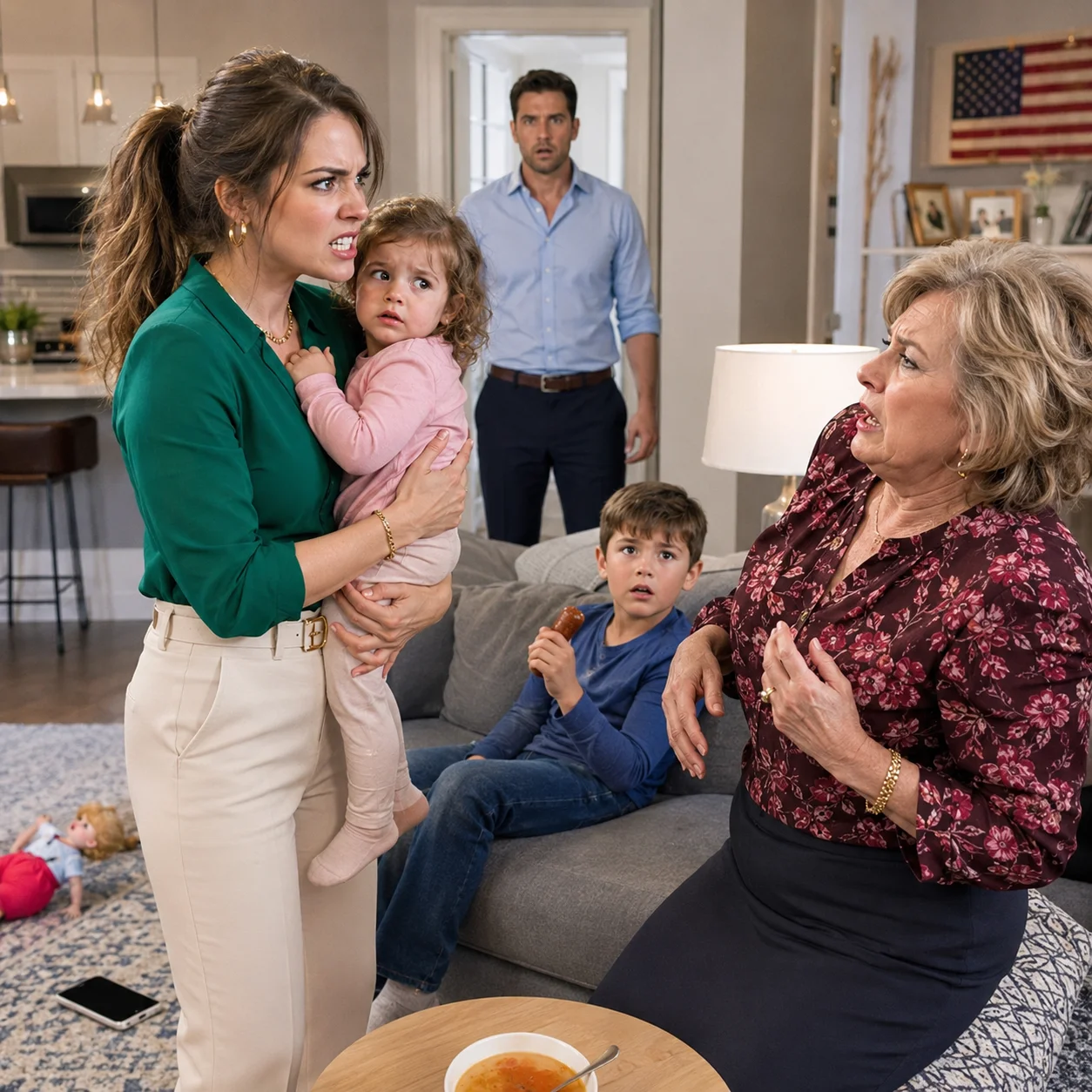
When I came out of the bedroom, Carmen was sitting on the couch with ice pressed to her cheek like she was the victim. Mateo sat beside her, pale and confused, the forgotten sausage still in his hand.
For the first time, I did not see him as the spoiled boy Carmen had created.
I saw another child trapped in adult lies.
“Where is Ricardo?” I asked.
Carmen straightened. “On his way. And you had better beg forgiveness when he gets here.”
“From Monterrey?”
Her face twitched.
Just one second.
Enough.
“Of course.”
“That is strange,” I said. “Because no flight could get him here that fast.”
“Do not start with your paranoia.”
I tapped the screen of my work phone.
“The recording is still running.”
Her eyes narrowed.
“What recording?”
“The one where you said Mateo is Ricardo’s son.”
Mateo lifted his head.
His face changed.
He did not understand everything, but he understood his name.
“My dad?” he asked softly.
Carmen spun toward him.
“Be quiet!”
I stepped forward.
“Do not yell at him.”
“You do not command me in this house.”
I looked around the room.
My table. My sofa. My curtains. My rent. My food. My daughter’s blood.
“Yes,” I said. “I do.”
A knock sounded at the door.
For one bright second, Carmen looked relieved, thinking Ricardo had arrived.
But when I opened the door, two police officers and a paramedic stood outside.
Carmen’s relief collapsed.
Camila began crying the moment she saw the uniforms. I picked her up immediately.
“She is scared,” I told the paramedic. “She is two. She was hit in the face.”
The paramedic approached slowly, keeping her voice gentle.
“Hello, princess. I only want to look at your little nose, okay?”
Camila buried her face in my neck.
“Mami.”
“I’m here, my love.”
Carmen jumped up and launched into her performance.
“Officer, this woman attacked me! She is unstable. I only corrected the child because she tried to steal food.”
One officer stared at her.
“Are you saying you hit a minor because she took food?”
Carmen opened her mouth.
Closed it.
“That is not what I meant.”
“It is what you said,” I replied.
I played the first recording.
Carmen’s own voice filled the room.
“Your daughter is greedy and badly raised. That is why I hit her.”
Mateo started crying again, silently this time.
The paramedic examined Camila and recommended immediate medical evaluation. I agreed. Nothing mattered except making sure my daughter was safe.
Then Ricardo arrived.
Not from Monterrey.
He came in with damp hair, no tie, and the face of a man interrupted in the middle of a lie.
“What is going on here?” he demanded.
Carmen rushed to him.
“Your wife hit me! She called the police! She canceled my medical card!”
Ricardo turned to me with fury.
“Valeria, what did you do?”
I lifted Camila slightly so he could see her face.
Her swollen nose. The dried blood. The red marks.
“This is what your mother did.”
For one second, I waited for him to become a father.
I waited for him to rush to Camila, to ask if she was okay, to look horrified that his baby had been hurt.
Instead, he looked at his mother first.
That was his trial.
And he failed.
“Mom would not do something like that without reason,” he said.
The paramedic looked at him like she could not believe he was real.
I felt something inside me go silent.
“She is two,” I said.
“You always exaggerate with Camila.”
Mariana walked in at that exact moment.
She wore black pants, a white blouse, and the expression of a woman who had not come to negotiate.
“Ricardo,” she said, “step away from Valeria and the child.”
He glared at her.
“What are you doing here?”
“My job.”
Carmen pointed a shaking finger. “Of course. You brought that poisonous woman.”
Mariana did not blink.
“Mrs. Carmen, there is an injured minor, a recorded confession, and evidence of family violence. If there is another child in this home under emotional manipulation or abuse, that will also be reported.”
“Mateo is not your business,” Ricardo snapped.
I looked at him.
“Mateo became my business when you put him in my house under a lie.”
His face changed.
“What?”
I played the second recording.
Carmen’s voice came through clearly.
“She cannot know the child is yours.”
The room died.
Mateo stood up from the couch.
“Are you my dad?” he asked Ricardo.
Ricardo closed his eyes.
He did not answer.
He did not have to.
Mateo’s face crumpled.
“They told me my dad was dead.”
Carmen grabbed for him.
“That was to protect you!”
Mateo pulled away from her.
It was a small movement, but it broke my heart.
He had never pulled away from Carmen before.
The officer looked from Carmen to Ricardo, then to Mariana.
Mariana’s voice stayed firm.
“Valeria, take Camila to the hospital. Officers, please note there are two minors involved, and we are requesting protection authorities be notified.”
Ricardo moved in front of me.
“Camila is my daughter. I have rights too.”
“You made your choice,” I said.
“Do not provoke me.”
“No,” I answered. “That part of my life is over.”
I carried Camila toward the door. Mateo followed a few steps, barefoot, holding his tablet against his chest.
“Do I go too?” he asked.
No one answered him.
So I stopped.
I looked at Mariana. She understood.
“The child should not remain in the care of a woman who just justified assaulting a toddler and hiding his identity,” Mariana told the officers.
Carmen screamed.
“You cannot take him! He is my boy!”
Mateo hid behind me.
Ricardo looked at him, and for the first time I saw it clearly: the boy Carmen called the heir was not a son to him in that moment. He was a problem.
“Mateo, stay with your grandmother,” Ricardo ordered.
Mateo shook his head.
“I don’t want to.”
Carmen pressed a hand to her chest.
“Traitor.”
I crouched as much as I could with Camila in my arms.
“Mateo, no one is going to force you to hug anyone right now. We are going to get Camila checked, and then the adults will figure out what happens next.”
He looked up at me with wet eyes.
“Do you hate me?”
That question hurt more than I expected.
“No,” I said. “You are a child.”
And it was true.
My rage had names.
Carmen.
Ricardo.
The lie.
But not Mateo.
At the hospital, Camila was examined, photographed, and treated. Her nose was swollen but not badly broken. The bleeding had stopped. The doctor explained what to watch for and asked careful questions. A social worker came. A report was filed.
Camila cried whenever anyone lifted a hand near her face.
That broke me more than the blood.
A child does not learn to protect her face from one accident. She learns it from fear.
Ricardo arrived an hour later with Carmen and a lawyer.
That told me everything.
Not an apology. Not flowers. Not panic. A lawyer.
Carmen had changed clothes and wrapped a gray shawl around her shoulders, as if fabric could turn cruelty into fragility.
“Valeria,” Ricardo said in a low voice. “Let’s handle this as a family.”
“Our family is in the emergency room because of your mother.”
“My mother made a mistake, but you hit her too.”
“And I will face whatever comes from that,” I said. “But you will not use my reaction to erase Camila’s blood.”
His lawyer stepped forward.
“Mrs. Morales, I advise everyone to avoid emotional statements.”
Mariana appeared beside me.
“Excellent. Then you can receive copies of the recordings: one where Mrs. Carmen admits hitting a two-year-old, and another where the hidden paternity of Mateo is discussed.”
Ricardo’s jaw tightened.
“Mateo has nothing to do with this.”
“He has everything to do with this,” I said. “You brought him into my home under a lie. You let me feed him, educate him, and care for him while your mother humiliated my daughter because of him. You let Camila be treated like less in her own home.”
“It was not the right time to tell you.”
“When was the right time? After I signed over part of my company? After Camila understood her father loved his secret son more because he was a boy?”
Ricardo looked down.
That was when I knew there was more.
“What papers did you want me to sign?” I asked.
Mariana turned to him.
“Answer carefully.”
Ricardo said nothing.
Carmen did.
“The family company needed protection.”
I laughed once, bitterly.
“My natural cosmetics company is not a family company. I founded it. I registered it. I built it selling soaps at weekend markets and creams at women entrepreneur fairs.”
“Ricardo helped you,” Carmen spat.
“Ricardo borrowed money from me.”
Mariana opened her folder.
“Valeria, I reviewed the draft you sent me last week. The proposed modification would convert personal shares into marital participation administered by Ricardo.”
My stomach turned.
That document.
Ricardo had told me it was a tax form.
“You were going to use my company to secure Mateo’s inheritance?” I asked.
Ricardo finally spoke.
“Mateo is also my son.”
“And Camila is also your child.”
“But Mateo is a boy.”
The sentence slipped out too quickly for him to hide it.
Carmen closed her eyes, not because she disagreed, but because he had said it in front of witnesses.
Mariana went still.
I smiled without warmth.
“Thank you.”
Ricardo frowned.
“For what?”
“For saying that out loud.”
That night, I did not return to the apartment.
Mariana drove Camila, Mateo, and me to my sister Laura’s home in Narvarte. Camila fell asleep with a cold compress near her cheek, clutching her doll. Mateo sat at the kitchen table with his shoulders curled inward, staring at a bowl of soup like he did not know if he was allowed to eat.
“You can eat,” I told him.
He swallowed.
“I don’t know if I can.”
I sat across from him.
“Here, food is not a prize. It is food.”
His eyes filled.
“Does Camila hate me?”
“Camila is two. Her face hurts. The rest is for adults to fix.”
He cried then, quietly, covering his mouth.
“I didn’t know the sausage was a problem.”
I had to look away for a second.
“You did not hit her.”
“But it was mine.”
“No,” I said gently. “It was food. Food is never worth a child’s blood.”
The next morning, I returned to the apartment with police, Mariana, and a locksmith.
Ricardo was there.
So was Carmen.
They had suitcases open, but not like people preparing to leave. They had spread papers across the dining table: invoices, company files, medical folders, lease documents, even Camila’s vaccination records.
“What are you doing?” I asked.
Ricardo stood.
“I am protecting family information.”
“My family is already protected.”
Mariana presented the emergency protective documents. They were temporary, not the final battle, but enough to make Carmen understand the home she had ruled was no longer hers.
“You have one hour to collect personal belongings,” Mariana said. “No company documents, no medical files belonging to the child, no cards, no electronics that are not yours.”
Carmen stared at me with pure hatred.
“You are leaving me without surgery.”
“No,” I said. “Your son can pay for it.”
Ricardo glared.
“I do not have that kind of money.”
“Sell your car.”
“It is my work tool.”
“My daughter also needed an unharmed face.”
Carmen began to cry again, but the sound no longer moved me.
For years, I had mistaken age for innocence. Illness for goodness. Mother-in-law for mother.
Never again.
When Carmen stepped into the hallway with her bags, she turned back one last time.
“You will regret this. A woman without a husband is nothing.”
I held Camila carefully against my chest.
“A girl without bruises is worth more than any husband.”
Then I closed the door and changed the lock.
The weeks that followed were ugly.
Statements. Doctors. Lawyers. Social workers. Child psychologists. Bank calls. Canceled cards. Blocked accounts. Copies of recordings. Screenshots. Receipts. Draft documents. Every piece of my life became evidence.
Ricardo tried to paint me as violent because I had slapped Carmen. I did not deny it.
I told the truth.
“I slapped her after seeing my daughter bleeding on the floor.”
I did not glorify it. I did not pretend it was wise. But I refused to let them make Carmen’s cheek more important than Camila’s face.
Mateo was eventually placed temporarily with his biological mother, Elisa.
Elisa was not dead.
She had not abandoned him.
She had been pushed away.
I learned that she had been young when she became pregnant by Ricardo. Carmen had convinced everyone it would be better if the child stayed with the Morales family. Then stories changed. Threats were made. Elisa was told that if she tried to reclaim Mateo, Ricardo would bury her in court, use money she did not have, and prove she was unstable.
So she disappeared from his daily life, but not from grief.
When Elisa arrived for the first meeting, she carried a backpack full of children’s clothes that were too small for Mateo now. She had kept them anyway.
She did not rush toward him.
She knelt a few feet away.
“Hi, Mateo,” she said, voice shaking. “My name is Elisa. You do not have to love me today.”
Mateo hid behind my arm.
I touched his shoulder.
“No one is forcing you.”
That was the day I realized Ricardo had not lost one family.
He had been exposed in front of both of them.
Camila began play therapy. For several sessions, she did not explain anything. She stacked blocks, knocked dolls down, then hugged them afterward. Her psychologist told me children that young do not narrate fear the way adults do. They repeat it with toys, with sleep, with silence, with the way their bodies react before their minds understand.
I started therapy too.
Because every time Camila reached for food with her little hand, my body tensed, waiting for a scream that was no longer there.
Healing was slow.
First, Camila stopped flinching when someone moved too fast near her.
Then she stopped hiding behind my legs whenever an older woman spoke loudly.
Then one afternoon, while I was cooking, she pointed to a package in the fridge and said, “Sausage?”
I cried in the kitchen.
I cut one into tiny pieces, placed it on her blue plate, and sat beside her.
She picked up one piece, looked at it carefully, then offered it to me.
“Mami.”
“It is yours, my love.”
She pushed it toward me again.
“You.”
So I ate it.
It tasted like victory.
Months later, a judge established protection measures for Camila. Ricardo received supervised visits, not as a reward, but as a test. He would have to prove he could be a father without Carmen’s poison guiding his mouth.
Carmen was not allowed near my daughter.
Not near my home.
Not near my card.
Not near my forgiveness.
Ricardo asked to speak to me once outside court. I agreed only because Mariana stood beside me.
“Valeria,” he said, looking tired and smaller than I remembered. “My mother made mistakes. I made mistakes. But we can rebuild.”
I looked at him and thought of all the times I had begged him to choose his daughter in small ways before the day forced him to choose her in the biggest way.
“No,” I said. “I will not rebuild a house where my daughter bled and you asked about your mother first.”
“Camila needs her father.”
“Camila needs a father who chooses her.”
His face tightened.
“I did not know how to handle Mateo.”
“He was not misplaced furniture, Ricardo. He was your son. And you used him to hide your cowardice.”
“My mother pressured me.”
“Your mother did not sleep with Elisa. Your mother did not lie at my table every day. Your mother did not try to trick me into signing away control of my company. Your mother hit Camila, yes. But you opened the door and taught her she could.”
He had no answer.
Because for the first time, Carmen was not there to speak for him.
I changed the apartment after they were gone.
I threw out the couch where Mateo had sat that day, frozen with his tablet. I replaced the curtains. I painted the living room wall a soft green. Not because I cared about decoration.
Because the place needed air.
Camila grew. She did not remember everything in words, but her body remembered pieces. So I never allowed anyone to call her greedy, even jokingly. I never let anyone compare her worth to a boy’s. I never let food become power in my house again.
Food became food.
Not reward.
Not hierarchy.
Not a reason to hurt a child.
Mateo visited once months later with Elisa and a social worker. He was thinner, quieter, but his eyes no longer looked around for permission to exist.
Camila was playing on the rug when he approached.
He held out a small bag of turkey sausages.
“For you,” he said.
Camila did not understand the weight of the gesture. She only smiled.
“Thank you.”
Mateo burst into tears.
Elisa held him.
I cried too, silently, because children are not responsible for the adults who turn them into weapons.
A year later, I signed the divorce papers.
Ricardo came alone.
No Carmen. No speeches. No false tenderness.
At the end, he said, “My mother is very sick.”
I looked at him calmly.
“Then her son can care for her.”
His jaw tightened.
“You became hard.”
I thought of Camila on the floor. Her bleeding nose. The red fingers on her cheek. Carmen calling my daughter a burden. Ricardo saying Mateo mattered more because he was a boy.
“No,” I said. “I became a mother.”
I left the courthouse with Camila in my arms.
Outside, the city sounded the same as always. Vendors calling out tamales. Cars honking. Office workers rushing with coffee. Dogs barking from balconies. Life had not stopped for my heartbreak.
So I decided not to stop either.
That night, I made chicken soup.
The same soup I had abandoned on the stove that Sunday.
Carrots. Potatoes. Zucchini. Rice. Shredded chicken.
Camila sat in her little chair, swinging her feet. I placed a small bowl in front of her.
She lifted the spoon.
“Hot?”
“Yes, my love. Blow on it.”
She blew carefully.
Then she ate.
No fear.
No looking toward the door.
No waiting for someone to snatch the food away.
I sat across from her and finally understood what victory really looked like.
It was not Carmen leaving my house.
It was not Ricardo being exposed.
It was not the canceled card, the court order, the divorce, or the company documents saved in time.
Victory was my daughter eating peacefully at her own table, with a clean face, a healed nose, and the certainty that in her home, no sausage, no surname, no inheritance, and no male heir would ever be worth more than her.



![[FULL STORY] My Fiancée’s Ex Told Her "He’ll Never Find Out" While Shopping For Our Wedding, So I Canceled Everything And Left Her To Her Fate](https://social-media.rabedo.com/thumbnails/1776938902_42.png)