The moment the brand died, I was standing ten feet away holding a bag of organic kale.
That is the part I remember most clearly. Not the insult itself, although I can still hear it. Not Caroline’s laugh from just outside the frame. Not the river of skull emojis and laughing faces racing up the screen like digital applause.
The kale.
A ridiculous detail, I know, but memory is cruel like that. It holds onto the useless things because the important ones are too sharp.
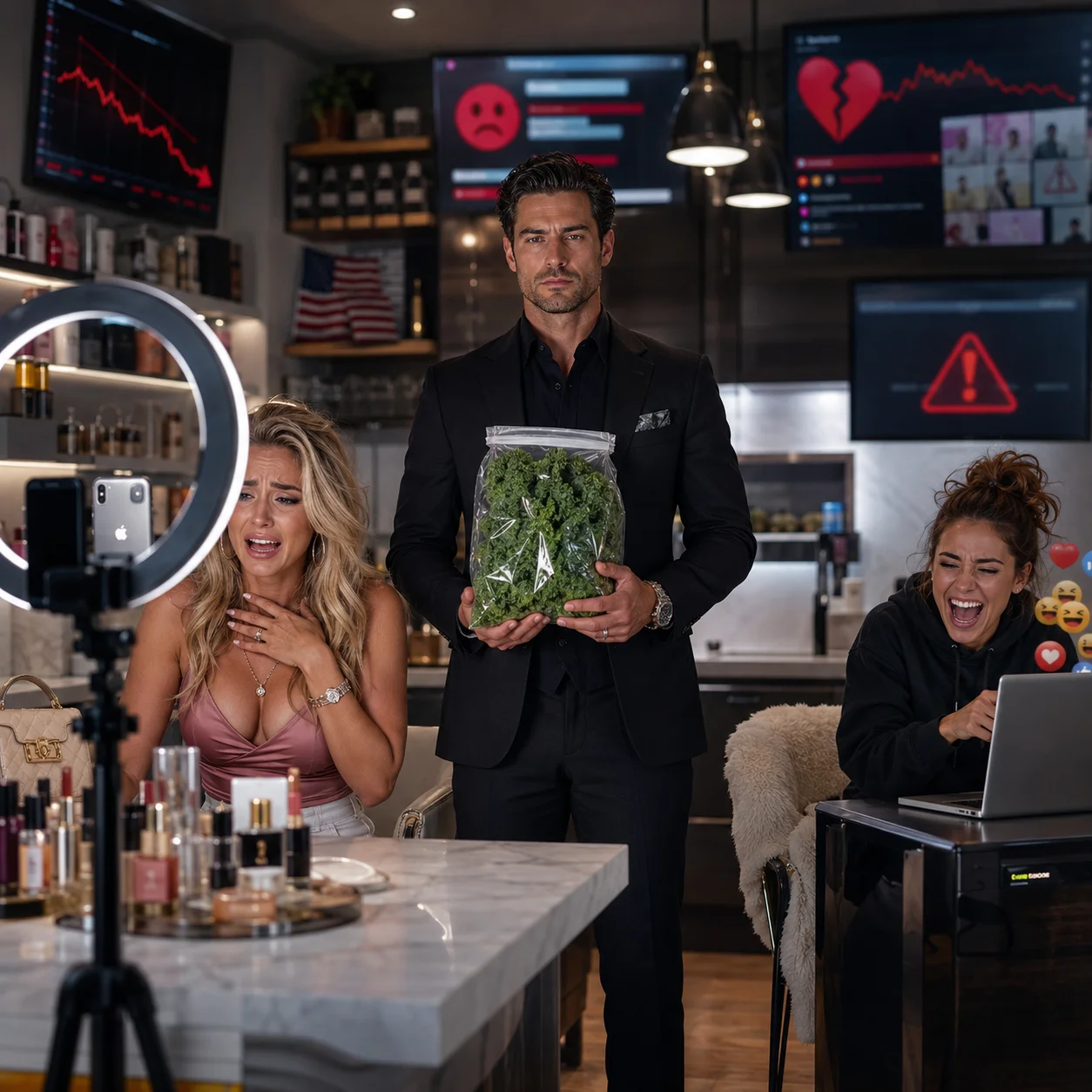
I had just come back from the grocery store, arms full, keys still hanging from one finger. My girlfriend Maya was in her element at the kitchen island, bathed in the artificial glow of a ring light. Her phone was propped at the perfect angle. Her hair was glossy, her skin lit like an ad campaign, her voice bright and animated as she talked to thousands of people watching her TikTok livestream.
Her best friend and professional hypewoman, Caroline, sat just out of frame with a laptop open, monitoring comments like she was mission control for a rocket launch.
“Oh my god, you guys are so funny,” Maya said, reading from the screen.
She glanced over her shoulder at me as I walked in. For half a second, annoyance flashed across her face. I had entered the shot without permission. I was not part of the planned content. I was not styled, not lit, not useful.
Then she turned back to her audience with a dazzling smile.
Someone named StylinStef22 had commented, “Is that the boyfriend in the background? He’s so normal.”
Caroline snorted.
Maya leaned toward the phone conspiratorially, her voice dropping into a performative whisper that was clearly meant for everyone to hear.
“Guys, be nice,” she said, failing to suppress a smirk. “We can’t all be tens. Honestly, sometimes I feel like I’m doing charity work, you know? Like, everyone keeps asking me why I’m dating down.”
The comments exploded.
From where I stood, I could see the laptop screen reflected in the glass cabinet door. Laughing emojis. Skull emojis. “OMG spill the tea.” “Maya you’re savage.” “Charity work I’m dead.” “Girl you can do better.”
Caroline howled with laughter, rocking back in her chair.
Maya basked in it.
That is the only word for it.
She basked.
She had just thrown me to her digital wolves for a few seconds of cheap engagement, and she was pleased with the conversion rate.
I did not move.
I did not speak.
I just stood there in the doorway holding groceries, my face completely still.
Inside my head, a switch flipped. Not an emotional switch. A professional one.
I am a brand strategist. I build things: narratives, images, reputations, campaigns, careers. I understand how audiences attach meaning to a person and how quickly admiration becomes contempt when the story turns. I know the difference between a recoverable mistake and terminal brand poisoning.
In that moment, I recognized the diagnosis.
The Maya brand was dead.
Not wounded.
Not in crisis.
Dead.
She had publicly, irrevocably, and fatally poisoned her own product.
My job now was to manage the recall.
I calmly walked to the fridge, unloaded the groceries, and placed the organic kale in the crisper drawer. I did not interrupt her livestream. I did not confront her in front of her audience. An audience of thousands was not the place for a strategic discussion.
They thought I was the background character in her show.
They had no idea I was the executive producer.
And I was about to cancel the series.
That night, after Maya fell asleep, I went to my office.
I did not pack my bags in a fit of anger. I executed a pre-planned contingency protocol. That may sound cold, but cold is useful when someone has just reminded you that warmth was never being reciprocated.
I packed only mission-critical assets: laptops, hard drives, personal documents, contracts, credentials, backups. Then I began the systematic dismantling of the digital empire I had spent two years building for her.
Let me be clear about something.
Our relationship was not a traditional romance. Not really.
It was a joint venture.
I met Maya two years ago when she was a waitress with a charming personality, a pretty face, and about seven hundred followers. She was funny, confident, and had a natural ease on camera, but she had no strategy. No brand identity. No content discipline. No monetization structure. Just occasional outfit videos, coffee selfies, and vague captions about growth.
I saw potential.
Not only in her, precisely, but in the idea of her.
That is important.
In branding, raw charisma is clay. Valuable, yes, but useless without structure. Maya was a blank canvas, and for someone in my line of work, that is the most valuable asset you can find.
I made her a proposal.
I would take her on as my sole client pro bono. I would invest my time, expertise, and a significant amount of my own capital to turn her into a successful lifestyle influencer. I would handle strategy, tech, branding, deal negotiations, content planning, backend analytics, equipment, workflows, editing systems, and growth campaigns.
Her job was to be the talent.
To be charismatic on camera.
To follow the plan.
Our romantic relationship developed alongside that arrangement, but it also became part of the brand strategy. The aspirational couple narrative. The “soft life with a supportive partner” angle. The cozy apartment content. The grocery hauls. The Sunday reset videos where my hands would appear chopping vegetables while she talked about balance.
It worked.
Too well.
Within two years, Maya went from seven hundred followers to 1.2 million on TikTok, a strong Instagram presence, a polished website, and six lucrative long-term sponsorship deals with fashion, beauty, skincare, and wellness companies.
She became MayaTheGlowUp.
A brand.
A business.
A product.
And somewhere along the way, she forgot who built the machine that made her look inevitable.
I was not a simp paying her way.
I was the founder and CEO of her career.
She was the face of the product.
And on that livestream, she proved the product was defective.
So at two in the morning, sitting in my office under the blue light of three monitors, I initiated the shutdown sequence.
The first twenty-four hours were about extraction and containment.
My primary objective was to decouple every one of my assets from the failing brand before Maya understood the scale of her exposure.
Maya was a heavy sleeper, which was a logistical advantage.
Before I left that night, I took back my property.
The professional-grade camera she used to film her high-performing videos. The lighting rigs. The external hard drives. The MacBook Pro I had bought for editing. The microphones. The portable backdrops. The color calibration tools. All of it was mine, purchased by me through my company or on personal cards as part of the venture.
I packed everything neatly into Pelican cases.
I also took the server that hosted her personal website, a sleek professionally designed portfolio I had built from scratch. It contained her media kit, press page, sponsor links, contact form, and campaign case studies. Sponsors loved it because it made her look polished and legitimate.
By sunrise, I was out of the apartment.
I did not leave a note.
A note is an emotional gesture.
This was a corporate dissolution.
I moved into a new apartment I had kept on standby for the last six months, a corporate lease under my company’s name. A good strategist always has contingency plans, especially when the asset starts believing it is bigger than the system.
Once established in my new command center, I began phase two.
The digital takedown.
First, the website.
At 7:00 a.m., MayaTheGlowUp.com went offline.
I replaced the beautifully designed homepage with a stark white page containing one line of plain black text.
“This brand is no longer under the management of its founding strategist.”
No explanation.
No drama.
Just a cold corporate statement that would be mystifying to followers and terrifying to brand partners.
Next came the sponsorships.
Over the past year, I had personally negotiated and secured six long-term deals for Maya. These were not casual affiliate links or one-off free-product posts. These were structured campaigns with deliverables, morality clauses, positivity requirements, and brand-safety language that I had drafted carefully because I always knew the biggest risk to Maya’s brand would be Maya.
I had the contact information for every marketing executive.
I spent the morning crafting one email template.
Subject: Urgent strategic update regarding the Maya brand.
“Dear [Executive Name],
Please be advised that as of today, I have formally ceased my role as brand strategist and manager for Maya.
As the architect of the brand identity and primary negotiator of our partnership, I feel it is my professional duty to inform you that I can no longer vouch for the strategic alignment or brand safety of the content she may produce moving forward.
For your reference regarding this decision, I have attached a timestamped eight-second video clip from her most recent public livestream.
Best,
[My Name]”
The attached clip was, of course, the “dating down” comment.
Eight seconds.
Enough.
I sent the first email at 9:00 a.m.
Then I sat back and watched the dominoes begin to fall.
While that was working, I moved on to content.
A significant portion of Maya’s most successful videos used background music. What she and her audience did not know was that the tracks were not random trending sounds. I had licensed them commercially through my agency. This was intentional. From the beginning, I had built the brand to look effortless while ensuring I controlled the legal infrastructure underneath it.
At 11:00 a.m., I submitted formal copyright takedown notices to TikTok and Instagram for every video using music licensed by my agency.
I was not making false claims.
I was not abusing the system.
I was revoking her right to use my licensed assets after terminating the brand partnership. Every notice was legitimate, documented, and legally sound.
Finally, I dealt with account infrastructure.
I had set up her accounts using a master recovery email I controlled through my company. I could not take over her TikTok or Instagram accounts. That would cross legal lines I had no interest in crossing. But I could remove my administrative and recovery protocols.
So I changed the password on the master email, enabled multi-factor authentication tied exclusively to my devices, and removed every recovery pathway connected to my systems.
I did not lock her out of her social accounts.
But I removed the safety net.
If she ever lost access, she would have no way to recover them through me.
The digital kingdom I built for her still stood for the moment, but the foundation beneath it had turned to sand.
By noon, the work was done.
Assets extracted.
Stakeholders notified.
Licensed content revoked.
Infrastructure severed.
I blocked Maya’s number, but not Caroline’s. I knew Caroline would be the first messenger sent from the collapsing empire to assess the damage.
I made coffee and waited.
The first communication arrived at 3:17 p.m.
Caroline.
“What the hell is going on? Maya’s website is weird and three of her best videos just got deleted for copyright infringement. Are you doing this?”
I replied with a single sentence.
“I am managing a brand dissolution.”
She sent a string of question marks.
Then, a few minutes later:
“Maya is freaking out. She’s been calling you. You need to fix this. That skincare brand just emailed her asking about some video you sent them.”
The first sponsor had made contact.
The plan was working faster than expected.
The next forty-eight hours were a symphony of consequences conducted from afar.
I learned most of it through a burner Instagram account I used to monitor the situation. Maya’s first response was panic dressed as professionalism. She posted a tearful Instagram story from the old apartment, poorly lit, filmed on her phone.
“Hey guys, I’m having some technical issues with my account and my website is down. Working on fixing it. Thanks for your patience.”
She was trying to project control, completely unaware she had none.
But the copyright strikes kept coming.
By the end of the day, a dozen of her most popular videos had been removed. Her follower count, which I had painstakingly grown through targeted content cycles and paid amplification, began to stagnate. Then dip. Her engagement rate plummeted as the algorithm punished deleted content and disrupted viewer patterns.
Then the sponsors started pulling back.
The skincare company paused their partnership pending review. The video clip violated the “positive and uplifting” clause I had insisted on during negotiation. By the next day, two more brands followed. These were not small deals. This was thousands of dollars in monthly income disappearing in writing.
Maya’s content quality fell off a cliff.
Without my camera, lighting, microphones, and editing computer, she was back to filming on her phone in mediocre light. Her videos looked amateurish, and the change was jarring enough that her audience noticed immediately.
“Why does this look different?”
“Did you change your setup?”
“Where’s the old aesthetic?”
“Something feels off.”
She tried to maintain her bubbly persona, but stress seeped through every frame. Her smiles landed late. Her voice was too high. Her eyes kept flicking off-screen, probably to Caroline, probably waiting for instructions neither of them had.
She was a CEO suddenly forced onto the factory floor, and she had no idea how any of the machines worked.
Caroline’s loyalty lasted about as long as the free products did.
Through a mutual acquaintance, I heard she was distancing herself. That did not surprise me. Caroline had enjoyed being adjacent to success: the events, the gifted PR boxes, the reflected glow. She had been Maya’s hypewoman because Maya had been worth hyping. Now that the brand was failing, Maya was no longer an asset.
She was a liability with mascara stains.
Maya continued calling from different numbers. Angry voicemails became pleading ones. Pleading became threats. Threats became sobbing apologies. I listened to none of them.
The official termination of our romantic contract had to happen in person.
But the brand collapse came first.
The fatal blow landed on the second day.
TikTok’s copyright system is largely automated. An account receiving multiple legitimate strikes in a short period gets flagged for review. Because my takedown notices were valid and backed by documentation, the system worked exactly as I knew it would.
At approximately 4:00 p.m. on the second day, the MayaTheGlowUp TikTok account, with its 1.2 million followers, was permanently banned for repeated intellectual property violations.
Just like that.
Gone.
Two years of curated relatability, soft lighting, skincare routines, morning affirmations, and brand partnerships disappeared behind a violation notice.
A digital empire reduced to an error screen.
It has been a week since I initiated the brand recall.
Two days after her account was deleted, my buzzer rang.
It was Maya.
I let her come up because I wanted her to see my new apartment.
It was larger than our old place, cleaner, more minimalist. No ring lights. No fake plants chosen for background texture. No piles of sponsored products staged as lifestyle clutter. Just a home designed around utility, quiet, and control.
The home of a man with no liabilities.
When she walked in, she looked like a ghost.
Her face was pale and swollen from crying. The designer clothes she wore looked like a costume she no longer had the energy to inhabit. She clutched her phone like a broken oxygen mask.
She started sobbing the moment she saw me.
“You have to fix it,” she wept. “Everything is gone. My account, the sponsors, everything. You did this.”
I did not offer her a seat.
I did not offer a tissue.
I stood with my arms crossed.
“I didn’t do anything, Maya,” I said calmly. “I simply took back what was mine. My equipment, my website, my licensed music, my infrastructure.”
“You ruined me.”
“No,” I said. “I unwound our partnership.”
She stared at me like she had never heard the word before.
“The brand was a joint venture,” I continued. “You were the talent. I was the strategist. When the talent publicly humiliated the strategist and revealed herself to be a deeply flawed product, the venture was terminated.”
“It was a joke,” she cried. “A stupid joke. I didn’t mean it.”
“You performed a cost-benefit analysis in real time in front of thousands of people,” I replied. “You decided that a few moments of cheap engagement were worth more than my dignity, our relationship, and the business infrastructure supporting your career.”
Her face twisted.
“You ruined my life because your feelings got hurt?”
“You are fundamentally misunderstanding the situation.”
I stepped closer.
“My feelings are irrelevant. This was not an emotional decision. It was a business decision. You were not simply my girlfriend who made a mistake. You were a brand that had become toxic, a product generating negative returns. My job is to mitigate risk and cut losses.”
She flinched.
“You weren’t a person to me in that moment, Maya. You were a line item in the red. So I wrote you off.”
For the first time since she arrived, she stopped crying.
I walked to my desk and picked up a single sheet of paper.
A final itemized invoice.
It listed the cash value of the equipment I had provided, the market rate for two years of brand strategy and management services, website development costs, content planning, campaign management, sponsorship negotiation, analytics, paid growth campaigns, licensing fees, consulting hours, and production support.
The total at the bottom was well over two hundred thousand dollars.
I handed it to her.
“This is what I invested in you,” I said. “I do not expect you to pay it. I want you to understand the scale of the asset you destroyed.”
She looked down at the paper.
Her hands trembled.
“You didn’t just lose a boyfriend,” I said. “You lost an entire corporation dedicated to your success.”
That was when it landed.
Not the breakup.
Not the account ban.
Not the sponsor emails.
The truth.
She had not been dating down.
She had been carried upward by a man she never really saw.
“I have nothing,” she whispered.
“I know.”
I walked to the door and opened it.
“The market corrected itself. Goodbye, Maya.”
She stumbled out, still clutching the invoice.
I closed the door and felt no rush of victory. No cinematic satisfaction. Just the quiet finality of a project completed.
Her social media presence is gone. Her sponsors are gone. Her friends are gone. Caroline vanished the moment the perks did. Maya is back to being what she was when I met her: a waitress with a pretty face, a charming personality, and seven hundred followers.
Maybe she will rebuild. Maybe she will learn. Maybe she will find another strategist willing to turn raw material into a business.
But it will not be me.
My revenge was not loud.
It was not public screaming or messy online drama.
It was quiet, precise, and absolute.
I did not ruin her life.
I took my life back.
And when I did, I took back everything I had built around hers.

![[FULL STORY] My Wife Declared: 'Let’s Divorce Before You Lose Your Pride ' Then She Left With a Stranger—and](https://social-media.rabedo.com/thumbnails/1777004418_S2.png)
![[FULL STORY] She Lashed Out at Me in Front of Her Friends: 'You Can’t Please Me or Support Me ' I Grinned](https://social-media.rabedo.com/thumbnails/1777305155_S6.png)