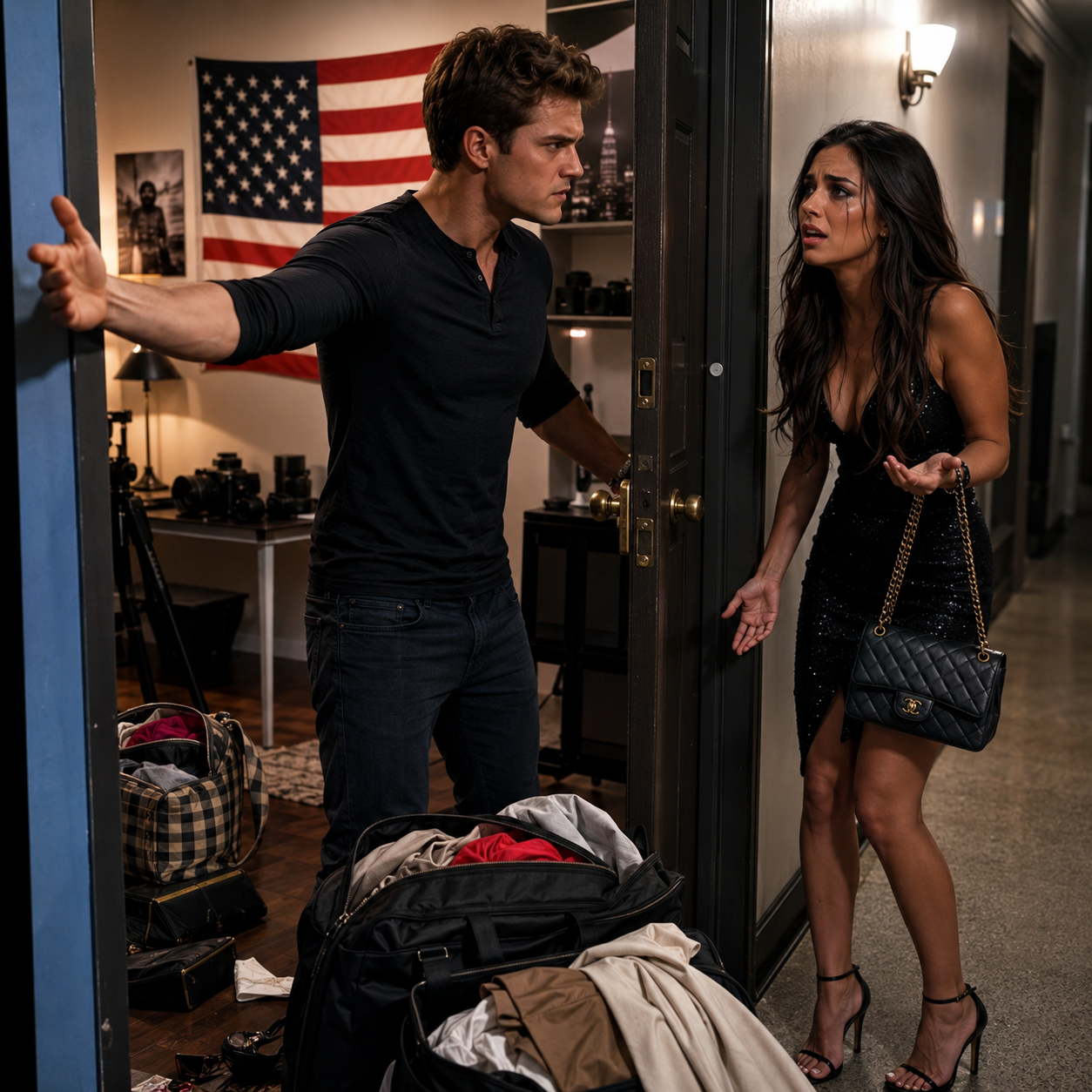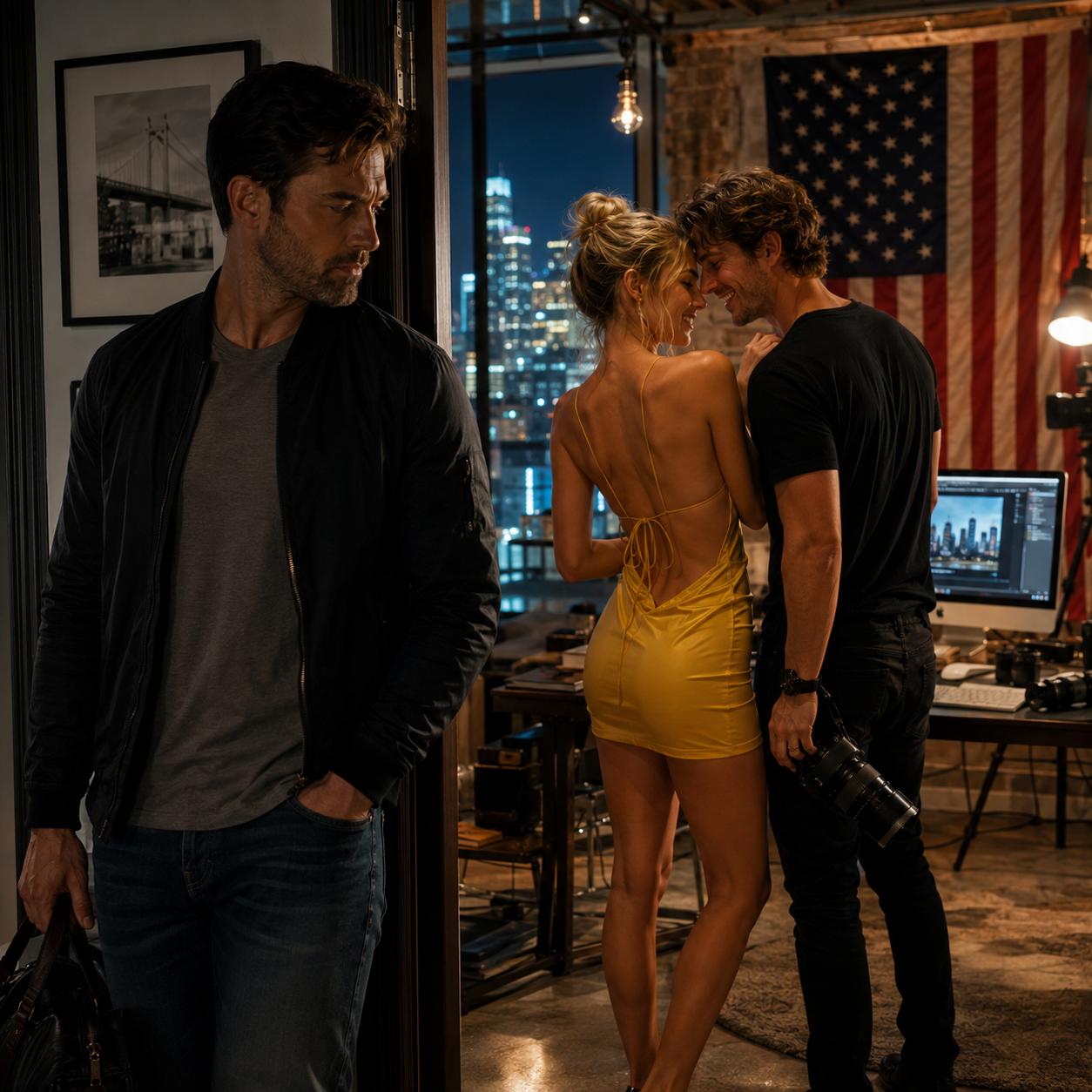
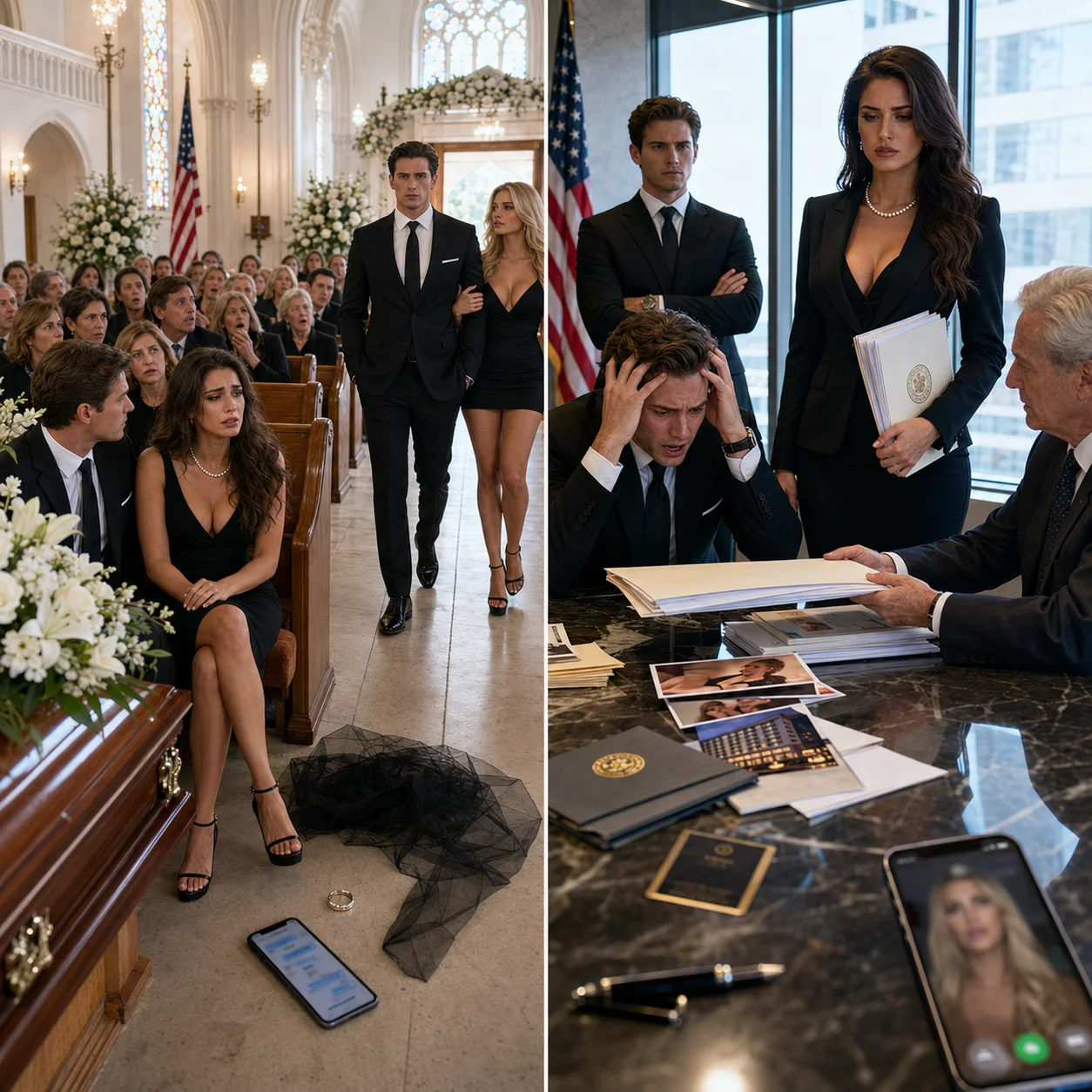
My husband brought his mistress to my father’s funeral.
Not quietly. Not respectfully. Not by accident.
He walked into the chapel with her hand looped around his arm like he was arriving at a charity gala instead of the service for the man who raised me, protected me, taught me to drive stick shift in a gravel lot behind a warehouse, and built an entire company from two pickup trucks and a rented trailer.
Then Preston leaned down, kissed my cheek in front of half the county, and whispered, “Don’t make a scene today, Claire. Your father wouldn’t want that.”
He was right about one thing.
My father did not want a scene.
That was why he had already prepared one for after the funeral.
My name is Claire Whitaker Caldwell. At the time all this happened, I was thirty-nine. My husband, Preston Caldwell, was forty-two. We had been married for twelve years, together for fourteen, and for most of that time I believed I understood the shape of my life. Maybe not happily every second, maybe not perfectly, but at least clearly.
I was the daughter of Edward Whitaker, founder of Whitaker Development, a respected regional construction company in Virginia. We built schools, municipal offices, small medical centers, churches, affordable neighborhoods, and the kind of practical community buildings people use for decades without ever wondering who poured the foundation. My father was not a billionaire. He was not flashy. But in our part of Virginia, the Whitaker name meant something. It meant the bid would be honest, the workers would be paid, and if Edward Whitaker shook your hand, you could stop worrying.
Dad believed contracts were sacred. He believed promises mattered. He believed men who cheated working people out of overtime were lower than dirt, and he said that phrase often enough that half our employees repeated it like scripture.
Preston used to admire that about him.
Or maybe he admired the money.
It is hard now to tell where the man I married ended and the man who saw my family as an investment opportunity began.
When Preston and I first met, I was working as a project coordinator at Whitaker Development. I had grown up around blueprints and job trailers, but Dad insisted I learn the company from the bottom, not the top. That meant purchase orders, subcontractor calls, permit delays, angry clients, site visits in hard hats too large for my head, and endless spreadsheets that smelled faintly of toner and coffee.
Preston was a commercial real estate attorney at a firm that handled some of our permitting issues. He was handsome in the polished way attorneys can be handsome when they know their suits fit and their smile has a billing rate. He was charming, attentive, ambitious, and very good at making older men feel respected. My father liked him at first. Preston had a firm handshake, direct eye contact, and just enough golf references to seem familiar without sounding like he was trying too hard.
I thought it was sweet.
Now I wonder how much of it was research.
Three years into our marriage, Dad offered Preston a position as general counsel for Whitaker Development. Preston said it would be an honor. He made a whole speech at Sunday dinner about legacy and family and how rare it was to help protect something built with integrity.
My father nodded, pleased. I remember watching them across the dining room table and thinking how lucky I was that the two most important men in my life respected each other.
Looking back, that was the beginning of the infection.
Not obvious at first. Infections rarely are. They start small, beneath the surface, hidden under warmth and normalcy until one day the whole body is fevered.
For years, I told myself our marriage was normal. Not perfect, but solid. We had the big brick house in Richmond, the charity dinners, the Sunday lunches at Dad’s, the Christmas cards where everyone looked happier than they probably were. We had no children, not for lack of trying. After two miscarriages and a year of fertility treatments that left me feeling like my body had become a medical file, Preston said maybe life was telling us to focus on the legacy we already had.
“Our legacy,” he called it.
By that, he meant my father’s company.
I did not hear it then. Not fully. I heard comfort because I needed comfort. I had just lost a second pregnancy at eleven weeks, and my grief had no place to go. Preston held my hand in the doctor’s office. He brought me soup. He spoke softly. He told me I was more than motherhood, more than biology, more than loss.
I believed him.
The mistake I made was thinking tenderness and ambition could not live in the same body. They can. Sometimes the tenderness is real and still not strong enough to restrain the ambition.
By year ten of our marriage, Preston had become deeply involved in Whitaker Development. Too involved, Dad started saying. Preston attended meetings that had nothing to do with legal matters. He inserted himself into vendor relationships. He charmed clients. He questioned long-time employees under the guise of “modernization.” He started using words like expansion, liquidity, outside capital, and strategic partnerships. My father used words like payroll, concrete, and promises.
They clashed more often in the last year.
I thought it was stress. Dad was aging. Preston was ambitious. The company was growing. I told myself conflict was inevitable when two strong-willed men loved the same business.
Then came Marissa Lane.
Marissa was thirty-one, a development consultant Preston insisted we hire to help with “high-net-worth client positioning.” That was his phrase. My father hated it immediately.
“We build buildings,” Dad said after Preston’s first presentation. “We don’t position rich people’s worth.”
Preston laughed like Dad had made a charming old-man joke, but I saw the tightness around his mouth.
Marissa was beautiful in a deliberate, expensive way. Sleek blonde hair, pale silk blouses, perfume that arrived before she did, and a voice that always sounded like she was amused by something private. She knew how to stand slightly too close without seeming obvious. She knew how to compliment men by making them feel understood rather than flattered. She called my husband “Pres” before anyone else did.
The first time I mentioned it, Preston smiled without looking up from his phone.
“Claire, don’t start.”
“Don’t start what?”
“Turning a professional relationship into one of your anxious little stories.”
That sentence stayed with me.
Your anxious little stories.
After that, every concern I raised became evidence of my instability. If Marissa texted him at midnight, I was insecure. If he flew to Atlanta with her for a client meeting and forgot to mention she was also going, I was paranoid. If I noticed her hand on his forearm at a fundraiser, I was grieving our fertility losses and projecting abandonment issues.
He became very fluent in therapy language for a man who refused to attend therapy.
That is something people should talk about more. The way certain people learn the language of healing just well enough to weaponize it. Preston called me anxious, triggered, avoidant, controlling, reactive. He said I catastrophized. He said I was “emotionally looping.” He said my father had raised me to confuse loyalty with fear.
The irony of that last one almost hurts now.
Because my father was the first person to notice what I kept explaining away.
Two months before he died, Dad asked me to come by the house alone. He had pancreatic cancer. Short, brutal, merciless. The diagnosis came like a door slamming. One month he was still driving himself to the office and arguing with suppliers about lumber prices. The next, he was wrapped in a cardigan in his study even though it was seventy degrees outside, his body shrinking faster than my mind could accept.
Cancer carved him down fast, but his eyes stayed sharp. That was almost worse. His body was failing, but nothing got past him.
I found him sitting behind his desk, a cup of tea untouched beside him. He looked toward the door and said, without greeting me, “Is Preston sleeping with that Lane woman?”
The humiliation hit before the grief.
My dying father, who should have been thinking about rest and peace and pain medication schedules, was asking if my husband was cheating on me.
“I don’t know,” I said.
Dad studied me for a long moment.
“That means yes, baby.”
I started crying then. Quietly. Not because he had said it, but because I was too tired to defend Preston and too ashamed to admit how long I had been defending him anyway.
Dad reached across the desk and put his hand over mine. His skin felt thin and dry, but his grip was still my father’s.
“I need you to listen to me,” he said. “Men like Preston count on women like you confusing loyalty with blindness.”
“Dad.”
“No. Listen. You are loyal. That is one of the best things about you. But loyalty without truth is just a leash someone else is holding.”
I cried harder because some part of me knew he was not only talking about my marriage.
He was saying goodbye in the language he trusted most: warning, evidence, protection.
That was the last real conversation we had before the pain became too heavy and the medications made long talks impossible.
Or at least, I thought it was.
The funeral was held at St. Andrew’s, the same church where my parents married and where my mother’s service had been held eight years earlier. I wore a black dress my father had once said made me look like a Supreme Court justice, which from him was a compliment. My brother Daniel flew in from Denver. My aunt Rosemary sat in the front pew with tissues folded in her lap like tiny white flags.
Employees from Whitaker Development filled three rows. Men with rough hands and women in office blouses came up to me with stories about Dad paying medical bills, fixing cars, helping their kids get apprenticeships, quietly covering rent when someone’s spouse got laid off. A superintendent named Glenn hugged me so hard I almost lost my balance and whispered, “Your daddy saved my boy.” I still do not know what that meant, and maybe I never will.
The point is, my father had a whole life of kindness I only knew in fragments.
Then Preston arrived fifteen minutes before the service.
With Marissa.
She was wearing black, technically. But it was not funeral black. It was fitted, glossy, sleeveless, with a slit too high for a chapel and heels too sharp for holy ground. She carried a small clutch and kept one hand hooked around Preston’s elbow as if she had earned a place there.
For a second, I genuinely thought grief had distorted my vision.
Then Daniel muttered beside me, “You have got to be kidding me.”
The room noticed. Of course it noticed. Funeral homes and churches are built for whispers. Preston escorted Marissa down the side aisle as if they had every right to arrive together. He kissed my cheek in front of everyone.
Cold lips. Warm performance.
“Claire,” he murmured. “You look exhausted.”
Marissa gave me a sad little smile. “I’m so sorry for your loss.”
I looked at her hand still resting on my husband’s sleeve.
“Are you?”
Her eyes flicked toward Preston.
His jaw tightened. “Not today.”
“Then why is she here?”
He leaned close, his voice soft enough for only me to hear.
“Because important people will be watching how this family handles transition. Do not make a scene today. Your father wouldn’t want that.”
Transition.
Not funeral. Not grief. Transition.
In that moment, I understood something with a clarity that felt almost peaceful.
Preston was not there to mourn my father.
He was there to position himself.
For months, he had believed my father would leave him operational control of Whitaker Development. He had hinted as much at dinners, telling people Dad wanted “continuity” and that I was “too emotionally close to the company” to make hard decisions. He had started calling vendors directly. He had taken meetings without me. He had even referred to himself once as “Edward’s natural successor.”
My father had heard that.
Apparently, he had done more than hear it.
I did not make a scene. I sat in the front pew with my brother on one side and my husband’s mistress two seats behind me. I listened as the pastor spoke about my father’s integrity. I watched Preston dab his eyes at exactly the right moments. I watched Marissa bow her head while checking her phone in her lap.
At the graveside, Preston stood beside me for the cameras. Yes, cameras. Local paper, business journal, community people. Dad’s funeral was partly a civic event because his work was woven into half the county.
When the coffin was lowered, something in me folded inward.
For all the betrayal, all the humiliation, all the whispers, my father was still gone. The man who taught me to drive. The man who came to every school play and pretended not to cry when I graduated college. The man who called me “kiddo” even when I was nearly forty. I wanted one moment of pure grief, one clean breath where the only pain in the world was losing him.
Preston ruined even that.
As people began walking back toward their cars, I heard him behind me talking to Councilman Reeves.
“Edward and I had many discussions about the future,” Preston said smoothly. “Obviously, Claire will need time. I’ll be stepping in to help stabilize things.”
Marissa added, “Preston has been preparing for this for months.”
I turned.
Preston saw my face and gave me a warning look.
A warning look.
At my father’s grave.
Daniel stepped closer to me. “Claire,” he said quietly, “not here.”
So I smiled.
Not warmly. Not happily. Just enough to make Preston think I had swallowed it.
“You’re right,” I said. “Not here.”
The will reading was scheduled for the next morning at Dad’s attorney’s office. Preston insisted on coming. Marissa did not, though I suspect not by choice. Daniel came with me. Aunt Rosemary came too, mostly because she had known Dad’s attorney, Leonard Briggs, for forty years and said she wanted to watch “that polished jackal learn something.”
Leonard Briggs was eighty if he was a day, with silver eyebrows and the permanent expression of a man who had watched families destroy themselves over dining room sets. He greeted us solemnly, then looked at Preston over his glasses.
“Mr. Caldwell.”
“Leonard,” Preston said with professional warmth. “Difficult circumstances.”
“Indeed.”
We sat around the conference table. Preston sat beside me, close enough to suggest unity. Daniel sat on my other side. Aunt Rosemary sat across from Preston and stared at him like he had tracked mud onto a white carpet.
Leonard opened a blue folder.
“There is a matter Mr. Whitaker requested I address before reading the final testament.”
Preston leaned back slightly, wearing that calm attorney face I had seen him use in negotiations.
Leonard continued, “Mr. Whitaker revised his estate plan six weeks before his death.”
Preston’s posture changed.
Just a fraction.
But I saw it.
“Six weeks?” he asked.
“Yes.”
“I was not informed.”
Leonard looked at him. “You were not a beneficiary of that information.”
The silence that followed was small but delicious.
Leonard turned a page.
“Mr. Whitaker also recorded a statement to accompany the revised will. He requested that it be played in the presence of all principal parties.”
My heart began to pound.
Leonard pressed a button on his laptop.
My father’s voice filled the room.
Weak, roughened by illness, but unmistakably his.
“If you’re hearing this, then I’m dead, which means I have finally found a meeting I can’t walk out of.”
Aunt Rosemary made a strangled sound between a sob and a laugh.
Dad continued.
“Claire, baby, I’m sorry. I know you hate drama. I know you wanted peace. But sometimes peace is what dishonest people ask for when they don’t want consequences.”
I stopped breathing.
Preston went very still.
“I built Whitaker Development for my family and for the people who trusted me. I did not build it for a man who confused marriage with acquisition. Preston, if you are in this room, let me be clear. I know.”
Preston’s face drained of color.
Dad’s voice sharpened, even through the recording.
“I know about Marissa Lane. I know about the hotel in Raleigh. I know about the consulting invoices you approved without board review. I know about the draft partnership agreement you prepared naming yourself acting president after my death. And I know you thought grief would make my daughter easier to manage.”
My fingers went numb.
Preston whispered, “What the hell is this?”
Leonard paused the recording.
“Mr. Caldwell, you will remain silent or leave.”
“I am her husband.”
Daniel leaned forward. “Not for long if you keep talking.”
Leonard resumed the recording.
“Claire, I should have told you everything sooner. But I wanted proof before I put more pain on your shoulders. Leonard has the file. Daniel knows enough. Rosemary knows more than she says, which has been true since 1974.”
Aunt Rosemary whispered, “Damn right.”
Dad continued.
“I have changed my will. Claire, you inherit my controlling shares in Whitaker Development outright, held in a protective trust for eighteen months with Daniel and Leonard as temporary co-trustees only to shield you from immediate pressure. The house on Hanover Street goes to you. My personal accounts go to you and Daniel equally. Rosemary gets the lake cabin because she loved your mother and because she cheats at gin rummy with style.”
My vision blurred.
“But there are conditions. Preston Caldwell receives nothing. Not a consulting role. Not stock. Not voting authority. Not a board seat. Nothing. Any attempt by him to claim marital interest in company assets will trigger the litigation fund I established for Claire’s protection. Leonard, enjoy yourself.”
Leonard’s mouth twitched.
Dad’s voice softened.
“Claire, listen carefully. If Preston brought that woman to my funeral, or if he used my death to posture for control, do not cry in front of him. Do not negotiate with him. Do not protect him from embarrassment he earned. You are my daughter. You have more steel in you than you know.”
The recording ended.
No one moved.
For the first time in twelve years, Preston had no script.
Then Leonard slid a thick folder across the table toward me.
“This is the documentation your father referenced. Copies of invoices, hotel records obtained by investigator report, internal emails, and a copy of a draft operating agreement Mr. Caldwell created but never had authority to execute.”
Preston stood so fast his chair scraped the floor.
“This is outrageous. Edward was medicated. This is undue influence.”
Leonard folded his hands.
“Mr. Whitaker completed the revisions before witnesses, with medical competency confirmed in writing by two physicians. Challenge it if you wish.”
Preston looked at me then.
Not with love. Not even with fear.
With calculation.
“Claire,” he said softly. “We need to talk privately.”
There it was. The voice he used when he wanted me isolated. The voice that usually came before a slow explanation of how my emotions were making things worse.
I looked at him across my father’s will.
“No.”
His eyes hardened.
“You are grieving. You are not thinking clearly.”
“For the first time in years,” I said, “I think I am.”
I did not expect the story to spread as fast as it did. At first, all I could process was the immediate chaos. Preston followed me into the parking lot after Leonard’s office, moving quickly enough that Daniel physically stepped between us before Preston could touch my arm.
“Move,” Preston snapped.
Daniel smiled in a way I had not seen since we were kids and he caught a neighbor boy throwing rocks at my bike.
“No.”
Preston tried to soften his voice again. “Claire, this is your brother poisoning you.”
Daniel laughed once. “She just heard Dad call you out from beyond the grave, and your first move is blaming me? Bold.”
I got into Daniel’s rental car and left without speaking to my husband.
That was the first boundary.
The second was calling a divorce attorney before sunset.
Her name was Helena Morris, and if Leonard Briggs looked like a man who had watched families fight over silverware, Helena looked like a woman who had made powerful men regret underestimating quiet wives. She listened without interrupting as I explained the funeral, the mistress, the will, the company, the invoices, the recording, and the way Preston had looked at me afterward like I was a locked door he still intended to open.
When I finished, she said, “Do you have somewhere safe to stay?”
That question broke something open in me.
Because nobody had asked that before.
Preston had never hit me. He had never thrown plates or punched walls. But safety, I realized, is not only about bruises. Sometimes safety means being able to finish a thought before someone rearranges it for you. Sometimes it means sleeping somewhere your grief cannot be used against you.
I told Helena I was staying at my father’s house.
“Good,” she said. “Do not go home alone. Do not speak to him without counsel. Do not promise anything. Do not apologize to make him calmer. Men like this feed on access.”
Men like this.
I wanted to deny the category.
Then I remembered Marissa at the funeral.
I hired Helena.
By that evening, Preston had sent forty-three texts.
The first few were loving.
Claire, please. We need to grieve together.
Your father was confused at the end.
Don’t let your brother and Leonard turn you against me.
Then came guilt.
Twelve years means nothing to you?
I stood by you through the miscarriages.
You are letting a dead man destroy your marriage.
Then anger.
You are embarrassing yourself.
You have no idea how to run that company.
Your father knew you were too emotional. That’s why he put trustees around you.
Then panic.
Please call me.
Marissa means nothing.
I made mistakes, but you are my wife.
We can fix this.
I did not respond.
Instead, I sent every text to Helena.
The third boundary came the next morning at Whitaker Development.
Preston walked into the office at 8:15 like he still owned the air other people breathed. I know because Denise, our office manager, called me immediately from the supply room.
“Claire,” she whispered, “he’s here.”
“What is he doing?”
“Acting like Tuesday never happened. He told everyone there will be an executive transition meeting at ten.”
My whole body went cold.
I called Leonard. Leonard called Helena. Helena called the sheriff’s civil division and then Whitaker’s outside corporate counsel.
At 9:42, I walked into the building with Daniel, Leonard, and a uniformed deputy.
Everyone looked up.
Preston was standing near Dad’s old office, wearing a navy suit and speaking to two project managers. He saw us and smiled like we were late to his meeting.
“Claire,” he said. “Good. We need to present unity.”
I kept walking until I was ten feet away.
“You are not authorized to be in this office.”
The lobby went silent.
His smile held, but barely.
“Excuse me?”
“Your employment as general counsel is suspended pending investigation into unauthorized invoices, conflicts of interest, and misuse of company resources. You are to surrender your office key, building access card, company laptop, and phone.”
Preston looked around at the employees watching.
“You cannot do this.”
Leonard stepped forward. “She can.”
Preston’s eyes moved to the deputy.
“You brought law enforcement to my workplace?”
“No,” I said. “I brought law enforcement to my father’s company.”
That landed.
For the first time, I saw something like fear behind his eyes.
He lowered his voice. “Claire, you are making a mistake you cannot undo.”
I thought of Dad’s recording.
Do not cry in front of him. Do not negotiate with him. Do not protect him from embarrassment he earned.
“I hope so,” I said. “I am tired of undoing myself to keep you comfortable.”
The deputy escorted him to his office. Daniel and one of our IT managers followed to collect equipment. Preston tried to take two folders. Daniel stopped him. Preston argued attorney-client privilege. Leonard told him company documents remained company property and any privilege issues would be reviewed by outside counsel.
Marissa called him while he was being escorted out.
Denise told me later his phone lit up with her name three times.
He did not answer.
By noon, the whole county knew Preston Caldwell had been removed from Whitaker Development by his wife two days after bringing his mistress to her father’s funeral.
I did not leak that.
I did not need to.
Some stories grow legs because everyone who hears them wants to be the one who tells the next person.
By three, Marissa emailed me.
Subject: Professional Courtesy.
Claire,
I know emotions are high, but I hope we can avoid unnecessary hostility. My relationship with Preston is private and separate from my consulting work. Your father valued my expertise, and removing me from active projects due to personal discomfort would expose the company to reputational and contractual risk.
I am happy to meet woman-to-woman.
Best,
Marissa
Woman-to-woman.
I forwarded it to Helena.
Helena replied, “Do not answer. Also, I already dislike her.”
Then we found the invoices.
Dad’s file had the overview, but our accounting manager, Sheila, pulled the details. Marissa’s consulting firm had billed Whitaker Development nearly $186,000 over fourteen months. Some invoices were legitimate, or at least looked legitimate if you squinted and were feeling generous. Others were vague nonsense.
Strategic visibility audit.
Donor-adjacent market positioning.
Lifestyle integration review.
One invoice charged $7,500 for “executive hospitality coordination” on dates that matched Preston and Marissa’s Raleigh hotel stay.
Sheila took off her reading glasses, looked at me, and said, “Honey, I have been doing books for thirty-two years. This is either fraud or poetry written by a thief.”
I laughed for the first time since Dad died.
Then I cried in the bathroom for ten minutes because laughing felt like betrayal.
Grief is strange. One minute you are authorizing forensic accounting. The next you are staring at the break room coffee maker because your father hated that machine and threatened to throw it off the roof every tax season.
That night, I went back to Dad’s house. Daniel ordered Chinese food. Aunt Rosemary came over with bourbon and three photo albums. We sat on the living room floor looking at pictures of Dad young and broad-shouldered, Dad holding newborn me like I was explosive, Dad with Mom at the lake cabin, Dad asleep in a recliner with baby Daniel on his chest.
For two hours, Preston did not exist.
Then my phone buzzed with an email from him.
Claire,
You are being manipulated by people who want access to your inheritance. I forgive your behavior because grief makes people irrational. But you need to understand something: whatever your father wrote, we are still married. You do not get to cut me out of a life I helped build.
You are not capable of running Whitaker alone.
You need me.
P.
I stared at the last line.
You need me.
A month earlier, that sentence would have hooked into every fear I had. The fear that I was too emotional. Too soft. Too dependent. Too broken from infertility and grief and years of being told I was overreacting.
That night, it hit differently.
I walked into Dad’s study and opened the middle drawer of his desk. Inside was a yellow legal pad with his handwriting on the top page.
Claire:
If you are reading this, Preston is probably saying you need him.
You do not.
You need a good accountant, a better lawyer, and people who tell you the truth when it costs them something.
You already have those.
Also, fire anyone who says “synergy” twice in one meeting.
Love,
Dad
I sat in his chair, holding that note, and finally sobbed the way I had not allowed myself to sob at the funeral.
Not because Preston had hurt me.
Because my father had protected me even while dying.
Two weeks later, I filed for divorce.
Preston contested everything.
Marissa turned out to be exactly as stupid as she was pretty, which feels unfair to pretty people who have sense.
Helena filed the divorce petition on grounds of adultery and financial misconduct. Preston’s attorney responded with the kind of aggressive nonsense designed to scare people who do not have receipts. He claimed I was emotionally unstable, that I had “weaponized bereavement,” that my father’s will was the product of paranoia, and that Preston had contributed substantially to the growth of Whitaker Development and was entitled to equitable compensation.
Helena read the response, made a little humming sound, and said, “He’s scared.”
“How can you tell?”
“Confident men ask for specific things. Scared men throw fog.”
The fog got thicker when Preston tried to claim Marissa had never been his mistress.
That lasted thirty-six hours.
Because Marissa posted.
I am not making this up.
She posted a black-and-white photo of herself looking dramatically out a window, captioned:
Sometimes love arrives in complicated seasons. I will never apologize for being chosen.
Being chosen.
At my father’s funeral, apparently.
Someone screenshotted it before she deleted it. By dinner, three people had sent it to me, including one of Dad’s old subcontractors who wrote, “Miss Claire, I don’t know if you need this for court, but this lady seems dumb.”
Then came the board meeting.
Whitaker Development had a small advisory board. Dad kept controlling ownership, but he valued outside voices. Two retired builders, one banker, one former city planner, and my mother’s old friend Elaine, who ran a nonprofit housing group and could detect male nonsense through concrete walls.
Preston requested to attend and “provide continuity context.”
Leonard denied him.
Preston came anyway.
He arrived ten minutes into the meeting with his attorney and a leather folio. I was presenting the forensic accounting plan when the conference room door opened.
Every head turned.
Preston smiled.
“Apologies. I believe my perspective is necessary here.”
Elaine looked at him over her coffee.
“Your perspective left with security two weeks ago.”
His attorney began speaking about marital rights, implied partnership, reputational damage, and the importance of continuity. Helena, who was on speakerphone, let him talk for ninety seconds.
Then she said, “Counselor, unless your client is here to surrender remaining company property or confess to misuse of corporate funds, he is trespassing.”
The attorney objected.
The banker asked, “Is this the fellow who brought the girlfriend to Edward’s funeral?”
The room went beautifully still.
Preston’s face tightened.
Elaine said, “It is.”
The retired builder named Mack shook his head. “Hell of a strategy.”
Preston tried to appeal to the room.
“I understand emotions are high. But Edward and I had a vision for this company.”
That was when I opened the folder in front of me.
“No,” I said. “You had a vision for this company.”
I distributed copies of the draft partnership agreement Dad had referenced in the recording. Preston had prepared it before Dad died. In it, Preston would become acting president upon Edward Whitaker’s incapacity or death, with authority to negotiate outside investment, restructure leadership, and approve executive consulting contracts.
My name appeared once.
Spousal advisory role.
Not owner. Not executive. Not trustee.
Spousal advisory role.
Elaine read that phrase aloud and laughed like a door slamming.
“Spousal advisory role? Is that Latin for shut up and smile?”
Preston’s attorney leaned over to whisper something to him.
I continued.
“This document was never approved, never signed, and never presented to the board. But it shows intent. Preston was not trying to help me transition. He was trying to erase me before my father was even buried.”
Mack looked at Preston.
“Edward knew?”
“Yes,” Leonard said. “Edward knew.”
That was the end of Preston’s attempted comeback.
After he left, the board voted unanimously to suspend all contracts connected to Marissa Lane’s firm pending investigation. Elaine also moved that I be named interim president of Whitaker Development, subject to the protective trust terms, with Daniel and Leonard serving oversight roles for eighteen months as Dad requested.
The vote passed.
I should have felt triumphant.
Instead, I went into Dad’s office, closed the door, and sat behind his desk shaking.
Because here is the thing people do not always understand about being protected. Protection does not erase fear. My father had left me the company. He had given me proof. He had built legal walls around me. But I still had to stand up inside those walls and become the person he believed I was.
That is terrifying.
Preston knew exactly where to strike.
That night, he sent me an email.
You looked ridiculous today playing CEO in your father’s chair. Everyone is humoring you because he just died. In six months, they will see what I saw for years: you are sweet, Claire, but you are not built for hard decisions.
I read it three times.
Then I printed it.
The next morning, I taped it inside my desk drawer.
Not because I believed it.
Because one day, when I no longer felt afraid, I wanted proof of the kind of voice I had survived.
Marissa escalated next.
Her attorney sent a demand letter claiming wrongful termination, reputational harm, and gender-based retaliation. According to her version, I had targeted a successful female consultant because I was jealous and grieving.
Helena called it “a Pinterest lawsuit.”
But the timing helped us.
The forensic accountant found payments from Whitaker Development to Marissa’s firm that had been approved solely by Preston, bypassing standard review. Worse, some deliverables were copied from public reports. One “market analysis” still had another company’s name in the footer on page twelve.
Sheila found that.
She printed it, highlighted it, and walked into my office with the expression of a woman delivering a birthday cake.
“Got her,” she said.
We referred everything to outside counsel.
Then came the personal hit.
Preston gave an interview.
Not to a major paper. He was not important enough for that. But to a local business blog hungry for drama. The headline was:
Prominent Attorney Claims Whitaker Heiress Is Dismantling Father’s Legacy Amid Grief.
Heiress.
I hated that word immediately.
In the article, Preston described himself as a devoted husband and trusted adviser pushed out by “old family resentments” and “a sudden estate change made during a period of medical vulnerability.” He said he worried about the employees. He worried about clients. He worried about the company’s future.
He did not mention Marissa.
He did not mention the funeral.
He did not mention the invoices.
By the time I finished reading, my hands were cold.
The old Claire would have called him. Begged him to stop. Asked how he could do this after everything.
The new Claire called Helena.
She said, “Good. Now we respond.”
I did not want to respond. I wanted to hide. I wanted my father alive. I wanted my husband to have been the man I thought I married. I wanted to not be the woman strangers whispered about in grocery store aisles.
But wanting is not strategy.
So we released a statement.
Not emotional. Not messy.
Whitaker Development confirmed Preston Caldwell had been suspended pending investigation into unauthorized contracts and potential misuse of corporate funds. We stated that Edward Whitaker’s estate plan had been executed with full legal and medical competency. We stated that leadership continuity was already in place and all projects remained active.
Then Elaine, without telling me first, gave her own quote.
“Edward Whitaker spent forty years building houses with foundations stronger than the egos of men trying to inherit what they did not earn. Claire Whitaker Caldwell has the full confidence of this board.”
I framed that one.
The blog updated its story.
Then other people started talking.
Former employees came forward about Preston pressuring them to route approvals through him. A vendor admitted Preston had hinted future contracts would depend on loyalty after Edward passed. One junior accountant told Sheila she had been uncomfortable for months but feared losing her job.
The investigation widened.
And then Marissa turned on Preston.
Of course she did.
People like Marissa do not go down with ships. They look for lifeboats and call it self-care.
Through her attorney, she claimed Preston had represented himself as having authority to approve her contracts and had assured her that his marriage to me was “functionally over.” She provided texts.
So many texts.
Preston telling her I was fragile.
Preston saying Dad was old-fashioned and needed to be moved aside.
Preston promising Marissa a formal VP role once he controlled the company.
Preston writing, “After Edward is gone, Claire will fold. She always does.”
That one hurt.
Not because it was true now.
Because for a long time, it might have been.
The divorce was finalized six months after my father’s funeral.
I am no longer Claire Caldwell.
I am Claire Whitaker again.
Typing that still makes me emotional.
The settlement was not the fantasy Preston wanted. The company shares were protected by Dad’s estate structure and legal planning. Preston received no ownership, no control, no board seat, no payout tied to Whitaker Development. He received his personal belongings, his car, and a very expensive lesson in the difference between marrying into a family and owning it.
The adultery evidence helped. The financial misconduct helped more. The funeral stunt helped most of all, not legally, but socially. Judges and lawyers are trained to ignore drama, but people are still people. A man who brings his mistress to his wife’s father’s funeral and then claims emotional injury has a credibility problem no tailored suit can fix.
Preston’s professional life took a hit.
Not destroyed. Men like him rarely fall all the way through the floor. But he lost his position with Whitaker, several clients distanced themselves, and the state bar opened an inquiry related to conflicts of interest and misuse of authority. Last I heard, he had joined a smaller firm two counties over, doing contract review for developers who probably think ambition and ethics are the same thing if billed hourly.
Marissa fared worse.
Her consulting firm collapsed after we demanded repayment for fraudulent or unsupported invoices. She settled privately rather than face litigation. The number is confidential, but Sheila smiled for two straight days after the agreement was signed, so make of that what you will.
Marissa and Preston did not last.
I know. Shocking.
Their great love story, born in hotel bars and funeral whispers, could not survive depositions, invoices, public embarrassment, and the sudden absence of my father’s company as a prize. According to someone who knows someone who should mind her business but thankfully does not, Marissa left Preston after realizing he had no path back into Whitaker Development.
Apparently, being chosen felt less romantic when the man choosing you was unemployed, angry, and legally radioactive.
As for me, I am still learning how to run the company.
I will not pretend it has been easy.
The first month, I woke up every morning convinced I would ruin everything by lunch. I kept hearing Preston’s voice telling me I was not built for hard decisions. Sometimes I heard my father’s voice too, but grief made his voice harder to reach. It came through in flashes. In notes. In old emails. In the way employees would tell me, “Your dad always said…” and then hand me some piece of wisdom disguised as a complaint about concrete prices.
Daniel stayed for two months before returning to Denver. He still joins weekly calls with Leonard. Aunt Rosemary comes by the office every Friday with muffins and unsolicited opinions. Elaine has become my unofficial mentor and the official terror of anyone who uses vague language in board meetings.
Sheila remains the queen of accounting.
Denise finally replaced the break room coffee maker.
We held a small memorial for Dad at the first affordable housing project completed after his death. No press release circus. Just employees, families, and a plaque near the entrance.
Edward Whitaker
Built What Lasted
I cried when they unveiled it.
Not the contained funeral tears. Real ones. Ugly ones. The kind that make people look away politely because grief deserves privacy even in public.
After the ceremony, Mack came up beside me.
“Your dad would be proud,” he said.
I almost said, “I hope so.”
Instead, I said, “I’m trying.”
He nodded. “That’s why.”
The house on Hanover Street is mine now. I have not decided whether to live there permanently. Some rooms still feel too full of ghosts. Dad’s study is mostly untouched, except for one thing.
I added my own note under his yellow legal pad message.
Dad,
I fired three synergy people.
You were right.
Love,
Claire
I am in therapy. That seems worth mentioning because a lot of people ask how someone survives being betrayed by a spouse and losing a parent almost at the same time. The honest answer is: some days, well; some days, badly; most days, somewhere in between.
Betrayal is strange because the person who hurts you is not always the person you miss. I do not miss Preston as he is. I miss the version I believed in. The man who held my hand through the second miscarriage. The man who danced with me barefoot in the kitchen during a thunderstorm. The man who once drove three hours to bring me my mother’s necklace because I panicked before a fundraiser and said I needed her with me.
Maybe that man existed.
Maybe he was always auditioning.
I may never know.
What I do know is that love without respect becomes theater. And I had been performing a marriage long after Preston stopped honoring one.
A week after the divorce finalized, I visited Dad’s grave alone. The grass had settled. The flowers from the funeral were long gone. I brought black coffee in a paper cup because he hated fancy coffee and said lattes were “milkshakes with ambition.”
I sat beside the headstone and told him everything.
About the divorce.
About the company.
About Preston being escorted out.
About Marissa’s settlement.
About the coffee maker.
I told him I was angry he had not told me sooner. I told him I was grateful he had protected me. I told him I missed him so badly some mornings that breathing felt like work.
Then I said the thing I had been afraid to say.
“I don’t know if I can be who you thought I was.”
The cemetery was quiet. Wind moved through the trees. Somewhere nearby, a lawn mower started and stopped.
There was no sign. No voice. No dramatic answer from beyond.
But I thought about the recording.
You have more steel in you than you know.
I used to think steel meant never bending.
Now I think it means bending without breaking. Holding shape under pressure. Being forged by heat you did not ask for.
Preston brought his mistress to my father’s funeral because he thought grief would make me small.
He thought public humiliation would keep me quiet.
He thought my father’s death was the opening he had been waiting for.
He did not know my father had seen him clearly.
He did not know the will had changed.
He did not know I would change too.
The last time I saw Preston in person was outside the courthouse after the final hearing. He looked thinner. Still handsome, but sharpened by bitterness. He approached me while Helena was taking a call.
“Claire,” he said.
I turned.
For one second, I saw the old performance trying to assemble itself. Soft eyes. Regretful mouth. The posture of a man preparing to ask for mercy while pretending he deserved it.
“I hope one day you understand I did love you,” he said.
Six months earlier, that sentence would have ruined me for a week.
That day, it only made me tired.
“No,” I said. “You loved what being near me gave you.”
His face shifted.
I walked away before he could answer.
That was the final boundary.
No speech. No explosion. No dramatic last line delivered under courthouse columns.
Just my feet moving forward.
My life is quieter now. Not empty. Quiet.
There is a difference.
The company is stable. The house is peaceful. My name is mine again. My father is gone, and I am still learning how to live in a world without him. Some nights, grief sits beside me like an old dog, heavy and familiar. Some mornings, I wake up ready.
I do not know what comes next.
For the first time in years, that does not scare me as much.
Because whatever comes next, it will be mine.
And if my father taught me anything, it is this:
Never build your life on someone else’s permission.
Build it on truth.
Truth holds.