
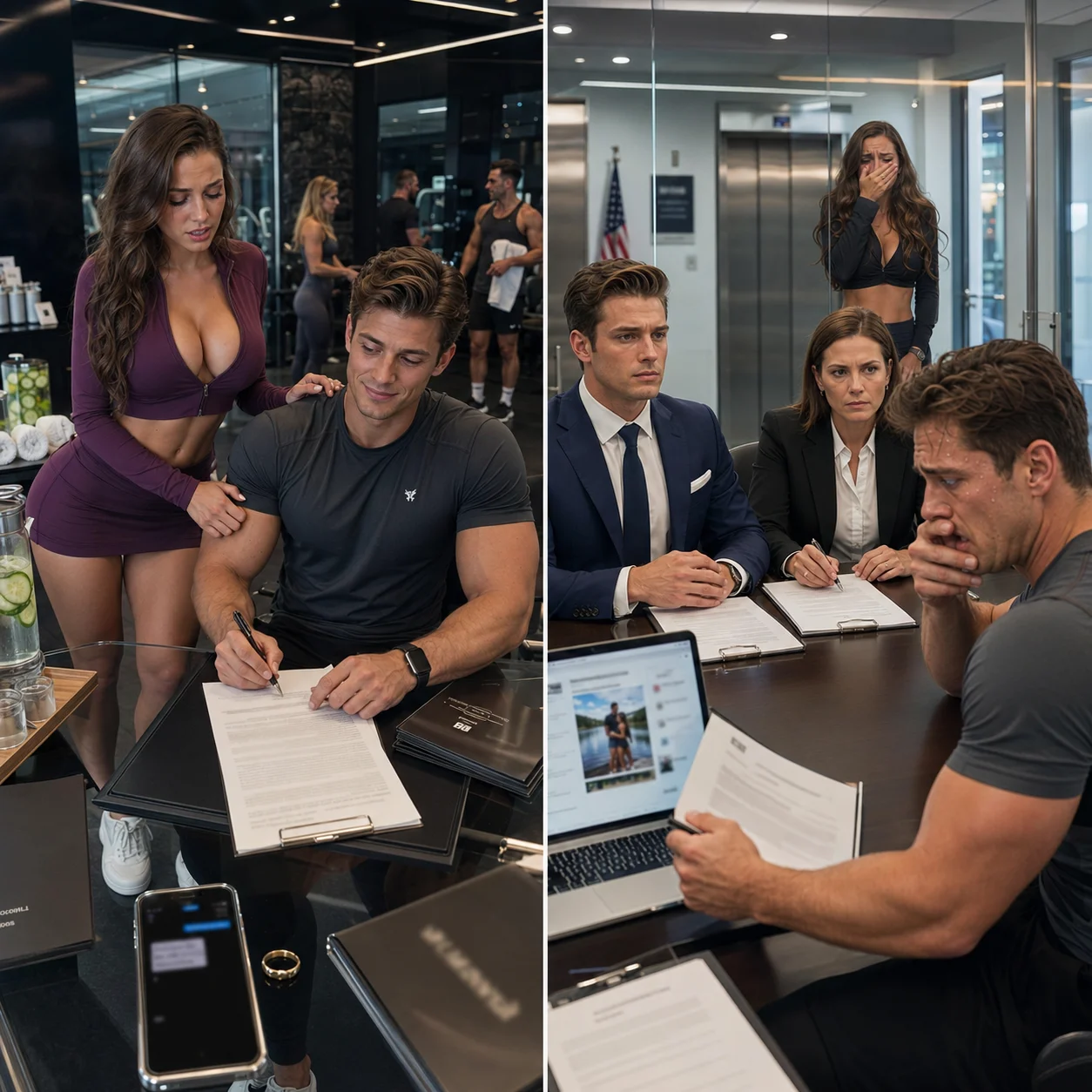
I never thought a gym contract would be the thing that ended my marriage.
Not a hotel receipt. Not a lipstick stain on a shirt collar. Not a late-night text lighting up a phone screen while my wife slept beside me. Not even some whispered confession delivered through tears after months of guilt became too heavy to carry.
A contract.
A clean, professionally drafted, twelve-page service agreement with initials on every page, compliance language most people would skim without thinking, and one confident signature at the bottom.
His signature.
The man my wife told me made her feel “alive.”
My name is Evan. I’m forty-one. My wife, Claire, is thirty-eight. We were married for eleven years and together for thirteen, and for most of that time I believed we had built something solid. Not perfect. Not cinematic. Not the kind of marriage people write songs about. But solid.
We had a house in a good neighborhood, two decent careers, shared insurance, a mortgage, a favorite Thai place, and a Google calendar filled with dentist appointments, client deadlines, car maintenance reminders, and dinner reservations we kept canceling because we were both too exhausted by Thursday night to pretend we wanted to dress up.
We did not have children, which is something I used to regret in a quiet, private way. Now I feel grateful for it, and that gratitude has a sadness attached to it that I do not know how to explain. It feels merciful and tragic at the same time, like discovering a room in your house never caught fire because you never finished building it.
Claire worked in interior design. Mostly boutique offices, luxury condos, and high-end residential projects for people who used phrases like “organic warmth” and “intentional texture” without irony. She was good at it. More than good, actually. Claire could walk into a bland, expensive room and immediately know what it was pretending to be. She could make cold spaces feel alive. She understood light, color, scale, mood. She understood how people wanted to feel when they entered a room, even when they did not understand it themselves.
That was part of what made people notice her.
The other part was Claire herself.
She was beautiful, yes, but it was never just beauty. Claire had presence. She had one of those laughs that made people turn toward it. When she was happy, she could make everyone around her feel like they had been personally invited into the warmth. At parties, strangers told her things they probably had not meant to reveal. Clients trusted her too quickly. Waiters remembered her. Dogs liked her. My mother liked her immediately, which should have been more impressive to me than it was at the time.
When I first met her, I loved that about her. She made ordinary life feel lit from the inside. She made errands feel like small adventures and rainy Sundays feel like something worth remembering. She once convinced me to repaint our first apartment kitchen blue at midnight because she said beige was “what dental offices wear when they give up.” I remember her standing barefoot on newspaper with paint in her hair, laughing so hard she had to lean against the refrigerator.
That was the Claire I married.
Somewhere along the way, ordinary life stopped being enough for her.
Or maybe ordinary life stopped reflecting the version of herself she wanted to see.
I know now that both things can be true.
Last year, Claire joined a private fitness studio called VantaFit. It was not a gym in the way normal people understand gyms. It was a “wellness performance studio,” which means everything cost too much and smelled faintly of cedar, eucalyptus, and financial insecurity. The towels were rolled like sushi. The lobby had matte black walls and sculptural lighting. The front desk offered cucumber water with the solemn seriousness of a church communion.
Her trainer was named Mason Vale.
Thirty-two. Former college athlete. Perfect teeth. Instagram face. One of those men whose entire personality seemed calibrated to make women feel observed and men feel slightly underdressed. He called himself a “movement architect,” which was the first red flag I ignored because I did not want to become the husband who resented his wife for trying to feel better.
At first, I was genuinely happy for her.
Claire had been restless for months. She was approaching forty and hated that the number bothered her. She said younger designers at work were getting the flashier clients. She complained that her body did not recover from stress the way it used to. She had trouble sleeping. She would stand in front of the bathroom mirror, touching the skin near her jaw or looking at the faint lines beside her eyes, and say, “I don’t recognize myself lately.”
I tried to help in the limited, clumsy ways husbands often try to help when they are scared but do not know what they are scared of.
I told her she was beautiful. I suggested therapy. I planned weekend trips that she said sounded exhausting. I offered cooking classes, short vacations, even ballroom dancing once, which she laughed at until she realized I was serious and then looked at me with a kind of pity that I pretended not to notice.
She chose Mason.
Not immediately. That is the thing about betrayal. It rarely knocks on the front door and announces itself. It slips in under practical names. Health. Growth. Friendship. Support. Coaching. Healing.
At first, Mason was just part of her new routine.
Claire started saying things like “functional strength,” “metabolic reset,” “mobility work,” and “nervous system regulation.” She bought expensive workout sets in muted colors with names like stone, fig, bone, oat, and ash. She meal-prepped grilled chicken and sweet potatoes in identical glass containers and drank powdered greens that smelled like someone had blended a lawn mower bag with regret.
She seemed happier. More energetic. More focused.
Then Mason began entering our marriage through language.
“Mason says I’m under-eating protein.”
“Mason says my hips are holding stress.”
“Mason says breathwork helps unlock emotional patterns.”
“Mason says most people confuse comfort with safety.”
That last one stayed with me.
Most people confuse comfort with safety.
It sounded less like fitness advice and more like something a man says to another man’s wife when he is gently teaching her to resent the home she lives in.
One evening while we were making dinner, I asked about him. Claire was chopping peppers at the kitchen island, her hair pulled into a loose knot, still glowing from her session.
“Is Mason the owner or just a trainer?” I asked.
“Both, kind of,” she said without looking up. “He’s one of the founding partners. Why?”
“No reason. You mention him a lot.”
The knife paused.
Then she smiled, but there was something sharp tucked behind it.
“He’s helping me. Is that a problem?”
“No. I’m glad you’re feeling better.”
“You sound weird.”
“I’m not being weird. I just noticed.”
Claire set the knife down with a little more force than necessary. “Evan, please don’t become one of those husbands who gets threatened because his wife works out with a male trainer.”
The sentence landed too cleanly. That was what bothered me. It felt rehearsed, like she had prepared a defense for a crime I had not yet accused her of committing.
“I’m not threatened,” I said.
“Good.” She picked the knife back up. “Because Mason is a professional.”
That became the word.
Professional.
Every boundary I questioned was hidden behind it.
Texting after nine at night? Professional.
Private stretching sessions on Sundays? Professional.
A weekend “mobility workshop” two towns over? Professional.
A “recovery seminar” that required her to change clothes twice and come home smelling like eucalyptus and cologne? Professional.
The first real crack happened in March.
Claire and I had plans for our anniversary. Eleven years. I booked the restaurant where we had our first date. It was not wildly original, but it mattered to us. Or I thought it did. I bought her earrings too, small white-gold diamonds, classic and understated. She had pointed out a similar pair months earlier in a shop window and then insisted they were too expensive. I remembered.
At 4:17 that afternoon, she texted me.
“Can we rain check tonight? Mason got me into a recovery seminar. It’s invite-only and apparently really hard to get into.”
I sat at my desk staring at the message.
Not because she canceled. Couples cancel things. Work happens. Exhaustion happens. Life gets in the way.
I stared because she had forgotten.
Not ignored. Not rescheduled in advance. Forgotten.
There was no “I know it’s our anniversary and I’m so sorry.” No “Can we celebrate this weekend instead?” No acknowledgment of the date at all. She treated it like any random Thursday, and I suddenly felt foolish sitting there with a dinner reservation and diamond earrings hidden in my office drawer.
I typed, “It’s our anniversary.”
The three dots appeared. Disappeared. Appeared again.
“Oh my God. I’m awful. I forgot. I’m so sorry.”
Then, before I could respond, another message arrived.
“But this seminar is actually important. Can we celebrate tomorrow? Please don’t be mad.”
At first, I was not mad.
I was embarrassed.
There is a special humiliation in realizing you are standing somewhere emotionally significant with flowers in your hand, and the person you are waiting for has already walked into another room.
When Claire came home that night, she was glowing. Her cheeks were flushed, her hair loose around her shoulders, her eyes bright in a way I had been trying to bring back for months with kindness, patience, and increasingly desperate dinner reservations.
She dropped her bag near the door and said, “I feel incredible. Like, honestly, alive.”
Alive.
That was the word.
I looked at her standing in our entryway, radiant from a night she had chosen over our marriage, and something inside me folded quietly.
“I’m glad,” I said.
She heard something in my voice because she sighed instantly. “Evan.”
“What?”
“Don’t make this ugly.”
“I said I’m glad.”
“No. You said it like that.”
“Like what?”
“Like you’re judging me.”
“For going to a recovery seminar on our anniversary?”
Her face hardened. “I apologized.”
“You forgot.”
“I said I apologized.”
“And then you still went.”
She laughed once, sharp and disbelieving. “Do you hear yourself? This is exactly what I mean. Mason is right. You make everything feel heavy.”
There he was.
In our kitchen. In our anniversary fight. In our marriage.
I went still.
“What does Mason have to do with this?”
“He helps me understand things. About myself. About patterns.”
“Patterns.”
“Yes. Like how I shrink myself around you.”
That one hurt more than I expected.
I had spent thirteen years trying to make her life easier. When her freelance income dipped, I quietly paid more of the mortgage. When she wanted to build her design website, I stayed up late helping her organize copy and client photos. When her car was in the shop, I drove her to showrooms before work. When her mother got sick, I sat in hospital waiting rooms and held her while she cried into my shirt. I had done the boring, unglamorous, reliable husband things that do not look like romance on Instagram but keep a life from collapsing.
And somehow, in the story she was now telling herself, I had become the man who made her small.
“I didn’t know you felt that way,” I said.
“That’s the problem, Evan. You don’t know what I feel because you don’t ask the right questions.”
“What are the right questions?”
She looked at me with pity.
Actual pity.
“Mason asks them.”
I remember nodding slowly, not because I agreed, but because something had become very clear. I was no longer talking to my wife. I was talking to a woman who had been handed a script by another man and was waiting for me to read my villain lines.
Two weeks later, she said the sentence that ended us.
We were in the living room. Claire had just come back from a session at VantaFit and still wore leggings and a cropped zip-up jacket she never would have bought a year earlier. She was energized, almost buzzing, like her whole body had become an argument she intended to win.
“I need to tell you something,” she said, “and I need you not to react badly.”
No good sentence starts that way.
“What is it?”
She took a breath. Then she smiled like she was being brave.
“Mason makes me feel alive.”
There it was again.
Alive.
I set my coffee mug down carefully.
“What does that mean?”
“It means he sees me. Not as a wife. Not as someone aging out of herself. Not as a person who has to be practical all the time. He sees my strength.”
“Your trainer sees your strength.”
“You’re making it sound cheap.”
“I’m trying to understand.”
“No, you’re trying to reduce it because you’re uncomfortable.”
I stared at her. “Are you having an affair with him?”
Her eyes flashed. “How dare you?”
“How dare I ask?”
“He is my personal trainer.”
“He texts you at midnight.”
“He supports me.”
“He canceled our anniversary dinner.”
“You canceled our anniversary dinner,” she snapped.
That was the first honest thing she said that night.
Then came the speech.
She said our marriage had become safe but dead. She said she felt trapped in our routine. She said Mason challenged her in ways I never did. She said he awakened something in her. She said he believed she could become a more authentic version of herself.
I let her talk.
Part of me was listening to the words. Another part was watching her hands move, animated and elegant and furious. I remembered those hands holding mine in a courthouse hallway when we closed on our house. I remembered them covered in blue paint in our first apartment. I remembered them trembling around a paper hospital coffee cup the night her mother’s scan results came back. I remembered those same hands touching my face in bed on a rainy Sunday after I burned pancakes and tried to call them “rustic.”
For a moment, grief rose so quickly I almost could not breathe.
Then Claire said, “Maybe I need space to explore who I am outside of being your wife.”
And the grief cooled.
It did not disappear. It hardened.
“What kind of space?” I asked.
She seemed surprised by my calm. “I don’t know. Maybe a trial separation. Maybe I stay with Maya for a while.”
Maya was her college friend. Maya lived in a one-bedroom condo with two cats and no patience for drama. Claire was not staying with Maya. We both knew it.
“And Mason?” I asked.
Claire looked away. “This isn’t about Mason.”
Of course it wasn’t.
It was never about Mason in the same way a house fire is never about the match.
I nodded. “You’re right.”
She looked back at me. “I am?”
“Yes. If you need to feel alive, you should pursue that.”
Her face softened with relief. “Thank you. I knew if we talked like adults—”
“And I think I should help.”
That confused her. “Help?”
“Yes,” I said. “Actually, I might have a way.”
That was the moment the idea formed.
Not completely. Not polished. Not legally clean yet. But the first shape of it appeared.
Because here is something important about me.
I am not a trainer. I am not a fitness influencer. I do not have abs under my button-down shirts. I do not own supplements. I have never once described a smoothie as fuel.
I am a procurement director for a regional hospital network.
My entire professional life is contracts.
Vendors. Compliance. Liability. Insurance. Fraud prevention. Service agreements. Conflict disclosures. Data privacy terms. Professional conduct clauses. Audit rights. Indemnity provisions.
I spend my days reading the boring paragraphs people skip.
And VantaFit had been trying for months to break into corporate wellness contracts.
I knew this because Claire had mentioned it casually one night when she still believed I was too dull to matter. Mason wanted to expand beyond private memberships. He wanted stable revenue. Company partnerships. Executive wellness packages. On-site training. Branded retreats. Corporate legitimacy.
He wanted exactly the kind of opportunity I could offer.
So I looked at my wife, who had just told me another man made her feel alive, and said calmly, “Maybe our hospital network could use VantaFit for a wellness pilot.”
Claire stared at me. “What?”
“If he’s that good, maybe we should explore a vendor relationship. Our employee wellness program has been looking for new partners. It could be a real opportunity for him.”
Her confusion slowly became cautious excitement. “You’d do that?”
“If he’s a professional,” I said, “then professionalism should be easy.”
She smiled then.
Not the big glowing smile she gave Mason.
But close enough.
“Evan, that’s honestly really mature of you.”
Mature.
That word people use when they mean useful.
“I’ll set up a meeting,” I said.
For the first time in months, Claire touched my arm. Briefly. Gratefully. Like I had finally done what she needed me to do.
She had no idea.
A lot of people would probably call what happened next a trap.
It was not.
I did not forge anything. I did not trick Mason into signing blank pages. I did not hack anyone’s phone, follow anyone, plant recording devices, or do anything that would make a lawyer pinch the bridge of her nose and whisper my name like a diagnosis.
I did something much simpler.
I let an arrogant man sign a document he did not bother to read because he thought charm was the same thing as competence.
The meeting happened nine days after Claire’s “alive” speech.
I arranged it at VantaFit because I wanted to see the environment Mason had built around himself. The studio sat between a boutique dermatology clinic and a wine bar, which told me nearly everything about the target demographic. Inside, the lighting made everyone look like they were either about to exercise or confess something. The equipment was minimalist and expensive. The staff spoke in soft voices. There were framed black-and-white photos of bodies in motion on the walls, and every surface looked designed to suggest discipline without discomfort.
Mason came out wearing black joggers, a fitted charcoal shirt, and the relaxed confidence of a man who had practiced humility in mirrors.
“Evan,” he said, gripping my hand with unnecessary force. “Man, finally. Claire talks about you all the time.”
I smiled. “All good things, I hope.”
His eyes flicked toward Claire for half a second.
“Of course.”
Claire stood beside him looking nervous and proud, like she had introduced two important men in her life and expected civilization to break out between them.
That was almost funny.
Mason gave me the tour. He talked about movement screening, breath work, injury prevention, executive burnout, personalized accountability, longevity programming, and sustainable vitality. I will give him credit. He knew how to sell. He had that gifted con man’s ability to make vague concepts feel urgent.
“This isn’t a gym,” he said, spreading his arms as if revealing a cathedral. “It’s a performance ecosystem.”
I nodded like that meant something.
Afterward, we sat in his glass-walled office. Claire joined us even though she had no professional reason to be there. Her presence was emotional theater, and by then I understood that Claire had started mistaking theater for truth.
I explained the pilot.
Thirty employees. Six months. Monthly fee per participant. Optional leadership coaching add-on. Potential expansion if the metrics looked good. Wellness engagement, absenteeism reduction, burnout mitigation, injury prevention, all the language corporate wellness people like to hear.
Mason’s eyes brightened when I mentioned the monthly retainer.
“How fast could this move?” he asked.
“That depends on compliance.”
His smile thinned. “Right. Corporate stuff.”
“Exactly.”
I slid the preliminary vendor packet across his desk.
He glanced at the first page. “This is just standard?”
“There is no such thing as just standard,” I said pleasantly. “But yes, it’s our usual onboarding packet. Service agreement, insurance requirements, provider code of conduct, data privacy terms, conflict disclosure, audit cooperation, background authorization for principal providers. Nothing unusual for a health-adjacent vendor.”
Claire shifted in her chair. “Background authorization?”
I looked at her. “For anyone working directly with our employees. Standard.”
Mason laughed. “Should I be worried?”
“I don’t know,” I said. “Should you?”
He laughed again, louder this time.
“No skeletons here.”
That turned out to be optimistic.
I told him to have his attorney review the documents. He waved that off.
“I’ve signed plenty of contracts.”
“I’m sure.”
He skimmed the packet while talking about scalability. He barely looked at the clauses. He paused at compensation. He paused at marketing rights. Money and visibility mattered to him. The rest, apparently, was beneath his attention.
The conflict disclosure clause, he initialed without reading.
The professional boundaries clause, he initialed while answering a text.
The audit rights clause, he initialed while telling Claire she should fix her posture.
That detail stayed with me.
My wife sat there while another man corrected her body in front of me.
He did not touch her. Not exactly. He just made a little two-finger gesture toward her shoulders, like she was an object he had trained and adjusted and owned.
“Open chest,” he said.
Claire straightened immediately.
I watched it happen and felt something inside me finish dying.
By the end of the meeting, Mason had signed.
Full signature.
Mason Vale, Managing Partner, VantaFit Performance Studio.
He pushed the packet back across the desk and grinned. “Looking forward to working with you.”
“I bet,” I said.
The pilot required a site compliance review before final approval. That was not special treatment. That was the job. We needed proof of insurance, tax documentation, instructor certifications, consent procedures, incident reporting policies, client data safeguards, and records involving off-site services or comped arrangements.
For most vendors, this kind of review is boring administrative work.
For Mason, it was a minefield he had just agreed to cross blindfolded.
The first problem was insurance.
His professional liability coverage had lapsed for three months the previous year. Not fatal by itself, but not ideal.
Then came two prior client complaints. They were not public and had not resulted in criminal charges or lawsuits, but one had generated an insurance notice, which meant our compliance consultant found it during the risk review. Both involved boundary issues with female clients. One complaint said Mason pressured a client into “emotional vulnerability coaching” outside paid sessions. Another said he blurred personal and professional lines, texted late at night, then claimed the messages were part of accountability coaching.
Familiar.
The third problem was VantaFit’s waiver system.
They used a digital app for client forms. When compliance requested sample records, Mason sent over a batch of anonymized documents. Except he was careless. One PDF still had metadata attached.
Claire’s name.
My wife was listed not only as a client, but as a “private performance partner” receiving comped services under an internal promotional category.
Comped.
For months.
That mattered because Claire had made a point of telling me she was paying for every session herself. She had once said, with wounded dignity, “You don’t get to make my fitness into a household expense.”
Apparently it had not been an expense at all.
It was a benefit.
A gift.
Or payment of another kind.
Still, none of that proved an affair. It proved Mason was sloppy, unprofessional, and probably dumb. But the contract had been written for sloppiness. Sloppiness leaves fingerprints.
The key clause required disclosure of any personal, romantic, financial, or household relationship between VantaFit staff and any employee, spouse, decision-maker, or related party connected to the corporate wellness pilot.
Mason had checked “None.”
He signed under penalty of termination, indemnity, and referral for fraud review.
Claire had watched him do it.
That detail mattered later.
The next document was the vendor marketing release. Mason wanted permission to use the hospital network’s name in promotional materials if the pilot was approved. Naturally, our communications office requested samples of his branding, investor decks, client testimonials, and partnership materials.
He sent a shared drive folder.
Inside were polished videos, client transformation reels, retreat photos, before-and-after testimonials, and one folder labeled “VF Expansion Pitch — Investors.”
That was where Mason got stupid.
Very stupid.
The pitch deck had a slide titled “Lifestyle Conversion Model.”
It described how VantaFit turned “emotionally underserved high-income clients” into “long-term premium wellness subscribers.”
Emotionally underserved.
I stared at those words for a long time.
There were client avatars. No names, but the descriptions were specific enough.
“Married female, 35–50, high household income, identity disruption, body dissatisfaction, seeking vitality.”
I did not need a detective to recognize my wife in a sales funnel.
Then came the projected revenue slide.
“Private Partner Program: Invite-only elite coaching tier. Includes off-site intensives, recovery evenings, lifestyle accountability, and travel retreats.”
Off-site intensives.
Recovery evenings.
Travel retreats.
I forwarded everything to compliance.
Not because of Claire.
Not yet.
Because any vendor pitching relationship-based psychological manipulation as wellness programming to hospital employees was a liability grenade.
Meanwhile, at home, Claire became careless.
Success made her soft. She thought my involvement meant I had accepted Mason’s place in our lives. She stopped hiding his name again.
“You have no idea what this could mean for him,” she said one night while pouring wine. “This contract could change everything.”
“For Mason?”
“For the studio.”
“Right.”
“He’s worked so hard. People don’t understand how hard it is to build something from nothing.”
I almost said, “Especially when you build it with comped private sessions for married women.”
I did not.
Instead, I asked, “Are you still thinking about space?”
She paused. “I don’t know.”
“Still feel trapped?”
Guilt crossed her face for about two seconds before defensiveness replaced it.
“I feel like we’re finally being honest.”
Honest.
The word floated through our kitchen and died there.
The following week, compliance escalated the review. Mason was asked to provide additional documentation about off-site services, comped clients, client consent, promotional arrangements, and any personal or financial relationships involving prospective corporate decision-makers or their spouses.
He called me within twenty minutes.
Not emailed.
Called.
“Hey, man,” he said, too casual. “What’s with the extra documentation request?”
“Compliance.”
“Yeah, but some of this feels excessive.”
“For a hospital network vendor? Not really.”
He laughed, but the sound had strain in it. “Asking about comped clients seems a little invasive.”
“You signed the audit clause.”
“Sure, but I thought that was standard.”
“There is no such thing as just standard,” I reminded him.
Silence.
Then he said, “Is this about Claire?”
There it was.
The first crack.
I leaned back in my chair. “Why would it be about Claire?”
“I just mean because she’s connected to both of us.”
“Connected how?”
Another silence.
“You know what I mean.”
“I’m not sure I do.”
His breathing changed.
“Evan, I respect you. I respect your marriage.”
That sentence told me more than any confession could have.
People who respect your marriage do not usually need to announce it during a compliance call.
“I’m glad to hear that,” I said. “Then the disclosure forms should be easy to clarify.”
He hung up five minutes later.
That night Claire came home angry.
Not frightened. Not ashamed.
Angry.
“What did you say to Mason?”
I was at the dining table with my laptop open. “Hello to you too.”
“Don’t do that. He said compliance is harassing him.”
“Compliance is reviewing a potential vendor.”
“This feels targeted.”
“That’s interesting.”
Her eyes narrowed. “What does that mean?”
“It means you sound more protective of him than curious about why he’s concerned.”
“He’s under a lot of pressure.”
“So am I.”
“What pressure?” she snapped. “You’re sitting behind a desk sending emails.”
I looked up slowly.
There are moments in a marriage when you realize the person across from you has rewritten you so completely that no real version of yourself can survive in their story.
I was no longer the man who had supported her for thirteen years.
I was a desk.
A weight.
A dead thing.
“Claire,” I said quietly, “are you sleeping with him?”
Her face changed.
Not like someone falsely accused.
Like someone annoyed that the wrong person had asked the right question too soon.
“No.”
One syllable.
Flat.
Too fast.
I nodded. “Okay.”
“That’s it?”
“What else is there?”
“You believe me?”
“I heard you.”
“That’s not the same thing.”
“No,” I said. “It isn’t.”
She stared at me for several seconds, then grabbed her keys.
“I can’t breathe in this house.”
Of course.
I did not ask where she was going.
I already knew.
The part that still amazes me is how much truth people will hand you when they believe you are too weak, too polite, or too emotionally exhausted to use it.
Claire stayed out that night.
At 11:43 p.m., she texted, “Staying with Maya. Need space.”
Maya called me at 12:06 a.m.
That should tell you everything.
I answered from the living room. The lights were off. My laptop was still open on the coffee table.
“Evan?” Maya sounded tired and irritated. “Is Claire with you?”
“No.”
“She texted me asking if I could cover for her. I told her I’m too old for freshman dorm lies.”
I closed my eyes. “I’m sorry.”
“Don’t apologize. I’m calling because I need to know how bad this is.”
“Bad.”
“With gym guy?”
“Yes.”
Maya cursed softly. “I knew it. I told her she was playing with fire. She kept saying it was transformational.”
“Everything is transformational until invoices arrive.”
That made Maya laugh once, but sadly.
“She told me you were controlling.”
“I figured.”
“She also told me you were emotionally dead.”
“That one’s new.”
“She said Mason helps her feel embodied.”
I rubbed my face. “I hate every word in that sentence.”
Maya sighed. “Evan, I’m not getting in the middle. But I’m also not lying for her. If she says she was with me tonight, she wasn’t.”
“Thank you.”
“Protect yourself,” she said. “Claire is not thinking clearly. And Mason gives me cult leader with a meal plan vibes.”
That became my favorite description of him.
The next morning, Mason submitted the additional compliance documents.
I do not know whether he was panicking or arrogant enough to believe nobody would connect the pieces. Maybe both. Men like Mason often think documentation is something other people use because they lack charisma.
Among the files was a spreadsheet of comped promotional clients.
Claire’s initials appeared four times.
C.M.
The notes beside them were coded, but not well.
“CM — premium retention conversion.”
“CM — off-site recovery evening.”
“CM — private vitality pathway.”
Then one entry made my mouth go dry.
“CM + MV — Lakeside intensive, 2 nights, content captured, no billing.”
MV.
Mason Vale.
Two nights.
Lakeside.
I knew that weekend immediately.
Claire had told me she was visiting a design client with a difficult renovation. She sent me pictures of a fireplace, a lake view, and a breakfast tray. I remembered telling her I was glad she was getting a break. I remembered feeling proud of myself for not making her feel guilty about working over a weekend. I remembered ordering takeout alone and texting, “Drive safe tomorrow.”
She had been with him.
The rage came then.
Not loud. Not cinematic. No broken glass. No shouting into an empty room.
Just a clean, bright line through my chest.
I stood up from my desk, walked outside the office building, and sat in my car for twenty minutes with both hands on the steering wheel. I let myself feel it. Not analyze. Not organize. Just feel.
I thought about every ordinary kindness I had given her while she was building a secret life with another man. Every dinner saved in the oven. Every “drive safe” text. Every time I believed her exhaustion came from work stress and not from maintaining two versions of herself.
Then I went back inside.
Because rage without structure is just weather.
The contract gave me structure.
Our compliance counsel, Denise Patel, scheduled a formal vendor review meeting. Denise is five foot two, always wears navy suits, and has the terrifying calm of a woman who can end careers without raising her voice.
She asked me privately if I had a personal conflict.
“Yes,” I said.
“Explain.”
“My wife appears to be one of the undisclosed comped clients. I suspect an inappropriate relationship with Mason Vale.”
Denise looked at me for a long moment. “Did you initiate this vendor review to expose a personal affair?”
I respected the directness.
“I initiated it because my wife praised his services and I knew he wanted corporate business. I suspected boundary issues. I did not have proof of an affair when he signed.”
“Do you now?”
“Not personal proof. But the documents suggest undisclosed conflicts, misrepresentation, and possible misconduct.”
She nodded.
“Then you will not lead the review. I will. You will attend as procurement observer only. You will answer questions if asked. You will not editorialize.”
“Understood.”
“And Evan?”
“Yes?”
“If this becomes divorce-related, get your own attorney. I represent the network, not your marriage.”
That was the most comforting thing anyone had said to me in weeks.
Professional clarity is underrated.
The formal review was scheduled for the following Thursday.
Mason was invited.
His business partner, Tessa Rowe, was invited.
Compliance attended.
Legal attended.
HR wellness attended.
Claire was not invited because Claire had no official role.
That did not stop her from showing up.
Ten minutes before the meeting, she appeared in the lobby wearing a cream blazer and the desperate expression of someone trying to look composed after very little sleep.
“What are you doing here?” I asked.
“I came to support Mason.”
I looked at her. “My wife came to my workplace to support the vendor under compliance review.”
Her face flushed. “That’s not fair.”
“It is exactly accurate.”
“Evan, please don’t do this.”
“Do what?”
“Destroy him because you’re angry at me.”
There it was.
Not “I’m sorry.”
Not “Let’s talk.”
Not even “You’re misunderstanding.”
Destroy him.
“You think I’m angry at you?” I asked.
“Aren’t you?”
“Yes,” I said. “But not enough to make him sign false disclosures. He did that all by himself.”
She stepped closer and lowered her voice. “You don’t understand what he means to me.”
I laughed.
I wish I had not, but it escaped before I could stop it.
“I understand more than you think.”
Her eyes filled with tears. “He helped me find myself.”
“No, Claire. He found a wealthy married woman in a vulnerable phase and sold her a vocabulary for betrayal.”
She recoiled like I had slapped her.
Maybe I had. Not physically. Never. But truth has force when it lands after months of lies.
Mason arrived then.
He saw Claire. Then me. Then the conference room beyond us.
For the first time since I met him, he did not look relaxed.
“Claire,” he said sharply. “You shouldn’t be here.”
That hurt her.
I saw it happen. A tiny fracture moved across her face. Because in her mind, she was his partner in some great awakening. In his mind, she was a liability standing in a lobby.
“Mason,” she whispered.
“Go home,” he said.
Not lovingly. Not gently.
Like a manager removing a problem from the sales floor.
Denise stepped out of the conference room at that exact moment.
“Mr. Vale,” she said. “We’re ready.”
Then she looked at Claire.
“And you are?”
Claire opened her mouth.
I answered. “My wife.”
The silence that followed was small but complete.
Denise’s expression did not change.
“Mrs. Marshall, this is a confidential vendor review. You may wait in the public lobby or leave the building.”
Claire looked at Mason.
He did not defend her.
He adjusted his watch and muttered, “I’ll call you later.”
She left.
And that, more than anything, told me the affair was already dead.
It just did not know it yet.
The meeting lasted ninety-four minutes.
Mason started charming.
By minute twenty, he was sweating.
Denise began with the basics. Insurance lapse. Incomplete consent documentation. Prior boundary complaints. Inconsistent off-site service records.
Mason explained each one as “growing pains.”
Then Denise moved to the disclosures.
“You certified that VantaFit had no personal, romantic, financial, or household relationships involving any network decision-maker, employee, spouse, or related party connected to this pilot. Correct?”
“Yes,” Mason said.
“Did you understand that certification?”
“Generally, yes.”
“Generally is not a legal standard. Did you understand it?”
He glanced at me.
“Yes.”
Denise clicked to the next slide.
“Please explain the comped client marked C.M.”
Mason shifted. “That’s anonymized.”
“We are aware. We are asking you to identify the client.”
“I’d have to check.”
Tessa, his business partner, turned toward him. “Mason, who is C.M.?”
He did not answer.
Denise continued, calm as winter.
“We have metadata indicating C.M. is Claire Marshall, Mr. Marshall’s spouse. Is that correct?”
The room went still.
Mason said, “Claire was a client.”
“Was she comped?”
“At times.”
“Why?”
“She was helping us develop women’s vitality programming.”
“Was there a written consulting agreement?”
“No.”
“Was she paid?”
“No.”
“Did she provide professional design services?”
“No.”
“What did she provide?”
Mason swallowed. “Feedback.”
Denise turned a page.
“Feedback during a two-night lakeside intensive listed as C.M. plus M.V.?”
His face went gray.
Tessa looked like she might be sick.
“What lakeside intensive?” she asked.
Mason ignored her.
Denise did not.
“Ms. Rowe, were you aware company resources were used for off-site private sessions involving comped clients?”
“No,” Tessa said immediately. “Absolutely not.”
That was when the contract became a blade.
Denise asked Mason to read section 7.4 aloud.
His voice was thin.
“Vendor represents and warrants that no provider has engaged in undisclosed romantic, sexual, or intimate personal conduct with any individual whose relationship to the network may create actual, potential, or perceived conflict of interest…”
He stopped.
“Continue,” Denise said.
He looked at me then.
Not smug. Not enlightened. Not amused.
Just exposed.
He continued.
“…and that failure to disclose such conduct constitutes material misrepresentation sufficient for immediate termination, indemnification, and referral to appropriate regulatory, civil, or professional bodies.”
Denise folded her hands.
“Mr. Vale, did you have an intimate personal relationship with Claire Marshall when you signed this contract?”
He looked at his business partner.
Then at legal.
Then at me.
Finally, for the first time, he told the truth.
“Yes.”
No one spoke.
I expected rage from myself. Some dramatic burst. A speech. A table flip. Something that would match the size of what I had just heard.
Instead, I felt hollow.
There it was.
A single syllable ending thirteen years.
Denise nodded once.
“Thank you. VantaFit is disqualified from the pilot effective immediately. The network reserves all rights under the agreement. Ms. Rowe, you may want independent counsel regarding your partner’s representations.”
Tessa stood. “Mason, what the hell did you do?”
He muttered, “Not here.”
But it was already there.
All of it.
On the record.
In the signed contract.
In the compliance minutes.
In the documents he provided himself.
I left the meeting without looking back.
Claire was waiting near the elevators.
One look at my face and she knew.
“He told them,” she said.
“Yes.”
She covered her mouth. “Evan, I—”
“No.”
The elevator doors opened behind me.
She reached for my sleeve. “Please. I need to explain.”
I stepped back.
“You already explained. Mason made you feel alive.”
Her hand fell.
“I was lost.”
“I know.”
“I didn’t mean to hurt you.”
“That’s not true,” I said quietly. “You meant to get what you wanted and hoped I would never hurt enough to stop you.”
She started crying then.
Not loud. Not performative. Real tears, I think.
But real tears do not rewind choices.
“I love you,” she whispered.
The elevator waited.
I looked at her and saw every version of us at once. The woman on our second date laughing under a broken umbrella. The woman painting our apartment kitchen blue. The woman crying into my shirt after her mother’s diagnosis. The woman who forgot our anniversary to lie in another man’s arms and call it vitality.
“I loved you too,” I said.
Then I stepped into the elevator.
The doors closed between us.
It has been seven months since the gym contract review.
The divorce is almost final.
I waited to write this part because for a while there was nothing satisfying to say. People like clean endings. They want the villain destroyed, the hero healed, the cheater humiliated in public, and the betrayed spouse standing in a brighter apartment with perfect peace, a new haircut, and a body transformed by righteous cardio.
Real life is less efficient.
Real life has attorney invoices, appraisal appointments, short emails about who gets the stand mixer, and random Tuesdays where you find an old grocery list in your coat pocket and feel like someone pressed a thumb directly into a bruise.
But consequences did come.
Slowly.
Then all at once.
VantaFit imploded first.
Tessa hired a lawyer within forty-eight hours of the review. I know because her attorney sent a preservation notice to our legal department and, separately, to Mason. From what I later learned, Tessa had no idea Mason was comping private sessions, using studio resources for off-site “intensives,” or promising investors a corporate wellness pipeline that had not actually been secured.
The hospital network formally disqualified VantaFit and sent a notice reserving rights for material misrepresentation. We did not sue. It was not worth the cost. But the disqualification itself poisoned the expansion deal.
Mason had been using the pending pilot as leverage with investors.
Without it, the money vanished.
Then one of the prior boundary complaints resurfaced. I do not know whether Tessa found it, another client heard rumors, or the universe simply enjoys timing, but a former client posted a long, carefully worded account of her experience with Mason’s “emotional coaching.” She did not name Claire. She did not name me. But she described the pattern perfectly.
Late-night texts.
Special client status.
Blurred boundaries framed as healing.
Isolation from partners who “didn’t understand growth.”
The post went local-viral in our small affluent neighborhood ecosystem. Not national news. Nothing explosive enough for strangers across the country to care. But enough. The kind of viral that makes women in expensive leggings whisper in parking lots. The kind that makes clients cancel without explanation. The kind that makes a luxury wellness studio feel less like a sanctuary and more like a crime scene with better lighting.
Memberships started dropping.
Tessa forced Mason out.
He tried to launch a solo coaching brand called Vale Method. It lasted three weeks before people began commenting “disclose your conflicts” under his posts.
Claire did not run to him after the review.
That surprised me, although maybe it should not have.
The moment Mason told her to go home in my workplace lobby, something shifted. She saw, briefly and brutally, her actual role in his life. Not muse. Not partner. Not awakened woman. Not the brave love he would defend in public.
Risk exposure.
She came home that night.
I was in the guest room folding clothes into a suitcase.
She stood in the doorway wearing the same cream blazer, now wrinkled, her makeup worn off, her face small and exhausted.
“I ended it,” she said.
I nodded. “Okay.”
“That’s all?”
“What do you want me to say?”
“I don’t know. Something.”
“I’m tired, Claire.”
She sat on the edge of the bed.
“I made it into something it wasn’t.”
“No,” I said. “You made it exactly what it was. You just gave it better language.”
She flinched.
“I was unhappy.”
“I believe you.”
“I felt old.”
“I believe that too.”
“I felt like you didn’t see me anymore.”
That one hurt because part of it was probably true.
Long marriages create blind spots. Familiarity can become a fog. I had seen Claire every day, but maybe I had stopped seeing her deeply. Maybe I had assumed loving someone reliably was the same as making them feel desired. Maybe I missed some doors closing.
But missing a door closing is not the same as forcing someone through another man’s.
“I’m sorry for my part in the distance between us,” I said.
Her eyes filled with hope.
“But I am not responsible for your affair.”
The hope died.
Good.
It needed to.
We separated the next week.
I moved into a short-term rental downtown. Claire stayed in the house while we figured out the sale. At first, she tried to frame the divorce as mutual growth. That lasted until her attorney saw the contract review record.
Mason’s signed admission was not technically a love letter, but it did what I needed it to do.
It prevented the fog.
Claire could not claim I was paranoid. She could not claim it was purely professional. She could not claim Mason was just a trainer, not after he admitted to an intimate relationship during a formal vendor compliance review tied to his own signed disclosure.
Facts are not always comforting.
But they are stabilizing.
Her parents called me once.
I almost did not answer, but I had always liked them. Her father, Richard, is a quiet man who fixes things whenever he visits. Loose cabinet handles. Sticky locks. A running toilet. He expresses love through hardware stores.
He said, “Evan, we heard enough to know not to ask you to reconsider.”
That broke something in me.
Not because it was cruel.
Because it was kind.
Her mother cried softly in the background and said, “We’re sorry.”
I said, “Me too.”
And I meant it.
Claire tried therapy. First alone, then she asked if I would attend one closure session. I went.
Not to reconcile.
To understand what kind of wreckage I was leaving behind.
She cried through most of it. She said Mason made her feel chosen at a time when she felt herself disappearing. She admitted he encouraged her to interpret every frustration in our marriage as evidence that I was holding her back. She admitted she enjoyed having a secret self, a version of Claire untouched by mortgage payments, laundry, aging parents, dinner dishes, and the quiet disappointments of adulthood.
Then she said something that has stayed with me.
“I think I confused intensity with truth.”
That was probably the most honest sentence she had given me in a year.
I told her I hoped she kept that sentence and built something better from it.
Just not with me.
The house sold in August.
We split the equity according to the prenup we signed before the wedding, which Claire had once called unromantic and which I now consider the most romantic gift Past Evan ever gave Future Evan.
She kept her business.
I kept my retirement intact.
There was no dramatic courtroom showdown. No screaming outside the courthouse. No judge delivering poetic justice in a booming voice.
Just signatures, notarized pages, email threads, and the slow administrative death of a marriage.
Mason tried to contact me once.
Email.
Subject line: Man to man.
That alone nearly made me throw my laptop into traffic.
He wrote that he was sorry things “got complicated,” that he never intended to damage my marriage, that Claire and I clearly had issues before him, and that he hoped I could separate personal pain from professional consequences.
I replied with one sentence.
“Do not contact me again.”
Then I forwarded it to my attorney.
Mason disappeared from town about two months later. According to the grapevine, he is in Arizona now, selling online coaching packages and posting shirtless desert sunrise videos about resilience.
Good for the desert, I guess.
Claire moved into a condo near her office. We have not spoken except through attorneys in six weeks. Maya tells me Claire is “doing the hard work,” and I hope that is true.
I do not hate her.
That surprises people. Some days it surprises me.
I hate what she did. I hate the lies. I hate that she let another man teach her to look at our marriage like a cage while still living inside the shelter it provided. I hate that she turned my steadiness into evidence against me. I hate that she stood in our kitchen and used therapy-adjacent language like a knife.
But hating Claire as a person would require carrying her around with me, and I am tired of carrying things for Claire.
As for me, I am rebuilding.
Not dramatically.
No new girlfriend. No revenge body. No inspirational podcast. No sudden reinvention where I become the kind of man who wakes up at four-thirty to plunge himself into ice water and talk about discipline online.
I bought a smaller place near the river. The first night there, I ate takeout on the floor because my furniture had not arrived yet. I remember sitting there with a plastic fork in my hand, watching headlights move across the bare wall, and realizing no one knew where I was unless I wanted them to.
It felt lonely.
Then peaceful.
Then both.
I started running again. Badly. Slowly. Without a trainer. My knees complain, but at least their complaints are honest. I joined a cheap gym with fluorescent lights and normal towels. No eucalyptus. No vitality pathways. No movement architects. Just treadmills, old men grunting near the free weights, and a front desk guy named Luis who calls everyone boss.
It is perfect.
Therapy helps.
My therapist says betrayal creates a split between the life you remember and the life you now know you were living. Both are real. That is the hardest part. The good years were not fake just because the ending was ugly. Claire did love me once. I loved her. We were kind to each other. We built things. We also broke.
Both truths exist.
I am learning to let them.
People ask if I felt satisfied when Mason admitted the affair in the review meeting.
Yes.
For about ten seconds.
Then I felt empty.
Because proof is not healing. Proof is just a light switched on in a room you already knew was burning.
Still, I am grateful for that contract.
Not because it exposed them.
Because it protected me from the worst kind of uncertainty.
Claire could have lied forever. Mason could have smiled forever. They could have wrapped their affair in words like growth, healing, energy, embodiment, vitality, and transformation. They could have made me question whether I was insecure, outdated, controlling, emotionally dead.
But a signature is harder to gaslight.
A checked box is harder to romanticize.
He signed “None.”
Then had to admit there was something.
That was the whole story.
To anyone reading this who feels like the unreasonable one because your partner has found someone who “just understands them,” please listen carefully.
You are allowed to notice when someone else starts living inside your relationship.
You are allowed to question late-night messages, sudden secrecy, emotional intimacy dressed up as mentorship, coaching, healing, or friendship.
You are allowed to protect yourself without becoming cruel.
And when the person crossing the line keeps hiding behind words like professional, evolved, modern, transformed, or alive, pay attention to what they do when accountability arrives.
Real professionals disclose conflicts.
Manipulators call disclosure an attack.
Claire said Mason made her feel alive.
Maybe he did.
But the life he offered her required my silence, my trust, my money, my reputation, and my willingness to stand in the background while they built a fantasy over the bones of my marriage.
I declined.
Calmly.
Contractually.
Permanently.
The final divorce hearing is next month. I will walk in with my attorney, sign whatever remains, and walk out no longer married to a woman who needed another man to make her feel alive by making me feel invisible.
I am not fully healed.
But I am sleeping again.
I am eating better.
I laugh more than I expected.
Some mornings, when I run by the river and the air is cold enough to sting my lungs, I feel something open in my chest. Not happiness exactly. Not yet.
But space.
Clean, quiet space.
And maybe that is where feeling alive starts for me.
Not in another person’s hands.
Not in a locked studio with black walls and expensive towels.
Not in being chosen by someone who profits from your confusion.
Maybe alive is simply this:
Waking up in a life where the truth is finally allowed to breathe.
![[FULL STORY] My girlfriend — the one I spent thousands on over the last two years— suddenly stood up in front of](https://social-media.rabedo.com/thumbnails/1776930167_28.png)

![[FULL STORY] My Girlfriend of Five Years Told Me: 'I'm No Longer Attracted to You, I Want an Alpha Male ' I](https://social-media.rabedo.com/thumbnails/1777359728_B29.png)
![[FULL STORY] She Said Another Man Made Her Feel “Alive” — Then Lost Everything and Left Him With the Child](https://social-media.rabedo.com/thumbnails/1776853248_cf532175-d096-4056-be95-f9b8a8eb975e.png)

![[FULL STORY] My fiancée drained our wedding fund and vanished, so I chose legal justice over mercy despite her family’s desperate pleas.](https://social-media.rabedo.com/thumbnails/1776920244_21.png)