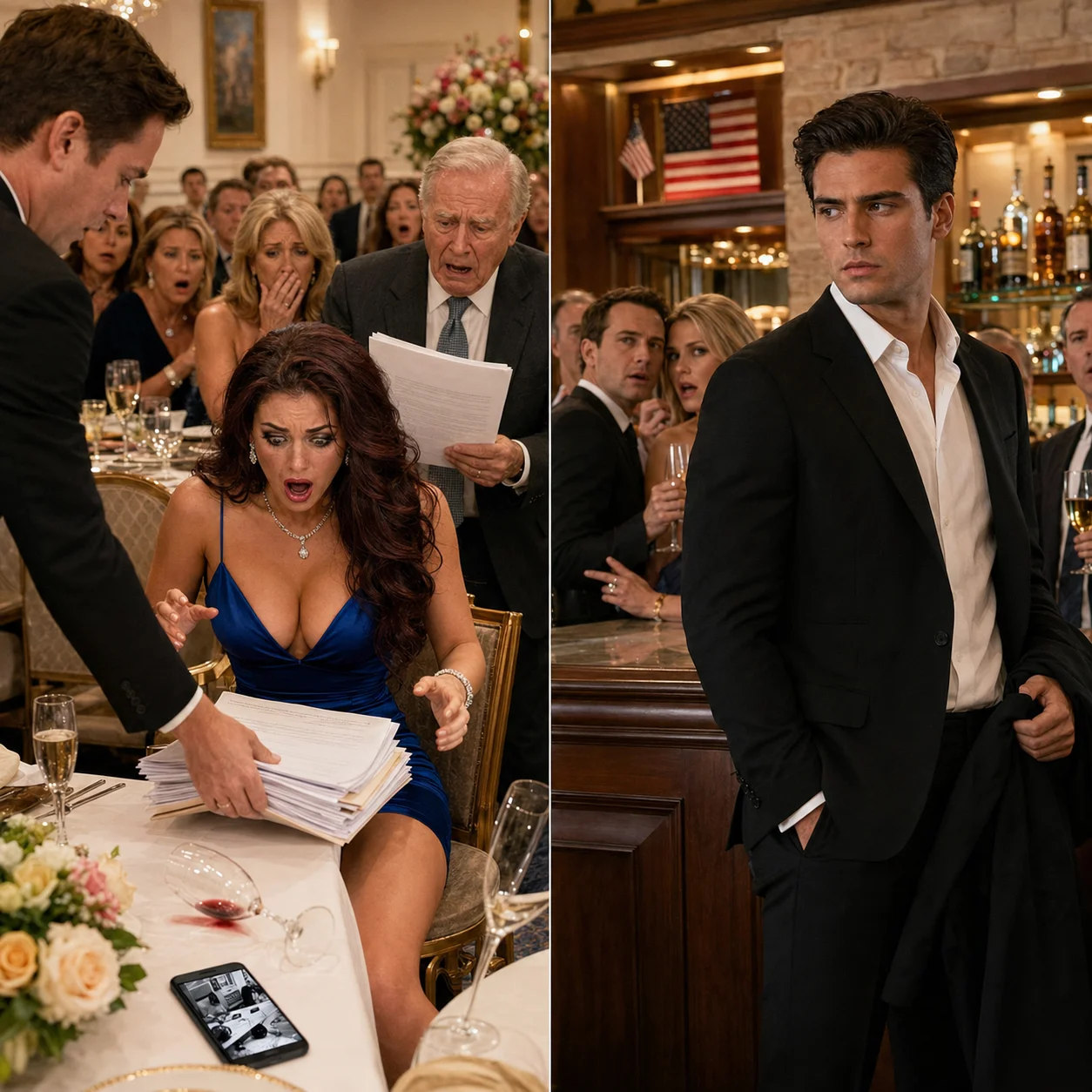
My wife told her lover he was better for my image while I was standing twelve feet away holding the speech she had asked me to memorize.
She did not know I heard her.
That was the part I couldn’t stop replaying afterward. Not the affair itself. Not even the contempt buried beneath her voice. It was how natural it sounded coming from her. Casual. Comfortable. Like she had been thinking it for a long time.
“He’s decent,” Lenora said softly. “People trust him. But decent doesn’t photograph well anymore. Rowan does. Rowan understands power. Honestly, he’s better for Warren’s image than Warren is.”
Then she laughed.
Not loudly. Not cruelly.
Worse.
Intimately.
I stood frozen outside the library door of my own house while something inside my chest went strangely still.
My name is Warren Hale. I was fifty-six years old then, director of one of North Carolina’s largest pediatric hospital foundations, husband for nearly three decades, father to one daughter, and — until that moment — a man who genuinely believed loyalty could outlast vanity if you fed it long enough.
I built my life carefully. Not dramatically. Carefully.
My father founded the Hale Children’s Medical Foundation after my younger brother died from a blood disorder back in the seventies. He used to say grief becomes dangerous when it has nowhere useful to go, so he turned his grief into hospital wings, family grants, research funding, and rural care programs. I inherited the foundation in my thirties after he retired. By my fifties, we had funded clinics across the state and become one of the few charities donors trusted without hesitation.
Trust, I learned, is built through profoundly unglamorous things.
Clean audits.
Returned phone calls.
Showing up to hospitals at two in the morning because a family had nowhere else to sleep.
Remembering names years later.
Not stealing.
Especially not stealing.
Lenora used to admire that about me.
We met at a fundraiser in Charlotte when she was thirty-two and I was already beginning to gray at the temples. She was elegant in a way that shifted the atmosphere of a room the second she entered it. Men stood straighter around her. Women watched her carefully. She knew exactly how to hold eye contact long enough to make someone feel selected.
I was not exciting.
I knew that.
I wore navy suits, discussed donor compliance at dinner parties, and genuinely enjoyed balanced spreadsheets. But Lenora once told me she trusted me because I made people feel safe.
“You make stability feel luxurious,” she said during our third date.
I believed her.
For a long time, I think she believed it too.
We built a respectable life together. Not perfect. Real. We survived miscarriages before Claire was born. We survived my mother’s stroke, long workweeks, family deaths, money stress during the recession, and all the ordinary erosions marriage suffers if two people stop paying close attention to each other.
Looking back, I think Lenora eventually confused steadiness with invisibility.
Then politics entered the picture.
Running for state senate had not been my ambition originally. A coalition of hospital administrators, pediatric specialists, and rural health advocates approached me after years of watching funding bills die in committee. They wanted someone credible. Someone trusted. Someone who understood healthcare beyond campaign slogans.
Lenora was thrilled.
At first I thought she believed in the mission.
Later I understood she believed in the spotlight.
Politics changed the temperature around us almost immediately. Invitations increased. Wealthier donors suddenly became friendlier. Reporters wanted profiles. Strategists wanted meetings. And somewhere inside all that attention, my wife began treating our marriage less like a relationship and more like a brand partnership.
That was when Rowan Pierce appeared.
He arrived through a donor named Mitchell Drayton, a man who used the word “access” like it was a religion. Mitchell introduced Rowan as an elite political image consultant who specialized in “modernizing trusted public figures.”
I disliked him instantly.
Not because he was handsome. Though he was.
Not because he was younger. Though he was.
I disliked him because he looked at every person in the room the way investors inspect property before buying it.
Rowan Pierce was forty-two, polished to the point of artificiality, silver at the temples in a way that looked professionally maintained, with expensive restraint in everything from his watch to his smile. He spoke slowly. Deliberately. Like every sentence had been tested with focus groups beforehand.
During our first meeting he leaned back in the chair across from my desk and said, “Warren, your problem is that people respect you but they don’t emotionally crave you.”
Lenora smiled immediately.
That should have warned me.
Over the next several weeks Rowan inserted himself into nearly every part of my campaign preparation. He rewrote speeches. Changed photographers. Criticized my posture. Replaced my wardrobe. He told me my glasses made me look “administratively competent but electorally forgettable.”
I remember staring at him and thinking I had somehow hired a man to insult me professionally.
“You’re thinking like a public servant,” Rowan said one afternoon while adjusting my tie in front of a mirror. “Campaigns are theater first. Service comes later.”
“I’m not interested in becoming theater,” I replied.
“That,” he said calmly, “is why you need me.”
Lenora laughed from across the room.
That laugh stayed with me.
Not because it was loud.
Because it sounded admiring.
The affair unfolded the way most affairs do — gradually enough that you can keep explaining it away if you want to remain married badly enough.
Lenora started taking calls outside.
She suddenly cared intensely about events she previously found boring.
She mentioned Rowan constantly.
“Rowan thinks your speeches need more edge.”
“Rowan says younger donors respond to confidence.”
“Rowan believes you should stop sounding apologetic.”
Soon it became:
“Rowan says.”
“Rowan thinks.”
“Rowan recommends.”
Like my own life now required translation through another man.
I noticed smaller things too. The private smiles. The lowered voices. The way Rowan touched her elbow when speaking to her. The way she angled her body toward him without realizing it.
But after nearly thirty years of marriage, suspicion feels humiliating. You don’t just question your spouse. You question your own judgment, your own memories, your own ability to understand the person sleeping beside you.
So I watched quietly.
And then came the library.
The strategy dinner at our house had been loud enough to hide private conversations. Donors filled the downstairs rooms. Staff moved between trays of wine glasses and appetizers. Someone from local media was already discussing launch coverage near the fireplace.
Lenora asked me to retrieve the revised campaign speech from the library.
When I approached the partially closed door, I heard Rowan say, “You’re wasting yourself beside him.”
Lenora sighed softly.
“He’s a good man.”
“That isn’t the same thing.”
“He’s safe,” she admitted. “Dependable. But sometimes I feel like I’m disappearing beside him.”
Then came the sentence that ended my marriage before any divorce papers existed.
“He’s decent. People trust him. But decent doesn’t photograph well anymore. Rowan, honestly, you’re better for Warren’s image than Warren is.”
Silence followed.
Then fabric moving.
An embrace, probably.
I stepped backward into the hallway feeling strangely calm. Not angry yet. Calm in the terrifying way buildings become calm before collapsing.
Then Rowan said something that mattered even more.
“After the gala, we’ll control the campaign.”
Lenora laughed quietly. “Warren won’t fight. He absorbs things. That’s what he does.”
That sentence hurt worse than the affair.
Because she was right.
For years I had absorbed discomfort to preserve peace.
I walked away from the library, waited ten seconds, then returned loudly enough to announce my presence. When I entered, Lenora was smoothing her dress while Rowan stood by the fireplace smiling like a man who believed he understood every variable in the room.
He did not.
What Rowan didn’t know was that every campaign hire connected to my exploratory committee had already been flagged for vetting by my attorney, Elaine Mercer.
Elaine was sixty-one, terrifyingly intelligent, and professionally incapable of ignoring suspicious paperwork. She had spent fifteen years protecting the foundation from lawsuits, bad contracts, donor conflicts, and opportunists who mistook charity money for accessible wealth.
Three days before the library incident, she had already warned me.
“Something about Rowan Pierce doesn’t balance,” she said over dinner after a compliance meeting.
“How so?”
“Too polished. Too expensive. Too vague.”
“That’s not illegal.”
“No,” Elaine replied. “But it’s often adjacent.”
After overhearing Lenora and Rowan, I called her the next morning.
“I want the background investigation expanded,” I said.
“How expanded?”
“Everything.”
Elaine was quiet for a second.
Then she said, “All right.”
The first report arrived ten days later.
At first it looked like ordinary résumé inflation. Rowan exaggerated campaign roles, overstated academic credentials, and strategically blurred consulting timelines.
Embarrassing.
Then the deeper findings arrived.
Rowan Pierce had previously operated under different names.
There were civil judgments in Georgia tied to campaign finance disputes. Shell vendors linked to political consulting retainers. Lawsuits from former clients claiming unauthorized invoice routing. A literacy nonprofit in Alabama had quietly settled allegations involving donor funds redirected through entities connected to him.
No criminal convictions.
That was the disturbing part.
Men like Rowan survive in the narrow space between unethical and prosecutable.
Then Elaine uncovered the vendor network.
Three companies Rowan recommended for my campaign shared mailing addresses and financial ties with his associates. One belonged to a cousin. One to a former girlfriend. Another to a man named in a prior fraud complaint.
And buried in the middle of those documents was my wife’s signature.
Lenora had authorized preliminary onboarding paperwork tied to Rowan’s vendor structure.
When Elaine told me, I sat silently for nearly thirty seconds.
“She signed this willingly?” I finally asked.
“Yes.”
“Did she know?”
Elaine looked at me carefully.
“I think she believed she was helping Rowan secure influence before the campaign launch.”
I stared at the report.
Paper.
People think affairs destroy lives through passion. Most of the time they destroy lives through paperwork.
The second report arrived the day before the gala.
That one revealed Rowan’s pattern.
He targeted ambitious public figures with socially restless spouses. He inserted himself as a consultant, flattered the spouse, isolated the candidate from long-term advisors, redirected vendor approvals, then vanished before financial scrutiny fully arrived.
Savannah.
Tennessee.
Alabama.
Different cities. Same structure.
Different women too.
There was even a photograph from eight years earlier showing Rowan beside a former nonprofit board chair named Margaret Ellis outside a courthouse in Birmingham. She looked heartbreakingly familiar to Lenora — elegant, ambitious, convinced she was partnering with brilliance instead of becoming collateral damage.
“What happened to her?” I asked Elaine.
“She lost everything,” Elaine replied quietly. “Marriage, board position, reputation. Rowan settled privately and disappeared under another name.”
I remember looking down at the photograph thinking not even my wife’s betrayal was original.
She had simply become his next pattern.
Elaine advised me to cancel the gala immediately.
Instead, I asked a question.
“If we proceed,” I said, “will he think he’s winning?”
Elaine smiled slightly.
“Absolutely.”
“Good.”
The gala took place Saturday night at the Whitaker Hotel downtown.
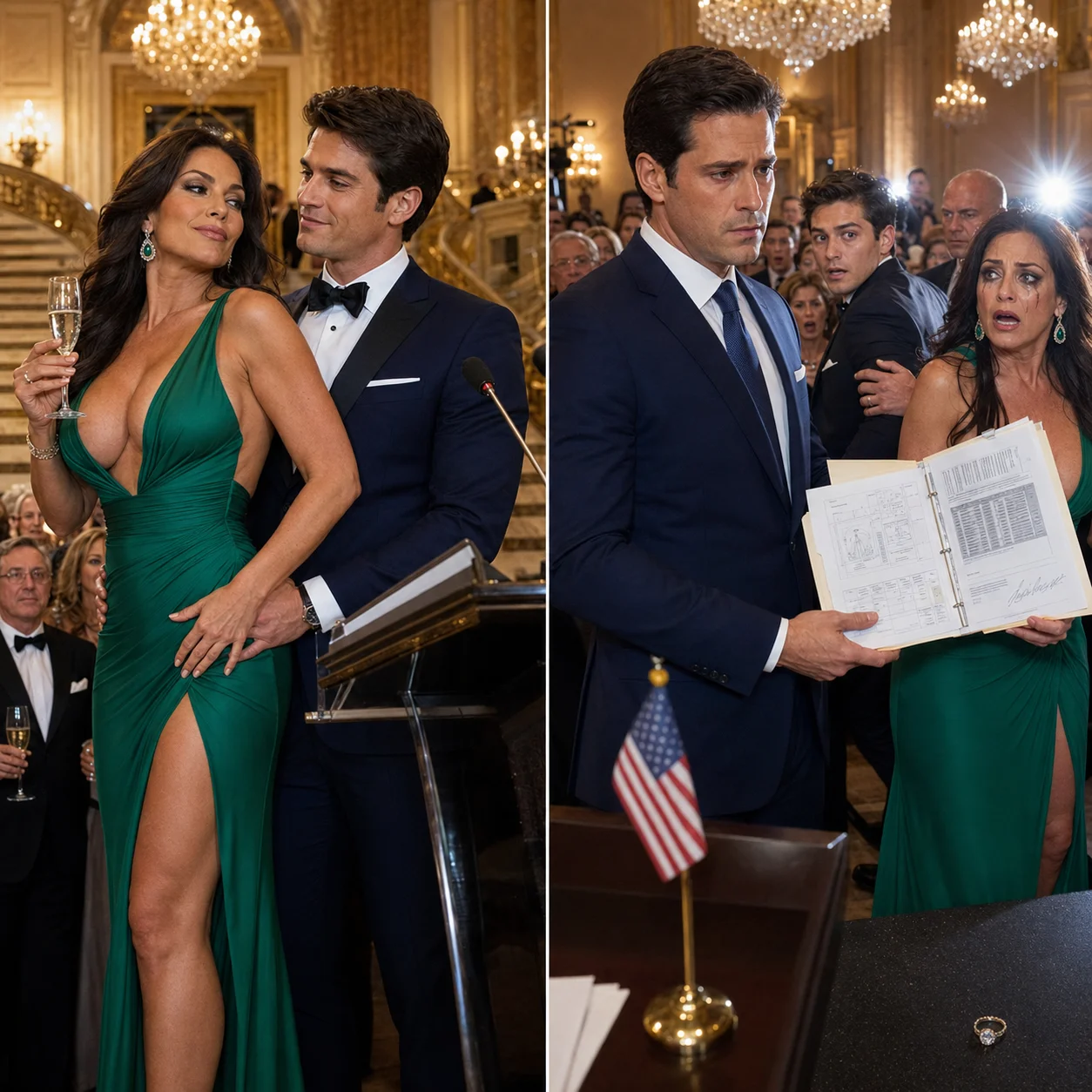
Lenora orchestrated every detail personally. Emerald lighting. String quartet. Donor seating charts. Press positioning. Floral arrangements. She wore a dark green gown Rowan reportedly selected because it projected “elegant renewal.”
She looked stunning.
Rowan floated through the ballroom like a man already spending money he hadn’t stolen yet.
Claire arrived late from Atlanta just before the speeches began. She took one look at Rowan beside her mother and immediately asked me, “Why does that man look like he sells yachts during divorces?”
Despite everything, I nearly laughed.
My daughter noticed more than people realized.
“How bad is it?” she asked quietly once we were alone near the bar.
“Bad.”
“Affair bad?”
“Yes.”
“Money bad too?”
I nodded.
Her expression hardened instantly.
“All right,” she said. “Tell me where to stand.”
That was Claire. No dramatics. Just loyalty.
The ballroom lights dimmed at nine.
Videos played. Donors applauded. My father’s face appeared onscreen during the foundation tribute, and for one painful moment I nearly called the entire thing off because I could hear his voice in my head warning me never to stand publicly beside people whose integrity you haven’t tested privately.
Then Lenora took the stage.
She was magnificent at public speaking. Calm. Warm. Elegant. She spoke about my dedication, my integrity, my service to families across North Carolina.
Then she pivoted.
“But integrity alone is not enough in modern leadership,” she said smoothly. “Leadership also requires vision, transformation, and the courage to evolve.”
That word.
Evolve.
People like Rowan always use evolutionary language when justifying moral decay.
Then she smiled toward him.
“And tonight I’m proud to introduce the strategist helping guide Warren Hale into this new era. Rowan Pierce.”
Applause began politely.
Rowan approached the stage smiling modestly.
He kissed Lenora on the cheek slightly too close to her mouth.
Enough people noticed.
Then Rowan stepped to the podium.
“Thank you, Lenora,” he said warmly. “And Warren, thank you for trusting me with your image, your future, and this campaign.”
That was when I stood.
The room shifted instantly.
Elaine stood beside me holding the investigation folder.
Claire quietly moved toward the ballroom exit.
I walked toward the stage while hundreds of wealthy, politically connected people watched in absolute silence.
Lenora intercepted me halfway.
“What are you doing?” she whispered sharply.
“What I should’ve done weeks ago.”
Her face tightened.
“Don’t embarrass me.”
I looked directly into her eyes.
“You handled that part yourself.”
Then I stepped onto the stage.
Rowan smiled tightly. “Warren, I was just introducing—”
“I know.”
I took the microphone from his hands.
He resisted for half a second before letting go.
I faced the audience.
“My father believed public trust begins with private accountability,” I said calmly. “Which is why every individual connected to my campaign underwent a compliance and background review.”
The word background changed the atmosphere immediately.
Rowan’s posture stiffened.
I continued.
“That review uncovered serious discrepancies involving Mr. Rowan Pierce, including prior identities, undisclosed civil judgments, shell vendor relationships, and financial irregularities tied to previous political and nonprofit engagements.”
The ballroom froze.
I could literally hear silverware settle onto china somewhere near the back tables.
Lenora went pale.
Rowan recovered quickly, I’ll give him that.
“This is a misunderstanding,” he said smoothly. “Campaign consulting often involves complex vendor structures—”
Elaine stepped forward beside me.
“My office possesses documentation connecting multiple entities recommended by Mr. Pierce to previously litigated financial disputes,” she said crisply. “Including vendor routing arrangements materially similar to those proposed for this campaign.”
That was the moment the room stopped viewing this as drama and started viewing it as liability.
Donors physically shifted backward from Rowan.
The local press erupted into frantic typing.
Mitchell Drayton looked like a man calculating escape routes in real time.
Then I delivered the final blow.
“There are also signed authorization documents involving my wife, Lenora Hale, connected to preliminary vendor activity now under legal review.”
Lenora whispered, “Warren, please.”
Not because she was sorry.
Because she suddenly understood consequences.
And the most devastating part happened next.
She looked at Rowan for help.
Rowan looked toward the exits.
In that tiny moment, my wife finally understood what she truly meant to him.
Not partner.
Not soulmate.
Access point.
Rowan straightened his jacket and said coldly, “I won’t participate in public humiliation.”
“No,” I replied evenly. “You prefer private exploitation.”
He walked offstage.
Claire calmly blocked the nearest exit long enough to force him toward hotel security waiting near the lobby.
Nobody stopped him dramatically. Nobody needed to.
Humiliation works best when it remains dignified.
I returned to the microphone.
“I will not formally launch my campaign tonight,” I said. “Not until every account, vendor agreement, and authorization connected to this exploratory committee is reviewed independently.”
The room remained utterly silent.
“But the foundation’s work continues. The children and families we serve will not suffer because adults failed basic tests of character.”
Then I stepped away from the podium.
For a second nothing happened.
Then people stood.
Slowly at first.
Then fully.
Not applause for a politician.
Respect for a man who chose truth over preservation.
Lenora confronted me afterward in a private hotel lounge while Elaine, Claire, and several board members stood nearby.
“How could you do this to me?” she demanded through tears.
Claire laughed once without humor.
“You were sleeping with a fraud consultant during Dad’s campaign,” she said. “What exactly did you think happened after that?”
Lenora ignored her and looked at me instead.
“I felt invisible,” she whispered.
“You stood beside me in public for twenty-eight years.”
“As your wife,” she snapped. “Always your wife. Never myself.”
“And Rowan made you feel seen?”
“Yes.”
I looked at her quietly for a long moment.
“No,” I said gently. “He made you feel reflected. Those aren’t the same thing.”
That broke something inside her face.
Not dramatically.
Quietly.
The divorce happened exactly the way large respectable divorces usually happen — through lawyers, asset reviews, negotiated disclosures, and carefully worded documents designed to contain embarrassment.
The foundation survived untouched because our internal safeguards blocked Rowan’s vendor approvals before money moved.
That fact alone probably saved my father’s legacy.
Rowan’s reputation collapsed within days once reporters connected his prior lawsuits and settlements across multiple states. Former clients surfaced. Archived complaints resurfaced. Vendor records circulated privately among political consultants.
Predators survive through obscurity.
Once searchable, they weaken quickly.
Lenora eventually cooperated fully with investigators once she realized Rowan had already begun distancing himself from her legally.
That realization destroyed her more than my public exposure ever did.
Because betrayal hurts differently when you discover you weren’t loved uniquely — only manipulated efficiently.
I did not run for senate afterward.
A few people encouraged me to reconsider. Some even claimed the scandal improved public trust in me because I chose transparency instead of concealment.
Maybe.
But after months of watching people reduce human beings into optics, strategy, positioning, and image management, I no longer wanted my life measured through polling language.
I returned fully to the foundation instead.
Six months later we opened a new family respite center beside a children’s hospital in Asheville. Small library. Sleeping rooms. Quiet spaces for exhausted parents whose children were undergoing long treatments.
I placed my father’s old chair inside the reading room after having it reupholstered.
Not replaced.
That distinction mattered to me.
During the opening ceremony, a reporter asked if I regretted how publicly the gala collapsed.
I looked across the room at a mother holding her sleeping son beside the window while one of our volunteers handed her coffee.
“No,” I said honestly. “I regret what made it necessary.”
That night I returned home to a quieter house.
Not emptier.
Just honest.
The expensive decorative perfection Lenora loved slowly disappeared over the following months. Family photos returned to shelves. My father’s books came out of storage. The furniture became comfortable again instead of impressive.
Grief stayed longer than anger did.
That surprised me.
People assume betrayal immediately kills love.
It doesn’t.
Love dies slowly even after trust is buried.
You can know someone betrayed you and still mourn the version of them you once protected.
A year later Lenora and I crossed paths at a charity luncheon in Durham.
She looked older.
So did I.
She approached carefully holding a glass of water in both hands.
“I heard about the respite center,” she said softly. “Your father would’ve loved it.”
“Yes,” I replied. “He would have.”
A long silence followed.
Then she looked at me with exhausted honesty and said, “I was wrong about your image.”
I waited.
“Decency photographs better than I thought.”
That was probably the closest thing to redemption either of us was ever going to receive.
I nodded once and walked away toward Claire, who was impatiently waving me over from another table.
As I crossed the ballroom, I caught my reflection in the windows.
Gray hair.
Navy suit.
My father’s watch.
No campaign strategist adjusting my posture.
No wife trying to redesign me into something more marketable.
Just me.
Decent.
Trusted.
Finally standing in public without anyone beside me trying to turn integrity into a branding problem.
And in the end, that mattered more than winning an election ever could.