
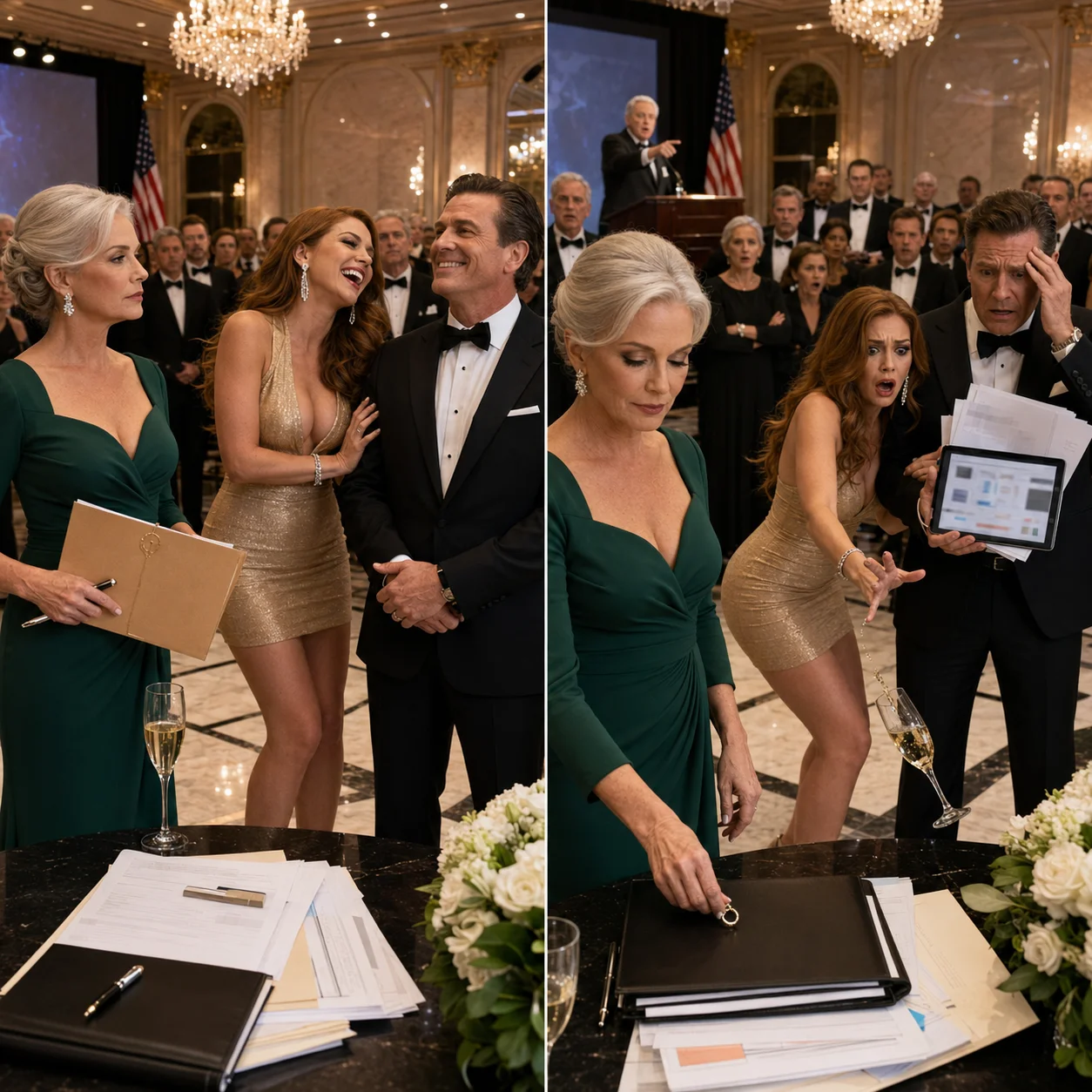
My husband’s mistress laughed at me during our company’s black-tie gala.
Not quietly. Not accidentally. She laughed the way a woman laughs when she believes the wife is already defeated, when she thinks the room has chosen youth over history, spectacle over substance, charm over the woman who actually built the foundation beneath everyone’s feet.
Her name was Isla Monroe. Thirty-two years old, glamorous in that effortless way that actually requires a team of professionals and an alarming expense account. She had glossy dark hair, a designer silver gown, and the kind of smile that made donors, vendors, and insecure executives feel as if they had briefly become more interesting in her presence.
I was fifty-five, wearing a midnight-blue silk dress I had owned for six years and pearls my daughter once told me made me look “dangerously calm.” I was standing near the east staircase of the ballroom, holding a glass of champagne I had not touched, watching my husband, Richard Crane, place his hand lightly against Isla’s lower back.
That was when she looked at me, leaned closer to him, and laughed.
I remember thinking, almost academically, that she had excellent teeth.
That was the strange part about betrayal at my age. It did not arrive like it did in movies. There was no broken glass, no trembling hand pressed against my mouth, no dramatic music swelling as the truth revealed itself. By then, I had known about Richard and Isla for months. I had known about the hotel receipts, the private dinners, the “brand development retreats” that required one CEO and one brand strategist to occupy adjoining suites in cities where we had no clients. I had known about the lipstick on the inside of his collar and the new password on his phone and the sudden cruelty in his voice when he spoke to me at home.
But the laugh still landed.
Not because it hurt more than everything else.
Because it confirmed what I had already understood.
They did not simply believe they were getting away with it. They believed I had already lost.
Richard was across the ballroom surrounded by board members, hospital system executives, donors, and regional press. He was the public face of Crane Medical Logistics, the man with the silver hair, the clean smile, and the gift for making people believe urgency was just another form of elegance. He could stand on a stage and talk about delivering life-saving surgical supplies through hurricanes, cyberattacks, labor shortages, and rural hospital closures, and people would lean forward as if he were personally holding the healthcare system together with his bare hands.
I knew better.
Crane Medical Logistics had been built in our garage twenty-six years earlier with two used delivery vans, one borrowed warehouse bay, and my ability to make numbers behave when our lives did not. Richard had vision. I will never take that away from him. He could sell an idea to anyone. He could convince a skeptical hospital administrator to take a meeting, charm a banker into extending a line of credit, and make a room full of investors believe that a regional logistics problem could become a national solution.
But vision does not pay drivers on time. Vision does not negotiate fuel contracts, audit controlled-temperature shipping compliance, keep accounts receivable from suffocating cash flow, or notice when one cost center starts bleeding money under a name that does not belong there.
That was me.
I was co-founder and CFO. I built the systems that allowed Richard’s speeches to sound true. I knew every routing model, every vendor contract, every debt covenant, every compliance risk, every payroll category, every quiet emergency we had survived without ever letting clients see us sweat. For more than two decades, Richard and I had been the Crane partnership. He stood at podiums. I made sure the floor beneath the podium did not collapse.
For a long time, I did not resent that arrangement.
I was never a woman who needed applause. I liked precision. I liked clean books, honest reporting, and employees who knew their retirement contributions would be funded before the CEO ordered new office art. I liked watching something strong grow out of disciplined work. I liked knowing that our company delivered critical medical supplies to hospitals that could not afford delay.
And I loved Richard.
That is the part people always want to simplify after a betrayal. They want you to say you were blind, foolish, naive, greedy, cold, too trusting, not trusting enough. They want the marriage to become a cautionary label they can apply to their own lives from a safe distance.
But the truth is harder.
I loved my husband. I built a company with him. I raised two children with him. I sat beside him when his father died, slept in vinyl hospital chairs when he had his first cardiac scare at forty-eight, and forgave more arrogance than I should have because I believed arrogance was the price of ambition.
I did not understand until much later that ambition can become a door through which entitlement enters quietly.
Isla arrived fourteen months before the gala.
Officially, she was hired as a brand strategist. Richard introduced her during an executive meeting with the confident satisfaction of a man unveiling a new acquisition.
“We’ve spent too long being respected but invisible,” he said, standing at the head of the conference table while Isla smiled beside him. “Isla has helped reposition several healthcare-adjacent companies for national visibility. We need fresh energy.”
Fresh energy. That phrase became his weapon for the next year.
At first, I did not object to hiring her. The company had grown. Our profile had changed. We were no longer two vans and a borrowed warehouse bay. We had distribution centers in five states, contracts with major hospital networks, and a board that wanted expansion. A brand strategist was not unreasonable.
What was unreasonable was Isla.
Not immediately. Not in ways that looked obvious on paper. She was polished in meetings, always prepared enough to appear useful, always vague enough that measurable results slipped through your fingers. She used words like “narrative architecture” and “executive presence ecosystem.” She proposed expensive video campaigns, gala redesigns, leadership profiles, private media coaching, reputation audits, and a complete refresh of Richard’s public image.
Not the company’s image.
Richard’s.
When I questioned deliverables, he called me old-fashioned. When I asked for performance metrics, he said branding was not accounting. When I refused to approve an expanded budget without a written scope, he smiled tightly and said, in front of our executive team, “This is exactly why we need people who understand the modern market.”
The room went quiet.
Isla lowered her eyes in a way that was meant to look respectful but did not quite hide her satisfaction.
After that, the temperature changed.
Richard began excluding me from meetings he once would have insisted I attend. He said I was overextended. He said the finance team needed me more than strategy did. He said Isla could “translate the creative side” without my skepticism poisoning the process.
At home, he became impatient with the smallest signs of my presence. My reading glasses on the counter. My shoes by the back door. My questions about his schedule. My habit of reviewing board packets at the breakfast table. Everything about me seemed to irritate him, especially the parts that had once kept his life organized.
“You don’t have to manage everything, Evelyn,” he said one evening as I asked about a last-minute trip to Chicago that had appeared on his calendar.
“I’m not managing everything. I’m asking why you’re meeting a branding consultant in Chicago when our only Chicago client moved their headquarters three years ago.”
He looked up from his phone slowly. “Because not everything is about your spreadsheets.”
“No,” I said. “But company travel usually is.”
His jaw tightened. “This is what I mean. You have no instinct for trust anymore.”
That was rich, considering he left the next morning with Isla on the same flight.
The affair became obvious long before I had proof.
Women my age are often treated like we become invisible by accident. We do not. We learn to use other people’s assumptions as cover. Richard thought I did not notice when he began dressing differently. Isla thought I did not notice when she started wearing a delicate gold bracelet I had seen in a charge dispute file from a luxury boutique. The executive assistants thought I did not notice when Richard’s closed-door “brand alignment” meetings with Isla lasted ninety minutes longer than scheduled.
I noticed everything.
But noticing an affair and proving corporate fraud are very different things.
If Richard wanted to destroy our marriage, that was one battlefield. Painful, humiliating, personal, but survivable. If he was using company money to finance the woman helping him humiliate me, that was another matter entirely.
I was CFO before I was a wife.
The first real thread appeared during a quarterly payroll review.
A department code under my division showed a recurring consulting payment I did not recognize. The vendor name was Monroe Strategic Narrative LLC. The payments had been issued monthly for fourteen months. Not through the marketing budget. Not through executive discretionary spending. Through my department.
At first, I thought it was a coding error.
Then I opened the approval chain.
There was my name.
Digital approval. Timestamped. Attached to a scope of work I had never seen. The authorization indicated that Monroe Strategic Narrative LLC had been retained under the CFO’s office for “reputation risk mitigation, stakeholder trust mapping, and executive transition narrative planning.”
Executive transition.
That phrase sat on my screen like a snake.
I pulled the payment history. Fourteen months. Monthly retainer. Supplemental expense reimbursements. Travel, wardrobe consultation, private media training, event development, luxury hotel stays, image consulting, meal charges, and something categorized as “executive influence positioning.”
The total was more than $340,000.
Paid under my department.
Approved with my credentials.
I sat in my office very still for a long time.
Outside my glass wall, the finance team moved through their day. Keyboards clicked. Phones rang. Someone laughed near the printer. An analyst named Priya carried a stack of reconciliations to the conference room. The ordinary rhythm of a company at work continued around me while I stared at evidence that my husband had not only betrayed me, but used my office as the hiding place.
That was the first moment I truly understood the scale of what Richard was doing.
The affair was not the whole plan. The affair was only the appetite.
The plan was removal.
I began pulling documents carefully. Not from anger. Anger makes noise, and noise warns people. I pulled approval logs, IP records, payment batches, expense reports, vendor onboarding forms, contract attachments, and system access records. I called our outside cybersecurity consultant under the pretext of reviewing approval integrity before year-end compliance. I asked for a quiet access audit on my account and Richard’s.
Two days later, I had the first confirmation.
Several approvals bearing my name had been executed from Richard’s executive assistant’s workstation after normal hours. Others came through a remote login tied to a device registered under Richard’s office suite. My password had not been used directly. The approvals had been routed through an administrative override feature available only to executive-level accounts and two system administrators.
One of those administrators had left the company eight months earlier.
His credentials had not been properly deactivated.
I felt physically cold reading that report.
That was not a mistake. That was not a romantic indiscretion. That was fraud layered over negligence layered over a takeover plan.
I brought in outside counsel quietly. Not the firm Richard preferred. Not the attorney who played golf with him. I called a woman named Margaret Vale, a corporate compliance attorney I had known for years and trusted because she had once told a billionaire client “no” in a room where everyone else was trying to soften the word.
Margaret listened without interrupting as I laid out the timeline.
When I finished, she said, “Do not confront him.”
“I wasn’t planning to.”
“Good. Do not access anything you are not authorized to access. Do not accuse anyone without board process. Do not remove documents from company systems improperly. We do this cleanly or he uses your anger against you.”
“I know.”
“Does the board know?”
“Not yet.”
“They need to. Carefully.”
Within a week, we had formed a special review through the audit committee. Quietly. Legally. With independent forensic accountants, outside employment counsel, cybersecurity review, and a narrow mandate that did not initially name Richard or Isla. On paper, we were investigating irregular approvals under the finance department and possible vendor classification issues.
In practice, we were building the map of Richard’s collapse.
The board chair, Henry Lawson, was seventy-one and had known Richard and me since the early years. He was a former hospital network CEO, careful, deeply formal, and allergic to scandal. When Margaret and I first briefed him privately, he looked as if he had aged ten years in twenty minutes.
“Evelyn,” he said quietly, “are you certain?”
“No.”
He blinked.
“I’m not certain about every piece yet,” I said. “That’s why we investigate. But I am certain I did not approve those payments. I am certain the vendor is Isla’s company. I am certain the payments were hidden under my department. And I am certain Richard has been preparing something he calls an executive transition.”
Henry closed his eyes.
The phrase meant something to him too.
Two weeks later, the forensic auditors found drafts of transition materials in a restricted folder Richard’s office had shared with Isla. The files described my planned retirement from Crane Medical Logistics due to “health, family priorities, and a desire to focus on philanthropic initiatives.” There was a draft press release thanking me for my years of service. There was a proposed consulting agreement offering me a ceremonial advisory role with no operational authority. There was even a suggested internal email from me, written in a voice so unlike mine that I almost smiled.
“After much reflection, I have decided it is time to step back and allow the next generation of leadership to guide Crane Medical Logistics into its bold future.”
Bold future.
Fresh energy.
Executive transition.
Richard had been building a coffin for my career and lining it with compliments.
At home, he began acting strangely kind.
That was how I knew the announcement was close.
He brought me tea one evening while I was reading in the den. Richard had not brought me tea in years. He stood in the doorway and watched me with an expression I might once have mistaken for affection.
“You’ve been working too hard,” he said.
“I have always worked hard.”
“I know. But maybe it’s time to think about yourself.”
I looked up from my book. “Is that what you think I haven’t been doing?”
He smiled, missing the blade in the question. “You know what I mean. We’ve built something incredible. You’ve built something incredible. No one can take that away from you.”
No one can take that away from you.
People say things like that right before they try.
“What are you suggesting, Richard?”
He came into the room and sat across from me. “Just that life is short. The kids are grown. We have enough. You don’t need the daily grind anymore.”
“The daily grind is the company.”
“The company has depth now.”
“The company has debt covenants, a driver retention problem in the Midwest region, a temperature-monitoring vendor issue, and two acquisition opportunities that require careful modeling.”
His mouth tightened. “This is what I mean. You can’t turn it off.”
“Why would I turn off the thing keeping us compliant?”
He stood, irritated now. The kindness had lasted less than three minutes. “Not every conversation has to become an audit.”
“Funny,” I said. “Most audits start because someone didn’t want a conversation.”
He stared at me.
For a second, I wondered if he knew.
Then his phone buzzed. He glanced down, and his expression softened before he could hide it. Isla, almost certainly. The man had never learned that betrayal is often less visible in the lie than in the tenderness reserved for someone else.
He left the room without another word.
I watched him go and felt nothing dramatic. No jealousy. No pleading ache.
Just a clean, quiet grief.
Our children found out before the gala, but not the details.
Anna was thirty, a pediatric surgeon with her father’s charisma and my tolerance for pressure. Michael was twenty-seven, a civil engineer who had inherited my love of structure and Richard’s ability to charm waitstaff into finding impossible reservations. They were adults with their own lives, but divorce at any age rearranges the family architecture.
I invited them to dinner at the house one Sunday while Richard was supposedly in Dallas. He was actually at a spa resort two hours away with Isla, but I did not tell them that part.
Anna knew immediately.
“Mom,” she said after we sat down, “what happened?”
Michael looked between us. “Is Dad sick?”
“No,” I said. “Your father is not sick.”
Their shoulders relaxed for half a second.
“Your father and I may be separating,” I continued.
Anna went very still.
Michael looked at the empty chair where Richard usually sat. “May be?”
“There are legal and corporate matters being reviewed. I cannot discuss all of it yet. I need you both to hear this from me before you hear a distorted version from someone else.”
Anna’s voice was low. “Is there another woman?”
I looked at my daughter, my brilliant daughter who had spent her childhood watching me swallow more than I should have, and decided she deserved respect, not euphemism.
“Yes.”
Michael exhaled sharply and stood, walking to the window.
Anna closed her eyes. “Is it someone from the company?”
“Yes.”
“Is it Isla?” Michael asked without turning around.
That surprised me.
Anna looked at him.
He gave a humorless laugh. “Come on. Dad’s not subtle. He thinks he is, but he isn’t.”
I did not cry until then.
Not because of Richard. Because our children had noticed more than I wanted them to. Because even grown children still deserve parents who do not make them watch dignity being negotiated in public.
Anna reached across the table and took my hand. “What do you need from us?”
“Nothing,” I said.
“Mom.”
“I mean it. I do not want either of you involved in the corporate side. I do not want angry calls or confrontations. Your father may try to tell you I am unstable, controlling, bitter, or confused. He may tell you I am choosing work over family. I need you to wait. That is all. Wait until the facts are public.”
Michael turned from the window. His eyes were wet, but his voice was steady.
“You have facts?”
I nodded.
“Good,” he said. “Then I’ll wait.”
The gala was scheduled for the first Saturday of October.
It had originally been my idea, which I admit gave the whole thing a bitter symmetry. Crane Medical Logistics had just secured a major expansion partnership with three regional hospital systems, and the board wanted a public event to celebrate. Donors, clients, physicians, logistics partners, investors, and press would attend. Richard wanted glamour. Isla wanted spectacle. I wanted to thank the employees who had made growth possible.
In the end, the gala became all three.
The venue was a restored train station downtown, all marble columns, arched windows, brass fixtures, and chandeliers bright enough to make everyone look expensive. Isla had redesigned the event around a theme she called “The Future in Motion,” which appeared to mean ice sculptures, dramatic lighting, white orchids, and a video montage featuring Richard in heroic profile at least nine times.
My face appeared twice.
Once in an old photo from the garage days, partially hidden behind a stack of inventory boxes.
Once beside Richard at a ribbon-cutting, cropped so tightly I looked like a dignified accessory.
I wore midnight-blue silk, pearls, and comfortable heels. I had my hair swept into a low chignon. My makeup was understated. Isla, by contrast, dressed like a silver flame. Her gown clung to her body with strategic precision, and every time she moved, cameras found her.
Richard looked magnificent. I will give him that. A black tuxedo, silver hair, easy smile. He worked the room like the CEO everyone believed him to be. One hand on shoulders, warm laughter, meaningful eye contact, intimate pauses. He introduced Isla to hospital executives as “the woman helping us tell our story properly.”
Our story.
At one point, Isla approached me near the staircase with two champagne flutes.
“Evelyn,” she said brightly. “You look lovely.”
“So do you.”
She held out a glass. “Big night.”
“Yes.”
Her smile sharpened. “Richard is very excited.”
“I know.”
“I think everyone is ready for the next chapter.”
There it was. Not even hidden.
I looked at her beautiful, confident face and wondered what Richard had promised her. A title? Equity? My office? My husband had always been generous with futures that belonged to other people.
“Chapters are interesting things,” I said. “People often forget they come after consequences.”
For the first time, uncertainty flickered in her eyes.
Then Richard appeared, slipping his hand lightly to her back before remembering himself and lowering it. Too late. I had seen it. So had at least three board members.
“Evelyn,” he said, voice smooth. “Henry was looking for you.”
“Was he?”
“Yes. Something about the audit committee. Probably just housekeeping.”
Housekeeping.
That was what he thought I was. The woman who kept the house. The company house, the family house, the moral house. Always cleaning up, always making sure the rooms looked acceptable before guests arrived.
Isla glanced at Richard, then at me, and laughed softly.
That laugh.
It was not loud enough for the room. It was meant for me. A small, polished declaration of victory.
I smiled.
That unsettled her more than anger would have.
At nine o’clock, Richard took the stage.
The ballroom quieted. The lights dimmed slightly. A large screen behind him displayed the Crane Medical Logistics logo and the words THE FUTURE IN MOTION. Applause rolled across the room. Richard waited for it to crest, then placed both hands on the podium.
“Good evening,” he began. “Tonight is not only a celebration of how far Crane Medical Logistics has come. It is a celebration of where we are going.”
He was good. I had forgotten, in my anger, how good he was.
He spoke about resilience, growth, rural access, hospital partnerships, and the employees who worked through storms and supply shortages. He thanked clients, vendors, and the board. He thanked Isla for “helping us articulate our next era with courage and clarity.”
Isla lowered her eyes modestly from a front table.
Then Richard looked toward me.
“And of course,” he said, voice softening for performance, “none of this would exist without my wife, my co-founder, and our longtime CFO, Evelyn Crane.”
Applause.
I stood because manners are armor. People turned. Cameras lifted. I smiled the way women learn to smile when every muscle in their body has been trained not to reveal the cost of composure.
Richard continued.
“Evelyn has given this company more than anyone could ever measure. Her discipline, her sacrifice, and her unwavering commitment have carried us from a garage operation to a national leader. And after many private conversations, I believe we all understand that legacy sometimes means knowing when to step gracefully into a new role.”
There it was.
The retirement announcement.
The room shifted. Not dramatically. Just enough. A murmur at the edges. A few surprised glances. Board members sitting too still.
Richard looked down at his notes, preparing to read the statement he believed would end my career with polite applause.
But Henry Lawson stood before he could continue.
“Richard,” Henry said.
No microphone. He did not need one.
Richard looked up, startled. “Henry?”
Henry stepped toward the stage. The room quieted in a different way now, not celebratory but alert.
“Before you continue,” Henry said, “the board has a question that must be addressed.”
Richard’s smile tightened. “This is hardly the time for board procedure.”
“I disagree.”
A ripple went through the ballroom.
Isla’s posture changed.
Henry accepted a microphone from an event staff member. His expression was grave, formal, and devastatingly calm.
“This morning,” Henry said, “the CEO signed a quarterly compliance certification affirming that, to his knowledge, all vendor payments, executive approvals, department allocations, and consulting agreements were accurate, properly authorized, and free of undisclosed conflicts.”
Richard’s face lost a shade of color.
I watched his hands grip the podium.
Henry turned slightly, looking not just at Richard but at the room.
“The board’s audit committee has been reviewing irregular payments issued over the past fourteen months to Monroe Strategic Narrative LLC, an entity owned by Ms. Isla Monroe.”
The silence that followed was surgical.
Isla’s lips parted.
Henry continued. “Those payments were allocated under the CFO’s department using approvals attributed to Evelyn Crane. The board has reason to believe those approvals were not authorized by Mrs. Crane.”
Richard said, “Henry, this is a confidential matter.”
“It was,” Henry replied. “Until you attempted to announce an executive transition publicly while standing on a false compliance certification signed this morning.”
That was the moment Richard understood.
Not everything. Not yet. But enough.
His eyes found mine across the ballroom.
For the first time all evening, he looked afraid.
Henry looked down at a folder in his hand. “The board would like to ask why Ms. Monroe’s company has received more than three hundred forty thousand dollars in consulting payments, travel reimbursements, and executive image expenses through the CFO’s department when Mrs. Crane denies approving the engagement, and system access records indicate administrative overrides from the CEO’s office.”
Someone gasped.
Not loudly, but in that kind of silence, even breath becomes evidence.
Richard stepped back from the podium. “This is being mischaracterized.”
Isla stood abruptly. Her chair scraped against the floor.
Henry looked at her. “Ms. Monroe, please remain available. Outside counsel will need to speak with you.”
She looked at Richard.
That was the first honest thing she did all night.
Because in that look was the entire affair stripped of glamour. She was not asking if he loved her. She was asking if he could still protect her.
Richard could not.
The general counsel walked to the stage with Margaret Vale beside him. Two members of the audit committee followed. The gala guests were frozen between scandal and disbelief. Reporters near the back were no longer pretending not to record.
Richard tried to regain control.
“Everyone,” he said into the microphone, voice strained but still attempting charm, “I apologize for this inappropriate interruption. There are internal matters being reviewed, but I assure you—”
Margaret stepped forward and removed the microphone from the podium.
Not dramatically. Not forcefully. She simply took it because he had no right to keep using the company’s event as cover.
The room saw it.
That mattered.
Henry spoke again. “Effective immediately, Richard Crane is suspended from all executive duties pending the outcome of the board’s investigation. Ms. Monroe’s access to company systems and events is terminated. Crane Medical Logistics remains operationally stable under CFO and co-founder Evelyn Crane and the executive continuity plan approved by the board.”
There are sentences that change a life.
That one changed mine in public.
People turned toward me. Clients, investors, employees, cameras, board members, friends who had suspected nothing, rivals who had suspected everything, and my husband’s mistress, whose laugh had vanished completely.
I walked to the stage.
Not quickly. Not triumphantly. I did not need speed. The room was already waiting.
Richard whispered my name as I passed him.
“Evelyn.”
I stopped beside him.
Up close, he looked older than he had ten minutes earlier. It is astonishing how quickly power drains from a man once people stop agreeing to pretend he has it.
“Not here,” I said softly.
His eyes flashed with desperation. “You did this?”
“No, Richard. You did this. I documented it.”
Then I stepped to the microphone.
I had not planned to speak. Margaret had advised against saying too much, and she was right. A woman in my position has to be careful. Rage can be satisfying for ten seconds and expensive for ten years. But the employees in that room deserved more than stunned silence.
“Ladies and gentlemen,” I said, “I apologize that a night meant to honor our employees and partners has been disrupted. Crane Medical Logistics is bigger than any one person’s ego, including my husband’s and including mine. Our clients depend on us. Patients indirectly depend on us. Our employees and drivers deserve stability. That stability will continue.”
My voice did not shake.
I looked toward the tables where our regional managers sat, where warehouse supervisors and dispatch leads had been invited for once instead of being hidden behind executive polish.
“To the people who actually move the work every day,” I continued, “your jobs, your pay, and your dignity are not at risk because of choices you did not make. The board and I will protect this company.”
Applause began somewhere near the back.
Not thunderous at first. Just a few employees. Then more. Then the sound spread until it filled the ballroom, not with celebration, exactly, but with recognition.
I did not look at Richard.
I did not look at Isla.
I looked at the people who mattered.
The aftermath was not as glamorous as the reveal. It rarely is.
Scandal looks cleanest at the moment of exposure. After that come depositions, legal holds, forensic reports, emergency board meetings, employment reviews, insurance notifications, lender calls, client reassurances, and the painful administrative labor of separating personal betrayal from corporate damage.
Richard was formally removed as CEO within three weeks.
The board investigation found that he had authorized payments to Isla’s company through improper administrative overrides, failed to disclose a personal relationship, signed false compliance certifications, and participated in drafting materials intended to pressure me into retirement without board approval. Outside counsel referred certain findings to the appropriate authorities, and the company pursued recovery of misused funds through civil action.
Isla was terminated immediately and later sued for repayment tied to unjustified consulting fees and expenses. Her public persona collapsed faster than I expected. Glamour is surprisingly fragile when invoices become exhibits.
Richard tried to save himself with the usual sequence.
First, denial. He claimed the payments were legitimate and that I had forgotten approving them because I was overwhelmed.
Then minimization. He said Isla’s work had increased the company’s visibility and that classification errors were common in fast-growing firms.
Then blame. He said I had become controlling, bitter, resistant to change. He told two board members I was jealous of Isla’s youth and threatened by succession planning.
Finally, pleading.
That came at home.
He returned three nights after the gala to find the locks changed on my bedroom suite and his personal belongings packed in the guest wing. I had not thrown him out of the house because my attorney advised patience. But I had moved him out of my life as much as the law allowed.
He stood in the hallway holding a garment bag from the gala, looking less like a CEO than a man who had misplaced the script.
“Evelyn,” he said. “Can we talk?”
“We can speak with counsel present.”
He flinched. “After thirty-two years, that’s where we are?”
“No, Richard. After thirty-two years, you put your mistress on my payroll, forged approvals under my department, and tried to announce my retirement in front of our company.”
His face twisted. “I made mistakes.”
“You committed fraud.”
“You’re enjoying this.”
That almost made me laugh.
Men like Richard often mistake a woman’s refusal to collapse for enjoyment. They cannot imagine dignity as anything but revenge wearing better clothes.
“I am not enjoying any of this,” I said. “I am surviving it cleanly.”
He stepped closer. “Isla meant nothing.”
I looked at him then, really looked at him. My husband. The father of my children. The man I had loved through debt and risk and childbirth and grief and expansion and age. The man who had once slept on a warehouse floor beside me because our first freezer unit failed and we could not risk losing a vaccine shipment.
“Do you think that helps?” I asked.
He opened his mouth, then closed it.
“If she meant nothing,” I said, “then you destroyed our marriage, endangered our company, humiliated your children, and risked criminal exposure for nothing. If she meant something, then at least there was a reason. Not a good one. But a reason.”
His eyes filled with tears.
I felt sadness then. Not softness. Sadness.
Because there had been a time when his tears would have moved me to cross the hallway, touch his face, and begin the work of forgiving him before he had even finished apologizing.
That woman was gone.
Our children each dealt with it differently.
Anna arrived the morning after the gala with coffee, legal pads, and the furious efficiency of a surgeon preparing for a difficult procedure. She hugged me longer than usual, then sat at my kitchen island and asked, “What do you need?”
“Sleep.”
“Besides that.”
I smiled for the first time in days.
Michael came later, angry in a quieter way. He wanted to confront Richard. He wanted to know how a man could risk his family and company for someone like Isla. I told him the truth.
“It was not for Isla,” I said.
He frowned. “What do you mean?”
“Isla was part of it. But your father was really chasing a version of himself that did not have to age, share credit, or answer to anyone who remembered the garage.”
Michael looked away.
That was the wound beneath all of it. Richard had not simply chosen a younger woman. He had chosen a story where I became the past, and he became the future without me. Isla just helped him decorate the lie.
The divorce took eight months.
Richard fought harder for narrative than assets at first. He wanted a mutual statement. He wanted language about growing apart. He wanted me to agree that the separation was private and unrelated to company matters. He wanted, above all else, ambiguity.
I refused.
Not publicly with rage. Not through interviews or social media. I refused in documents.
The settlement reflected misconduct. My ownership interests were protected. Our adult children’s inheritance structures were revised. Richard’s voting rights connected to certain family-held shares were restricted under negotiated agreements tied to the corporate settlement. He kept enough wealth to live comfortably because the law is not a fairy tale, but he lost control of the company, the public mythology, and the assumption that I would help him preserve his dignity at the expense of my own.
The first time I walked into the boardroom as interim CEO, I expected to feel victorious.
Instead, I felt the weight.
Richard’s chair sat at the head of the table. For years, I had sat to his right with the financial packet, the risk notes, the quiet corrections. That morning, Henry gestured to the head chair.
“Evelyn,” he said. “It’s yours.”
I stood behind it for a moment before sitting.
Not because I was afraid.
Because I understood what taking that seat meant.
It meant I could no longer hide behind being the practical one. It meant the company would now see what had always been true, and I would have to let them. It meant carrying authority without apology.
So I sat.
The company steadied.
Not overnight. Clients called. Lenders asked careful questions. Competitors sniffed around for weakness. A few executives loyal to Richard resigned when it became clear I would not protect anyone who had participated in hiding payments. One regional director admitted he had suspected something wrong with Isla’s contract but had not wanted to challenge the CEO. I accepted his resignation without drama.
We tightened controls. We rebuilt trust. We clarified approval systems, eliminated dormant credentials, created stronger conflict-of-interest enforcement, and moved branding back under a properly supervised budget where adjectives had to justify their invoices.
The work was not glamorous.
It was honest.
A year after the gala, Crane Medical Logistics posted its strongest compliance score in company history and retained every major hospital contract. The board removed “interim” from my title six months after that.
Richard moved to Florida.
That is not a metaphor. He actually moved to Florida, bought a condo near a golf course, and reportedly began consulting for smaller companies that did not mind scandal as long as he could still open doors. Isla did not go with him. She gave one interview to a business gossip podcast implying she had been manipulated by a powerful older CEO. It did not go well. Too many documents had her signature on them. Too many reimbursements had her personal expenses attached.
I did not respond.
There is a special peace in refusing to join every argument you are invited to.
Two years after the gala, our daughter Anna got married.
Richard attended as a guest, not as the man controlling the room. He walked her down the aisle because Anna chose grace in that specific place, and I respected her for it. At the reception, he approached me while the band played softly and the younger guests crowded the dance floor.
“You look well,” he said.
“I am well.”
He nodded, looking around the room. “She’s happy.”
“Yes.”
“I’m glad.”
For once, he sounded like he meant it without needing ownership over the moment.
We stood in silence for a while.
Then he said, “I never apologized properly.”
“No,” I said. “You didn’t.”
“I was afraid of becoming irrelevant.”
I looked at him. He seemed smaller now. Not physically, exactly, but stripped of the momentum that had once made every room rearrange around him.
“So you tried to make me irrelevant first,” I said.
His mouth tightened. “Yes.”
That was the closest thing to honesty he had given me in years.
I accepted it for what it was. Not enough to rebuild. Not enough to excuse. But enough to close one door without needing to slam it.
“I hope you learn to live without an audience,” I said.
He gave a sad smile. “I’m trying.”
Then he walked away.
At the end of that night, Anna found me on the terrace. She was still in her wedding dress, holding her shoes in one hand, cheeks flushed from dancing.
“Are you okay?” she asked.
I looked through the glass doors at the reception, at Michael laughing with cousins, at Richard speaking quietly with an old family friend, at the life that had rearranged itself and somehow continued.
“Yes,” I said. “I really am.”
She leaned her head on my shoulder like she used to when she was little.
“I’m proud of you,” she said.
That broke something open in me, but gently.
For years, I had thought dignity meant not letting anyone see the wound. Now I think dignity is something different. It is refusing to make your wound the most important thing about you. It is letting the truth stand without screaming beside it. It is protecting what you built, not because you are ruthless, but because care without boundaries becomes sacrifice to people who mistake sacrifice for permission.
People still ask about the gala sometimes.
They lower their voices, as if scandal remains contagious. They ask how I stayed so calm. They ask if I knew before that night. They ask what it felt like to watch Richard and Isla exposed in front of everyone.
I usually say, “It felt necessary.”
That is the cleanest answer.
The fuller answer is this: it felt like watching a building I loved catch fire because the man beside me had been pouring gasoline in the walls. It felt like grief wearing a tailored dress. It felt like every year I had been underestimated finally sending an invoice.
But it did not feel like revenge.
Revenge would have been easy and messy. Revenge would have been screaming in the ballroom, leaking photos, humiliating Isla for being younger, throwing Richard’s suits onto the lawn, making our children choose sides in public. Revenge would have centered Richard and Isla.
I chose evidence instead.
Evidence centered the truth.
Now, when I walk into Crane Medical Logistics, no one calls me Richard’s wife. No one calls me the woman behind the man. No one says I am good with numbers in that patronizing tone people use when they mean harmless.
They call me Evelyn Crane.
Co-founder.
CEO.
The woman who kept the company standing when the public face tried to sell its integrity for vanity and a silver gown.
I still wear the pearls sometimes.
Not because they make me look calm.
Because they remind me that calm is not weakness. Silence is not surrender. And a woman who does not scream may still be the most dangerous person in the room when she has the receipts.
Richard wanted to announce my retirement.
Instead, he announced himself.
Isla wanted to laugh at me.
Instead, she became a line item in a forensic audit.
And I walked out of that ballroom with my company, my children’s future, my reputation, and my name intact.
Quiet triumph does not sound like applause.
Sometimes it sounds like a boardroom door closing behind you while everyone waits for you to take the chair you earned.
![[FULL STORY] My Girlfriend of Five Years Told Me: 'I'm No Longer Attracted to You, I Want an Alpha Male ' I](https://social-media.rabedo.com/thumbnails/1777359728_B29.png)

![[FULL STORY] My Best Friend Confessed She Loved My Husband at Her Own Wedding—Then Said I Never Deserved Him](https://social-media.rabedo.com/thumbnails/1777620166_686899557_1928089668144199_1086161567231116735_n.jpg)
.jpeg)

![[FULL STORY] My Girlfriend Left Me When Doctors Thought My Illness Might Be Terminal Because She Didn’t Want ...](https://social-media.rabedo.com/thumbnails/1776418055_f58fbec7-d9b0-4b3e-bfba-496a83fbb96b.png)