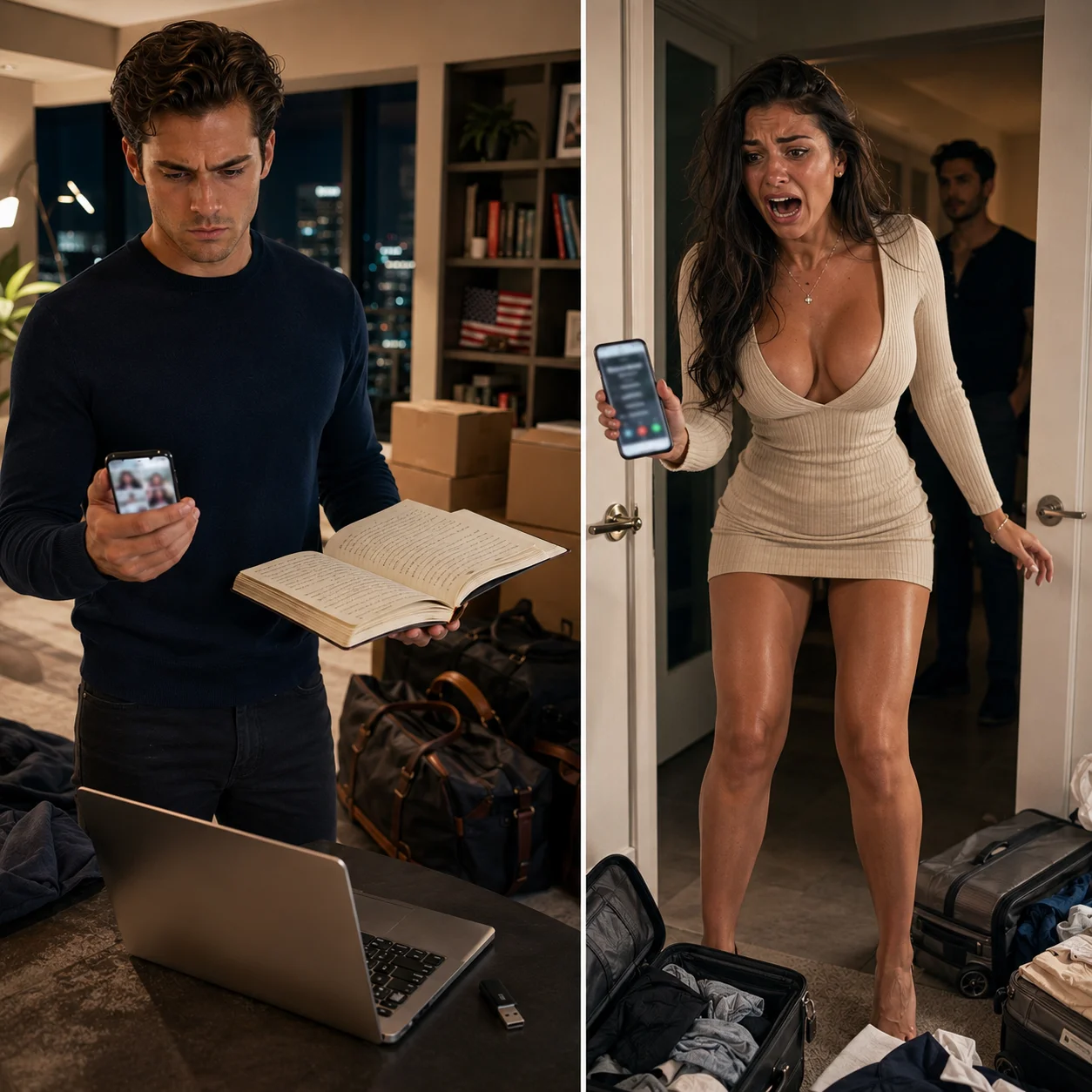
I saw my girlfriend’s diary left open on our bed.
What I read changed everything.
I took photos, packed my bags, and left without saying a word. Two days later, she walked into my empty apartment screaming my name like she was the one who had been betrayed.
I’m Liam, twenty-nine, and I am a creature of habit. I like my coffee black, my workspace tidy, and my life predictable. I plan my weeks on Sunday nights. I keep receipts in labeled folders. My friends joke that if I ever became spontaneous, I would schedule it three weeks in advance and color-code the calendar invite.
Maybe that is why I did not see it coming.
Or maybe, looking back, I just did not want to.
My girlfriend, Chloe, twenty-seven, and I had been together for three years. She was everything I was not: vibrant, impulsive, magnetic, the kind of woman who could convince you to book a flight to somewhere you had never heard of at two in the morning just because the airfare dropped and “the universe was giving us a sign.” She made ordinary life feel cinematic. She danced while brushing her teeth. She bought flowers for no reason. She changed plans mid-sentence and somehow made it feel like an adventure.
I thought she was the beautiful chaotic yin to my quiet, structured yang.
I loved her.
I really, truly believed I did.
For most of our relationship, I saw our differences as balance. I had the stable job, the apartment, the spreadsheets, the carefully built savings. Chloe had the spark, the social energy, the daring. I thought I gave her safety, and she gave me color. People liked us together. My mother adored her, or at least adored the version of Chloe who brought soup when Mom’s health got bad and sat beside her bed pretending to understand gardening shows. My friends thought Chloe was fun. Her friends called me dependable, which I took as a compliment back then.
I did not understand that “dependable” can sound very different depending on who is saying it.
This past Friday, Chloe left for what she called a spa weekend with her friends. She was rushing around our apartment that afternoon, packing bags in that chaotic way of hers, a whirlwind of perfume, loose makeup brushes, tangled chargers, and dramatic statements about being “so overdue for feminine healing.” She kissed me goodbye at the door, told me not to work too much, and reminded me to water the basil plant she had insisted we needed but never remembered existed.
I told her to have fun.
Then I settled in for a quiet weekend of project work and video games.
It felt normal.
At around 8 p.m., I went into our bedroom to grab a charger.
That was when I saw it.
Her diary.
It was a beautiful leather-bound journal I had bought her for our second anniversary. She had always loved handwritten things, or claimed she did. She said typing felt too sterile, that real thoughts needed ink. I remembered watching her unwrap it, running her fingers over the cover, smiling as if I had given her something deeply personal.
Now it was lying open on her side of the bed, splayed across the comforter, turned to a page she had clearly written in a hurry before leaving.
My first instinct was to close it.
I am not a snooper. I believe in privacy. I believe people are entitled to corners of themselves that do not belong to their partners. If I had seen a random complaint about me, or an anxious thought, or some private insecurity, I like to think I would have closed the book and walked away.
But a few words caught my eye.
My name.
And beside it, another name.
Marcus.
Marcus was her ex. The one she swore was just a good friend. The one who occasionally liked her photos too fast. The one whose name popped up in conversations whenever she talked about “creative people” who were too misunderstood for normal jobs. The one I had been told, over and over, not to worry about.
My stomach tightened into a cold, hard knot.
I should not have read it.
I know that.
Every decent part of me said to close the diary, put it down, and ask her about it when she got home. But there are moments when your body understands danger before your ethics can form a speech. My hand moved before I had fully decided.
I picked it up.
And I read.
It was not just one page.
It was months of entries. A detailed, chronological account of Chloe’s double life written in her neat, loopy handwriting, as if she were recording a love story instead of documenting a con.
“Liam is so wonderfully predictable,” one entry read. “He’ll be working on his stupid design portfolio all weekend. Perfect time to actually have a real weekend with M.”
M.
Marcus.
The spa weekend was not a spa weekend.
It was a trip with Marcus.
The photos of mimosas she had sent earlier that day were not from the resort she claimed to be visiting with friends. They were recycled photos from a vacation she and Marcus had taken the previous year. I did not want to believe that part, so I went to my computer and reverse image searched one of the pictures. It took less than a minute to find the same photo buried in an old album she had once posted and later archived.
A mimosa glass. A resort balcony. A lie with a citrus wedge.
Then it got worse.
So much worse.
Chloe was not just cheating. Cheating would have been devastating, but simple. Ugly, human, and common. This was something colder.
She was running a long con.
And I was the mark.
In the diary, she called me her “stability phase.” My decent-paying stable job, my predictable schedule, and my apartment—which I paid about seventy percent of because my income was higher—were described not as parts of our shared life, but as a convenient launchpad. Marcus, a “freelance entrepreneur,” which in practice meant chronically unemployed with a ring light and ideas, needed time to get his act together.
I was footing the bill for their waiting period.
Chloe wrote about it almost academically, as if I were a resource allocation problem.
“Liam is so easy when you frame things as future planning.”
“He loves feeling useful.”
“He thinks providing is love, which is convenient.”
I kept reading because after a certain point, pain becomes momentum. You are not reading to learn anymore. You are reading because the truth is already bleeding, and you need to know how deep the wound goes.
The real kicker was the financial endgame.
I had been saving aggressively for a down payment on a small house. Not a mansion. Not some fantasy. Just a small home in a decent neighborhood. Something quiet, stable, and ours. I had told Chloe about it with genuine excitement. I showed her listings. I talked about mortgage rates, inspection costs, and how the extra bedroom could become a studio for her creative work.
She had been so supportive.
Or she had pretended to be.
In the diary, she called my dream house “the boring beige box.”
She wrote that once I hit my savings goal in about two months, she was going to convince me to invest half of it—around thirty thousand dollars—into a boutique marketing agency she planned to launch.
An agency that, according to the diary, would be co-owned by Marcus.
“Liam’s such a provider, he’ll fall hard,” she wrote. “He’ll think he’s building a future with me. Once the money is secured in a business account, M and I can finally get our own place and I can drop the dead weight.”
Dead weight.
I sat down on the edge of the bed.
The room looked exactly the same as it had five minutes earlier, but reality had tilted so violently that I felt almost dizzy. Our framed vacation photos. Her sweater over the chair. My charger on the nightstand. The basil plant on the windowsill, already drooping. Everything looked normal, which somehow made it worse.
The diary continued.
There were details about my family. About my mother, who had been unwell. Chloe wrote about charming her, about bringing flowers, about remembering appointment dates. Not because she loved my mother. Because “sick moms are emotional anchors” and being kind to mine helped “cement the good girlfriend image.”
She called my mother’s illness “a convenient way to look like a saint.”
I had to stop reading for a moment.
That hurt more than Marcus.
More than the money.
More than the sex I now knew she had been having behind my back.
My mother had trusted Chloe. She had held Chloe’s hand in hospital waiting rooms. She had told me once, voice weak but smiling, “That girl has a good heart, honey.”
And Chloe had written about her like a tool.
Then came the small cruelties.
She mocked a framed print I had given her for our anniversary: a star chart from the night we met. It had been sentimental, maybe overly so, but genuine. She had cried when she opened it. In the diary, she said she kept it in the closet and laughed about it with Marcus.
“He tries so hard. It’s almost adorable.”
I did not feel rage.
Not at first.
I did not even feel sadness in the way I expected.
It was like a switch flipped in my brain. The world went quiet and sharp. All the little inconsistencies, the late nights at work, the sudden errands, the secretive phone calls, the way she tilted her screen away from me, all snapped into focus with horrifying clarity.
I put the diary down.
Then I took out my phone.
With steady hands, I photographed every single page from the last six months. Clear, high-resolution photos. Dates visible. Margins visible. I turned pages carefully, documenting everything: Marcus, the fake spa weekend, the business plan, the references to my savings, the mockery of my mother, the timeline of lies.
Then I backed the photos up to my cloud drive. A separate secure folder. Then an encrypted USB stick.
That diary was my artifact of truth, and I would not lose it.
Only after that did I start packing.
Not everything. Just what mattered. Clothes. My computer and work equipment. My grandfather’s watch. The books I loved. Family photos. Documents. A few sentimental things Chloe had never noticed enough to mock.
I left her things.
All of them.
The expensive clothes I had bought her. The jewelry. The furniture we had picked out together. The decorative objects that had made the apartment look like our home. I left them where they were because at that moment, ownership felt less important than escape.
I packed my car methodically.
Then I stood in the middle of the living room and looked around one final time.
The apartment was once my idea of home. Now it looked hollowed out, like a stage set for a life that had never been real.
I drove to my parents’ house two hours away.
I did not call first.
My dad opened the door, saw my face, then looked down at the duffel bags by my feet. He did not ask a question. He just nodded, a grim understanding passing between us, and helped me carry my things inside.
For two days, I ignored Chloe’s texts.
At first they were cute.
“Miss you already.”
“Spa robe life is changing me.”
“Don’t forget the basil.”
Then came recycled photos of cocktails and steam rooms. Then, when I did not respond, the tone shifted.
“You okay?”
“You’re being quiet.”
“Liam?”
By Sunday evening, annoyance started bleeding through.
“Answer your phone.”
“Seriously, this is childish.”
Monday morning, the panicked calls began.
I let them go to voicemail.
Then, about an hour later, my old next-door neighbor Carol texted me. Carol is a kind older woman who used to bring us banana bread and complain about the building’s elevator.
“Young man, there is a woman screaming your name in the hallway outside your old apartment. Is everything all right?”
I knew exactly what had happened.
Chloe had returned from her fake spa weekend expecting me to be there waiting like a lost puppy. She would not have used her own key at first. She would have knocked, maybe called, maybe performed concern in the hallway. Finding the apartment half empty, finding my office stripped bare, finding me gone without a trace—that would have broken her script.
My phone started blowing up with calls from Chloe, her mom, her friends, numbers I did not recognize.
I did not answer.
I sat at my parents’ kitchen table drinking my dad’s too-strong coffee and preparing for the next act.
Because I knew it was coming.
And this time, I was ready.
The storm made landfall the next day.
The screaming in the hallway was only the overture. After realizing I was not there, Chloe used her key. The sight of my half of the apartment gone, my workspace cleared, my monitors and files missing, apparently sent her into a full meltdown.
I finally answered her call Tuesday because I needed to establish the first boundary.
“Liam,” she shouted, “where are you? What the hell is going on? Half the stuff is gone. My TV is gone.”
My TV.
The one I had paid for with my last bonus. The receipt was in my email.
“I moved out, Chloe,” I said calmly.
“Moved out? What are you talking about? You can’t just move out. We live here. You were supposed to pick me up from the station.”
The entitlement was breathtaking.
Not “What happened?” Not “Are you okay?” Not “Why did you leave?”
You disrupted my schedule.
“I read your diary,” I said.
Silence.
Then everything changed.
The frantic anger vanished and was replaced by cold, sharp fury.
“You went through my private things,” she said. “That is a complete violation of my privacy. Liam, I cannot believe you would do that.”
“And I cannot believe you were planning to defraud me of thirty thousand dollars and run off with Marcus,” I replied. “I guess we both have our disappointments.”
The line went quiet for a full ten seconds.
Then came the gaslighting.
It was a master class.
She said I was twisting her words. She said the diary was fantasy, a safe place to process feelings she did not mean literally. She said Marcus was just a friend supporting her business dream. She said I was being insecure and controlling. She said no healthy partner would invade privacy and then use private thoughts as a weapon.
I let her talk.
Then I said, “I have photos of every page, Chloe. Every single word.”
That was when her mother got on the phone.
Apparently, Chloe had me on speaker.
Mrs. Davidson did not yell. She used that disappointed, condescending tone that had always made my skin crawl, the one reserved for people she considered beneath her but still useful enough to correct.
“Liam,” she said, “this is incredibly immature. Whatever is in there, you need to be a man. Come back and talk it through.”
There are phrases that reveal entire worldviews.
Be a man, in her mouth, meant absorb the damage quietly.
“No,” I said. “There is nothing to talk through.”
Then I laid out the first real consequence.
“I spoke to the property manager this morning. I’ve given my official thirty-day notice to vacate as allowed under our lease agreement. Since Chloe is also on the lease, she has two options. She can re-qualify for the apartment on her own income, or she can also give notice and move out by the end of next month.”
Chloe came back on the line screaming.
“You can’t do that. I can’t afford this place by myself.”
“That sounds like a you problem,” I said, “not a me problem.”
That sentence enraged her so much she actually stuttered.
“Which brings me to your things,” I continued.
“What about my things?” she snapped.
“Our lease is paid until the end of the month. I still have legal access to the apartment. Yesterday, while you were at work, I hired a moving company. All of your belongings—your clothes, your furniture, everything that was clearly yours—have been carefully packed and moved into a ten-by-fifteen climate-controlled storage unit. A very nice one.”
The silence was profound.
I could almost hear the gears in her head grinding, trying to process this deviation from her plan.
“You did what?”
“I’ll send you the address and the key,” I said. “As soon as you pay me back for your share of the last three months’ rent and utilities you forgot to pay, plus the cost of the movers and the first month of storage. The total is $3,121.58. I’ll text you a formal itemized invoice. Once the money is in my account, the key is yours.”
Then came sputtering. Accusations. Theft. Emotional abuse. Holding property hostage.
“It’s not theft, Chloe,” I said. “It’s collateral. You’ll get your things back when you settle your debts.”
Then I hung up.
The smear campaign started the next day.
Vague social media posts about escaping a controlling relationship. Quotes about narcissistic men. A photo of her looking sad in a coffee shop with the caption, “Starting over when someone shows you who they really are.” Marcus chimed in with supportive comments, which was almost funny given that he was one of the people she had been planning to start over with using my money.
I will not lie. It stung.
For one hot minute, I wanted to burn it all down and post the diary pages.
But that was not the plan.
The plan was a slow, methodical dismantling.
They thought this was a messy breakup.
They did not understand it was an audit.
The pressure built quickly, and their tactics got more desperate.
First came the storage unit.
Chloe and her mother went to the facility and made a scene demanding access. The manager, a guy named Dave, called me while they were standing there. In the background, I could hear Mrs. Davidson saying, “He stole her property.”
Dave sounded tired before he even finished introducing himself.
I calmly explained, “The unit is in my name and paid for by me. The contents are part of a civil dispute over a significant unpaid debt. Ms. Davidson can have full access as soon as she settles that debt, or she can obtain a court order.”
Dave, who apparently dealt with messy domestic situations more often than anyone should, was unmoved by their drama.
He repeated it almost word for word.
“Ma’am, this is a civil matter. The contract is with Mr. Kent. I cannot grant access without his written permission or a court order. If you continue to cause a disturbance, I’ll have to ask you to leave the premises.”
They left, but not before Chloe screamed that she was calling a lawyer.
And she did.
Her father hired one.
I received a letter full of bluster and legal jargon accusing me of unlawful seizure of property and intentional infliction of emotional distress. It demanded the immediate return of her belongings and payment of five thousand dollars, or they would “see me in court.”
They were trying to bully me.
They expected me to fold.
Instead, the letter gave me the push I needed to initiate act two.
Because this was never really about furniture. It was not even about the social media slander.
It was about the thirty thousand dollars.
In her diary, Chloe had named their target investor: Mr. Alistair Finch, a semi-retired old-money angel investor known for shrewdness, discretion, and a nearly obsessive focus on personal integrity. Chloe and Marcus believed he was their gateway. With my money as the first chunk of “committed capital” and Finch as the big investor, they thought they could build the agency, get their own place, and leave me behind after I had funded their launch.
My first email to Finch’s firm was cautious. A soft touch. Professional courtesy.
I wrote that I had reason to believe a proposal being presented by Chloe Davidson and Marcus Thorne involved fraudulent intent, misrepresented funding sources, and unethical personal conduct that might be relevant to due diligence.
I received a generic two-line reply from an assistant thanking me for my correspondence.
A polite dismissal.
They probably got emails from cranks all the time. Chloe and Marcus were likely counting on that. Maybe they even laughed about it, thinking the crazy ex had taken his shot and missed.
But I had anticipated that a single email would not be enough.
I needed to bypass the gatekeepers.
I needed the evidence directly in Finch’s hands.
So I put the encrypted USB stick containing high-resolution photos of the diary into a small padded envelope. Then I wrote a short formal letter.
“Dear Mr. Finch,
Further to my email of [date], to which your office replied, I understand the uncorroborated nature of my claim may have led to its dismissal. However, given the significant financial and ethical implications, I feel compelled to provide the documentary evidence I mentioned.
The enclosed drive contains photographs of the primary source documents outlining the fraudulent intent behind the business proposal presented to you by Chloe Davidson and Marcus Thorne.
I trust your discretion in this sensitive matter.
This will be the last you hear from me.
Sincerely,
Liam Kent.”
I did not send it to his office.
I paid for a professional courier service, the kind that guarantees person-to-person delivery to the named recipient. It was expensive, but it mattered. I sent it directly to Mr. Finch’s private residence, which I found through public property records.
It was aggressive.
It was risky.
But their lawyer’s letter told me they wanted to play hardball.
So would I.
The package was delivered two days later. The courier sent confirmation with a signature.
Then I waited.
The fallout was not immediate, but when it came, it was total.
About two weeks after I sent the package, a friend who works in finance heard rumblings. Mr. Finch had not just pulled his funding. He had quietly flagged Marcus and Chloe in his network. He did not spread gossip. Men like Finch do not need to. He simply let it be known that due diligence on their proposal had revealed significant ethical and financial irregularities that made them an untenable investment risk.
In that world, that is a death sentence.
The dream was dead.
The explosive breakup between Chloe and Marcus came fast.
With no money on the horizon, Marcus apparently stopped seeing Chloe as his brilliant partner and started seeing her as the source of his failure. He was gone within a week, leaving her with the wreckage.
Which brought her to the next problem.
The apartment.
With me gone and the landlord holding firm, Chloe could not afford the rent. She was served an eviction notice. That, I believe, was what finally broke through her parents’ protective shell. Until then, they had treated me like a bitter ex spinning private drama into punishment. But an eviction notice is not abstract. A failed investment pitch is not abstract. A daughter with no plan, no money, and no Marcus is not abstract.
Two weeks ago, a cashier’s check for exactly $3,121.58 appeared in my parents’ mailbox.
The return address was Chloe’s parents’ house.
No note.
I deposited it. Once it cleared, I drove to the storage facility, placed the key in an envelope, and mailed it to her parents’ address.
No note from me either.
It was a transaction.
Case closed.
Then came the final bookend.
Chloe’s father called me.
I expected anger, but his voice was tired.
He told me Chloe was moving back home. He said the lawyer had been “a stupid mistake made in anger.” Then he was quiet for a moment.
“Mr. Kent,” he said, then corrected himself. “Liam. My daughter is a mess. And I am out a considerable amount of money between her debts and this eviction. I need to know. Was any of it real?”
I did not gloat.
I told him the truth.
I walked him through the diary, the plan to take my savings, the mockery of my family, the entries about Marcus, the business account, the “dead weight” line. I did not embellish. I did not call her names. I simply told him what she had written.
Then I said, “All I did, sir, was refuse to be their business’s first victim. Everything that happened after that was the result of their choices hitting daylight.”
There was a long pause.
He sighed, a heavy, weary sound.
“She burned the diary,” he said. “She told us you made it all up. But a man doesn’t hire movers and couriers over a simple misunderstanding.”
“No,” I said. “He doesn’t.”
“Thank you for your honesty.”
Then he hung up.
I saw Chloe once from a distance a few days ago.
I was in a coffee shop downtown. She walked past the window, staring at her phone. She looked diminished. The vibrant, spontaneous energy that once captivated me was gone, or maybe I was finally seeing past it. She was just a person with slumped shoulders, tired eyes, and anger turned inward because there was nowhere left to spend it.
Our eyes did not meet.
I felt a brief, strange pang of something.
Not pity.
Not regret.
Maybe just the sad acknowledgment that the past I had been grieving was a complete fabrication. The closing of a book I should never have opened, yet one that saved me because I did.
As for me, I am good.
The boring beige box I was saving for is now my home. I closed on it last month. It is small, quiet, imperfect, and mine. The paint in the hallway needs touching up. The kitchen cabinets are not what Chloe would have chosen. The yard is smaller than I imagined, and the front porch creaks in one corner. I love every inch of it.
My “stupid design portfolio” landed me a promotion with a nice raise.
I have reconnected with friends I neglected while trying to make room for Chloe’s chaos. I spend weekends with my family. My mother is doing better. Last week, while we were sitting on my new porch, she told me, “I never trusted her smile, honey. It never reached her eyes.”
Mothers always know.
The other day, I was unpacking a box and found the framed star chart I had made for Chloe. For a moment, I almost threw the whole thing away. Then I stopped. The frame was good. The memory was poisoned, but the object did not have to stay that way.
So I took out the old print and replaced it with a new one.
A simple, clean design with a quote:
“The truth will set you free, but first it will piss you off.”
I hung it in my hallway.
It is the first thing I see when I come home.
A reminder that my predictable, structured life is also honest. It is real. And after three years living inside a beautifully constructed lie, real feels pretty damn good.
![[FULL STORY] I Thought Stability Was Boring, Until I Lost the Man Who Loved Me for Real](https://social-media.rabedo.com/thumbnails/1777636310_9f44d4f4-9313-42d4-aef4-029ea019d0c1.png)