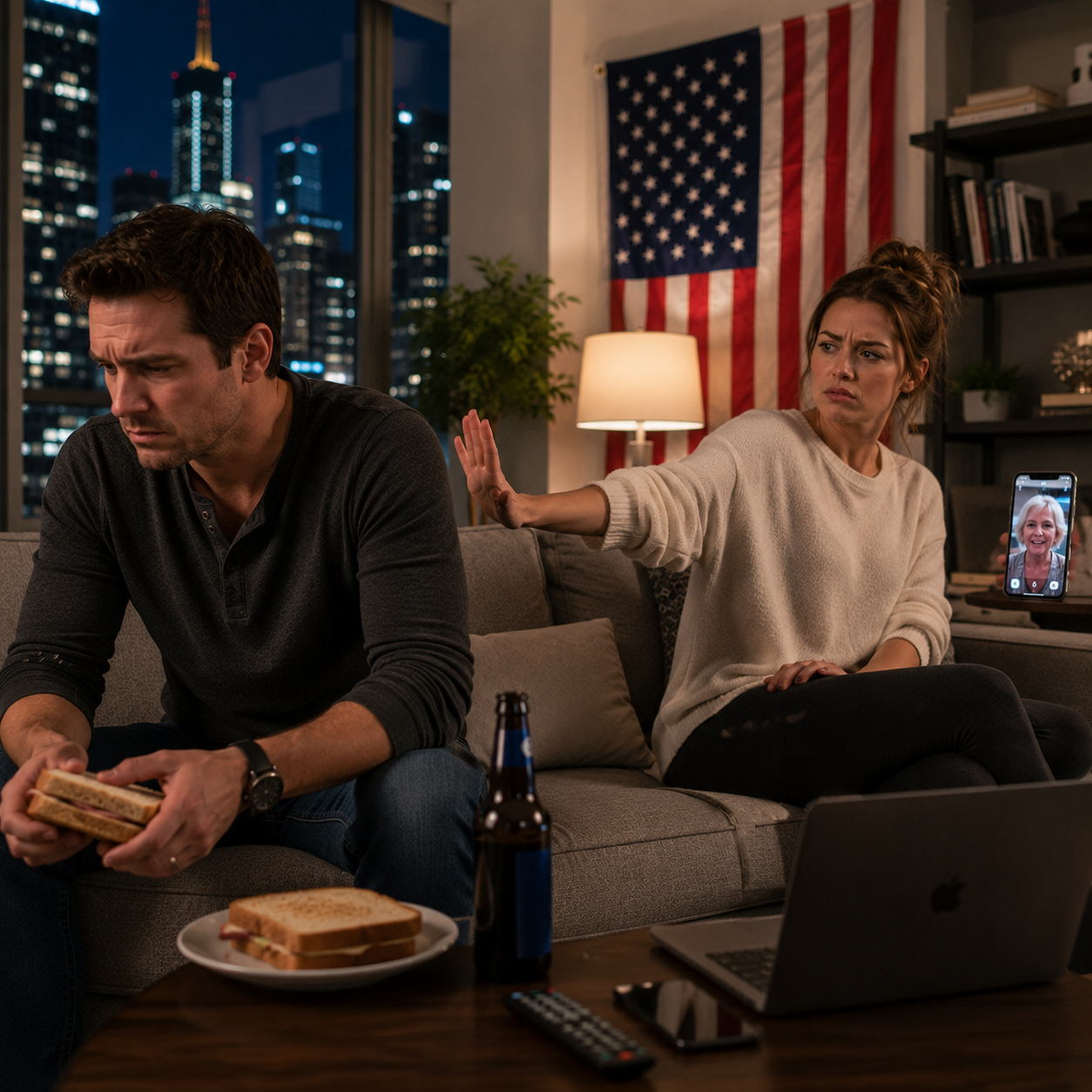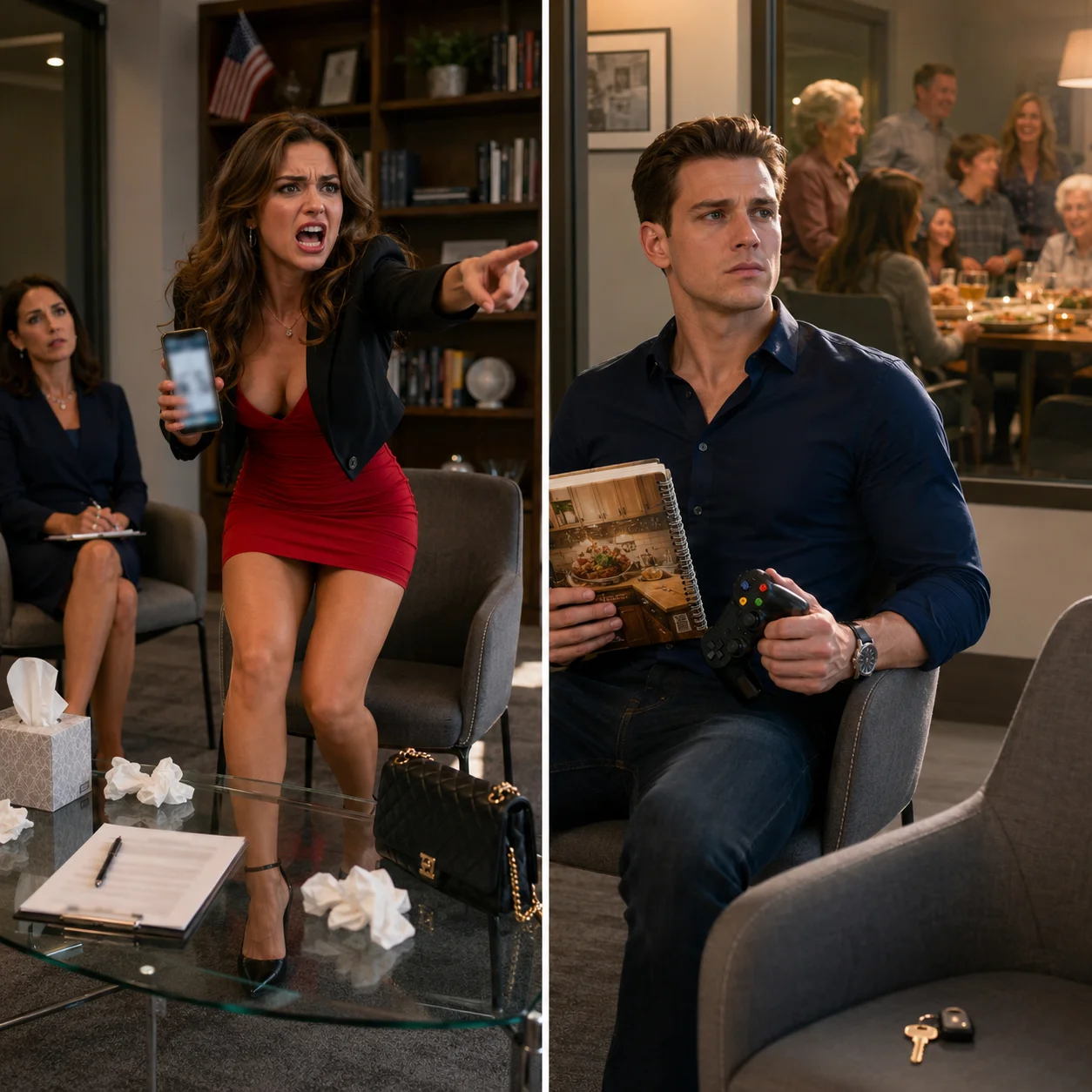
Vanessa demanded, “Answer me. Is your family more important than us?”
The counseling room went so quiet I could hear the clock ticking above Dr. Reeves’s bookshelf. Vanessa was sitting forward in the chair beside me, her face flushed, her hands clenched in her lap, her whole body vibrating with the kind of rage I had spent three years learning how to predict. Dr. Reeves didn’t interrupt. She just looked at me calmly, like she already understood that whatever I said next mattered more than I realized.
I took one breath and said, “Yes. They actually love me.”
For a second, Vanessa looked like I had slapped her. Her face went from red to white so quickly it was almost frightening. Then came the sputtering, the accusations, the familiar rush of words she used whenever she needed to bury something true before it could breathe. I was ungrateful. I was a mama’s boy. I was emotionally immature. I was throwing away our future. I was proving everything she had ever said about my family controlling me.
But for the first time in years, her words didn’t move me. They landed somewhere outside my body. I could hear them, but I didn’t believe I had to obey them anymore.
I’m thirty-one now, and I guess I should have seen the red flags sooner. That is the sentence people expect you to say when you come out of something like this, like abuse is a puzzle you failed to solve fast enough. But the truth is, Vanessa didn’t walk into my life wearing a sign that said she wanted to isolate me from everyone who cared about me. She was charming. Attentive. Funny. She made me feel chosen in those early months, and when someone makes you feel chosen, you don’t immediately question the cost.
We were together for three years and lived together for the last eighteen months. In the beginning, everything felt easy. Vanessa remembered small things. She knew my coffee order after our second date. She sent me songs she said reminded her of me. She liked hearing stories about my childhood, or at least I thought she did. She smiled when I talked about my parents. She laughed at the way my brother Derek and I insulted each other as a love language. She said my sister sounded “intense but sweet,” which should have been my first clue, because that was Vanessa’s gift: turning a compliment into something with a hook inside it.
The control started so small that I didn’t recognize it as control. It began as little comments, tossed out casually enough that responding seriously made me feel dramatic. “Your mom texts you a lot,” she said once while we were watching TV. Another time, when my sister called on a Sunday afternoon, Vanessa smiled without looking up from her phone and said, “Does she need to check in every week?” When I got off the call, she kissed my cheek and added, “Don’t you think you’re a bit old to be this close with them?”
I brushed it off. Vanessa’s own family was distant. Not estranged exactly, but cold in a way mine never was. Her parents communicated through short practical calls. Her siblings sent birthday texts, not birthday plans. Holidays with them sounded like corporate meetings with turkey. I told myself she simply didn’t understand what a close family looked like. I told myself her discomfort came from unfamiliarity, not resentment.
That was the mistake. I kept translating her contempt into confusion because confusion felt easier to forgive.
The isolation really kicked in about eight months before everything exploded. By then, Vanessa and I had been living together long enough that her routines had become the household’s routines. Her moods determined the temperature of the apartment. If she woke up happy, the day could be normal. If she woke up irritated, I could spend fourteen hours trying to figure out what invisible rule I had broken.
Every family event became a battle.
My nephew’s birthday party was the first one I remember clearly. My sister had planned a simple Saturday barbecue with a superhero cake and too many balloons. I mentioned it to Vanessa a week ahead of time, and she immediately frowned.
“We already have plans.”
I stared at her. “We do?”
She gave me that look. The one that said I was embarrassing both of us by requiring an explanation. “We talked about doing something together that weekend.”
“We said maybe we’d go to brunch. That’s not exactly a plan.”
“So your sister snaps her fingers and I just lose my weekend?”
That was how she did it. She turned invitations into commands, family into enemies, normal affection into evidence against me. If I went without her, I was abandoning her. If I brought her, she acted wounded the whole time and complained afterward about some imaginary slight. My mother had asked if she wanted more potato salad, and somehow that became “your mom thinks I don’t eat enough.” My brother Derek had joked that I was terrible at assembling toys, and somehow that became “your family doesn’t respect you, and you’re too weak to see it.”
Sunday dinners at my parents’ house became impossible. “I’m too tired from work,” she would say, even on weekends when she had spent most of the day scrolling through her phone. My brother’s engagement party was worse. Vanessa announced she didn’t want to go because his fiancée didn’t like her. They had met twice. Both times, Derek’s fiancée had been perfectly polite.
“She gives fake energy,” Vanessa said.
“What does that mean?”
“It means I’m not going somewhere I’m unwanted.”
Eventually, I started declining things before Vanessa even complained. That is one of the quietest ways control changes you. You begin doing the isolating yourself because it feels less painful than surviving the punishment afterward.
My family noticed. Of course they noticed. My mom started saying things like, “We miss you,” in that careful tone parents use when they are trying not to push too hard. My sister stopped asking if I was coming and started saying, “No pressure, but we’d love to see you.” Derek was more direct. He pulled me aside one night after I showed up alone for twenty minutes, kept checking my phone, and left before dessert.
“You okay?” he asked.
“Yeah.”
He didn’t believe me. Derek has known me since before I knew how to lie convincingly. “You sure?”
I got defensive because deep down I was terrified he was right. “I’m just busy.”
He looked at me for a long second and said, “No, you’re managed.”
I laughed it off. I told him he was being dramatic. I told myself the same thing the entire drive home.
Two months before the counseling session, my dad had a minor heart episode. Not a full heart attack, but serious enough that my mother called my sister crying and my sister called me immediately after. He was taken to the hospital and kept for three days while they ran tests and adjusted medication.
When I told Vanessa I was leaving work early to be there, she didn’t ask if he was okay. She didn’t ask which hospital. She didn’t ask whether I needed anything.
She said, “Are you serious right now?”
I was standing in our kitchen with my keys in my hand. “My dad’s in the hospital.”
“It’s not like he had a major heart attack.”
“We don’t know that yet.”
“If it were serious, they would’ve called an ambulance, not you.”
“They did call an ambulance.”
She rolled her eyes, like facts were just another tactic I was using against her. “You’re being dramatic. Your family loves making everything a crisis so you’ll run.”
I remember staring at her and feeling something inside me crack. Not break completely. Not yet. Just crack enough for light to get in.
“I’m going,” I said.
She crossed her arms. “Of course you are.”
I went anyway.
My dad was pale and irritated in a hospital bed, which was the most reassuring version of him under the circumstances. My mom sat beside him pretending not to be scared. My sister cried in the parking garage when she thought nobody could see her. Derek showed up with terrible vending-machine coffee and tried to make everyone laugh.
They needed me. Not because I could fix anything, but because love means being present for the waiting.
When I came home that night, Vanessa didn’t speak to me. Not that night, not the next morning, not the day after. Four full days of silent treatment. She moved through the apartment like I was a piece of furniture she disliked. She cooked only for herself. She turned away when I entered rooms. When I finally asked if we were going to talk, she said, “I’m not rewarding you for choosing them.”
That was my breaking point.
I suggested couples counseling.
To my surprise, she agreed. Looking back, I think she agreed because she assumed the therapist would validate her. Vanessa had spent so long convincing herself that my family was the problem that she expected a professional to diagnose me with unhealthy attachment and hand her the vocabulary to win every argument forever.
Our first session was on a Tuesday evening.
Dr. Reeves was in her mid-fifties, with silver-streaked hair, calm eyes, and the kind of voice that made it difficult to lie loudly. Her office was warm without being fake. Soft chairs, bookshelves, a small plant by the window, framed certificates on the wall. Vanessa chose the chair closest to the tissue box, which made sense in hindsight because she always liked props.
Dr. Reeves started with the basics. How we met. How long we’d been together. What brought us in.
Vanessa launched immediately.
She said I prioritized my family over our relationship. She said I was emotionally immature. She said my family was invasive, controlling, manipulative. She said I couldn’t make decisions without checking with my mother. She said my sister treated me like a second husband. She said my brother encouraged me to disrespect her boundaries. She said she had spent three years begging me to build a future with her, but I kept running back to “mommy and daddy” every time they wanted attention.
Dr. Reeves listened and took notes. She asked clarifying questions in a neutral voice. “Can you give me an example?” “What happened next?” “How did he respond?” “What did you ask for in that moment?”
Vanessa seemed energized by the attention. She cried twice, but the tears came strangely fast and stopped just as quickly when she needed to make a point. She kept touching my arm while saying awful things about me, like the affection somehow softened the blade.
Then Dr. Reeves turned to me.
“What is your experience of the relationship?” she asked.
I had planned to be careful. Diplomatic. Fair. I had spent years learning to present my pain in ways Vanessa couldn’t punish too easily. But sitting there, after listening to her turn my family into villains and my exhaustion into immaturity, I couldn’t perform balance anymore.
“I feel like I’m constantly walking on eggshells,” I said. “Nothing I do is right. If I see my family, I’m choosing them over her. If I don’t see them, I feel guilty and isolated. I miss them. I miss being able to answer my phone without wondering how much trouble I’m going to be in.”
Vanessa laughed once, sharp and humorless. “Trouble? You’re not a child.”
“No,” I said quietly. “But you treat me like one when I don’t obey you.”
That was when she exploded.
She started listing every time I had “chosen them over her.” Every phone call I had taken. Every birthday I had remembered. Every Sunday dinner. Every hospital visit. Every time my mother texted me and I answered within the hour. Every time Derek invited me somewhere. Every time my sister needed help moving furniture or fixing a leak or talking through something with her kids.
The list was endless because Vanessa had been keeping score for years.
Then she turned fully toward me, eyes blazing, and demanded, “Answer me. Is your family more important than us?”
And I finally told the truth.
“Yes. They actually love me.”
Vanessa’s face changed. The rage drained into shock, then rushed back twice as hot.
“How dare you?” she said. “I have loved you for three years. I have tried to build a life with you while you let your family poison you against me. You are a grown man who can’t commit because you’re still attached to your mother like a child.”
Dr. Reeves raised a hand. “Vanessa, I’d like to pause here.”
Vanessa ignored her. “No, he needs to hear this. He wants to play victim, but he’s the one abandoning me.”
“Vanessa,” Dr. Reeves said again, still calm, but firmer now. “I’d like to share some observations from this session.”
Something in the room shifted. Vanessa sat back slightly, expecting, I think, to be praised for her honesty.
Dr. Reeves flipped through her notes. “In the past forty minutes, I’ve documented thirty-eight instances of what appears to be emotional manipulation and control.”
Vanessa blinked. “Excuse me?”
Dr. Reeves continued, not unkindly, but with the steady precision of someone naming weather. “Using tears to shut down disagreement. Gaslighting about conversations that your partner says did not happen. Dismissing his feelings. Name-calling disguised as honesty. Financial threats. Referencing whose name is on the lease during conflict. Isolation tactics regarding his family. Guilt-tripping. Moving goalposts. False victimization. Threatening abandonment when he expresses needs. Reframing reasonable family contact as betrayal.”
By number fifteen, Vanessa was standing.
“This is ridiculous.”
Dr. Reeves did not raise her voice. “I understand this may be difficult to hear.”
“No,” Vanessa snapped. “You’re just another woman who thinks men are always victims now because they can’t handle strong women.”
Dr. Reeves glanced at her notes. “I’m identifying behavior, not character.”
Vanessa grabbed her purse. Her hand was shaking. She pointed at me with a look I had seen too many times in our apartment, but never with another person watching.
“We’re done,” she said. “Get your stuff out of my apartment.”
She stormed to the door and slammed it so hard the certificates on the wall shook.
For a moment, I just sat there, stunned by the sudden silence.
Dr. Reeves looked at the closed door, then back at me. “That was actually number thirty-nine. Emotional blackmail via housing threat.”
I laughed once, but it came out broken.
Then I cried.
Not loudly. Not dramatically. Just a few exhausted tears I could not stop. Dr. Reeves handed me tissues and let the silence sit without trying to rescue me from it. I stayed for another twenty minutes. She was incredibly kind. She gave me resources for emotional abuse survivors. She told me that what I had described was consistent with coercive control and emotional abuse. She said she would be willing to continue individual sessions if I wanted.
I walked out of that office feeling like someone had removed a blindfold I didn’t know I was wearing.
When I got home that evening, my clothes were in trash bags by the door.
My laptop and tablet were stacked on top of them. My work shoes were tossed beside a half-open duffel bag. But other things were missing. My gaming console. The TV I had bought. My coffee maker. My grandmother’s cookbook, the one with her handwritten notes in the margins. Little things, big things, things that belonged to me but had apparently become bargaining chips the second Vanessa felt herself losing control.
The bedroom door was locked. Music blasted from inside.
I stood in the entryway of the apartment I had helped pay for, looking at my life stuffed into garbage bags, and for the first time, I didn’t knock.
I picked up what was there and left.
Derek opened his door twenty minutes later and took one look at me before pulling me into a hug. I hadn’t even told him anything yet. He just knew.
When I finally got the story out, he listened without interrupting. When I told him what Dr. Reeves said, his jaw tightened. When I told him about Vanessa throwing my clothes into trash bags, he closed his eyes like he was trying not to say something violent.
Finally, he said, “We’ve been waiting for you to see it.”
That hurt, but not because it was cruel. Because it was true.
I slept on Derek’s couch that night under a spare blanket while his dog kept trying to climb onto my legs. My phone stayed silent until morning. For one night, Vanessa gave me nothing, and I slept better than I had in months.
Then the texts began.
Not apologies. Demands.
Where is my half of rent?
I stared at the message while drinking coffee from one of Derek’s chipped mugs. Her half of rent was an interesting phrase, considering I had been paying seventy percent because I made more and because she always seemed to have some emergency expense.
A second message followed.
Where’s grocery money?
I had been buying all the groceries for six months.
Then:
Why aren’t you answering my calls?
She had dumped me, kicked me out, and locked herself in the bedroom while my belongings sat by the door in trash bags. But in Vanessa’s mind, I was still failing in my assigned role.
I didn’t respond.
Then came the guilt trips.
I can’t believe you’re abandoning me like this.
Three years meant nothing to you.
Your family finally got what they wanted.
Still, I didn’t respond.
Then came the threats.
I’ll throw out everything you left.
I’ll tell everyone what you really are.
I’ll call your work.
That one got my attention.
I screenshotted everything and sent one reply.
The lease is in your name alone, as you have reminded me forty-seven times. I have no legal obligation to pay. Do not contact me again.
She called eighteen times in the next hour.
Meanwhile, I started taking action.
My name wasn’t on the lease, but because Vanessa’s credit was terrible when we moved in, the utilities were in my name. Electric, internet, streaming services, all paid from my account. In the chaos of leaving, I had forgotten about them.
I logged into everything. I scheduled the electric and internet disconnections for the end of the week and used the utility companies’ formal systems to notify the service address. Five days’ notice. Documented. Timestamped. Clean. I canceled the streaming services immediately because those were luxuries, not necessities.
Then I searched my email for receipts.
The gaming console was mine. Bought on my credit card. Same with the TV and the coffee maker. Total value was around two thousand dollars. The cookbook had no receipt, obviously, but it mattered more than the rest combined.
Derek convinced me to file a police report. I almost didn’t. Years of Vanessa had trained me to think protecting myself was escalation. Derek sat across from me at his kitchen table and said, “Bro, she stole from you. Stop making her choices sound like your aggression.”
So I filed.
The officer who took the report was named Martinez. He listened, looked at the receipts, looked at the messages, and said that because I could prove purchase, had established residency through mail, and she had locked me out without a formal eviction process, it could be treated as theft. He gave me a report number and said they would follow up.
That evening, Vanessa’s best friend Moira started blowing up my phone.
Moira had always disliked me, mostly because I didn’t worship Vanessa loudly enough. Her messages came in rapid fire.
How could you be so cruel?
She’s destroyed.
You’re financially abusing her.
You’re a monster.
I sent one response.
She kicked me out after verbally abusing me in therapy. She kept my property. She is harassing me. Please stop contacting me.
Moira replied, You’re a pathetic excuse for a man. No wonder she controlled you. You needed it.
I screenshotted it and blocked her.
That was the pattern for the next week. Vanessa would push. I would document. Someone from her circle would attack. I would document. Every instinct in me wanted to explain, defend, prove, argue. But Dr. Reeves had warned me during our first individual session that abusers often escalate when control slips. She called it an extinction burst: one final, frantic attempt to force the old system back into place.
Vanessa’s extinction burst was uglier than I expected.
Monday morning, my manager asked me to step into his office.
My stomach immediately tightened. When your abusive ex has threatened to call your work and your manager suddenly closes a door behind you, your body knows before your brain does.
He looked uncomfortable, but not hostile. “I need to show you something.”
Someone had sent an anonymous email to HR claiming I was unstable and potentially dangerous. It said I had been removed from my home for abusive behavior and that the sender was “concerned for coworker safety.” The language was pure Vanessa: emotionally dysregulated, narcissistic tendencies, unsafe emotional patterns. Projection dressed up in therapy vocabulary.
Thank God my manager knew me.
He didn’t accuse. He asked. I showed him the texts, the threats, the police report, Moira’s messages, the email from the utility company. His expression hardened as he read.
“This came from her?”
“I can’t prove it yet,” I said. “But yes.”
He immediately escalated to HR, but not against me. They opened an investigation into harassment and put a note in my file that the accusation appeared connected to a documented personal safety issue.
For the first time, I understood the power of documentation. Not revenge. Not drama. Protection.
Tuesday, Officer Martinez called.
They had gone to Vanessa’s apartment to serve notice that she needed to return my property or potentially face charges. Apparently, she had a complete meltdown. She screamed that I was abusing the legal system, that the items were gifts, that the police were helping me harass her.
Unfortunately for Vanessa, she had texted me two days earlier: Come get your stupid game system if you want it so bad.
I had replied, I’ll arrange pickup through the police, as you’ve been hostile.
She had responded, I threw it away. Sue me.
Officer Martinez found it interesting that she had acknowledged the item was mine before claiming to have destroyed it. She was given forty-eight hours to return the property or face charges for theft and destruction of property.
Wednesday, my mom called me at lunch.
“Vanessa called my office,” she said.
My whole body went cold. “What?”
Somehow, Vanessa had found my mother’s work number and called crying about how I had abandoned her with all the bills and she couldn’t afford food. My mom, who is the kindest woman alive until someone threatens one of her children, listened just long enough to understand what was happening.
Then she said, “That sounds like a you problem,” and hung up.
I laughed so hard I had to sit down.
But Vanessa wasn’t done.
Thursday night, she showed up at Derek’s apartment. His Ring doorbell captured everything. She stood outside in a coat too thin for the weather, crying into the camera, begging to talk to me. She said she’d had time to think. She said therapy was wrong. She said we could work it out if I stopped letting people interfere.
Derek didn’t open the door.
Through the intercom, he said, “You need to leave.”
“I know he’s in there,” she shouted.
“He doesn’t want to speak to you.”
“You owe me three years!” she screamed, as if my life were a debt she could collect. “You can’t just walk away.”
Derek called the cops. She left before they arrived, but we filed another report.
Friday morning, I got a text from an unknown number. Vanessa’s mother, whom I had met maybe three times, told me she was disappointed in how I was handling things. Her daughter was fragile. I was kicking her while she was down. A real man, she said, would at least pay this month’s rent so Vanessa could find a roommate.
I didn’t respond.
The woman who raised Vanessa wanted me to subsidize her daughter’s lifestyle after that daughter had abused me, kicked me out, stolen from me, harassed my workplace, and targeted my family.
No.
Friday afternoon, Officer Martinez called again. Vanessa had returned the gaming console and coffee maker. The TV, she claimed, had been “accidentally broken during a move.”
Sure.
Officer Martinez said I could pursue charges for the destroyed property or accept compensation for the TV and recover the returned items. If I pursued charges, it would likely mean community service and restitution. I thought about it. The angry part of me wanted consequences as sharp as possible. The exhausted part of me wanted my property back and my life quiet.
I accepted eight hundred dollars for the TV, retail value minus depreciation, and the returned items.
When Derek picked them up with me, Vanessa included a letter.
Two pages of beautiful delusion.
She wrote that I had ruined her life. That she would never love again. That my family had finally won. That I was a weak man who couldn’t handle a passionate woman. The last line read, You’ll regret this when you’re alone forever.
Derek read it, looked at me, and said, “Bro, being alone sounds amazing compared to that.”
At the time, I laughed.
Later, I realized he was more right than he knew.
The next week, Vanessa learned about utilities.
I had given proper notice. Written notice. Formal notice. Five days. She ignored it.
On Wednesday, the power was shut off.
She called me from Moira’s phone, screaming so loudly I could hear Moira trying to calm her in the background.
“How could you do this to me? This is illegal. I’ll sue you.”
I kept my voice even. “I gave written notice through the utility company. You had five days to transfer service into your name.”
“My credit is bad. They want a four-hundred-dollar deposit.”
“You should have thought about that before kicking me out.”
She hung up.
Thursday, I got an interesting call from the management office at my old apartment complex. Vanessa had tried to add me back to the lease, claiming we had reconciled so I could be liable for rent. The office called to verify because they needed my signature.
“We absolutely have not reconciled,” I said. “I haven’t lived there since she kicked me out weeks ago. This sounds like fraud.”
The property manager got very quiet.
“Thank you for confirming,” she said. “We’ll need to review our options regarding Ms. Vanessa’s tenancy.”
Friday morning, HR called.
They had completed enough of their investigation to confirm the anonymous email was part of a harassment pattern. They couldn’t share every detail, but they told me the message had been sent from a coffee shop near Vanessa’s apartment during a time when she had posted an Instagram story from that exact location.
Genius move. Posting your location while committing harassment.
They told me protective measures were in place. Translation: if she contacted my workplace again, they were ready to take formal action.
Friday afternoon was when karma decided to stop being subtle.
Vanessa worked in marketing for a small firm, the kind of company that cared deeply about image. For days, she had been posting about her “abusive ex” who had “financially abandoned” her. At first, she stayed vague. Then she got cocky and started using my full name.
My cousin Amelia is a lawyer. She had been quietly furious from the beginning, but this was the moment she stepped in. She drafted a cease and desist letter for defamation that laid everything out: the posts were false, provably contradicted by documentation, damaging to my professional reputation, and legally actionable. Remove them and stop, or face a lawsuit.
Vanessa deleted everything within two hours.
But someone had already screenshotted the posts. I did not send them to her company. I want to be clear about that. Derek, however, has always been protective, and Derek’s sense of restraint is different from mine. Someone sent Vanessa’s public posts to her company with a note expressing concern about their marketing manager’s online harassment campaign.
By Monday morning, her LinkedIn said she was “seeking new opportunities.”
I wish I could say that was the end.
It wasn’t.
After losing her job, Vanessa went nuclear one final time.
She showed up at my parents’ house on a Sunday during family dinner. The timing almost felt symbolic. For years, she had tried to make me feel guilty for sitting at that table. Now, there she was on the lawn, screaming at the people she had tried to erase from my life.
My dad refused to let her in. He stood behind the locked door and told her to leave. My sister recorded from the window. Derek moved like he was going to go outside, but my mom put one hand on his arm and said, “Don’t give her what she came for.”
So we watched.
Vanessa screamed that my family had ruined her life. That she had lost everything because of their “precious son.” That I was weak. That I was abusive. Then, because rage makes people careless, she started admitting things. She admitted she had lied to HR because she wanted me to know what it felt like to be scared. She admitted trying to get me back on the lease because I “owed” her. She admitted the TV had not been accidentally broken.
“I broke it because he loved that stupid thing more than me,” she yelled.
All while trespassing. All while being recorded.
My dad called the police.
This time, with multiple reports already filed, HR documentation, the lease fraud concern, the property issue, and video of her screaming admissions on my parents’ lawn, they arrested her. Nothing dramatic. No movie scene. She was released the same day. But now there was a record, and for Vanessa, consequences were apparently her kryptonite.
Her parents finally got involved seriously after that. They called me and asked if we could “work something out” so their daughter could move forward. I told them the only thing I wanted was to never hear from any of them again.
To their credit, they must have talked sense into her.
Everything stopped.
No calls. No texts. No emails. No surprise visits. No friends reaching out. Just silence.
Last I heard through the grapevine, because Derek’s girlfriend works with someone who knows Moira, Vanessa moved back in with her parents two hours away. She told people she was taking a sabbatical from “toxic city energy.”
Sure, Vanessa.
As for me, I’m still in individual therapy with Dr. Reeves. Turns out three years of emotional abuse leaves marks even after the person is gone. I still flinch when my phone buzzes too many times in a row. I still triple-check that my doors are locked. I still screenshot things out of habit. Sometimes I catch myself rehearsing explanations for completely normal decisions, like going to my parents’ house for dinner or calling my sister back during lunch.
But I’m healing.
I spend Sundays with my parents again. I call my sister whenever I want. I play games with Derek without being accused of choosing him over my relationship. My coffee maker makes perfect coffee every morning. My gaming console is back where it belongs. My grandmother’s cookbook sits safely on my shelf, and every time I see it, I remember that Vanessa could take a lot from me, but she never managed to take my history.
My apartment is quiet now.
At first, the quiet scared me. I was so used to tension that peace felt like waiting for a storm. But slowly, the quiet became something else. It became space. It became oxygen. It became the sound of my own life returning to me.
My family threw me a freedom party last weekend. I thought it was ridiculous when Derek suggested it, but my mom took the idea and ran with it. She made all my favorite foods. My dad bought the good beer. My sister made a cake that said, “Congratulations on Escaping.” Derek gave a toast about having his brother back, and I almost lost it right there in the backyard.
I am not saying everything is magically perfect. It isn’t. Abuse trains your nervous system to expect punishment, and unlearning that takes time. But I can breathe now. I can exist without performing emotional calculus before every decision. I can love my family without defending it. I can answer my phone without fear. I can spend an evening alone and understand it as peace, not failure.
Vanessa was wrong about one important thing.
I am not alone.
I never was.
I just couldn’t see all the people waiting to catch me when I finally jumped off that burning bridge.
To anyone reading this who recognizes even a piece of your life in mine, document everything. Trust your gut. Talk to someone outside the relationship. And remember this: someone who actually loves you will not make you choose between them and the other people who love you. That is not romance. That is not passion. That is not a strong personality.
That is control.
And control dressed up as love is still abuse in a pretty costume.
The restraining order is in progress. Amelia is helping me with it pro bono. I kept every text, email, recording, report, and screenshot. If Vanessa tries again, I’m ready.
But honestly, I think she finally understood the one lesson she spent three years avoiding.
Consequences don’t care how loudly you call yourself the victim.
![[FULL STORY] She Bragged at Dinner That 8 Months Was Her Longest Time Without Cheating — So I Paid My Share and Walked Out](https://social-media.rabedo.com/thumbnails/1777129852_6219f742-ba75-437a-8d72-bcd164be9f1e.png)

![[FULL STORY] My fiancée said, "Hospital pressure is too much, I need 3 days." I calmly replied, "Okay, rest well.](https://social-media.rabedo.com/thumbnails/1777002451_c18.png)
![[FULL STORY] My Wife Said: "It's Just Money. My Sister Needs The Lake House More Than We Do." I Said: "Then Sell](https://social-media.rabedo.com/thumbnails/1777352246_B17.png)