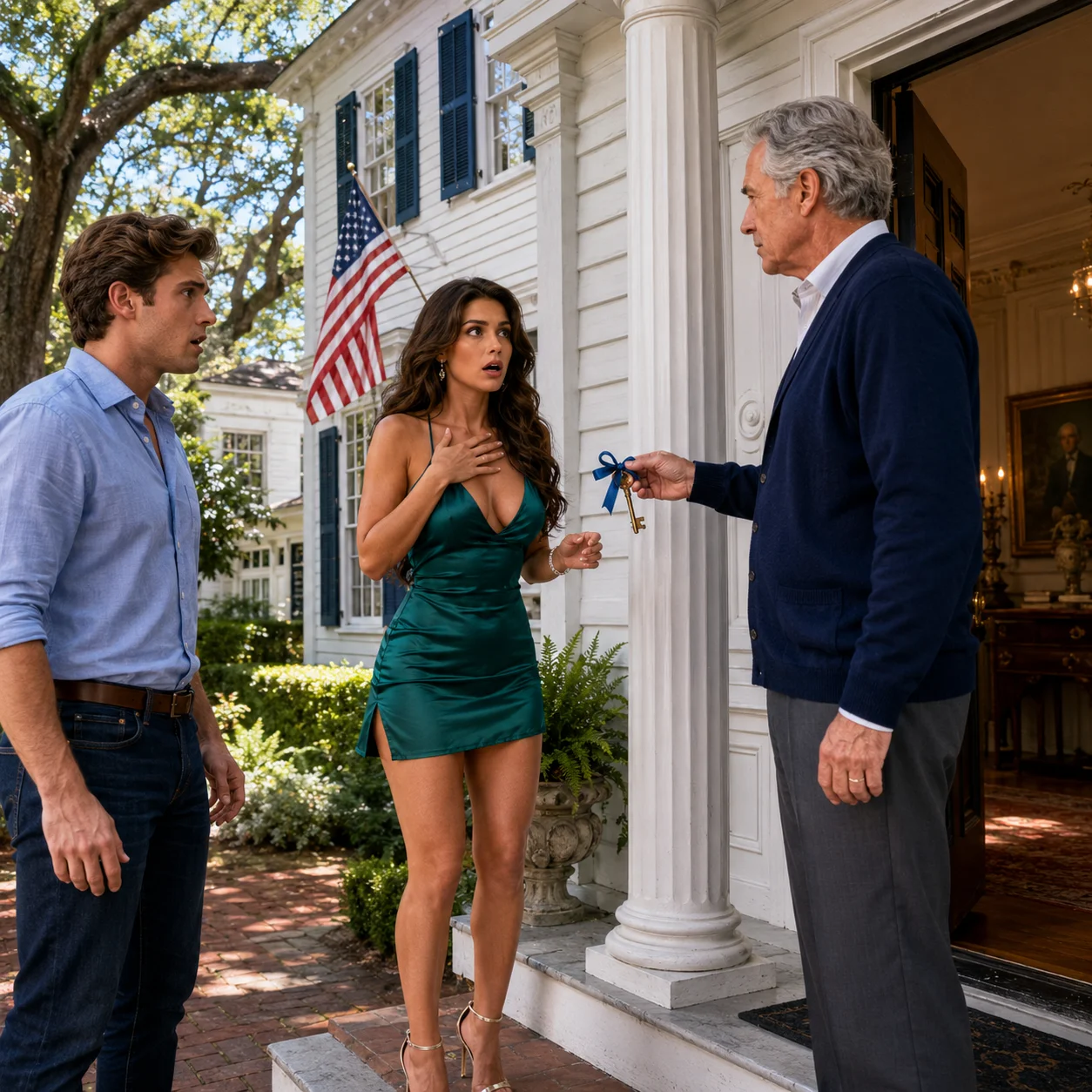
Arthur Hale crossed the street slowly. His eyes were on me at first, polite and curious. Then he saw Lily through the passenger window.
He stopped walking.
His face changed so completely that my stomach tightened. The polite smile disappeared. His eyes widened with recognition, then softened with something I could not name. Grief, maybe. Relief. Shock.
Lily’s hand went to the door handle.
“Don’t,” she whispered.
But Arthur was already beside the car.
I opened my door and stepped out. “Mr. Hale?”
He didn’t answer me. He was looking at Lily.
“Eleanor,” he said.
The name hung between us like smoke.
Lily opened her door so fast she nearly stumbled out. “No.”
Arthur’s mouth parted. “My God.”
“My name is Lily,” she said.
His eyes filled with tears.
“I know,” he whispered. “I know what your name is now.”
My body went cold.
“What is going on?” I asked.
Arthur finally looked at me. “You must be Daniel.”
That made it worse.
“How do you know my name?”
He swallowed, then reached into the pocket of his cardigan. When his hand came out, he was holding a small brass key with a faded blue ribbon.
He extended it toward Lily.
“I kept it exactly where you left it,” he said.
Lily stared at the key like it was a weapon.
I looked from him to her. “Lily?”
She didn’t answer.
Arthur’s hand remained outstretched.
“I promised I would,” he said softly.
And then, after several seconds of silence, Lily took the key.
Not like someone receiving a strange object from a stranger.
Like someone taking back something that had always belonged to her.
I felt my heart beating in my throat.
“You told me you’d never been inside that house,” I said.
Lily’s eyes were shining now, but she still didn’t look at me.
“I haven’t,” she said.
Arthur closed his eyes in pain.
“Not since you were thirteen,” he murmured.
I stepped back.
Thirteen.
That single word rearranged the entire moment.
Lily turned on him sharply. “You had no right.”
Arthur nodded. “I know.”
“You had no right to say that.”
“I’m sorry.”
“No,” she said, voice breaking. “You don’t get to be sorry now.”
I had seen Lily cry before. I had seen her overwhelmed, exhausted, scared. But I had never seen her look like that. Not sad. Not angry. Haunted. As if the house across the street had reached into her chest and pulled out a version of her she had buried alive.
“Someone tell me what this is,” I said.
Neither of them spoke.
So I said the thing I already knew but didn’t want to know.
“Lily, who is Eleanor?”
Her face crumpled.
Arthur answered for her.
“Eleanor Whitaker was her birth name.”
For a second, the world became perfectly still. A truck passed somewhere behind us, tires humming over pavement. A bird cried from one of the trees. I heard all of it too clearly because my mind had no room to understand the sentence I had just heard.
“Birth name?” I repeated.
Lily whispered, “Daniel, please.”
“You told me your parents died when you were little.”
“They did.”
“You told me you grew up with your aunt in Norfolk.”
“I did.”
“You told me your name was always Lily Mason.”
She closed her eyes.
Arthur looked away.
That was when I understood the first shape of the lie.
Not the whole lie. Not yet. Just the outline.
There was a dead family. A changed name. A house. A key. A man who knew me when I had never met him. And my fiancée, the woman I was supposed to marry in six months, standing in the middle of all of it like a stranger wearing a familiar face.
“I need to leave,” Lily said.
She moved toward the car, but Arthur stepped back and spoke quickly.
“There’s something inside you need to see.”
“No.”
“Eleanor—”
“Don’t call me that.”
“Lily,” he corrected, his voice trembling. “I wouldn’t have contacted Daniel if it wasn’t important.”
My head snapped toward him. “You contacted me?”
Arthur looked at me with regret.
“The listing,” he said. “It wasn’t real.”
My mouth went dry. “What?”
“The house is not available for weddings.”
I stared at him.
“The photos were posted privately,” he continued. “Only one inquiry was allowed through. Yours.”
I turned to Lily. Her face had gone pale.
“You set this up?” I asked Arthur.
“Yes.”
“Why?”
“Because every letter I sent her came back unopened. Every phone number I found was disconnected. Every attempt I made to reach her failed. Then I saw your engagement announcement online.”
Lily flinched.
Arthur’s expression twisted with guilt. “I didn’t know what else to do. I thought if he loved you, he deserved to know before the wedding. And I thought maybe you deserved one last chance to face it before the estate transfer.”
“Estate transfer?” I said.
Lily’s voice was barely audible. “Stop.”
Arthur shook his head. “It can’t be stopped anymore.”
“What estate transfer?” I demanded.
Arthur looked toward the house. “The Whitaker House becomes hers on her thirtieth birthday.”
Lily was twenty-nine.
Her birthday was in three weeks.
For a long moment, I could not speak.
Then I laughed once, not because anything was funny, but because my brain was rejecting the situation.
“My fiancée owns this house?”
“Not yet,” Arthur said. “But she is the legal heir.”
Lily turned away, covering her mouth.
“Daniel,” she said, “I was going to tell you.”
That sentence did more damage than all the others.
Because people only say “I was going to tell you” when they know they should have told you already.
I looked at the woman I had planned to marry. The woman whose student loans I had helped refinance. The woman who cried when I surprised her with a used Honda because her old car kept breaking down. The woman who told me she had no living family, no inheritance, no secrets worth mentioning.
“You were going to tell me when?” I asked.
She didn’t answer.
“After the wedding?”
Her silence was enough.
Arthur stepped away from us, as if ashamed to be near the blast zone he had created.
Lily reached for my hand. “Please, just come inside with me. Let me explain.”
I looked at the key in her palm.
Then at the house.
Every instinct I had told me to get back in the car and drive away. But another instinct, colder and stronger, told me that if I left then, I would spend the rest of my life wondering what I had almost married.
So I nodded.
“Fine,” I said. “Explain.”
We followed Arthur across the street. Lily walked beside me but didn’t touch me. Her shoulders were rigid, her steps slow. The closer we got to the porch, the younger she seemed. Not physically, but emotionally. By the time Arthur unlocked the front door, the woman beside me no longer looked like my confident fiancée. She looked like a child being led into a room where something terrible had happened.
Inside, the house smelled faintly of cedar, old paper, and lemon polish. Sunlight came through tall windows, falling across hardwood floors that had been kept in beautiful condition. The entrance hall had a curved staircase, faded floral wallpaper, and framed photographs lining both walls.
Lily didn’t look at the photographs.
I did.
And that was how I saw her.
Not Lily at twenty-nine. Lily at twelve or thirteen, standing on the porch in a blue dress beside a woman with the same green eyes and a man with dark hair and a serious face. There was a younger boy beside her, maybe seven, missing a front tooth and grinning wildly.
Under the photo, a small brass plaque read:
The Whitaker Family, 2009
I stared at it.
“Lily,” I said quietly.
She kept her eyes on the floor.
Arthur stood near the staircase. “Your mother loved this house.”
Lily’s laugh was bitter and broken. “My mother died in this house.”
The sentence landed heavily.
Arthur nodded. “Yes.”
“And my father.”
“Yes.”
“And Noah.”
Arthur closed his eyes. “Yes.”
Noah. Her brother. Another name she had never said.
My chest tightened.
“What happened here?” I asked.
Lily turned toward me then. Her face was wet with tears, but her voice was flat.
“The official story was carbon monoxide poisoning,” she said. “Faulty furnace. Winter storm. Everyone asleep.”
Official story.
The words made my skin crawl.
“And the unofficial story?” I asked.
She looked at Arthur.
He answered, “Her aunt believed it wasn’t an accident.”
Lily’s jaw clenched. “My aunt believed a lot of things.”
“She believed your father was going to change his will.”
Lily snapped, “Don’t.”
Arthur continued anyway, perhaps because he knew this was the last chance the truth had before Lily buried it again.
“Your grandfather left the house in trust. Your father couldn’t sell it outright, but he controlled it until you turned thirty. If your parents died before then, guardianship and estate management passed to your closest living adult relative.”
“My aunt,” I said.
Lily’s face tightened.
Arthur nodded. “Rebecca Mason.”
Mason.
Lily’s last name.
My pulse slowed into something heavy.
“She raised you,” I said to Lily.
“She took me in,” Lily corrected.
Arthur’s expression darkened. “She took everything.”
Lily turned on him. “You don’t know what she took.”
“I know what the court records say.”
“You know paperwork.”
“I know she petitioned to change your name six months after the funeral.”
“She said it was to protect me.”
“From what?”
Lily’s mouth opened, then closed.
Arthur stepped toward the hallway table and picked up a folder. It had been waiting there.
“From this?” he asked.
Lily stared at it.
“What is that?” I asked.
Arthur handed it to me, not to her.
Inside were copies of old documents. Death certificates. Trust records. Court filings. Letters. Newspaper clippings. A handwritten note from someone named Margaret Whitaker, Lily’s grandmother, dated years before the deaths. I scanned enough to understand pieces, but not all.
The Whitaker family had money. Not billionaire money, not the ridiculous kind from movies, but enough to make people behave badly. The house, several acres of land, investment accounts, and a charitable foundation had all been placed in a trust designed to pass to the next generation when Lily turned thirty. After the death of her parents and brother, Lily became the sole surviving beneficiary.
Her aunt, Rebecca Mason, became her guardian.
And for sixteen years, Lily had never told me any of it.
I looked up. “Why hide this from me?”
Lily wiped her face. “Because I wanted one part of my life that wasn’t connected to this.”
“That’s not an answer.”
“It is the only answer I have.”
“No. It explains why you don’t like talking about it. It doesn’t explain why you lied about your name, your family, your inheritance, this house, him—” I pointed toward Arthur. “All of it.”
Her eyes flashed. “Because people change when they find out there’s money.”
I recoiled slightly.
There it was.
The accusation underneath the secret.
“You thought I would change?”
“I didn’t know.”
“We’ve been together three years.”
“My parents were together twenty years, and someone still smiled at their funeral while calculating what they could take.”
Arthur’s face tightened at that, but he didn’t interrupt.
I took a slow breath. “So instead of trusting me, you tested me.”
“No.”
“You let me help you financially.”
Her face crumpled. “Daniel—”
“I helped you refinance your student loans. I paid your rent for two months when you said your aunt cut you off. I bought you a car.”
“I never asked you to buy that car.”
“But you let me believe you had no safety net. You let me believe we were building from nothing together.”
“We were.”
“No, I was. You were hiding an estate.”
“I don’t have it yet.”
“But you knew.”
Her silence answered.
Arthur looked down.
I wanted to be angry at him too. He had manipulated me, used my love for her as bait, dragged me into a family tragedy without permission. But the awful truth was that he had shown me something I needed to see.
Lily folded her arms around herself. “My aunt told me if anyone knew who I was, they would come for me. Reporters, distant relatives, men who wanted money, people who believed rumors about the accident. She said my parents’ name was cursed. She said the only way I could have a normal life was to become Lily Mason and never look back.”
“And you believed her?”
“I was thirteen.”
That stopped me.
For the first time since Arthur handed her the key, I saw not the lie, but the child inside it. A thirteen-year-old girl whose entire family died in one night, taken in by the only adult left, told that her name was dangerous, her past was poison, and her future would be stolen if she ever opened the wrong door.
My anger didn’t disappear.
But it changed shape.
“Why didn’t you tell me after we got engaged?” I asked more quietly.
Lily looked at the staircase. “Because the closer we got to the wedding, the more scared I became.”
“Of me?”
“Of everything.”
Arthur spoke then. “Rebecca contacted her last month.”
Lily’s head snapped toward him.
I looked at her. “Your aunt?”
She said nothing.
Arthur nodded grimly. “Rebecca has been living off advances and management fees from the trust for years. Those stop when Lily turns thirty. Once the estate transfers, Rebecca loses control.”
My chest tightened again. “And?”
“And she wants Lily to sign a private agreement allowing her to remain financial manager after the transfer.”
I turned to Lily. “You didn’t tell me that either.”
Her voice broke. “Because I knew you would tell me not to sign it.”
“Were you going to?”
She looked away.
My stomach dropped.
“Lily.”
“I don’t know.”
“You don’t know?”
“She raised me.”
“She lied to you.”
“She was still there when everyone else was dead.”
That sentence made the room go quiet.
I understood then that this was not just about money. Money was the surface. Underneath was grief, loyalty, fear, manipulation, and a girl who had been trained to believe survival meant silence.
Arthur placed one hand on the banister.
“Rebecca is the reason I asked Daniel here,” he said.
Lily’s eyes narrowed. “What did she do?”
Arthur hesitated. “She came to the house two weeks ago.”
Lily went still.
“She said she had power of attorney.”
“I never signed that.”
“I know.”
“She said she needed access to family records before the transfer. She brought a locksmith.”
My skin went cold.
“What did she take?” Lily asked.
Arthur’s face was pale now.
“She tried to take the original trust documents.”
Lily laughed once, sharp and humorless. “Of course she did.”
“I stopped her,” Arthur said. “But not before she saw the sealed box.”
Lily’s expression changed.
“What sealed box?” I asked.
Arthur looked at her, not me.
“Your father’s box.”
Lily whispered, “That’s not real.”
“It is.”
“My aunt said there was no box.”
“She lied.”
Lily’s knees seemed to weaken. I reached for her instinctively, but she moved away, and that small rejection hurt more than I expected.
Arthur led us down the hallway into a study. It was a beautiful room with built-in bookshelves, a green leather chair, and dustless surfaces that showed he had cared for it faithfully. On the desk sat a metal lockbox.
Lily stared at it like it might breathe.
“Your father gave this to me three days before he died,” Arthur said.
“Why you?” I asked.
Arthur looked at me. “I was the family attorney.”
That answered several questions at once.
“You’re not just the owner,” I said.
“No. I am the trustee’s local custodian for the property. The legal owner remains the Whitaker trust until Lily’s birthday.”
Lily’s eyes remained fixed on the box.
Arthur took a small envelope from the desk and handed it to her.
“This key was yours,” he said. “But this one was his.”
Inside the envelope was another key.
Lily’s hands shook as she took it. For almost a minute, she did nothing. Then she knelt in front of the box, inserted both keys into two separate locks, and turned them.
The lid opened with a soft metallic click.
Inside were folders, a flash drive, and a letter sealed in yellowed paper.
Lily reached for the letter first.
Her name was written across the front.
Not Lily.
Eleanor.
She stared at it for so long I thought she might not open it. Then she tore the envelope carefully and unfolded the pages.
As she read, her face changed again. Confusion first. Then disbelief. Then pain so intense I had to look away.
“What does it say?” I asked gently.
She swallowed.
“My father knew something was wrong.”
Arthur’s jaw tightened.
Lily kept reading aloud, her voice trembling.
Her father had written that if she was reading the letter, it meant he had failed to protect her from “Rebecca’s reach.” He said he had discovered irregular withdrawals from accounts connected to the foundation. He believed Rebecca and her husband had been using family money through shell vendors. He had planned to remove her from any position of influence and amend the guardianship provisions in case anything happened to him.
Then came the sentence that made Lily stop breathing.
If your mother and I die suddenly, do not accept the first explanation.
The room went silent.
My hands curled into fists.
Lily pressed the letter to her chest. “No.”
Arthur’s voice was barely above a whisper. “I’m sorry.”
“No,” she repeated. “No, no, no.”
I moved closer. This time, she didn’t move away.
“What else is in the box?” I asked.
Arthur opened one of the folders. Bank statements. Copies of checks. Emails. A printed maintenance report for the furnace. A handwritten note from Lily’s mother saying Rebecca had been furious after being removed from the foundation’s advisory role.
And then, at the bottom, a sealed evidence bag.
Inside was a small carbon monoxide detector.
Cracked.
Lily stared at it.
Arthur said, “The police report stated the detectors were missing batteries. This one was found in the outside trash by your father’s groundskeeper two days after the funeral. He gave it to me because he thought it was strange. I turned it over to the investigator, but somehow it never made it into the official evidence log.”
“Somehow,” I said bitterly.
Arthur nodded. “The sheriff at the time was a close friend of Rebecca’s husband.”
Lily pressed one hand to her mouth.
This was bigger than a secret inheritance. Bigger than a hidden past. It was the kind of truth that rewrites a person’s entire childhood in a single afternoon.
“My aunt killed them,” Lily whispered.
Arthur didn’t answer.
He didn’t have to.
The letter, the documents, the detector, the timing—none of it proved everything on its own. But together, it formed a shadow too large to ignore.
Lily sat down hard in the leather chair.
For several minutes, no one spoke.
Then her phone rang.
The sound made all three of us jump.
Lily looked at the screen.
Her face went white.
“It’s her,” she whispered.
Rebecca Mason.
Arthur reached for the phone. “Don’t answer.”
But Lily did.
She put it on speaker.
A woman’s voice filled the room, smooth and sharp.
“Where are you?”
Lily didn’t speak.
“Eleanor,” Rebecca said.
The name made Lily flinch.
Rebecca’s tone changed immediately. “So you went there.”
Lily looked at Arthur.
Rebecca laughed softly. “I told you that house was poison.”
My blood ran cold.
“How did you know?” Lily asked.
“Because Arthur Hale has been desperate to play hero for sixteen years. Did he show you the box?”
Lily’s silence betrayed her.
Rebecca sighed. “Sweetheart, listen to me very carefully. Whatever he showed you is old grief dressed up as evidence. Your father was paranoid. Your mother was dramatic. Arthur has hated me since the funeral because I protected you from his influence.”
“You told me there was no box,” Lily said.
“I told you what you needed to hear.”
Lily closed her eyes.
Rebecca continued, her voice softening into something almost maternal. “I saved you. You were a child. You were broken. Reporters were calling. Relatives appeared out of nowhere. Arthur wanted to parade you through court and make you relive everything. I gave you a new name. I gave you peace.”
“You gave me fear,” Lily whispered.
“I gave you a life.”
“No,” Lily said, stronger now. “You gave yourself control.”
There was a pause.
When Rebecca spoke again, the warmth was gone.
“Be careful.”
Arthur looked at me.
Lily sat straighter. “Is that a threat?”
“It’s advice. You are emotional. You are standing in a house filled with bad memories, being manipulated by a lonely old man and a fiancé who will suddenly find your inheritance very interesting.”
I felt the sentence hit its target. Lily looked at me.
Rebecca knew exactly where to cut.
I said nothing. This wasn’t my fight to control.
Lily’s voice shook, but she kept going. “Why did my father write that I shouldn’t accept the first explanation if they died suddenly?”
Rebecca was silent.
Only for two seconds.
But it was enough.
Then she said, “Because your father was mentally unwell near the end.”
Lily closed her fist around the letter. “You always said he was perfect.”
“He was your father. I didn’t want to hurt you.”
“You hurt me every day for sixteen years.”
Rebecca exhaled sharply. “Come home, Lily.”
Not Eleanor. Lily.
The name sounded wrong in her mouth.
“We’ll talk privately. You don’t need these men filling your head with suspicion.”
Lily looked at me then, and for the first time since we arrived, I saw clarity in her eyes.
“I’m not coming to you,” she said.
Rebecca’s voice hardened. “Then you will regret making me your enemy.”
The call ended.
The room seemed colder afterward.
Arthur immediately began gathering documents. “We need to contact Malcolm Reeves.”
“Who’s that?” I asked.
“An attorney in Richmond. Estate litigation and criminal referrals. I trust him.”
Lily laughed weakly. “You trust him. That’s comforting.”
Arthur accepted the blow without defending himself. “You don’t have to trust me. But you need independent counsel. Not mine. Not Rebecca’s. Yours.”
That was the first truly wise thing anyone had said all day.
I turned to Lily. “He’s right.”
She looked exhausted. “I don’t even know what right means anymore.”
I wanted to comfort her. I wanted to reach for her, hold her, tell her we would handle it together. But the word together felt fragile now. Everything between us had been built on partial truth.
So I said the only thing I could say honestly.
“I’ll help you today. But after this, we need to talk about us.”
Her face crumpled.
She knew exactly what I meant.
We spent the next three hours inside that house. Arthur made copies of everything. Lily called an attorney from the study while I stood in the hall, staring at family photos and trying to reconcile the child in them with the woman I loved. The lawyer, Malcolm Reeves, agreed to meet us Monday morning and instructed Lily not to speak with Rebecca, not to sign anything, not to remove original documents from the house without a chain of custody, and not to be alone for the next few days.
By the time we left, the sun was low and gold behind the trees.
Lily locked the front door with the brass key.
Then she stood on the porch and looked out over the yard.
“I used to sit there,” she said, pointing to the base of an oak tree. “Noah and I would pretend it was a fort.”
It was the first memory she had offered willingly.
I didn’t know what to do with it.
In the car, neither of us spoke for nearly twenty minutes. Then Lily said, “I know you hate me.”
“I don’t hate you.”
“You should.”
“I’m angry.”
“That’s cleaner.”
I glanced at her.
She was staring out the window.
“Anger has edges,” she said. “You can hold it. You can point to it. What I did to you is messier than that.”
I tightened my grip on the steering wheel. “Why didn’t you trust me?”
She wiped a tear from her cheek. “Because the last person who loved me and knew everything died.”
That answer broke something in me.
Not enough to erase the lie.
But enough to keep me from saying something cruel.
When we got back to my apartment, Lily didn’t come inside immediately. She stood in the parking lot, arms wrapped around herself.
“I can stay at Marissa’s,” she said.
“You don’t have to leave tonight.”
“I think I do.”
I looked at her.
She nodded slowly, as if answering a question I hadn’t asked.
“You need space from me.”
I hated that she was right.
She packed a bag in silence. Before she left, she placed her engagement ring on the kitchen counter.
I stared at it.
“I’m not ending it,” she said softly. “I just don’t think I have the right to wear it while you decide whether I’m still the person you asked.”
I wanted to tell her to take it. I wanted to tell her not to make this more dramatic than it already was.
But I couldn’t.
So the ring stayed between us, bright and small and devastating.
Over the next two weeks, Lily’s life came apart in public and private ways.
Malcolm Reeves filed emergency motions to prevent Rebecca from accessing any trust assets before the transfer. Arthur gave a sworn statement. The old groundskeeper, now living in a retirement community in Roanoke, confirmed he had found the carbon monoxide detector in the trash. A retired deputy admitted, through his own attorney, that evidence from the Whitaker case had been “misplaced” after pressure from the sheriff.
Rebecca fought viciously.
She sent Lily messages that swung between love and threat. She accused Arthur of grooming her for money. She accused me of pushing Lily to claim an inheritance. She told relatives Lily was having a mental breakdown. She posted vague things online about “ungrateful children” and “men who divide families for profit.”
Then she made one mistake.
She came to my apartment.
It was raining that night. I opened the door expecting food delivery and found a woman in her late fifties standing under the hallway light in a beige trench coat, perfectly styled, perfectly composed. I knew her before she introduced herself.
Rebecca Mason had Lily’s eyes, but none of her softness.
“Daniel,” she said with a sad smile. “I hoped we could speak privately.”
“No.”
Her smile faltered. “I understand you’re upset.”
“You need to leave.”
“I’m not your enemy.”
“You threatened my fiancée.”
“I protected my niece from people like Arthur Hale.”
“And from her own name?”
Rebecca’s face hardened for a fraction of a second.
Then she looked past me into my apartment.
“She’s not here?”
“No.”
“Good,” she said softly. “Then maybe I can speak plainly.”
I should have shut the door. Instead, I stepped into the hallway and closed it behind me.
Rebecca lowered her voice. “Lily is unstable. You’ve seen that by now. She lies. She panics. She rewrites memories. She has done it since she was a child.”
I stared at her. “You came here to convince me she’s crazy.”
“I came here to warn you.”
“No. You came here because you’re losing control.”
Her eyes sharpened.
There she was.
Not the grieving aunt. Not the protective guardian.
The manager of a collapsing empire.
“You think you know her?” she asked.
“I know enough.”
“You know what she tells you. That is very different.”
“She told me less than she should have. But you taught her that.”
Rebecca smiled coldly. “Men always think love makes them qualified to understand trauma.”
“And thieves always think trauma makes good cover.”
Her face went still.
I saw then that I had hit something true.
She stepped closer. “Be very careful, Daniel. You are not family. When this gets ugly, and it will, she will choose blood.”
“No,” I said. “She already chose truth. That’s why you’re here.”
Rebecca’s expression twisted.
Then, before she could answer, a door opened down the hall.
Mrs. Alvarez from 4C stepped out holding a trash bag, looked directly at Rebecca, then at me.
“Everything okay, Daniel?”
Rebecca’s mask snapped back into place.
I smiled slightly. “Yes. Ms. Mason was just leaving.”
Rebecca looked at Mrs. Alvarez, then back at me.
“This is not over,” she whispered.
“No,” I said. “But now I know what Lily grew up with.”
Rebecca left.
I called Lily immediately.
For the first time in two weeks, she picked up on the first ring.
When I told her what happened, she went silent.
Then she said, “I’m sorry.”
“You don’t have to apologize for what she does.”
“I know. I just don’t know how to stop feeling responsible for every room she walks into.”
That sentence stayed with me.
Three days later, Malcolm called an emergency meeting. He had received records from the trust accountant. Rebecca had not just mismanaged the estate. She had drained hundreds of thousands of dollars through fraudulent consulting fees, property maintenance charges, and fake invoices issued by companies connected to her late husband’s brother.
The inheritance Lily had feared would change how people saw her had already been feeding the woman who taught her to fear it.
The criminal part moved slower. Legal truth often does. But the estate part moved quickly enough. A judge froze Rebecca’s access. Lily’s thirtieth birthday arrived quietly, without celebration. The Whitaker House transferred to her name under court supervision.
She didn’t tell me right away.
Arthur did.
Not because he was meddling this time, but because he asked me to come to the house.
“She wants you there,” he said.
I almost said no. Pride is strange that way. It calls itself self-respect when sometimes it is only fear wearing a better suit.
But I went.
The house looked different that day. Not happier exactly, but less forbidden. The front door was open. Lily stood in the entrance hall wearing jeans and a white sweater, her hair tied back, no makeup except the faint marks of exhaustion under her eyes.
She looked like herself.
And not like herself.
“Thank you for coming,” she said.
Arthur left us alone.
We stood in the same hall where everything had broken open.
Lily held a folder in her hands.
“I signed the transfer documents,” she said. “The house is mine now.”
I nodded. “I heard.”
“I’m not keeping it.”
That surprised me.
“What?”
“Not as a private home.” She looked around at the walls, the staircase, the photographs. “This house destroyed too much when everyone treated it like property. My parents used part of the foundation for children’s legal advocacy. I’m restoring that.”
I stared at her.
“I’m turning the house into a family trauma legal center,” she said. “For kids who lose parents and get swallowed by adults fighting over money. Malcolm thinks the trust can support it if we sell some land and recover what Rebecca stole.”
“That’s… Lily, that’s incredible.”
Her eyes filled with tears. “It’s the first decision I’ve made about this place that feels like mine.”
I smiled faintly. “Eleanor would be proud.”
She flinched at the name, but not the way she had before.
“Maybe someday,” she said. “Right now, Lily is doing her best.”
We both laughed softly, and the sound hurt because it reminded me of who we used to be.
Then she opened the folder.
“I also made a full financial disclosure,” she said. “Everything. Trust assets, debts, legal restrictions, pending recovery claims. I’m giving you a copy. Not because I expect anything from you. Because I should have done this before I ever said yes.”
I took the folder slowly.
“Thank you.”
“And I started therapy.”
I looked up.
“Twice a week,” she said. “Trauma specialist. Malcolm recommended her, but I chose her myself.”
“That’s good.”
“I know it doesn’t fix what I did.”
“No,” I said gently. “It doesn’t.”
She nodded, absorbing the honesty.
“I lied to you,” she said. “Not once. Not by accident. I built a version of myself that felt safe and asked you to love her without showing you the locked rooms.”
The house creaked around us in the afternoon light.
“I did love her,” I said.
Her lips trembled.
“I still love you,” I admitted. “But I don’t know how to marry you right now.”
She closed her eyes, and one tear slipped down her cheek.
“I know.”
“I can’t build a marriage on sympathy. Or guilt. Or a rescue mission.”
“I don’t want you to.”
“And if we ever try again, it has to be slow. Honest. No hidden rooms. No tests.”
She nodded. “No tests.”
I looked at the staircase, the photos, the doorway to the study where her father’s letter had waited sixteen years.
“Do you want me to give you the ring back?” I asked.
Her breath caught.
“I want that more than I should,” she whispered. “But not yet.”
That answer told me more than any promise could have.
Six months passed.
Rebecca Mason was indicted on financial fraud charges first. The investigation into the deaths of Lily’s family reopened, though everyone warned us that justice after sixteen years would be difficult. The retired sheriff died before he could be questioned again. Some records were gone. Some witnesses had aged into unreliable memory. But not everything was lost. Money leaves trails. Fear leaves patterns. And Rebecca, for all her control, had spent years believing Lily would never open the box.
She was wrong.
The Whitaker House changed slowly. The formal dining room became a conference space. The study became Lily’s office, though she kept her father’s desk. The upstairs bedrooms were converted for visiting attorneys and social workers. On the porch, Lily placed a small plaque for her parents and Noah, not grand or dramatic, just their names and the words:
May every child who enters here be believed.
I helped with the renovation.
At first, only as a contractor. Then as a friend. Then as something more complicated and more honest than before.
We started dating again nine months after the day Arthur handed her the key.
Not engaged. Not living together. Not pretending the past had been washed clean because enough beautiful things had happened afterward.
We went to dinner. We took walks. We argued more openly. She told me when she was scared instead of disappearing into silence. I told her when I felt shut out instead of trying to fix everything. Trust did not return like lightning. It returned like construction. Foundation first. Framing next. Careful inspection after every storm.
A year after the transfer, the Whitaker House held its first public fundraiser.
I arrived late because of work. When I stepped onto the porch, I saw Lily standing near the front door in a dark green dress, greeting guests with Arthur at her side. She looked nervous, but steady. Strong in a way that did not pretend weakness had never existed.
When she saw me, her smile changed.
Not the polite smile for donors. Not the practiced smile for photographs.
The real one.
I walked up the steps, and she met me at the door.
“You came,” she said.
“I said I would.”
“I’m learning that means something.”
I looked past her into the entrance hall. The old family photographs were still there, but now new ones had been added. Children with attorneys. Families reunited. Volunteers painting rooms. Lily standing beside a group of teenagers on the lawn, laughing.
The house no longer felt like a secret.
It felt like a witness.
Arthur approached us with tears in his eyes and two glasses of champagne.
“To new keys,” he said.
Lily smiled and reached into her small purse.
For a second, my heart stopped.
She pulled out the old brass key with the faded blue ribbon. The same one Arthur had handed her that day. The key that had shattered our engagement and unlocked her past.
She placed it in my palm.
I stared at it.
“Lily…”
“I’m not giving you the house key because I need saving,” she said softly. “And I’m not giving it to you because we’re pretending everything is simple.”
My throat tightened.
“Then why?”
“Because this time, I’m choosing who gets to walk in.”
I closed my hand around the key.
A year earlier, that key had felt like proof of betrayal.
Now it felt like trust.
Not perfect trust. Not easy trust. Better than that.
Earned trust.
I didn’t propose again that night. That would have made a prettier ending, but real healing rarely cares about pretty timing. Instead, I stayed until the last guest left. I helped Lily fold chairs in the conference room that used to be her family’s dining room. We washed glasses in the kitchen where her mother once made Sunday breakfast. We sat on the porch after midnight, shoulder to shoulder, watching fireflies blink over the lawn.
Eventually, Lily leaned her head against my shoulder.
“I used to think this house took everything from me,” she said.
I looked down at the brass key in my hand.
“Maybe it was waiting to give something back.”
She was quiet for a long time.
Then she said, “Do you think we’ll be okay?”
I didn’t give her an easy answer.
I had learned better.
“I think we’re telling the truth now,” I said. “That gives us a chance.”
She slipped her hand into mine.
For the first time, the silence between us didn’t feel like something hidden.
It felt like peace.


![[FULL STORY] I Found My Wife’s Secret Group Mocking Me — Then Realized I Was Losing Her](https://social-media.rabedo.com/thumbnails/1777449375_[FULL STORY] I Found My Wife’s Secret Group Mocking Me — Then Realized I Was Losing Her.png)
![[FULL STORY] He Called Me His “Rock” — So I Let the Truth Break Him on Stage](https://social-media.rabedo.com/thumbnails/1777543208_e4f2cdaa-93c8-4dee-81be-1ba014900a9d.png)