
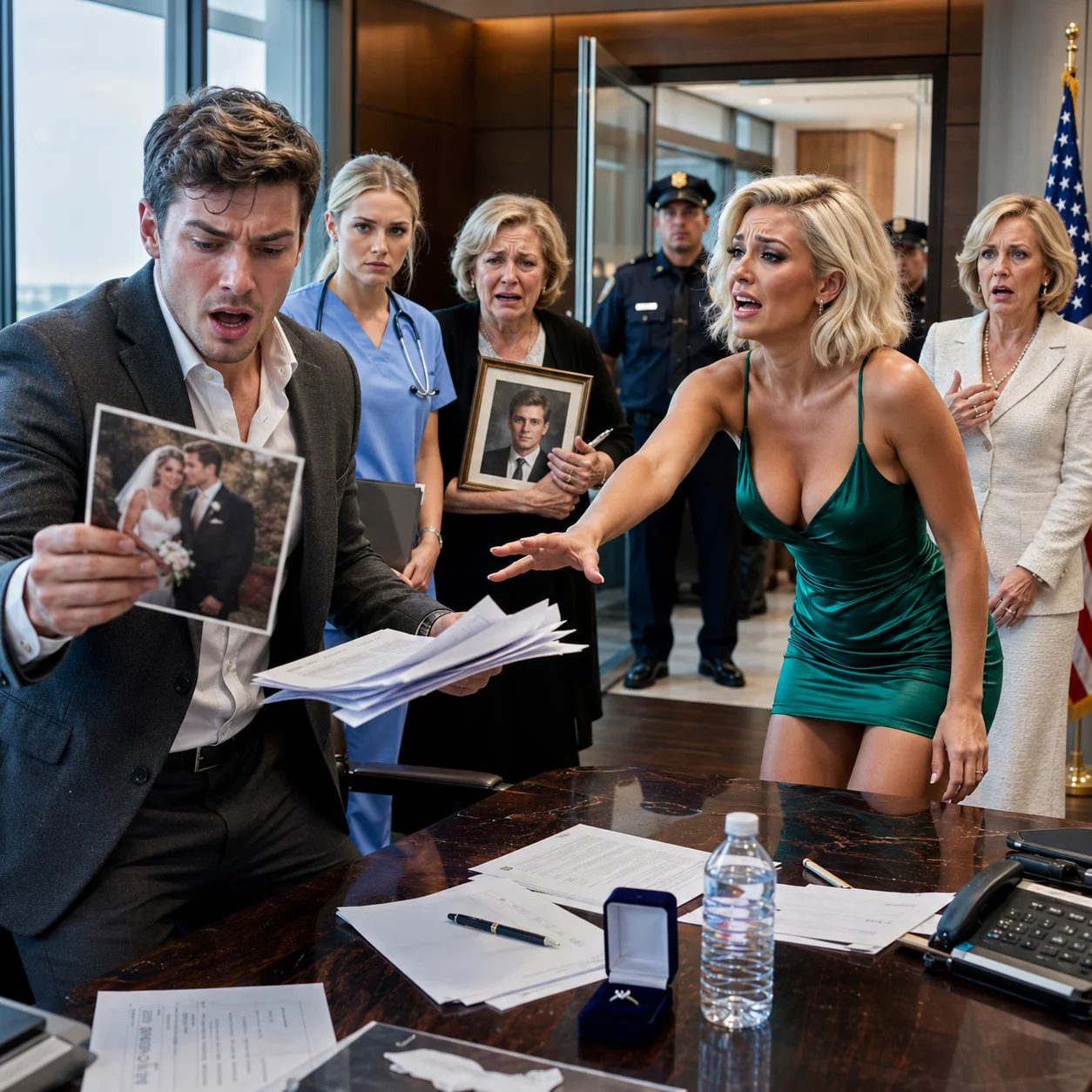
The room seemed to tilt.
“What are you talking about?”
Gabriela took a thin folder from her bag and placed it between us.
“I’m saying you are not her first fiancé.”
I did not want to touch the folder.
She opened it anyway.
Inside were copies of documents, photographs, screenshots, newspaper clippings, and handwritten notes. Three men. Three planned weddings. Two legal marriages. One suspicious accident. One property sold. One family that lost nearly everything.
My throat went dry.
“No,” I said, because it was the only word my mind could form.
Gabriela looked at me with exhausted pity.
“My brother was the second.”
The café noise faded.
“Your brother?”
“Tomás Ruiz,” she said. “He met her at a singles event in Roma. She was sweet. Calm. Attentive. She wanted premarital medical exams before the wedding too. She won over my parents. She accepted money from his family for ‘shared expenses.’ They married within six months.”
Her jaw tightened.
“Eight months later, Tomás was dead.”
My hands went numb.
“How?”
“Road accident. They were coming back from Puebla. She survived with a scratch. He was thrown from the car because of an alleged seatbelt failure.” Gabriela’s eyes hardened. “Three weeks before that accident, he had signed a life insurance policy and given her power to manage his apartment in case anything happened.”
I leaned back as if distance could make the facts less real.
“What did the police say?”
“That it was an accident.”
“But you didn’t believe that.”
“My family never believed it. But we had no money, no connections, and no proof strong enough to fight. After the funeral, she disappeared.”
“Why didn’t you report her?”
“We did. But her names change. Her papers change. Witnesses disappear. And she always has help.”
“Who helps her?”
Gabriela looked toward the window.
“Her mother.”
Cecilia.
I remembered Valeria’s mother with painful clarity. Cecilia Sandoval, elegant, soft-spoken, always carrying a rosary in her purse. She cried when I asked for her blessing to marry her daughter. She called my parents consuegros after one dinner. She hugged my mother in Puebla and said our families had been brought together by God.
She also asked too many questions about my parents’ house.
Was it in my father’s name?
Would it eventually be mine?
Had they considered giving us property as a wedding gift?
At the time, I thought she was just practical.
Now, a cold line ran down my spine.
“What do they want from me?” I asked.
“I don’t know everything,” Gabriela said. “But yesterday, when I checked the forms, I saw that she requested complete copies of your medical results, your blood type, your signature, and your family data. That is not normal for a basic premarital certificate.”
“She filled out the forms,” I whispered.
“I know. And she added an authorization to send results to a third party.”
“What third party?”
Gabriela pulled out another sheet.
A notary office in Polanco.
The same notary where Valeria had told me we would sign our prenuptial papers on Saturday.
“To protect what we’re building,” she had said.
My stomach turned.
“I was supposed to sign there this weekend.”
Gabriela closed her eyes for a moment.
“Then I wasn’t too late.”
I wanted to stand up, run to Valeria, throw the photo on the table, demand the truth. I wanted her to cry and explain it away. I wanted some impossible answer that would give me back the woman I thought I loved.
Gabriela reached across the table and gripped my wrist.
“Do not confront her without proof.”
“I can’t pretend.”
“Yes, you can.”
“No, I can’t.”
“If you confront her today, she will cry. She will say I’m crazy. She will say the photo is fake. She will say she has a twin sister, or an abusive past, or that someone stole her identity. She will give you a story so beautiful you will want to believe it.”
I hated her for saying that.
Because she was right.
A part of me was already searching for excuses. Maybe Paola was a relative. Maybe Gabriela was bitter. Maybe Valeria had survived something terrible and changed her name for safety. Maybe the woman I loved was real.
The heart becomes stupid when it is terrified of losing the future it invented.
“There’s something else,” Gabriela said.
“What?”
“My brother left a recording. My mother kept it hidden because she was afraid. In it, Tomás says that if anything happens to him, Paola and Cecilia are pressuring him to change beneficiaries.”
I covered my face.
“God.”
“My mother can meet you tomorrow.”
That afternoon, Valeria came to my apartment with food.
She brought tortilla soup, jamaica water, and the smile that used to make me imagine Sunday mornings, children, anniversaries, a calm life.
“I brought you something good,” she said. “You looked strange yesterday.”
I let her in.
Every step she took across my floor sounded like a lie.
She kissed my cheek.
I did not pull away.
I hated myself for that.
She sat across from me and talked about wedding invitations, flower arrangements, the salon in Puebla, and how her mother wanted to review the guest list again. Then she said something that made my blood slow.
“Your parents should transfer the venue deposit before Friday.”
“My parents?” I asked.
“Yes, love. It’s better to secure the date before someone else takes it.”
“How much?”
“Two hundred thousand.”
She said it casually, as if asking for sugar.
“My father can transfer it directly to the venue,” I said.
Valeria smiled.
“Better to send it to my mom. She already has contact with the provider.”
There it was.
Not a wedding plan.
A funnel.
A system dressed in flowers and lace.
“Sure,” I said. “I’ll tell him tomorrow.”
Her shoulders relaxed.
“You’re the best.”
That night, while she showered, I searched her purse.
I am not proud of it.
But survival rarely feels noble while it is happening.
Inside, I found a small key, printing shop receipts, two SIM cards, and an old identification card cut in half. Only part of the name remained visible.
Méndez.
I photographed everything and put it all back exactly as I found it.
The next day, I told Valeria I was going to Puebla to see my parents. In reality, Gabriela took me to a small house in Iztapalapa where her mother, Doña Aurora, lived.
Doña Aurora opened the door with tired eyes and the kind of grief that never leaves the face completely. On the wall behind her was a framed photograph of Tomás. He was young, smiling, wearing a blue shirt.
He did not look like me physically.
But I recognized something in his expression.
Trust.
That hurt more than resemblance.
Doña Aurora served café de olla and placed an old recorder on the table.
“My son was good,” she said. “That woman taught him to distrust his own mother.”
She pressed play.
Tomás’s voice filled the kitchen.
“Ma, if something happens to me, don’t believe it was an accident. Paola and her mother want me to sign insurance papers. They say it’s normal. They say if I don’t trust her, then I don’t love her. I don’t know what to think anymore.”
My body went cold.
Valeria had said almost the same words to me one week earlier.
“If you don’t trust me, how are we supposed to build a marriage?”
Doña Aurora cried silently.
“I couldn’t stop her,” she whispered. “But you still can.”
I made a promise I was not sure I knew how to keep.
“I’ll stop her.”
The hardest part was not canceling the wedding immediately.
The hardest part was pretending.
For two weeks, I played the role of a man still in love.
I smiled through cake tastings. I answered messages about flowers. I let Valeria hold my hand in front of people. I let Cecilia call me son. I let my mother keep asking whether Valeria preferred gold or pearl earrings for the wedding gift.
And all the while, I collected proof.
Gabriela helped me.
Doña Aurora agreed to give a formal statement.
My lawyer, Licenciado Arriaga, reviewed the notary documents and found the trap buried where no excited groom would think to look. The prenuptial agreement included an annex I had never seen. In that annex, I would authorize Valeria to manage a joint account, modify certain insurance beneficiaries, and act on my behalf regarding a property my parents planned to put in my name as a wedding gift.
Arriaga removed his glasses after reading it.
“This is not love,” he said. “This is hunting.”
Telling my parents was one of the most painful moments of my life.
My mother stood in the kitchen in Puebla, surrounded by pots of mole, dried chiles, and Talavera plates she had bought for the wedding. When I showed her the photo, she sank into a chair.
“That girl called me Mom,” she whispered.
My father looked at the documents in silence.
Then he folded his napkin slowly and said, “The fifty thousand pesos?”
“Probably gone,” I said. “But that money may help prove the pattern.”
My mother covered her mouth.
“I gave it with love.”
“I know,” I said.
And that was the cruelest part.
People like Valeria did not steal only money.
They stole the meaning behind it.
The day of the signing arrived.
Valeria entered the notary office in Polanco wearing a simple white dress, her hair pinned softly at the back of her neck, her perfume light and floral. She looked innocent. Elegant. Almost sacred.
Cecilia came behind her, dressed in cream, smiling like a woman attending the first page of a beautiful family story.
She kissed my cheek.
“Today, you begin building your future,” she said.
I thought of Tomás.
I thought of the recording.
I thought of Gabriela whispering, End it with her right now.
“Yes,” I said. “Today begins something.”
The conference room had a long wooden table, bottled water, leather chairs, and too much calm. The notary placed the documents in front of me. Valeria sat beside me and took my hand.
“Sign, love,” she said softly.
I looked at the pen.
I wondered how many men had sat where I was sitting, facing that same kind of moment.
A beautiful woman beside them.
A smiling mother nearby.
A document full of traps.
A sentence designed to shame them into obedience.
If you trust me, sign.
I picked up the pen.
Valeria smiled.
Cecilia smiled too.
Then I set the pen back on the table.
“Before I sign anything,” I said, “I want someone to read something.”
Valeria blinked.
“What do you mean?”
The door opened.
My lawyer walked in first.
Behind him came Gabriela Ruiz.
Behind Gabriela came Doña Aurora, holding Tomás’s photograph against her chest.
Valeria’s face emptied.
Not with confusion.
With calculation.
Cecilia reacted first.
“What is this?” she demanded.
Arriaga placed a folder on the table.
“This means my client will not be signing documents obtained through deception.”
Valeria turned to me with instant tears in her eyes.
She was fast.
So fast.
“Love, what is happening?”
I reached into my jacket and removed the folded photograph.
I laid it in front of her.
“You tell me, Paola.”
The silence became so thick I could hear the air conditioner humming.
Cecilia gripped her purse.
Valeria looked at the photo, then at me.
“You don’t know what you think you know.”
Gabriela stepped forward.
“I do.”
Valeria recognized her.
I saw it in her eyes.
For the first time since I had met her, the mask cracked completely.
“You,” Valeria whispered.
Doña Aurora lifted the picture of her son.
“Tomás wanted to get married too.”
Valeria closed her eyes.
Cecilia spoke quickly. “This is defamation. We are leaving.”
“No,” Arriaga said. “Investigators are outside. A report has been filed for fraud, identity falsification, document manipulation, and possible connection to the suspicious death of Tomás Ruiz.”
Valeria stood so fast her chair scraped the floor.
“I didn’t kill anyone.”
That was the first thing she said.
Not, I am not Paola.
Not, that photo is fake.
Not, I don’t know Tomás.
I didn’t kill anyone.
My heart finished breaking at that exact moment.
“But you knew him,” I said.
She looked at me.
“I had another life.”
“How many?”
She did not answer.
Cecilia tried to walk toward the door, but it opened from the outside. Two investigators entered. The room exploded into voices. Cecilia shouted that she knew lawyers. Valeria cried my name. The notary asked everyone to remain calm. Gabriela stood perfectly still, pale and shaking, as if she was watching a door finally close after years of being trapped in the same nightmare.
Before they took Valeria out, she grabbed my arm.
“I did love you,” she whispered.
For one weak second, I wanted to believe her.
I wanted the hospital, the photo, the folder, the recording, the documents — all of it — to vanish. I wanted to go back to the restaurant by the lake, to the moment when she cried over the ring and I thought those tears meant joy.
But then I looked at her hand on my sleeve.
I wondered how many men had mistaken that grip for love.
“No,” I said quietly. “You studied how to be loved.”
That hurt her more than an insult.
I saw it land.
Then she was gone.
There was no wedding.
There were statements, police interviews, canceled vendors, embarrassed phone calls, family meetings, bank disputes, fake receipts, cloned documents, old identities, and an investigation that grew far beyond anything I expected.
Other men appeared.
One in Querétaro.
Another in Toluca.
A family in Morelos that had lost a house and never understood how everything had slipped away so legally, so cleanly, so politely.
Valeria was not some movie monster with a knife in the dark.
She was worse in the way real people can be worse.
She knew how to find loneliness.
She knew how to become the answer to it.
She could look at an ordinary man and sense exactly what he wanted most — calm, loyalty, admiration, family, tenderness — and then shape herself into that dream until he handed her the keys to his life.
Cecilia was the architect.
Valeria was the beautiful door.
It took months before I stopped missing someone who had never existed.
That was the part nobody warned me about.
People think betrayal turns love into hate overnight. It does not. Sometimes you wake up missing the same voice that lied to you. Sometimes you remember the way she knew how you liked your coffee and have to remind yourself that observation is not intimacy. Sometimes you miss the dimples, the soft questions, the hand on your arm, and then you hate yourself for grieving a performance.
But grief is not proof that the lie was real.
It is proof that your heart was.
Gabriela returned to work at the hospital. Doña Aurora gave her statement and, for the first time in years, stopped blaming herself for not saving Tomás. My parents recovered part of the money they had given Valeria, though my mother told me the most expensive thing she lost was not the fifty thousand pesos.
“It was the ease of trusting a smile,” she said.
I kept the folded photograph.
Not because I loved Valeria.
Because I needed a vaccine.
One year later, I walked through Roma again, past the same hotel where I had met her. Warm lights glowed inside. Music drifted through the doors. People were arriving for another singles event, laughing nervously, adjusting their clothes, hoping maybe tonight would be the night their life changed.
I stood on the sidewalk for a while.
Not afraid.
Just respectful of the man I had been.
That man wanted to love someone.
That was not a crime.
His mistake was believing that calm always meant peace.
Sometimes calm means practice.
Now, when people ask why I canceled my wedding two months before the ceremony, I do not give them every detail. I do not explain Paola, Mariana, Cecilia, Tomás, the annex, the fake vendor, the hidden authorization, the insurance pressure, or the photograph.
I simply say a nurse saved my life with one sentence.
And that is the truth.
Gabriela Ruiz did not give me a medical diagnosis that day.
She gave me an exit.
She slipped proof into my pocket while my eyes were still closed.
Because of her, I did not sign.
I did not lose my parents’ house.
I did not marry a woman who collected names like keys.
I did not become another photograph taped to the kitchen wall of a grieving mother.
The day of my premarital medical exam, I thought I was checking my health before marriage.
In reality, I was receiving the most important test of my life.
It did not appear in my bloodwork.
It did not appear on a certificate.
It came from the trembling voice of a nurse brave enough to lean close and whisper:
“End it with her right now.”
And although obeying her felt like tearing my own heart out with both hands, I did it.
Sometimes saving yourself does not feel like victory at first.
Sometimes it feels like sitting alone in a hospital waiting room, a folded photo burning in your pocket, watching the future you planned dissolve before it ever begins.
But then time passes.
You breathe again.
You walk through streets where your life once broke open.
And eventually, you understand.
Losing a wedding is not the same as losing your life.
Sometimes losing the wedding is how you get your life back before you sign it away.

![[FULL STORY] She spent $18,000 of my money while refusing to feed my daughter, then learned that my bank account isn't her problem either.](https://social-media.rabedo.com/thumbnails/1777023557_C3.png)
![[FULL STORY] My Wife Said She Needed “Girls’ Nights” Every Weekend — So I Followed Her and Found Her Ex Waiting at a Hotel](https://social-media.rabedo.com/thumbnails/1776420749_5bb60e6f-4512-40e7-8148-47d3036df143.png)