“Mamá,” he whispered, “don’t scream.”
“My love, it’s me. I’m here. I’m here now.”
He shook his head, trembling so hard his teeth clicked together.
“They didn’t take me.”
The room went silent.
Javier froze behind me.
“What?” he said.
Mateo pointed under the bed.
There was a shoebox pushed against the wall.
I reached for it with shaking hands. Inside were candies, a bandage, an old photograph of our house, and a cheap phone.
The phone was old, cracked across the corner, but it still turned on.
There were messages.
Many of them.
All from a contact saved as one letter.
“J.”
Javier snatched the phone from my hand.
He read one message.
Then another.
The blood drained from his face.
“No,” he said, barely above a whisper. “No, no…”
I grabbed the phone back.
The last message read:
“Keep him there until she signs. If the girl keeps watching the window, we’ll take her too.”
My hand went numb.
I looked at Javier.
“Who is J?”
Mateo started crying.
“Mamá,” he whispered, “I heard his voice.”
Javier stopped breathing.
So did I.
The room smelled of bleach, damp wood, and fear. Mateo sat on the floor, his green shirt clinging to his thin shoulders, his eyes locked on his father like he had just watched a monster remove a mask.
“What voice, my love?” I asked, though something inside me already knew.
Mateo hugged his knees to his chest.
“Papá’s.”
Javier gave a dry, ugly laugh.
“He’s confused, Laura. They kept him locked up for a month. He doesn’t know what he’s saying.”
But my son was not looking at Don Ignacio. He was not looking at Doña Elvira.
He was looking at Javier.
“You came at night,” Mateo whispered. “I heard you downstairs. You said Mamá still hadn’t signed.”
Signed.
That word opened a door in my memory.
Three days after Mateo disappeared, Javier had placed papers on our kitchen table. I was barely functioning then. I had not slept. I had not eaten. I could not wash my face without imagining my son lying dead somewhere, cold and alone.
“It’s to protect the house,” Javier had said. “If we need to sell quickly, if we need private investigators, if someone asks for ransom, everything has to be ready.”
I remember picking up the pen.
I remember the weight of it.
Then Lucía started screaming from the hallway.
“Mateo doesn’t want you to!”
She cried so hard I could not sign. She clung to my waist and sobbed like something invisible was tearing her apart.
Javier did not speak to me for two days after that.
Now I understood why.
The house was not his.
It had belonged to my grandmother. A small Puebla house with a blue facade, a brick patio, clay flowerpots, and broken Talavera tiles around the old fountain. It was not luxurious, but it was ours. Mine. My children’s. A place built from memory and women who survived too much to leave nothing behind.
Javier had always wanted to sell it.
“It’s too small,” he would say.
“It’s old.”
“We’d live better in Lomas de Angelópolis.”
I always said no.
And then my son disappeared.
Javier took one step toward me.
“Laura, listen to me. I had a debt. I never meant for anyone to hurt him.”
I put my body between him and Mateo.
“Don’t come closer.”
“It was temporary!”
Mateo began shaking harder.
“He said if I cried too much, they would take Lucía too.”
Downstairs, Doña Elvira was screaming that she was calling the police. Don Ignacio appeared in the doorway, pale and bent, looking like a man who had run out of lies.
“Javier,” he said weakly, “this has gone too far.”
The sound of that name in his mouth finished breaking whatever was left of me.
Javier turned on him.
“Shut up!”
“You said it would only be a few days,” the old man murmured. “You said you would convince her. You said the boy wouldn’t suffer.”
I looked down at Mateo.
There were marks on his wrists.
Not deep.
Enough.
I picked him up, though he was too big for me to carry easily. But he weighed so much less than he should have. He clung to my neck, and I felt every bone in his back under my hand.
Javier tried to move toward us.
I lifted the phone.
“One more step,” I said, “and I will run into the street screaming that you kidnapped your own son.”
He stopped.
I carried Mateo down the stairs.
Lucía was in the living room with our neighbor Mariana, who must have heard the shouting and run over. My daughter was still holding her red crayon.
When she saw Mateo, she did not scream.
She ran to him.
“I told you I saw you,” she said.
Mateo started crying.
“I saw you too.”
Lucía touched his face carefully, like she was afraid he might disappear.
“I waved slowly so Mamá would believe me.”
He nodded.
“I put my hand on the window when I could.”
Mariana was already calling emergency services.
“They found the boy,” she said, her voice breaking. “Yes, the child from the Amber Alert. He’s in the house across the street.”
Doors began opening up and down the block.
Neighbors stepped outside, one by one, staring at the yellow house as if seeing it for the first time.
Javier tried to leave.
Don Ignacio blocked him with trembling hands.
“Don’t run,” he said. “Enough.”
Javier shoved him.
“You’re going down too.”
Mateo buried his face in my neck.
“Mamá, don’t let them take me.”
“Never again,” I said.
Police cars arrived with red lights flashing against the white gate. An ambulance came behind them. Paramedics wrapped Mateo in a blanket and checked his eyes, his mouth, his wrists, his ribs.
Javier tried to approach with the face of a desperate father.
“I’m his dad. I need to go with him.”
Mateo screamed.
He did not say a word.
He just screamed.
That sound was enough for a police officer to step between them.
“Stay away from the child.”
Javier lifted his hands.
“My wife is in shock. She doesn’t understand. I’m a victim too.”
I held up the old phone.
“Your messages are here.”
His face changed.
The mask fell completely.
He was no longer the broken husband who had held me while I shook. He was no longer the father who had printed posters. He was no longer the man shouting our son’s name in the rain.
He was a cornered man.
At the hospital, Mateo would not let go of my hand.
Doctors diagnosed dehydration, weight loss, severe anxiety, and minor injuries. Each word was a stone laid on my chest.
The child psychologist did not force him to tell everything immediately. She gave him crayons.
Mateo drew a window.
A bed.
A locked door.
And a small girl pointing from across the street.
“Who is she?” the psychologist asked.
“Lucía,” he said. “She saw me.”
Lucía, sitting beside me with her knees tucked under her chin, lifted her chin proudly.
As if someone had finally recognized her job as guardian of the world.
That night, while Mateo slept with the light on, prosecutors took my statement. They spoke with Mariana. With Don Ignacio. With Doña Elvira. They secured the old phone, the shoebox, the bandages, the photograph of our house, and the chain across the stairs.
Javier was arrested before dawn.
First, he denied everything.
Then he said Don Ignacio and Doña Elvira had acted alone.
Then he said it was a “desperate strategy” to save us from a debt.
To save us.
That word made me sick.
I learned the truth in pieces, each one worse than the last.
Javier owed money from gambling, bad loans, and a land deal near Cholula that had collapsed. He had signed documents with people who did not forgive missed payments. He needed cash fast. He needed to sell my house.
But I would not sign.
So he chose to destroy me.
He waited for Mateo after school on a side street. He told him I was in the hospital. He told him to get into the van quickly.
Mateo trusted him.
Because he was his father.
That was the detail that haunted me more than anything else.
There had been no stranger.
No shadow.
No unknown van.
There had been a father using his son’s trust as a key.
They tossed the blue helmet near the curb. They opened the backpack and left the notebooks in the rain. Javier even screamed with me that afternoon.
“Mateo!”
He shouted the name of the child he had hidden.
For thirty-one days, he slept beside me.
He held me when I trembled.
He said, “We’re going to find him.”
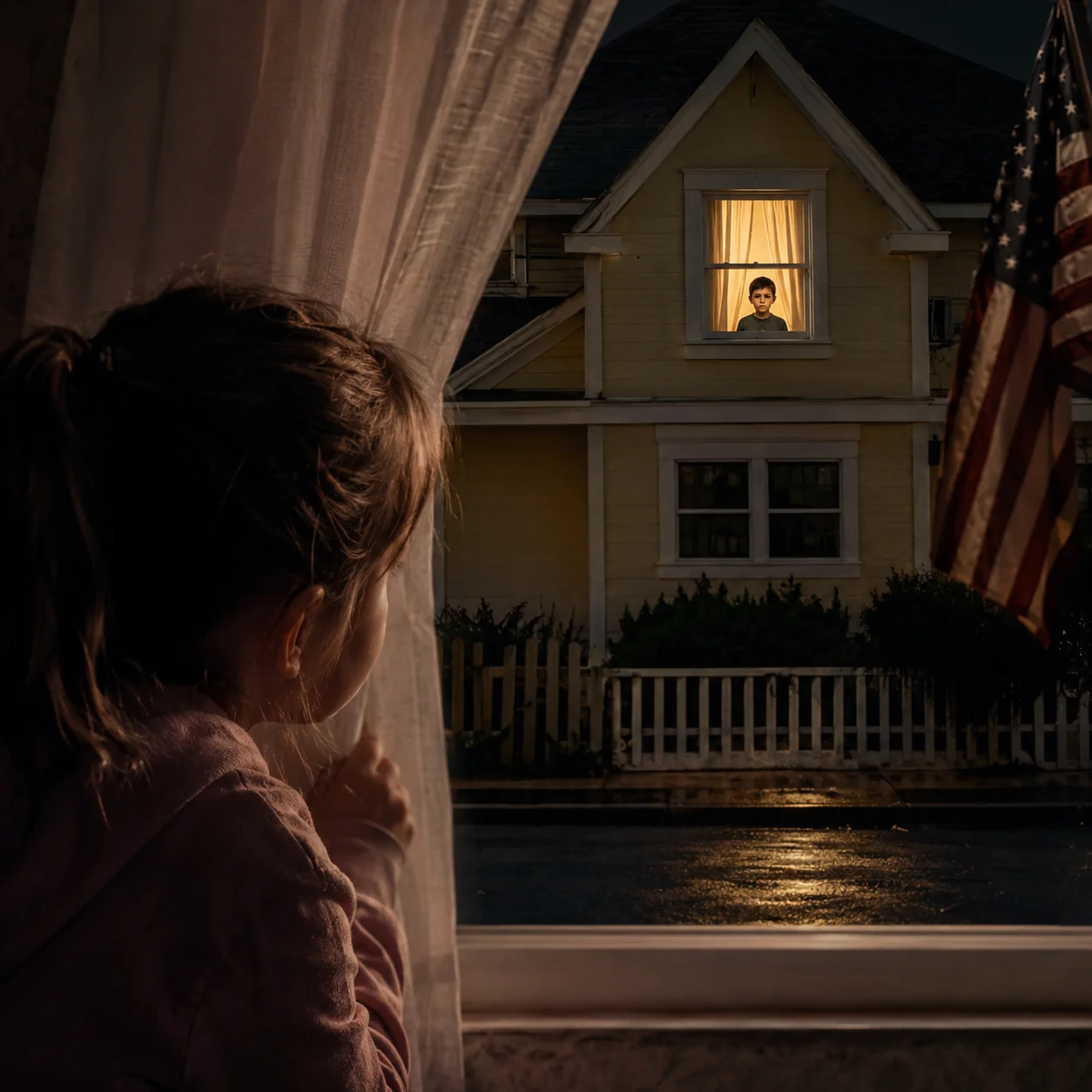
And my son was across the street.
Behind a curtain.
The first week after Mateo came home did not feel like happiness.
It felt like survival.
He would not close the bathroom door. He would not sleep without a light on. He panicked when someone rang the bell. If a van slowed down outside the house, he crawled under the table.
Lucía was not okay either.
She spent hours looking at windows.
“What if there’s another child?” she asked one evening.
I did not know how to answer.
So I sat beside her, and we looked together.
My mother came from Atlixco carrying bags of food: rice, soup, mole, fruit, sweet bread, tortillas wrapped in embroidered napkins.
“Children eat even when the world falls apart,” she said.
She was right.
Mateo ate little bites.
Lucía guarded his plate like someone might steal it.
Javier’s mother came crying one afternoon.
“Laura, let me see Javier,” she pleaded. “He’s your husband.”
I stood in the doorway and looked at her.
“Mateo is my son.”
I did not let her in.
That day, I learned some doors are closed not out of hatred, but out of health.
The legal process was long and ugly.
Javier tried to say I was unstable. That Mateo’s disappearance had made me paranoid. That he had only wanted to protect the family’s assets. His lawyer talked about father’s rights, family unity, reconciliation.
Family.
The word sounded obscene.
The judge allowed Mateo to testify in a protected space. He did not have to face Javier. He spoke with a psychologist present, drawing first the yellow house, then the window, then Lucía with her red crayon.
When they asked who took him, he said, “My dad.”
He did not cry when he said it.
That hurt me more.
As if the tears had already been used up.
During the case, Javier’s parental rights were suspended. Later, after sentencing, they were permanently removed. He was convicted of child abduction, unlawful confinement, family violence, threats, and attempted fraud.
The law named what it could.
But no legal sentence was enough to explain the truth:
A father turned his son into a hostage to take a house from his wife.
Don Ignacio and Doña Elvira were convicted too. The yellow house remained sealed for months, with tape and official papers across the door. Every time I opened my window, I saw that silent facade like a mouth that could no longer lie.
One day, Mateo asked to cross the street.
“I want to see it from outside,” he said.
We went with his psychologist. Lucía slipped her hand into his and came too.
Mateo stood in front of the white gate. He looked up at the second-floor window.
“That’s where I counted the days,” he whispered.
“How?” I asked.
“With little marks on the wall. But Don Ignacio painted over them.”
Lucía pressed her lips together.
“I saw you.”
Mateo looked at her.
“Yes.”
“I saved you.”
He nodded seriously.
“Yes.”
Lucía took a deep breath.
“Then you owe me your fries forever.”
A tiny laugh escaped Mateo.
Small.
Almost invisible.
But it was laughter.
And to me, it sounded like water after a fire.
Months later, we left Puebla.
I sold the house. Not because Javier won, but because my children could not heal while looking every day at the window where their nightmare had taken shape behind a curtain.
It hurt to leave the patio. It hurt to say goodbye to my grandmother’s broken Talavera tiles, the clay pots, the old fountain, the blue facade that had seen generations of women survive.
But a house also knows when it can no longer protect you.
We moved to Cholula, into a smaller place with bougainvillea, a little patio, and a distant view of the hill where the church seems to float when the sky is clear. On Sundays, we bought cemitas. Some afternoons, we went back into Puebla for sweets, but never to our old street.
At first, Mateo walked pressed against my side.
Then one step away.
Then two.
Lucía still looked at windows, but no longer with terror. She said she wanted to be a detective, a psychologist, a police officer, or an ice cream seller, depending on the day.
The blue bicycle stayed locked away.
For almost a year, no one touched it.
Then one afternoon, Mateo rolled it into the patio.
“I want to paint it,” he said.
Fear moved through me before I could stop it.
“What color?”
He thought for a long time.
“Red.”
So we painted it together.
Lucía ended up with more paint on her arms than on the bicycle. Mateo got annoyed. Then he laughed. I sat on the floor with red paint on my hands and cried quietly when they were not looking.
The first time he rode again, we chose a closed street.
I walked beside him.
Lucía shouted instructions like a tiny military commander.
“Brake! Not that fast! Now fast! Watch the rock!”
Mateo pedaled ten meters.
Then he stopped.
He was shaking.
“I can’t.”
I walked toward him.
“Yes, you can,” I said. “But you don’t have to today.”
He looked at the red bicycle.
Then at me.
“Papá told me you would forget me if I took too long to come home.”
Something inside me broke again.
I crouched in front of him.
“Mateo, I would have searched for you my whole life.”
“Even if everyone said I was dead?”
“Even if God Himself came down and told me, I would have asked Him to check again.”
Lucía pushed herself between us.
“And I would have pointed at windows.”
Mateo hugged his sister.
Not from fear this time.
From gratitude.
The years did not erase what happened.
But they rearranged it.
Mateo had nightmares. Lucía was afraid of closed curtains. I had panic attacks every time a van stopped near the house. We went to therapy. We learned new words: trauma, boundaries, repair, safety.
We also learned simple words again.
Bread.
Sun.
Laughter.
Patio.
Home.
Javier wrote letters from prison.
At first, I opened them.
He said he was sorry. He said debt had made him crazy. He said I should think of the children. He said a father was still a father.
Then I stopped opening them.
Not every voice deserves to return to a house.
I kept the letters in a box, not for my heart, but for the legal file.
Mateo never asked to read them.
One day, Lucía asked, “Did Papá love us?”
I took a long time to answer.
I did not want to give her an easy lie.
“He wanted to have us,” I said finally. “That is not the same as loving us well.”
She nodded.
As if she already knew.
When Mateo turned twelve, he asked to go back to Puebla to see his old school.
I was afraid.
But we went.
The gate looked the same. The murals. The little store. The tamale stand on the corner. Children poured out with huge backpacks, shouting, laughing, alive in the careless way children should be.
Mateo stood near the curb where his helmet had been found.
He reached into his backpack and took out a folded paper.
It was a drawing.
The yellow house.
The window.
And a small girl pointing.
At the bottom, he had written:
“My sister saw me when no one else could.”
Lucía, nine years old by then, turned red.
“Oh, Mateo.”
He handed her the drawing.
“It’s yours.”
She hugged him so tightly he almost dropped his bag.
I looked down the street.
For a month, we had searched far away.
Hospitals.
Bus stations.
Empty lots.
Highways.
And my son had been right across the street.
Behind a curtain.
Hidden by quiet people.
Delivered there by the man who should have protected him.
Saved by a little girl I almost did not believe.
Today, Mateo is fifteen.
He rides a red bicycle through Cholula, always wearing his helmet even though he says it embarrasses him. Lucía still notices windows, but now she says that only means she is observant.
And I am still their mother.
Harder now.
More suspicious.
But also more awake.
I no longer ignore a feeling in my gut. I no longer let anyone call instinct exaggeration. I no longer teach my children that politeness matters more than truth.
Sometimes I still dream about the yellow house.
In the dream, I am standing in the rain. I see the curtain move. I see a small hand against the glass.
But this time, I do not wait a month.
This time, I cross the street in the first second.
I wake up sweating.
I go to Mateo’s room and watch him sleep. Then I go to Lucía’s room, where she is sprawled across her bed with one leg outside the blanket, her mouth open, the absolute owner of her world.
Then I breathe.
My son was missing for thirty-one days.
I thought my daughter’s words were only the grief of a child.
They were not.
They were love looking in the place where adults had lost the strength to look.
And because of that love, Mateo came home.
![[FULL STORY] My Husband Called Me Replaceable — So I Let Him Try Living Without Me](https://social-media.rabedo.com/thumbnails/1777455568_3715b409-724e-423e-9faf-3a87e2ab301e.png)
![[FULL STORY] At a Family Gathering, She Announced: 'My Ex Will Always Be in My Life, Accept It or Don’t Marry](https://social-media.rabedo.com/thumbnails/1777307810_M5.png)
![[FULL STORY] Before Going to a Show with Her Pals, I Heard My Girlfriend Giggle and Say: 'I Got a Full Body](https://social-media.rabedo.com/thumbnails/1777021211_T5.png)