
“Study, Luis,” he would tell me. “Get out of this life. I am not going to be here forever.”
When I was accepted into UNAM, he held the letter like it was holy.
He read it even though he stumbled through some of the words. Then he hugged me so hard my ribs hurt.
“My son,” he whispered. “My son is going to the university.”
I laughed. “I haven’t graduated yet.”
“To me, you already did.”
He went with me to Mexico City when I moved. He carried my bags like they weighed nothing, even though one was full of books and the other had everything we could afford to send with me.
At the bus station, before leaving me there, he pressed both hands on my shoulders.
“Listen to me,” he said. “There will be people who speak better than you, dress better than you, and act like they were born knowing things. Don’t shrink. You earned your place.”
I nodded, but my throat was too tight to answer.
He gave me a plastic bag with food for the road, some money folded into a napkin, and a small photograph of my mother.
Then he turned away quickly.
I think he did not want me to see him cry.
I promised myself that day that one day I would pay him back for everything.
I studied like hunger was chasing me.
In a way, it was.
I worked nights. I tutored classmates. I ate cheap food. I slept little. I watched students from wealthy families complain about things I would have considered miracles. But whenever I felt tired, I remembered Don Ramón’s arm with cotton taped over the vein.
I remembered his voice.
A student needs a good back.
I graduated.
I got a job.
Then a better one.
Then another.
By my early thirties, I was working for a technology company in Santa Fe, sitting inside a glass office on the thirty-fourth floor, looking down at buildings that glittered like another country.
I earned more than one hundred thousand pesos a month.
I had a beautiful apartment.
A new car.
An expensive watch.
Shirts that did not come from discount bins.
Shoes that had never known mud.
People called me successful.
But every time I visited Veracruz, Don Ramón was still in the same rented room.
Same old shirts.
Same repaired shoes.
Same fan that sounded like it was dying in installments.
I tried to give him money.
He refused.
“Keep your money,” he would say.
“Papá, please.”
He always smiled when I called him that, but there was something behind his eyes I never understood then.
“A father does not charge his son for what he did out of love.”
“But you need things.”
“I need you to live well. That is enough.”
I bought him clothes. He wore them only when I visited.
I offered to rent him a better place. He told me he liked hearing the river.
I offered to hire someone to help him. He said he still had two hands.
He was stubborn in a way that made generosity feel like an insult if it was not offered carefully.
So I stopped pushing.
That is one of my greatest regrets.
I mistook his pride for strength.
I did not see how much his body was failing until someone else told me.
Three months before the day he came to my apartment, my phone rang while I was in the office.
It was Doña Chayo, his neighbor.
She had known me since I was small. She used to bring soup when Don Ramón worked late and I was too young to cook without burning something.
“Luisito,” she said, and the way she used my childhood name made me sit up straight. “Your father is not well.”
My father.
She had always called him that.
I had never corrected her.
“What happened?”
She sighed. “He does not want you to know. He says you have important things to do in the capital.”
I looked around my office.
Glass walls. Smooth desk. Computer screens. A coffee machine humming in the corner. My expensive watch catching the light.
Suddenly, all of it felt obscene.
“What happened?” I repeated.
“He is fading, mijo.”
That same night, I drove to Veracruz without telling him.
I did not go to his door.
I watched him from a distance.
I saw him walk along the malecón with slow steps, stopping now and then to look at the sea as if he were counting the waves he had left. I saw him enter the market, greet the fish sellers, buy two pieces of bread, and ask for credit on a coffee he barely drank.
The man at the stall leaned toward him.
“Ramón, tell the boy.”
Don Ramón smiled weakly.
“My son made it out. I’m not dragging him back into the mud.”
I bit the inside of my cheek until I tasted blood.
The next morning, I spoke to the doctor.
The surgery cost two hundred thousand pesos. But that was only the beginning. He needed tests, medication, transportation, recovery care, and someone to make sure he did not try to go back to work three days later out of stubbornness.
When the doctor told him about the recovery process, Don Ramón only asked one question.
“After that, can I still sell candies?”
I left the clinic and sat in my car for almost an hour.
Then I made calls.
I paid for everything directly.
No cash.
No envelope.
No chance for him to refuse and call it charity.
Surgery. Hospital stay. Medication. Lab work. Transportation. Follow-up appointments. Recovery nurse.
All of it.
Then I bought a small house in Boca del Río.
Not a mansion.
Don Ramón would have hated a mansion.
It was a clean, simple house with white walls, a blue door, good ventilation, a small patio, and a window from which you could hear the sea when the wind was generous. There was a real bed, a dry bathroom, a kitchen without mold, a rocking chair for the afternoons, and a young lemon tree in the yard that had not yet given fruit.
I put the deed in his name.
Ramón Hernández.
Not mine.
Not borrowed.
His.
Then I waited.
Because I knew him.
If I arrived with papers and told him I had paid for everything, he would fight me. He would say no. He would accuse me of wasting money. He would rather suffer than feel like a burden.
So I needed him to ask.
I needed him to bring me the problem.
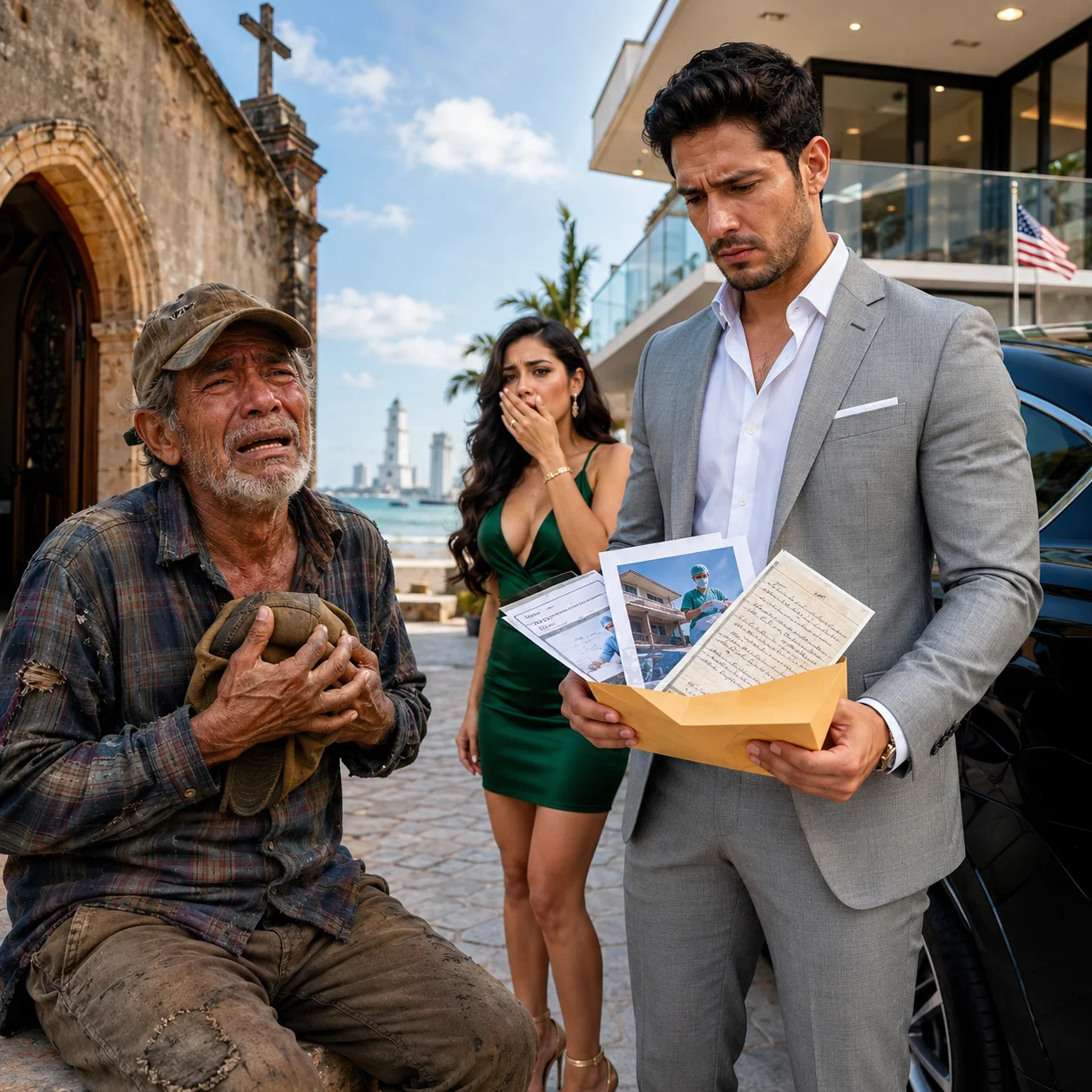
And when he finally did, he arrived at my apartment wearing his best old shirt, the one with the collar that never sat right anymore. His hands trembled when he held the coffee my wife brought him.
He sat on the edge of the sofa.
“Hijo,” he said quietly. “I need to ask you something.”
My chest tightened.
“Tell me, Papá.”
He looked down.
“The doctor says I need surgery. It costs around two hundred thousand pesos.” He swallowed hard. “I know it is a lot. I am asking for a loan. I will pay you little by little. Even if I have to sell candies.”
I looked at him.
This man had given his blood for me.
This man had eaten beans so I could carry new books.
This man had never told me no.
And I took a deep breath and said the cruelest sentence of my life.
“No. I can’t. I won’t give you a single cent.”
His eyes filled with tears.
But he did not argue.
That was Don Ramón.
He would defend me against the world, but he would not defend himself against humiliation.
He only nodded.
“I understand, son. Forgive me for bothering you.”
When he walked out, something inside me wanted to run after him, fall at his feet, and tell him everything.
But I did not.
Not yet.
Because a trembling envelope was burning inside my jacket.
The letter from my mother had arrived two weeks earlier through Doña Chayo. She had found it inside an old tin box while helping clean Don Ramón’s room after one of his bad episodes.
It was sealed, yellowed, and addressed to me.
At first, I thought it was just a letter from a dying mother to her son.
Then I read the first line.
“Ramón did not take you in out of pity. He took you in because you were also his son.”
I could not breathe.
I read the rest in fragments because every sentence seemed to rearrange my life.
My mother wrote that the man whose last name I carried had not been my real father. He had been a promise. A mistake. A roof she believed she needed. Her own father had warned her that Ramón was too poor, too unstable, too rough around the edges to give a child a future.
She had been young.
Afraid.
Proud.
She had chosen the other man because he had cleaner shoes, steadier work, and a family that looked respectable from the outside.
But he left.
And Ramón stayed.
When she became ill, she confessed the truth to him.
She asked him not to tell me.
“Do not confuse him,” she wrote. “If I die, care for him. But do not charge him the truth.”
So Ramón did exactly that.
He became my father without demanding the title.
He gave me everything without asking for my name in return.
He let me call him stepfather because he believed fatherhood was not something he needed to win in court or shout in a room. He proved it in school uniforms, warm meals, repaired shoes, and blood sold for tuition.
Outside the chapel, I watched him wipe his face with his sleeve and put his cap back on, as if adjusting the cap could restore his dignity.
He started walking toward the bus stop.
I got out of the car.
“Don Ramón.”
He stopped.
When he saw me, he tried to smile.
“Don’t worry, son. I understand. Really. I should not have put you in that position.”
That broke me.
He was still apologizing.
He was the one who had given everything, and still he apologized for needing help.
“Come with me,” I said.
“No, Luis. It is fine. I will figure something out.”
“Papá,” I said.
The word came out different this time.
Not as habit.
As discovery.
Don Ramón froze.
“What did you say?”
My eyes blurred.
“I said Papá.”
He looked confused. “You have always called me that.”
“Not like this.”
His face changed.
The little chapel stood behind us, smelling of candle wax, old flowers, and sea air. Don Ramón pressed his cap against his chest.
“You read the letter,” he whispered.
I nodded.
He closed his eyes.
“Your mother did not want you to know.”
“Why?”
He took a long time to answer.
“Because when you were born, I had nothing. No clean name, no house, no steady job. Your grandfather told her that if she stayed with me, she would condemn you to poverty. She got scared. Then that other man came along and promised marriage, stability, a roof.”
“And he left.”
Don Ramón smiled sadly.
“Yes. His stability lasted less than a payday.”
“Did you know I was yours?”
“From the moment I saw you.”
His voice broke.
“You had the same crooked fingers as my mother. And when you cried, you made the same ugly face I make when I try not to cry.”
I laughed once, but it came out like pain.
“She denied it at first,” he continued. “Later, when she became sick, she told me. She begged me not to confuse you. She said, ‘Ramón, if I die, take care of him. But do not charge him the truth.’”
My chest split open.
“So that is why you never said anything?”
“You had already lost too much.”
“I lost my father while thinking he was just a kind stranger.”
Don Ramón covered his mouth with one shaking hand.
“Forgive me, son.”
I hugged him.
At first, he went stiff, like a man who did not know whether he had permission to receive love.
Then he clung to me with old, desperate strength.
He smelled of clean sweat, ointment, sun-dried cotton, and every tired evening of my childhood when he still asked me if I had homework before asking himself if he had strength left.
“I do not forgive you,” I whispered.
He pulled back, frightened.
“Not yet,” I said. “First, you have to let me take care of you.”
His brow furrowed.
“I do not want to be a burden.”
“I was a burden. You carried me without complaint.”
“You were a child.”
“And you are my father.”
His knees almost gave out.
I held him up.
Then I helped him into my car.
He asked three times where we were going.
I only said, “To pay a debt.”
First, we went to the hospital.
When we arrived, the receptionist already had his file ready.
“Señor Ramón Hernández,” she said, “your surgery is scheduled for Monday. It has already been covered. We just need to confirm these details.”
Don Ramón turned to me.
“What is this?”
“Your operation.”
“Luis…”
“It is not money,” I said. “It is a medical order. So technically, I did not give you a single cent.”
He tried to be angry.
He failed.
His eyes filled again.
“I was going to sell candies.”
“You can sell lemons from your patio if you want,” I said. “But only after you recover.”
“What patio?”
I took a breath.
“There is one more stop.”
We drove to Boca del Río as the afternoon sun lowered over the streets, touching seafood restaurants, hotels, palm trees, sidewalks, and people carrying bags of bread. Don Ramón looked out the window as if he could not understand why the world still looked beautiful on a day so large.
Then we arrived.
White facade.
Blue door.
Small new sign beside the bell.
Ramón Hernández.
He read his name.
Then he looked at me.
“No.”
“Yes.”
“No, Luis.”
“It is done.”
“A house is not a small thing.”
“Neither was your blood.”
I handed him the deed.
He held the papers but did not open them.
“Son, I cannot accept this.”
“Then accept it for me,” I said. “Because for years I thought I could repay you with achievements. With UNAM. With my degree. With my salary. With my office in Santa Fe. But none of that gave back the nights you ate beans so I could have books. None of that gave back the blood you sold.”
Don Ramón cried silently.
“I did not sell blood so you would owe me.”
“And I did not buy this house to repay you. I bought it so you could rest.”
We stepped inside.
The house smelled of fresh paint and sea air.
In the kitchen there was coffee, rice, beans, bread, medicine arranged neatly, and a pitcher of cold water. In the bedroom, on the bed, there was a new white shirt, a cap, and a framed photograph of the two of us.
It was from my graduation at Ciudad Universitaria.
I was wearing my gown.
Don Ramón stood beside me in a borrowed shirt, looking at the murals of the Central Library as if the stone itself had graduated too.
In the photo, he was not smiling at the camera.
He was looking at me.
Like a father.
Like always.
“I thought you lost this,” he said.
“Never.”
He sat on the bed and touched the frame.
“That day, I did not eat until night.”
“Why?”
He chuckled softly.
“Because I spent my breakfast money getting your shoes shined.”
I covered my face.
“Papá…”
“Do not call me that if you are going to cry every time.”
“Then I am going to cry a lot.”
The surgery was on Monday.
I stayed at the hospital.
Not as an important man.
Not as a successful executive.
As a son.
My wife came too. She brought Don Ramón a light blanket, water, magazines he never read, and a small bag of volovanes because she said no man from Veracruz should face surgery with a sad stomach.
Before they took him into the operating room, Don Ramón held my hand.
“If I do not come out…”
“You will.”
“Let me speak.”
I clenched my jaw.
“If I do not come out, do not carry guilt. I lived long enough to see you become a man.”
I leaned closer.
“No. You lived long enough to see me become a son. Now you still need to see me become a good one.”
He smiled.
“You already were. Just expensive.”
The operation lasted hours.
I walked the hallway until my legs ached. I thought of the river near our room, the smell of fish, the cold northern winds, Don Ramón putting plastic bags over my shoes so I would not arrive at school soaked. I thought of my glass office in Santa Fe and all the times I said, “I do not have time,” while he said, “Do not worry.”
When the doctor finally came out, I stood too fast.
“It went well,” he said.
I sat down on the floor.
Not gracefully.
My legs simply stopped belonging to me.
Don Ramón woke the next day.
The first thing he asked was, “How much do I owe?”
My wife laughed through tears.
I took his hand.
“Nothing. But there is interest.”
He looked alarmed.
“What interest?”
“You have to stay in your new house for at least three months while you recover. You have to eat properly. You have to let a nurse visit. And you have to tell me everything you never told me.”
He closed his eyes.
“That last part will hurt.”
“I know.”
“It will hurt you too.”
“I know that too.”
The months that followed were the hardest and most beautiful of my life.
Don Ramón learned to walk slowly through the patio. At first, he hated the cane. Then he named it Evaristo.
“This is Evaristo,” he would say. “He gets in the way, but he helps.”
My wife made him fish soup, rice, and coffee with milk in a tall glass. He tapped the spoon against the glass like people do at La Parroquia and complained that if it did not make noise, it did not taste right.
In the afternoons, we sat near the window and listened to the sea.
He told me about my mother.
Not like a saint.
Like a woman.
He told me she loved to dance son jarocho at neighborhood parties. That she got angry whenever someone tried to control her. That she once sold her radio to buy medicine for me when I had a fever. That she cried when she chose to hide the truth.
“She loved you,” he said. “But she was afraid of condemning you with me.”
“And you accepted being nobody.”
He shook his head.
“I was not nobody. I was the one who stayed.”
That sentence stayed with me forever.
Months later, we went to the civil registry.
Not to erase my history.
To complete it.
The process was not simple. There were lawyers, old documents, the letter from my mother, witnesses, and tests. Tears are powerful, but they do not replace paperwork. In Mexico, even love needs stamps.
But one day, we walked out with a corrected birth record.
Luis Hernández.
Son of Ramón Hernández.
Don Ramón read the document in silence.
Then he started crying right there in the office.
“Now,” he said, “now I can die in peace.”
“Do not start.”
“I did not say today.”
He lived four more years.
Four years in his little house in Boca del Río.
Four years of afternoons on the malecón, coffee with sweet bread, phone calls where he asked if I had eaten as if I were still a student in Ciudad Universitaria. Four years of introducing him at my office in Santa Fe not as the man who raised me, not as my stepfather, but as my father.
The first time I brought him there, he wore a white guayabera and new shoes.
My coworkers greeted him with respect.
He looked at the windows, the elevators, the screens, the polished desks.
“So all this came from my veins?” he joked.
I hugged him in front of everyone.
“No,” I said. “It came from your love.”
When he died, he was in his bed with the window open and the sound of the sea entering softly.
I was beside him.
So was my wife.
On the table near him were his old cap, the graduation photo, and the document where his name finally appeared as my father.
He opened his eyes one last time.
“Luis.”
“I am here, Papá.”
He smiled.
“You did not give me a single cent.”
I cried and laughed at the same time.
“Not one.”
“Good boy,” he whispered.
Then he left quietly.
Like a man who had collected everything without ever asking to be paid.
I buried him in Veracruz, near my mother.
Not because the story was perfect.
It was not.
There were too many silences, too many fears, too many years stolen by pride and poverty and old decisions. But they deserved to rest near each other after spending so much of life separated by things they never fully controlled.
On his grave, I had these words engraved:
Ramón Hernández. Father by blood, by choice, and by sacrifice.
Today, I still earn well.
Sometimes more than before.
But I no longer look at money the same way.
Every month, part of it goes into a fund for students from Veracruz who cannot pay for courses, enrollment fees, transportation, books, or the small costs that make poor children believe their dreams are too expensive.
I did not make it some elegant foundation with my name on a plaque.
It carries his.
The Ramón Hernández Scholarship.
The first rule is simple.
No one should have to sell their blood so a child can study.
Sometimes I return to Boca del Río and open the little house.
The lemon tree now gives fruit.
The rocking chair still faces the window.
In the kitchen, the tall glass he used for coffee is still there, and sometimes I tap a spoon against it just to hear the sound.
I sit in that house and read my mother’s letter again.
It does not hurt the same way anymore.
Now I understand it the way human things must be understood: crooked, fearful, loving, cowardly, incomplete.
Don Ramón came to me asking for two hundred thousand pesos.
And I told him I would not give him a single cent.
Anyone who heard only that part could call me ungrateful.
Cruel.
A monster.
And maybe, for a few seconds, I was. Because I saw his eyes go dim, and I still let him walk out.
But I followed him.
I watched him cry outside that chapel.
And that day, I stopped being the boy who kept promising he would repay everything someday.
I became the son who finally understood that some debts are not paid by placing money in a trembling hand.
They are paid by arriving before you are asked.
By signing papers quietly.
By caring without humiliating.
By giving shelter, truth, time, dignity, and a name.
My father sold his blood for me.
I could never give it back.
But life allowed me one small mercy.
I made sure his final years were not spent selling candies to survive, but looking at the sea from a house with his own name on the door, knowing the son he raised finally knew who he was.
And whenever someone asks me how much I owed Don Ramón, I always answer the same thing.
Everything.
But not a single cent.
![[FULL STORY] My Stepmother Tried to Break Into My Late Mother’s Warehouse — But She Had No Idea I Was Ready for Her](https://social-media.rabedo.com/thumbnails/1776667648_8acc6d2c-1c91-4edb-bb6d-5d2f9ea52a51.png)
![[FULL STORY] My Girlfriend Shared Secret Photos Of Me To Her "Assessment Group" To Mock My Body, So I Systematically Deleted Her From My Life.](https://social-media.rabedo.com/thumbnails/1777344833_d4.png)