I knew my wife was lying long before she knew I had proof. The strange thing about betrayal is that people think they’re hiding it in secret meetings, deleted messages, and carefully rehearsed excuses. They never realize it starts leaking out through the smallest cracks: an invoice that doesn’t make sense, a story that changes by a few words, a daughter who suddenly looks at her father like he has become the villain in his own family.
My daughter Abigail’s wedding was supposed to be one of the happiest days of my life. I was sixty-one years old, retired, financially secure, and proud beyond words to walk my only child down the aisle. I had imagined that moment for years. I imagined Abigail’s hand resting on my arm, the music swelling, the guests rising, and me somehow keeping myself together long enough to place her hand into the hand of the man she loved.
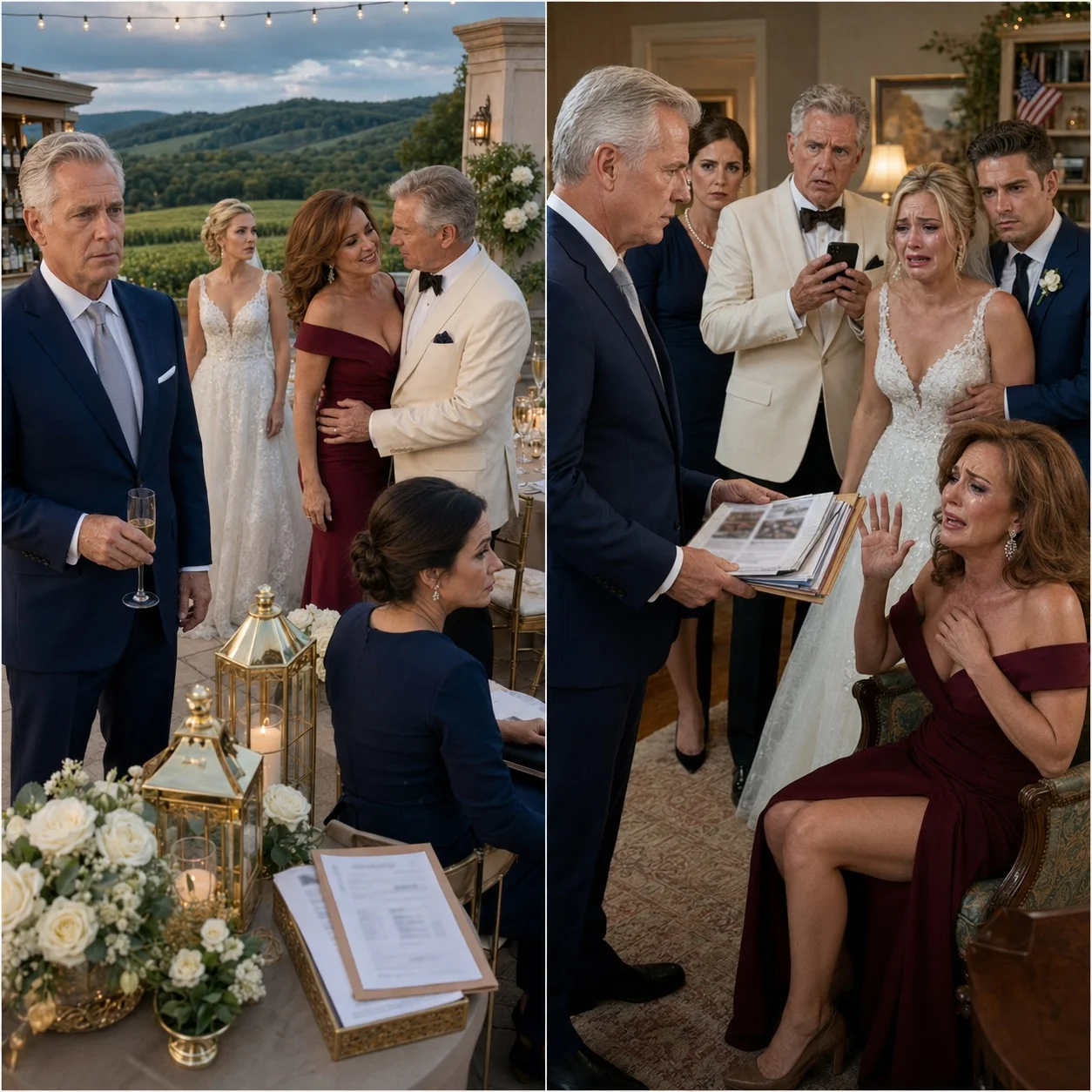
Instead, I spent most of that day watching my wife smile at another man.
His name was Victor Hale.
To everyone else, Victor was simply the charming owner of the vineyard hosting the wedding. He was handsome in that polished, late-middle-aged way that made women at charity luncheons forgive arrogance as confidence. Silver hair, tailored suits, warm handshake, expensive watch. The kind of man who made people feel chosen when he remembered their name. To Abigail, he was the generous businessman who had supposedly given us special discounts and helped make her dream wedding possible.
But I knew something nobody else knew.
Three tables away from the dance floor sat a woman named Nora Cavanaugh. Most guests assumed she was an old friend of mine, maybe a former colleague or distant cousin. She wore a navy dress, drank sparkling water, and blended into the reception with a quiet ease that would have impressed me under different circumstances.
She wasn’t an old friend.
She was the private investigator I had hired six weeks earlier.
And she had spent those six weeks documenting every lie my wife thought she had buried.
The betrayal had not started with a hotel receipt or lipstick on a collar. It started with flowers. More specifically, an invoice for flowers that cost more than my first work truck. Somehow, that made the betrayal feel even uglier, because Marlene had hidden it inside something beautiful.
At first, I told myself I was just being an old engineer who hated waste. Weddings were expensive. Vendors charged ridiculous fees. Maybe “supplemental floral architecture” really was something brides needed now. Maybe I had spent too many years measuring everything by labor, steel, concrete, and practical value.
But when I called Abigail and asked if she had changed the flower plan, her voice went careful in a way that made my chest tighten.
“Mom said you thought the first version looked cheap,” she told me.
I was standing in the kitchen when she said it, one hand on the counter, the invoice open beside a half-empty mug of coffee. I remember staring at the line item while my daughter waited for my answer.
“I never said that,” I told her.
There was a pause. Not a long one, but long enough for me to hear the doubt in it.
“Oh,” Abigail said quietly. “Maybe I misunderstood.”
But she hadn’t misunderstood. I knew my daughter’s voice. I had heard it through scraped knees, school plays, college applications, heartbreaks, and the day she called to tell me she was engaged. That pause was not confusion. It was a young woman trying to decide whether her father was telling the truth or whether her mother had warned her correctly.
A week later, another invoice appeared. Blue Harbor Consulting. Wedding logistics support. Twenty-seven thousand five hundred dollars. Marlene waved it away like I had questioned the weather instead of a charge large enough to buy a car.
“Victor recommended them,” she said, standing at the dining room table with her reading glasses low on her nose. “They handle complex vendor coordination. Please don’t embarrass me by interrogating every detail.”
Victor.
The name had already started appearing too often. Victor said the lighting company was excellent. Victor knew a pianist. Victor had a preferred caterer. Victor had a friend who imported linens. Victor could get us a discount on wine if we finalized early. Victor, Victor, Victor, always delivered in Marlene’s voice with a casualness that felt slightly too rehearsed.
“The wedding planner isn’t handling logistics?” I asked.
Marlene looked at me as if I had tracked mud across a white carpet. “You know Abigail wants everything perfect.”
“I know,” I said. “That’s why I’m asking why we’re paying three people to coordinate one wedding.”
Her expression hardened. “This is exactly what I didn’t want. You turning our daughter’s wedding into a spreadsheet.”
That was Marlene’s favorite weapon after thirty-four years of marriage. She didn’t answer the question. She made the question itself feel cruel.
So I stopped asking in front of her.
Then Abigail came by the house for her grandmother’s pearl bracelet.
The bracelet had belonged to my mother. She was not a fancy woman, my mother. She wore the same winter coat for fifteen years and kept rubber bands in an old coffee tin because “you never know.” But she had owned one truly lovely thing: a delicate bracelet of small pearls with a gold clasp shaped like a rose. She had once told me that if I ever had a daughter, I should give it to her on a day when she needed to remember she came from women who survived more than they said out loud.
Abigail stood in my garage while I searched through the small fireproof box where I kept the things that mattered. I had been sanding a cedar hope chest for her, a wedding gift I had worked on in secret for months. The air smelled like sawdust and varnish, and sunlight fell across the concrete floor in long rectangles.
She took the bracelet gently, running her thumb over the clasp. “It’s beautiful,” she whispered.
“She would have wanted you to have it,” I said.
For a moment, she looked like my little girl again. Then her face changed.
“Dad,” she said, “do you still want to give a speech?”
I turned off the sander completely and stared at her.
“What?”
She looked down at the bracelet. “Mom said you felt uncomfortable. That you didn’t want to make a big thing out of it.”
I had been writing that speech in my head since Abigail was twelve years old. Since the summer she built a crooked birdhouse beside me and declared she was going to be an architect, a veterinarian, or president, depending on the weather. I had pictured myself standing in front of our friends, telling her new husband that loving Abigail meant understanding she looked soft but was made of steel. I had practiced the ending during long drives when nobody could hear me.
I swallowed slowly. “Your mother said that?”
Abigail nodded, still not meeting my eyes.
“I never said I didn’t want to give a speech,” I told her. “I would be honored to.”
Her shoulders eased, but not completely. “She made it sound like you were annoyed about everything.”
There it was again. The invisible hand turning my daughter away from me one careful lie at a time.
“Abby,” I said, using the nickname she only tolerated from me, “have I made you feel that way?”
Her eyes filled too quickly, like she had been holding back tears for weeks. “I don’t know. You’ve been so quiet. Mom keeps saying you think we’re spending too much. She said you didn’t want live music, that you complained about the flowers, that you thought the vineyard was showing off.”
“I asked questions about invoices,” I said. “That’s not the same thing as not wanting you to have a beautiful wedding.”
She nodded, but I could see the damage had already been done. She wanted to believe me. She also wanted to believe her mother. The cruelty of Marlene’s lies was not only that they wounded me. It was that they forced Abigail to choose between her parents before she even realized a choice was being placed in her hands.
That was the moment I understood something far worse than money was being stolen.
My wife was taking my place in my daughter’s heart and filling it with lies.
The next morning, I met Nora Cavanaugh in a coffee shop twenty miles from home. She was calm, gray-haired, and sharp-eyed, the kind of woman who could make silence feel like evidence. I had found her through my attorney, who told me she was discreet, meticulous, and allergic to drama. I liked her immediately.
I told her I needed the truth. I told her I needed discretion. Most importantly, I told her I would not let Abigail’s wedding become a battlefield.
Nora listened without interrupting. When I finished, she stirred her tea once and said, “Do you suspect financial fraud, infidelity, or both?”
The directness of it made me look away.
“Both,” I said.
Nine days later, Nora sent the first report.
Marlene had not been meeting Victor for wedding planning. She had been meeting him at a townhouse near the university, sometimes for hours, sometimes after dark, always when she told me she was somewhere else. A bridal dress fitting that ended at two somehow became a three-hour visit to Victor’s townhouse. A florist consultation that never happened became lunch behind closed curtains. A supposed meeting with Abigail and the caterer took place while Abigail was at work, completely unaware her mother had used her name as an alibi.
Then Nora slid one photograph across the table during our second meeting, and every invoice, every lie, every cold look from my daughter suddenly connected.
It was Marlene leaving Victor’s townhouse at 11:43 p.m., her hair loose around her shoulders, one hand touching the collar of her blouse. Victor stood in the doorway behind her in shirtsleeves, smiling like a man who had no fear of consequences.
There are moments when pain arrives too large to feel all at once. My first reaction was not rage. It was a strange, almost clinical stillness. I noticed the angle of the porch light. The wet pavement. The small overnight bag in Marlene’s hand. I noticed that she was wearing the earrings I had bought her for our thirtieth anniversary.
I had loved that woman for more than half my life.
And there she was, carrying my trust out of another man’s house.
After that, I stopped sleeping properly. I moved through the house like an actor playing myself. Marlene would ask if I wanted coffee, and I would say yes. She would discuss napkin colors, and I would nod. She would complain about vendors, about my attitude, about Abigail being overwhelmed, and I would study her face, wondering how many versions of my wife had existed inside our marriage without me knowing.
But betrayal has a strange clarifying power. Once the worst thing becomes visible, the fog around everything else begins to lift.
I gave Nora permission to keep digging. I also hired a forensic accountant named Daniel Price, a dry, unsentimental man who seemed personally offended by sloppy fraud. Within two weeks, he found what I had been too trusting to see.
Blue Harbor Consulting was not a real wedding logistics company. It had a website, yes, but it was thin enough to be almost insulting. Stock photos, vague language, no staff, no office address beyond a rented mailbox. Payments to Blue Harbor moved through two accounts before landing in an entity connected to Victor Hale. Several vendor bills had been inflated, then “adjusted” through credits that never returned to Abigail’s wedding budget. There were duplicate charges, fake rush fees, and forged authorization forms with my signature copied from older household documents.
That last discovery changed everything.
I could survive heartbreak. I could survive humiliation. But Marlene had used my name to steal money from our family. She had not only betrayed me as a wife. She had tried to make me an accessory.
I remember sitting in my attorney’s office while he reviewed the paperwork. His name was Thomas Greer, and he had handled our estate planning years earlier. He removed his glasses, set them carefully on the desk, and said, “You need to freeze suspicious payments immediately.”
“What happens if I do?”
“If they’re counting on a final transfer, they’ll notice.”
I looked at the evidence spread across his desk: bank statements, invoices, copies of forged approvals, photographs of Marlene and Victor. “Good.”
Thomas studied me for a moment. “Robert, I need to ask this plainly. Are you planning to confront them at the wedding?”
“No,” I said.
He looked relieved.
“I’m planning to protect the wedding,” I added. “But if they bring the truth into that room themselves, I won’t protect the lie.”
That was the line I drew and held.
For the next three weeks, I lived inside a silence so heavy it felt physical. I signed what needed signing. I froze what needed freezing. I moved remaining liquid assets into protected accounts Marlene could not touch without legal review. I filed preliminary paperwork with Thomas. I made sure Abigail’s legitimate vendors were paid directly, quietly, and fully, so no innocent person would suffer because of what her mother and Victor had done.
And then I invited Nora to the wedding.
Not to cause a scene. Not to expose anyone. I invited her because if the truth surfaced, I wanted someone present who had seen the entire road leading to it.
Marlene never suspected a thing.
That was the part that still amazes me. She lived beside me every day and mistook my restraint for ignorance. She thought because I did not shout, I did not know. She thought because I still kissed her cheek in front of Abigail, I was still the same trusting man she had been deceiving for months.
Maybe longer.
I did not let myself think about how long. Not yet.
The morning of the wedding arrived bright and clear, the kind of weather people call a blessing because they don’t know what is happening underneath it. The vineyard looked unreal in the sunlight. Rows of grapevines rolled over the hills like green waves, and the ceremony lawn had been arranged beneath an arch of white roses and eucalyptus. Abigail’s taste was everywhere: elegant, warm, not too fussy. Even after everything, I could see my daughter in the details.
When I first saw her in her dress, the grief inside me cracked open and let in something pure.
She looked beautiful.
Not in the shallow way people say brides are beautiful because the dress is white and everyone is emotional. Abigail looked luminous. Nervous, happy, fragile, strong. My little girl and a grown woman at the same time.
She smiled when she saw me. “Dad.”
That one word nearly broke me.
I walked to her carefully, afraid that if I moved too quickly the whole day would shatter. “You look just like yourself,” I said, because every grand sentence I had practiced disappeared.
Her eyes softened. “Is that good?”
“That’s perfect.”
For a few minutes, it was only us. Not Marlene. Not Victor. Not invoices or photographs or attorneys. Just my daughter adjusting her veil while I tried not to cry in a room that smelled faintly of perfume and white flowers.
Then Marlene entered.
She looked victorious.
That was the only word for it. She wore a champagne-colored dress that suited her beautifully, her makeup flawless, her smile bright enough to fool anyone who had not spent weeks studying the shape of her lies. She fussed over Abigail’s veil, complimented the flowers, and squeezed my arm in front of the photographer like we were still a proud, united family.
“You’re very quiet,” she murmured while Abigail turned toward the window for a photo.
“It’s a big day,” I said.
Her smile did not falter. “Try not to look so grim. Abigail deserves joy.”
I looked at her then, really looked at her, and wondered what kind of person could say a sentence like that while stealing from the daughter she claimed to adore.
“She does,” I said. “More than anyone.”
The ceremony was perfect. That is the truth, and I am grateful for it. Whatever else happened later, Abigail got that moment untouched. The music began, the guests stood, and my daughter took my arm with trembling fingers.
Halfway down the aisle, she whispered, “Are you okay?”
I covered her hand with mine. “I’m proud of you.”
Her lips pressed together, and for a second she leaned into me the way she used to when she was small and sleepy and trusted me to carry her from the car to her bed.
When we reached the end of the aisle, I placed her hand into Caleb’s. Caleb was a good man, steady and kind, with the kind of nervous smile that told me he understood the weight of what he was being given. He mouthed, “Thank you,” and I nodded because if I spoke, I would not have managed it cleanly.
For a few hours after that, I almost convinced myself I could wait.
The reception began under strings of lights as the sun lowered over the vineyard. Glasses chimed. People laughed. Abigail danced with Caleb beneath a canopy of warm bulbs while guests raised phones and wiped their eyes. Marlene floated through the crowd like a queen receiving tribute, accepting compliments on the wedding as if she alone had created beauty from chaos.
Victor worked the room with infuriating ease.
He shook hands. He kissed cheeks. He accepted praise for the vineyard and made modest little gestures that fooled people into thinking humility was one of his virtues. Once, from across the patio, I saw him touch Marlene’s lower back as he passed behind her. It lasted less than a second, but intimacy has its own language, and I had been married long enough to read it.
Nora saw it too. She caught my eye from her table, expression unreadable.
I gave my speech after dinner.
Standing there with the microphone in my hand, I looked at Abigail and felt the full cruelty of what Marlene had tried to take from me. My daughter had almost reached her wedding believing I had resented her happiness. Believing I had complained about her joy like it was a bill I regretted paying.
So I spoke carefully.
“When Abigail was twelve,” I began, “she helped me build a birdhouse that leaned so badly even the birds looked suspicious of it.”
The room laughed. Abigail covered her face.
“She insisted it was not crooked,” I continued. “She said it had character. And that has always been my daughter. She sees possibility where other people see flaws. She loves with her whole heart. She builds homes out of patience, humor, and stubborn hope.”
Abigail’s eyes shone.
I turned slightly toward Caleb. “So my advice is simple. Never mistake her gentleness for weakness. Never let a hard season convince you that love is only real when it is easy. And when life gets crooked, as it will, build anyway.”
The applause was warm. Abigail stood and hugged me hard enough to hurt. In my ear, she whispered, “I’m sorry I doubted you.”
I closed my eyes. “You don’t have to be sorry today.”
But Marlene had heard it. When Abigail pulled away, I saw my wife watching us from beside the head table, her smile fixed and brittle.
Then Victor’s money stopped moving.
The final payment had been scheduled to clear that afternoon through one of the accounts Daniel and Thomas had flagged. It was not wedding money, not anymore. It was part of the fake consulting scheme, a final transfer disguised beneath revised venue fees and vendor coordination costs. The freeze hit during dessert.
Panic has a way of making guilty people careless.
I saw Victor check his phone near the bar. His expression changed instantly. Not slowly. Not subtly. One moment he was laughing with a guest, the next his face emptied. He looked toward Marlene with a sharpness that confirmed every suspicion I had carried into that room.
Marlene was speaking to Caleb’s mother when she felt his stare. Victor tilted his head toward the side hallway. She excused herself too quickly.
Nora moved first. Not obviously. She simply stood, adjusted her shawl, and drifted toward the hallway like a woman looking for the restroom.
A minute later, my phone buzzed.
Private office. East hall. Door not fully closed.
I looked at Abigail. She was dancing with Caleb, laughing at something he had said. For one final second, I considered letting the moment pass. I considered waiting until morning, until after brunch, until after the honeymoon, until some imaginary kinder time when the truth would hurt less.
Then I heard Marlene’s voice from the hallway.
Not the words. Just the tone.
Sharp. Afraid.
I followed.
The east hall was quieter, lined with framed photographs of the vineyard through different seasons. At the end, near a service entrance, a door stood open by an inch. Nora was near the corner, pretending to look at her phone. When she saw me, she didn’t speak. She only gave the smallest nod.
Inside the office, Victor was no longer charming.
“What do you mean it’s frozen?” he demanded.
Marlene’s voice shook. “Keep your voice down.”
“Don’t tell me to keep my voice down. That transfer was supposed to clear today.”
“I know that.”
“You said he wasn’t paying attention.”
A pause.
My hand tightened at my side.
“He wasn’t,” Marlene snapped. “He never pays attention to anything that matters unless it has a serial number.”
Victor laughed once, ugly and humorless. “Apparently he paid enough attention to freeze my money.”
“Your money?” she said. “That money came from my accounts.”
“It came through your accounts,” Victor corrected. “Don’t start rewriting the arrangement because your husband suddenly grew a spine.”
Something inside me went very still.
Marlene lowered her voice, but I could still hear her. “We can fix this. I just need time.”
“We don’t have time. The lender calls Monday. If I don’t cover that note, they start proceedings. Do you understand what that means? The vineyard, the house, everything.”
“Victor—”
“No. You promised me this would be handled.”
“You promised me Abigail’s wedding would look legitimate.”
There it was. Clear. Cold. Unmistakable.
The office fell silent.
Then Victor said, “You were the one who wanted to punish him.”
Marlene’s answer came so quietly I almost missed it. “I wanted him to know what it felt like to be unnecessary.”
Of all the things she could have said, that was the one that cut deepest. Not that she loved Victor. Not that she wanted money. Not even that she had used our daughter’s wedding as a cover. She had wanted to erase me from my own family so that, when she finally left, Abigail would believe I deserved it.
I pushed the door open.
Marlene turned first. Her face drained of color so completely that for a moment she looked like a stranger wearing my wife’s dress. Victor stepped back from the desk, phone still in his hand.
“Robert,” Marlene said.
It was amazing, how much history could fit inside one guilty voice.
I looked at Victor. “Lender calls Monday?”
He recovered faster than she did. Men like Victor always do. “This is a private conversation.”
“Not anymore.”
Marlene moved toward me. “Please don’t do this here.”
“I didn’t do this here,” I said. “You did.”
Her eyes flicked past me toward the hallway. That was when she saw Nora.
Recognition did not come immediately. Then it did. I watched her understand who Nora was, why she was there, and how long she must have been there. Her mouth opened slightly.
“You had me followed?” she whispered.
“Yes.”
“How could you?”
I almost laughed. Not because it was funny, but because the human mind can only hold so much absurdity before something breaks loose. “Marlene, I have photographs of you leaving his townhouse at midnight. I have forged authorization forms with my signature on them. I have invoices from a fake consulting company moving money into accounts connected to him. And your question is how could I?”
Victor’s face hardened. “You have no idea what you’re talking about.”
Nora stepped into the doorway then, calm as ever. “He does.”
Victor looked at her with contempt. “And you are?”
“A witness,” she said.
Behind her, another voice said, “Dad?”
I turned, and my stomach dropped.
Abigail stood in the hallway in her wedding dress, Caleb beside her. She must have seen me leave. Or maybe some instinct had pulled her after us. Her face moved from me to Nora, from Nora to her mother, from her mother to Victor.
“What’s going on?” she asked.
Marlene transformed instantly. Tears filled her eyes with a speed that would have impressed me if I had not been so disgusted. “Sweetheart, go back to the reception. Your father is confused and upset.”
Abigail looked at me. “Dad?”
I hated that this was happening in her dress. I hated that the truth had found her before I could soften its edges. But lies had already done their damage in whispers. I would not let another one stand.
“I’m not confused,” I said.
Marlene took another step toward Abigail. “Please. Not tonight. I can explain later.”
Abigail’s voice cracked. “Explain what?”
No one answered.
So Nora did.
“Mrs. Hale has been having a personal relationship with Victor Hale,” she said evenly. “There is also evidence that funds connected to your wedding were redirected through fraudulent invoices.”
The silence after that sentence felt like the whole building had stopped breathing.
Abigail looked at her mother. “No.”
Marlene began crying in earnest now. “It’s not that simple.”
That sentence is the last refuge of people caught doing something very simple and very wrong.
Caleb put a hand on Abigail’s back. “Abby, sit down.”
She shook her head. “Mom. Tell me she’s lying.”
Marlene looked at Victor, just for a fraction of a second.
That was enough.
Abigail made a small sound I will never forget. It was not a sob. It was the sound of a daughter watching her mother become someone else.
“You told me Dad didn’t care,” she whispered.
Marlene flinched. “I was trying to protect you from stress.”
“You told me he didn’t want the music. You told me he hated the flowers. You told me he didn’t want to give a speech.”
“Abigail—”
“You made me angry at him.”
Marlene reached for her. Abigail stepped back so sharply Caleb had to steady her.
Victor, sensing sympathy moving away from him, made a fatal mistake. “This family drama is irrelevant. The financial accusations are baseless.”
Thomas Greer chose that moment to enter the hallway.
I had not invited my attorney to the reception, but I had sent him a message after Victor and Marlene disappeared. He had been at the hotel bar nearby, precisely because he had suspected the freeze might cause a reaction. He walked in wearing a dark suit and the tired expression of a man who had seen too many fools underestimate paperwork.
“They are not baseless,” Thomas said.
Victor stared at him. “Who the hell are you?”
“Robert’s attorney.”
Marlene looked at me with pure hatred then. Not fear. Not regret. Hatred. “You set me up.”
“No,” I said. “I gave you six weeks to stop lying.”
Thomas held a folder at his side. He did not open it theatrically. He did not need to. “Mrs. Whitaker, Mr. Hale, the accounts connected to the disputed transfers have been flagged. Any attempt to destroy records, contact vendors to alter invoices, or move remaining funds will create additional legal exposure.”
Marlene’s crying stopped.
Abigail noticed. I saw the last thread of hope snap in her eyes.
“You used my wedding,” she said.
Marlene’s face twisted. “I gave you this wedding.”
“No,” Abigail said. Her voice was soft, but it had steel in it. “Dad gave me this wedding. You used it.”
That was when Marlene lost control.
“You have no idea what I sacrificed,” she hissed. “You think your father is some saint because he builds furniture and gives sentimental speeches? He ignored me for years. He retired into his little projects and left me to disappear in that house.”
I absorbed that, because there was some truth buried inside the cruelty. I had been quiet. I had worked too much before retirement. I had not always known how lonely Marlene was. Marriage failures are rarely born in one day. But loneliness did not forge signatures. Loneliness did not steal from your child. Loneliness did not turn a daughter against her father to make an affair easier to justify.
“I’m sorry you were unhappy,” I said. “I am. But you chose this.”
Victor muttered, “This is ridiculous.”
Abigail turned on him with a look so fierce he actually stepped back.
“And you,” she said. “You stood there today smiling at my guests while you were stealing from my family?”
Victor lifted his hands. “Your mother and I had an arrangement.”
Marlene spun toward him. “Victor.”
He ignored her. Panic had stripped him down to his real self. “She said the money was hers. She said Robert controlled everything and she was entitled to what she helped build.”
Abigail looked sick. “Through my wedding invoices?”
Victor said nothing.
Nora, who had been quiet again, looked at me. “Robert, you should end this conversation now.”
She was right. There is a point where truth stops being revelation and becomes spectacle. I would not let my daughter’s humiliation become entertainment for anyone drifting too close to the hallway.
I turned to Caleb. “Take her somewhere private.”
Abigail shook her head. “No. I want everyone to know.”
“Abby—”
“No,” she said again, tears running down her face now. “I don’t want people out there thinking Mom is some perfect hostess and you’re the cold father who complained about flowers. I don’t want to dance in a room full of lies.”
Marlene whispered, “Please don’t ruin your wedding.”
Abigail stared at her. “You already did.”
Then my daughter lifted the front of her dress slightly, turned, and walked back toward the reception.
I followed because I was her father, and because no matter how old she got, some part of me would always move when she moved toward pain.
The music was still playing when Abigail stepped onto the small stage where the band had set up. Guests turned, smiling at first, expecting a bouquet toss or another toast. Caleb stood beside her. I stayed just below the stage, close enough to catch her if her knees gave out.
She took the microphone from the singer with trembling hands.
“I’m sorry,” she said, and the room quieted almost immediately. “I know this is strange. I know we’re supposed to be celebrating. But I need to say something before I can continue tonight.”
Marlene appeared at the edge of the room, pale and frozen. Victor stood behind her, already looking toward the exits.
Abigail swallowed. “For the last few months, I believed my dad was making this wedding harder. I believed he was criticizing choices, refusing traditions, and pulling away from me. I believed that because someone I trusted told me it was true.”
The guests shifted uneasily.
“It wasn’t true,” she continued. Her voice shook, but she did not stop. “My dad has supported me quietly, fully, and lovingly. And I need to apologize to him publicly because some of you may have heard otherwise.”
A murmur moved through the room.
She looked down at me then. “Dad, I’m sorry.”
I could not speak. I only nodded.
Abigail turned back to the guests. “There are private family matters that will be handled privately after tonight. But I will not let my father be disrespected at my wedding because of lies. So if you are here to celebrate me and Caleb, please stay. If you are here for anything else, please leave.”
It was not an exposé. It was not revenge. It was better. It was dignity, drawn like a blade.
No one moved at first.
Then Caleb’s father stood and began clapping. Slowly, others joined. Not wild applause, not the joyful kind. Something steadier. Support, maybe. Protection. A room of people choosing not to look away from a young woman reclaiming her own wedding.
Marlene turned and walked out.
Victor followed, but not before Thomas stepped into his path near the hallway. I could not hear what he said, but Victor’s face went gray.
The reception did not become what it had been before. It couldn’t. Some fractures cannot be hidden with music. But something strange happened after the shock settled. The people who loved Abigail gathered closer. Her bridesmaids surrounded her. Caleb held her hand and never let go. The band began again softly, and this time when my daughter asked me to dance, she cried against my shoulder through half the song.
“I should have known,” she whispered.
“No,” I said. “You should have been able to trust your mother.”
She cried harder.
I held her the way I had when she was five and feverish, when she was sixteen and heartbroken, when she was twenty-two and terrified she had chosen the wrong career. A father does not stop being a father just because the room is full of people watching.
Later that night, after Abigail and Caleb left under a tunnel of sparklers, I returned to my empty house alone.
Marlene did not come home.
For the first time in thirty-four years, I was grateful for that.
The weeks after the wedding were brutal in the way aftermath always is. People imagine exposure as the ending, but it is only the beginning of paperwork, grief, phone calls, bank statements, awkward silences, and waking at three in the morning because your body has remembered what your mind tried to file away.
I filed for divorce the following Tuesday.
Marlene hired an attorney who initially tried to frame the situation as a marital misunderstanding about shared finances. That lasted until Thomas provided copies of the forged authorizations and Daniel’s accounting report. After that, her tone changed. She stopped asking for sympathy and started asking for settlement terms.
Victor fared worse.
It turned out his vineyard had been drowning long before Abigail’s wedding. He owed money to lenders, vendors, and at least two private investors who had been promised returns from events that never generated enough revenue. Blue Harbor Consulting was only one piece of a larger pattern. Once our attorney notified the proper parties, other people came forward. Former clients. A florist who had been pressured to inflate invoices. A caterer who had never received full payment. A bookkeeper who suddenly remembered documents Victor had asked her to shred.
Fraud has a smell. Once one person names it, everyone else realizes they had noticed it too.
Marlene insisted she had been manipulated. Maybe part of that was true. Victor was practiced at finding weakness and calling it love. But she had manipulated Abigail all on her own. No one forced her to tell our daughter I didn’t care. No one forced her to forge my signature. No one forced her to turn a wedding into a laundering machine for resentment.
Abigail did not speak to her mother for nearly four months.
That hurt my daughter more than she admitted. People online like clean justice. They like villains punished and victims vindicated in one satisfying paragraph. Real life is messier. Abigail still loved her mother. She hated what Marlene had done, but love does not evaporate just because the truth deserves it. Some days she was furious. Some days she was grieving. Some days she called me and said nothing for a full minute until I asked if she wanted me to talk about the weather, and she laughed through tears.
Caleb proved himself during those months. He never pushed her to forgive, never told her to “move on,” never tried to become the hero of a story that was not his. He simply stayed. Sometimes that is the most powerful thing a person can do.
The divorce finalized eleven months after the wedding.
Marlene received far less than she expected. The court did not look kindly on forged documents, concealed transfers, or attempts to dissipate marital assets. Part of her settlement was reduced to account for the recovered funds and legal exposure. She avoided prison, which angered me at first, but not as much as I expected. By then I had learned that not every consequence needs a cell to be real.
She lost the house. She lost Abigail’s trust. She lost the version of herself that could walk into a room and expect admiration. She moved into a condo two towns over and, according to mutual acquaintances, told people I had “financially abused” her until the evidence became too inconvenient for that story to survive.
Victor lost the vineyard.
The property went into foreclosure before the following summer. There was no dramatic arrest at midnight, no newspaper photo of him hiding his face under a jacket. Just the slow, humiliating collapse of a man who had built his life on charm and other people’s money. The last I heard, he was living with a cousin in another state and fighting civil suits from people far less patient than I had been.
As for me, I kept the cedar hope chest in my garage for almost a year.
I had meant to give it to Abigail at the wedding, but after everything that happened, it felt attached to the wreckage of that day. So it sat beneath a canvas tarp while dust gathered on the corners and life slowly rearranged itself around the empty spaces Marlene left behind.
Then one Sunday afternoon, Abigail came over with Caleb. She was not wearing makeup, her hair was in a messy knot, and she carried a paper bag of bagels like a peace offering even though she had nothing to apologize for.
We ate in the kitchen. We talked about ordinary things: Caleb’s job, a leaky faucet, a movie they hated but finished anyway. Ordinary conversation felt like sunlight after a long winter.
After lunch, Abigail wandered into the garage.
A minute later, she called, “Dad?”
I found her standing beside the tarp. She had lifted one corner and seen the cedar underneath.
“What is this?”
I hesitated. “Your wedding gift.”
Her face changed.
“I didn’t give it to you,” I said, “because I didn’t want it tangled up in everything else.”
She pulled the tarp back slowly.
The chest was simple but beautiful. Cedar panels, hand-cut joints, a smooth lid, and inside, a small engraved brass plate I had installed before the wedding. It read: Build anyway.
Abigail covered her mouth.
“I started it before I knew,” I said. “Back when I thought the hardest part of the wedding would be not crying during my speech.”
She ran her fingers over the engraving. “Dad.”
“If you don’t want it, I understand.”
She turned and hugged me so suddenly I almost stumbled. “I want it.”
That was the moment I finally cried. Not at the wedding, not in the attorney’s office, not when the divorce papers came through. I cried in my garage with sawdust on the floor and my daughter holding onto me like something had finally been returned to both of us.
A few months later, Abigail told me she was pregnant.
She gave me the news in the backyard while I was pretending not to hover over Caleb as he assembled a grill. She handed me a small box. Inside was a pair of tiny socks and a note that said, Grandpa, get your tools ready.
I sat down hard on the patio chair.
Abigail laughed and cried at the same time. “Please say something.”
I looked at my daughter, alive and healing and building a family of her own despite everything that had tried to poison the beginning of her marriage.
“Your grandmother would have loved this,” I said.
Then I added, “And I’m going to build the baby a crib so sturdy it’ll survive college.”
When the baby was born, Abigail named her Nora.
Not after the investigator exactly, though she joked about it. She said the name reminded her of light, of truth, of someone standing quietly in the room until lies ran out of places to hide.
Marlene found out through a relative. She sent Abigail a long letter, handwritten, apologizing without excuses for the first time. Abigail let me read it because she said she didn’t know what to feel. The letter did not ask for money. It did not blame me. It did not mention Victor except once, to say that whatever he had done, she had made her own choices.
That mattered.
Not enough to erase the past. But enough to open a door the size of a crack.
Abigail eventually agreed to meet her mother in a public park. I did not go. That was not my place. When Abigail called afterward, she sounded tired but calm.
“How was it?” I asked.
“Sad,” she said. “But honest, I think.”
“Do you feel better?”
She was quiet for a while. “I feel less haunted.”
That was enough.
I have not forgiven Marlene in the way people like to demand forgiveness. I don’t wish her harm. I don’t rehearse arguments in my head anymore. I don’t check for news about Victor. I don’t wake up angry every morning. Maybe that is forgiveness. Maybe it is just exhaustion turning into peace.
But I have learned this: karma is not always loud. Sometimes it does not arrive as a public scandal or a dramatic downfall. Sometimes karma is a daughter seeing clearly. Sometimes it is a forged signature becoming evidence. Sometimes it is a man who stayed quiet not because he was weak, but because he understood the difference between revenge and protection.
Marlene thought she could make me unnecessary.
She almost succeeded.
But on Saturday mornings now, Abigail brings baby Nora to my house. Caleb fixes things that are not broken just to ask me questions about tools. My granddaughter sleeps against my chest while the coffee maker hums and sunlight moves across the kitchen floor. In the garage, the cedar chest sits in Abigail’s home now, filled with blankets, letters, and the pearl bracelet she wore on her wedding day.
The wedding was not the happiest day of my life.
It was the day the truth finally stopped whispering.
The happiest days came after, quietly, one by one, as my daughter found her way back to me and I found my way back to myself.
And if there is any justice in this world, maybe that is the kind that lasts.


![[FULL STORY] She Chose Her Ex Over Me — So I Left, Moved Overseas, and Never Looked Back](https://social-media.rabedo.com/thumbnails/1776618643_649d24e6-46a0-4d02-83eb-b1087ed5d7ad.png)