
I knocked once.
Twice.
Three times.
Doña Elvira opened the door only a crack.
She was a small woman with silver hair pulled tight at the back of her head. She wore a cardigan despite the heat, and behind her came a strong smell of bleach.
Too much bleach.
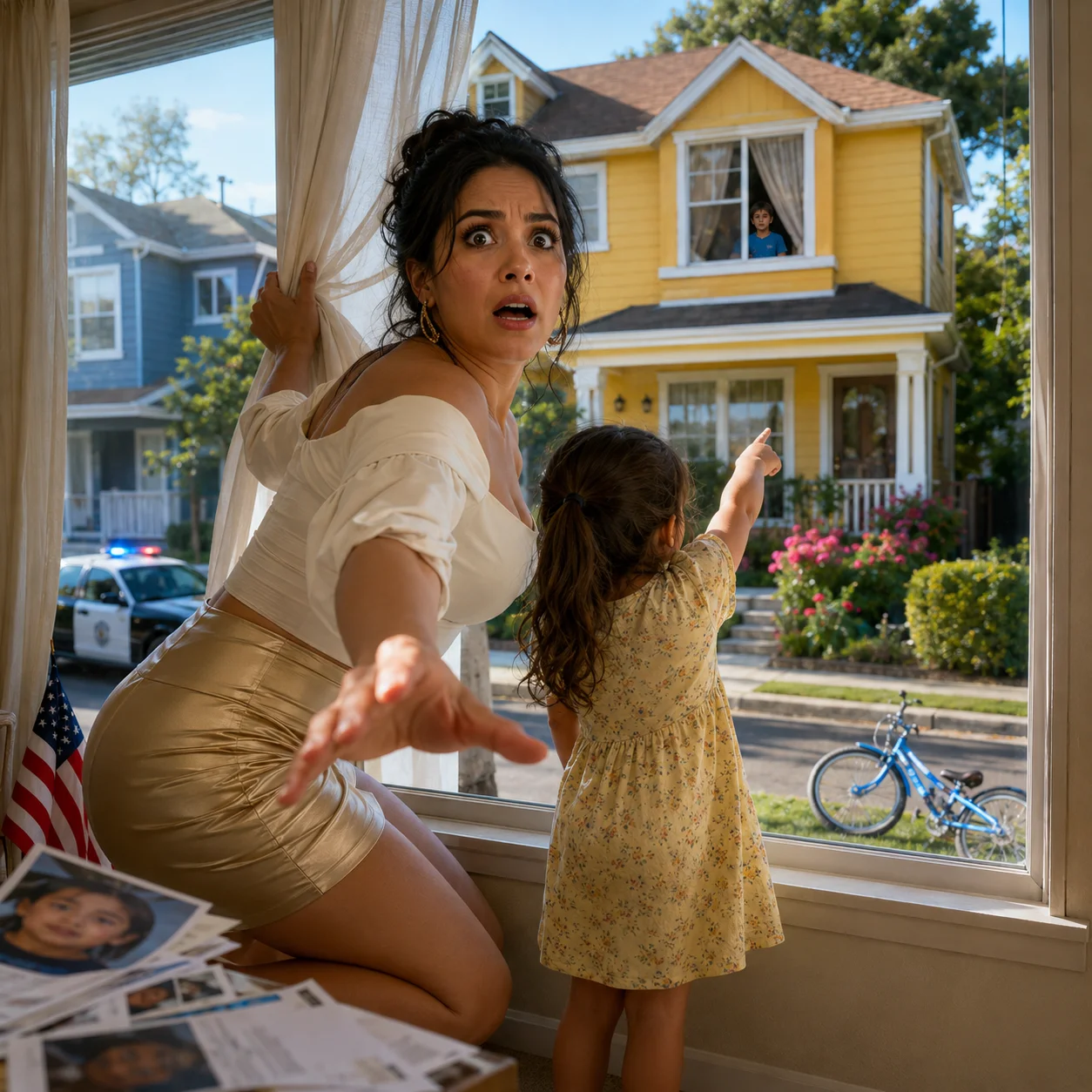
“Good morning,” I said, my throat dry. “I’m sorry to bother you, but my daughter says she saw a little boy in your upstairs window.”
Doña Elvira smiled without showing her teeth.
“There are no children here, señora.”
Javier stepped forward.
“Can we speak with Don Ignacio?”
“My husband is ill.”
“Then we can speak with you.”
Her smile vanished.
“I told you. There are no children here.”
She started to close the door.
Then something crashed upstairs.
A hard thud.
Then another.
Like someone had thrown something against a wall.
Doña Elvira’s face went pale.
Javier put his foot in the doorway before she could shut it.
“What was that?”
“My cat,” she said.
Javier stared at her.
“You don’t have a cat.”
The old woman’s eyes turned cold in a way that did not belong to a harmless neighbor.
“Leave before I call the police.”
“Call them,” I said. “I want to talk to them too.”
That was when we heard the voice.
It came from somewhere inside the house.
Small.
Weak.
Barely more than breath.
“Mom…”
My knees almost gave out.
Javier shoved the door open.
Doña Elvira screamed. The smell of bleach hit us full in the face, sharp enough to make my eyes water. Inside, chairs had been dragged across the hallway as if to block passage. Old family photographs lined the walls. At the back of the house, a staircase had a chain across it.
A chain.
In a neighbor’s house.
Across the street from mine.
Javier grabbed a heavy ceramic planter and smashed the lock. The metal snapped loose, and I ran up those stairs screaming Mateo’s name.
The first room was empty.
The second was empty.
Then I heard crying behind the last door.
Javier kicked it once. Twice. Three times.
The frame cracked.
The door flew open.
And my son was there.
Mateo sat on the floor against the wall, thinner than he had been, his hair tangled, his lips cracked, wearing the same blue shirt from the day he disappeared.
I ran to him, but he did not run into my arms.
Not at first.
He looked behind me.
His face twisted with terror.
“Mom,” he whispered, “don’t yell.”
“My love, it’s me,” I said, falling to my knees. “I’m here. I’m right here.”
He shook his head violently.
“They didn’t take me.”
The room went silent.
Javier froze.
“What?”
Mateo pointed under the bed.
There was a shoebox pushed against the wall. Inside were candy wrappers, bandages, a photograph of our house, and an old phone.
I picked it up with trembling hands.
The screen was cracked, but it still worked.
There were messages.
Many of them.
All from a contact saved only as “J.”
Javier snatched the phone from me.
He read one message.
Then another.
The blood drained out of his face.
“No,” he said. “That’s not—”
“What is it?” I demanded.
He did not answer.
I grabbed the phone back.
The most recent message was still visible.
Keep him there until she signs. If the girl keeps staring at the window, we’ll take her too.
For a second, my mind refused to understand the words. They floated in front of me, impossible and meaningless, as if they had been written in another language.
Then Mateo began to cry.
“Mom,” he said, “I heard his voice.”
I looked at Javier.
“What voice?”
Mateo wrapped his arms around himself.
“Dad came at night,” he whispered. “Not always upstairs. Sometimes he stayed downstairs. But I heard him talking to Don Ignacio.”
The room tilted.
“No,” I said.
Not to Mateo.
Not to Javier.
To the world.
Javier tightened his grip on the phone.
“He’s confused,” he said.
His voice did not sound desperate.
It sounded dangerous.
“Mateo has been locked up for a month. He’s scared. He doesn’t know what he’s saying.”
Mateo shrank against the wall.
“Mom, don’t let him take me.”
That was enough.
I stood between my husband and my son.
“Don’t touch him.”
Javier looked at me as if I had betrayed him. As if he was not standing in front of our missing child, holding a phone that pointed directly back to him.
Downstairs, Doña Elvira was screaming that we had no right to be there, that it was her house, that she would call the police.
I heard her and felt a rage so clean it became calm.
“Call them,” I shouted. “Tell them we found the missing boy.”
Don Ignacio appeared in the doorway behind Javier.
He no longer looked like a quiet old man. His face was gray, his hands trembling, his eyes darting like a trapped animal’s.
“Javier,” he said, “this got out of control.”
The name landed like a gunshot.
Javier closed his eyes.
I stared at him.
“What did you do?”
He tried to move closer.
“Laura, listen to me.”
Laura.
That was my name.
For a month, I had not felt like Laura. I had been “the mother of the missing boy.” The woman on the posters. The woman crying outside the school. The woman calling hospitals, bus stations, morgues, and offices where tired employees barely looked at me twice.
But in that moment, I became myself again.
And I no longer believed him.
“Stay away from us,” I said.
I lifted Mateo in my arms. He weighed less than he should have. Much less. His bones pressed through his shirt. He clung to me like he was afraid someone might peel him off my body.
As I carried him down the stairs, I remembered Lucía.
My little girl was still in our house.
The message burned through my mind.
If the girl keeps staring at the window, we’ll take her too.
By the time we reached the living room, neighbors had begun gathering outside. Someone must have heard the shouting. Marcus, who lived on the corner, pushed through the front door with his phone in his hand.
“The police are coming,” he said. “I also called the Amber Alert number.”
Javier turned on him.
“Stay out of this.”
Marcus looked at Mateo in my arms.
“A missing child just came out of the house across the street. We’re all in this now.”
Doña Elvira dropped into a chair and began sobbing.
“They told me it would only be a few days.”
“Shut up!” Javier shouted.
That shout did not sound like a husband.
It sounded like a man who had been discovered.
I looked at him and asked the only question left.
“Why?”
Javier breathed hard through his nose.
“Because you left me no choice.”
The sentence disgusted me.
“I left you no choice but to kidnap your own son?”
“It was temporary!”
Mateo covered his ears.
I crouched beside him and took his face gently in my hands.
“Look at me. You’re with me now. Nobody is going to lock you in a room again.”
He gripped my blouse.
“Dad said if I cried, you would sign faster.”
My heart split open.
“Sign what?”
Javier looked away.
And then I remembered.
Three days after Mateo disappeared, Javier had placed a folder in front of me at our kitchen table.
“It’s to transfer the house into a trust,” he had said. “In case we need to sell quickly. Private investigators, lawyers, ransom, whatever it takes. We have to be prepared.”
I had been destroyed. I had not slept. I had barely eaten. My son’s face was on every wall in the neighborhood, and every minute felt like a punishment.
I had picked up the pen.
Then Lucía began screaming in the hallway.
“Mateo doesn’t want you to!”
She had hit her head against the wall until I dropped the pen and ran to her.
That night, I did not sign.
Javier did not speak to me for two days.
Now I understood.
The house we lived in was not Javier’s.
It had belonged to my grandmother. A small blue-faced house in Puebla with a cracked tile fountain in the patio and old talavera around the kitchen doorway. I had never wanted to sell it, no matter how many times Javier insisted we should move to a “better area.”
“You owed money,” I said.
Javier said nothing.
Don Ignacio did.
“A lot,” the old man whispered.
Javier whipped around.
Don Ignacio stepped back, but he kept talking.
“Gambling. Bad business. Loans. Men from Cholula. Men who don’t wait.”
I looked at my husband, and for the first time, I saw a stranger.
Javier, the father who cried in front of cameras.
Javier, the man who taped missing posters onto telephone poles.
Javier, the husband who held me in bed and whispered, “We’ll find him.”
He had known where Mateo was.
He had always known.
The police arrived minutes later, but it felt like hours. Everything became noise. Red and blue lights flashing on wet pavement. Neighbors watching from windows. Doña Elvira crying into her hands. Don Ignacio giving up keys. Javier saying it was a misunderstanding, then saying Mateo was confused, then saying I was hysterical.
Hysterical.
That word.
They use it when a woman starts telling the truth too loudly.
Mateo would not let go of me, not even when the paramedics came. They wrapped him in a blanket and led us to the ambulance. Lucía came too, carried by Mrs. Gable from 3B, who had run to our house the moment she heard the sirens.
Lucía saw her brother and went completely still.
“I saw you,” she whispered.
Mateo reached for her hand.
“I saw you too.”
Her face crumpled.
“I waved small so Mommy would believe me.”
Mateo closed his eyes.
“I couldn’t shout. They said if I shouted, they’d take Sofi too.”
“My name is Lucía,” she said, offended through tears.
For the first time in a month, Mateo smiled.
Only a little.
Only for a second.
But it was a smile.
And that tiny smile kept me from falling apart completely.
At the hospital, the doctors said words I never wanted attached to my child.
Dehydration.
Weight loss.
Anxiety.
Bruising.
Confinement trauma.
I listened as if each word were a stone being placed on my chest.
The prosecutor’s office arrived. Child psychologists. Search commission officials. Social workers. The same police who had told me for weeks that they were “continuing the investigation” now moved quickly, took photographs, collected the phone, sealed evidence bags, and asked for statements.
I wanted to scream that Mateo had been across the street the entire time.
Across the street.
Behind a curtain.
Close enough for his sister to see.
But my rage could wait.
Mateo could not.
That night he slept with the light on and his hand locked around mine.
Every time his eyes closed, he startled awake.
“Don’t turn off the light.”
“I won’t.”
“Don’t close the door.”
“I won’t.”
“Don’t let Dad come in.”
I swallowed my tears.
“Never again.”
Javier was arrested before dawn.
At first, he denied everything.
Then he said Don Ignacio and Doña Elvira had acted alone.
Then he said it was a “family arrangement that got misunderstood.”
Finally, when investigators recovered deleted messages, bank transfers, camera footage, and records connected to the old phone, Javier began speaking less.
The truth came out in pieces.
The truck on the corner had not taken Mateo.
Javier had.
He waited for him on a side street in Don Ignacio’s vehicle. He told Mateo I was in the hospital, that there had been an emergency, that he needed to get in quickly.
Mateo trusted him.
Of course he did.
He was his father.
They took him into the yellow house through the back entrance. They hid his bicycle. They threw his helmet near the bench. They opened his backpack and left it in the rain to make it look like someone else had grabbed him.
While I ran through the streets screaming my son’s name, Javier was half a block away, knowing exactly where Mateo was crying.
The motive was money.
Debt.
Gambling.
A failed investment.
A property used as collateral without my knowledge.
Loans with interest that grew like mold.
My signature was supposed to unlock the house. Sell it, pay the debt, “start over.” That was how Javier described it later, as if a life could simply restart after you locked a child in a room.
Don Ignacio and Doña Elvira had agreed because Javier owed them money too. Because he promised they would be paid. Because, in their own words, “the boy did not suffer that much.”
When I read that sentence in the official statement, I threw up in the bathroom at the prosecutor’s office.
My son had spent thirty-one days locked away from his home.
Thirty-one nights without his bed.
Without his stories.
Without his sister.
Without me.
And someone dared to say he had not suffered that much.
The first week after Mateo came home was a mixture of miracle and horror. Our house filled with people. Lawyers. Therapists. Relatives. Police officers assigned to protection measures. My mother arrived from Atlixco carrying baskets of food because she did not know how else to keep us alive.
Soup.
Rice.
Mole.
Fruit.
Sweet bread.
“Children eat even when the world falls apart,” she said.
She was right.
Mateo ate very little at first. Lucía watched the windows. I stopped sleeping entirely.
Every sound from the street pulled me upright. Every car slowing in front of the house made my hands shake. I changed locks, installed cameras, reinforced windows, and removed every curtain facing the yellow house because I could not stand to see that facade anymore.
The yellow house was sealed by investigators. Police tape crossed the gate. Neighbors whispered as they passed. Some looked ashamed, as if not knowing had made them guilty too.
I wanted to burn it down.
But one afternoon, Mateo asked to cross the street.
“I want to see it from outside,” he said.
His psychologist came with us.
Lucía took his hand as we stood in front of the white gate. Mateo stared up at the second-floor window.
“That’s where I counted the days,” he whispered.
I forced myself to breathe.
“How?”
“With little lines on the wall. But Don Ignacio painted over them.”
Lucía pressed her lips together.
“I saw you.”
Mateo looked at her.
“Yes.”
“I saved you.”
He nodded.
“Yes.”
She straightened like a tiny soldier.
“Then you owe me your fries.”
Mateo let out a small laugh.
It did not last long.
But it was laughter.
And to me, it sounded like a door opening somewhere deep inside our ruined lives.
The legal process was long, ugly, and exhausting.
Javier tried to say I was unstable. He claimed the trauma of Mateo’s disappearance had made me paranoid. His lawyer said he had only wanted to “protect family assets.” He requested supervised visitation. He talked about father’s rights. He talked about forgiveness. He talked about family.
The judge listened.
Then she ordered Mateo’s testimony to be taken in a protected room with a child psychologist, away from Javier.
My son did not have to face him.
He drew first.
The yellow house.
The window.
A small girl pointing with a red crayon.
When they asked who took him, Mateo answered quietly.
“My dad.”
He did not cry when he said it.
That hurt more than tears.
As if the crying had already been used up.
Javier lost parental rights. He was convicted for child abduction, unlawful confinement, family violence, and every legal name the system could attach to a betrayal that no language could fully hold. Don Ignacio and Doña Elvira were convicted too.
The yellow house was sold years later.
I never wanted to know who bought it.
We left before that.
I sold my grandmother’s house, not because Javier won, but because I could not make my children heal while they had to look every day at the window where their nightmare had lived behind a curtain.
We moved to Cholula.
A smaller house. A quiet patio. A distant view of the church on the hill when the sky was clear. On Sundays, we bought cemitas. Sometimes we went back into Puebla for sweets from Santa Clara, and Mateo walked close to my side until, little by little, he began to step ahead.
He never rode the blue bicycle again.
For months, he would not even look at it.
I kept it in storage with the new helmet someone had given us after hearing his story.
Almost a year later, Mateo walked into the storage room and pulled it out.
“I want to paint it,” he said.
“What color?”
He thought for a moment.
“Red.”
So we painted it in the patio.
Lucía ended up with more paint on her arms than on the bicycle. Mateo got annoyed. Then he laughed. I sat on the ground with red paint on my hands and cried silently where they could not see me.
The first time he rode again, we chose a closed street with no traffic. I walked beside him, one hand hovering near the seat even though he told me not to hold it. Lucía ran behind us shouting instructions like a professional coach.
“Brake! Not so fast! Now go fast! No, not that fast!”
Mateo made it ten meters before stopping.
His hands shook.
“I can’t.”
I knelt in front of him.
“Yes, you can. But you don’t have to do it today.”
He looked at the red bicycle.
Then at me.
“Dad told me you would forget me if I was gone too long.”
Something inside me broke all over again.
I took both his hands.
“Mateo, I looked for you when everyone told me there was nothing left to find. I would have looked for you my entire life.”
“Even if I was dead?”
“Even if the whole world told me you were.”
Lucía pushed herself between us.
“I would have looked too. I knew where you were.”
Mateo hugged his sister.
This time, not from fear.
From gratitude.
Years passed.
Not magically. Not like a movie where one brave moment fixes everything.
Mateo had nightmares. Lucía became afraid of windows. I had panic attacks whenever I heard a truck slow down outside. We went to therapy. We learned new words: trauma, triggers, recovery, safety, boundaries.
We also learned older, simpler words again.
Bread.
Sun.
Laughter.
Home.
When Mateo turned twelve, he asked to go back to Puebla and see his old school.
I was afraid.
But we went.
The school looked almost the same. The gate. The murals. The tamale stand at the corner. Children pouring out with oversized backpacks and untied shoelaces. Mateo stood on the sidewalk near the place where his helmet had been found.
Then he reached into his backpack and pulled out a folded paper.
It was a drawing.
The yellow house.
The upstairs window.
And a little girl pointing.
At the bottom, he had written:
My sister saw me when nobody else could.
Lucía, who was nine by then, turned bright red.
“Mateo…”
He handed it to her.
“It’s yours.”
She hugged him hard.
And in that moment, I understood something that still holds me together.
Adults often demand enormous proof.
Videos.
Signatures.
Statements.
Official stamps.
But the truth in our family began with a five-year-old girl pointing at a window.
A child I almost did not believe because I thought her grief was inventing ghosts.
Lucía did not invent anything.
She saw what the rest of us had stopped having the strength to see.
Today Mateo is fifteen. He rides a red bicycle through Cholula, always wearing a helmet even when he thinks it makes him look childish. Lucía still watches windows, but not with fear anymore. Depending on the day, she says she wants to become either a detective or a psychologist.
I am still their mother.
More suspicious now.
Harder in some places.
Softer in others.
I no longer ignore instinct. I no longer let anyone call a mother’s fear irrational just because it sees danger before evidence arrives. I no longer mistake politeness for goodness or silence for innocence.
Javier writes letters from prison.
At first, I opened them.
Then I understood something important: not every voice deserves a way back into your home.
Now I keep his letters unread in a box for the legal file, not for my heart.
Mateo has never asked to see them.
One day, Lucía asked me, “Did Dad love us?”
I took a long time to answer.
I did not want to give her an easy lie.
“He wanted to have us,” I said finally. “That is not the same as loving us.”
She nodded.
As if she had already known.
The yellow house no longer exists in our street, but sometimes it appears in my dreams. I am standing outside in the rain, staring up at the curtain. Only this time, I do not wait a month. This time, I cross the street the first second my daughter points.
I wake up sweating.
Then I go to Mateo’s room and watch him sleep.
Then Lucía’s.
She sleeps with one leg outside the blanket, mouth open, completely unafraid, the absolute owner of her little world.
And I breathe.
My son was missing for a month.
We searched far away.
Hospitals.
Bus stations.
Fields.
Roads.
Empty places where hope went to die.
But he was across the street.
Behind a curtain.
Inside the quiet home of quiet neighbors.
Hidden by people who looked harmless.
Betrayed by his own father.
Saved by his sister.
That is the whole truth.
The part that hurts.
And the part that heals.
Because my five-year-old daughter pointed at a yellow house and said, “Mateo is there.”
I thought it was a child’s grief.
But it was not.
It was love looking where the adults had become too exhausted to look.
And because of that love, my son came home.

![[FULL STORY] My Wife Coldly Said, “You’re A Grown Man. Cook For Yourself. I’m Not A Restaurant,” When I Came Home](https://social-media.rabedo.com/thumbnails/1777882424_R8.jpg)
![[FULL STORY] My Young Wife Said: “I’m Too Young, I Need To Experience Life,” So I Let Her Go Without A Fight...](https://social-media.rabedo.com/thumbnails/1776395183_d87ab528-45fe-4a39-bb42-95cb1cd1f098.png)