I said those words again and again until they sounded like a prayer.
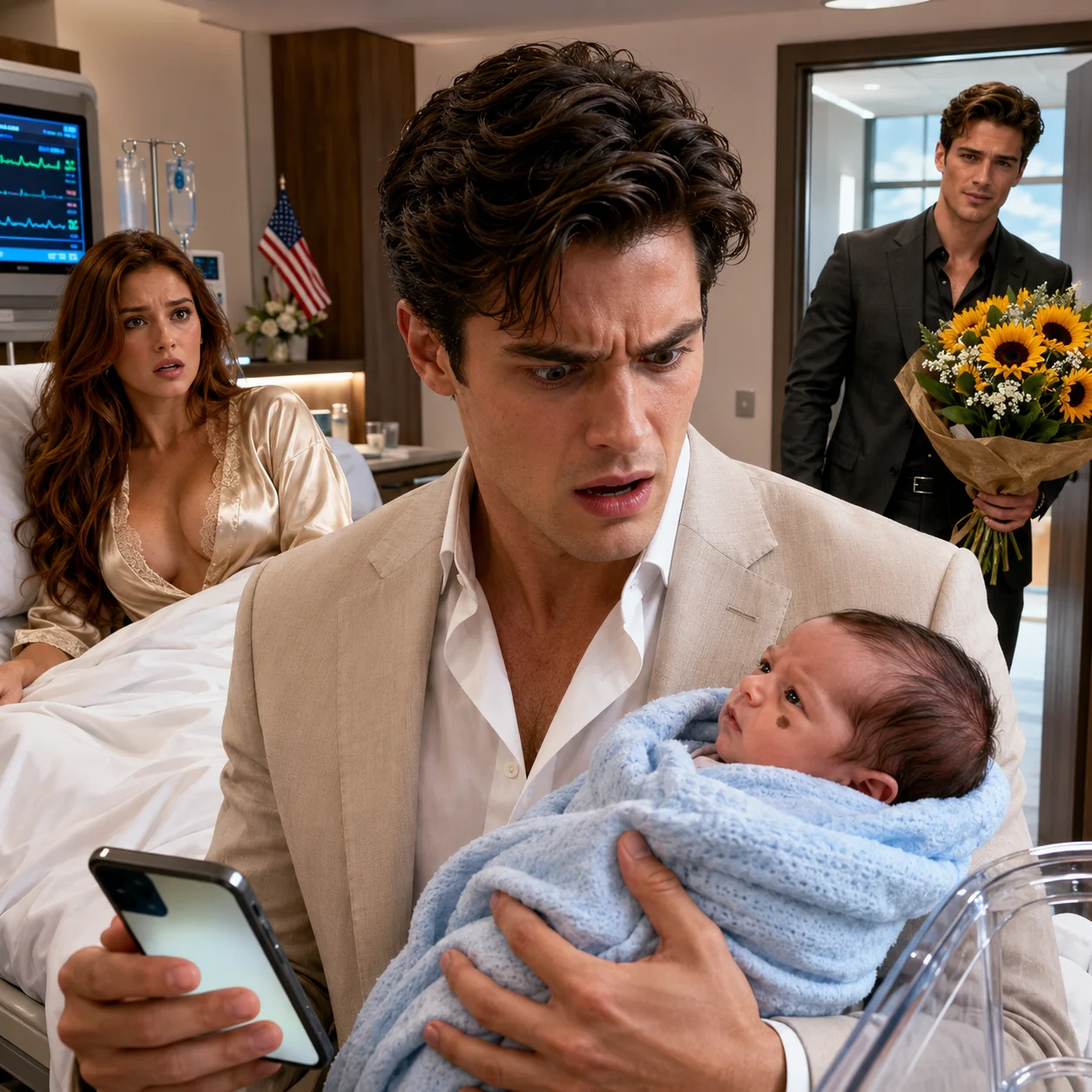
When the baby finally cried, something inside me broke open.
“It’s a boy,” the nurse said.
For one beautiful, stupid second, I believed the world had forgiven me.
Then she placed him in my arms.
And I saw Diego’s face.
The birthmark.
The dimple.
The eyebrow.
The shape of the mouth.
My legs went weak.
“No,” I whispered.
Valeria turned her face away.
That was what confirmed it.
She did not ask what was wrong. She did not look confused. She did not act offended.
She only closed her eyes.
The nurse stepped closer with some documents.
“Señor Méndez, we need your signature here.”
But I could not move.
I could not even hand the baby back.
Then my phone vibrated in my pocket.
It was a message from Lucía.
“Congratulations, Raúl. Today I received my results too.”
Under the message was a photo.
A positive pregnancy test.
For a moment, my mind refused to understand what I was seeing. I stared at the image while Valeria’s baby slept in my arms, his tiny face pressed against the blanket, Diego’s birthmark sitting beneath his eye like a signature.
Then another message arrived.
“I am not pregnant by another man.”
My chest tightened.
Another photo came through.
This one was not just a pregnancy test. It was a medical report. Lucía’s name was at the top. Years of normal results. Notes from doctors confirming that she had no major fertility issues. Recommendations that had been ignored. A line explaining that further evaluation of the male partner was strongly advised.
My stomach turned cold.
Then another message came.
“I also received yours.”
I opened the next image.
My name.
Raúl Méndez.
Severe male factor infertility.
Extremely low natural probability.
I gripped the side rail of Valeria’s hospital bed because the room tilted.
For eight years, I had told Lucía she was broken.
For eight years, I had watched her drink special teas, swallow vitamins, go through humiliating exams, track her cycle, stop drinking coffee, stop hoping too loudly, and pray over a body that had never been the problem.
The emptiness had been in me.
Not in her.
Valeria looked at me from the bed, pale and sweaty, her hair stuck to her forehead.
“Raúl…”
I hated her.
But not as much as I hated myself.
“How long?” I asked.
She swallowed.
“Don’t do this here.”
“How long have you been sleeping with Diego?”
She looked toward the door.
“Raúl, I just gave birth.”
A horrible laugh came out of me.
“And I was just born an idiot.”
Before she could answer, the door opened.
Diego walked in holding a bouquet of sunflowers.
Not white roses, which Valeria liked.
Sunflowers.
Because Diego always forgot what other people loved, but somehow never forgot himself.
“Brother,” he said, smiling. “Is he here?”
Then he saw my face.
His smile died.
I looked at him.
Then I looked at the baby.
“He has your birthmark,” I said.
The room went silent.
Valeria started crying.
Diego glanced at the newborn in the bassinet.
He did not deny it.
That was the worst part.
He did not deny the baby.
He only denied me.
“Raúl,” he said carefully, “we can talk.”
I punched him.
I did not think. I did not measure the distance. My fist hit his mouth, and Diego fell back against the wall, knocking the sunflowers to the floor. The nurse screamed. Valeria screamed. The baby woke and started crying.
I wanted to keep hitting him.
I wanted to break the face of the man who had called me brother while letting me spend millions on his child.
But then I saw my reflection in the hospital window.
My shirt wrinkled. My eyes red. My face twisted with rage.
And something more humiliating than betrayal came over me.
I was not innocent.
I had built that room.
I had paid for it with lies, arrogance, money, and Lucía’s pain.
I left before security arrived.
Outside, Guadalajara smelled like rain and gasoline. Cars moved along Avenida Patria as if the city had no idea that my life had just collapsed in a hospital room.
I called Lucía.
She did not answer.
I called again.
Nothing.
I wrote, “I need to see you.”
Her answer came a few minutes later.
“No. You needed to see me years ago.”
I sat on a bench in the parking lot and cried.
Not for Valeria.
Not for Diego.
Not even for the baby.
I cried because I saw Lucía in my mind, picking up a fallen baby bottle from the kitchen floor without saying a word. I saw her face the night I called her bitter. I saw all the mornings she ironed my shirts while I sprayed on cologne for another woman.
When I went back inside, Diego was gone.
Valeria was holding the baby.
She looked exhausted, but not ashamed enough.
“You’re not going to make some legal scandal, are you?” she asked.
I stared at her.
“Legal scandal? I bought you a five-million-peso apartment because I thought you were carrying my son.”
“You wanted to,” she said quietly.
“Because you lied.”
“You lied too.”
The words hit me because they were true.
“I didn’t owe you loyalty,” she said. “You had a wife.”
“And you had a price.”
Her face hardened.
“Don’t act morally superior now, Raúl. You wanted a child more than you wanted the truth. I gave you a story, and you paid for it.”
I looked at the baby.
He was sleeping again.
He had no guilt in this. That almost made it worse because I could not hate him.
“Did Diego know?” I asked.
Valeria touched the baby’s forehead.
“He always knew.”
The floor seemed to open beneath me.
“Then why push me toward you?”
Her eyes shifted.
“Because he needed you distracted.”
That was when the second bill arrived.
The first was the baby.
The second was everything else.
Contracts. Transfers. Powers of attorney. Project files. The Santa Fe development. Documents Diego had told me were “just formalities.” Shares we had moved around “for protection” before my divorce. The apartment purchased through a company where Valeria appeared as a beneficiary.
I had been so busy pretending to become a father that I stopped being a businessman.
That night, I did not go home.
I went to the office.
The building in Puerta de Hierro was nearly empty. The security guard looked surprised when I walked in past midnight. I went upstairs, locked myself in my office, and turned on my computer.
The files were different.
Folders had been moved.
Contracts had been signed.
Loans had been opened.
My ownership had been diluted.
Emails had been forwarded.
Diego had not only stolen my mistress.
He had stolen my company.
At three in the morning, my lawyer, Octavio, arrived with messy hair and a furious expression.
“What did you do, Raúl?” he asked.
I showed him everything.
He reviewed the documents in silence. Page after page. Signature after signature. Mistake after mistake.
Finally, he leaned back.
“They emptied you.”
“How much?” I asked.
He looked at me.
He did not need to say everything.
His face said it.
“I need to sue,” I said. “Challenge the contracts. Freeze the accounts. Everything.”
“We can fight,” Octavio said. “But many of these signatures are yours.”
“I was deceived.”
“You were buying silence,” he replied. “Not reading contracts.”
I had no answer.
Sometimes the truth does not need to shout.
It simply sits across from you with evidence.
At dawn, I went to Lucía’s house.
Our house.
The house where my clothes still hung in the closet. The house that smelled of soft coffee, lavender soap, and toasted bread. The house where Lucía had waited through years of disappointment while I built another life with another woman.
I knocked.
Her brother Tomás opened the door.
He looked at me like a wet dog trying to enter a church.
“She doesn’t want to see you,” he said.
“I need to talk to her.”
“She needed you at doctor’s appointments. You weren’t there.”
“Tomás, please.”
“Do not humiliate her with that word.”
Then Lucía appeared behind him.
Her hair was tied back. She wore a gray robe. One hand rested gently on her stomach.
It did not show yet.
But I saw it as if she was carrying a miracle that no longer belonged to me.
“Lucía,” I said.
She did not cry.
That killed me more than tears would have.
“Don’t come in,” she said.
“Is it mine?”
The question came out pathetic.
Her face turned cold.
“After everything you read, you still ask like you have a right to celebrate?”
“Tell me.”
“Yes,” she said.
Something inside me folded.
The child I had begged for during eight years was there.
In the woman I had insulted.
In the wife I had abandoned without leaving.
In the only person who had never sold me a lie.
“Lucía, I—”
“No.”
She lifted one hand.
“You are not going to turn this pregnancy into your redemption. You are not going to show up with flowers, guilt, and the face of a punished man asking for a place in a life you destroyed.”
“I’m the father.”
“Biologically, yes,” she said. “Morally, I don’t know.”
Tomás stared at me like he wanted to remove me from the porch himself.
I lowered my eyes.
“I want to be responsible.”
“Then start by signing the divorce.”
The word hit me like a door closing.
“No.”
“Yes.”
“Lucía, please. I made a mistake. I was deceived.”
She gave a sad laugh.
“No, Raúl. You were deceived because you wanted to be deceived. You wanted to believe a younger woman made you a man, and that I was an old house you could return to when you were tired.”
I could not speak.
“I have an appointment with a family lawyer,” she continued. “We will establish child support, custody after the baby is born, and clear boundaries. I do not want your shouting, your drama, or your repentance at my door.”
“How can you be so calm?” I asked.
Lucía looked at me for a long time.
“Because I cried twelve years in eight,” she said. “I got ahead of you.”
Then she closed the door.
Not loudly.
Worse.
Calmly.
The months that followed were a slow fall.
Diego disappeared three weeks later. First Miami, then Monterrey, then no one really knew. He left behind debts, lawsuits, angry suppliers, and a board of partners who looked at me like a child who had been playing with an adult company.
Valeria tried to keep the Santa Fe apartment.
Octavio managed to freeze some of the movements because there were irregularities, but nothing was clean. In business, paper is heavy even when it is dirty. And I had signed too many papers with the hands of a vain man.
The baby was registered under Diego’s name.
Not out of love.
Out of pressure from Valeria and fear of a DNA test.
His name was Bruno.
I did not attend.
Someone sent me a photo anyway.
He had the birthmark beneath his eye.
The same one.
I stared at his face for several minutes.
First I felt rage.
Then shame.
That child owed me nothing.
I was the adult who had walked into a lie because I wanted to buy a destiny.
Lucía went through her pregnancy far away from me.
I asked about her through her lawyer.
The answers were short.
“She is stable.”
“The baby is developing well.”
“She does not want visits.”
Once, I saw her from a distance at Vía RecreActiva. She was walking slowly with Tomás and a friend. Guadalajara was full of bicycles, families, dogs, juice stands, and people acting as if living was easy.
Lucía looked tired.
Beautiful.
Not happy yet.
But free.
I wanted to approach her.
I did not.
For once, I did not do what I wanted.
When my son was born, I received a call at 5:18 in the morning.
It was Tomás.
“He’s here,” he said.
I sat up in bed.
“Is he okay?”
“They both are.”
“Can I go?”
There was silence.
“She said you can see him through the glass. Not inside.”
I went to the hospital with my shirt buttoned wrong and my heart in my hands.
I saw him behind the glass.
Small. Red. Perfect. His fists closed like he had arrived ready to fight the world.
My son.
My real son.
This time, I did not cry from fear.
I cried because I finally understood that love cannot be demanded with a surname.
It has to be earned with presence.
Lucía named him Gabriel.
After her grandfather.
Not after my father.
Not after me.
It hurt.
And I accepted it.
A few days later, I signed the divorce papers.
I signed the child support agreement too.
The house stayed with Lucía and Gabriel.
My company was split open.
My pride was already in ruins.
Valeria lost the apartment months later because Diego had used the company behind it to guarantee one of his debts. When she came looking for me, she had Bruno in her arms.
“I need help,” she said.
I looked at her.
No desire.
No hate.
Only the tired recognition of someone who had once been stupid enough to call destruction love.
“Bruno needs help,” I said. “You need consequences.”
I gave her the contact of a lawyer who could help her file for child support against Diego. I also paid for medicine for the baby directly through a pharmacy, not through her.
“After everything, you’re helping me?” she asked.
I looked at Bruno.
“At him,” I said. “Not you.”
Bruno looked back at me with dark, innocent eyes.
For once, I did not see Diego.
I saw a child.
That was the only decent thing I managed to do that day.
Years passed.
I did not become a saint.
Men like me do not change because of one dramatic scene in a hospital room. We change by paying, losing, listening to closed doors, and learning not to kick them open.
At first, I saw Gabriel on Saturdays under supervision.
Lucía would sit on a bench at Parque Metropolitano while I pushed the stroller. We did not talk much. When Gabriel learned to walk, he would wobble toward me with uncertain little steps, and I would feel like God, after sending me the bill, had allowed me to pay it in installments.
When Gabriel was four, he asked me a question that stopped me cold.
“Why don’t you live with Mom?”
Lucía looked up from the bench.
I swallowed.
“Because I hurt your mom very badly,” I said.
Gabriel frowned.
“Did you say sorry?”
“Yes.”
“Did it get fixed?”
I looked at Lucía.
She did not look away.
“Not everything gets fixed just because someone says sorry,” I told him.
Gabriel thought about that seriously.
“Then be good for a long time,” he said.
I smiled sadly.
“I’m trying.”
Lucía rebuilt her life without me.
She opened a small café in Chapalita with plants, warm lighting, sweet corn bread, and an espresso machine I would never have known how to use. She named it Perfecto.
When I saw the sign, I understood.
Sometimes God does not punish quickly, Raúl.
He punishes perfectly.
She did not invite me to the opening.
I went weeks later as a customer.
I ordered coffee.
She served it to me.
“It’s hot,” she said.
“Thank you.”
There was no reproach.
There was no tenderness.
Only peace.
Her peace.
The kind I could no longer touch.
Diego returned to Mexico three years later, ruined by debts and lawsuits. He tried to find me. I refused to see him. I heard Bruno met him late, and that Valeria had to work for the first time in her life without hiding behind a man’s wallet.
It did not make me happy.
Other people’s misery tastes bitter when you helped cook it.
Today, Gabriel is nine.
Bruno is nine too.
Sometimes their lives cross in places neither of them chose, because life has a cruel sense of irony. They are both good children. Neither of them asked to be proof of their parents’ sins.
Once, Gabriel asked me who Bruno was.
“A boy who deserves to be okay too,” I said.
I did not know how to say more.
I still live in Guadalajara.
I no longer have the big company. I run a small architecture office near Americana, where I read every contract twice and every decision three times. I no longer wear expensive watches. I no longer brag about meetings in Mexico City. I no longer say “my legacy” as if the world owes me a statue.
My legacy is a boy who calls me Dad on Saturdays and a woman who learned to live better without me.
It is also guilt I no longer try to cover with money.
Sometimes I pass through Santa Fe for work and see the glass towers, the shining offices, the apartments where people buy views so they do not have to look at their emptiness. I think about Valeria. I think about that apartment. I think about the man I used to be, believing he could build a family on stolen foundations.
Then I return to Guadalajara.
I buy a torta ahogada with less chili because my stomach no longer forgives me the way it used to. I walk beneath the trees along Avenida México. And I remember that delivery room.
The nurse placing the baby in my arms.
My heart believing God had finally given me a son.
No.
God was showing me a bill.
One with every date listed clearly.
The night Lucía picked up the fallen baby bottle from the kitchen floor.
The appointments she attended alone.
The cruel words.
The slammed door.
The five-million-peso apartment.
Diego’s smile.
The birthmark beneath Bruno’s eyelid.
Lucía’s positive pregnancy test.
Everything was there.
Charged with perfect precision.
I did not lose Lucía the day I signed the divorce papers.
I lost her every night she sat across from me at dinner, knowing I smelled like another woman, and still chose silence because she had not yet chosen herself.
I did not lose my company when Diego betrayed me.
I lost it when I trusted my vanity more than my conscience.
And I did not win a son when Gabriel was born.
I received a small, limited, supervised chance not to remain the same coward forever.
Lucía never came back to me.
And that is right.
Some women were not born to become a prize after a man’s regret.
They were born to save themselves.
Sometimes, I see her in the café, serving coffee with that calmness I once mistook for weakness. Gabriel runs to her. She hugs him. Then he runs back to me.
I receive him.
And in that short distance, from her arms to mine, I understand both my punishment and my mercy.
God did not give me what I wanted when I wanted it.
He took away the lie.
He left me the truth.
And He forced me to watch it grow from outside the home I broke with my own hands.
![[FULL STORY] My girlfriend’s best friend shocked me with a phone call at the exact moment when I had finished all](https://social-media.rabedo.com/thumbnails/1776929710_27.png)
![[FULL STORY] My Wife Said: "Stop Smothering Me, I Need Girl Time Every Weekend " I Replied: "Sure, Babe " The](https://social-media.rabedo.com/thumbnails/1776408499_5bb60e6f-4512-40e7-8148-47d3036df143.png)