
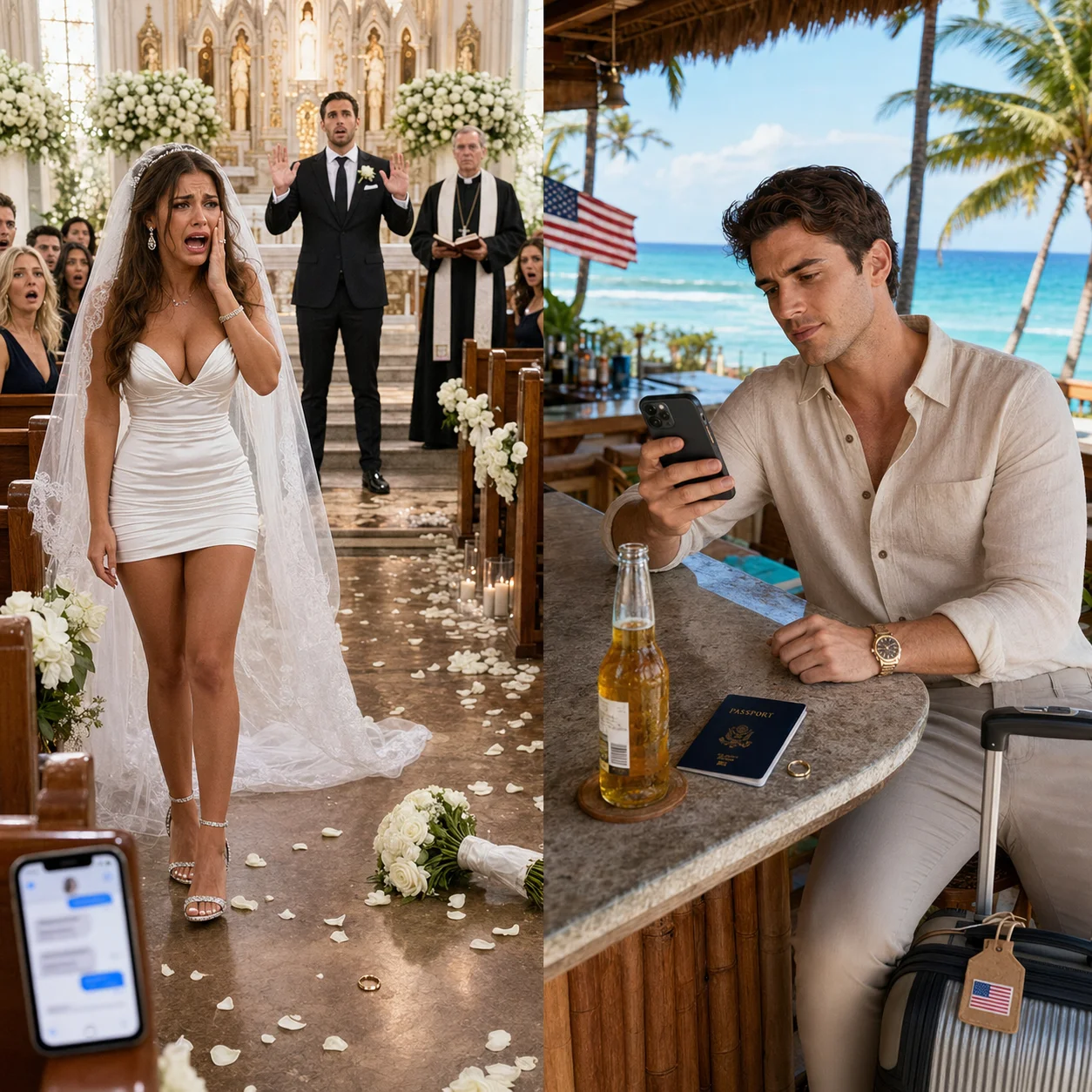
Before our wedding rehearsal ended, my fiancée pulled me aside and said, “Don’t wait up tonight. I’m going out with my ex. It’s just for closure.”
I didn’t argue.
But the next morning, when she walked down the aisle in her white dress, I wasn’t the man waiting for her at the altar.
My name is Liam, and I have always been the kind of man who believes in clear lines. You are either in or you are out. You are either building a life with someone, or you are keeping one foot pointed toward the exit. I do not do blurred loyalties. I do not do emotional backup plans. I do not believe love should feel like a courtroom where you are constantly arguing for your own place.
For three years, I believed Emily understood that.
We had built what most people around us called a good life. I ran a small engineering firm, which meant long hours, demanding clients, and a brain that rarely shut off even after dinner. But the work was stable. It paid for a nice house, helped us save properly, and allowed us to plan the kind of wedding Emily had talked about since our second year together. Not just a ceremony, either. A full weekend. Rehearsal dinner, cathedral wedding, reception at a gorgeous venue, flowers that cost more than my first car, a honeymoon in Costa Rica, and a guest list that somehow grew every time Emily looked at it.
I was a planner. Details made me feel safe. Contracts, schedules, budgets, backup plans — that was my language. Emily was different. She floated through life with a kind of charming looseness that I used to admire. She called me her anchor. I called her my sail. At the time, I thought that sounded romantic. I thought we balanced each other.
What I did not understand was that sometimes a sail is not attached to the boat at all. Sometimes it is just waiting for the right wind.
The wind, in our case, was named Greg.
Greg was Emily’s ex-boyfriend, the one she insisted was ancient history. They had dated for years before me, and according to Emily, the relationship ended badly. She said he was immature, selfish, emotionally dramatic, and completely wrong for her. She also said she was over him, which would have been easier to believe if his name did not keep appearing like a stain that refused to wash out.
A text on her birthday. A like on an old photo. A mutual friend mentioning that Greg had asked about her. A sudden quietness in Emily whenever his name came up. Nothing big enough to accuse her of anything. Just small enough to make me feel petty for noticing.
I chose trust. Over and over, I chose trust.
I told myself the future mattered more than the past. I told myself every adult comes with history. I told myself that loving someone meant not punishing them for the life they lived before you. And for three years, I believed Emily had chosen me.
That belief died on a Friday night, less than twenty-four hours before our wedding.
The rehearsal itself went perfectly. That was the cruel part. We were standing in the church where we were supposed to become husband and wife the next morning, surrounded by both families, our wedding party, and the soft echo of footsteps against old stone floors. Emily looked beautiful. Nervous, maybe, but beautiful. Her mother cried during the practice vows. My father clapped me on the shoulder. My brother, who was also my best man, kept joking that I looked like I was about to inspect a bridge instead of get married.
Everything felt normal. Almost sacred.
Afterward, we went to the rehearsal dinner. There were speeches, wine, laughter, and Emily’s hand resting on my knee under the table. People kept telling us how happy they were for us. Her father gave a toast about new beginnings. My mother hugged Emily and called her “almost daughter.” I remember watching Emily smile through all of it, thinking she looked exactly like the woman I wanted to spend my life with.
Then dinner ended, and while our parents lingered near the door saying their long goodbyes, Emily touched my arm and said, “Can I talk to you for a second?”
Her tone was casual. Too casual.
She pulled me a few steps away from the group. That was when I noticed she had changed something about herself. Her lipstick had been reapplied. Her purse was already on her shoulder. Her energy was not tired-bride-going-home energy. It was going-out energy.
“Hey,” she said, not quite meeting my eyes. “Don’t wait up for me tonight.”
I stared at her, waiting for the punchline. “What do you mean?”
She adjusted the thin strap of her purse. “I’m going out for a little bit.”
“Emily, we have to be up at the crack of dawn. The wedding is tomorrow.”
“I know.” She swallowed, and for the first time, she looked uncomfortable. Not guilty exactly. More like annoyed that guilt was being required of her. “Greg is in town.”
The room behind her seemed to quiet, even though no one had stopped talking.
“He called,” she continued. “He wants to meet for a drink. Just for closure.”
I did not answer.
She rushed to fill the silence. “I know how it sounds, but it’s not like that. He said he just wants to officially close that chapter before I start a new one with you. And honestly, I think maybe it’s healthy. Like, one final conversation so there’s no weird energy going into tomorrow.”
No weird energy.
The night before our wedding, my fiancée wanted to get dressed up and meet her ex-boyfriend for drinks so there would be no weird energy.
The disrespect was so complete that for a moment I could not even feel it. It was like being hit with something so cold your skin goes numb before the pain arrives. I looked at the woman I was supposed to marry in a few hours and realized she had not asked me a question. She had not said, “Would this hurt you?” or “Are you comfortable with this?” or even “Can we talk about it?”
She was informing me.
She had already decided. She was going. My feelings were a scheduling detail.
My brother was standing a few feet away, close enough to hear the last part. I saw his expression shift from confusion to disbelief to pure fury. He looked ready to step in, but I lifted one finger slightly, just enough to stop him.
Emily seemed to be waiting for a reaction. Maybe she expected jealousy. Maybe she expected me to raise my voice so she could call me controlling. Maybe she expected an argument she could later use as proof that she had needed one last moment with someone who “understood” her.
But something strange happened inside me.
The emotional part of my brain went quiet.
It did not break. It did not explode. It simply powered down, like a system protecting itself from a surge. What took over was the part of me that solved problems for a living. Clean lines. Load-bearing facts. Failure points. Contingency plans.
This was not a misunderstanding. This was not pre-wedding nerves. This was not something to process in couples therapy after the honeymoon.
This was a catastrophic systems failure.
So I gave her a small, tight smile.
“Okay,” I said.
Emily blinked. “Okay?”
“I understand. You do what you need to do.”
Relief moved across her face so quickly it almost made me laugh. She thought she had won. She thought I had folded because I loved her too much to risk losing her. She stepped closer and kissed my cheek, quick and dismissive, the kind of kiss you give someone when you are already thinking about the next room.
“Thank you for being so understanding,” she said. “I won’t be late.”
Then she walked away from me, climbed into a rideshare, and disappeared around the corner into the last night of our engagement.
My brother came up beside me. For a few seconds, neither of us spoke.
Finally he said, “Are you seriously okay with that?”
“No,” I said, pulling out my phone. “I’m not.”
“Then what are you doing?”
“I’m not going to argue about it.”
He stared at me. “The wedding is in twelve hours.”
“Exactly,” I said, scrolling through my contacts. “That’s just enough time.”
Emily wanted closure.
I was about to give it to her.
The moment her car turned the corner, I went into a state of calm so sharp it almost scared me. My brother followed me into the parking lot, still half expecting me to collapse, rage, or change my mind. Instead, I started making calls.
The first thing I needed was confirmation of where she was. That part was easy. Emily and I still shared location through Find My Friends, a detail she had clearly forgotten in her confidence. A few taps, and her little dot appeared downtown at a cocktail bar called The Alibi.
Even in that moment, I had to appreciate the universe’s sense of humor.
The second thing I needed was Greg.
I did not have his number, but I had his last name and knew the company he worked for. Within minutes, I found his professional profile. Sales. Of course. His photo showed a man in an expensive-looking blazer with the kind of smile that had probably opened doors for him since high school. Confident. Polished. A little too pleased with himself.
A man like Greg did not want truth. He wanted a role. Preferably heroic.
So I gave him one.
Using a temporary number, I sent him a message under the name of one of Emily’s bridesmaids, Sarah. I knew enough from wedding planning to make it believable. I wrote: “Hey Greg, this is Sarah, one of Emily’s bridesmaids. This is going to sound crazy, but Emily is having a full meltdown. She’s supposed to get married tomorrow, but she’s still in love with you. She’s at The Alibi right now, but she’s too scared to say it. She keeps saying Liam is controlling and she feels trapped. If you care about her, you need to be honest with her tonight.”
It was manipulative. I know that. I am not going to dress it up as noble. But I also knew Emily had created the opening. She was the one meeting him the night before our wedding. She was the one handing him emotional access at the worst possible time. I simply nudged two people toward the fantasy they were already flirting with.
While I waited for Greg to respond, I assembled my own side.
I called my three groomsmen, my father, and my mother. I told them exactly what had happened. No embellishment. No screaming. Just the facts. Emily had left the rehearsal dinner to meet Greg for drinks “for closure.” The wedding was in the morning. I would not be there.
There was a stunned silence on the line after I finished. Then my father, who has never been a man for unnecessary words, said, “Tell me what you need, son.”
That almost cracked me.
Not Emily leaving. Not Greg. Not the wedding imploding. That one sentence from my father nearly broke the calm open. Because suddenly I was not just an engineer managing a failure. I was a son whose father understood that something sacred had been insulted.
I swallowed it down and kept moving.
The plan was simple in concept and messy in execution: the wedding would not be canceled. It would be repurposed.
I sent a message to every guest on my side of the family and every friend I trusted not to warn Emily. It said: “Urgent update. The wedding plans have changed. This is not a joke. Tomorrow’s ceremony is no longer for me and Emily. Please come to the church as planned, sit on the groom’s side, and do not contact Emily or her family. I’m safe. I’ll explain everything. Trust me.”
The replies came in fast. Confusion first. Then anger. Then support. My aunt wrote, “I’ll be there in pearls.” My college roommate wrote, “Say less.” One cousin simply replied with a popcorn emoji, which under normal circumstances would have annoyed me, but that night felt appropriate.
Then I handled the money.
The wedding contracts were complicated. Some were in both our names. Some had been co-signed by her father, who had insisted on certain upgrades because he wanted “his little girl’s day” to look impressive. But almost every active payment method connected to future charges was mine. I called the bank, froze what needed to be frozen, put stop payments where I legally could, and made sure no last-minute balance was coming out of my account without review. I was not going to fund my own public humiliation.
My phone buzzed.
Greg.
“Who is this really?” he wrote. “Is this a joke? Emily is right here.”
I stared at the message for a moment. So he was with her. She had not lost her nerve. She had not turned around. She was sitting across from him at a bar while our wedding flowers were probably already being refrigerated for the morning.
I wrote back, “Of course she’s with you. She’ll deny everything because she’s scared. Ask her if she’s truly happy. Ask her if she wishes things had ended differently. Look at her face before you believe her words.”
I waited.
No response.
That told me enough.
I knew Emily after a few drinks. Sentimental Emily. Soft-eyed Emily. The Emily who could say, “Sometimes I wonder what would have happened,” and convince herself it meant nothing because she did not explicitly say, “I want you back.” The Emily who liked being wanted. The Emily who had always enjoyed knowing there was a man from her past still carrying a torch.
I also knew Greg. Not personally, but structurally. Some men are built like unlocked doors. Touch the ego in the right place, and they swing open.
An hour later, I sent one final message.
“Tomorrow morning, she is supposed to be at Grand Cathedral at 11 a.m. If you are the man she thinks you are, be there. Stand where she needs you to stand.”
It was ridiculous. It was theatrical. It was also exactly the kind of thing a man like Greg would imagine himself doing if he believed he was starring in the movie version of his own life.
While Emily and Greg were apparently closing chapters, I went home and opened a suitcase.
The house looked painfully normal. Her shoes were by the entryway. A stack of wedding programs sat on the dining table. Her veil hung in the guest room, soft and white and absurdly innocent. On the kitchen counter was the folder with our honeymoon itinerary. Costa Rica. Seven days. Ocean view. Nonrefundable.
I packed my essentials, my laptop, my work documents, and the personal items I could not risk leaving behind. In my office, I gathered every original document that mattered and shredded old duplicate planning papers with my financial information on them. I was not destroying our life out of rage. I was separating mine from hers before the blast radius widened.
Then I walked into the living room and saw my parents’ wedding album on the bookshelf.
I do not know why I took it down. Maybe because I needed to look at proof that marriage could still mean something. I opened it to a photo of my parents on their wedding day, young and nervous and looking at each other like the room had disappeared. They had not had a perfect marriage. I grew up hearing arguments about bills, family, work, and all the unglamorous friction of building a real life. But they respected each other. Even when they were angry, they never treated commitment like a prop.
I placed the album open on the kitchen counter.
Then I took off my engagement ring and set it beneath the photo.
No note.
Notes are for people who might misunderstand. Emily understood enough.
By 3 a.m., I was at my brother’s house. I left my car in his garage, and he drove me to the airport in near silence. As we pulled up to departures, he gripped the steering wheel and said, “You know you don’t have to be okay right now.”
“I know.”
“You’re allowed to be hurt.”
I looked through the windshield at the terminal lights. “I am hurt.”
“You don’t look it.”
“That’s because if I start feeling it right now, I won’t make my flight.”
He nodded, then got out and hugged me hard enough to bruise a rib. “I’ll handle the church.”
“I know.”
I had used my airline miles to change the honeymoon booking into a one-way escape. Same destination. Different purpose. Instead of taking Emily to Costa Rica as my wife, I was going alone as a man who had just walked away from the biggest mistake of his life before it became legally binding.
At the gate, as dawn started bleeding pale light through the airport windows, my phone buzzed one last time.
Greg.
“I’m in. I’ll be there.”
I looked at that message for a long time.
Then I turned my phone off and boarded the plane.
By the time Emily woke up for her wedding day, the groom was already in the air.
I landed in Costa Rica eight hours later with the strange, floating exhaustion of a man whose life had exploded but whose body had not received the message yet. The air was warm and damp. The sky was violently blue. Couples in resort clothes laughed near baggage claim, and I stood among them with one suitcase, no bride, and a phone I was not ready to turn on.
For a few hours, I let myself become no one.
I checked into the hotel. The woman at the front desk smiled and asked if my wife would be joining me later. I said no, and something in my face must have stopped her from asking anything else. She quietly changed the room notes, gave me the key, and said she hoped I enjoyed my stay.
I went to a beachside bar, ordered a beer, and watched the water move like nothing in the world had gone wrong.
Then, because curiosity is stronger than self-preservation, I turned on my phone.
The explosion was immediate.
Missed calls. Voicemails. Text messages. My mother. My father. My brother. Emily. Emily’s mother. Emily’s father. Unknown numbers. Friends. Cousins. Vendors. People who had not spoken to me since college. It was as if the entire town had tried to crawl through my screen.
I ignored almost all of it and opened the messaging app where my brother had been sending updates.
His first message was simple: “You are not going to believe this.”
Then he told me everything.
The church had filled almost exactly as planned. Emily’s guests arrived smiling, dressed, perfumed, and completely unaware that they were walking into the most uncomfortable ceremony of their lives. My side arrived quieter. They sat together on the groom’s side with the tense anticipation of people attending a funeral where the deceased might sit up and start naming names.
My brother had spoken to the sound guy before the ceremony. My father had positioned himself near the front. My mother, apparently, looked so calm that several relatives became afraid of her.
And Greg showed up.
I had to reread that part twice.
Greg actually came.
According to my brother, he arrived about twenty minutes before the ceremony in a suit that looked newly purchased and slightly too tight across the shoulders. He walked down the center aisle like a man trying to look brave while realizing too late that bravery and stupidity often wear the same shoes. He stood near the altar, shifting his weight, checking the door every few seconds.
The officiant was deeply confused. He whispered to Greg. Greg whispered back. The officiant looked toward my brother. My brother gave him what he later described as “a please just survive the next ten minutes” look.
Then the music started.
The doors opened.
And there was Emily.
White dress. Perfect hair. Bouquet in hand. Her father beside her, proud and emotional and completely unaware that he was escorting his daughter toward the consequences of her own arrogance.
She began walking down the aisle with that slow bridal pace people practice but pretend they did not. She smiled at the guests. She nodded at relatives. She looked radiant, my brother said, right up until the moment she finally looked toward the altar.
She saw Greg.
My brother swears her face changed so many times in three seconds that it deserved its own weather report. Confusion came first. Then irritation, as if Greg had broken some private agreement. Then fear. Then a dawning horror so complete that she stopped walking.
The music kept going for two more awkward seconds before someone cut it off.
Her father looked from Greg to Emily, then back to Greg. His face hardened in a way I almost wish I had seen. Not because I hated him, but because her father was a proud man who loved appearances, and in that moment, his daughter had dragged him into a scandal he could not buy his way out of.
Greg, realizing that he had not walked into a romantic rescue but a public trap, gave a weak little shrug. My brother said it was the least heroic gesture any man has ever made in a church.
Emily stood frozen halfway down the aisle.
Then my father rose.
He had the microphone.
My father is not a dramatic man. He does not enjoy public speaking. He did not raise his voice when I wrecked my first car at seventeen. He did not yell when my brother dropped out of college for a semester. His anger is quiet, which makes it much worse.
But that morning, his voice carried through the cathedral like a judge reading a verdict.
“Good morning, everyone,” he said. “It seems there has been a change of plans.”
No one moved.
“My son, Liam, was informed last night by his fiancée that she needed to meet her ex-boyfriend for closure before marrying him today. He decided not to interfere with that need. Since closure was clearly important enough to take priority over the wedding, he arranged for it to be present here as well.”
My brother said Emily whispered, “Oh my God,” but no one helped her.
My father continued, calm as stone. “Liam will not be participating in this ceremony. He sends his best wishes to Emily as she decides which chapter of her life she would actually like to live in.”
Then he looked at Greg.
“And to the gentleman at the altar, congratulations. I believe you are here for closure.”
He handed the microphone back and sat down.
That was when the church unraveled.
Emily burst into tears in the aisle. Not delicate bridal tears. Full, panicked, gasping sobs. Her mother rushed toward her. Her father began demanding answers from Greg, who was already trying to retreat toward a side exit. One of Emily’s uncles blocked him for a moment, which apparently caused Greg to say, “I was told she wanted me here,” possibly the worst sentence he could have chosen.
The whispers became voices. The voices became shouting. People stood. Someone knocked over a floral arrangement. The officiant stepped away from the altar with the careful movements of a man avoiding lightning.
And my side of the church, according to my brother, remained mostly seated.
Watching.
Not cheering. Not laughing. Just witnessing.
That mattered to me. More than I expected.
Because I had not wanted a circus. Not exactly. I had wanted the truth placed in the center of the room where Emily could not soften it, rename it, or make me the villain for reacting to it. I wanted the same people who had come to watch us make vows to understand why those vows were not happening.
Emily had gambled that I loved her too much to draw a line.
She lost.
The financial aftermath began almost immediately.
The venue, caterer, florist, photographer, transportation company, and half a dozen smaller vendors all expected payment or final settlement. Some had already been paid. Some had balances due. Some tried to charge the card on file and discovered the payment method was no longer available. Some turned to the co-signers listed in the contracts, including Emily’s father, who had insisted on being involved when he thought the wedding would be a social triumph.
By sunset, he was calling my brother and threatening lawsuits.
My brother, who had apparently inherited my father’s calm for the day, said, “Your daughter went out with her ex-boyfriend the night before her wedding. Liam didn’t cancel anything. He simply declined to participate. You may want to ask Emily why Greg was at the altar.”
That did not go over well.
Emily called me eighty-seven times in the first two days. I know because eventually I looked. Her messages moved through stages like grief, except less noble. First shock. Then rage. Then pleading. Then blame. Then romance. Then threats. Then apology. Then rage again.
“You humiliated me.”
“You could have just talked to me.”
“You made everyone think something happened.”
“Nothing happened.”
“Greg misunderstood.”
“My dad is furious.”
“I can’t believe you left me alone up there.”
“I love you.”
“Please call me.”
“You’re cruel.”
“You planned this like a psychopath.”
“I just needed closure.”
That last one was the only message that almost got a response.
Because she still did not understand.
Closure was not the problem. Greg was not even the problem. The problem was that she believed our relationship could be paused at her convenience while she checked whether an old door was still unlocked. The problem was that she had treated my commitment like a safety net, not a choice she had to honor.
I did not answer.
My lawyer did.
From Costa Rica, I authorized him to send a formal letter terminating the engagement and directing all communication through his office. He also addressed the shared expenses I had paid and the remaining contractual obligations. It was not about revenge at that point. It was about containment. Emotional disasters become financial disasters quickly when people are embarrassed.
For two weeks, I stayed in Costa Rica.
I wish I could say it was healing from the first day. It was not. The first few nights, I barely slept. I would wake at 3 a.m. and reach across the bed before remembering there was no one there. I would replay Emily’s face in my mind even though I had not seen it in person. I would imagine alternate versions of the night where I begged, where she stayed, where we married anyway and I spent years wondering what had happened at The Alibi after midnight.
Then morning would come, and I would be grateful all over again that I had left.
I surfed badly. I hiked through rainforest with a guide who spoke very little English and still somehow understood that I did not want to talk. I drank strong coffee on balconies overlooking green hills. I ate alone in restaurants and slowly stopped feeling like everyone was staring at the empty chair across from me.
They were not.
Most people are too busy living their own lives to notice yours has fallen apart.
That realization was strangely comforting.
When I finally flew home, the house was quiet in a way that felt both peaceful and haunted. Emily’s things were still there. Dresses in the closet. Makeup in the bathroom. Half-read books on the nightstand. A mug in the sink with lipstick on the rim. Evidence of a woman who had believed she could leave for the night and return to the same life waiting obediently in place.
I hired a packing company.
I did not touch her belongings myself. I did not want the drama of deciding what mattered and what did not. Everything that was hers went into boxes, and the boxes went into a storage unit paid for one month in advance. I mailed the key to her parents’ house with no note.
The wedding album remained on the kitchen counter for another day before I put it back on the shelf.
The ring went into a drawer.
For a while, life became very quiet.
Not lonely, exactly. Quiet.
There is a difference.
Lonely is an absence that begs to be filled. Quiet is what remains when noise stops pretending to be love.
I threw myself into work. My engineering firm had projects waiting, clients who did not care about my personal catastrophe, and employees who needed me functional. At first, I was grateful for the distraction. Then I became grateful for the competence. There is something deeply stabilizing about problems that can be solved with math, materials, and honest communication. Beams do not say they need closure with old buildings. Blueprints do not meet their exes for drinks the night before inspection.
My friends checked on me without smothering me. My family did what good families do: they gave me space but never let me wonder if I had somewhere to land. My father came by one Saturday and helped me fix a loose railing on the back deck even though I could have done it myself. We barely talked about Emily. At the end, he said, “You did the right thing,” and I nodded because if I spoke, I might have cried.
The legal threats from Emily’s family went nowhere.
Her father apparently wanted to sue me for emotional distress, wedding costs, reputation damage, and probably the weather if his lawyer had let him. My lawyer shut it down quickly. I had not defamed Emily. I had not made false claims. I had not abandoned a legal spouse. I had not breached a marriage contract because there was no marriage. I had simply chosen not to go through with a wedding after my fiancée told me she was meeting her ex-boyfriend the night before.
Embarrassment is not a legal injury.
The vendors, less sentimental than the families involved, wanted payment. Emily’s father ended up settling much of it himself to avoid further collection actions and public filings. From what I heard, the financial hit was substantial. But the real damage was pride. He had spent months treating that wedding like a family achievement. In the end, it became the story people whispered about in grocery aisles and country club parking lots.
Emily tried to control the narrative.
Of course she did.
For a few weeks, social media became her battlefield. She posted vague quotes about narcissists. She shared things about emotional abuse, public cruelty, and “men who punish women for having a past.” She implied I had been controlling and jealous. She never mentioned The Alibi. She never mentioned telling me, less than twenty-four hours before the wedding, that she was going out with Greg for closure. She definitely never mentioned Greg standing at the altar.
Unfortunately for her, too many people had been in the church.
My cousins were not subtle. My friends were even less subtle. Someone posted, “Funny how closure needed a cocktail dress at midnight before the wedding.” Someone else wrote, “Hard to call him controlling when he literally let you choose.” My aunt, in what may have been the most devastating Facebook comment ever written by a woman over sixty, simply said, “A bride should know which man she wants before the music starts.”
Emily deleted the posts within a week.
Greg disappeared from the story almost as quickly as he entered it. He was not the great lost love. He was not the hero. He was a man who got lured into a fantasy and then publicly exposed as either foolish or complicit, depending on who was telling the story. From what I heard, he was furious with Emily for letting him walk into that church. Emily was furious with him for showing up. Neither of them seemed to understand that they had both been willing participants until consequences arrived.
They did not end up together.
That surprised no one.
Emily moved back in with her parents for a while. The atmosphere in that house, according to the grapevine, was arctic. Her father could barely look at her. Her mother kept trying to salvage sympathy from relatives and finding very little. Some of Emily’s friends stayed loyal, at least publicly. Others quietly drifted away, especially the bridesmaids who had warned her not to go that night.
I learned that part two months later at a hardware store.
I was in the fastener aisle buying deck screws when I saw Sarah, the bridesmaid whose name I had used when I messaged Greg. She saw me at almost the same moment and looked like she wanted to vanish into the drywall section.
I considered pretending not to notice her. Then she gave me a small, awkward wave, so I walked over.
“Hey,” I said.
“Hey,” she replied, gripping a paint sample card like it was a legal document. “I didn’t know if I should say anything.”
“You don’t have to.”
“No, I do.” She exhaled. “I’m sorry. About all of it. We told her not to go. All of us. We told her it was insane to meet Greg the night before the wedding.”
That information landed quietly. Not as a shock, but as confirmation.
“She made it sound like everyone thought I was being unreasonable,” I said.
Sarah winced. “No. She said you’d be upset at first, but you were predictable. Her word. She said you’d get mad, then calm down, and by morning you’d be so focused on the wedding that you’d let it go.”
I looked down at the box of screws in my hand.
Predictable.
That was the word that stayed with me.
Not cruel. Not controlling. Not jealous.
Predictable.
Emily had mistaken consistency for weakness. She thought because I was steady, I was immovable. She thought because I loved her, I would absorb whatever insult she handed me as long as she returned eventually and smiled in the right dress. She thought my boundaries were decorative. Something nice to acknowledge, not something structural.
Sarah gave me a sad little smile. “She really underestimated you.”
I nodded. “She was half right.”
“What do you mean?”
“I didn’t get mad.”
Sarah did not laugh, but her mouth twitched like she almost did.
That conversation helped me more than I expected. Not because it made Emily look worse, but because it closed one final question in my mind. I had wondered if I overreacted. Of course I had. Anyone with a conscience replays their worst decisions in the dark. But hearing that her own friends had warned her, that she had chosen to go anyway because she assumed I would tolerate it, removed the last bit of fog.
She knew.
She just thought knowing would not cost her anything.
Six months have passed since the wedding that wasn’t.
The silence in my life is still profound, but now it feels earned. The house no longer looks like a museum of a failed relationship. I repainted the guest room. I replaced the dining table Emily picked because it photographed well but wobbled every time someone cut steak. I gave away the decorative pillows she insisted made the living room feel “elevated” even though no one was allowed to lean on them. Small things, maybe, but each one made the house feel less like a place I had been left and more like a place I had chosen.
I started dating again recently.
Nothing dramatic. Nothing rushed. Her name is not important here because she deserves to be more than an epilogue to someone else’s betrayal. What matters is that she is honest in a way that feels almost startling after Emily. She says what she means. She asks direct questions. She does not turn old flames into emotional emergencies. The first time she told me she could not make dinner because she was exhausted and needed a quiet night, I realized how peaceful straightforwardness can be.
A few weeks ago, she asked about my last relationship.
We were walking after dinner, and the air had that early evening softness that makes people brave. She said, “You don’t have to tell me if you don’t want to, but I get the feeling your engagement ended badly.”
I laughed once. “That’s one way to put it.”
“What happened?”
I thought about giving her the clean version. Sometimes I still do that. I say, “It didn’t work out,” because people rarely need the full cathedral-and-ex-boyfriend edition over appetizers.
But she had asked honestly, and I am trying to build my next life on the thing my last one lacked.
So I told her.
Not every detail. Not at first. But enough. I told her I was supposed to get married, and the night before the wedding, my fiancée went out with her ex for closure. I told her I decided not to attend the wedding. I told her I went on the honeymoon alone.
She stopped walking, stared at me for a second, and then laughed so hard she had to cover her mouth.
“I’m sorry,” she said. “That’s awful. I’m not laughing at the pain part.”
“I know.”
“That is the most sensible insane thing I have ever heard.”
I smiled because that was probably the most accurate description anyone had given it.
Sensible and insane.
That is how it looks from the outside. A man calmly rerouting his life in twelve hours, sending an ex-boyfriend to stand at an altar, boarding a plane while a cathedral fills with guests. It sounds outrageous because people expect heartbreak to look messy. They expect screaming, begging, bargaining, shattered glass, long speeches in the rain.
But sometimes heartbreak is quiet.
Sometimes it is a man standing in a parking lot after rehearsal dinner, realizing the person he loves has just shown him exactly where he ranks.
Sometimes the most emotional decision of your life feels, in the moment, like math.
Emily gave me the data. She told me, through action more than words, that her past still had a claim on her. She told me my dignity was less important than Greg’s closure. She told me she believed I would be waiting no matter what.
So I stopped waiting.
I did not steal her choice. I did not ruin her future. I did not force her into anyone’s arms. I simply removed myself from the altar and let everyone see the space she had created.
For a long time, I thought love meant being patient enough to work through anything. I do not believe that anymore. Love requires patience, yes. Forgiveness, sometimes. Grace, often. But love without self-respect becomes permission. And once someone believes they have permission to disrespect you, they rarely stop at the first line.
Emily wanted closure.
She got it.
So did I.
And from where I am standing now, in a quieter house, with a steadier heart and a life that finally feels like mine again, leaving that ring on the counter and getting on that plane was not the craziest thing I ever did.
It was the first truly clear decision I had made in years.
![[FULL STORY] My Wife Got Pregnant By Her Ex, Then Begged Me To Take Her Back After He Left Her For Her Best Friend](https://social-media.rabedo.com/thumbnails/1777823705_686209225_943653805178672_1684553857711266602_n.jpg)
![[FULL STORY] She Dumped Me but Expected Boyfriend Benefits — So I Gave Her Exactly What She Asked For](https://social-media.rabedo.com/thumbnails/1776413070_668094175_1908075296812303_1970149885876391582_n.jpg)


![[FULL STORY] My Fiancée Declared: "I'm Calling Off the Wedding I've Fallen for the Wedding Planner " I](https://social-media.rabedo.com/thumbnails/1776737315_8.png)
![[FULL STORY] She Ran From the Altar Into the Arms of a Wanted Criminal — Less Than 24 Hours Later, She Was in Handcuffs](https://social-media.rabedo.com/thumbnails/1776615650_6c16e731-7e2b-422e-8bd9-eef1d9412b47.png)