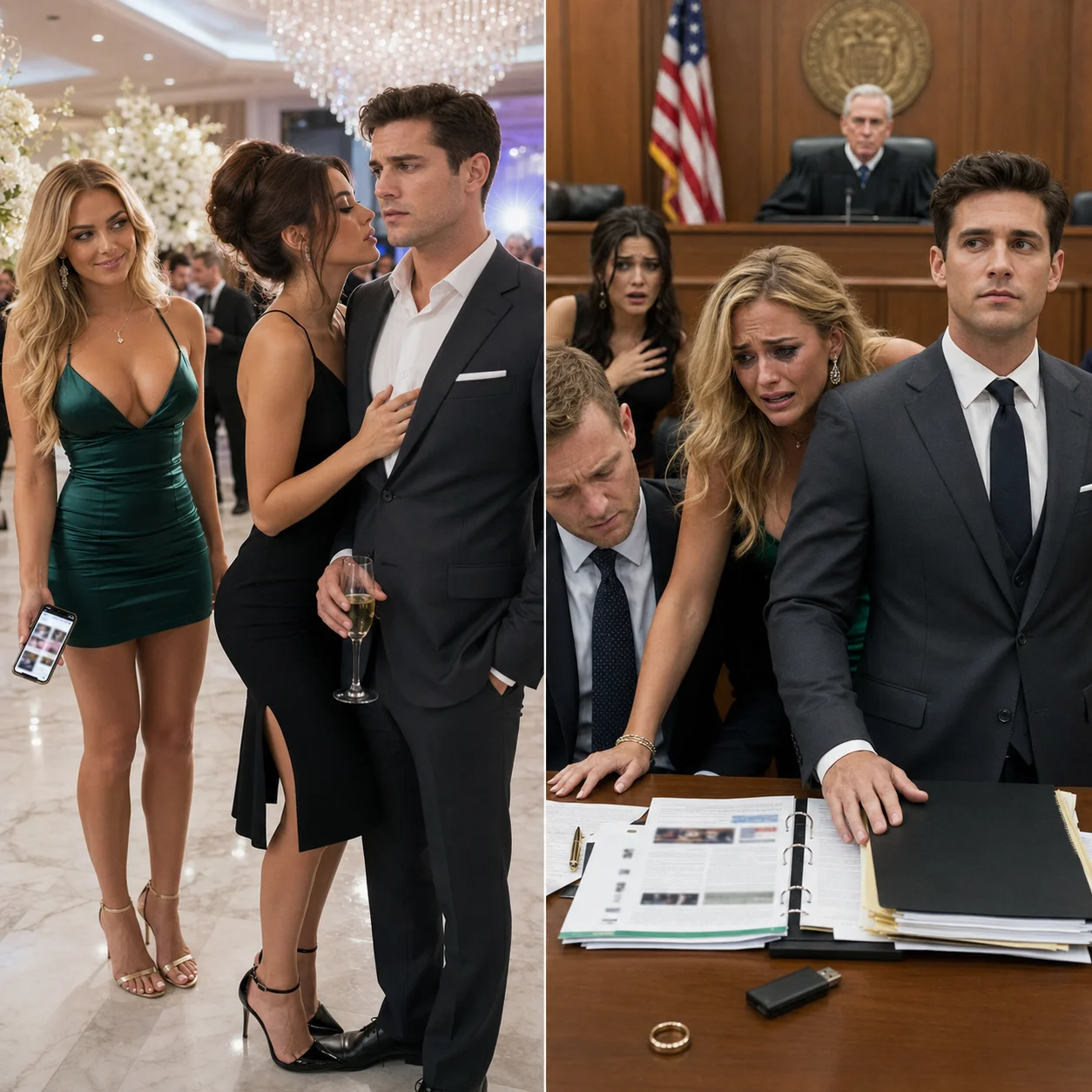
I was supposed to be married right now. That is still the strangest sentence to write, because for months I pictured this week very differently. I imagined waking up beside Emily in some overpriced honeymoon suite, tired from dancing, laughing about little things that went wrong during the ceremony, maybe reading cards from family members and feeling that quiet, overwhelming sense that our real life had finally begun. Instead, I am sitting alone in a smaller apartment, surrounded by half-unpacked boxes, with a legal judgment in my favor, a folder full of evidence archived on my laptop, and the peaceful knowledge that the worst day of my life may have saved me from the worst marriage of my life.
I am thirty-two. Emily is twenty-nine. Until recently, she was my fiancée. I loved her in the way people love when they believe sacrifice is proof of devotion. I paid for things without keeping score. I covered dinners when her father “forgot” his wallet. I helped her brother Joshua when he needed money for car repairs, rent, or phone bills. I paid the security deposit on our apartment. I bought her father, Paul, a custom suit for the wedding because he had “fallen on hard times.” I told myself generosity was part of building a family.
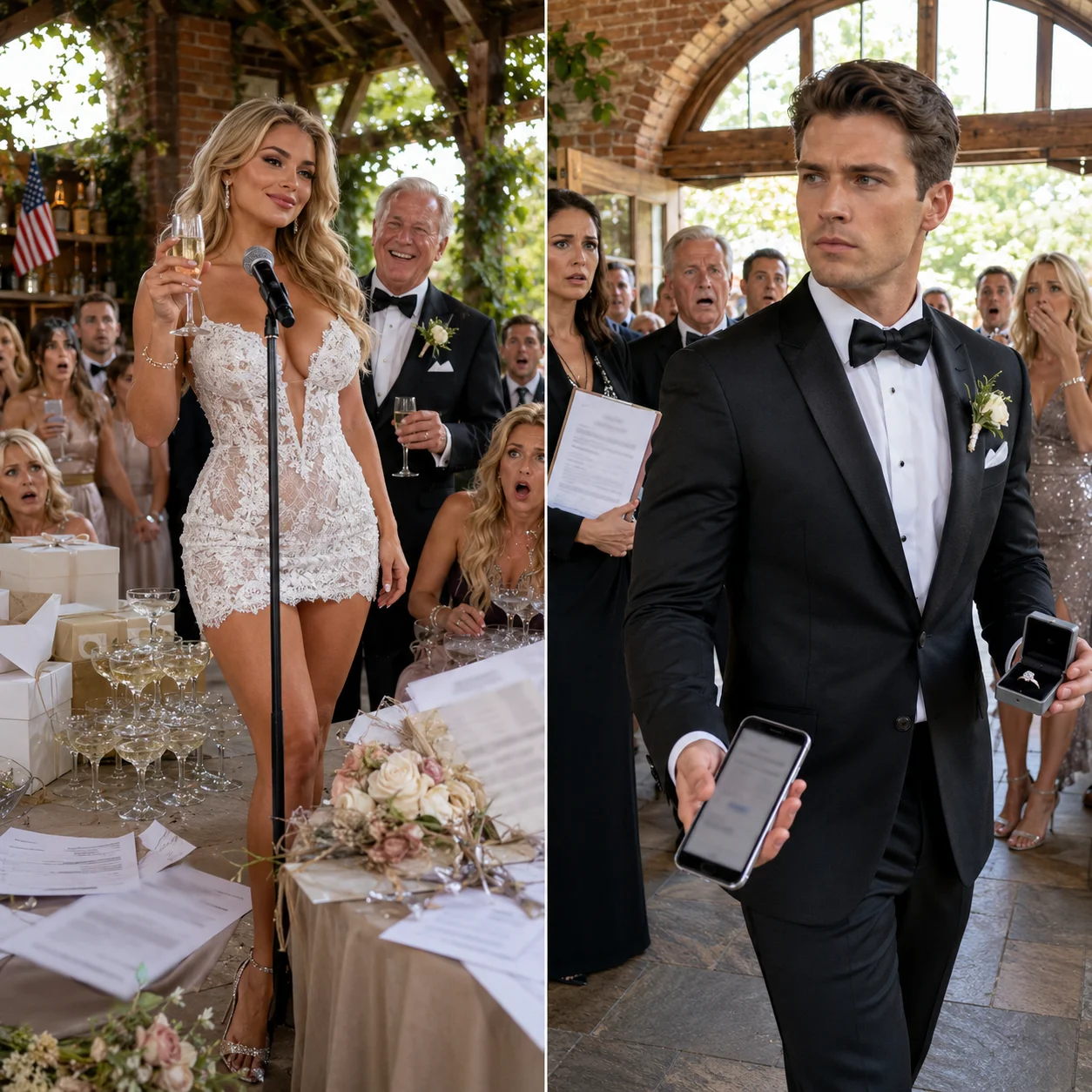
The wedding venue alone should have warned me. It was beautiful, but it cost a small fortune. Old brick walls, ivy climbing around tall windows, exposed wooden beams stretching over a cavernous reception room that looked like something out of a lifestyle magazine. Emily had always dreamed of a venue like that, and because I loved her, I paid for it. The deposit, the catering, the band, the flowers, the lighting, the planner, the little upgrades Emily kept adding because “we only get married once.” Every time the total went up, she kissed my cheek and told me I was the most amazing man alive.
I thought we were building a life together. Looking back, it felt more like a liquidation sale, and I was the one being liquidated.
The ceremony itself was beautiful. That is the part that still feels surreal. Nothing looked wrong at first. Emily looked incredible walking down the aisle. Her dress caught the afternoon light perfectly, and for a few minutes, I genuinely believed I was standing in the middle of the happiest moment of my life. Her mother, Donna, cried into a lace handkerchief. Paul shook my hand with that firm, needy grip of his, like he was always trying to prove he belonged at the head of a table. Joshua showed up late but at least wore the suit Emily picked for him. My own mother sat in the front row with wet eyes, proud and nervous in the way mothers get when they are watching their children step into something permanent.
After the ceremony, we moved into the reception room for champagne and speeches. The late afternoon sun came through the high windows, catching dust motes in the air so the whole room seemed to shimmer. Guests were smiling. Glasses were clinking. Emily stood beside me, my wife now, or so I believed, her hand resting lightly on my arm.
Then Paul tapped the microphone.
He gave the usual father-of-the-bride speech at first. He talked too loudly, laughed at his own jokes, and thanked everyone for coming. He said something vague about marriage being a partnership and family being the greatest blessing. Then he cleared his throat and said, “And now, a few words from my beautiful daughter, the bride.”
Emily practically glided to the microphone.
I remember how proud I felt watching her. She looked so composed, so radiant, so completely at home in the center of the room. She started with the expected things. She thanked everyone for coming. She told a sanitized version of our first date. She joked about how I had been nervous and spilled coffee on myself, which was true. People laughed. I laughed too. I was standing there with a champagne flute in my hand, my heart swelling in that ridiculous cinematic way people describe and I used to think was exaggerated.
Then her tone changed.
It was subtle at first. A small tremor in her voice. A practiced softness. She turned toward me with a smile that was just a little too wide.
“And of course,” she said, “I have to thank my incredible husband.”
There was a warm ripple through the room. A few people clapped. Someone made a little “aww” sound.
Emily paused like she was giving the moment room to bloom.
“He’s not just a wonderful partner,” she continued. “He’s a savior.”
That word made something cold move across the back of my neck.
Savior.
It sounded wrong. Too heavy. Too staged. Too public.
“Many of you know,” Emily said, her voice gaining strength, “that my family has faced some… unfair financial hurdles.”
My mother’s expression changed immediately. She sat up straighter, eyes narrowing just slightly. Some of the guests looked at one another. The room quieted.
“My father, a brilliant man, was betrayed in business,” Emily continued. “My mother has worked her fingers to the bone. It has been a heavy, heavy burden for us to carry.”
I glanced at Paul. He was sitting in the front row with his chest puffed out, nodding gravely like a politician at a charity gala. Donna dabbed her eyes, but I could not tell if the tears were real or part of the performance.
Emily turned fully toward me.
“And that is why I am so, so proud to announce that Andrew has insisted, truly insisted, on taking that burden from us.”
The room went perfectly still.
“As his first act as my husband,” she said, lifting her glass, “he is paying off my family’s entire debt. All of it. So they can finally have the fresh start they deserve.”
For a few seconds, nobody moved.
I could feel every face in that room turning toward me. Every friend, every relative, every coworker, every guest who had just watched us exchange vows was now staring as if waiting for me to perform generosity on command. Emily kept smiling. Paul beamed at me and gave a little thumbs-up from his chair.
That was the moment I knew he was in on it.
This had not been a misunderstanding. It had not been an emotional improvisation from a bride overwhelmed by the day. It was a plan. A public ambush. A financial hostage negotiation disguised as a wedding toast.
I knew Paul had money problems. He had mentioned a figure once, casually, something around twenty thousand dollars. I had privately considered helping with part of it as a wedding gift, not because I owed him, but because I thought easing one burden might help Emily start married life without so much stress from her family. I never told Emily I would pay off everything. I never agreed to become the emergency exit for every poor decision her family had made.
But the way she said entire debt made my stomach tighten. Entire debt. Not one loan. Not one overdue bill. Not one manageable number. A burden. Their burden. Now mine, because they had trapped me in front of a room full of witnesses and dressed coercion in white lace.
Emily raised her glass higher.
“To my husband,” she said, her voice bright and triumphant, “the most generous man alive.”
Nobody toasted.
The silence stretched. Emily’s smile started to falter at the edges. Guests exchanged confused, uncomfortable looks. My mother looked like she had swallowed a wasp. My cousin in the third row had his phone half-raised, recording. At the time, I did not know that shaky video would become the single most useful piece of truth I owned.
Something inside me became very calm.
It was not anger exactly. Anger came later. In that moment, what I felt was clarity so sharp it almost felt peaceful. I saw my future with Emily unfold all at once. Every holiday would come with a request. Every family dinner would become a negotiation. Every financial decision would be weighed against Paul’s failures, Donna’s tears, Joshua’s irresponsibility, and Emily’s belief that love meant absorbing whatever debt her family dragged to the door.
I would not be a husband.
I would be an ATM with a wedding ring.
Emily stared at me, waiting. The room waited too.
I lowered my champagne flute.
The microphone was on a small stand nearby. I walked over, picked it up, and looked at Emily. Her expression shifted again, relief flashing across her face because she thought I was about to play my part. She thought I would laugh, say something humble, maybe promise in front of everyone that her family would never struggle again.
I leaned into the microphone.
“What a burden.”
My voice was quiet, but it carried through the whole room.
Then I set the microphone down.
For one second, the silence deepened into something almost physical. Emily’s face froze. Paul’s smile collapsed. Donna’s hand dropped from her chest. Joshua muttered something I did not hear.
I turned away from them and walked straight to Kimberly, the wedding planner. Kimberly was a very capable woman who had handled every crisis that day with grace, from a late florist to a broken boutonniere. Now she stared at me with her mouth slightly open.
“Kimberly,” I said quietly, “please send me the final itemized bill for today. Everything. Cancel the reception, the band, the dinner, all of it. Pay the staff for their full scheduled time and add a generous tip. Use the card on file.”
Her eyes widened. “Andrew…”
“It’s over,” I said.
She glanced past me at the front of the room. I did not turn around, but I could hear the first wave of chaos rising behind me.
“It’s over,” I repeated more firmly.
Emily’s voice cracked through the room behind me. “Andrew?”
Then louder. “Andrew, what are you doing?”
I did not answer.
I walked out through the main doors into the late afternoon sun. The air outside felt cold against my face even though the day was warm. Behind me, I could hear voices swelling, shouts beginning, chairs scraping against the floor. I kept walking. I did not look back.
The first twenty-four hours afterward were a blur by choice. I turned my phone off and let the fallout happen without me. When I turned it back on the next day, it was like opening the door to a burning building.
One hundred seventeen missed calls.
Mostly Emily, Paul, Donna, and Joshua. A few mutual friends. More than two hundred texts. Rage, pleading, gaslighting, threats, apologies that were not apologies.
Emily wrote first.
How could you do that to me? To my family? You humiliated me. Call me now.
An hour later: I can’t believe you would throw everything away over a misunderstanding. It was a grand gesture, you idiot. A way to show everyone how much you loved me.
Twelve hours later: I’m at our apartment. I’m not leaving until you come here and we talk this out like adults. You owe me that.
Paul’s messages were exactly what I expected.
You’re a coward and a child. You embarrassed my daughter and my family, and you will answer for that.
Donna tried a softer weapon.
Andrew, honey, please. There’s been a terrible mistake. Emily is just beside herself. She loves you so much. She was just proud of you. Please call me. We’re family.
We’re family.
That one almost made me laugh. That was the entire trick, wasn’t it? Wrap debt in the language of family. Wrap manipulation in tears. Wrap entitlement in tradition. Then act shocked when the person being cornered refuses to call it love.
I ignored all of them.
Instead, I opened my laptop and created a folder in my email called The Project.
That was not a dramatic name, but it fit. This was no longer about feelings. Feelings had been used against me for too long. The Project was about facts.
I moved everything into that folder. The venue contract. Catering invoices. Band deposit. Florist emails. Planner documents. Receipts for alcohol, décor, transportation, tailoring, everything. Then I started a spreadsheet with three columns: expense, amount, who paid.
I went through my credit card statements for the last eighteen months. Every dinner Emily’s family insisted on where Paul conveniently forgot his wallet. Every loan to Joshua for his car, rent, phone bill, or vague emergency that never got repaid. The two thousand eight hundred fifty dollar security deposit on our apartment, paid entirely from my savings. The custom suit I bought for Paul because he had “fallen on hard times.” Little charges, big charges, favors that had not felt like favors at the time because I thought I was helping my future family.
Then I got to the wedding gifts.
The gift table had been near where Emily’s family was sitting. In the chaos after I walked out, I was certain they secured everything. Physical gifts, envelopes, cards, checks, cash. I did not know the value yet, but I knew enough to add a new line.
Wedding gifts. Value unknown. Possession: Paul and Emily.
It was another debt they owed me, and maybe one I would never fully collect, but I would not pretend it did not exist.
Then I called my lawyer.
Not to sue. Not yet. I needed advice on disentangling myself cleanly. People imagine breakups are emotional explosions. Sometimes they are. But the real end of a life you planned together is paperwork. It is leases, passwords, bank accounts, receipts, written notices, itemized bills, and the cold comfort of documentation.
The first message I answered came from Emily that evening.
I’m at the apartment. Joshua’s here with me. We need to talk. I’m not leaving.
My blood ran cold.
Joshua was a freeloader with a temper. The kind of man who thought other people’s homes existed for his convenience. He left muddy sneakers on new rugs, drank your expensive beer, and called it “being comfortable.” The idea of him in my apartment, around my belongings, emboldened by Emily and Paul, made something harden in me.
I replied for the first time.
The apartment is in my name only. I will be there tomorrow at noon with a friend to collect my personal belongings. You have thirty days to vacate the premises as per standard tenant law. Official notice will be delivered tomorrow.
Her response came instantly.
Our apartment. You can’t be serious. You’re kicking me out after you left me at the altar? Are you kidding me? You’re the monster here.
I screenshotted the exchange and saved it to The Project.
The next day, I brought Steven.
Steven is my friend from college, and he is built like a refrigerator with the temperament of a professional hostage negotiator. He is calm in a way that makes angry people feel ridiculous. When we arrived at the apartment, Emily was there. So were Paul, Donna, and Joshua.
Joshua was lounging on my couch wearing one of my university hoodies.
That hoodie had survived finals, bad winters, moving apartments, and years of careless laundry. Seeing him wear it with a smug look on his face made my jaw tighten more than I expected.
Donna started crying the second she saw me.
“Andrew, how can you be so cold?”
Paul stepped forward, jabbing a finger in my direction. “I’m not letting you in. You have no right.”
Joshua chimed in from the couch. “Yeah, get lost, man. You don’t get to just walk in here.”
I ignored Joshua and Donna completely. I looked at Paul.
“The lease is in my name,” I said. “You are currently trespassing.”
Paul scoffed. “This is my daughter’s home.”
“No,” I said. “It is an apartment leased under my name. Steven, would you mind calling the non-emergency police line so an officer can mediate this?”
Paul’s face went purple.
That was not part of their script. Their entire strategy depended on emotion, pressure, and family shame. Actual impartial authority was not something they wanted in the room.
He sputtered for a moment, then stepped aside.
The next two hours were a masterclass in petty obstruction. Donna “accidentally” stood in front of boxes. Paul muttered under his breath. Joshua made comments from the couch about my “little toys” while wearing my hoodie and drinking from a mug I bought. Emily followed me from room to room, her voice low and shaking.
“Remember that weekend in the mountains?” she whispered. “Did that mean nothing to you?”
I did not answer.
That was the hardest part, not because I wanted to reconcile, but because I recognized the hooks. Memory as bait. Nostalgia as leverage. She was reaching into our happiest moments and trying to use them as a rope to pull me back into the same trap.
I packed my clothes, my books, my computer, important documents, keepsakes from my family. I documented everything as I went. Photos of scuff marks on the wall where Joshua had obviously banged his bike. A wine stain on the rug. A missing espresso machine I had bought six months earlier.
DeLonghi espresso machine. $800. Missing.
By the time I finished, Emily’s anger had started cracking into something closer to fear. When I handed her the printed formal notice to vacate, she stared at it like paper could physically injure her.
“This is insane,” she whispered. “My whole life is in this apartment.”
“You have thirty days,” I said.
Then Steven and I left.
The social fallout was messy at first. Emily got to people quickly. Some mutual friends heard about my “psychotic break” at the wedding and chose her side before asking a single question. According to her version, she had made a heartfelt speech, and I had humiliated her out of nowhere because I was controlling, cruel, and embarrassed by her family’s financial struggles.
For the first few days, I stated facts only. I did not rant. I did not post. I did not defend myself to people who had already decided that calm evidence was less exciting than a crying bride.
Then my cousin sent me the video.
He had been sitting in the third row and started recording when Emily’s speech shifted. The footage was shaky, and the audio had a little background noise, but Emily’s words were perfectly clear.
He is paying off my family’s entire debt. All of it.
Then my reply.
What a burden.
The clip showed enough. Her tone. Paul’s thumbs-up. The shocked silence. My calm response. It was the difference between a story and evidence.
After that, I did not need to say much.
I sent the clip to the people who mattered. My closest friends. A few relatives. The mutual friends who had reached out quietly. Some apologized immediately. Others disappeared, which was an answer of its own. The truth has weight when you stop decorating it.
I also sent Emily one final text about the wedding gifts.
Please provide a full list and return my half. Otherwise, I will add it to the list of debts to be settled.
Her response was short, furious, and extremely revealing.
Those were gifts to our family.
I saved the screenshot.
The Project continued.
Emily did not leave the apartment after thirty days. Of course she did not. She used every delay available, filed motions, claimed hardship, and dragged the process out for another three months. At first, it made me furious. I was paying for an apartment I could not live in while she remained there, surrounded by items I had purchased, telling anyone who would listen that I had abandoned her.
But bureaucracy, while slow, has one advantage over emotional manipulation. It does not care how loudly someone cries.
I stopped engaging directly. My lawyer handled the filings. The notices went out properly. The deadlines passed. The documentation stacked higher. Every message from Emily went into the folder. Every bill was recorded. Every delay became part of the paper trail.
Finally, the day came when sheriff’s deputies escorted her out.
I did not go myself. That was one of the healthiest decisions I made. I sent a property management agent to handle the walkthrough. When I received the report, I sat at my desk and read it slowly.
It was grim.
Holes in the drywall. Garbage left behind. Stains on the carpet. Damaged blinds. Scratches on the floor. Missing blender. Missing air fryer. Missing espresso machine. The agent’s report was clinical and damning, full of time-stamped photos that said more than any angry message could.
The next day, I went to the police station.
I knew a criminal case over appliances was unlikely to go far, but that was not the point. The point was documentation. I filed a formal report for theft, listing each missing item and its approximate value. I walked out with an official police report number.
One more piece of paper.
One more brick in the wall of facts.
Then I filed in small claims court.
My claim was not for heartbreak. It was not for humiliation. It was not for the wedding speech, the public ambush, or the months of stress that followed. Those things were real, but courts do not exist to validate your emotional wounds just because someone betrayed you beautifully in a rented venue.
My claim was for tangible, provable damages.
Repair costs to the apartment, backed by the property manager’s report and contractor invoices. Her share of the final four months of utility bills, which she refused to pay. The value of the missing appliances, backed by receipts and the police report number. The total came to just under five thousand dollars.
The court date took another two months.
Emily represented herself.
She looked different when she walked in. Still polished, but tired in a way makeup could not fully hide. Paul came with her and sat behind her like a disapproving statue. Donna was not there. Joshua was not there either. Maybe even he understood that court was less forgiving than a family argument.
Emily’s defense was not really a defense. It was a performance.
She told the judge I was a cruel millionaire. I am not. She said I had abandoned her after emotionally manipulating her into depending on me. She said the appliances were “ours” and that she deserved them as emotional alimony. She said the apartment damage was normal wear and tear. She implied I had used money to control her, then punished her when she tried to stand up for herself.
When she finished, the judge looked tired.
Then it was my turn.
I presented the lease. The move-in checklist. The dated walkthrough photos from before and after. The repair invoices. The utility bills. Receipts for the missing appliances. The police report.
When the judge asked about the appliances, I kept my voice steady.
“Your Honor, I have receipts showing I purchased them. My ex-fiancée does not. I also have a police report filed the day I regained possession of the apartment declaring those items stolen.”
The judge was not impressed by “emotional alimony.”
I won.
The judgment was for four thousand six hundred fifty dollars. The judge adjusted the appliance value for depreciation, which was fair. It was not a life-changing amount of money, but it was a public record. A legal, binding consequence. Something Emily could not rewrite as a misunderstanding, a grand gesture, or proof that I had failed to love her correctly.
The social reputation of her family crumbled quietly after that.
The wedding video had already done most of the work. People might forgive money problems. They might even sympathize with debt. But watching a bride publicly announce, without consent, that her new husband would pay off her family’s entire debt made something very clear. It was not vulnerability. It was strategy.
I eventually did a little digging through public records. I wish I could say I was too noble for that, but I had spent months being painted as a monster and wanted to know exactly what burden they had tried to place on my back.
I found it.
A one hundred sixty-seven-thousand-dollar tax lien against Paul’s defunct business.
That was the number.
Not twenty thousand. Not a difficult but manageable family emergency. One hundred sixty-seven thousand dollars, plus whatever other private debts they had hidden behind vague phrases like “unfair financial hurdles” and “a fresh start.”
That was what Emily had planned to announce into my life five minutes after becoming my wife.
From what I heard afterward, she moved back in with her parents. Their financial situation got worse. Paul remained bitter. Donna told people she had “lost a son.” Joshua complained online that wealthy people had no loyalty. Emily stayed convinced she was the victim, because some people would rather lose everything than admit they tried to steal someone else’s future with a smile.
But eventually, they became background noise.
The first night in my new apartment felt strange. It was smaller than the place Emily and I had shared. The kitchen was outdated. The bedroom barely fit my bed and dresser. There were no exposed beams, no wedding flowers, no carefully curated furniture Emily had chosen and I had paid for. But when I turned the key in the lock, I felt something I had not felt in a long time.
Ownership.
Not just of the apartment. Of myself.
I spent the first weekend unpacking slowly. Books first, because that made the place feel like mine. Then the kitchen. Then clothes. I ordered a cheap coffee maker instead of replacing the stolen espresso machine immediately, and the first morning I used it, the coffee tasted terrible and still somehow better than anything from my old life.
A few weeks later, while unpacking a box I had ignored, I found a framed photo of Emily and me. It had been taken during our engagement shoot. We were standing in a park, her hand on my chest, both of us smiling like people who had no idea what was coming.
For a moment, I just looked at it.
The old version of me would have stared until sadness arrived. He would have replayed every good memory. He would have wondered whether he had been too harsh, whether he should have pulled her aside privately, whether love required one more conversation.
But that man was gone.
I took the photo out of the frame, tore it into four clean pieces, and dropped it in the trash.
I felt nothing dramatic. No rage. No grief. No cinematic rush of freedom.
Just quiet.
That was how I knew I was healing.
Months have passed now. The judgment is still unpaid, because of course it is, but it exists. My lawyer says there are ways to enforce it if I choose. For now, I keep the paperwork safely filed. Not because I want revenge, but because I have learned the value of evidence when dealing with people who treat truth like a flexible material.
The Project folder is archived.
I kept one copy in cloud storage, one on a drive, and one printed because old habits die hard when someone has tried to rewrite your life in real time. But I do not open it anymore. I do not reread the messages. I do not watch the wedding clip. I do not check on Emily. I do not ask mutual friends for updates. I spent enough of my life inside her family’s crisis. I refuse to rent them space in my head for free.
My mother visited last month and brought soup, which is her way of saying she is worried without using the word worried. She walked around the apartment, touching the backs of chairs, inspecting the kitchen, quietly taking in the fact that I was alone but not destroyed.
At one point, she stood by the window and said, “I keep thinking about that day.”
“So do I,” I admitted.
“She looked so sure you would say yes,” my mother said.
I nodded. “So did I, once.”
My mother turned to me, her eyes soft. “I’m proud of you for walking out.”
That almost broke me more than the wedding did.
Because the truth is, walking away did not feel heroic when it happened. It felt cold, terrifying, almost unreal. There was a moment after I left the venue when I sat in my car with my hands on the steering wheel and wondered whether I had just detonated my entire life. I had. But some lives need to be detonated before they become prisons.
Now, on quiet evenings, I cook simple dinners in my small kitchen. I pay my own bills. I answer to no one’s father, no one’s brother, no one’s invented emergency. I sleep without checking whether another financial request is waiting on my phone. I buy things because I need them, not because I am trying to prove devotion to people who measure love in dollars.
Sometimes I remember Emily standing at that microphone, beautiful and smiling, announcing my future like she owned it.
I remember the silence afterward.
I remember Paul’s thumbs-up.
I remember the exact moment I understood that being generous without boundaries is not kindness. It is self-abandonment.
Emily wanted a savior. Paul wanted a bailout. Donna wanted family to mean obligation. Joshua wanted access. They all thought the wedding would make me too embarrassed, too trapped, too publicly committed to refuse.
They forgot one thing.
A wedding is not a contract to carry someone else’s burden without consent.
And love is not debt collection with flowers.
My life is no longer a negotiation. It is not a family bailout plan. It is not a public performance. It is not an open wallet disguised as a husband.
It is just my life.
And the silence is wonderful.
![[FULL STORY] My Girlfriend Said She Didn’t Like My Kids From My Previous Marriage. I Heard Her Clearly And ...](https://social-media.rabedo.com/thumbnails/1777180732_R7.png)
![[FULL STORY] At a Family Gathering, She Announced: 'My Ex Will Always Be in My Life, Accept It or Don’t Marry](https://social-media.rabedo.com/thumbnails/1777307810_M5.png)
![[FULL STORY] My fiancée told me, "Don't expect any gift from me this Christmas."I calmly replied, "Fair](https://social-media.rabedo.com/thumbnails/1776959918_48.png)