
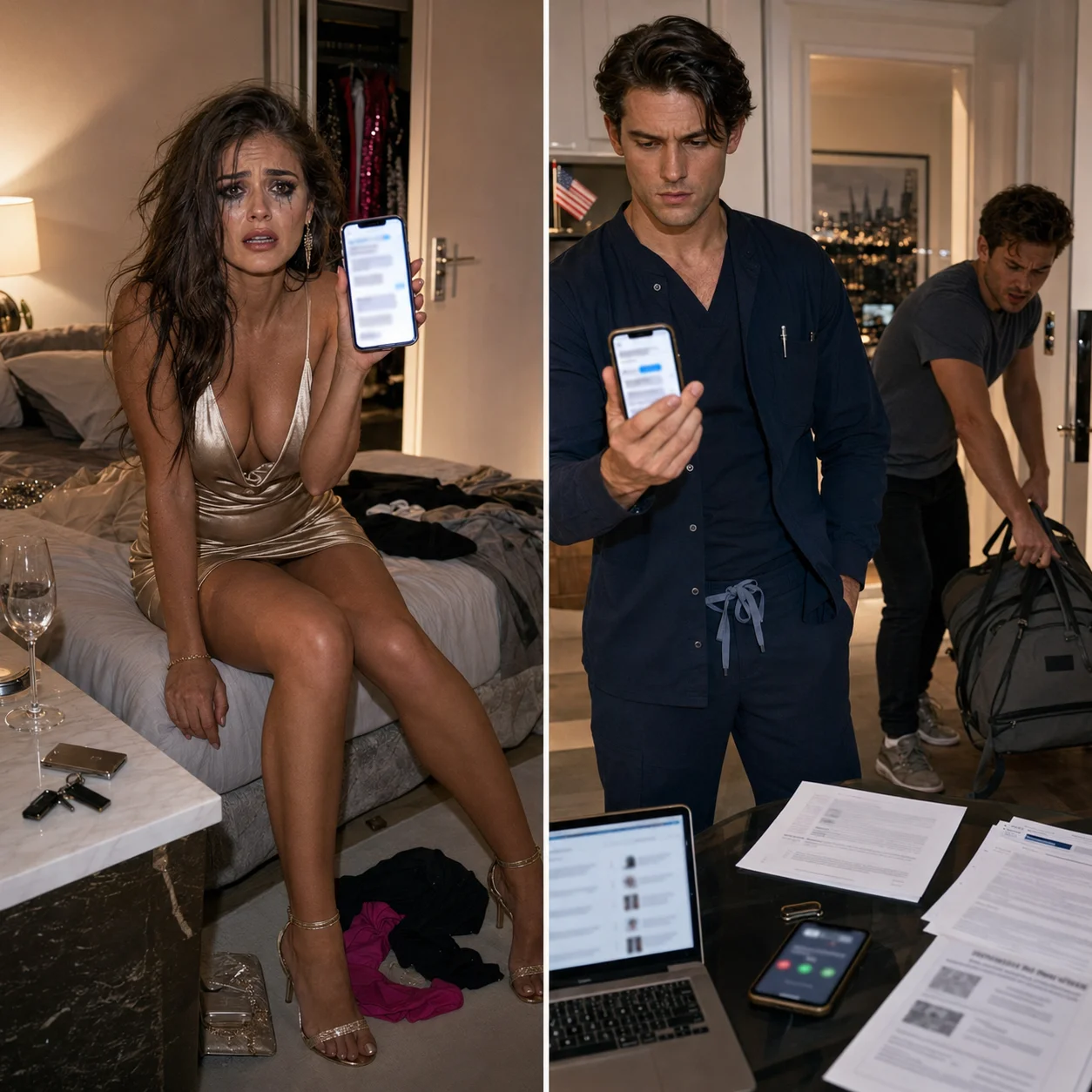
Melissa texted me at 2:47 a.m. on a Tuesday.
I know the exact time because I was half-asleep after a twelve-hour shift at the hospital, lying in bed with one arm thrown over my face, trying to convince my brain to stop replaying patient scans, hallway alarms, and the fluorescent buzz of the radiology department. My phone lit up on the nightstand, and for a second, I thought it was work. Then I saw her name.
Melissa.
Eight months had passed since I caught her in my apartment with Derek, her “just a friend from work” coworker. Eight months since I walked in after a night shift and found her using my spare key to bring another man into my bedroom while I was helping run imaging exams on strangers in the middle of the night. Eight months since she tried to tell me they were “just watching Netflix” while half-dressed on my couch like I had lost the ability to understand human behavior.
I should have blocked her everywhere. I know that now. At the time, I left one line open, mostly because breakups make you stupid and part of me wanted proof that she might one day understand what she had done. Not because I wanted her back. Not exactly. More because betrayal leaves this ugly unfinished feeling in you, like someone set your house on fire and never admitted there was smoke.
Her text was long. Rambling. Emotional in that polished way Melissa could be when she wanted something. She wrote about how much she had grown, how she had realized what she lost, how she could not stop thinking about what we had. She said she missed the way I made her feel safe. She said she had made the biggest mistake of her life. She said she knew she did not deserve it, but she was asking anyway.
The last line read, “Please give me another chance. I’ll do anything.”
I stared at the screen for maybe thirty seconds.
Then I typed back, “Apology accepted.”
That was it.
No speech. No anger. No emotional essay about closure or pain or how badly she had wrecked me. Just two words, because that was all I had left for her.
Immediately, the typing bubble appeared. Three little dots jumping like they were trying to dig themselves out of a grave. I could almost picture her on the other end, drunk or lonely or both, suddenly hopeful because I had answered instead of ignoring her.
Before she could send whatever novel she was preparing, I took a screenshot of our conversation and forwarded it to her current boyfriend, Marcus.
I had met Marcus once at a friend’s birthday party months earlier. He seemed like a decent guy. Quiet, solid, maybe a little too eager to believe Melissa’s version of everything. Back then, she had introduced him like she was announcing she had upgraded from me, which was funny considering she spent half the night watching whether I noticed.
I sent Marcus the screenshot with one simple message.
“Hey man, thought you should see this. She sent this twenty minutes ago. For context, she cheated on me with her coworker Derek in my own apartment. Just looking out for you.”
Then I put my phone down and went back to sleep.
Or tried to.
Twenty minutes later, my phone exploded.
Seventeen missed calls from Melissa. One after another. I watched the screen light up, go dark, light up again. On the eighteenth call, curiosity got the better of me, and I answered.
“You vindictive piece of garbage,” she screamed before I could say hello. “How dare you?”
“Good morning to you too.”
“Marcus just broke up with me. He’s packing his stuff right now. This is your fault.”
I sat up slowly, rubbing my eyes. “Actually, I’m pretty sure it’s your fault for texting your ex at three in the morning asking for another chance while you have a boyfriend.”
“I was drunk,” she snapped. “It didn’t mean anything.”
“Then why are you so upset?”
She hung up on me.
That should have been the end of it. A messy, pathetic little episode in the long afterlife of a bad relationship. But Melissa had never handled rejection well. Not when we were dating, not when I caught her cheating, and definitely not when her latest relationship collapsed because she had once again mistaken secrecy for safety.
I knew the storm was only starting.
First, she called my mother.
At seven in the morning on a Saturday, my mom answered the phone to Melissa sobbing about how I had ruined her life and manipulated the situation. Melissa told her I had “weaponized a vulnerable moment” and tried to destroy her happiness because I could not move on.
My mom, who has loved me through enough nonsense to recognize a performance when she hears one, simply said, “Sweetheart, you texted him first.”
Melissa hung up on her too.
Then came the social media campaign. Melissa posted a long Instagram story about toxic exes who could not let go, narcissistic revenge, and how some people would rather sabotage your healing than watch you grow. She used soft fonts, a sad selfie, and a song about betrayal playing underneath it. It would have been almost impressive if it had not been so predictable.
The comments were chaos. Half her friends called me trash, a bitter ex, and proof that women should be careful whom they trust. The other half, including a few people with apparently functioning brains, pointed out the obvious: she had texted me first while in a relationship.
Melissa did what Melissa always did when truth made her uncomfortable. She tried to drown it under volume.
The real kicker came the next day when I got a text from an unknown number.
“This is Becca, Melissa’s sister. What you did was messed up and you know it. She’s been crying for three days. Marcus won’t even talk to her. You need to fix this.”
I stared at the message while eating cereal at my kitchen counter.
“How exactly should I fix your sister texting me at 3 a.m. while she has a boyfriend?” I replied.
“You didn’t have to forward it to Marcus. That was pure revenge.”
“It was transparency. Something your sister might want to try.”
“Forget you. You always were a self-righteous prick.”
“And yet your sister still wanted me back.”
She blocked me after that.
I thought that would be the most ridiculous moment of the week.
I was wrong.
Because Derek, yes, the coworker Melissa cheated with, suddenly slid into my DMs.
“Bro, that was cold what you did to Mel.”
The audacity of that message was so enormous I actually laughed out loud. I did not respond. I screenshotted it, posted it to my story, and added one caption: “The audacity.”
My friends had a field day. People who had been there for the original breakup started messaging me jokes, memes, and variations of “there is no way this man is serious.” For a few hours, it felt almost funny. Like Melissa and Derek were characters in a badly written drama who had somehow escaped the script and started improvising.
Then Marcus called.
I woke up the next morning to twelve missed calls from him. Not Melissa. Marcus.
When I called him back, he sounded like a man standing in the wreckage of a house he had only just realized was built out of cardboard.
“Bro,” he said. “I need to know everything. Everything. Was she always like this?”
I leaned back against my kitchen counter and took a breath. “What happened?”
“She’s been lying to me,” he said. “A lot.”
So I told him what I knew.
I told him about the night I found Melissa with Derek in my apartment. How she had been using my spare key while I worked night shifts. How she had tried to gaslight me on the spot, insisting they were just hanging out, just watching Netflix, just talking, as if the entire scene was not obvious. I told him how, afterward, she convinced half our friend group that I was controlling because I had been uncomfortable with her spending late nights alone with male coworkers. I told him how she cried in public and sneered in private. How she made every boundary sound like insecurity and every consequence sound like abuse.
Marcus went quiet.
Then he said, “She told me you were abusive.”
I closed my eyes.
Of course she had.
“Said you were jealous and possessive,” he continued. “Said that’s why she had to leave.”
“Let me guess,” I said. “She also told you Derek was gay.”
The silence on the other end changed.
“How did you know that?”
“Because she told me he was gay too,” I said. “Right up until I found them together.”
Marcus swore under his breath.
Then he told me Melissa had not just texted me. After he confronted her and went through her phone, he found messages to three other exes. Different names, same emotional template. Late-night nostalgia. I miss us. I made a mistake. You understood me better than anyone. All while she was supposedly building a future with him.
The screenshot I sent him had not been the first red flag.
It was just the one he could no longer explain away.
But Marcus was not done digging. In the kind of move only a man fueled by betrayal and caffeine could make, he contacted Derek on LinkedIn and asked to meet for coffee. A professional networking ambush, basically. Derek showed up nervous, apparently thinking Marcus might beat him up. Instead, Marcus asked questions.
And Derek spilled.
Not only was Derek not gay, but Melissa had pursued him for months before we broke up. She had told him we were in an open relationship. She had told him I knew about them. She had told him she was unhappy, trapped, and waiting for the right time to leave. Derek claimed he only realized she had lied when I walked in on them and completely lost it.
He had tried to apologize afterward, according to Marcus, but I had blocked him everywhere.
“So why did Derek DM me calling me cold?” I asked.
Marcus went quiet for a second.
“That wasn’t Derek, bro.”
“What?”
“That was Melissa. She has his Instagram password. Apparently, she has like four exes’ passwords because she ‘helps them with social media.’”
I pulled up the DM again. Now that Marcus said it, I noticed things I had missed. The tone was off. The profile activity had shifted. Recent posts had that same Melissa flavor: motivational quotes, sunset pictures, gym selfies staged like someone else had chosen the lighting. It was absurd, and still, somehow, believable.
We talked for two hours.
By the end of it, Marcus had moved back in with his parents and scheduled an STD test just in case. He sounded embarrassed, angry, and relieved all at once. Before we hung up, he asked me something I expected but still had to think about.
“Why did you forward the screenshot immediately?” he asked. “Why not just ignore her?”
I looked across my apartment at the place where I had once found her with Derek. I had moved the furniture since then, but memory does not care about interior design.
“Because eight months ago, I wish someone had told me the truth about her,” I said. “Figured I’d pay it forward.”
For a few days after that, I thought the worst was over.
Melissa had lost Marcus. Her sister had yelled. Her social media post had backfired. Derek had been exposed as either a liar, a fool, or both. I thought maybe she would finally retreat and start rewriting the story somewhere I did not have to see it.
Instead, she tried to burn my life down.
I am a radiologic technologist at a major hospital. It is a good job. Stable. Demanding, but honest. I have been there three years with zero major issues, good reviews, solid relationships with my team. So when my supervisor, Rachel, called me into her office, I was not worried at first.
Then I saw her face.
“We received a complaint about you,” she said.
She slid a printed email across the desk.
My stomach dropped before I even finished the first paragraph. Someone had sent an anonymous email to the hospital’s HR department. Three pages accusing me of unprofessional behavior, sexual harassment of coworkers, and creating a hostile work environment. The language was dramatic but vague, the kind of complaint written by someone who understood accusation but not evidence.
Then I read closer.
The email referenced incidents that supposedly happened outside work, in places I had only ever been with Melissa. It used phrases she had used during our arguments. Words like “controlling,” “unstable,” “punishing,” and “narcissistic retaliation.”
I looked up at Rachel.
“This is my ex-girlfriend,” I said. “She’s been harassing me for two weeks because I exposed her cheating to her current boyfriend.”
Rachel nodded slowly. “I figured it might be something like that.”
That surprised me.
She continued, “IT traced the email. It came from a coffee shop IP address, sent from a Proton Mail account created the same day. We are not taking any action based on an anonymous complaint with no evidence. But I need you to document everything. If she escalates, we will involve legal.”
I showed her the texts, the calls, the Instagram posts, the DM that was probably Melissa pretending to be Derek. Rachel’s eyebrows rose higher with each screenshot.
“Your ex seems unstable,” she said.
“That’s one word for it.”
I walked out of that office shaken but grateful. A less competent manager could have let an anonymous accusation stain my reputation before asking questions. Rachel did the right thing, and I will always respect her for that.
I thought that was Melissa’s extinction burst.
Again, I was wrong.
Two days later, my apartment building’s management called. Someone had reported me for noise violations, aggressive behavior toward neighbors, and possible drug activity.
My building manager, Tony, sounded more confused than alarmed.
“Jake,” he said, “you are literally our quietest tenant. You work nights and barely make a sound. What’s going on?”
I explained the situation.
Tony pulled up the complaint email. Same writing style. Same phrases. Same Proton Mail domain. Same desperate attempt to create smoke where there was no fire.
“We’ll disregard it,” Tony said. “But if this keeps happening, you should consider a restraining order.”
Then the Yelp reviews started hitting the hospital.
One-star reviews mentioning me by name. Claims that I had been rude, unprofessional, and had made inappropriate comments during exams. All posted within a six-hour window. All from accounts created that day. Some used identical wording. One even misspelled a medical term in a way Melissa used to when she tried to sound knowledgeable about my job.
At that point, the hospital’s legal department got involved.
They issued a cease and desist letter to Melissa’s last known address. Rachel told me to keep doing my job, keep documenting everything, and not engage. My coworkers, once they understood what was happening, circled around me in that quiet hospital way people do when they know someone is being targeted unfairly. No dramatic speeches. Just extra coffee left near my station. Someone covering a break without making a big deal of it. A nurse from the ER saying, “People are wild,” and handing me a donut.
The false complaints stopped after the legal letter.
But the real karma came from somewhere Melissa never expected.
Derek’s actual girlfriend.
Yes. Plot twist. Derek had a girlfriend the entire time he was hooking up with Melissa. Her name was Carmen, and she worked in the same company as Derek and Melissa, but in a different department. She had no idea about Melissa until Marcus reached out to Derek for that coffee chat.
When Marcus contacted Derek, Derek panicked and brought backup in the form of his buddy Tom from accounting. Tom, unfortunately for Derek, happened to be dating Carmen’s best friend Emma. And Emma, apparently being a person with a functioning moral compass, heard about the drama from Tom and immediately called Carmen.
“Girl,” she said, according to Carmen later, “you need to hear this.”
Carmen confronted Derek. Derek tried the usual sequence: denial, minimization, partial admission, then the “brief mistake” routine. Carmen dumped him on the spot.
Then she messaged me on Instagram.
“Hey, I know we don’t know each other, but I heard about what your ex put you through. I just found out my boyfriend was the other guy. I’m really sorry for what happened to you.”
I stared at that message for a while before replying. There is a strange bond between people harmed by the same liar. You do not know each other, but you recognize the same wreckage.
We talked. Compared notes. Shared timelines.
It turned out Melissa had told Derek all kinds of lies too. She told him she was leaving me. She told him we were separated. She told him I was abusive and that she needed comfort. Carmen was furious, not just at Derek, but at Melissa.
“She knew he had a girlfriend,” Carmen wrote. “We met at company events. She smiled in my face knowing she was sleeping with my boyfriend.”
Then Carmen sent one more message.
“I think it’s time Melissa learned that actions have consequences.”
Carmen worked in HR, though not at Derek and Melissa’s company anymore. She had transferred to a competitor after getting promoted, but she still had connections. A lot of them. And people in certain industries talk. Not loudly at first. Not in a way that shows up in official documents. But they talk over coffee, in private messages, at networking events, in the kind of quiet professional whisper networks that exist long before HR ever writes anything down.
Within a week, word spread through their industry.
Melissa had pursued taken men. Melissa had lied about relationships. Melissa had tried to destroy an ex’s hospital career with false anonymous complaints after being exposed. Melissa had used people’s passwords, impersonated accounts, and turned every breakup into a smear campaign.
Her LinkedIn started changing.
Former coworkers removed her as a connection. Recommendations disappeared one by one. People who used to comment supportively on her career updates went silent. The women in her orbit did what women do when they realize someone is not messy in a harmless way but dangerous in a targeted way. They warned each other.
Then came the “restructuring.”
Melissa’s company announced her position had been eliminated. Officially, it had nothing to do with any of this. Companies love that word, restructuring. It can mean budgets, strategy, politics, or “you have become a liability and we found a legal way to make you someone else’s problem.”
Unofficially, Emma’s boyfriend Tom from accounting had apparently mentioned to his boss that Melissa had been making the workplace extremely uncomfortable for several people. Other stories surfaced. Old issues that had once seemed small suddenly looked like part of a pattern.
Melissa called me one last time the following week.
I almost did not answer, but curiosity won.
She was sobbing.
“I lost everything,” she said. “My job, Marcus, my reputation. Are you happy now?”
I sat on the edge of my bed and listened to her cry through the speaker.
“Melissa, I didn’t do anything except forward your own words to the person who deserved to see them. Everything else was you.”
“You turned everyone against me.”
“No. You lied to everyone separately, and then everyone started comparing notes.”
“I’m going to sue you for defamation.”
“Good luck with that. Truth is an absolute defense.”
“I hate you.”
“That’s fine,” I said. “But next time you’re drunk at three in the morning, maybe just order a pizza instead of texting your ex.”
She screamed something incoherent and hung up.
For the first time in weeks, I laughed. Not because it was funny exactly, but because the absurdity had finally looped back around into comedy.
A few days later, I ran into Derek at a coffee shop.
He looked rough. Not movie-villain rough, just human-consequence rough. Tired eyes, unshaven jaw, clothes slightly wrinkled. Carmen had apparently made sure everyone knew exactly why they broke up. His reputation at work was shot, and he had been passed over for a promotion he had expected to get.
He saw me near the pickup counter and started to approach, probably to apologize.
I held up one hand.
“Dude,” I said. “Just don’t.”
He stopped, nodded once, picked up his coffee, and left.
That was enough. I did not need an apology from Derek. I did not need a scene. I did not need to hear how Melissa lied to him or how sorry he was. Maybe he had been deceived at first, maybe not. Either way, he had still walked into my apartment with my girlfriend while I was at work. Some conversations do not add anything useful to the world.
As for Marcus, the strangest thing happened.
We became friends.
Not best friends overnight, not trauma-bonded brothers or anything dramatic like that. But after the dust settled, we grabbed a beer. Then another one a few weeks later. There is something weirdly freeing about sitting across from a guy who believed the same woman’s lies and realizing neither of you is stupid. You were just targeted by someone good at making deception feel like intimacy.
Marcus was funny once he stopped spiraling. Dry humor. Good taste in wings. He joked that our friendship was the healthiest relationship Melissa ever accidentally created. I told him that was the most insulting compliment I had ever received.
Carmen moved on too. She eventually started dating a guy from her new company who, according to her, knew how to communicate like an adult and did not require a forensic investigation to be trustworthy. A few months later, she sent me a vacation photo with the caption, “Living my best life. Thanks for the wake-up call.”
I was genuinely happy for her.
Rachel, my boss, handled the hospital situation better than I could have hoped. After legal confirmed the Yelp reviews were coordinated and false, the hospital had several removed. The rest disappeared into the internet swamp where fake outrage goes to die. During my next review, Rachel actually complimented me for remaining professional under pressure.
Then, because she apparently has a dangerous sense of humor, she said, “My sister is single, by the way. She does not have any fake email accounts that I know of.”
I told her I appreciated the endorsement but needed a break from women with plot twists.
That break lasted a while.
Eventually, I started seeing Grace, a pediatric nurse who worked on a different floor. She had heard a sanitized version of the Melissa saga through hospital gossip and thought the entire thing was both horrifying and darkly hilarious. On our third date, my phone buzzed around ten p.m., and she leaned over with a grin.
“Is that an ex at three in the morning asking for a second chance, or are we safe?”
I laughed harder than I expected to.
Grace was different in ways that felt simple but profound. She said what she meant. If something bothered her, she told me directly. If she needed space, she did not manufacture a villain narrative to justify it. She never made me feel like calm was boring or trust was something to exploit. We took it slowly, because I had learned that chemistry is not character, and attention is not honesty.
Still, it felt good to sit across from someone who did not treat truth like a weapon.
Melissa, from what I heard through the grapevine, moved back in with her parents and tried to rebrand herself online as a life coach. Her TikTok bio said something about healing from toxic relationships, reclaiming feminine power, and rising above narcissistic abuse. Her videos got maybe twelve views each, which felt like the universe showing unusual restraint.
I did not watch them after the first one someone sent me. There was no point. Melissa had always been good at changing costumes. Victim. Lover. Survivor. Misunderstood woman. Empowered truth-teller. The role never mattered as long as she could avoid being the person responsible for her choices.
The difference now was that fewer people were applauding.
I kept everything documented. Every text. Every call log. Every fake complaint. Every email from HR and building management. The cease and desist remained in effect, and I made sure she knew through legal channels that any further attempt to interfere with my job, housing, or reputation would be handled formally.
She never tried again.
At least, not with me.
Sometimes people ask if I feel bad.
The honest answer is no.
I do not feel good in a cruel way either. I do not wake up celebrating her job loss or Marcus packing his things or Carmen finding out her boyfriend had betrayed her. None of this was clean. People got hurt who did not deserve to be hurt. Marcus got hurt. Carmen got hurt. Even Derek, for all his stupidity, got caught in a web of lies Melissa had spun with frightening ease.
But I do not feel bad for forwarding that screenshot.
Eight months earlier, I had been the man no one warned. I had been the idiot coming home from night shifts to an apartment my girlfriend was using like a motel room. I had been the guy called controlling for noticing disrespect. I had been the villain in a story Melissa wrote because the truth made her look ugly.
When she texted me at 2:47 a.m., she made Marcus the next version of me.
All I did was refuse to let that happen quietly.
People who say I went too far usually focus on the fallout. The job, the reputation, the social consequences. But I did not create those things from nothing. I did not make Melissa cheat. I did not make her text exes while she had a boyfriend. I did not make her impersonate Derek online. I did not make her file anonymous false complaints against my hospital job or my apartment. I did not make her lie to Marcus, Derek, Carmen, Becca, my mother, her friends, or herself.
I just stopped keeping her secrets.
There is a difference between revenge and disclosure. Revenge is when you invent pain to punish someone. Disclosure is when you hand the truth to the person who has a right to know it. Melissa called it revenge because consequences always feel like cruelty to people who thought they would never face them.
The strangest part of all this is how peaceful my life became afterward.
For a while, I kept expecting another attack. Another email. Another fake review. Another call from someone asking why my name had been dragged into some new Melissa-made disaster. But nothing came. The silence started out tense, then became normal, then became something I realized I had missed for years.
I work my shifts. I come home tired. I sleep without checking whether someone has turned my life into a lie while I was gone. I see Grace when our schedules line up. I get beers with Marcus sometimes. Carmen sends the occasional update, usually funny, always blunt. My mom still asks whether I have blocked Melissa on everything, and I can finally say yes without feeling like I left some emotional door unfinished.
One night, months after the chaos ended, I found my old spare key in a drawer.
The one Melissa had used.
I had changed the locks long ago, so it was useless now. Just a small piece of metal attached to a faded key tag. Still, holding it brought me back to that morning eight months before her text, standing in my apartment doorway in scrubs, exhausted and stunned, watching the woman I loved try to convince me my own eyes were unreliable.
For a long time, that memory had made me feel stupid.
That night, it finally made me feel free.
I walked downstairs, dropped the key into the trash outside my building, and stood there for a moment in the cold air. No dramatic music. No audience. No final confrontation. Just a door I no longer needed to open.
Melissa thought texting me “I’m sorry” would reopen the past.
Instead, it exposed the pattern she had been hiding from everyone.
Marcus got out. Carmen got out. I stayed safe. My job survived. My name stayed clean. And Melissa, after years of moving through people’s lives like consequences were optional, finally met the one thing she could not manipulate.
The truth.
She played stupid games and won stupid prizes, sure.
But more than that, she taught me something I will never forget: when someone builds their life on lies, you do not have to destroy them.
You only have to stop protecting the structure.
Eventually, it collapses on its own.

![[FULL STORY] She Called It a “Girlfriend Bonus”… So I Ended the Relationship Like a Contract She Signed Herself](https://social-media.rabedo.com/thumbnails/1777142250_a75647bd-4a08-4ee8-9844-8050070acac1.png)

![[FULL STORY] My girlfriend said, "This apartment is mine, you can go stay with your parents."I smiled and said](https://social-media.rabedo.com/thumbnails/1776842544_9.png)
![[FULL STORY] I Canceled Our Belize Trip After My Girlfriend Called Me Embarrassing](https://social-media.rabedo.com/thumbnails/1777750511_688250533_1929455661340933_6023893728595210415_n.jpg)