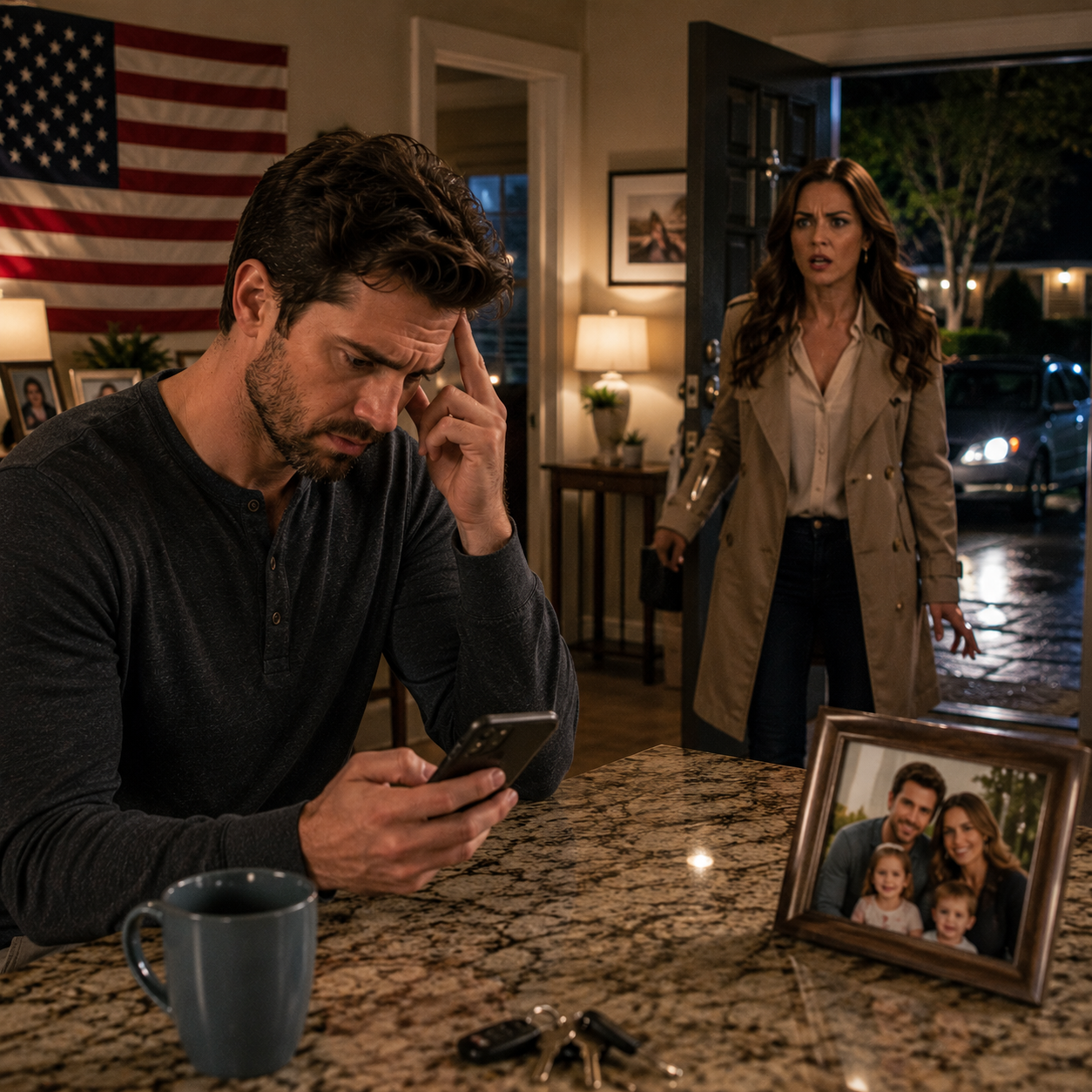
I never set out to destroy Naomi’s family.
That is the part people will either believe or they will not. I know how it looks from the outside: angry boyfriend, humiliating betrayal, religious father, printed screenshots, one envelope mailed to a church office, and suddenly a respected family is in shambles. I know there are people who will say I went too far. Maybe I did. Maybe there was a cleaner, kinder version of the story where I simply blocked her, packed away two years of memories, and let her keep wearing the mask.
But when someone expects you to bleed quietly so their image stays spotless, sometimes the truth finds the one address they prayed it would never reach.
My name is James. I am 27. I met Naomi Thompson two years ago at a volunteer event for a local food bank. She was 25 then, bright and warm in a way that made strangers trust her quickly. She had an easy laugh, a calm voice, and the kind of polished kindness that made people assume she had been raised well. In a way, she had. Her father, Pastor David Thompson, led one of the largest churches in our city, a man known for traditional values, charity work, and community influence. People treated him like a moral landmark. If Pastor Thompson endorsed a cause, donors appeared. If he gave a speech, rooms listened.
Naomi lived in the glow of that reputation.
She was not famous exactly, but in our community, her last name opened doors. She worked part-time in the church administrative office while pursuing a graduate degree in religious studies, a path her father had strongly encouraged. Her family paid her tuition. They provided a condo owned by a family trust. They covered most major expenses. On paper, Naomi looked independent. In practice, she lived inside a carefully padded life built by her parents’ expectations and money.
When we started dating, there was one rule.
To her father, I was not her boyfriend.
I was her “good friend.” Someone she was getting to know slowly. A respectable man from the volunteer circle. A safe influence. A person who attended church services with her sometimes, helped at community events, and never did anything to threaten the image of Pastor Thompson’s well-brought-up daughter.
In reality, Naomi and I had been sleeping together since our third date.
The deception was her idea.
“My dad would never understand a modern relationship,” she told me early on, curled against me in my apartment after dinner. “He still thinks I’m saving myself for marriage. It’s easier this way.”
I was not comfortable with it, but I told myself family dynamics were complicated. My own parents were not religious, and they were far more relaxed about relationships, but I had friends who came from strict homes. I understood that sometimes people build private lives before they are ready to confront public expectations. At least, that is what I told myself.
So I played along.
I attended services with her sometimes, though I was never particularly religious. I shook Pastor Thompson’s hand. I helped carry boxes during food drives. I smiled politely when church ladies said Naomi and I made such “nice companions.” I never claimed to be devout, but I allowed the impression to exist because Naomi said it was necessary.
For nearly two years, it worked.
We were together in all the ways that mattered privately. We spent nights at my place, cooked together, went on trips, talked about the future. I was thinking about proposing, partly because I loved her and partly because I believed engagement might finally give us a reason to stop lying. Once there was a ring, I thought, she would tell her father the truth. We could stop pretending. We could build something honest.
Looking back, that belief feels almost naive enough to hurt.
The night everything changed was a Wednesday.
We were having dinner at my place. Nothing dramatic. Pasta, salad, half a bottle of wine. Naomi had been quiet all evening, not sad exactly, but charged with some private excitement. She kept checking her phone under the table, then setting it facedown when I looked over.
Finally, she put her fork down and said, “I’ve been doing a lot of thinking about my personal growth.”
There are sentences that sound harmless until they become the first crack in the floor.
I looked at her. “Okay.”
“I’ve realized I’m polyamorous.”
My fork stopped halfway to my mouth. “What do you mean?”
“I mean I don’t think I’m built for monogamy,” she said, as if discussing a minor preference. “I’ve been reading about ethical non-monogamy, and it really resonates with me. I want the freedom to explore connections with multiple people.”
I set my fork down. “Are you saying you want to sleep with other people?”
She sighed, like I had reduced a profound concept to something vulgar. “It’s not just about sex, James. It’s about forming meaningful connections wherever they happen. But yes, those connections could become physical.”
I took a moment before answering, because I did not want to react out of shock. “I respect that you’re figuring yourself out, but I’m not comfortable with a polyamorous relationship. That’s not what I agreed to.”
That was when her expression changed.
The softness vanished. In its place came something smug and almost cruel.
“It’s not like you’re the only one who wants me,” she said.
The sentence landed like a slap.
Two years. Two years of lying to her family for her. Two years of church smiles, coded introductions, being introduced as a friend while sleeping beside her at night. Two years of thinking we were protecting a future. And now, apparently, I was just one option in a line.
“Several guys, huh?” I asked, keeping my voice level. “When did they express this interest?”
Naomi waved her hand dismissively. “That’s not the point. The point is I’m telling you what I need. You can either accept it or not.”
I stared at her.
“And have you already acted on this revelation?”
She hesitated just long enough for the answer to reveal itself before she spoke.
“I’ve been exploring some connections,” she said. “Nothing serious yet.”
Nothing serious.
There is a special kind of insult in those words when they are spoken by someone who has already made the decision and is only informing you afterward.
Part of me wanted to end it right there. A cleaner version of me would have. Instead, I nodded slowly and said, “I need some time to think about this.”
She relaxed, visibly. I could see the victory in her posture.
She thought she had managed me.
Maybe, in that moment, she had. But not in the way she believed.
Over the next two weeks, I pretended to process what she had told me. Naomi treated my silence like maturity. She assumed I was adjusting to the new reality because she had framed it as growth and expected me to feel too small-minded to object. She became careless almost immediately.
She started leaving her phone unlocked around me. She texted other men while sitting on my couch. She began talking about them casually, always dressing it in language meant to sound elevated.
“Tyler really gets my creative side.”
“Brandon and I had the most amazing conversation about spirituality last night.”
“Evan makes me feel seen in a way I didn’t expect.”
Funny how these spiritual, emotional, deeply meaningful conversations always seemed to happen after midnight, in private apartments, with wine involved.
I did not argue.
I documented.
Text screenshots she left visible. Messages she sent me where she described what she called “connections,” then slipped into details she clearly found thrilling. Conversations with friends where she bragged about balancing multiple men and joked about me “coming around.” Her own words, preserved with dates and context.
Was it my proudest moment? No.
But by then, I no longer saw Naomi as a confused partner trying to communicate a difficult truth. I saw someone who had built a system where everyone served a different purpose. Her father funded the image. The church protected the reputation. I provided emotional stability and social cover. The other men provided validation. And she expected all of us to remain in our assigned lanes so she could enjoy the benefits without consequence.
The breaking point came one evening when she mentioned sleeping with three different men in one week, then, without even pausing to consider the absurdity, reminded me that her father wanted me at a church leadership dinner the following weekend.
“Dad still thinks you’re such a good influence on me,” she said, scrolling through her phone on my couch.
Then she laughed.
That laugh did something to me.
I looked at her. “What about Tyler, Brandon, and whoever else? Do they know about your father’s expectations? About the image you’re maintaining?”
Naomi looked up, suddenly serious. “Of course not. They don’t need to. My family life is private. Those worlds don’t mix.”
There it was.
The whole philosophy of her life in one sentence.
Those worlds don’t mix.
She wanted to live one life in the shadows and another in the sanctuary. She wanted freedom without honesty. She wanted me to keep showing up beside her father as proof she was still the daughter he believed in while she privately mocked the very values that paid her tuition and kept a roof over her head.
After she left that night, I sat alone for a long time.
Then I printed everything.
Screenshots. Text logs. Her own written admissions. I organized the pages chronologically, not because I wanted drama, but because I wanted the truth to be undeniable. I included a brief factual cover letter explaining that I could no longer participate in a deception where I was being presented to the family and church community as a platonic friend while Naomi lived a completely different life privately.
I mailed the package to Pastor Thompson’s office at the church, where I knew he personally opened important correspondence.
Then I blocked Naomi’s number, removed her from my social media, and waited.
The fallout came three days later, on a Sunday morning.
My phone exploded.
New accounts. Calls from unknown numbers. Messages through mutual acquaintances. Her brother called. Friends of hers called. By noon, I had 87 missed calls before I stopped counting.
Naomi’s messages swung wildly from rage to panic.
“How could you do this to me?”
“My father is devastated.”
“My mom won’t stop crying.”
“They’re talking about sending me to a Christian counseling retreat.”
“My dad can’t even look at me.”
“He’s threatening to take back the condo.”
“They’re cutting me off financially.”
“Please call him and tell him this was a misunderstanding.”
I did not respond.
Then I received a message from Pastor Thompson himself.
“James, I would appreciate a meeting with you to discuss the materials you sent. While I am deeply troubled by the content, I want to hear your perspective before making any judgments. This is a private family matter that has now affected my ministry. Please have the courage to face me in person.”
That message hit differently.
Naomi’s panic felt like consequence. Her father’s message felt like the blast had reached a man who, whatever his flaws and beliefs, had not personally wronged me. I agreed to meet him at a quiet coffee shop across town.
When I arrived, Pastor Thompson looked like he had aged ten years in three days. The man I had seen standing confidently before a congregation of thousands now sat hunched over a paper cup of coffee, eyes bloodshot, shoulders heavy.
He did not waste time.
“My daughter claims you fabricated those messages out of jealousy,” he said. “She says you could not handle rejection, so you created this fiction.”
I took out my phone and opened the original message threads with timestamps and context intact. I slid it across the table.
“I understand why she would say that,” I said. “But I didn’t fabricate anything.”
He read for a long time.
Every few seconds, his jaw tightened.
Finally, he looked up. “Your relationship with her was never platonic.”
“No,” I admitted. “It wasn’t. I’m sorry for my part in that deception.”
His eyes closed briefly.
“I asked her about that,” he said. “She denied it.”
“I expected she would.”
He leaned back, looking exhausted. “Why did you send this to me? Why not simply end the relationship?”
It was a fair question. One I had asked myself repeatedly since dropping the envelope in the mail.
“Because she wanted to have it both ways,” I said finally. “She wanted the freedom to disrespect our relationship while keeping me around as part of the image she showed you and the church. I was supposed to keep playing the good Christian friend while she did whatever she wanted privately.”
“And you thought exposing her to her family was the appropriate response?”
His voice held no open judgment. It was worse than judgment, in a way. It was tired curiosity from a father trying to understand how his daughter’s private life had arrived at his office in printed pages.
“I thought it was time for the truth,” I said. “For everyone involved.”
He nodded slowly, then stood.
“I appreciate your honesty today, if not your methods,” he said. “I need to focus on my family now. Please do not contact any of us again.”
I honored that.
Through mutual acquaintances, I heard what happened afterward anyway.
Naomi was sent to a Christian counseling retreat as a condition of continued financial support. Her parents took back the family-owned condo and required her to live at home for a while. Tuition for the next semester became contingent on regular therapy and renewed church attendance. Several church elders questioned whether Pastor Thompson could continue leading effectively given the scandal inside his own family. For a while, there were rumors of resignation, whispered concerns, meetings behind closed doors.
A family shaken.
A ministry questioned.
All because of printed screenshots and the lies behind them.
Do I regret it?
That is complicated.
I did not enjoy hearing that her mother cried. I did not enjoy imagining Pastor Thompson standing before people who had trusted his leadership while privately dealing with humiliation and grief. I did not set out to hurt a church community. I simply refused to keep being used as a prop in someone else’s performance.
Was mailing those messages extreme? Probably.
But after two years of helping Naomi maintain a false image, extreme felt like the only path back to daylight.
Six weeks later, I heard Naomi had returned from the retreat and was living with her parents under their supervision. Pastor Thompson kept his position at the church after addressing the congregation directly. From what I was told, he spoke about forgiveness, family failure, the difficulty of raising adult children, and the difference between public reputation and private repentance. The family reframed the situation as a prodigal daughter story of redemption.
Maybe that is what they needed.
Maybe that is what Naomi needed too.
As for me, I moved on. Slowly at first, then with more peace than I expected. I started dating again eventually, someone who does not ask me to pretend to be something I am not. Someone whose private life and public life at least resemble each other. That matters to me now in a way it never did before.
The lesson I took from all of this is not that people with strict families deserve to be exposed or that every private mistake should become public punishment. It is simpler than that.
Do not build your freedom on someone else’s silence.
Naomi wanted growth without honesty. She wanted independence funded by dependence. She wanted her father’s approval, my loyalty, other men’s attention, and none of the consequences those worlds would create if they ever touched.
But worlds do touch eventually.
Secrets are not walls. They are pressure points.
And when Naomi smiled at me across my dinner table and said, “It’s not like you’re the only one who wants me,” she thought she was proving I was replaceable.
She was wrong.
She was proving that the version of her I loved had never really existed.
The envelope did not destroy her life. Her choices did. I simply stopped helping her hide the evidence.
And for the first time in two years, I was no longer part of the lie.