

Two weeks ago, I was supposed to be celebrating my fifth wedding anniversary with my wife. Instead, I was sitting alone in a hotel room with two suitcases, a half-empty takeout container, and the strange hollow feeling that comes when your life changes so quickly your brain keeps trying to reject it as impossible.
I’m thirty-two. Rachel is thirty-one. We met in college, and for a long time, I thought our love story was one of the quiet good ones. We were never that chaotic, movie-style couple that fought hard and made up harder. We were best friends first. We studied together, ordered cheap pizza together, moved through those uncertain early adult years together. Our relationship was stable, comfortable, and familiar in a way I found deeply reassuring. There was enough spark to keep things interesting, or at least I thought there was. I thought the foundation mattered more than constant fireworks.
Apparently, Rachel had been craving a different kind of fire.
The night before our anniversary, I made dinner at home. Nothing extravagant, just her favorite pasta, garlic bread, and a bottle of wine I knew she liked. I had spent months secretly saving for a weekend trip to a mountain resort. It wasn’t flashy, but it was beautiful. A cabin-style suite, lake views, spa reservations, and two days away from work, bills, and routine. I had printed the confirmation and tucked it into an envelope I planned to give her the next morning.
I remember feeling proud of it. Not because it was expensive, but because it was thoughtful. Rachel had been stressed lately, distant in a way I kept telling myself was just work pressure, and I thought a quiet weekend together might help us reconnect.
We were halfway through dinner when she swirled her wine and said, “So, I’ve been thinking about what I want for our anniversary.”
I smiled because I thought she was about to ask for jewelry, a dinner reservation, maybe some overly specific spa treatment she had seen online. “Yeah? Well, I might have something planned already.”
She leaned forward, watching me carefully.
“I want to sleep with someone else.”
For a second, I laughed. Not because it was funny, but because my mind refused to accept the sentence as real. It sounded like a bad joke delivered too seriously.
Then I saw her face.
She wasn’t joking.
“You’re serious,” I said.
“Yes,” she replied softly, like she had rehearsed being calm. “Look, it’s something I’ve been thinking about. We’ve only ever been with each other, and I just want to know what it’s like. Just once.”
I put my fork down. “You want to cheat on me as an anniversary gift?”
“It’s not cheating if you know about it,” she said, with the confidence of someone presenting a perfectly reasonable solution to a scheduling problem. “It would just be one night. One experience. Then we go back to normal.”
Normal.
That word sat between us like something rotten.
I stared at her across the table, at the candles I had lit, at the meal I had cooked, at the woman I had married five years earlier. “Is there already someone?”
Rachel hesitated. It was brief, but it told me everything before she said a word.
“There’s this guy from work,” she admitted. “Mark.”
My chest tightened. “You’ve been talking to him?”
“We talk, yes.”
“About sleeping together?”
“Not exactly.”
“Rachel.”
She looked irritated now, as if my need for details was ruining the mature atmosphere she had imagined. “There’s chemistry. That’s all. I’ve been honest with him about being married.”
“Oh,” I said, voice flat. “Well, that makes it better.”
“I wouldn’t do anything behind your back,” she said quickly. “That’s why I’m asking.”
She reached for my hand. I pulled mine away before she touched me.
For a moment, all I could hear was the low hum of the refrigerator and the soft clink of her wine glass as she set it down. Five years of marriage, and this was what she wanted to celebrate. Not us. Not our history. Not the life we had built. She wanted permission to test-drive another man and come home afterward expecting the bed to still be warm.
“I know it’s a lot,” she said. “But I’ve read about couples who try this. It can make relationships stronger.”
“You want me to sit at home while you go sleep with Mark?”
“You could do the same thing if you wanted,” she offered, like she was being generous. “Find someone for a night.”
“That’s not what I want at all.”
She sighed, already frustrated that I wasn’t keeping up with the enlightened version of this conversation she had built in her head. “It’s just sex. It doesn’t mean anything. I’d come home to you after.”
That was supposed to comfort me. Somehow, in Rachel’s mind, returning home after sleeping with another man was proof that our marriage still mattered.
I got up from the table.
“I need some air.”
I walked around the neighborhood for nearly an hour. I don’t remember the route clearly. I remember porch lights, passing cars, and the feeling of my thoughts slamming into each other. Part of me wanted to believe this was a temporary madness, some strange intrusive desire she had mistaken for a need. Another part of me knew the problem wasn’t the request alone. It was the fact that she had a man in mind. A coworker. Someone she had already been emotionally preparing this with before she ever brought it to me.
When I came back, Rachel was waiting on the couch.
“I’ve thought about it,” I said. “And I can’t do it. If that’s what you need, then maybe we want different things.”
She looked disappointed more than devastated. That hurt in a way I didn’t expect. She wasn’t horrified that she had wounded me. She was annoyed that I had become an obstacle.
“You’re overreacting,” she said. “It’s just one time.”
“The fact that you want to do it at all is the problem.”
“I’m coming to you first instead of cheating behind your back. Doesn’t that count for something?”
“No,” I said. “Not the way you think it does.”
Her expression hardened. “So that’s a no?”
“That’s a no.”
She leaned back and let out a dramatic sigh. “Fine. But I think you’re being controlling. It’s my body.”
I slept in the guest room that night. Or tried to. Mostly I stared at the ceiling until the gray light of morning crept through the blinds. By then, something inside me had settled. I didn’t know the full legal path yet. I didn’t know how ugly things would become. But I knew one thing with absolute clarity.
I couldn’t stay.
While Rachel was in the shower, I packed two suitcases with essentials. Clothes, documents, chargers, work laptop, a few sentimental things I didn’t want disappearing. Then I took the anniversary envelope, the one with the resort reservation inside, and left it on our bed.
I added a note.
“The gift is yours. Go with whoever you want.”
Then I walked out.
I called a friend, crashed on his couch, and turned my phone off for the day. I knew if I left it on, Rachel would pull me into a conversation before I had enough emotional distance to think clearly.
When I turned it back on the next morning, I had forty-seven missed calls.
Not from Rachel.
From her brother Kevin.
Kevin is a lawyer, which he has always treated less like a profession and more like a personality disorder. There were also a dozen texts accusing me of abandonment, threatening to take me for everything, and claiming I had no right to “just walk out” because Rachel had been “trying to be open and honest.”
One text said, “You don’t get to punish her for expressing a need.”
Another said, “She could destroy you in court if she wants.”
That was when I realized Rachel had already started building a version of the story where I was the villain.
Within days, I moved into an extended-stay hotel. Rachel went nuclear almost immediately. She told mutual friends I had emotionally abused her by leaving. She said I was controlling because I wouldn’t “let her explore her sexuality.” She said I had abandoned her with the bills, which was a complete lie. Our finances were mostly separate, and I was still contributing to the joint household account until a lawyer told me exactly what to do.
Meanwhile, her relationship status online changed to “It’s complicated,” and Mark appeared in three separate posts.
Subtlety was apparently not one of Rachel’s gifts.
A week after I left, Kevin showed up at my workplace. He barged into the office demanding to “talk some sense” into me, loud enough that several coworkers heard. My team lead had to step in and threaten to call security before Kevin finally left.
That night, Rachel texted, “You’re being ridiculous. Just come home so we can talk about this like adults.”
I didn’t respond.
The next day, a mutual friend sent me screenshots. Rachel had been telling people I had suddenly had a mental breakdown and abandoned her with all the bills. She made it sound like she was sitting in the dark, starving, while I ran off to punish her for being honest. The reality was that she still lived in our apartment, still had access to money for household expenses, and still had Mark orbiting close enough to show up in photos.
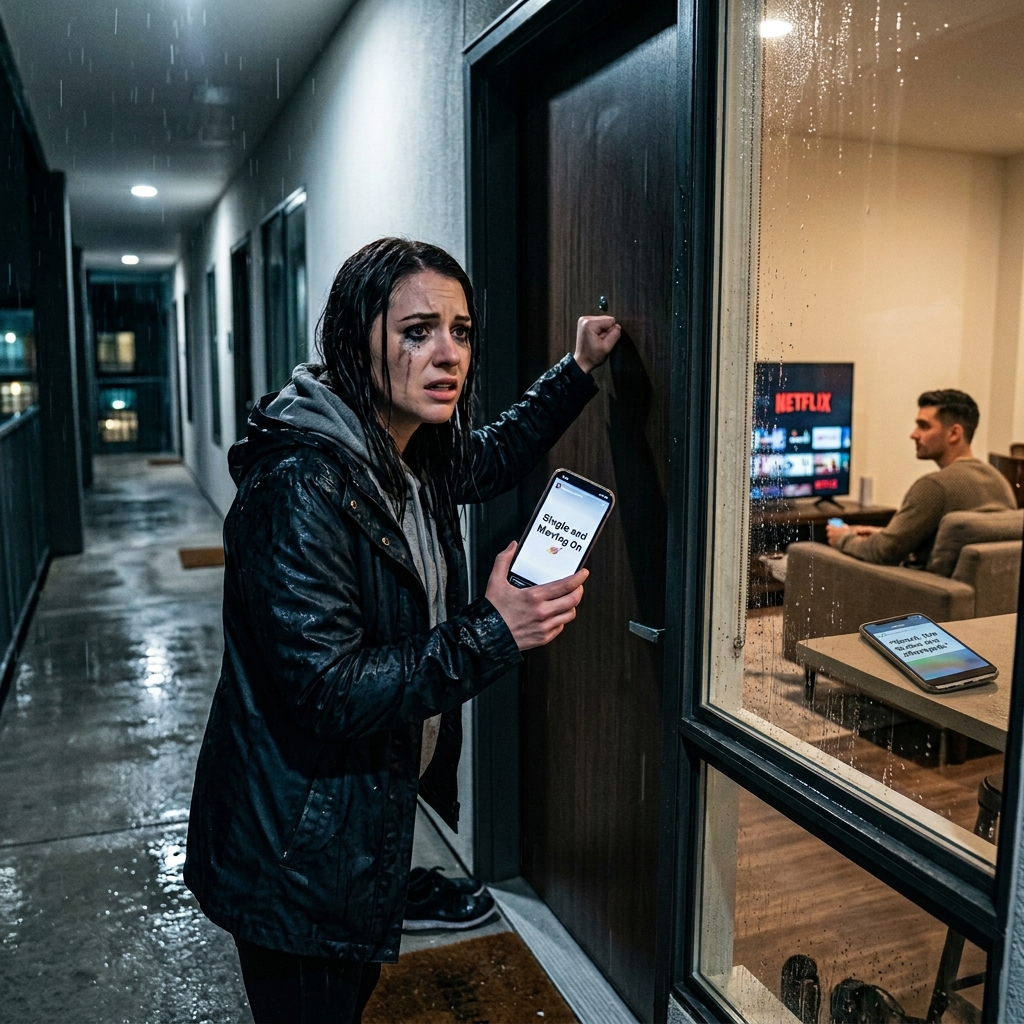
Then she found my hotel.
I got back from work one evening and saw her sitting in the lobby like she belonged there. My first instinct was to turn around and leave, but she spotted me before I could.
“You can’t just ghost your wife,” she said loudly enough for the front desk clerk to glance up.
“I’m not ghosting you,” I replied. “I’m separating from you after you asked to sleep with another man as an anniversary present.”
Her face flushed. “Can we not do this in public?”
Against my better judgment, I agreed to talk in the hotel restaurant. It was a mistake, but at the time I still had a small, exhausted part of me that wanted one honest conversation.
Rachel began with a revision.
“Mark was just an example,” she said.
“You specifically named him.”
“I didn’t mean I specifically wanted him.”
“You told me there was chemistry and that you’d been talking.”
She looked away. “You’re twisting my words.”
“No. I’m repeating them.”
She took a breath, then shifted tactics. “Look, I’ve been talking to my therapist about this.”
That caught me off guard. “Since when do you have a therapist?”
“For a few months.”
A few months. Another thing she had hidden.
“She says it’s healthy to acknowledge desires instead of suppressing them.”
“Did your therapist tell you to ask your husband for permission to sleep with a coworker as an anniversary gift?”
Rachel rolled her eyes. “Stop calling it cheating. It’s ethical non-monogamy.”
“It’s ethical non-monogamy when both people enter it honestly and willingly,” I said. “You sprung it on me after five years of monogamous marriage, with a specific man already lined up.”
“People evolve,” she said. “I’m not the same person I was five years ago.”
“Clearly.”
That was when the tears started.
Not quiet tears. Not the kind that come despite someone trying to hold themselves together. These were loud, public sobs. Heads turned. A server slowed down near our table and then wisely walked away.
“How can you be so cold?” Rachel cried. “I’m your wife.”
I sat there watching her, and for the first time, I noticed the performance in it. She wasn’t crying because the marriage was broken. She was crying because the scene wasn’t going her way. She wanted witnesses. She wanted me to look cruel and detached while she looked wounded and desperate.
I stood up.
“If you walk away now, don’t bother coming back,” she shouted.
I looked at her for one second, then left.
The next day, Kevin sent a message claiming I had caused Rachel “extreme emotional distress.” He suggested a settlement where I would pay for six months of her therapy, plus emotional damages.
For refusing to let my wife sleep with her coworker.
I finally hired my own lawyer.
That turned out to be the smartest decision I made.
Then things got stranger.
Rachel’s parents called. Her mother, Mrs. Davis, sounded exhausted but firm, like someone preparing to be compassionate toward a difficult son-in-law.
“We know things have been bad,” she said. “Rachel told us you’ve been emotionally distant for months and rejected all her attempts to save the marriage.”
I closed my eyes. “That is not what happened.”
Then she said something that made me sit up straight.
“We know about the affair you had last year, but we believe in forgiveness.”
For a moment, I couldn’t speak.
“What affair?”
There was a pause.
“The girl from the conference,” Mrs. Davis said carefully. “Rachel showed us messages.”
“I’ve never had an affair,” I said. “I’ve never even been to a conference without Rachel.”
The silence on the other end changed. I could hear uncertainty entering the room.
My lawyer told me we needed to move quickly and get ahead of the claims. Rachel wasn’t just lying emotionally. She was manufacturing a framework where my leaving looked like guilt, instability, or retaliation. I started documenting everything. Screenshots. Dates. Call logs. Messages. Financial contributions. I requested my location data to prove I had never been anywhere near this imaginary conference situation.
Two weeks after I left, I went back to our apartment to pick up more of my things.
When I opened the door, half the furniture was gone.
Rachel had left a note on the kitchen counter.
“Just taking what’s mine. — R”
I took photos immediately. Every room. Every missing item. Every remaining object. I was still legally tied to that residence, and I wasn’t about to let her claim later that I had taken things or destroyed property.
While I was documenting everything, the door opened.
Mark walked in with a dolly.
He froze when he saw me.
“Rachel said no one would be here,” he said, looking uncomfortable.
“I bet she did.”
He glanced at the dolly like he wished it would swallow him. “I’m just here to help her move some stuff.”
“This is still legally my residence too,” I said. “You need to leave.”
His embarrassment faded just enough for him to attempt confidence. “Rachel said you abandoned the place, so technically—”
“Leave now,” I interrupted, “or I call the police for breaking and entering.”
He left.
But before he did, he turned at the door and said, “She told me you guys were already separated when we started talking. Just so you know.”
That sentence bothered me for hours.
Not because I believed Mark was innocent exactly, but because it confirmed Rachel had been telling everyone a different version of reality depending on what she needed from them.
The truth arrived through Jenna, Rachel’s best friend.
Jenna asked to meet for coffee. I almost said no because by then I was tired of conversations that began with concern and ended with manipulation. But Jenna sounded genuinely shaken, so I went.
She looked nervous when I sat down.
“Rachel has been seeing Mark for at least three months,” she said.
The café noise seemed to fade around me.
“Three months?”
Jenna nodded. “She told me you two had an open marriage agreement.”
I almost laughed, but nothing about it was funny.
“She even showed me texts supposedly from you agreeing to it,” Jenna continued. “But they seemed weird. Not like how you talk. When I questioned her, she got defensive.”
Jenna then showed me screenshots. Conversations with mutual friends. Rachel framing me as controlling to some people, unfaithful to others, mentally unstable to another group, and consensually non-monogamous to her work friends. She had different stories for different audiences, all designed to make her actions seem justified.
Worst of all, there were messages where Rachel had been planning her exit strategy. She discussed what she could take from the apartment, how to make me look like the bad guy, how to explain Mark, how to keep sympathy on her side.
I sat there staring at the screen while the last pieces of my denial quietly died.
Rachel hadn’t come to me honestly before cheating.
She had already been cheating.
The anniversary “gift” request was not a vulnerable confession or an attempt at ethical exploration. It was a retroactive permission slip. She wanted to turn her affair into something I had agreed to, so she could keep both the marriage and Mark without carrying the guilt.
Jenna apologized. She said she should have realized sooner. I told her she had done the right thing by telling me now.
Armed with that information, my lawyer filed for divorce citing adultery, supported by evidence Jenna provided.
Rachel responded by showing up at my parents’ house during Sunday dinner.
She put on a tearful performance about how worried she was for my mental state. My mother called me in a panic, asking if I was okay, why Rachel was saying I had become unstable, and whether I needed help. It took nearly an hour to explain what had really happened.
That was the part that made me angriest. Not the affair itself, though that hurt. Not even the request, though it disgusted me. It was the way Rachel tried to poison every safe place I had left. Friends. Work. Family. She didn’t just want out. She wanted control of the story so completely that there would be nowhere I could stand without defending myself.
Rachel’s new legal argument became that we had a verbal agreement to open our marriage and that my sudden refusal constituted emotional abuse. Kevin started contacting my friends asking for “evidence” of my controlling behavior. Most of them ignored him. One friend sent Kevin screenshots of Rachel’s own Instagram stories showing her and Mark looking cozy, with captions like, “Sometimes the right person comes at the wrong time. #NoRegrets.”
Kevin replied, “That doesn’t prove anything. They’re just friends.”
Sure. Friends with a dolly.
Then my lawyer received their settlement offer.
They wanted the apartment, half my savings, including my premarriage investments, and alimony because Rachel had supposedly sacrificed career opportunities to support my career.
Rachel was a marketing manager who made only ten thousand less than I did.
There were no sacrificed opportunities. No abandoned career. No years spent supporting me from the shadows. She had a full-time job, her own income, and apparently enough free time to conduct a three-month affair with Mark.
My lawyer drafted a counteroffer.
Rachel would keep what she brought into the marriage. I would keep what I brought. Common assets acquired during the marriage would be split fifty-fifty. No alimony. I would keep my premarriage investments. And Rachel would admit to the extramarital relationship in writing to avoid a fault-based divorce becoming part of a more public record.
Kevin fought hard against that last part.
My lawyer held firm.
Then Rachel’s parents called again. This time, their voices were different. Smaller. Less certain. Rachel had finally admitted she had been seeing Mark before our separation. Not the whole truth, I’m sure, but enough.
Mrs. Davis apologized for believing her lies.
Her father got on the phone and said quietly, “We didn’t raise her to behave this way.”
I didn’t know what to say to that. Part of me appreciated it. Another part of me wondered what might have been different if anyone had warned me earlier that Rachel had a pattern of rewriting betrayal until she became the victim.
That revelation came later, over dinner.
One month after Rachel asked for that “anniversary gift,” the legal mess finally began to settle. My lawyer mentioned that we were prepared to subpoena Rachel’s phone records and bring Mark in for a deposition. Suddenly, Kevin became much more reasonable. Funny how quickly moral outrage softens when evidence is about to be placed under oath.
We reached a settlement.
Assets acquired during the marriage would be split fifty-fifty. No alimony. I kept my premarriage investments. Rachel kept the apartment. I kept my car. We each handled our own debts.
And Rachel signed a document acknowledging her extramarital relationship as part of the settlement.
Two days after signing, she texted me.
“Happy now? You’ve ruined my reputation for your ego.”
I didn’t respond.
There was nothing left to say. Her reputation had not been ruined by my ego. It had been dented by her choices, her lies, her fake stories, her attempt to turn an affair into a marriage experiment, and her belief that everyone around her could be managed with tears and selective details.
The social fallout came quickly.
Rachel’s fantasy with Mark imploded almost immediately after reality arrived. According to mutual friends, Mark broke things off the week after the settlement conversation got serious. Apparently, he wasn’t looking for anything long-term and got spooked when Rachel started talking about moving in together.
That was the great romance she had risked everything for: a man who was happy to be chemistry from work but not interested in carrying the weight of her consequences.
Rachel responded with a social media rampage. Vague posts about toxic men. Posts about knowing your worth. Posts about “outgrowing people who can’t handle your evolution.” Her latest said, “Sometimes the universe removes people from your life as a favor. #levelingup #newchaper.”
The misspelled “chapter” somehow made it perfect.
Work was awkward for a while. My boss pulled me aside to check if I was okay and mentioned that Rachel had been telling people I had severe anger issues. Thankfully, anyone who has worked with me for more than five minutes knows I’m more likely to over-document a problem than explode over one. The rumor went nowhere.
I moved into my new place not long after. It wasn’t fancy, but it was mine. I bought new furniture, cheap at first, then gradually better pieces as the place started feeling less temporary. I learned how quiet can feel lonely at first and peaceful later. I joined a rock climbing gym. Reconnected with old friends. Started accepting invitations I would have declined during my marriage because Rachel always had some reason we couldn’t go.
Eventually, I even started dating again. Casually. Carefully. Nothing serious yet. I’m not rushing to replace a five-year marriage with the first person who smiles at me. But it feels good to sit across from someone and not wonder which version of reality they’re telling everyone else.
Last week, while unpacking the last box from the move, I found the original anniversary envelope.
The resort reservation had expired unused. For a while, I just held it in my hand. I thought about the man I had been that night, proud of a quiet surprise, hoping a weekend in the mountains might bring us closer. I thought about Rachel sitting across from me, already involved with Mark, asking for permission after the betrayal had likely begun. I thought about how close I came to letting her convince me that my pain was control and her selfishness was growth.
Then I threw the envelope away.
No ceremony. No dramatic speech. Just paper into the trash.
I still have moments of anger. Not really because Rachel wanted someone else. Desire happens. People change. Marriages end. Painful as that is, I could have survived an honest conversation. What I struggle with is the architecture of the lies. The fake affair she invented for me. The fake mental breakdown. The fake abandonment. The fake open marriage. The fake victimhood. The way she tried to turn friends, family, and even my workplace into stages for her performance.
But mostly, I feel grateful.
Grateful she showed me who she was before we had children.
Grateful I walked away before she could trap me in years of confusion.
Grateful Jenna told the truth.
Grateful I had a lawyer who understood that calm documentation beats emotional chaos.
And grateful that, when Rachel asked me for permission to destroy our marriage and call it an anniversary gift, something in me knew enough to leave.
Sometimes the best response to chaos is not a speech. It is not revenge. It is not screaming until the other person admits what they did.
Sometimes the best response is simple.
Pack your bags.
Leave the note.
Start again.

![[FULL STORY] My Brother Said: 'Dad Left Me The House Because I Stayed. You Just Left.' I Replied: 'Then You Can](https://social-media.rabedo.com/thumbnails/1777350863_B9.png)
![[FULL STORY] I Thought Stability Was Boring, Until I Lost the Man Who Loved Me for Real](https://social-media.rabedo.com/thumbnails/1777636310_9f44d4f4-9313-42d4-aef4-029ea019d0c1.png)

![[FULL STORY] She Made a List of Everything I Didn’t Have — Then Lost Everything I Already Was](https://social-media.rabedo.com/thumbnails/1777888023_12501eeb-e583-4fb9-a826-e161e7d40d62.jpg)