After the appointment, she asked me to stop by the courthouse annex. She went inside alone, moving slowly with her cane. I waited in the truck for almost forty minutes. When she came back out, she looked tired but peaceful.
“Everything okay?” I asked.
She smiled at me. “It will be.”
That was all she said.
Now, standing on her porch with Raymond blocking the doorway, I remembered that envelope and felt a strange flicker of hope.
“Grandma had papers,” I said.
Raymond’s expression changed so fast most people would have missed it. But I had spent enough time around him to know his face. He didn’t look confused.
He looked worried.
“What papers?” he asked.
“I don’t know. She went to the courthouse a few weeks ago.”
Denise’s mouth tightened.
Raymond recovered quickly. “Old people do strange things when they’re scared. Doesn’t mean anything.”
“Then let me in.”
“No.”
“I live here.”
“You lived here because my mother let you. She’s dead now.”
The cruelty of it silenced even Denise for a second.
Then Raymond reached into his pocket and pulled out a folded document. “Since you want to talk about papers, here’s one. I spoke to an attorney this morning. As next of kin and executor—”
“You’re executor?” I interrupted.
“I will be.”
“That’s not the same thing.”
He ignored me. “As the person responsible for protecting the estate, I’m giving you notice that you’re not to enter this property again unless I approve it. If you try, I’ll call the sheriff.”
Something cold moved through me, but it wasn’t fear.
It was clarity.
Because Raymond had always been loud when he was lying. He used volume the way other people used evidence.
I stepped back from the porch. “Fine.”
His eyebrows lifted, like he hadn’t expected me to stop fighting.
“Fine?” he repeated.
“I’ll call someone myself.”
Denise gave a small laugh. “Who? Your mother? She didn’t even come to the funeral.”
That one landed exactly where she wanted it to.
I looked at her, then at Raymond, then at the house. I thought about Grandma’s hands folding napkins at the kitchen table, her voice telling me not to answer cruelty with chaos because chaos always helped the cruel person.
So I didn’t yell.
I walked back to my truck, got in, and drove away while they stood on the porch watching me like vultures guarding a roof.
I didn’t go far.
I parked at Miller’s Diner, two miles down the road, in the same booth where Grandma used to order peach pie and pretend one fork was enough for both of us. My hands were shaking when I pulled out my phone.
First, I called my boss and told her I needed the afternoon. Then I called the county clerk’s office.
The woman who answered sounded tired but kind. I explained that my grandmother had recently passed, that I had been living in her house, and that a relative had changed the locks.
“What exactly are you trying to verify?” she asked.
“I need to know whose name is on the deed.”
There was a pause. “Property records are public, but I can’t give legal advice.”
“I understand. I just need the record.”
She asked for the address. I gave it to her slowly.
Keys clicked in the background.
Then she said, “Hmm.”
One sound. That was all.
But my stomach tightened.
“What?” I asked.
“Sir, are you able to come to the recorder’s office in person?”
“Why?”
“I think you should request a certified copy.”
“Can you tell me the name on the deed?”
Another pause.
Then she said, more carefully, “The most recent recorded deed is not in your grandmother’s name.”
For a moment, the diner noise disappeared.
Not in Grandma’s name.
My first thought was Raymond.
He had done something. Somehow, while Grandma was sick, he had gotten her to sign the house over. Maybe that was why he changed the locks so fast.
My grip tightened around the phone. “Whose name is it in?”
“I’m not comfortable discussing details over the phone. But if you come before four, we can issue a certified copy.”
I looked at the clock above the counter. 2:18 p.m.
“I’m on my way.”
The courthouse annex smelled like old paper, dust, and floor polish. I signed in at the recorder’s window with my pulse hammering in my throat. A woman with silver glasses asked for my ID and the property address. I slid both through the slot.
She disappeared into the back.
I stood there trying not to imagine every possible disaster.
Raymond’s name. Denise’s name. Some trust I didn’t know about. A lien. A sale. A scam.
When the woman returned, she had a certified copy clipped together with a blue stamp at the top. She looked at my ID again, then at me.
“Mr. Hale,” she said, “you may want to read the grantee line.”
I took the papers.
The words blurred at first. I forced myself to focus.
Warranty Deed.
Grantor: Margaret Louise Whitaker.
Grantee: Ethan Daniel Hale.
My name.
Not Raymond’s.
Not the estate.
Mine.
The room tilted.
I read it again, slower this time, because there had to be a mistake. But there was my full legal name, my date of birth, the legal description of Grandma’s property, and the recording date.
Three weeks ago.
The same day she had gone inside with the manila envelope.
My grandmother had transferred the house to me before she died.
Not promised it.
Not mentioned it in a will.
Transferred it.
The clerk watched me with a gentleness that told me she had seen people receive life-changing papers before.
“She recorded it properly,” she said. “Signed, notarized, witnessed, and filed.”
I swallowed. “Can anyone undo this?”
“That’s a legal question,” she said. “But from our side, this is the recorded deed.”
I paid for three certified copies. My hands barely worked when I signed the receipt.
Outside, the sunlight felt too bright.
I sat in my truck for a long time, holding the deed against the steering wheel, thinking about Grandma.
She had known.
She had known Raymond would do exactly what he did. She had known he would come for the house before her flowers even died. She had known he would use grief as a crowbar.
And she had quietly moved the one thing he wanted out of his reach.
I wanted to cry. I wanted to laugh. I wanted to drive straight to the house and throw the deed in Raymond’s face.
Instead, I called an attorney.
Her name was Alicia Monroe, and she had helped my coworker with a boundary dispute the year before. Her assistant said she could fit me in for a fifteen-minute emergency consultation by phone.
I sent a photo of the deed, the lock, and Raymond’s handwritten no-entry notice.
Alicia called me twenty minutes later.
“Mr. Hale,” she said, “first, I’m sorry for your loss.”
“Thank you.”
“Second, based on what you sent me, the house is titled in your name. Your uncle had no authority to change the locks unless you gave him permission.”
“He locked me out.”
“That can create several issues for him.”
“He said he’d call the sheriff if I tried to enter.”
“He can call whoever he wants. But I would rather you not force entry or escalate this alone.”
“What should I do?”
“Call the sheriff’s non-emergency line. Explain that you are the deeded owner, you have been locked out by a family member, and you need a civil standby to regain access. Bring the certified deed, your ID, and any proof you were residing there.”
“My stuff is inside.”
“Good. Bring proof of that too if you have it. Mail, photos, anything.”
I had all of it. My driver’s license still showed the address. My bank statements went there. My work laptop’s device location would show it. Grandma and I had taken a photo in the kitchen on her birthday two months earlier, both of us wearing paper crowns from the cake box.
Alicia continued, “Do not threaten him. Do not argue. Let law enforcement see the deed. If your uncle refuses to leave after being told, that becomes his problem.”
There was something steady in her voice that helped me breathe.
I thanked her, then called the sheriff’s office.
The dispatcher listened, asked questions, and put me on hold. When she returned, she said a deputy could meet me at the property in about forty minutes.
“Do you feel unsafe?” she asked.
I thought about Raymond’s temper. His need to win. The way Denise looked at Grandma’s house like she was already choosing paint colors.
“I don’t know,” I admitted.
“Stay in your vehicle when you arrive. Wait for the deputy.”
I did exactly that.
When I pulled back into Grandma’s driveway, Raymond’s truck was still there. So was Denise’s SUV. A third car had arrived too — my Aunt Carol’s old sedan. Apparently Raymond had started gathering an audience.
Through the front window, I saw movement inside the house.
My house, I corrected silently, and the thought felt both impossible and sacred.
Grandma’s house was mine.
Not because I had earned it. Not because I deserved it more than anyone else. Because she had chosen me. And for the first time all day, grief and gratitude twisted together so tightly I could barely separate them.
I parked near the mailbox and waited.
Raymond came out almost immediately.
He stomped down the porch steps, face red. “What are you doing back here?”
I stayed in the truck and lowered the window halfway. “Waiting.”
“For what?”
“You’ll see.”
His eyes narrowed. “You called someone?”
I didn’t answer.
Denise appeared behind him, then Aunt Carol. Carol looked nervous. She had cried through the funeral and avoided Raymond the whole day, which told me she knew more than she wanted to say.
Raymond walked closer to my truck. “If you think you can intimidate me, you’re making a mistake.”
“I’m not here to intimidate you.”
“No, you’re here to manipulate the situation like you manipulated Mom.”
That one made me turn my head slowly.
“What did you say?”
He pointed at me through the window. “You think nobody noticed? Moving in here, acting like the devoted grandson, cooking meals, driving her around, whispering in her ear while she was weak?”
I felt my jaw tighten.
“I changed her bandages,” I said quietly. “I cleaned the bathroom when she couldn’t stand. I slept on the recliner because she was afraid to be alone at night. If that’s manipulation to you, then I hope one day someone manipulates you the same way.”
Aunt Carol looked down.
Denise scoffed. “Very noble.”
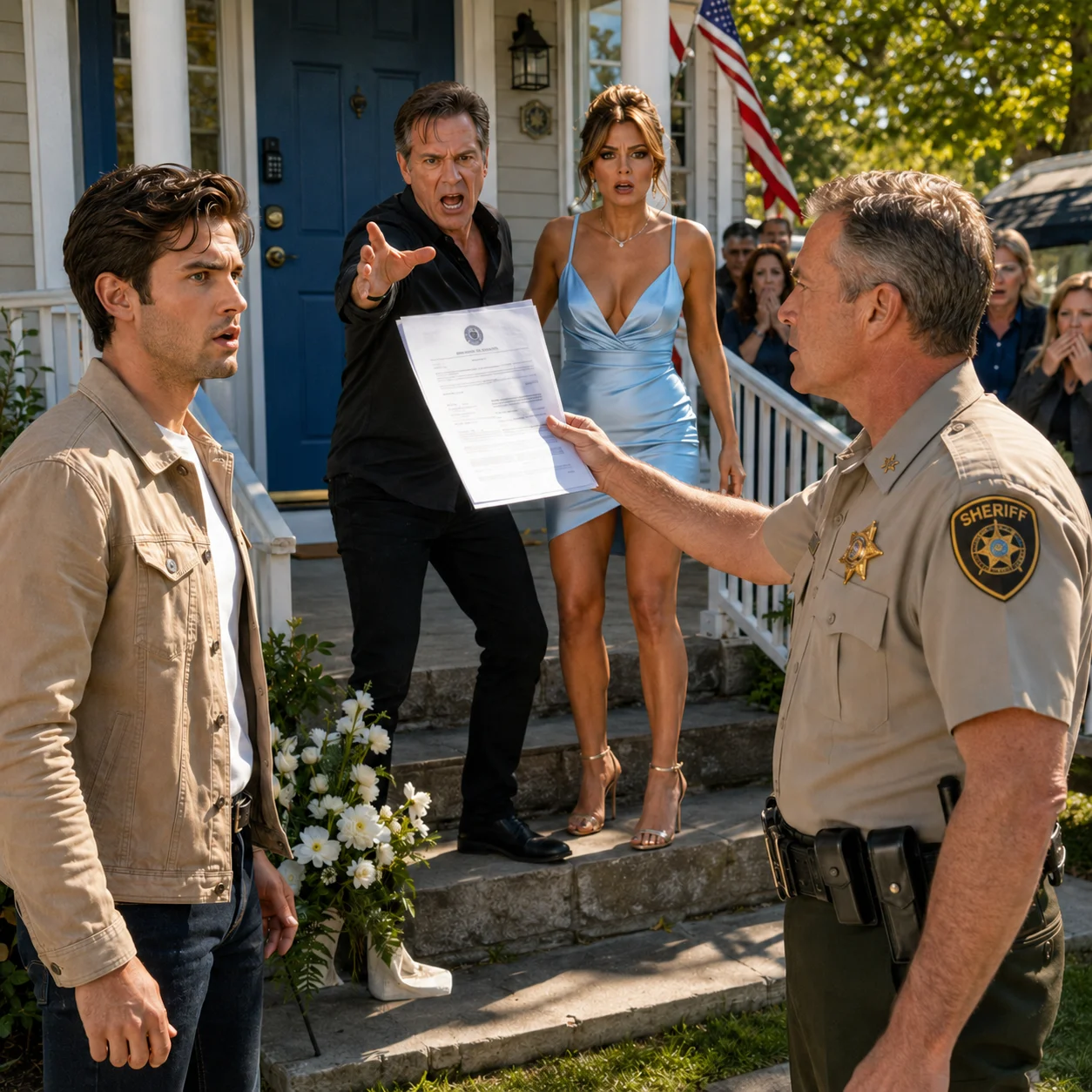
Before I could answer, a sheriff’s cruiser turned into the driveway.
Raymond stepped back, confused for half a second. Then his confidence returned like a mask snapping into place.
“Good,” he said loudly. “Now we can settle this.”
The deputy who got out was a broad-shouldered man in his fifties with calm eyes and a notebook in his hand. His name tag read: Deputy Harris.
He approached slowly, looking from Raymond to me.
“Afternoon,” he said. “Who called?”
“I did.” I stepped out of the truck, holding the certified deed and my ID.
Raymond immediately raised his hand. “Deputy, this is a family estate matter. My nephew is trying to break into my late mother’s home.”
Deputy Harris looked at him. “I’ll speak with everyone one at a time.”
“I’m the next of kin,” Raymond said. “I’m responsible for this property.”
The deputy didn’t react. “Sir, I said one at a time.”
Raymond’s mouth shut, but barely.
I handed the deputy my ID and the certified deed. “My grandmother transferred the property to me before she passed. My uncle changed the locks after the funeral and refused to let me in. My belongings are inside. I was living here as her caregiver.”
Deputy Harris looked over the deed carefully. He checked my ID, then the property address. He took his time, which made Raymond impatient.
“That paper is probably meaningless,” Raymond said. “Mom wasn’t in her right mind.”
Deputy Harris looked up. “Do you have a court order invalidating it?”
Raymond blinked. “No, but—”
“Do you have a deed showing your name on this property?”
“I’m her son.”
“That’s not what I asked.”
Denise stepped forward. “Deputy, this is more complicated than he’s making it sound.”
“I’m sure it feels complicated,” Harris said. “But right now I’m looking at a certified recorded deed listing Mr. Hale as the owner.”
The words hung in the air.
For a second, nobody moved.
Then Aunt Carol’s hand flew to her mouth.
Denise’s face went pale.
Raymond stared at the paper as if it had personally betrayed him.
“That’s impossible,” he said.
I looked at him then, really looked at him. “You knew she went to the courthouse.”
His eyes flicked to mine.
There it was.
Not surprise.
Confirmation.
Aunt Carol turned on him. “Raymond?”
He ignored her. “Mom was sick. She didn’t understand what she was signing.”
Deputy Harris handed the deed back to me. “That may be something you can challenge in civil court if you have grounds. But unless a judge says otherwise, this deed is valid for our purposes today.”
Raymond’s voice rose. “So you’re just taking his side?”
“I’m not taking sides. I’m recognizing the recorded owner.”
“He can’t just throw us out!”
Deputy Harris glanced toward the open door. “Do you reside here?”
Raymond hesitated. “It’s my mother’s house.”
“Do you reside here?”
“No, but—”
“Then you need the owner’s permission to remain inside.”
The yard went silent except for the wind moving through Grandma’s maple tree.
Raymond looked at me with a hatred so naked it almost looked like pain.
“You’d do this?” he asked. “To your own family?”
I almost laughed, but there was nothing funny about it.
“You changed the locks on me the day after Grandma’s funeral.”
“That was different.”
“How?”
“I was protecting what belonged to us.”
“No,” I said. “You were taking what you thought no one could stop you from taking.”
His face twisted. “You ungrateful little—”
Deputy Harris stepped slightly between us. Not dramatically. Just enough.
“Mr. Whitaker,” he said, “you need to calm down.”
Aunt Carol began crying quietly. “Raymond, what did you do?”
Denise grabbed his arm and whispered something, but he shook her off.
“You think this is over?” he said to me. “I’ll contest everything. I’ll drag you through court until you can’t afford to keep this place.”
That threat would have scared me an hour earlier.
Now I had Grandma’s deed in my hand, an attorney’s number in my phone, and a sheriff standing beside me.
“Do what you need to do,” I said. “But you’re leaving today.”
Raymond’s expression collapsed into disbelief.
Deputy Harris turned to me. “Mr. Hale, are you asking them to leave the property?”
I looked at the porch. The flowers. The crooked new lock. The house where Grandma had taught me how to make biscuits, balance a checkbook, and leave people with their dignity when possible.
I thought about giving Raymond a few minutes to save face.
Then I remembered him telling me Grandma was gone like that erased everything she wanted.
“Yes,” I said. “I am.”
Deputy Harris nodded. “Mr. Whitaker, gather any belongings you brought in and exit the property.”
Raymond didn’t move.
Denise did. She hurried inside, suddenly very interested in removing her purse and a tote bag from the kitchen. Aunt Carol followed slowly, wiping her face.
Logan came out last, carrying a cardboard box. He looked embarrassed.
“Ethan,” he said quietly, “I didn’t know.”
I believed him.
Logan had always been careless, not cruel. There was a difference.
“I know,” I said.
He swallowed and walked to the truck.
Raymond remained on the porch.
“You poisoned her against me,” he said.
“No,” I replied. “You did that yourself.”
His eyes shone for a second, but not with tears he would ever let fall. “She was my mother.”
“She was,” I said. “And she waited for you for years.”
That silenced him.
Because we both knew it was true.
Grandma never stopped hoping Raymond would become the son she remembered from before greed hardened him. Every Christmas, she set aside his favorite cookies. Every birthday, she mailed a card. Every time he visited only to ask about money, repairs, property taxes, or what she “planned to do with the house,” she made excuses for him after he left.
“He’s busy,” she would say.
Or, “He doesn’t know how to show love.”
Or, “Some people get scared when they feel they’ve lost their place.”
But near the end, even Grandma stopped making excuses out loud.
Two months before she died, Raymond came by while I was replacing the kitchen faucet. He didn’t ask how she felt. He walked through the house pointing out what needed updating, saying the market was good, saying a place this old was “wasted” if no one smart handled it.
Grandma sat in her recliner, tiny under a quilt, watching him talk about her home like it was already empty.
When he left, she looked at me and said, “Some people don’t inherit houses. They inherit hunger.”
I hadn’t understood then.
I did now.
Deputy Harris cleared his throat. “Sir, it’s time.”
Raymond stepped off the porch slowly. As he passed me, he leaned close enough that only I could hear.
“You’ll regret humiliating me.”
I met his eyes. “No. I’ll regret that Grandma had to protect her home from her own son.”
For once, he had no answer.
He got into his truck, slammed the door, and backed down the driveway so fast gravel sprayed across the grass.
Denise followed. Aunt Carol stayed.
When the vehicles disappeared down the road, the silence felt enormous.
Deputy Harris looked at the new lock. “Do you have the code?”
I almost smiled. “No.”
He nodded toward the door. “You may want to call a locksmith. Since you’re the owner, you can change it.”
Owner.
The word still felt too large.
Aunt Carol approached me carefully. Her eyes were red. “Ethan, I’m sorry.”
I didn’t know what to say.
She looked at the deed in my hand. “Your grandmother told me she was doing something. She didn’t tell me what. She just said she was tired of people circling the house like it was a carcass.”
That sounded exactly like Grandma.
“I should have warned you,” Carol whispered. “Raymond was asking questions. After she got sick, he kept pushing her about the will. She stopped answering his calls near the end.”
I looked toward the house. “Did he know she changed the deed?”
“I don’t think so. But I think he suspected she might.”
That explained the locks. The speed. The panic hidden under his confidence.
Deputy Harris finished writing notes. “Mr. Hale, I’ll document the civil standby. If there are further issues, contact us. If he threatens you or returns after being told not to, call.”
“Thank you,” I said.
After he left, Aunt Carol offered to wait with me until the locksmith came. I said yes, because the truth was, I didn’t want to stand outside Grandma’s house alone.
The locksmith arrived twenty-five minutes later, a young guy named Ben who looked uncomfortable when he heard the short version.
“Funerals bring out the worst in people,” he said softly while removing Raymond’s crooked deadbolt.
“Didn’t know they could bring it out this fast,” I said.
He gave me a sad half-smile. “You’d be surprised.”
When the door finally opened, the house smelled like dust, lemon furniture polish, and something faintly floral.
Grandma.
I stepped inside and nearly broke.
Everything was wrong and exactly the same.
Her cane leaned beside the hall table. Her reading glasses sat next to a stack of crossword puzzles. A mug with a faded cardinal on it rested by the sink, clean and upside down on a towel. The afghan she used every evening was folded over the back of her chair.
But Raymond had been inside.
Cabinet doors were open in the dining room. The desk drawers had been pulled out. The hall closet boxes were disturbed. A stack of old photo albums sat on the floor like someone had searched them and abandoned them when they found nothing worth selling.
Aunt Carol made a wounded sound behind me.
“He went through her things,” she whispered.
I walked to the kitchen table.
There, under a ceramic rooster paperweight, was a note.
Not in Raymond’s handwriting.
Grandma’s.
My name was written on the front in her shaky blue ink.
Ethan.
My knees almost gave out.
I sat down before opening it.
The letter was only one page.
My sweet boy,
If you are reading this, then I am gone, and someone has probably made the house feel less like home. I am sorry for that. I wanted to tell you sooner, but I knew you would argue with me. You would say it was too much. You would say I should divide things fairly.
Fair is not always equal.
Your uncle received help from me many times in his life. More than he will admit. Your mother received help too, though pride may keep her from saying it. You gave me something different. You gave me your time when I had nothing left to offer except stories, soup, and stubborn opinions.
This house is yours because you never treated it like a prize. You treated it like a home.
Do not let guilt hand my wishes to people who only respected me when they wanted something.
Change the locks.
Plant rosemary in the spring.
And remember what I told you: a person should always have one door in this world that opens for them.
Love,
Grandma
I cried then.
Not gently. Not politely. I folded over that letter at the kitchen table and cried like the twelve-year-old kid who had once ridden his bike to this house because his own home had become too loud.
Aunt Carol put a hand on my shoulder and cried with me.
For a while, neither of us spoke.
The days that followed were not peaceful, but they were clear.
Raymond hired a lawyer. Alicia Monroe sent a response with the deed, Grandma’s notarized capacity statement from the attorney who had prepared the transfer, and a copy of a doctor’s note from the same week confirming Grandma was mentally competent to make legal decisions.
That was Grandma’s final gift of logic.
She had not just transferred the house.
She had built a wall around her decision.
The attorney who prepared the deed, Mr. Feldman, called me himself. He told me Grandma had insisted on doing everything properly because, in her words, “Raymond will mistake my death for permission.”
“She was very clear,” he said. “Very calm. She understood exactly what she was doing.”
Raymond’s legal threats shrank after that.
But his pride didn’t.
He told relatives I had manipulated Grandma. He said I isolated her. He said I stole his inheritance while he was grieving. Denise posted vague things online about “snakes in the family tree” and “truth always comes out.”
So I let the truth come out.
Not on Facebook. Not in a rant. Not with screenshots and insults.
I invited the family to Grandma’s house one Saturday afternoon.
Not everyone came, but enough did.
Aunt Carol came. Logan came without his parents. Two older cousins came, along with Grandma’s sister, Ruth, who was eighty-four and had a sharper tongue than anyone in the family.
Raymond came last, probably because staying away would look like losing.
He walked in with Denise beside him, both dressed like they were attending a court hearing.
I had cleaned the house by then. The drawers were repaired. The photo albums were back on the shelf. Fresh rosemary sat in a pot on the kitchen windowsill.
On the dining table, I placed copies of the deed, Grandma’s letter, and a written timeline from Mr. Feldman’s office confirming the date she requested the transfer, the date she signed it, and the date it was recorded.
I did not make a speech at first.
I let everyone read.
The room changed slowly.
Suspicion became discomfort. Discomfort became shame. Shame became anger, but not at me.
Aunt Ruth finished reading Grandma’s letter and looked directly at Raymond.
“You changed the locks before that woman was cold in the ground?” she said.
Raymond’s face darkened. “You don’t understand the whole situation.”
“I understand plenty.”
Denise tried to speak. “We were protecting the estate.”
Aunt Ruth slammed one wrinkled hand on the table so hard everyone jumped.
“What estate? It wasn’t yours.”
Nobody said anything.
Raymond pointed at the letter. “That proves nothing except he got to her.”
I took a breath. “Grandma met with her attorney alone. She went to the courthouse alone. Her doctor confirmed she was competent. The deed was recorded before she died. You can hate it, but you can’t rewrite it.”
His voice turned bitter. “You think owning this place makes you better than me?”
“No,” I said. “But the way you tried to take it tells everyone exactly who you are.”
That landed.
Logan looked down at his hands.
Raymond saw it, and something in him cracked.
“I was her son,” he said, but this time it didn’t sound like a legal argument. It sounded like a wound.
Aunt Carol’s eyes filled again. “Then you should have acted like it while she was alive.”
Raymond turned on her. “Don’t you start.”
“No,” Carol said, surprising all of us. “I should have started years ago.”
The room went still.
Carol stood, trembling but determined. “Mom waited for you. Every birthday. Every holiday. Every surgery. She waited for you to show up and be her son instead of her appraiser. And when Ethan was here changing sheets and driving her to appointments and helping her walk to the bathroom, you were calling to ask whether she had considered selling.”
Raymond looked around, but no one rescued him.
Not even Denise.
Aunt Ruth pushed Grandma’s letter toward him. “Read the last part again.”
Raymond didn’t move.
So Ruth read it aloud, her old voice sharp and clear.
“Do not let guilt hand my wishes to people who only respected me when they wanted something.”
Raymond’s eyes glistened.
For one strange second, I thought he might apologize.
Instead, he turned and walked out.
Denise followed him after a moment, but not before looking at the deed one more time with an expression that was almost fear.
The family stayed after that. Quietly at first. Then stories began.
Aunt Ruth told us about Grandma sneaking lipstick into church when she was sixteen. Carol found a photo album from the summer Grandma bought the house with Grandpa. Logan told me he remembered sleeping on the living room floor during thunderstorms when he was little, because Grandma said thunder was just “God moving furniture.”
By evening, the house felt less haunted.
Not healed.
But breathing again.
A week later, Logan came by alone.
He brought a box.
“I found this in Dad’s garage,” he said, setting it on the porch. “I think he took it from the house that day.”
Inside were Grandma’s silver picture frames, a jewelry pouch, and the small music box from her bedroom.
My throat tightened when I saw it.
“I’m sorry,” Logan said. “I should’ve said something sooner.”
“You’re saying it now.”
He nodded, eyes wet. “Dad’s furious with me.”
“That’s not your fault.”
“No,” he said quietly. “But maybe it’s my problem to stop becoming him.”
That was the first hopeful thing anyone from Raymond’s side of the family had said in years.
I invited him in for coffee.
Months passed.
Raymond did file one petition, but it went nowhere. Grandma’s documents were too clean, her intent too clear, and his behavior too ugly. Alicia said the judge didn’t appreciate the fact that he changed locks on a property he didn’t own and then threatened the legal owner.
Eventually, Raymond’s attorney advised him to drop it.
He did, though he never apologized.
The final paperwork came in the mail on a rainy Thursday. Alicia included a note: The property matter is resolved. Keep all original documents in a safe place.
I bought a fireproof box that afternoon.
Inside, I placed the deed, Grandma’s letter, the sheriff’s report, and the old brass key that no longer opened the front door but still meant everything.
In the spring, I planted rosemary along the walkway.
The first warm Saturday, I painted the front door the same soft blue Grandma loved. Not because it needed it, but because she would have noticed the scratches near the handle and made a comment about “letting a house look tired.”
While the paint dried, Mrs. Alvarez from next door came over with lemonade.
“She’d be happy,” she said, nodding toward the house.
“I hope so.”
“She told me once you were the only one who listened to the house.”
I smiled a little. “The house talks?”
“Oh, honey,” she said. “Old houses always talk. Most people are too loud to hear them.”
That night, after everyone left and the street went quiet, I sat on the porch steps with Grandma’s letter in my hand.
The new lock clicked softly behind me.
This time, it was my lock.
But the house didn’t feel like something I had won. It felt like something I had been trusted to protect.
That was the part Raymond never understood.
Inheritance was not just property. It was responsibility. It was memory. It was choosing what kind of person you would become after someone loved you enough to leave something behind.
A few weeks later, a letter arrived from Raymond.
No return address, but I knew his handwriting.
For a long time, I didn’t open it.
When I finally did, it contained only three sentences.
I still think Mom was wrong.
I still think you turned her against me.
But Logan says I should tell you I’m sorry for changing the locks.
It was not the apology I wanted.
It was not even a real apology.
But I folded it and put it in the fireproof box anyway, not beside Grandma’s letter, but underneath the sheriff’s report, where it belonged.
Proof of what had happened.
Proof of what people choose when grief reveals them.
I never heard much from Raymond after that. Denise unfriended half the family. Aunt Carol came by every Sunday with groceries she pretended were accidental. Logan visited sometimes and helped repair the back fence. Aunt Ruth sent me handwritten notes reminding me not to sell “unless a fool offers a fortune and you use it wisely.”
I didn’t sell.
I fixed the roof. Repaired the porch. Turned Grandma’s sewing room into my office but kept her old machine by the window. On hard days, when work ran late and the house creaked in the evening, I could almost hear her moving around in the kitchen, humming off-key, opening cabinets, telling me I worried too much.
The world outside kept changing.
But the door opened.
Every time.
And sometimes, when I came home after a long day and saw the porch light glowing against the blue door, I thought about that afternoon after the funeral — the new locks, Raymond’s smirk, the sheriff unfolding the deed while everyone watched.
I used to think that was the moment Grandma gave me the house.
But I was wrong.
She had given it to me years earlier, one ordinary afternoon when I was twelve, when she pressed a key into my palm and told me a person should always have one door in this world that opened for them.
The deed only proved what she had already made true.
And Raymond?
He changed the locks because he thought love ended when the owner died.
Grandma made sure he learned the hard way that real love leaves records.
![[ FULL STORY ] My Wife Said Her Boss Was “Just A Mentor”… So I Waited Six Months And Delivered The Truth To HR](https://social-media.rabedo.com/thumbnails/1777617848_20964e20-3d7c-4484-ac9d-c84e2a00bcbd.png)