“I would like to see that diary, please.”
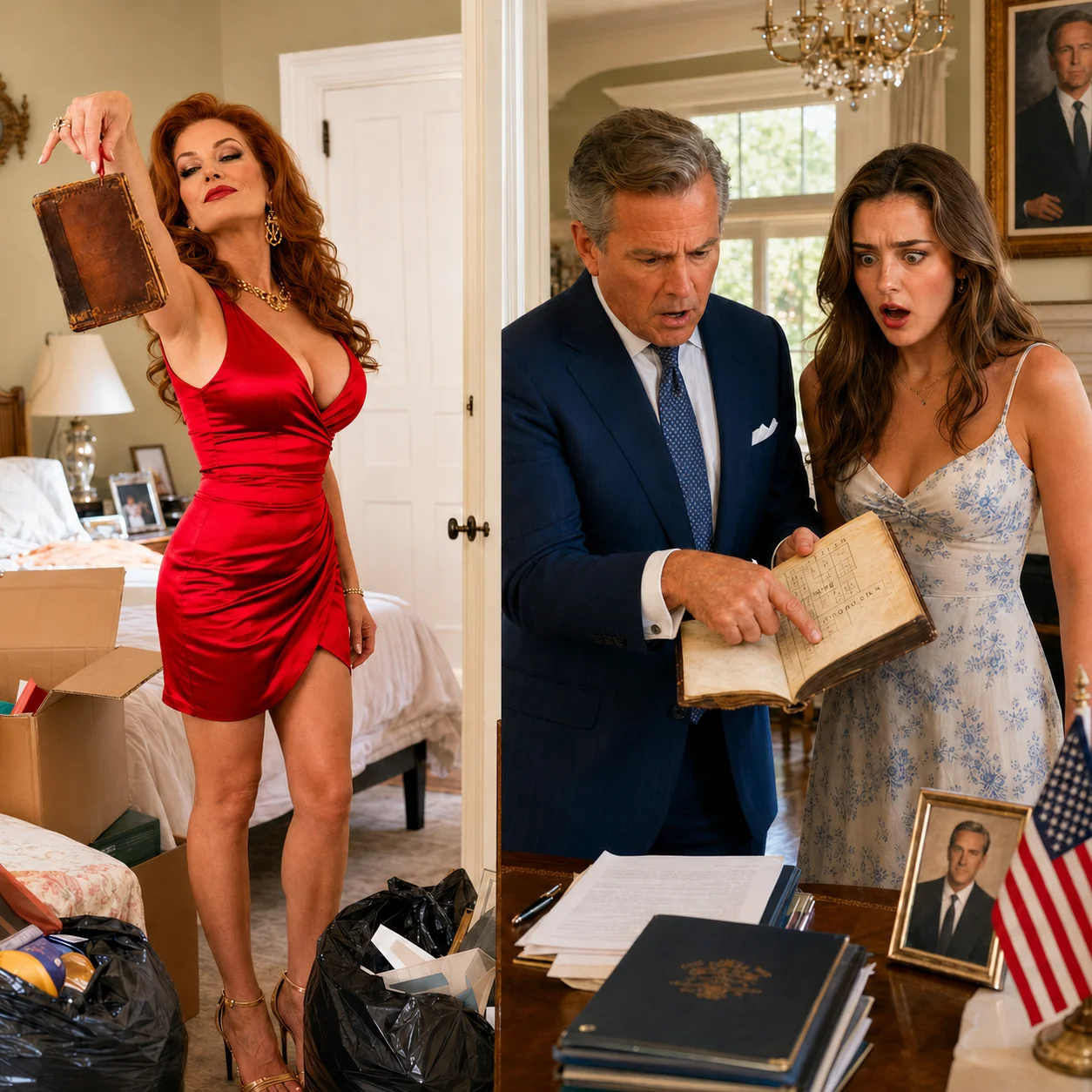
Marlene pulled it closer to her body. “This is private family property.”
“It belonged to my client,” he said.
“Your client is dead.”
“Certain instructions survive death, Mrs. Whitaker.”
Her face flushed. “I don’t know what game you’re playing, but I have no obligation to hand over personal items from my home.”
Mr. Calder opened his folder and removed a photocopied document. “Actually, you may.”
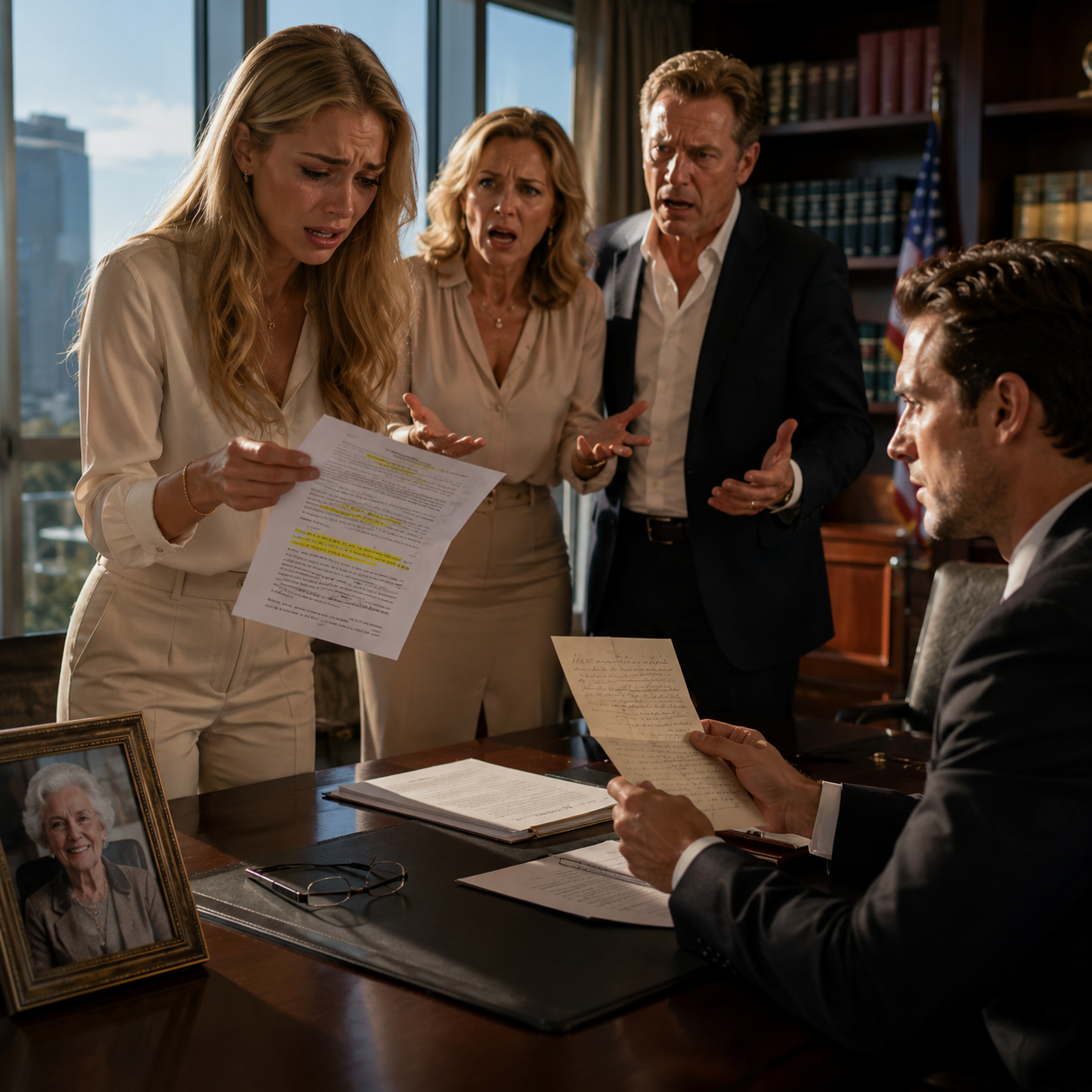
I did not understand what I was seeing at first. The paper looked old, but the copy was clear. At the top, in bold lettering, were the words: Personal Property Memorandum and Safekeeping Reference.
Marlene’s eyes flicked across the page. Her mouth tightened.
Mr. Calder continued. “Elaine executed a will in 2016. Attached to it was a memorandum identifying several personal items, including a leather diary with a brass clasp, to be delivered to her daughter, Nora Elaine Whitaker, upon either Elaine’s death or upon Nora’s request after reaching the age of twenty-five.”
I blinked. “Twenty-five?”
“You were twenty-two when your mother passed,” he said gently. “Your mother wanted some items held until she believed you’d be old enough to understand them.”
Marlene scoffed. “Understand what? Recipes?”
Mr. Calder looked directly at her.
“That remains to be seen.”
For the first time since I arrived, Marlene looked uncertain.
Then she made a mistake.
She turned toward the trash bag by the closet.
It was only a small movement, but Mr. Calder saw it. So did I.
“Marlene,” I said slowly, “what did you already throw away?”
She snapped back. “Nothing important.”
Mr. Calder’s expression hardened. “Mrs. Whitaker, I need you to put the diary on the dresser.”
“I don’t take orders from you.”
“No,” he said. “But if you destroy or conceal property that is subject to a legal memorandum, you may be creating a much larger problem for yourself.”
Patty whispered, “Marlene, just give it to him.”
Marlene’s eyes darted between us. For a second, I thought she might actually throw the diary into the bag just to prove she could. But she must have seen something in Mr. Calder’s face, because she tossed it onto the dresser with a bitter laugh.
“There,” she said. “Enjoy your old paper.”
Mr. Calder did not respond. He picked up the diary carefully, like it was evidence. Then he turned to me.
“Nora, may I open it?”
My throat felt tight. “Yes.”
He unfastened the broken clasp.
The diary gave a soft crackle as it opened. The first pages were exactly what I remembered: Mom’s handwriting, slanted and graceful, moving across cream-colored paper.
March 12. Rain all morning. Nora forgot her lunch, so I drove to school. She pretended to be embarrassed but smiled when she saw the soup.
April 3. The hydrangeas may survive if the frost stays away.
June 18. Thomas says I should write everything down clearly. I hate that clarity is needed inside a family.
My chest tightened.
Mr. Calder turned slowly, not reading every page aloud, but scanning with purpose. He knew what he was looking for.
Marlene crossed her arms. “This is ridiculous.”
Then Mr. Calder stopped.
He looked down at the page.
The room changed before anyone spoke. It was in his stillness. The careful way his eyes narrowed. The way his thumb held the page without moving.
“What is it?” I asked.
He did not answer immediately.
Instead, he turned the diary toward the window and examined the lower margin of a page filled with what looked like a recipe for peach preserves. Beneath the recipe, written in smaller letters, was a sequence of numbers and letters.
PC-17-4429-A / Buncombe Registry / Cedar Hollow Parcel
Below that, in my mother’s handwriting, was one sentence.
Nora, if anyone tells you the house was never mine, ask Thomas to pull this code.
Marlene’s face went pale.
I stared at the words until they blurred.
“The house?” I whispered.
Mr. Calder closed the diary halfway and looked at Marlene.
“Mrs. Whitaker,” he said, “I think we need to have a formal conversation downstairs.”
Marlene laughed again, but this time it broke in the middle. “A code in a diary doesn’t mean anything.”
“No,” he said. “But the property records it references may.”
She pointed toward the stairs. “You need to leave my house.”
Mr. Calder’s voice remained even. “Until we verify ownership, I would strongly advise you to stop referring to it as yours.”
That was the first time I saw real fear in my stepmother’s eyes.
We went downstairs to the dining room because Mr. Calder insisted we needed a flat surface, and Marlene refused to let us use Dad’s old office. She said it was “private.” Mr. Calder said nothing, but he made a note in his folder.
The dining room had once been Mom’s favorite room. She loved the morning light there. She used to spread bills, seed catalogs, and my homework across the table while Dad complained about clutter and then secretly brought her tea. Now the walls were painted a cold gray, and the old oak table had been replaced by a glass one Marlene loved because it made the room look “less country.”
Mr. Calder placed the diary in front of me, not Marlene.
Then he called his office.
I sat frozen while he spoke to someone named Linda and read out the code from the diary. Marlene paced near the window, her phone clutched in her hand. Patty hovered by the doorway, looking like she regretted coming.
“Yes,” Mr. Calder said into the phone. “Buncombe County Registry. Cedar Hollow parcel. Cross-reference Elaine Whitaker, maiden name Porter, possibly Porter Family Trust. Yes. Pull the deed history, transfer instruments, and any life estate or survivorship language.”
The words sounded like another language.
Marlene stopped pacing at “Porter Family Trust.”
I noticed.
So did Mr. Calder.
“Thank you,” he said. “Send it to my secure email and call me when you have the registry image.”
He hung up.
“What does that mean?” I asked.
Mr. Calder folded his hands.
“It means your mother may have owned this property separately from your father.”
Marlene snapped, “That’s impossible.”
He looked at her. “Why?”
“Because Daniel handled the house. He paid the taxes. He insured it. He maintained it.”
“Handling expenses is not the same as holding title.”
“My husband told me this house was his.”
“Perhaps he believed that,” Mr. Calder said.
But his tone told me he did not believe it.
I pressed my hand against the diary. “Mom owned the house?”
“I don’t know yet,” he said. “But this code appears to reference a recorded property instrument. Your mother wrote it down for a reason.”
Marlene pointed at the diary. “That woman wrote down everything. Soup recipes, flower names, nonsense.”
Mr. Calder’s eyes sharpened.
“That woman was my client,” he said. “And in my experience, Elaine Whitaker rarely wrote anything down without a reason.”
For a moment, no one spoke.
Then the front door opened.
My older half-brother, Grant, walked in wearing sunglasses and a golf shirt, though it was barely noon on a cloudy Tuesday. He was not really my brother by blood. He was Marlene’s son from her first marriage, but after she married Dad, she began calling him “Daniel’s boy” whenever it benefited her.
Grant looked from Marlene to Mr. Calder to me.
“What’s going on?” he asked.
Marlene rushed toward him. “This lawyer is trying to confuse Nora with some old diary.”
Grant removed his sunglasses slowly. “What diary?”
“My mother’s,” I said.
He gave me a bored look. “Seriously? You people are fighting over a journal?”
Mr. Calder said, “We are discussing possible ownership issues regarding the property.”
Grant froze.
That reaction was too fast.
“You told him?” Grant said to Marlene.
The room went silent.
Marlene’s face twisted. “Grant.”
Mr. Calder leaned back slightly. “Told him what?”
Grant looked at his mother, then realized what he had done. “Nothing. I meant—she told him about Dad’s will.”
“You said ownership issues,” I said.
Grant looked at me with irritation. “Don’t start acting like you understand legal stuff.”
Something inside me, something tired and bruised, stood up.
“I understand enough to know you reacted before he explained anything.”
Grant opened his mouth, but Mr. Calder’s phone rang.
He answered immediately. “Calder.”
We all watched him.
His expression did not change much, but his eyes lifted to mine.
“I see,” he said. “And the grantee?” A pause. “Recorded in 1998? Transfer from Harold and Beatrice Porter to Elaine Porter Whitaker as sole and separate property?” Another pause. “Any subsequent transfer to Daniel Whitaker?” He listened. “None?”
Marlene sat down.
Grant whispered, “Damn it.”
I heard him.
Mr. Calder turned slightly away from us, but his voice carried clearly.
“Life estate?” he asked. “Yes. Read the language.” He waited. “Elaine retains full ownership with a conditional right of occupancy granted to spouse Daniel Whitaker during his lifetime, provided the property is maintained and not transferred, encumbered, or claimed as marital asset. Upon Daniel’s death, full possessory interest to pass to Elaine’s named beneficiary under separate testamentary instruction.”
My heart began pounding so hard I could feel it in my hands.
Mr. Calder closed his eyes briefly.
“Send everything,” he said. “Now.”
He ended the call.
Marlene stared at the glass table like it had betrayed her.
Grant dragged a hand over his mouth.
I could barely breathe. “What does that mean?”
Mr. Calder looked at me with a gentleness that made my chest ache.
“It means your mother inherited this property from her parents before her marriage. She kept it as separate property. Your father had the right to live here for the rest of his life, but he did not own it outright. When he died, that right ended.”
Marlene’s lips parted.
“No,” she said.
Mr. Calder continued, “If Elaine’s beneficiary instruction names you, Nora, then this house likely belongs to you.”
The room tilted.
For five years, I had walked carefully around grief, guilt, and Marlene’s certainty. I had listened to her call my childhood home hers. I had allowed her to pack my mother into trash bags because I thought fighting would only make me look bitter.
But my mother had known.
She had known someone might try to erase her.
She had hidden the one thing I needed in the one thing Marlene thought was worthless.
Grant slammed his sunglasses on the table. “This is insane. Daniel lived here for thirty years.”
“Twenty-eight,” Mr. Calder said.
“What?”
“Daniel lived here for twenty-eight years. Elaine inherited the property from her parents two years after the marriage began.”
Grant glared at him. “That doesn’t matter. They were married.”
“It matters greatly.”
Marlene found her voice. “Daniel paid for renovations.”
“He may have,” Mr. Calder said. “That could create a claim for reimbursement by his estate under certain circumstances, depending on records and intent. It does not automatically transfer title.”
“He left me everything.”
“He could only leave what he owned.”
Marlene’s face hardened. “I want my lawyer.”
“That would be wise,” Mr. Calder said.
Grant leaned toward him. “You can’t just walk in here and take a widow’s house.”
Mr. Calder did not blink. “And you cannot sell, mortgage, occupy, or dispose of property you do not own.”
The word sell hit the room like a glass breaking.
My head turned toward Grant.
Marlene closed her eyes.
Mr. Calder noticed.
“What have you done?” he asked.
No one answered.
“What have you done?” I repeated.
Grant stood abruptly. “Mom, don’t say anything.”
But Marlene was already unraveling. “It wasn’t final.”
“What wasn’t final?” I asked.
She pressed her fingers against her temples. “Daniel told me the house would be mine. He promised me. I spent years in this place. I cared for him.”
“You hired a cleaning lady and complained when Dad forgot to transfer money into your account,” I said.
Her eyes flashed. “You don’t know what marriage is.”
“I know what theft looks like.”
Grant pointed at me. “Watch your mouth.”
Mr. Calder stood. “Enough. If there is a pending sale or loan involving this property, I need to know immediately.”
Grant’s jaw tightened.
Marlene whispered, “We listed it.”
The floor seemed to disappear beneath me.
“What?”
She looked at me, and for one brief second, I saw not grief or guilt, but pure resentment.
“We listed it,” she said. “The market is high. I wasn’t going to sit in this old house forever while your mother’s ghost took up every wall.”
I gripped the edge of the table. “You listed my mother’s house?”
“It was supposed to close next month,” Grant said bitterly. “Until you showed up with that stupid diary.”
Mr. Calder’s voice cut through the room. “Who is the realtor?”
No answer.
“Mrs. Whitaker,” he said, “if you attempted to sell property under false ownership claims, the consequences may be severe. I suggest you answer.”
Marlene swallowed. “Hastings Realty. Linda Mayfield.”
“Did you sign a listing agreement as owner?”
Marlene looked away.
Grant said, “She signed as surviving spouse.”
Mr. Calder wrote that down.
“Did you provide documentation of title?”
Grant said nothing.
That was answer enough.
Mr. Calder looked at me. “Nora, I recommend we leave now. I will file notice with the county and contact the title company handling the sale. No one should remove anything else from this house until ownership is formally clarified.”
Marlene shot up. “You are not putting a cloud on my property.”
“If the property is not yours, the cloud already exists,” he said.
Grant stepped toward him. “You think you can bully us?”
Mr. Calder looked at him like he was a document with a missing signature.
“I think your mother just admitted to attempting to sell a house she may not own,” he said. “And you appear to have prior knowledge of it.”
Grant stopped moving.
I picked up the diary. My hands were trembling, but this time it was not from fear.
Marlene watched me hold it.
“You think this makes you special?” she said, her voice low. “Your mother was weak. She hid behind paperwork because she couldn’t keep her husband’s love.”
For years, that kind of sentence would have destroyed me. It would have sent me back into a child’s silence, desperate not to make the adults angrier.
But I looked at the diary in my hands and thought of Mom writing by lamplight while cancer hollowed her face. I thought of her hiding a property code inside a peach preserve recipe because she knew exactly what kind of woman might one day call it old paper.
“No,” I said. “She protected what was hers.”
Then I walked out of the house with Mr. Calder beside me.
The next two weeks were the longest of my life.
Legal truth moves slowly, even when emotional truth arrives like lightning. Mr. Calder warned me not to assume anything until every document was reviewed. Property law was not a dramatic movie scene where one hidden sentence magically solved everything. There were deeds, wills, memoranda, tax records, estate filings, occupancy rights, and possible claims from Dad’s estate.
But the foundation was clear.
My mother had inherited the property from her parents through the Porter Family Trust. The deed had been recorded in 1998, naming her as sole owner. Because North Carolina recognizes separate property acquired by inheritance, the house had never automatically become marital property simply because she and Dad lived there together.
Mom had later signed a legal document granting Dad a life estate, meaning he could live in the house until his death. That explained why Dad had stayed there after she died. It also explained why he may have believed, or claimed, that the house was “his.” In daily life, it functioned that way. He paid utilities, handled repairs, and remained there with Marlene.
But ownership had not transferred.
The most important document was stored in Mr. Calder’s old file: a testamentary instruction from my mother naming me as the beneficiary of the property after Dad’s life estate ended. The diary did not create the ownership. The diary revealed the code that led to the recorded documents and confirmed what to ask for.
That was the genius of it.
Marlene had dismissed it because it looked emotional.
But Mom had hidden the practical inside the sentimental.
Mr. Calder filed an affidavit and notice with the county to prevent any sale until title was resolved. He contacted the title company involved in Marlene’s pending sale. Within forty-eight hours, the closing was frozen.
That was when Marlene started calling.
The first voicemail was angry.
“You have no idea what you’re doing, Nora. You’re letting that lawyer manipulate you because you hate that your father moved on.”
The second was softer.
“I know we’ve had our differences, but your father wanted me safe. Surely you don’t want to throw me out.”
The third came at 11:37 p.m.
“You selfish little girl. That house is all I have.”
I did not respond.
Grant texted me instead.
You’re going to ruin Mom financially over a technicality?
Then:
Dad would be ashamed of you.
Then:
We already put money down on a condo based on the sale.
That message made me sit up in bed.
I forwarded it to Mr. Calder.
He called me the next morning.
“Nora,” he said, “did you know they were using anticipated proceeds from the house sale?”
“No.”
“Grant’s message suggests reliance on funds they had no confirmed right to receive. Do not engage with him directly.”
“Could they have taken a loan against the house?”
“We are checking.”
They had tried.
That was the next reveal.
Marlene and Grant had approached a private lender two months after Dad’s death, seeking a bridge loan using the house as expected collateral. The application had not been completed because the lender requested clearer title documentation. Marlene apparently believed the pending sale would solve everything before anyone looked too closely.
But someone did look.
The title company.
A title officer named Rachel Kim called Mr. Calder after receiving his notice. She had already found inconsistencies in the deed chain but had been waiting on additional documentation from Marlene’s realtor. The sale was not as close to closing as Marlene claimed. It was already in trouble.
When Rachel learned about Mom’s original deed and life estate language, she sounded both relieved and furious.
“They represented the surviving spouse as owner,” she said during a conference call. “But the registry image does not support that. We would not have insured this sale.”
Marlene’s realtor, Linda Mayfield, called me once from an unknown number.
“I’m just trying to understand the situation,” she said in a bright, nervous voice.
“You should speak to my attorney,” I replied.
“I did not know there was a dispute.”
“Then you should definitely speak to my attorney.”
Mr. Calder later told me Linda had been given a copy of Dad’s will and Marlene’s marriage certificate, but not Mom’s deed history. Whether that was intentional concealment or reckless misunderstanding would matter later.
During all of this, I kept the diary on my kitchen table.
I lived in a small townhouse twenty minutes from the hospital where I worked as a physical therapist. My life was not glamorous. I had student loans, a reliable used Honda, and a habit of buying store-brand coffee even when I could afford better. The idea of owning my mother’s house felt unreal, almost embarrassing in its size.
But the more I read the diary, the more I understood that the house was never just an asset.
It was a promise.
Mom had written about the house constantly. Not in a possessive way, but in the way people write about living things they love.
May 7. Daniel wants to replace the porch railing with vinyl. I told him my father would climb out of the grave and remove it himself.
September 22. Nora fell asleep under the oak tree with a book on her face. I hope this land remembers her laughter.
January 14. Thomas says the life estate language is strong. I pray it is never needed. I pray Daniel honors what he knows.
That sentence made me stop.
What he knows.
Dad had known.
I wanted to believe he had simply misunderstood. I wanted to believe grief and remarriage had blurred everything. But Mom’s diary suggested otherwise. Dad knew the house was hers. He knew he had only a life estate. He knew it was supposed to pass to me.
And he never told me.
That hurt more than Marlene’s greed.
Marlene was easy to understand. She wanted what she wanted, and she shaped truth around it. But Dad had been complicated. He had loved Mom once. He had loved me, in his limited, quiet way. He had also allowed Marlene to erase my mother inch by inch while he sat in the same rooms my grandparents built.
Three days after the title freeze, I received a letter from Marlene’s attorney.
It was aggressive, full of phrases like wrongful interference, emotional distress, surviving spouse rights, equitable interest, and potential claim for improvements. Mr. Calder read it and sighed.
“This is a pressure letter,” he said.
“Does she have a claim?”
“Possibly a limited one if she can prove estate funds or her own funds significantly improved the property with expectation of ownership. But claiming reimbursement is different from claiming ownership. And if she attempted to sell the property without title, her position is weakened.”
“What happens next?”
“We ask for an accounting. We verify expenses. We petition the court if necessary to confirm title. And we make sure she stops disposing of property.”
I thought of the trash bags.
“My mother’s things,” I said.
His expression softened. “Make a list of what you remember.”
So I did.
The quilt. The blue velvet jewelry box. The cedar recipe chest. The framed photo of Mom and her parents on the porch. Her gardening tools. Her pearl earrings. The yellow mixing bowl with the chip on the rim. Her church choir pin. Her handwritten recipe cards.
Some items were already gone.
Patty, perhaps feeling guilty, called me privately.
“Marlene donated some things to Helping Hands,” she whispered. “And she sold a few pieces online.”
“What pieces?”
“I don’t know all of them. A jewelry box, maybe. Some dishes. A quilt.”
My stomach turned cold.
“Why are you telling me?”
Patty was quiet for a long moment.
“Because your mother was kind to me once,” she said. “Years ago. Before Marlene married Daniel. I came to a Christmas party at that house after my divorce, and Elaine sent me home with food. She didn’t have to. Marlene always hated that I remembered.”
After the call, I drove to Helping Hands.
The thrift store smelled like dust, detergent, and old wood. A woman named Denise listened as I explained, then took me to the back. They had already sold some items, but not all. I found Mom’s yellow mixing bowl on a metal shelf. I found her choir pin in a plastic bag of miscellaneous jewelry. I found the quilt folded in a donation bin, mispriced at twelve dollars.
I bought it back with shaking hands.
The blue velvet jewelry box was gone.
When I told Mr. Calder, he added it to the list.
“This may become part of a conversion claim,” he said.
I almost laughed. “Conversion sounds too polite.”
“In law, polite words often describe ugly behavior.”
The court hearing happened six weeks later.
By then, Marlene had moved from anger to performance.
She arrived wearing black, though no one had died recently enough for mourning clothes. Grant came with her, along with a different attorney than the one who sent the first letter. Her new attorney, a sharp woman named Celeste Bannon, clearly understood the weakness of Marlene’s position because she did not argue that Marlene owned the house outright. Instead, she argued that Marlene had been misled by Dad, had acted in good faith, and deserved time to vacate plus compensation for improvements.
Mr. Calder presented the documents calmly.
The 1998 deed.
The Porter Family Trust transfer.
Mom’s separate property declaration.
The life estate granted to Dad.
The testamentary instruction naming me.
The diary page with the property code was not the legal foundation, but it became the emotional center of the hearing. Celeste objected to its relevance. Mr. Calder argued it explained discovery of the documents and supported Elaine’s intent.
The judge, a woman with short gray hair and reading glasses low on her nose, examined the photocopy.
“She wrote, ‘If anyone tells you the house was never mine, ask Thomas to pull this code,’” the judge said.
Marlene looked down.
I watched her hands tighten in her lap.
The judge asked one question that changed the atmosphere.
“Mrs. Whitaker, when you listed the property, did you know Elaine Whitaker had inherited it from her parents?”
Marlene lifted her face. “My husband told me the house was ours.”
“That is not my question.”
Marlene swallowed. “I knew it had been in her family.”
“Did you know there was a life estate?”
“No.”
Mr. Calder stood. “Your Honor, we have text messages suggesting Mrs. Whitaker and her son were aware of a title issue before listing.”
Grant stiffened.
Celeste closed her eyes for half a second.
The judge allowed the messages.
One of them was from Grant to Marlene, dated three weeks before Dad died.
If Daniel never got Elaine’s name cleared off the old deed, this could be a problem. Need him to sign something or find another way.
Another from Marlene:
He keeps saying Nora doesn’t know anything. After he’s gone, we’ll use the will.
I could not move.
Dad had still been alive when they discussed it.
Marlene had known.
The judge read the messages twice. Her face did not change, but the room felt colder.
Celeste asked for a recess.
In the hallway, Marlene approached me.
For once, Grant was not beside her. He was on his phone near the vending machines, whispering harshly to someone.
Marlene’s eyes were wet, but I no longer trusted tears from her.
“Nora,” she said quietly, “I made mistakes.”
I looked at her.
“She was always there,” Marlene continued. “Your mother. In that house. In your father’s stories. In the neighbors’ faces. In the garden. I was his wife, but I always felt like I was living inside another woman’s life.”
For a second, I saw the human wound beneath her cruelty. Envy. Insecurity. The humiliation of competing with a dead woman and losing.
Then she ruined it.
“You could be generous,” she said. “You could let me have enough from the sale to start over.”
I almost smiled because the audacity was so clean.
“You tried to throw away her diary.”
Her mouth tightened. “I didn’t know what was in it.”
“No. You just knew it was hers.”
That silenced her.
I stepped closer, lowering my voice so only she could hear.
“You weren’t trying to escape my mother’s shadow, Marlene. You were trying to sell it.”
She had no answer.
The judge’s ruling did not give me everything immediately, but it gave me enough. She confirmed that based on the recorded documents, title was vested in me subject to final administrative filings. She blocked the pending sale, prohibited Marlene from removing fixtures or personal property, ordered an inventory, and required Marlene to vacate within forty-five days unless she could establish a lawful occupancy agreement.
As for Marlene’s claim for improvements, the judge allowed her to submit documentation. Later, most of it collapsed. The “improvements” were cosmetic changes paid from Dad’s account while he had a right to live there. Some were maintenance. Some were Marlene’s personal decorating choices. None gave her ownership.
Grant disappeared from the process once the text messages surfaced. Mr. Calder suspected he feared exposure over the attempted bridge loan. Marlene eventually settled. She waived further claims in exchange for not being pursued civilly over the attempted sale, though she had to return or compensate for certain personal items she had removed.
She could not return the blue velvet jewelry box.
But one afternoon, a package appeared at my townhouse with no return address.
Inside was the jewelry box.
The velvet was worn at the corners. The little gold latch still clicked the same way. Inside were Mom’s pearl earrings, her wedding band from her marriage to Dad, and a folded note in Patty’s handwriting.
Marlene gave this to me to sell. I couldn’t do it. I’m sorry I waited so long.
I sat on the floor and cried so hard I scared myself.
Not because of the jewelry.
Because one more piece of my mother had survived.
When Marlene finally left the house, she did not tell me. Mr. Calder called to say the keys had been turned over through her attorney. I drove there that evening alone.
The house looked tired.
The front porch railing was still wood, though badly painted. The garden was overgrown. The hydrangeas Mom loved had gone wild along the fence, stubborn and blue. Inside, the rooms echoed. Marlene had taken her glass table, her gray curtains, her modern lamps, and every trace of herself she could carry.
But she could not take the light.
The dining room still caught the morning sun. The stairs still creaked on the third step. The kitchen window still looked out over the oak tree where I used to read. In Mom’s bedroom, the walls were bare, but I could almost see the quilt folded at the foot of the bed.
I walked from room to room with the diary in my hand.
For a long time, I had thought inheritance was about receiving something after someone died. Money. Property. Objects. Legal rights.
But standing there, I understood it differently.
Inheritance is also the proof that someone thought of you when they were afraid. It is the hand they leave behind in the dark, pointing toward the door.
Mom had not been weak. She had been strategic in the quiet way women often have to be when louder people mistake kindness for surrender. She had known my father loved comfort more than confrontation. She had known grief might make me easy to push aside. She had known Marlene, or someone like Marlene, might one day stand in that house and call her life clutter.
So she wrote down the code.
Not in a safe deposit box I might never open. Not in a legal file Marlene could claim was irrelevant. She wrote it in the diary she knew I would fight for because it was hers.
Three months later, I moved into the house.
Not immediately. First, I repaired the porch, cleaned the gutters, replaced the locks, and hired a landscaper to save what could be saved of the garden. I kept my townhouse for a while because the idea of sleeping there again felt too large. But slowly, room by room, the house became less like a battlefield and more like a place where breathing was possible.
I painted the dining room warm white.
I put Mom’s quilt on the guest bed.
I placed the yellow mixing bowl on the kitchen shelf.
I hung the photo of Mom and her parents back in the hallway.
And in the living room, on the old wooden desk my grandfather built, I placed the diary inside a glass-topped box. Not locked away. Not hidden. Protected.
One Saturday in early spring, Mr. Calder came by with final paperwork. He looked older than he had during the first hearing, but satisfied.
“It’s done,” he said, handing me the folder. “The title is confirmed. The property is yours.”
I looked down at the documents.
For a moment, I expected to feel triumphant. I expected some grand rush of victory, like the ending of a story where the villain loses and the heroine gets the house.
Instead, I felt quiet.
“Thank you,” I said.
Mr. Calder smiled. “Your mother did the hard part.”
“She knew Dad might not protect it.”
His expression softened. “Elaine loved your father. But she was not blind.”
I looked toward the garden. “Do you think she knew Marlene would happen?”
“Not specifically,” he said. “But she understood human nature.”
That made me laugh a little.
Before he left, he paused at the door and looked back at the diary on the desk.
“She asked me once if writing the code there was foolish,” he said. “I told her legal documents belong in files. She told me daughters don’t always go looking in files when they’re grieving.”
My throat tightened.
“She was right,” I whispered.
After he left, I made tea and sat on the porch.
The hydrangeas had started to bloom again.
That was where Marlene found me one final time.
She arrived in a beige sedan I did not recognize, parking at the end of the driveway like she was afraid to come closer. She looked smaller than I remembered. No red nails. No silk blouse. Just a tan coat and sunglasses pushed into her hair.
I stood but did not step off the porch.
“You can’t be here without notice,” I said.
“I know.” Her voice was flat. “I’m not staying.”
She looked at the house for a long moment.
“I hated this place,” she said.
“I know.”
“No,” she said. “I mean I hated that it never became mine. Even when I changed everything, it didn’t feel like mine.”
I said nothing.
She glanced at me. “Your father did tell me the house would be mine. But he also told me not to ask too many questions.”
That sounded like Dad.
A man who could build a shelf, fix a pipe, hold your hand in a hospital hallway, and still choose silence when truth became inconvenient.
“I wanted someone to choose me,” Marlene said.
“You chose wrong,” I said.
Her mouth trembled, but she nodded.
Then she reached into her purse and took out a small envelope.
“I found this in Daniel’s office before I left. I was going to throw it away.”
I did not move.
She placed it on the top porch step.
“Why didn’t you?”
She looked older then. Truly older.
“Because I’m tired of being the woman who throws things away.”
She turned and walked back to her car.
I waited until she drove off before picking up the envelope.
Inside was a photograph.
Mom, Dad, and me on the porch when I was about eight. I was missing a front tooth. Mom had one hand on my shoulder. Dad was laughing at something outside the frame. On the back, in my mother’s handwriting, were six words.
Let the house keep love.
I sat on the porch step for a long time with the photo in my lap.
I did not forgive everyone that day. Forgiveness, I had learned, is not a door you owe people just because they knock. I did not excuse Marlene. I did not rewrite Dad into a braver man than he had been. I did not pretend the legal fight had healed all the damage.
But I let the house keep love.
Not the fragile kind that depends on everyone behaving well. Not the performative kind people use to silence you when they want your inheritance, your memories, or your dignity. Real love. The kind that prepares documents when it has to. The kind that hides a property code inside a diary because it knows one day your daughter may need both tenderness and proof.
A year later, I hosted Thanksgiving in that house for the first time.
Not a huge gathering. Just a few people who had stood by me when the truth came out: Mr. Calder and his wife, Patty, my friend Leah from work, Mrs. Gable from next door, and Rachel Kim, the title officer who had stopped a stolen house from being sold with a polite email and a sharper eye than anyone expected.
We ate in the dining room under warm light. The yellow bowl held mashed potatoes. The repaired porch smelled like rain. Mrs. Gable brought sweet potato pie and told stories about Mom sneaking extra tomatoes over the fence. Patty cried once, quietly, when she saw the quilt folded over the rocking chair.
Before dinner, I opened Mom’s diary to a blank page near the back.
For years, I had been afraid to write in it. It felt too sacred, too much like touching a voice I might damage.
But that evening, with the house full of safe noise, I picked up a pen.
November 24. Rain in the morning, sun by dinner. The hydrangeas survived. The house is still standing. So am I.
Then I paused and added one more line.
Mom, they called it old paper. They were wrong.
I closed the diary and looked around the room.
The house had not saved me.
My mother’s planning had not erased grief.
The legal code hidden in those pages had not magically made the past fair.
But it had given me back something Marlene thought she could steal because she mistook quiet things for weak ones.
A diary.
A house.
A history.
A mother’s final protection.
And when the wind moved gently through the old porch boards that night, I could almost hear Mom laughing softly in the walls, as if she had known all along that paper only looks fragile until the right person reads what is written inside.
![[FULL STORY] “Without Me, You’re Nothing” — She Thought It Was the End Until I Made One Call](https://social-media.rabedo.com/thumbnails/1777542694_b482c0e4-3855-4cc6-9a63-7bd8a2d8abda.png)