
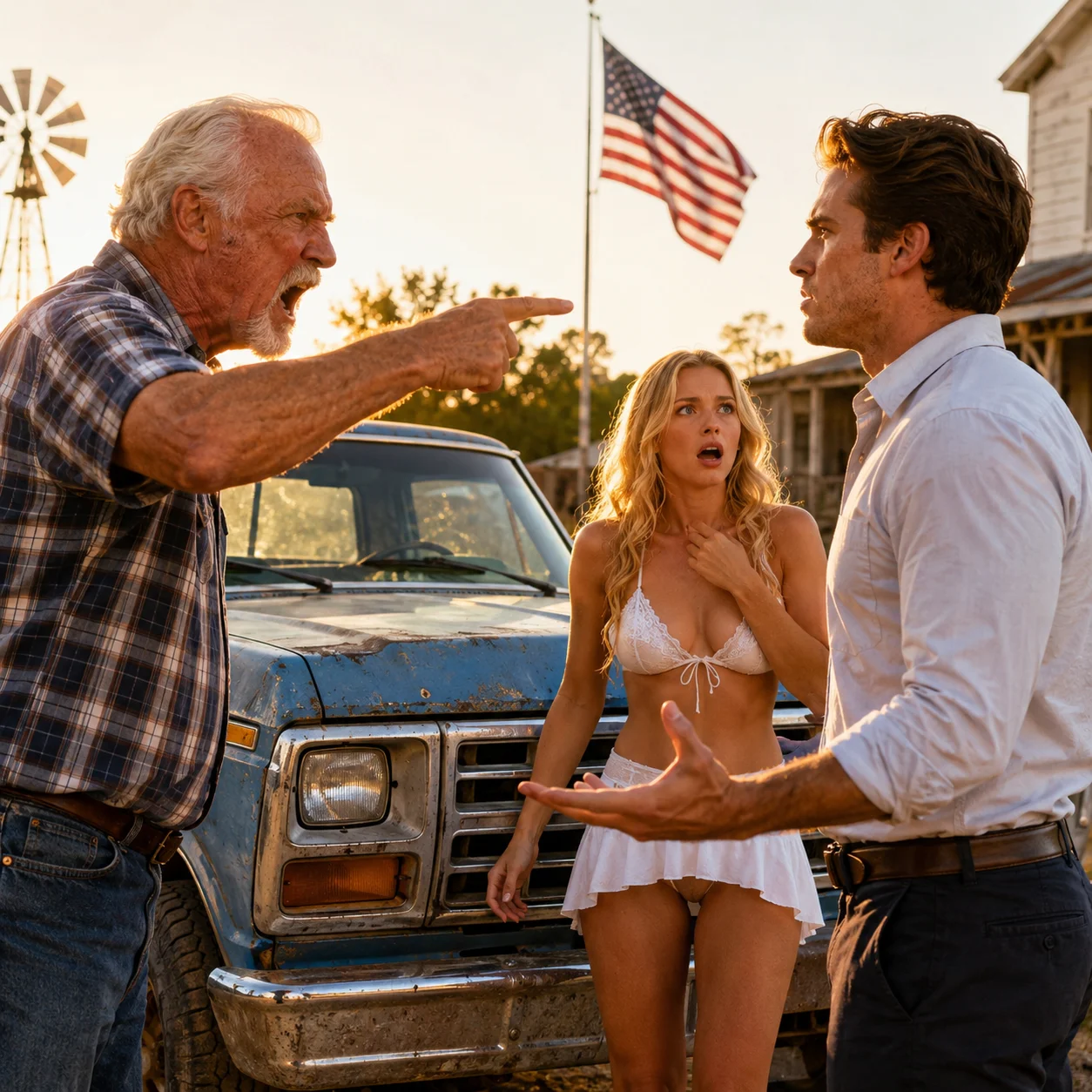
My mouth had gone dry.
Grandpa had never told me this.
He had talked around it, maybe. He had asked me once if I still liked working with my hands. He had asked if I thought the farm should stay quiet or become a parking lot. He had asked, during one of our last porch conversations, whether I believed land belonged to the person who paid for it or the person who protected it.
I had thought he was just talking.
Brent shoved his chair back. “This is insane. Owen works in HVAC. He doesn’t know anything about trusts or farms.”
Margaret folded her hands. “Your grandfather disagreed.”
“He was old.”
“He was competent.”
“He was manipulated.”
Margaret’s voice cooled by exactly two degrees. “Be careful, Mr. Miller.”
Brent pointed at me. “So he gets the farm? Just because he drove Grandpa to doctor appointments and played farm boy on weekends?”
I looked at him. “I didn’t do those things to get paid.”
“No, you just happened to end up with the land.”
“Enough,” Aunt Linda whispered.
But Brent was already leaning into the performance.
He laughed toward the others. “Look at him. He came here in Grandpa’s old truck like he was auditioning for a country music video, and now we’re supposed to believe he’s the chosen heir?”
Madison touched his arm, but he shook her off.
“That truck is probably the only thing he can afford,” Brent said. “Maybe Grandpa felt sorry for him.”
The old humiliation washed over the room. People stared at the table. No one defended me. Not really.
I could have told them then that I was not broke. That I had paid off my small house three years earlier. That I ran my own HVAC repair business and had more steady cash flow than Brent’s shiny life ever would. But I did not.
Grandpa had taught me something else.
Never prove yourself to people committed to misunderstanding you. Let time embarrass them.
Margaret finished the reading. Grandpa had left Uncle Ray his fishing rods, Aunt Linda the dining table and family Bible, Marcy a savings bond collection, and Brent a gold pocket watch that had belonged to Great-Granddad.
Brent looked insulted by the watch.
I looked at the farm paperwork like it might disappear if I blinked.
After the meeting, Margaret asked me to stay behind.
When everyone else left, she closed the conference room door gently.
“Your grandfather wanted you to have this,” she said, sliding a smaller envelope across the table.
Inside was a handwritten letter.
Owen,
If you are reading this, I have finally stopped arguing with doctors and weather reports.
I know this will make trouble. I am sorry for that, but not sorry enough to do it differently.
The farm needs someone who understands that value is not always loud. You listened when others talked. You fixed what others sold. You came by when no one was watching.
The truck is yours too. Not because it is worth much on paper, but because it remembers us.
There is one more thing. First Prairie Bank has instructions regarding the truck title and the storage box. Do not let Ray or Brent rush you. They will try. Take this letter to Mr. Alden at the bank.
And remember what I told you: an old thing can still carry the whole truth.
Grandpa
I read it twice.
Then a third time.
Margaret watched me kindly. “He trusted you.”
I swallowed hard. “I don’t know if I can handle all this.”
“That is probably why he chose you.”
I drove Grandpa’s truck home that afternoon with the letter on the seat beside me. For the first time since the funeral, I cried. Not loudly. Just enough that the road blurred and I had to pull over near a wheat field.
The next morning, Brent called me seven times before nine.
I ignored the first six.
On the seventh, I answered.
“We need to talk,” he said.
“No, we don’t.”
“Don’t be childish. This affects the whole family.”
“It affected the whole family when Grandpa was alive too. You could have visited.”
Silence.
Then Brent lowered his voice. “You don’t know what you’re sitting on.”
“I know exactly what I’m sitting in,” I said. “A truck you called scrap metal.”
“Cute. Listen, I’ve been in contact with people who understand land value. That trust language is restrictive, but not impossible. If we all agree, we can petition—”
“I’m not agreeing to sell Grandpa’s farm.”
“You haven’t even heard the number.”
“I don’t need to.”
“That’s stupid.”
“That’s final.”
He exhaled sharply. “You’re acting emotional.”
“Grandpa died six days ago.”
“And this is exactly why emotional people shouldn’t control assets.”
There it was. Assets. Not land. Not home. Not Grandpa’s place. Assets.
“Goodbye, Brent.”
I hung up.
For three days, my phone became a family complaint box.
Uncle Ray texted that I was being selfish.
Aunt Linda said she loved me but hoped I would “think of everyone.”
Marcy asked if I would at least consider selling part of the road frontage.
Brent sent articles about land development, tax burdens, maintenance costs, and estate liquidity. He also sent one message that read: You’re not built for this. Don’t embarrass yourself.
I did not reply.
On Friday, I drove to First Prairie Bank.
It was a brick building downtown with green awnings and polished brass handles. Grandpa had banked there since before I was born. He used to complain that banks had gotten too fancy, then spend twenty minutes chatting with every teller by name.
I parked the truck in the side lot.
As I got out, an older man in a navy suit near the entrance stopped and stared at the vehicle.
For one strange second, I thought he was judging it too.
Then his face softened.
“That Earl Miller’s truck?”
I nodded. “Yes, sir.”
He stepped closer, placing one hand lightly on the hood like it was an old horse. “I’m Thomas Alden. Your grandfather told me I’d see this truck again.”
I held up the envelope. “He told me to come see you.”
Mr. Alden nodded. “Then let’s go inside.”
His office overlooked Main Street. On the wall were framed photographs of local farms, old bank buildings, and one black-and-white picture of a much younger Grandpa standing beside a group of men at a county fair auction.
Mr. Alden offered coffee. I accepted because it felt rude not to.
He opened a file already waiting on his desk.
“Your grandfather was very specific,” he said. “Before we discuss the trust box, I need to confirm some records.”
He took my license, made a copy, and compared it to documents in the folder. Then he pulled out a vehicle title.
Not a photocopy.
The actual Kansas certificate of title for the 1987 Ford F-150.
My name was printed on it.
Owner: Owen Daniel Miller.
Issue date: two years earlier.
I stared at it.
“I don’t understand,” I said.
“Your grandfather transferred the truck to you two years ago,” Mr. Alden said. “Properly signed, notarized, filed with the state. He retained possession with your permission, according to the accompanying agreement.”
“My permission?”
Mr. Alden slid another document toward me.
It was signed by me.
For a moment, my stomach tightened. Then I recognized it.
Two years earlier, Grandpa had asked me to sign “some insurance paperwork” because he wanted me authorized to drive the truck if something happened. I remembered teasing him that he was being dramatic. He had told me to read things before signing, and when I admitted I trusted him, he had smiled sadly.
Now I understood.
“He didn’t want anyone fighting over it,” Mr. Alden said.
I let out a breath. “It’s just a truck.”
“No,” he said gently. “That is what everyone else was supposed to think.”
He opened the next folder.
Inside were records of a safe deposit box, storage receipts, and several photographs of the truck’s under-seat compartment.
Mr. Alden folded his hands. “Your grandfather used the truck to secure certain documents because he believed some family members might search his house after his death.”
I thought of Brent in the farmhouse kitchen after the funeral, opening drawers under the excuse of looking for serving spoons.
“What documents?” I asked.
“The original trust memorandum, mineral rights records, agricultural lease agreements, and a notarized statement regarding an outstanding private loan.”
“Private loan?”
Mr. Alden’s mouth tightened.
“To your uncle Ray.”
My stomach dropped.
“Grandpa loaned Uncle Ray money?”
“Several times. The last consolidated note was for one hundred and eighty thousand dollars.”
I stared at him.
Uncle Ray lived in a four-bedroom house, belonged to a country club, and liked to joke that my business was “blue-collar but honest.” He had once told me I should invest more aggressively if I ever wanted real security.
“One hundred and eighty thousand?” I repeated.
Mr. Alden nodded. “Secured by Ray’s expected inheritance interest, which no longer exists in the form he anticipated.”
I sat back slowly.
Now Brent’s desperation made sense.
If Uncle Ray had been counting on land sale proceeds to erase a debt, Grandpa’s trust had not only blocked his plan — it had exposed him.
Mr. Alden continued. “Your grandfather instructed us to meet with all relevant parties next week regarding the trust administration. Given recent communications from your cousin, I expect they may try to challenge the structure.”
“Recent communications?”
Mr. Alden hesitated. “Brent contacted the bank yesterday claiming authority to discuss a development offer.”
I almost laughed. “He has no authority.”
“No,” Mr. Alden said. “He does not.”
We scheduled the meeting for Tuesday.
By Monday night, Brent had apparently decided intimidation was not working and switched to humiliation.
He posted a photo on Facebook of Grandpa’s truck parked outside the church after the funeral. He had cropped it so my shoulder was barely visible beside it.
Caption: Some people inherit land. Some people inherit delusions. Hope that rusty truck comes with a reality check.
He did not tag me, but everyone knew.
Comments appeared quickly.
Mostly laughing emojis from his friends.
One person wrote, Is that thing even street legal?
Another wrote, Bro got the family farm starter pack.
Madison commented: Some people really think being sentimental pays bills.
I stared at the post for maybe thirty seconds.
Then I closed the app.
The next morning, I drove the truck to First Prairie Bank.
The same truck.
The same rust.
The same cracked dashboard.
The conference room was larger than Margaret Hale’s, with a polished table and a screen mounted on one wall. Mr. Alden sat at one end with a younger trust officer named Priya Desai. Margaret was there too. I sat beside her.
Uncle Ray arrived red-faced and stiff.
Aunt Linda looked worried.
Brent came in last, wearing a tailored charcoal suit and the expression of a man arriving to fix what lesser people had mishandled. Madison followed him, clutching a leather folder.
Brent saw me and smiled.
“Well,” he said, loud enough for the room, “at least the truck made it.”
No one laughed.
Mr. Alden stood. “Thank you all for coming.”
Brent did not sit immediately. “Before we begin, I want to make it clear that my family has serious concerns about undue influence.”
Margaret’s eyes sharpened. “Then you may put those concerns in writing through counsel.”
Brent smiled thinly. “We may.”
Mr. Alden gestured to the chairs. “Please sit.”
Brent sat.
For the first twenty minutes, Priya explained the trust. Grandpa had created it four years earlier. He had transferred the farm into it gradually with proper valuation and tax planning. The trust allowed me to live on and maintain the farm, required annual reporting, prohibited commercial development for fifteen years, and allowed limited agricultural leasing to cover taxes and upkeep.
Everything was documented.
Everything was legal.
Brent kept interrupting.
“So Owen controls land he didn’t pay for?”
Priya replied, “The trustee controls the land according to the trust terms. Owen holds beneficial use rights.”
“So he can profit from it?”
“He can receive income from approved agricultural use, after expenses.”
“So yes.”
“He can maintain the property as your grandfather intended.”
Brent leaned back. “Convenient.”
Then Mr. Alden opened a second file.
“We also need to address related obligations affecting certain family expectations.”
Uncle Ray shifted in his seat.
Brent noticed. “What obligations?”
Mr. Alden removed a promissory note and placed it on the table.
“This is a consolidated loan agreement between Earl Miller and Raymond Miller, executed three years ago.”
Aunt Linda looked at her brother. “Ray?”
Uncle Ray’s face had gone pale.
Brent frowned. “What is that?”
Mr. Alden continued, “The outstanding principal, with agreed interest, is currently one hundred eighty-seven thousand four hundred and twenty dollars.”
Madison’s mouth opened slightly.
Brent turned to his father. “Dad?”
Uncle Ray rubbed his forehead. “It was private.”
“It was secured,” Mr. Alden said, “by Raymond’s anticipated distribution from non-trust estate assets and any voluntary family settlement proceeds, should the trust property ever be sold.”
Brent’s polished mask cracked.
“You borrowed almost two hundred grand from Grandpa?” he asked.
Uncle Ray snapped, “Not now.”
“Oh, now seems perfect,” Aunt Linda said, her voice trembling. “Because you were calling Owen selfish while owing Dad money?”
Ray glared at her. “You don’t know what happened.”
“I know Dad never mentioned it.”
“He didn’t mention a lot of things.”
Brent’s hands flattened on the table. “This is irrelevant. The land value dwarfs that note. If we sell—”
“We are not selling,” I said.
He turned on me. “You don’t get to decide everyone’s future because Grandpa liked you best.”
“No,” I said. “Grandpa decided because he knew exactly who would try to sell his future the second he was gone.”
The room went still.
Brent’s face darkened. “You think you’re better than us because you play humble?”
I looked at him for a long moment.
“No. I think Grandpa was better at reading people than you realized.”
That was when Mr. Alden reached for the vehicle title.
“There is one more matter,” he said.
Brent laughed bitterly. “What, the truck gets a trust fund too?”
Mr. Alden looked at him. “In a manner of speaking, the truck is central to the file.”
Brent blinked.
Mr. Alden placed the certificate of title on the table and turned it so everyone could read it.
“Before we proceed with release of the safe deposit materials, I need to confirm something for the record.”
He looked at me.
Then at Brent.
Then back at the title.
“Why does the truck title have Owen’s name on it?”
Silence.
It was not normal silence. It was the kind that removes the air from a room.
Brent stared at the document.
Madison leaned forward.
Uncle Ray whispered, “What?”
Mr. Alden continued calmly. “The 1987 Ford F-150 was legally transferred to Owen two years ago. That transfer matters because Earl stored certain original documents in a compartment inside the vehicle after the transfer. Since Owen is the legal owner, those documents were preserved under his property rights and the bank’s custody instructions.”
Brent looked genuinely lost now. “What documents?”
Priya opened a sealed evidence-style envelope and removed photographs, inventory sheets, and certified copies.
“The original mineral rights reservation,” she said. “The agricultural easement. The full trust memorandum. And Earl Miller’s notarized statement explaining why he restricted sale of the property.”
Margaret slid one document forward.
Brent did not reach for it.
So Mr. Alden read a portion aloud.
“My son Raymond and grandson Brent have repeatedly pressured me to sell land I do not wish sold. Raymond has outstanding debts. Brent has represented himself as having future authority over my property, which he does not and will not. I am placing original records where they will be protected by Owen’s ownership because Owen is the only family member who has never asked me what the farm is worth before asking how I am feeling.”
Aunt Linda covered her mouth.
Uncle Ray stared at the table.
Brent’s face went from red to gray.
Mr. Alden was not finished.
“Earl also documented an incident in which Brent brought a representative from Flint Ridge Development to the property without Earl’s consent.”
Brent stood so abruptly his chair scraped backward.
“That is taken out of context.”
Margaret looked at him. “Sit down.”
“I was helping him understand his options.”
“You brought a developer to an elderly man’s home after he told you he was not interested,” Margaret said.
Brent pointed at the file. “That doesn’t make this legal.”
“No,” Margaret said. “The signatures, filings, competency letters, notary records, physician statement, trust registration, and bank custody records make it legal.”
Brent’s mouth opened, then closed.
For the first time in my life, I watched him run out of performance.
Mr. Alden slid another paper across the table.
“There is also a letter addressed to you, Brent.”
Brent did not move.
Madison whispered, “Take it.”
He snatched it.
His eyes moved across the page. His jaw tightened. Whatever Grandpa had written, it did not make him feel victorious.
Later, Aunt Linda told me Grandpa’s letter to Brent was only four sentences.
Brent,
You have spent years trying to look rich instead of becoming trustworthy.
The farm was never your backup plan.
If you want a legacy, build one that does not require selling someone else’s.
Grandpa
Brent folded the letter with shaking hands.
Then he looked at me with something worse than anger.
Fear.
Because now everyone knew. The truck he mocked had been the lockbox. The land he wanted was protected. The inheritance he expected was gone. His father’s debt was exposed. And Grandpa had seen him clearly enough to write it down.
The meeting ended with no sale, no petition, and no victory for Brent.
But families rarely collapse in one clean moment. They splinter afterward.
Uncle Ray tried to argue that Grandpa had promised loan forgiveness. Mr. Alden asked for documentation. Ray had none. The note stood.
Aunt Linda cried in the parking lot and apologized to me for not speaking up sooner. I told her I understood, though part of me did not. Silence had been the family’s favorite way of protecting the loudest person in the room.
Madison left separately from Brent.
Brent waited beside his BMW, watching me walk toward the truck.
For a second, I thought he might apologize.
Instead, he said, “You enjoyed that.”
I stopped.
“No,” I said. “I hated it.”
“Could’ve fooled me.”
“I hated watching Grandpa have to protect himself from his own family before he died.”
His face twisted. “Don’t act noble. You won.”
I looked at the old truck, then back at him.
“No, Brent. Grandpa won. I’m just the person he trusted to carry the keys.”
I got in, turned the ignition, and the engine coughed twice before starting.
Brent laughed bitterly from behind me. “Still sounds like junk.”
Maybe it did.
But when I drove away, it sounded like truth.
Over the next few months, I moved into the farmhouse on weekends first, then permanently by late summer. My HVAC business gave me enough flexibility, and I hired two part-time helpers for service calls in town. The farm needed work. A lot of it.
The porch sagged on the west side. The barn roof leaked near the feed room. The south fence had three broken stretches. The creek bank was overgrown. The kitchen smelled faintly of old coffee and dust. Every corner held memory.
I repaired things slowly.
Not romantically. Not like a movie montage where grief turns into sunlight in four minutes. Some days I cursed Grandpa for leaving me a house with plumbing older than my parents. Some nights I stood in the barn doorway and missed him so sharply I could barely breathe.
But the work steadied me.
Neighbors stopped by.
Mrs. Keller from the next property brought peach preserves and told me Grandpa had once fixed her mailbox in a thunderstorm. Mr. Duvall offered to cut hay on shares. A local 4-H group asked if they could use one pasture for a summer livestock clinic, something Grandpa had allowed years earlier. I said yes.
The farm became noisy again in the right ways.
Tractors. Kids laughing. Dogs barking. Wind in the cottonwoods.
As for the family, things got complicated.
Uncle Ray sold his boat first.
Then his country club membership disappeared.
Then his house went on the market.
Brent’s BMW vanished sometime in August, replaced by a used black sedan with a cracked taillight. He stopped posting motivational quotes about wealth. Madison filed for separation in September. Rumor said she discovered credit cards in her name she had not authorized. I never confirmed it. I did not need to.
In October, Brent showed up at the farm.
I was replacing boards on the front porch when his car pulled into the drive. He stepped out wearing jeans and a plain jacket. No sunglasses. No watch that I could see.
For a moment, he looked younger.
Or maybe just smaller.
“What do you want?” I asked.
He glanced at the truck parked near the barn. I had washed it, tuned it, replaced the tires, and repaired the passenger window. The paint was still faded. The dented tailgate remained. I had no intention of fixing that.
“Dad’s selling the house,” Brent said.
“I heard.”
“He says the bank is forcing it.”
“The bank didn’t borrow money from Grandpa.”
His mouth tightened. “I’m not here to fight.”
I set down the hammer.
He looked around the farm. “You really living out here now?”
“Yes.”
“Must be quiet.”
“It is.”
He nodded, though I could tell he did not understand whether quiet was a blessing or punishment.
After a long pause, he said, “Did Grandpa ever say anything good about me?”
The question surprised me.
Not because it was emotional, but because it sounded honest.
I wiped my hands on a rag.
“He said you were smart.”
Brent gave a humorless laugh. “That it?”
“He said smart people can still become fools if they only use intelligence to get around doing the right thing.”
He looked away.
The wind moved through the dry grass. Somewhere behind the barn, a gate chain knocked lightly against metal.
“I thought he looked down on me,” Brent said.
“He was disappointed.”
“That’s worse.”
“Maybe.”
He stared at the farmhouse. “Dad always said Grandpa favored you because you were simple. Easier to impress.”
I almost smiled, but there was nothing funny in it.
“Grandpa wasn’t impressed by simple,” I said. “He was impressed by steady.”
Brent swallowed.
For one fragile second, I thought he might finally say he was sorry.
Instead, he reached into his jacket and pulled out an envelope.
“I found this in Dad’s files,” he said. “It’s an old survey map. Figured it belongs here.”
He handed it to me.
I opened it carefully. It was a copy of the original farm boundary survey from 1969, with Grandpa’s handwritten notes in the margins.
“Thank you,” I said.
Brent nodded, then turned to leave.
“Brent,” I called.
He stopped.
I did not forgive him. Not then. Forgiveness is not a gift you hand someone because they looked sad in the right lighting. But I thought of Grandpa, and of old things that still carried truth.
“If you ever want to help fix the north fence,” I said, “be here Saturday at seven. Work boots, not loafers.”
He looked back at me, suspicious. “Why?”
“Because it needs fixing.”
He stared for a moment, then gave one short nod.
“I’ll think about it.”
He did not come that Saturday.
Or the next.
But three weeks later, just after sunrise, his black sedan pulled into the drive. Brent stepped out wearing cheap leather gloves and boots that were too new.
He worked badly at first. He complained about the cold. He hammered like the nails had personally offended him. He tore his sleeve on barbed wire and cursed loud enough to scare crows from the field.
But he stayed until noon.
Then he came back the next week.
And the week after.
We did not become best friends. Life is not that neat. Some damage does not disappear because two men repair a fence. But something shifted. Brent stopped mocking what he did not understand. I stopped expecting him to become someone else overnight.
By winter, the farm was stable. The agricultural lease covered taxes. The 4-H group sent thank-you cards. I framed one and put it in Grandpa’s kitchen.
On Christmas Eve, I drove the old truck into town to buy coffee, nails, and peppermint candies for the jar by the door.
When I came out of the hardware store, an older man stood near the truck, admiring it.
“Beautiful old Ford,” he said.
I laughed. “That’s generous.”
He ran a hand over the faded hood. “No. They don’t make them like this anymore.”
I thought about Grandpa’s hands on the wheel. Mr. Alden’s question in the bank conference room. Brent’s face when he realized the thing he mocked had protected everything he wanted to steal. The title with my name on it. The farm behind me. The strange, heavy responsibility of being trusted by someone who knew exactly what he was doing.
“No,” I said quietly. “They don’t.”
That night, I parked the truck beside the barn and sat there for a while after turning off the engine.
The farmhouse windows glowed warm in the dark. The fields stretched quiet beneath a thin layer of frost. In the glovebox, I kept Grandpa’s paper map, still folded along the same tired creases. In the ashtray, where he used to keep spare change, I kept a few peppermint candies.
I finally understood what he had left me.
Not just land.
Not just a truck.
Not just documents that proved ownership.
He had left me a test.
A way to reveal who saw value and who only saw price. A way to protect what mattered without shouting. A final lesson hidden inside rust, old vinyl, and a title no one thought to check until it was too late.
People still laughed sometimes when they saw me driving Grandpa’s old truck.
They saw faded paint.
I saw the morning fields of my childhood.
They saw cracked leather.
I saw the hand of a man who taught me how to be steady.
They saw junk.
I saw the reason a bank manager once looked across a conference table and asked why my name was on the title.
And every time I turned the key, every time that stubborn old engine coughed itself awake, I could almost hear Grandpa laughing beside me.
Not loud.
Not proud.
Just satisfied.
![[FULL STORY] My girlfriend said, "If you can’t handle me going out with my ex, then maybe we should break up."I](https://social-media.rabedo.com/thumbnails/1776842279_8.png)
![[FULL STORY] She Sent One Text That Ended My Engagement — And Revealed Everything I Needed to Know](https://social-media.rabedo.com/thumbnails/1776883065_47f8b8ca-227b-4f71-b080-ad857ed96747.png)