
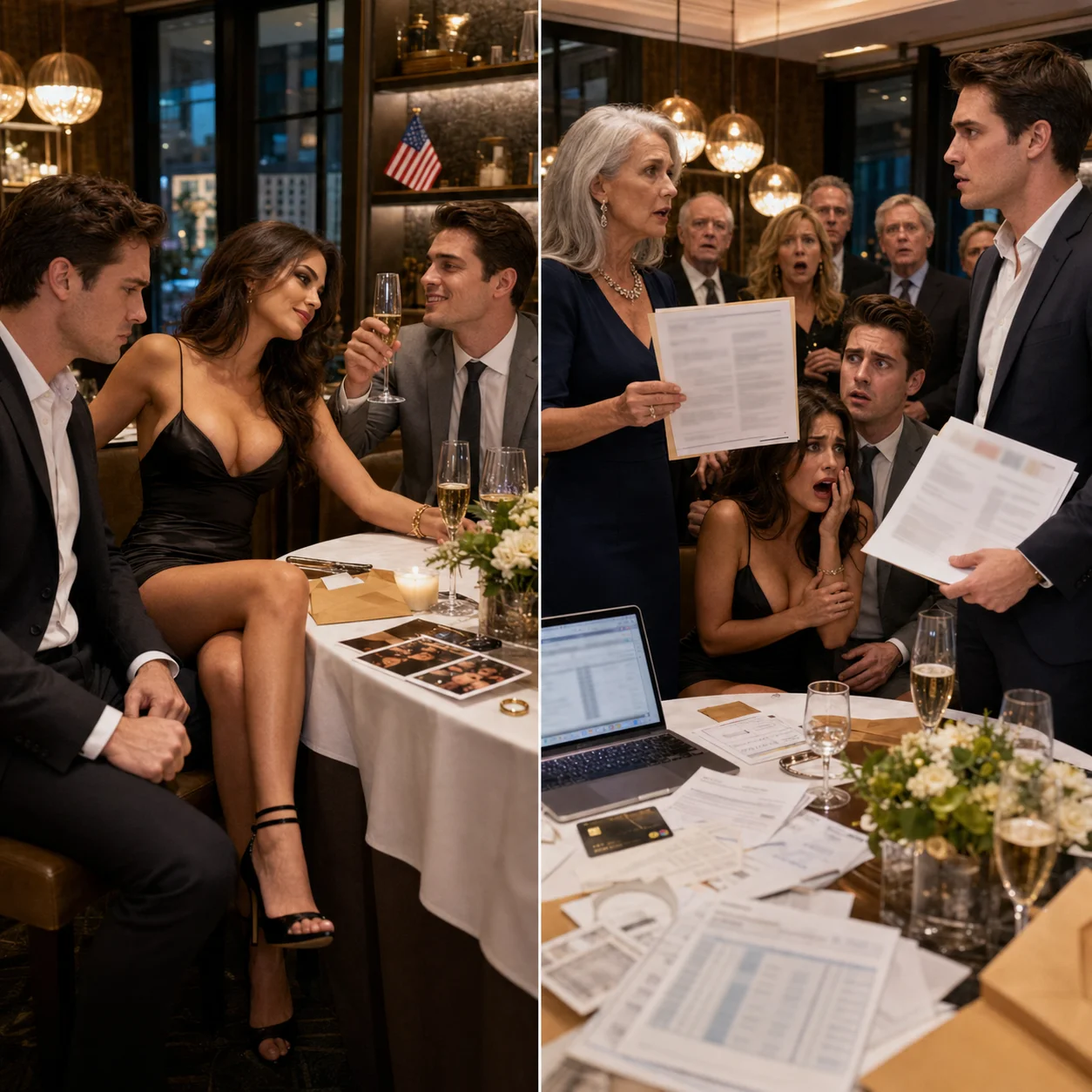
I knew my wife was cheating on me when she stopped asking if I was coming home late. For seven years, Natalie Whitman had always cared about time. If I was ten minutes late, she texted. If I worked through dinner, she called. If I forgot to tell her about a meeting, she would sit at the kitchen island in our house in Portland, Oregon, arms folded, pretending she wasn’t hurt while asking questions she already knew would make me feel guilty. Back then, I thought her questions meant love. I thought the little check-ins, the saved dinners, the sleepy smile from the couch when I came in after midnight all meant I mattered to her.
Then, one day, they stopped.
No more “Drive safe.” No more “I saved you dinner.” No more soft light from the living room when I pulled into the driveway after a long job. Just silence. At first, I told myself we were both exhausted. Natalie had recently taken a marketing job at Lawson & Pierce, one of the fastest-growing real estate firms in the Pacific Northwest, and I was still running my small construction company, fixing other people’s roofs, kitchens, decks, and mistakes while trying to keep our bills paid. We had always been busy. We had always worked hard. So I let myself believe that was all it was, because the truth would have required me to admit my marriage was turning cold in front of me and I was too afraid to touch it.
The first real warning came on a Thursday night in October. Natalie said she had a client dinner downtown. I believed her because I wanted to. Around nine, after finishing a repair job near the Pearl District, I drove past a restaurant I had only ever looked at through the window, the kind of place where the lighting made every plate look like art and every glass of wine probably cost more than lunch for my whole crew. And there she was, sitting across from her boss, Tyler Grant.
Everyone in Portland real estate knew Tyler. Expensive smile. Perfect hair. Family money. The kind of man who treated every room like it had been built for him and every person inside it like they should be grateful he had arrived. Natalie leaned across the table and wiped something from the corner of his mouth with her thumb. It was such a small gesture, so intimate and casual, that for a second my brain refused to understand it. Then Tyler caught her hand and kissed her fingers.
I kept driving.
That was the part I hated admitting later. I did not storm inside. I did not bang on the glass. I did not demand an explanation in front of the waiters and candles and soft piano music. I drove home, parked in the driveway, and sat in the dark for forty minutes while rain crawled down the windshield and my hands shook against the steering wheel. When Natalie came home, she smelled like wine and his cologne.
“How was the client dinner?” I asked.
She dropped her purse on the counter, slid off her heels, and did not even blink. “Exhausting.”
That was when I understood something terrible. My wife was not only lying to me. She had gotten good at it.
For the next two months, I watched my marriage turn into a performance. Natalie smiled when neighbors were around. She touched my arm at church. She posted old photos of us on Facebook with captions about loyalty, forever, and building a life with your best friend. But at home, she looked through me like I was furniture. When I tried to talk, she said I was needy. When I asked about Tyler, she said I was insecure. When I asked why she had started locking her phone, she laughed and said, “Maybe I’m tired of feeling like I’m married to my father.”
I almost apologized. That was the saddest part. After years of trying to be a good husband, you start believing every problem must somehow be your fault. If she was distant, maybe I had become boring. If she was cruel, maybe I had made her feel trapped. If she lied, maybe I had become the kind of man a woman could not be honest with. I carried every accusation she handed me because I still loved the version of her I married.
Our anniversary dinner was her idea. Seven years. Natalie booked a private dining room at The Alder Room, an upscale restaurant with low lighting, white tablecloths, and a wine list longer than my first business plan. She invited her parents, her sister Brooke, a few friends, and several people from work.
Including Tyler.
When I saw his name on the guest list, I looked at her across our bedroom while she fastened a diamond earring in the mirror. “Why is he coming?”
Natalie did not turn around. “Because he’s important to my career.”
“He’s important to our anniversary?”
She finally looked at me, but there was no warmth in her face, only irritation, like I had asked something embarrassing in public. “Don’t embarrass me tonight, Daniel.”
My name is Daniel Whitman. And in that moment, hearing my own wife say my name like a warning, I realized she was not worried about hurting me. She was worried I might inconvenience her.
The private room was already half full when we arrived. Natalie looked beautiful in a black satin dress I had never seen before. Her hair fell in soft waves over one shoulder. Around her wrist was a gold bracelet I had not bought. I noticed it immediately because when you have spent years counting money carefully, you learn the weight of things. You know what your wife buys. You know what she cannot afford. You know when something expensive appears without a story attached.
Tyler stood near the bar holding two glasses of champagne. One for himself. One for my wife. He handed it to her before I could even pull out her chair.
“Natalie,” he said, smiling like I wasn’t standing there. “You look incredible.”
She blushed. Not politely. Not accidentally. The way she used to blush when I told her she looked beautiful in our old apartment, back when we ate takeout on folding chairs and dreamed about the house we would someday own.
I sat down at the head of the table because the reservation was under my name. Natalie sat beside me. Tyler sat across from her, close enough that their knees touched under the table. I know because I saw her move her foot against his. Dinner began with small talk. Her mother praised the restaurant. Her father asked Tyler about commercial properties downtown. Brooke avoided looking at me.
That told me she knew.
Maybe they all knew. Maybe I was the only person at my own anniversary dinner still pretending there was a marriage left to celebrate.
Halfway through the main course, Tyler raised his glass. “I’d like to make a toast.”
Natalie’s eyes widened, but she did not stop him. He stood, one hand tucked casually into his pocket, every inch the confident man who had never paid a real price for taking what belonged to someone else.
“To Natalie,” he said. “The smartest, most talented woman I know. A woman who has spent far too long being underestimated.”
A few people clapped softly. Tyler looked at me, then smiled.
“Sometimes the world gives extraordinary women ordinary lives first, just so they know what they deserve to leave behind.”
The room went still.
Natalie whispered, “Tyler…”
But she was smiling.
My chest felt hollow. I set down my fork carefully because my hand had started to tremble. “Is that what I am?” I asked quietly. “The ordinary life?”
Natalie turned to me with a face full of practiced pity. “Daniel, please don’t do this.”
“Answer me.”
She exhaled, as if I had forced her into cruelty. “You are a good man,” she said. “You were safe. And I needed safe when I married you.”
Safe.
Not loved. Not chosen. Safe.
Tyler leaned back in his chair, looking pleased. Natalie continued, voice softer now, but not kinder. “But people grow. I grew. I want more than a husband who comes home smelling like drywall dust and talks about invoices at dinner.”
Her mother looked down at her plate. Her father said nothing. Brooke closed her eyes. And that was when I knew for certain. They did not just know about the affair. They had made peace with it. Maybe because Tyler was rich. Maybe because Natalie looked happier beside him. Maybe because people forgive betrayal faster when the betrayer is wearing designer shoes.
I reached into my jacket pocket and touched the envelope I had carried all night. Inside were printed photos, restaurant receipts, hotel confirmations, and copies of messages from Natalie’s tablet, which she had forgotten was still connected to our home computer. I had planned to confront her privately after dinner. Some foolish part of me still wanted to protect her dignity.
Then a chair scraped back at table nine.
Everyone turned.
The woman who stood was in her early sixties, with silver hair pinned neatly at the back of her head and a navy dress that looked simple until you noticed the diamonds at her ears. She had been sitting quietly with the Lawson & Pierce guests all evening, barely speaking. Natalie went pale the second she saw her. Tyler’s smile disappeared.
I recognized her from one photo in Natalie’s company newsletter.
Eleanor Pierce.
Co-founder of Lawson & Pierce. Tyler’s aunt. And the woman who actually controlled the firm.
She picked up her purse, walked toward our table, and stopped beside me. “Mr. Whitman,” she said, her voice calm, “I owe you an apology.”
I blinked. “For what?”
“For allowing this woman to use my company as an excuse to betray her husband.”
Natalie stood too quickly. “Eleanor, this is personal—”
“No,” Eleanor said. “It became business when you charged hotel rooms to a corporate card.”
The silence that followed was so complete I could hear the ice shift in someone’s glass.
Tyler’s face went white.
Eleanor looked at him. “And it became a legal matter when you approved those expenses yourself.”
Natalie gripped the back of her chair. Tyler whispered, “Aunt Eleanor—”
She ignored him and turned back to me. “There is one more thing you should know, Mr. Whitman.”
She placed a folded document on the table in front of me. Across the top were the words: Internal Ethics Investigation — Lawson & Pierce.
My hands went cold.
Eleanor lowered her voice, but everyone still heard her. “Your wife and Mr. Grant were not just having an affair,” she said. “They were planning to frame you for financial fraud using invoices from your construction company.”
Natalie stopped breathing. Tyler took one step back. And I looked at my wife, the woman who had called me safe, ordinary, and not enough, as she realized I was no longer the husband she could humiliate. I was the witness she had failed to silence.
For a few seconds, nobody moved. The Alder Room’s soft jazz still played through hidden speakers, gentle and absurd, while my entire life rearranged itself on a white tablecloth. I looked down at the folded document, then at Natalie. Her lips parted like she wanted to deny it, but for once, she could not find the right lie quickly enough.
“What does she mean?” I asked.
Natalie swallowed. “Daniel, don’t listen to her. She’s angry because Tyler and I—”
“Because you what?” Eleanor cut in. “Because you used my nephew’s access to approve false reimbursements? Because you copied vendor paperwork from your husband’s business computer? Because you created a trail that made it look like Daniel Whitman Construction was submitting inflated invoices through a real estate project you had access to?”
My mind went numb at the edges. I owned a small company. Nothing glamorous. Nothing rich. Just honest work, long days, contracts, crew schedules, receipts, and customers who sometimes paid late. My reputation was everything. One accusation of fraud, even if I survived it, could destroy me before the truth ever caught up.
Tyler tried to regain his voice. “This is a misunderstanding. Those documents were preliminary.”
Eleanor turned to him so sharply he stopped speaking. “Preliminary fraud is still fraud.”
Natalie’s father finally pushed back his chair. “Natalie,” he said, his voice thin, “what is going on?”
She looked at him, then at her mother, then at Brooke. But no one came to rescue her. Not this time.
“It wasn’t like that,” Natalie said. “Daniel was already suspicious. Tyler said if things got ugly, I needed protection.”
“Protection?” I repeated. My voice sounded strange to me, too calm and too distant. “You were going to frame me for fraud and call it protection?”
Her eyes flashed. “You don’t understand what it felt like being trapped in that house with you.”
That one almost made me laugh, but there was no humor in me left. “The house I paid for? The house you redecorated twice? The house where I cooked for you, covered your car payment when you were between jobs, and waited up when you said you were working late?”
Tyler leaned forward. “Daniel, let’s not make this dramatic.”
I looked at him then. Really looked at him. At his perfect suit, his expensive watch, his polished confidence cracking under fluorescent truth. “You brought yourself to my anniversary dinner, toasted my wife in front of me, insulted my life, and helped plan a financial setup against my company. I think we passed dramatic a while ago.”
A low murmur moved through the room. One of Natalie’s coworkers looked like she might be sick. Brooke had tears in her eyes, but I could not tell whether they were for me, for Natalie, or for the fact that the family secret had finally become public.
Eleanor placed a business card beside the report. “My attorney and our outside forensic accounting team are prepared to cooperate fully with your legal counsel. I recommend you retain one immediately. I also recommend you do not speak privately with either of them tonight.”
Natalie reached for my arm. It was the first time she had touched me voluntarily in weeks. “Daniel, please. We can talk at home.”
I stepped back before her fingers reached my sleeve. “No.”
The word was quiet, but it felt like the first honest thing I had said all night.
Her face changed. The pity disappeared. The panic underneath was uglier. “You’re really going to humiliate me like this?”
I stared at her, stunned by the shape of her mind. “You invited your lover to our anniversary dinner.”
“That’s not fair.”
“You called me the safe choice in front of my family and yours.”
“You pushed me.”
“You tried to frame me for a crime.”
She opened her mouth again, but nothing came out.
I pulled the envelope from my jacket pocket and placed it on the table beside Eleanor’s report. “I came here with proof of the affair,” I said. “I thought that was the worst thing you had done.”
Natalie stared at the envelope like it was alive.
“I was wrong,” I said.
I walked out before dessert. I remember the sound of my chair legs against the floor. I remember Natalie saying my name, then Tyler saying hers in a warning tone. I remember Brooke standing as if she wanted to follow me but not knowing if she had the right. Outside, Portland rain fell softly over the sidewalk, turning the streetlights into long golden smears. I stood beneath the restaurant awning for maybe ten seconds before Eleanor stepped out beside me.
“I’m sorry,” she said.
I nodded because I did not trust myself to speak.
She looked at me with a kind of restrained sadness that felt more honest than any sympathy I had received in months. “I suspected Tyler was abusing his authority. I did not know how deeply your wife was involved until our audit connected the expenses to vendor documents from your company. When I saw your name on the reservation list tonight, I came because I thought you deserved to hear it from someone who had nothing to gain by lying.”
“Why didn’t you tell me before dinner?”
“Because I was hoping to speak privately before the toast,” she said. “Tyler forced my hand.”
I looked back at the restaurant windows. Inside, shadows moved behind the frosted glass. My wife was still in there, probably explaining, crying, rearranging the truth into something softer. The old version of me would have gone back in to help her. The old version of me would have worried about her reputation even after she had tried to destroy mine.
That man felt very far away.
Eleanor’s driver took me home because I did not think I could safely drive. By the time I reached the house, Natalie had already called twenty-three times. There were texts too. Some angry. Some pleading. Some so perfectly constructed that I could almost admire the craftsmanship.
Daniel, please don’t let Eleanor manipulate you.
We need to talk like adults.
Tyler pressured me.
I was confused.
I still love you.
The last one made me sit down on the stairs and put my head in my hands, not because I believed it, but because I remembered when those words from her could have saved me.
They could not save anything anymore.
I locked the front door, took photos of every room, packed a bag, and drove to my brother’s place across town. He opened the door at nearly midnight in sweatpants, saw my face, and said nothing. He just stepped aside and let me in. The next morning, I called a divorce attorney named Maren Ellis, a woman with calm eyes and the kind of voice that made panic feel unnecessary. I brought her everything: Eleanor’s report, my envelope, bank statements, company records, screenshots, hotel confirmations, and the messages Natalie had accidentally synced to our home computer.
Maren read for nearly twenty minutes without interrupting. Then she looked up and said, “Daniel, this is not just divorce. This is civil liability, potential criminal exposure, and a reputation defense issue. We are going to move carefully, quickly, and cleanly.”
That became the rhythm of my life for the next three months. Carefully. Quickly. Cleanly.
Natalie was served at work. Tyler was placed on administrative leave the same morning. Lawson & Pierce released a bland internal statement about ethical violations, but Portland business circles did what business circles do. They talked. Quietly at first, then everywhere. Not because I posted anything online. I did not need to. The truth had its own legs.
Natalie’s first legal response was exactly what I expected: denial, injury, and performance. She claimed I had been emotionally neglectful. She claimed the affair began only after our marriage was already dead. She claimed the financial documents were misunderstood drafts, not an actual plan. Then Eleanor’s forensic team produced metadata showing when the files had been created, edited, and shared. Some had Tyler’s login attached. Some had Natalie’s. One spreadsheet even contained a note in Natalie’s own words: If Daniel fights the divorce, this gives us leverage.
When Maren showed me that line, I felt something inside me finally go quiet.
Not angry. Not broken. Quiet.
There are moments when grief stops being a storm and becomes a locked door. You still know what is behind it. You just stop walking back to open it.
Brooke came to see me two weeks after Natalie was served. I almost did not answer when she knocked, but through the peephole she looked so small and ashamed that I opened the door. She stood on my brother’s porch with red eyes and a paper grocery bag full of things from the house: my old college hoodie, a framed photo of my dad, the pocketknife my grandfather left me.
“I should have told you,” she said.
I did not invite her in, but I listened.
She told me Natalie had admitted the affair to her months earlier, framing it as emotional confusion, a connection she could not help, something sophisticated and tragic. Brooke had told herself it was not her marriage, not her place, not her responsibility. Then Natalie began talking about divorce, money, and how Daniel would “make things difficult unless he was scared.” Brooke said that was when she started worrying, but by then she had already stayed silent for too long.
“I’m sorry,” she said. “I know that doesn’t fix anything.”
“No,” I said. “It doesn’t.”
She nodded, crying harder.
“But it matters that you said it,” I added.
That was all I could give her. It was not forgiveness. Not yet. But it was the first time since the dinner that anyone from Natalie’s family had looked me in the eye and admitted what they had done.
Natalie’s parents were different. Her mother sent a long email about marriage being complicated and public embarrassment being painful for everyone. Her father called once and said he hoped I would not “overreact legally” because Natalie had always been emotional and Tyler had clearly influenced her. I listened until he finished, then said, “She tried to destroy my business.” He sighed like I was being stubborn.
So I stopped answering.
The divorce itself moved faster than most because Natalie’s attorney understood what mine did: if this reached a full trial, every detail would become part of a public record. Natalie wanted spousal support. Maren responded with the fraud evidence. Natalie wanted a share of my business. Maren responded with the metadata. Natalie wanted to keep the house temporarily. Maren responded with the fact that she had used our home office computer to copy company documents for a scheme against me.
In the end, she walked away with far less than she expected. No spousal support. No piece of my company. No claim against the business accounts. We sold the house because I could not sleep there anymore, and after debts and legal costs, her share was smaller than she thought it would be. Mine went partly into a new office space for my company and partly into a savings account I did not touch for a long time.
Tyler’s fall was quieter but deeper. Lawson & Pierce terminated him after the investigation concluded. Eleanor did not protect him. That surprised people who did not know her, but it did not surprise me. She had built that company from one leased office and three employees. Tyler had treated it like a family toy. The state licensing board opened a review, and while I never followed every detail, I heard enough to know his real estate career did not survive intact. Men like Tyler rarely vanish. They rebrand. But he lost the thing he valued most: the assumption that consequences were for other people.
Natalie tried to reach me once after the divorce was final.
It was a gray March afternoon, the kind of Portland day where the sky feels low enough to touch. I had just finished walking through a renovation site when I saw her standing beside my truck. She looked thinner. Her hair was shorter. She wore a beige coat I recognized from better years. For a second, memory did something cruel. It showed me Natalie at twenty-six, laughing on a camping trip with rain in her eyelashes. It showed me her dancing barefoot in our first kitchen. It showed me the woman I had loved before ambition, resentment, and Tyler Grant turned her into someone who could sit beside me at an anniversary dinner and call me safe like it was an insult.
“Daniel,” she said.
I stopped a few feet away. “You shouldn’t be here.”
“I know.” She wrapped her arms around herself. “I just wanted to say I’m sorry.”
I waited.
Her eyes filled, but this time she did not perform grief. She looked exhausted by herself. “At first, I told myself I was unhappy because you weren’t enough. Then I told myself Tyler saw me in a way you didn’t. Then everything got bigger and uglier, and I kept making choices because admitting the first one was wrong would mean admitting what I had become.”
I said nothing because I had learned silence was sometimes the only way to keep someone from using your empathy against you.
She looked down. “The fraud idea wasn’t all Tyler. I let people believe that because it made me look less awful. But I knew. I participated. And I am sorry.”
That was the first real apology she had ever given me. No excuses. No “but.” No request hidden inside it. Just the truth, standing in the rain between us.
I wanted to feel satisfaction. I wanted that apology to unlock something, to make the months of humiliation and grief feel balanced. But real life does not work that neatly. Sometimes the apology comes after the damage has already changed the shape of you.
“I loved you,” I said.
She cried then, quietly.
“But I don’t miss who you became,” I continued. “And I don’t want to spend the rest of my life trying to understand why you thought I deserved it.”
She nodded like each word landed where it was supposed to. “I know.”
I unlocked my truck. She stepped back.
“Daniel?”
I looked at her one last time.
“You were never ordinary,” she said.
For a moment, that old wound pulsed. Then I closed the truck door between us and drove away without answering, because the part of me that once needed her to see my worth had finally stopped waiting.
A year later, my company had its best spring season ever. Not because revenge made me stronger or betrayal magically turned into success, but because the people who stayed around me were real. My crew knew what had happened. Some clients did too. Instead of ruining me, the truth made loyal people more loyal. One longtime customer told me, “I trust a man who keeps receipts and doesn’t run his mouth.” I laughed for the first time in what felt like forever.
Eleanor referred two commercial renovation projects to me, not as charity, but because she said my work was clean and my documentation was better than half the firms twice my size. I accepted after making sure every contract went through proper channels. I was done with blurred lines. Done with people who called betrayal complicated. Done with rooms where everyone knew the truth except the person being humiliated.
Brooke and I eventually met for coffee. I forgave her slowly, not because she deserved it instantly, but because carrying anger toward every person who failed me felt like letting Natalie keep part of my life. Brooke never defended her sister again. She only said, “I wish I had been braver.” I respected that more than any excuse.
As for Natalie, I heard she left Portland for a smaller marketing job in Boise. Tyler moved to California and tried to start over under a different branch of real estate consulting. I did not follow either of them. Their punishment was not something I needed to watch every day. The court had done its part. Their choices had done the rest.
On what would have been our eighth anniversary, I worked late on a kitchen remodel in an old Craftsman house near Laurelhurst. The homeowner, a widow in her seventies, insisted I take a plate of stew home because she said men who worked with their hands always forgot to eat. I sat in my truck afterward with the container warm on the passenger seat, rain tapping lightly against the windshield, and realized I was not lonely in the way I used to be.
I was alone, yes.
But I was not being lied to.
I was not sitting beside someone who secretly despised the life we had built. I was not apologizing for honest work, or shrinking myself so another person could feel more impressive standing next to someone crueler.
That night, before driving home, I opened the glove compartment and found the original anniversary card I had bought for Natalie but never gave her. I had forgotten it was there. The envelope was still sealed. For a while, I just held it. Then I stepped out into the rain, tore it in half, and dropped it into a trash bin beside the curb.
It did not feel dramatic. There was no music. No audience. No perfect final line.
Just paper leaving my hand.
And somehow, that was enough.
Because Natalie had called me the safe choice like safety was a weakness. Tyler had called my life ordinary like ordinary men could not fight back. But in the end, the life they mocked was the one thing they could not destroy. My name stayed clean. My company survived. My friends stayed. My hands kept building things that lasted.
And for the first time in a long time, I stopped wondering why I had not been enough for Natalie.
I finally understood that I had been enough.
I had simply been offering loyalty to someone who only knew how to spend it.
![[FULL STORY] My Ex Texted: 'You'll Come Back When She Gets Bored.' I Replied: 'Watch Me Move On.'](https://social-media.rabedo.com/thumbnails/1777349420_B1.png)

![[FULL STORY] She Said “He’s Just a Friend” — Then Announced She Was Pregnant With His Baby](https://social-media.rabedo.com/thumbnails/1777119574_f3f0d8f4-59a1-4261-a1e8-9e8b842d5bc0.png)