
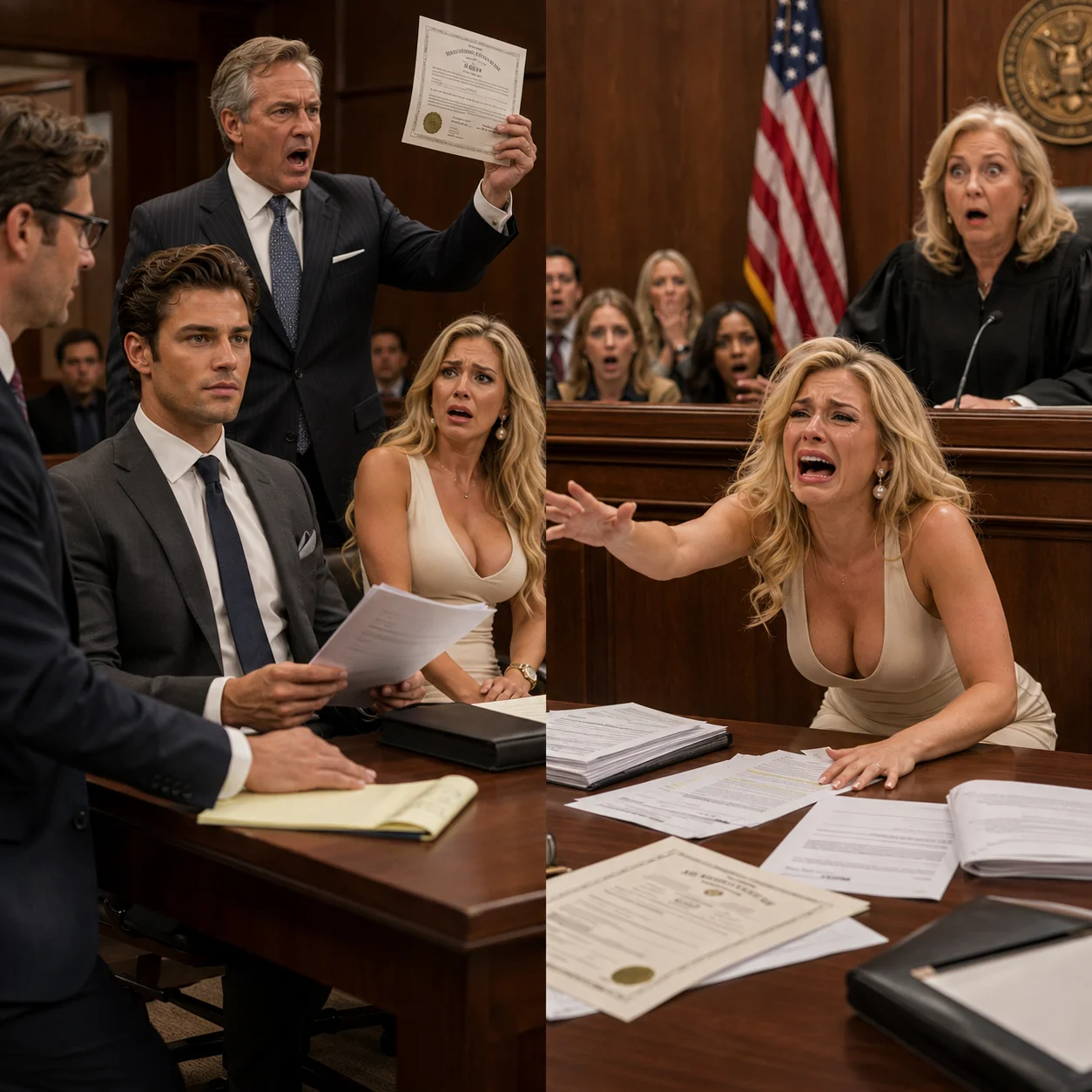
I should have known Lillian would never let me leave quietly.
A normal person might have accepted that the marriage was over, taken the fair settlement already agreed upon, and moved on with whatever dignity they had left. But Lillian had never been normal about losing control. She did not believe in endings unless she was the one writing them. So when the divorce was finalized, I thought I had escaped. She thought she had simply entered the next phase of the war.
The legal papers arrived on a rainy Thursday afternoon, folded inside a thick envelope that felt heavier than it should have. I remember standing in my kitchen, reading the first page twice because I genuinely thought I had misunderstood it. Lillian was not asking for a correction to the settlement. She was not requesting temporary support while she found work. She was demanding half my assets, lifetime alimony, a portion of my retirement fund, and additional compensation for what her filing described as “severe emotional and financial distress caused by abandonment.”
Abandonment.
That was the word she chose.
I almost laughed, but the sound caught somewhere in my chest.
If you met Lillian in public, you would never believe how dangerous she could be. She was charming in that effortless, practiced way some people learn when they realize beauty works better with softness. She knew how to lower her voice just enough to sound vulnerable, how to touch someone’s arm while asking for sympathy, how to make people feel protective of her before they knew a single fact. Elegant, fragile, sophisticated. That was the version she sold to the world.
Behind closed doors, she was a financial wrecking ball wrapped in silk.
During our marriage, she never worked consistently. Every time the idea came up, she had a reason why now was not the right time. She was considering a passion project. She was looking into consulting. She was too anxious. The job market was beneath her. Meanwhile, my money became “our lifestyle,” and her spending became something I was supposed to feel honored to support.
“Henry, you’re the provider,” she would say whenever I tried to discuss budgets. “A real husband wouldn’t make his wife worry about money.”
At first, I mistook that for old-fashioned romantic nonsense. Later, I understood it for what it was: entitlement dressed as femininity.
She did not contribute, but she absolutely consumed. Designer handbags, spa packages, last-minute trips with friends, memberships, treatments, clothes she wore once and forgot. If I objected, she cried. If I insisted, she called me controlling. If I tried to make a plan, she said I was treating her like an employee instead of a wife.
The marriage ended slowly, then all at once. There was no single explosion, no dramatic betrayal, just years of being drained until I could no longer pretend love was supposed to feel like a payment plan. When I finally filed for divorce, Lillian acted stunned, as if she had not watched me disappear inside the life she demanded I fund.
“I gave you the best years of my life,” she told me, standing in our bedroom with tears bright in her eyes. “And now you’re throwing me away like garbage.”
No, Lillian. I was not throwing her away.
I was escaping.
The divorce should have been simple. We had no children. No shared business. We had signed a prenuptial agreement before the wedding, one she had reviewed with her own counsel and smiled through because at the time she believed marriage to me meant permanent access to my bank account. The settlement she received was fair, generous even. She had access to funds to restart her life. She had time. She had options.
What she did not have was my willingness to keep financing her fantasy.
That was the real crime in her eyes.
So when she dragged me back to court, I was angry, but not shocked. What shocked me was the sheer audacity of her claims. According to Lillian, she had been a devoted wife who sacrificed her career, emotional well-being, and stability for a man who abandoned her without warning. She painted herself as helpless, discarded, ruined by my cruelty.
She claimed suffering.
That word stayed with me.
Suffering was what she called living in a nice home, spending money she did not earn, receiving a fair divorce settlement, and then being told no for the first time in years.
When I walked into the courthouse for the first hearing, I expected Lillian to at least pretend to be civil. I should have known better.
She sat across from me in a designer dress, pearl earrings, perfect hair, and the same expensive handbag I had bought her years earlier. The one she once claimed she would sell because she “didn’t need material things anymore.” She saw me looking at it, lifted her chin, and gave me a small smile.
Not sadness.
Not nerves.
A smile.
Then she leaned toward her lawyer, Mark Langley, whispered something, and sat back like the courtroom was a theater and she had reserved the best seat.
Mark stood first, all polished concern and expensive tailoring.
“Your Honor, my client, Mrs. Lillian Carter, has suffered severe emotional and financial distress due to Mr. Henry Wilson’s abandonment.”
Mrs. Lillian Carter.
That alone almost made me smile, though not for the reason anyone in the room understood yet.
Mark continued, painting me as a cold, wealthy man who had used up his devoted wife and discarded her. “She relied on his support. She gave up career opportunities. She supported his ambitions. She trusted him. And now, after years of marriage, she has been left to rebuild her life from nothing while Mr. Wilson enjoys the wealth they accumulated together.”
Every sentence was a performance.
She never gave up a career. She never had one to give up. She did not support my ambitions unless you counted spending the money those ambitions produced. And she had not been left with nothing. She had been left with more than many people get after a divorce and less than she believed she deserved.
But Lillian knew exactly when to begin crying.
She pulled a tissue from her purse and dabbed at the corner of one eye, careful not to disturb her makeup. “Your Honor,” she said, voice trembling, “I never thought I would be in this position. I loved Henry. I trusted him. He made me feel safe, and then he threw me away like I was nothing.”
The judge, an older man with sharp eyes and a face that gave away very little, took notes. I saw the slight shift in his expression, not belief exactly, but attention. Lillian was good at this. She always had been. She knew how to make a room lean toward her.
For a second, despite everything my lawyer had prepared, I felt my stomach tighten.
Then David Carter leaned toward me.
“Let her talk,” he whispered. “The more she lies, the harder she falls.”
David was my divorce attorney, and hiring him was the best decision I made during that entire nightmare. He had a reputation for dismantling baseless claims without theatrics. When I first sat in his office after being served, he had listened to me explain Lillian’s history, her spending, the manipulation, the prenup, the settlement, and her new demands. He did not react much. Just took notes, asked clean questions, and finally said, “She’s overconfident. That usually makes people sloppy.”
He started digging immediately.
Financial records. Credit history. Previous addresses. Past legal disputes. At first, he found what we expected: debts, luxury purchases, some inconsistent employment claims, nothing dramatic enough to end the case by itself. Then he called me one afternoon and asked me to come to his office.
When I arrived, he turned his monitor toward me.
“Have you ever seen this document before?”
I leaned in.
It was a marriage record.
Not ours.
The name on it was Lillian Carter. The groom was Daniel Brooks. The date was years before I ever met her.
I looked at David. “She was married before?”
“Not just married,” he said. He scrolled lower. “I can’t find any record of divorce.”
The room went very quiet.
My pulse began pounding in my ears. “Wait. Are you telling me she was still legally married when she married me?”
David sat back. “That is exactly what I’m telling you.”
It took a moment for the full weight of it to land.
If Lillian had never divorced Daniel Brooks, then her marriage to me was not legally valid. The wedding, the vows, the anniversary dinners, the rings, the public identity of being husband and wife—all of it had existed emotionally, socially, practically. But legally, it was built on a lie.
Which meant her entire claim collapsed.
No valid marriage. No alimony. No marital asset division beyond what had already been voluntarily handled. No lifetime support from a man who, in the eyes of the law, had never legally been her husband.
I remember sitting there staring at the screen, anger and relief twisting together until I could barely speak.
“What do we do with this?” I asked.
David’s expression did not change, but there was a sharpness in his eyes. “We wait.”
“Shouldn’t we submit it now?”
“No,” he said. “If we give her time, she’ll invent a story. She’ll claim confusion, misunderstanding, lost paperwork. She’ll rehearse tears. But if she commits to her narrative under oath first, the truth lands differently.”
That was the plan.
Let Lillian build her case. Let her present herself as the abandoned lawful wife. Let her say “my husband” until the word became a trap. Then, at the moment she believed she had won, David would pull out the document that turned her entire performance into evidence against her.
So in that courtroom, while she cried and Mark Langley described her suffering, I stayed quiet.
The judge eventually turned to me. “Mr. Wilson, do you have anything to say in response to these claims?”
I glanced at David. He gave a small nod.
I kept my voice calm. “Your Honor, I did not abandon Lillian. She received a fair settlement when we separated, and she had access to funds afterward. This case is not about fairness. It is about greed.”
Lillian gasped as if I had slapped her.
“Greed?” she said, tears flashing into outrage. “I gave you everything.”
The judge raised a hand. “Mrs. Carter.”
She fell silent, though her eyes burned.
David stood. “Your Honor, before we proceed further, I would like to cross-examine Mrs. Carter.”
The judge nodded. “Proceed.”
David picked up a stack of financial documents and walked Lillian through them carefully. Did she have access to a bank account after the separation? Yes. Did records show she spent over $10,000 on luxury handbags, spa treatments, and travel in the first three months after receiving funds? She flushed, then lifted her chin.
“Self-care is important,” she said.
A few people in the courtroom chuckled.
David did not. “Important enough to spend money you now claim was insufficient for basic survival?”
Her mouth tightened. “I was under emotional distress.”
“Of course.”
He asked about employment. She claimed she had sacrificed opportunities for me. He asked her to name one concrete job offer she had turned down because of our marriage. She could not. He asked whether she had ever enrolled in the certification program she claimed she delayed for my benefit. She said she had intended to. He asked if she had documentation. She said no.
Still, she did not look truly afraid.
Because she thought this was only about money. She thought the worst outcome was that the judge would reduce her demand. She had no idea the foundation beneath her case had already been cut through.
After both sides spoke, the judge leaned back and reviewed his notes.
“All right,” he said. “I believe I’ve heard enough. I’m prepared to make a ruling.”
Lillian straightened in her seat.
She actually smiled.
That was when David stood again.
“Your Honor, before you rule, there is something Mrs. Carter has not told the court.”
The room went silent.
Lillian’s smile froze.
The judge looked over his glasses. “Mr. Carter, what exactly are you referring to?”
David reached into his briefcase and removed a folder. “We recently uncovered certified documents regarding Mrs. Carter’s marital history.”
Lillian’s face twitched. It was small, but I saw it. The first real crack.
David withdrew the marriage record and placed it on the table.
“Your Honor, Lillian Carter was never legally married to my client.”
The courtroom froze.
The judge’s pen stopped mid-sentence.
Lillian’s jaw dropped. “That’s not true.”
David slid the documents to the judge. “This is a certified marriage record showing that Lillian Carter legally married a man named Daniel Brooks years before she met Mr. Wilson. We have found no record of a legal divorce. Therefore, at the time she entered into a ceremony with my client, she was still legally married to another man.”
The judge read the document. His expression hardened with every passing second.
David turned slightly toward Lillian. “So tell me, Mrs. Carter. How exactly were you planning to claim alimony from a marriage that never legally existed?”
Lillian’s face drained of color.
“This is a mistake,” she stammered. “I didn’t know.”
David raised an eyebrow. “You didn’t know you were married?”
“I thought it was handled.”
“Interesting,” David said. “Because according to property records, you and Mr. Brooks owned a home together five years ago. You also signed a lease with him after your marriage to my client. That suggests continued legal and financial ties.”
Lillian’s hands clawed at the table.
The judge looked directly at her. “Mrs. Carter, is this true?”
Her mouth opened and closed, but no sound came out.
“Mrs. Carter,” the judge said sharply. “Answer the question. Were you legally married to Daniel Brooks at the time of your supposed marriage to Mr. Wilson?”
She swallowed.
“I didn’t think it mattered.”
The judge stared at her.
“You didn’t think it mattered?”
His voice was so sharp that Lillian flinched.
The silence in the courtroom became unbearable. Mark Langley, her lawyer, had gone completely still beside her. I could see the calculation happening on his face. He had been ambushed too, which meant Lillian had lied not only to me and the court, but to her own counsel.
The judge set the certified record down with deliberate care.
“Mrs. Carter, do you understand what you have done here?”
“Your Honor, I just—”
“No,” he said. “You do not speak. You listen.”
Lillian froze.
“You came into this courtroom under oath and built a claim around the existence of a lawful marriage. You alleged abandonment, financial hardship, and entitlement to marital support arising from a marriage that, based on the certified records before me, may never have legally existed. You wasted this court’s time. You wasted Mr. Wilson’s time. And you appear to have attempted to manipulate the legal system for personal gain.”
The woman who had entered that room in pearls and confidence now looked like someone had switched off the lights behind her eyes.
The judge continued. “This is not a minor omission. This is not a misunderstanding. This is a material fact.”
Lillian turned to Mark. “You can fix this, right?”
Mark did not look at her.
Instead, he stood, buttoning his jacket with visible discomfort. “Your Honor, in light of this revelation, I request permission to withdraw from representation. I cannot continue in good faith if my client has materially misrepresented facts to both counsel and the court.”
Lillian stared at him. “Mark, no. You can’t just leave.”
The judge’s gavel came down once. “Mrs. Carter, sit down.”
She sank back into the chair.
Just like that, she was alone.
The judge dismissed the case with prejudice. He ordered Lillian to cover my legal fees. He also stated that due to the fraudulent nature of the filing and the sworn statements involved, the matter could be referred for further review to determine whether additional legal action was appropriate.
The word “fraud” hung in the air like smoke.
Lillian began shaking.
I wish I could say I felt joy in that moment, but what I felt was colder than joy. Relief, maybe. Vindication. The grim satisfaction of watching a lie finally become too heavy for the liar to carry.
When the hearing ended, whispers moved through the courtroom. People glanced at Lillian, then away. She had arrived expecting to be pitied and left being studied.
I gathered my papers.
David placed a hand briefly on my shoulder. “It’s done.”
Outside the courtroom, Lillian came after me.
“Henry, wait. Please.”
I turned.
She looked nothing like the woman who had walked in earlier. Her hands trembled. Her eyes were red. The designer dress suddenly looked less like armor and more like a costume from a role she could no longer play.
“This is a mistake,” she said, voice breaking. “You don’t really want to see me suffer like this, do you?”
I studied her face. For years, that expression would have pulled me back in. The tears. The trembling mouth. The suggestion that I was cruel if I did not rescue her from consequences she had created.
“Lillian,” I said, “you spent months trying to ruin my life.”
“I didn’t mean to,” she whispered. “I was scared. I thought I’d end up with nothing.”
I let out a slow breath.
“That is exactly what you were trying to leave me with.”
Her breath hitched. “You hate me, don’t you?”
The truth was worse than that.
I did not hate her anymore.
Hatred requires a kind of attachment, a willingness to keep someone alive inside you. Lillian had drained me for years, lied to me, dragged me through court, and tried to turn the law into another weapon of manipulation. But standing there in that hallway, looking at her, I felt the thing that finally set me free.
Nothing.
“Goodbye, Lillian,” I said.
Then I walked away.
For good.
A year passed.
In those twelve months, my life changed in ways that would have seemed impossible when I was still married to her. After the court case, I decided I was done living inside the wreckage of that chapter. I moved to a new city, not because I had to, but because I wanted a place where every street corner did not remind me of an argument, an apology, or a bill I paid to keep the peace.
I got promoted at work. It turns out that when you are no longer being emotionally and financially drained by someone who treats your stability as a resource to consume, you can focus. You can sleep. You can make decisions without worrying how they will be twisted against you at dinner.
I reconnected with old friends. I traveled. I learned how to enjoy quiet evenings without mistaking them for loneliness. Eventually, I started dating again, carefully at first, then with less fear. Nothing serious right away. I was not looking for another marriage to prove the first one had not broken me. I was just learning how to live without bracing for the next demand.
I barely thought about Lillian.
Until one afternoon, I saw her in a coffee shop near my office.
At first, I almost did not recognize her.
She sat alone at a corner table, staring at her phone with both hands wrapped around a paper cup. She looked different. Not destroyed. Not ugly. Just worn down in a way she had always spent money to avoid looking. No designer handbag on the chair beside her. No pearls. No glossy armor. Just a basic sweater, jeans, tired eyes, and a face that seemed to have forgotten how to perform.
For the first time since I had known her, Lillian looked normal.
I could have walked away.
Maybe I should have.
But curiosity is a strange thing, and closure sometimes wears the disguise of coincidence. I ordered my coffee, walked over, and said her name.
“Lillian.”
She looked up. The second she recognized me, her face flushed with emotion. Surprise first. Then embarrassment. Then something that might have been regret.
“Henry,” she said, sitting up straighter. She tried to smooth her hair like the old reflex still lived in her hands. “I didn’t expect to see you here.”
“Neither did I.”
There was a pause.
“I moved,” she said.
“Here?”
“Across town.” She looked down. “A small place.”
“Studio?”
She blinked, caught off guard, then gave a dry little laugh. “Yeah.”
I nodded. “How’s work?”
That question seemed to hurt more than I intended.
“I’m between jobs.”
Of course she was.
For a moment, silence sat between us, filled with everything we were not going to rehash. The courtroom. The marriage record. Daniel Brooks. The legal fees. The performance that had finally failed her.
She looked at me carefully. “You look good.”
“I feel good.”
Her lip trembled slightly. “I’ve been thinking about you.”
I set my coffee down on the table but did not sit.
“About everything,” she continued. “How things ended. How I acted. I was wrong, Henry.”
I waited.
She took a shaky breath. “I’ve changed. I’ve grown. Losing everything forced me to see things differently.”
There it was. Not an apology exactly. More like a door left open, waiting to see whether I would walk through and furnish it for her.
“I miss having you in my life,” she said.
Then she reached across the table, trying to touch my hand.
I pulled back.
The movement was small, but she understood it immediately. Her face crumpled, and for once, she did not try to cover it with outrage.
“Lillian,” I said quietly, “I don’t think about you at all.”
Her eyes filled.
There was a time when I would have softened that sentence. A time when her pain, real or performed, would have made me feel responsible. But I had spent too many years confusing compassion with surrender. I had learned that you can wish someone no harm and still refuse to be useful to them ever again.
She looked down at her coffee.
“I get it,” she whispered.
And for the first time, she did not argue.
She did not accuse me of cruelty. She did not cry louder to draw attention. She did not tell me I owed her kindness because I had once loved her. She just sat there, small and silent, with the life she had built from lies finally too empty to decorate.
I picked up my coffee.
“Take care, Lillian.”
Then I walked away.
I never saw her again.
People like to call what happened karma, and maybe it was. But I do not think karma is always lightning striking someone down in a courtroom. Sometimes karma is quieter. Sometimes it is a person who spent years building false realities finally having to live in the real one. Sometimes it is a judge reading the document they thought would never surface. Sometimes it is an ex-husband standing in a coffee shop, realizing the woman who once controlled his entire emotional climate no longer has the power to change the weather.
Lillian wanted everything.
She lost the one thing she never understood she had been spending all along: access to me.
And the day I walked out of that courthouse, then later out of that coffee shop, I finally understood something I wish I had learned earlier.
Freedom is not always dramatic.
Sometimes it is just the moment you stop explaining yourself to someone who only ever listened for leverage.


![[FULL STORY] She Announced, “I’m Leaving You For The Millionaire Who’s Been Texting Me!” I Calmly Forwarded Her](https://social-media.rabedo.com/thumbnails/1776409307_659e8639-6a18-4b67-8b33-d1ea98827b38.png)
![[FULL STORY] My Fiancée Confessed,"I Still In Love With My Ex. You're Just My Backup, When I Confronted Her About](https://social-media.rabedo.com/thumbnails/1776673081_3.png)
![[full story] She Took a “Girls’ Trip” with Her Ex — And Came Home to a Locked Door](https://social-media.rabedo.com/thumbnails/1777795952_688022576_994088086476727_7574761584673084522_n.jpg)