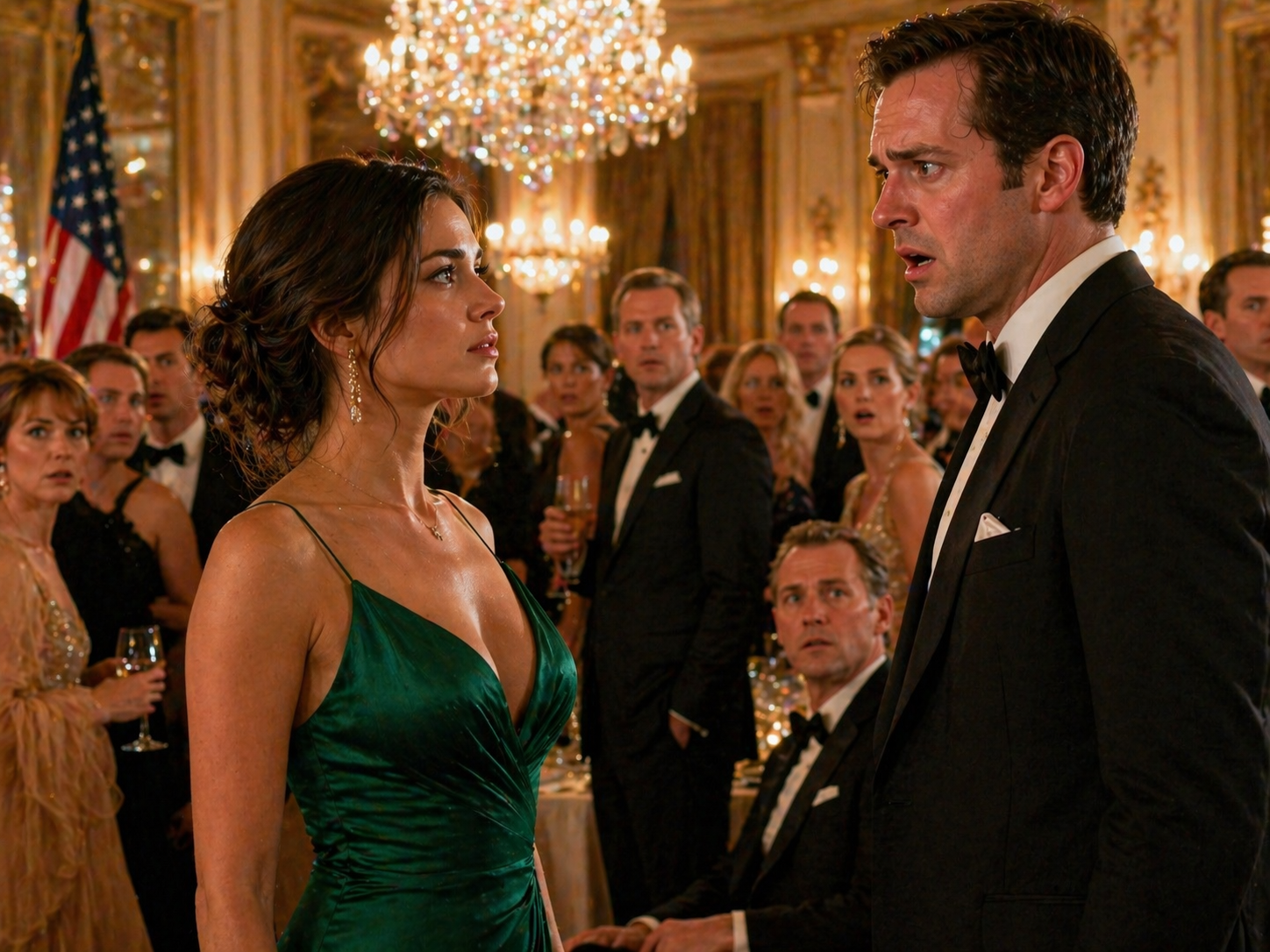

Preston shook her hand, but he didn’t hold it long.
“Daniel speaks highly of you,” he said.
“I hope so,” she replied, her voice light. “I have to keep him humble.”
A harmless joke.
Everyone smiled.
Still, my stomach tightened.
I told myself I was imagining things. Preston was my boss. Madison was my wife. It was normal for people to be polite and slightly awkward at company parties. Not every pause meant betrayal.
Then Bear appeared.
Preston’s golden retriever came bounding out from somewhere near the side yard, followed by a teenage girl I assumed was a neighbor’s daughter hired to keep him away from the food. Bear was large, fluffy, and absurdly happy, weaving through guests with the confidence of an animal that had never been told no in his life.
People laughed and reached down.
“Bear!”
“Come here, buddy!”
“Look at that handsome boy!”
Bear ignored them.
He ran straight to Madison.
Not near her.
To her.
He jumped up and pressed himself against her like he had been waiting all night.
Madison’s hand flew to his collar automatically.
Not awkwardly.
Automatically.
“Bear, down,” she whispered.
The command came out before she could stop it.
The dog obeyed.
He sat at her feet, tail sweeping against the patio stones, looking up at her with pure devotion.
A few people around us laughed.
“Well, he likes you,” someone said.
I looked at Madison.
Her face had gone pale.
Then Preston said, “Bear, leave her alone. You know Madison.”
The music kept playing.
People kept talking.
Someone behind me laughed too loudly at a joke.
But inside my head, everything became quiet.
You know Madison.
My wife looked at Preston.
Preston looked at me.
And in that one glance between them, I saw an entire conversation I had never been invited into.
I forced myself to smile because there were too many people watching.
“Funny,” I said. “For a dog who’s never met her.”
Madison’s hand tightened around my arm.
“Daniel,” she said softly.
Preston recovered first. Men like him always do.
“Oh, I probably misspoke,” he said, lifting his glass. “Bear loves everyone.”
“No,” I said, still smiling. “You said he knows Madison.”
A few heads turned.
Preston’s jaw flexed.
Madison gave a small laugh that sounded nothing like her. “Daniel, don’t be weird. He probably smells our dog.”
“We don’t have a dog.”
Silence spread in a small circle around us.
Bear, unaware that he had detonated my life, leaned his head against Madison’s knee.
That was when an older woman in a cream blazer walked past us carrying a plate of appetizers. I recognized her as Preston’s housekeeper, Elena, because I had seen her once at a smaller executive dinner.
She stopped when she saw Madison.
“Oh,” she said warmly. “You came back.”
Madison closed her eyes.
Just for a second.
But I saw it.
Elena looked from Madison to me, then to Preston, and immediately realized she had said something wrong.
“I mean,” she stammered, “welcome.”
I let go of Madison’s hand.
“Came back?” I asked.
Preston stepped forward. “Daniel, let’s not do this here.”
The sentence told me everything.
Not “there’s nothing to do.”
Not “you’re misunderstanding.”
Let’s not do this here.
Meaning there was something to do.
Meaning the only problem was the audience.
I looked at my wife. “How many times have you been inside this house?”
Her lips parted, but no answer came out.
Guests were definitely watching now. My coworkers. Their spouses. People who reported to me. People I had trained. People who had shaken my hand that week and asked me about quarterly projections.
Madison whispered, “Please.”
That one word nearly broke me.
Not because it was an apology.
Because it wasn’t.
It was a request for silence.
I turned and walked into the house.
I don’t know what I expected to find. Maybe nothing. Maybe I just needed air. Maybe some part of me wanted to prove myself crazy before reality finished forming.
The inside of Preston’s house was exactly what I expected from him: expensive, curated, cold. Marble entryway. Abstract art. Floating staircase. Floor-to-ceiling windows facing the pool. Everything smelled faintly of cedar, leather, and money.
Behind me, I heard Madison calling my name.
I kept walking.
“Daniel, stop.”
Preston followed too, lowering his voice. “You’re upset. I get it. But you need to calm down.”
I turned so fast he stopped mid-step.
“Do not manage me like one of your project teams.”
His face hardened.
Madison reached us near the hallway. Her eyes were wet now, but I couldn’t tell if they were tears of fear, guilt, or embarrassment.
“Daniel, please,” she said. “Let’s go home and talk.”
“Did you sleep with him?”
Her mouth trembled.
That was answer enough.
Still, I needed the words. Maybe every betrayed person does. We stand in the wreckage begging for someone to name the bomb.
“Did you sleep with my boss?”
Preston looked toward the patio, where several guests could see us through the glass.
“Keep your voice down.”
I laughed once. It sounded ugly.
“My wife has been in your house enough times for your dog and housekeeper to recognize her, and you’re worried about volume?”
Madison reached for me.
I stepped back.
“Don’t touch me.”
Her face crumpled. “It wasn’t supposed to happen like this.”
That sentence almost made me physically sick.
Because it meant there had been a way it was supposed to happen.
A timeline. A plan. A version where I stayed stupid a little longer.
“How was it supposed to happen?” I asked.
She shook her head. “I didn’t mean that.”
“Yes, you did.”
Preston exhaled sharply. “Daniel, your marriage issues are between you and Madison.”
I stared at him.
“My marriage issues are standing in your hallway wearing Italian leather shoes.”
His expression changed then. The charm fell away and something colder appeared.
“You should leave,” he said.
“I was planning to.”
Madison grabbed my sleeve. “I’m coming with you.”
I looked down at her hand on my arm.
“No, you’re not.”
She went still.
“You can get a ride from someone who knows you.”
Then I walked out.
I didn’t yell. I didn’t throw a glass. I didn’t make a speech in front of the whole party, even though some broken part of me wanted to burn the room down with words.
I walked past the patio, past the pool, past people pretending not to stare.
Bear followed me halfway to the driveway, then stopped.
Even the dog knew who he belonged to.
The valet brought my car. My hands shook so hard I could barely take the keys.
I drove home alone.
The entire way, my phone buzzed in the cupholder.
Madison.
Madison.
Madison.
Then Preston.
Then Madison again.
I didn’t answer.
When I got home, the house looked exactly the same as it had that afternoon. Her coffee mug in the sink. A throw blanket folded over the sofa. Her sandals by the back door. A framed wedding photo on the console table, both of us smiling like people who didn’t know one of them would one day become a stranger.
I stood there staring at that picture until my chest hurt.
Then I turned it face down.
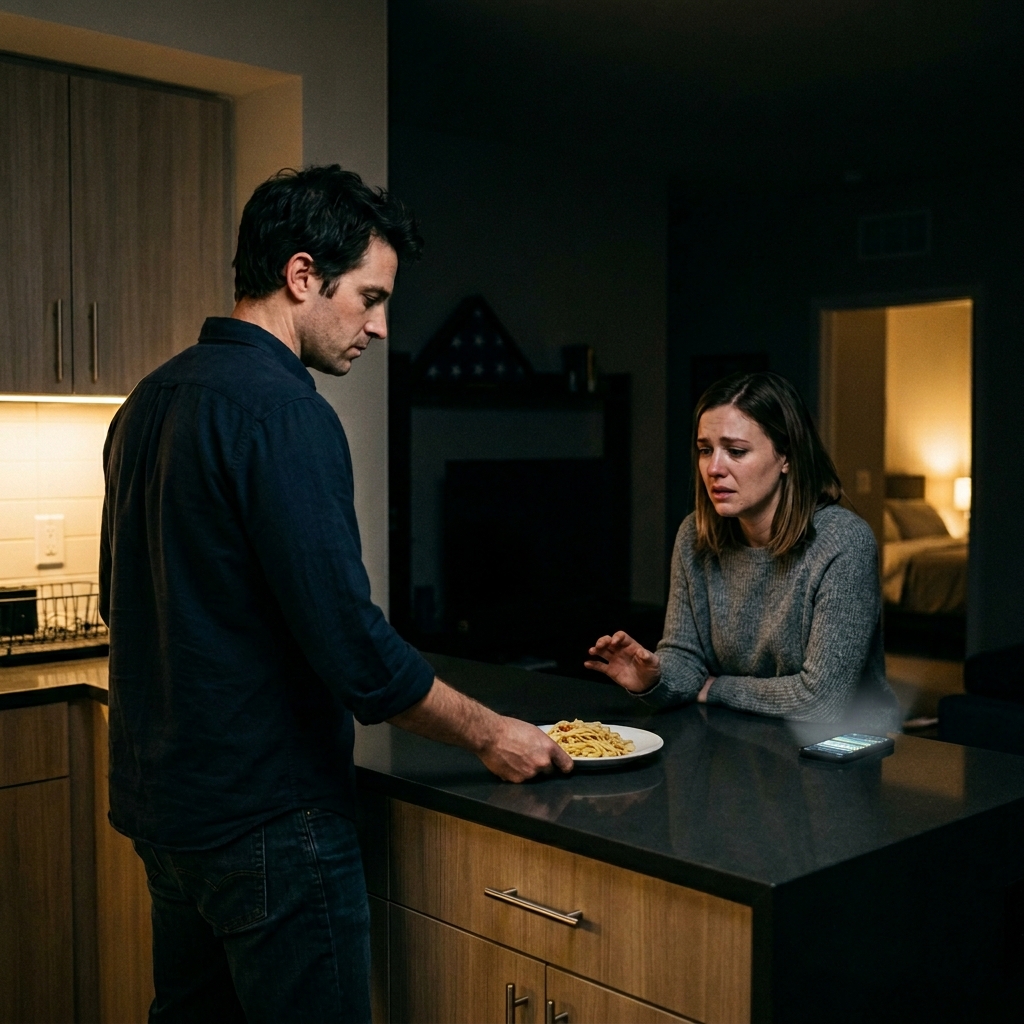
At 10:47 p.m., Madison came home in an Uber.
I was sitting at the kitchen table with a glass of water in front of me. Not whiskey. Not beer. I wanted my mind clear.
She came in slowly, carrying her heels in one hand.
Her makeup had smudged under her eyes.
For a moment, she looked like the woman I had loved. Vulnerable. Human. Scared.
Then I remembered Bear’s face pressed against her.
“Daniel,” she whispered.
“Sit down.”
She did.
Neither of us spoke for several seconds.
Then she said, “It started last year.”
The words hit me, but I forced myself not to react.
“How?”
She swallowed. “At a design charity event. Preston was there. We talked. He asked about my work. He said he had some rooms at his house he wanted redesigned.”
I laughed quietly. “Of course.”
“It wasn’t like that at first.”
“It never is, apparently.”
“He hired me professionally.”
“Did you invoice him professionally for sleeping with him?”
She flinched.
I didn’t apologize.
“I know you hate me right now,” she said.
“Hate would be simpler.”
Tears spilled down her cheeks.
“I was lonely.”
That sentence is common in confessions. I know that now. People use loneliness like it is a key that unlocks permission.
“You were lonely in our marriage,” I said.
“Yes.”
“While I was working fifty-five hours a week to pay for the house you wanted.”
“I didn’t ask you to work that much.”
“No. You just liked the result.”
Her face tightened. “That’s not fair.”
I leaned back.
“Fair?”
She looked down.
I asked, “How many times?”
“I don’t know.”
I closed my eyes.
Not because I couldn’t believe it.
Because I did.
“When was the last time?”
She didn’t answer.
“When, Madison?”
“Three days ago.”
The room seemed to shrink.
Three days ago, I had brought home Thai food because she said she was too tired to cook. We had eaten on the sofa. She had rested her feet in my lap while watching some renovation show. She had kissed me before bed.
Three days ago.
“Were you planning to leave me?”
She cried harder.
“That’s complicated.”
“No, it isn’t.”
She wiped her face. “Preston said he loved me.”
I stared at her.
There it was.
Not just sex. Not just a mistake. A whole alternate life.
“And you loved him?”
“I thought I did.”
“Did he promise you something?”
Her silence changed.
It became heavier.
“What did he promise you?” I asked.
Madison folded her hands in her lap. “He said he was going to help me open my own studio.”
I almost smiled.
Not because it was funny.
Because it was so painfully predictable.
“He was going to fund it?”
“He believed in me.”
“No. He wanted access to you without hotel receipts.”
“That’s cruel.”
“That’s accurate.”
She stood suddenly. “You don’t get to reduce me to that.”
I stood too.
“You reduced our marriage to that.”
She looked toward the living room, toward the life we had built. “I made a terrible mistake.”
“A mistake is forgetting an anniversary. A mistake is backing into the mailbox. You carried on an affair with my boss for a year. You walked into his house so many times his dog thought you were family.”
She covered her mouth.
I went upstairs and brought down a small duffel bag.
Her eyes widened. “What are you doing?”
“You’re leaving tonight.”
“Daniel, no.”
“Yes.”
“This is my home.”
“It was our home. Tonight you made it evidence.”
She shook her head rapidly. “Where am I supposed to go?”
I looked at her for a long moment.
That was the first time I saw the depth of her denial. She had not expected consequences. Not real ones. She had expected tears, shouting, maybe a few nights apart. She had expected me to still protect her from the wreckage she created.
“Call Preston,” I said.
Her expression changed instantly.
Not relief.
Fear.
And that told me Preston’s promises were already shrinking under the weight of reality.
“He can’t,” she whispered.
“He can’t what?”
“She glanced away.”
“He can’t have me at his house tonight.”
I stared.
“Why not?”
She didn’t answer.
Then my phone buzzed on the table.
A message from an unknown number.
I opened it.
It was from Preston’s ex-wife.
Her name was Claire Hale. I had met her only once, years ago, before their divorce became office gossip.
The message said:
You don’t know me well, but you need to know this is not the first time. If you want the truth about Preston, don’t confront him alone. Protect your job and your money first.
Below it was a screenshot.
A message from Preston to Claire, dated two months earlier.
She’s useful. Daniel trusts me completely. Once the Raleigh deal closes, I’ll cut him loose and keep her quiet with the studio money.
I read it three times.
Madison watched my face.
“What?” she asked.
I turned the phone toward her.
She took one look and went white.
“No,” she whispered.
That was the moment I realized something ugly and complicated.
Madison had betrayed me.
But Preston had used both of us.
And if I reacted emotionally, he would destroy me professionally before Monday morning.
So I stopped being a husband for the night.
I became an operations manager.
I packed Madison’s bag while she sat at the kitchen table crying over a man who had called her useful. I gave her enough clothes for three days, her toiletries, her charger, and the medication from her nightstand.
I didn’t yell. I didn’t insult her. I didn’t touch her.
At midnight, her sister came to pick her up.
Before Madison left, she stood in the doorway and said, “I’m sorry.”
I looked at her.
For six years, those words would have meant something.
That night, they sounded small.
“I know,” I said. “But sorry doesn’t rebuild what you helped destroy.”
She left.
I locked the door.
Then I sat at the kitchen table until sunrise, gathering every piece of information I could.
Emails. Calendar records. Project timelines. Expense approvals. Travel dates. Any situation where Preston had influenced my career while secretly involved with my wife.
By 6:30 a.m., I had a folder.
By 8:00 a.m., I had called a lawyer.
Her name was Elise Grant. She had handled a contract dispute for a friend of mine and was known for being calm in the way surgeons are calm.
I told her everything.
She listened without interrupting.
When I finished, she said, “Do not resign. Do not threaten him. Do not send emotional messages. Do not delete anything. We are going to separate the marital issue from the workplace issue and document both.”
That became my plan.
Madison sent me seventeen messages that day.
I answered only once.
Do not come to the house without arranging a time. Communicate by text or email only.
Preston called twice.
I didn’t answer.
At 9:14 p.m., he sent an email from his personal account.
Daniel, I regret how things unfolded last night. I hope we can discuss this maturely before any misunderstandings affect the workplace.
Misunderstandings.
I forwarded it to Elise.
She replied with one sentence.
Good. He is already scared.
On Monday morning, I walked into Whitcomb Development wearing a gray suit and a face that gave away nothing.
The office felt different immediately.
People knew.
Of course they knew.
At a company party, gossip travels faster than fire through dry grass. Conversations softened when I passed. Eyes flicked up from desks. Someone in accounting gave me a look of pity so sincere it nearly undid me.
I went straight to my office.
At 9:00 a.m., Preston’s assistant appeared at my door.
“Mr. Hale wants to see you.”
I stood. “Tell him any meeting between us needs HR present.”
She blinked. “Oh.”
“Please.”
Ten minutes later, HR director Lauren Pike called me into a conference room.
Preston was already there, jaw tight, expression controlled. He looked less like the charismatic founder and more like a man calculating exits.
Lauren sat between us with a notebook.
“Daniel,” Preston began, “I want to clear the air.”
I placed a printed folder on the table.
“My attorney has advised me that any conversation involving Mr. Hale’s affair with my wife, his conflict of interest as my direct supervisor, and potential retaliation should be documented.”
Lauren’s pen froze.
Preston’s face darkened. “That’s an aggressive way to start.”
“No,” I said. “Sleeping with your employee’s wife while supervising his compensation, assignments, and future promotion path was aggressive. This is documentation.”
Lauren turned slowly toward Preston.
He said nothing.
That silence was beautiful.
Not satisfying exactly.
But clean.
Over the next two weeks, my life split into two battles.
At home, Madison tried every version of regret.
The first version was brokenness.
She sent long messages about how ashamed she was, how she had lost herself, how Preston had manipulated her dreams. Some of that may have been true. But truth does not erase choice.
The second version was nostalgia.
She sent photos from vacations. Our first apartment. A video of us dancing badly at my cousin’s wedding. She wrote, Remember who we were.
I did remember.
That was the problem.
The third version was panic.
When Preston stopped answering her calls, when the studio money vanished, when her sister got tired of hosting her, Madison began asking if she could come home “temporarily.”
I said no.
Then came anger.
You’re punishing me.
You’re enjoying this.
You care more about winning than saving us.
That message sat on my screen for a long time.
Finally, I replied:
I am not trying to win. I am trying to survive what you chose.
At work, Preston tried to bury the issue.
He told HR it was a private matter. He claimed the affair had no impact on my job. Then Elise sent a formal letter requesting preservation of records related to my performance reviews, compensation discussions, project assignments, and the Raleigh expansion deal.
That changed everything.
Because Preston had made a mistake.
Men like him usually do.
They think charm is armor. They think people beneath them don’t keep receipts.
But his ex-wife did.
Claire Hale called me three days after the party.
Her voice was calm, tired, and sharp.
“I’m sorry you’re going through this,” she said.
“Why are you helping me?”
“Because Preston has been doing versions of this for years. Assistants. Consultants. Wives of investors. Anyone he could flatter, fund, or frighten.”
I leaned back in my chair.
“Why didn’t anyone stop him?”
“Money. Fear. Embarrassment. Pick one.”
She sent Elise several screenshots. None of them were explicit, but they showed a pattern. Preston mixing personal affairs with business favors. Studio leases offered then withdrawn. Payments described as consulting retainers. Promises made to women he later discarded.
Then she sent one email that changed the entire case.
It was from Preston to a board member.
Daniel is reliable but emotionally soft. Keep him on Raleigh until we finish negotiations, then we can restructure his role. Madison gives me useful insight into how he thinks.
I read that email alone in my office.
For the first time since the party, I felt something colder than heartbreak.
He had not only taken my wife into his bed.
He had taken conversations from my home, private fears I had shared with Madison, and used them to assess how easily I could be moved at work.
That was not betrayal.
That was strategy.
I printed the email and placed it in the folder.
Then I called Elise.
By Friday, Whitcomb’s board had opened an internal investigation.
Preston was placed on “temporary leave.”
The office pretended not to celebrate.
People are careful around power until power starts bleeding.
Then stories came out.
A former assistant who had transferred departments. A junior designer who left after a “mentorship” turned personal. A vendor who lost a contract after refusing a weekend invitation. Nothing dramatic enough alone. Together, it formed a map.
Madison called me when she heard Preston had been removed.
Her voice shook. “Is it true?”
“Yes.”
“He told me you were overreacting.”
I closed my eyes.
“Madison, at some point, you need to stop telling me what he said.”
She cried quietly.
“I destroyed us for someone who never cared about me.”
I didn’t respond.
Because the cruelest part was that I believed her.
And it still didn’t save us.
A month after the party, Madison asked to meet in person.
My lawyer advised against it unless we kept it public and brief. So we met at a coffee shop near our old neighborhood, the one where we used to go every Sunday after grocery shopping.
She looked different.
Less polished. No designer bag. No perfect makeup. Just Madison in a cream sweater, hair pulled back, eyes tired.
I sat across from her.
For a while, neither of us spoke.
Then she said, “I signed the separation papers.”
I nodded.
“Thank you.”
She gave a sad laugh. “That’s such a strange thing to thank someone for.”
“It makes things cleaner.”
“I don’t deserve clean.”
I looked at her carefully.
That was the first honest thing she had said without trying to soften it.
She wrapped both hands around her coffee cup.
“I kept thinking there would be a moment where I could stop,” she said. “After the first time. After the second. After he started talking about the studio. After I realized I was lying to you too easily. But every time, stopping meant admitting what I had become. So I kept going.”
I said nothing.
She looked up at me.
“I loved you. I know that sounds impossible now.”
“It doesn’t sound impossible,” I said. “It sounds insufficient.”
Her eyes filled.
“I don’t want the house,” she said. “I don’t want spousal support. I don’t want to fight you.”
I studied her.
“Why?”
“Because I already took too much.”
It would be easier to say she was a monster.
She wasn’t.
That was what made it hurt.
She was weak. Vain. Lonely. Ambitious. Susceptible to admiration from a man who knew exactly how to offer it. But she was also the woman who once stayed up all night with me when my father had heart surgery. The woman who cried when we found out our first offer on a house was accepted. The woman who knew I hated olives and picked them off my pizza without asking.
People want betrayal to turn the betrayer into a stranger.
Sometimes it doesn’t.
Sometimes they remain painfully familiar.
“Madison,” I said, “I hope you rebuild your life. I mean that.”
She wiped her tears.
“But not with you.”
“No.”
She nodded like she had expected it.
Before she left, she said, “Bear really did love me.”
I almost laughed.
Then I almost cried.
“I know,” I said.
She stood and walked out.
Three months later, the divorce was finalized.
The house stayed mine because I had bought it before the marriage and kept the records clean. Madison moved into a small apartment across town and started working for a local staging company. Not her own studio. Not the dream Preston sold her. Something ordinary. Something earned.
Preston resigned before the board could fire him.
The official statement said he was stepping down to pursue new opportunities.
Everyone knew what that meant.
Whitcomb Development restructured. The board brought in an interim CEO, and HR offered me a settlement tied to the conflict of interest and retaliation risk. Elise negotiated hard enough that even I felt nervous. In the end, I received enough to leave without fear.
I didn’t stay.
People told me I should, that leaving meant Preston still took something from me. But every hallway in that office held a version of the party. Every conference room reminded me that my private life had been quietly studied by the man signing my reviews.
So I left.
Six months after the party, I started consulting independently. Smaller clients. Less prestige. More control. I worked from a modest office with brick walls, bad coffee, and a view of a parking lot where nobody pretended to be family while sharpening knives behind their backs.
One afternoon, Claire Hale came by to sign paperwork for a project I was helping her nonprofit evaluate. She looked around my office and smiled.
“Not exactly Preston’s marble palace.”
“Thank God.”
She laughed.
Before she left, she paused at the door.
“For what it’s worth,” she said, “you handled it better than most people would have.”
“I don’t know about that.”
“You didn’t burn your life down just because someone handed you matches. That counts.”
After she left, I sat with that sentence for a long time.
Because she was right.
There had been nights when I wanted destruction. I wanted to call every client, expose every message, ruin Madison publicly, humiliate Preston the way I had been humiliated. I wanted the world to feel as unstable as I did.
But revenge, real revenge, had not been a dramatic speech at a party.
It had been documentation.
Silence when they expected rage.
Boundaries when they expected weakness.
Leaving with my name intact.
A year after the divorce, I received a letter from Madison.
Not a text. Not an email. A real letter.
I almost threw it away.
Instead, I opened it at my kitchen table in the same spot where she had confessed.
She wrote that she was in therapy. That she had apologized to people she had lied to. That she knew forgiveness was not something she could request like a favor. That she had adopted a senior dog from a shelter because coming home to silence had become unbearable.
Near the end, she wrote:
I used to think the worst thing that happened that night was Bear running to me. Now I think it was the first honest thing in a year. He recognized where I had been when I was still pretending I had never gone there.
I folded the letter and put it back in the envelope.
I didn’t reply.
Not because I hated her.
Because some doors stay closed even after the fire is out.
That summer, I was invited to a different company event by one of my new clients. Smaller house. Backyard barbecue. No marble. No whiskey speeches. No executives pretending their homes were kingdoms.
I almost didn’t go.
Then I did.
I stood near the grill with a plate of ribs, talking to a project director about zoning permits, when a small terrier ran up and pawed at my shoe.
A woman nearby laughed and bent down.
“Sorry,” she said. “He thinks every man with barbecue is his best friend.”
She had warm brown eyes, curly hair tied back loosely, and a smile that didn’t feel rehearsed.
I smiled back.
“That seems like a reasonable belief system.”
She laughed.
Her name was Audrey.
We talked for twenty minutes about dogs, bad catered food, and the strange politics of company parties. When she asked if I had always hated them, I almost gave her the polite answer.
Instead, I told the truth.
“I had a bad experience at one.”
She studied me for a moment, then nodded.
“Well,” she said, “this one has ribs and no speeches so far. That’s a promising start.”
It was not love at first sight.
I don’t believe in that anymore.
It was something quieter.
A conversation where I did not feel managed. A smile that did not ask me to ignore my instincts. A moment where the ground beneath me stayed still.
Months later, Audrey and I would have coffee. Then dinner. Then more dinners. I told her what happened before she heard it from someone else, because I had learned that secrets are only harmless when they are not being used as weapons.
She listened.
She didn’t pity me.
She didn’t rush me.
And when I finished, she said, “I’m sorry they made you question your own eyes.”
That sentence stayed with me.
Because that was the deepest wound.
Not just that Madison lied.
Not just that Preston betrayed me.
It was that for months, maybe longer, I had been living beside signs I taught myself not to read. A paused conversation when I walked into the room. A strange defensiveness about a house. A dress chosen too carefully. A dog’s joy turning my stomach to ice.
People say trust your gut.
But they don’t tell you how hard that is when your heart keeps defending the person your gut is warning you about.
I still think about Bear sometimes.
Not with anger.
With gratitude.
He was just a dog. He didn’t understand marriage, betrayal, corporate politics, or the delicate architecture of lies. He only knew scent, memory, affection, routine.
He knew Madison had been there.
So he ran to her.
And in doing so, he gave me back the truth everyone else had been trying to keep from me.
My wife told me she had never been inside my boss’s house.
Then his dog ran straight to her at the company party.
At the time, I thought that moment destroyed my life.
I know better now.
It destroyed the lie.
And sometimes, when a lie has been living in your house long enough, destruction is not the tragedy.
It is the beginning of being free.
![[FULL STORY] She Presented Me as “Her Chauffeur” at a Gathering I Co Funded She Said It Loudly Enough for](https://social-media.rabedo.com/thumbnails/1776735972_14.png)