
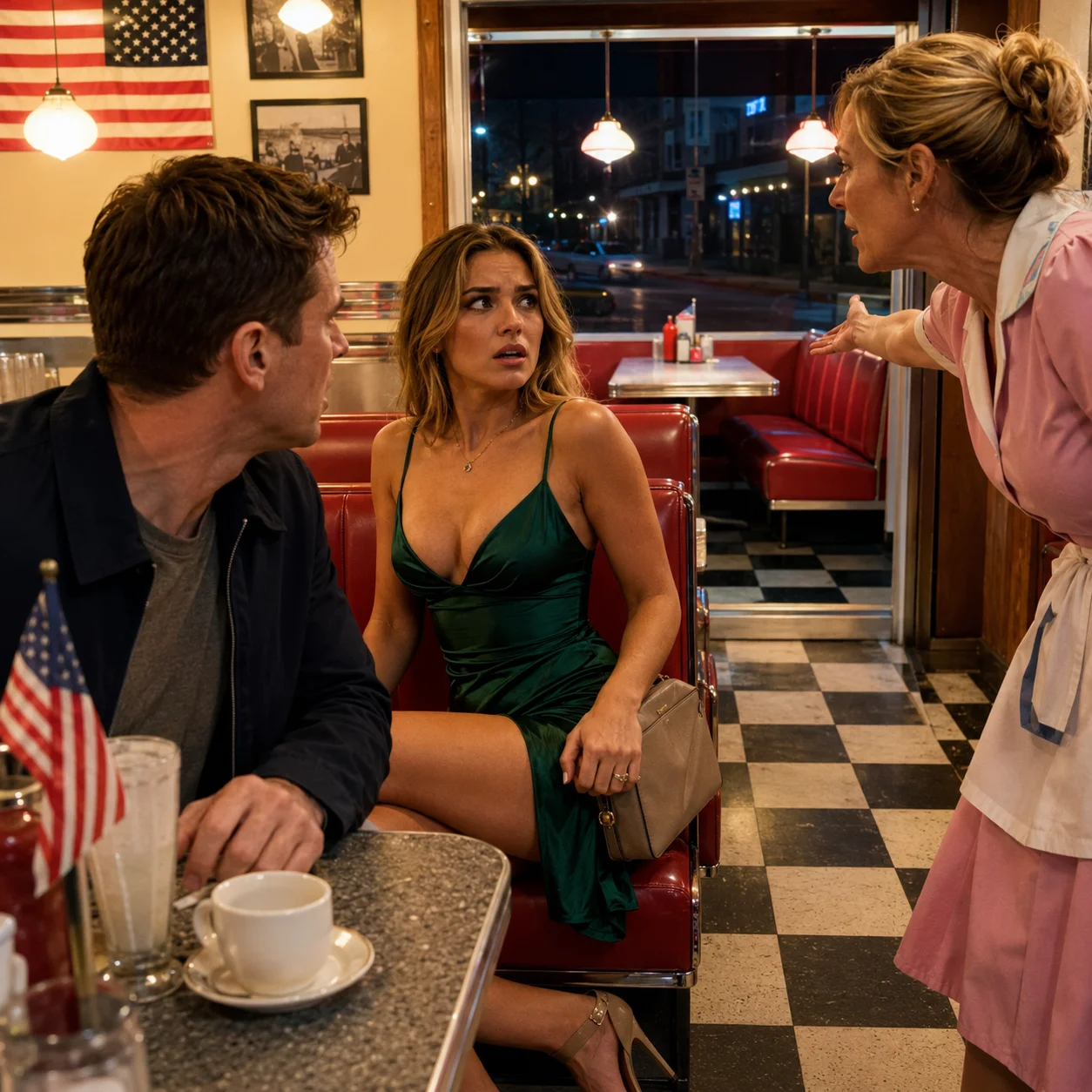
“Well, if it isn’t Danny Harper.”
Nobody called me Danny anymore except people who had known me before I became tall.
I smiled. “Sorry, I’m trying to place you.”
“Rachel Porter. Well, Rachel Mills now. I used to work the counter when you and your brother came in after games.”
“Oh my God. Rachel. Yeah. Hi.”
She laughed. “Don’t feel bad. You boys all grew beards and started looking tired.”
Caleb lifted a hand. “Speak for yourself.”
Rachel took drink orders, teasing my parents, greeting Mara, acting exactly like every hometown waitress who remembered too much and forgot nothing.
Then her eyes landed on Elise.
For one second, her expression didn’t change.
Then it did.
Not dramatically. Not enough for anyone else to notice, maybe. But I was looking at her because she was looking at my wife, and I saw recognition pass across her face like a shadow.
“Oh,” Rachel said. “I didn’t realize you were back in town.”
Elise went still.
Completely still.
My mother was busy helping my nephew with his straw wrapper. Caleb was scanning the beer list. Mara was checking her phone. Nobody else seemed to catch it.
I did.
Elise’s smile appeared, but it looked placed there by force.
“I’m sorry,” she said. “Do we know each other?”
Rachel blinked.
Then she gave a small, awkward laugh. “Maybe I’m mixing you up with someone.”
Elise tilted her head. “Probably.”
Rachel looked from Elise to me, then back to Elise.
And then she said the sentence that changed my marriage.
“Well, I just thought you might want the usual table. The one by the window. You and Ryan always sat there.”
The table went quiet in pieces.
First Mara looked up.
Then Caleb.
Then my mother.
Then my father.
I heard the faint clink of ice from another booth. I heard the kitchen bell. I heard someone laugh near the bar, completely unaware that my life had just split open beside the ketchup bottles.
Elise’s face drained.
Not a little.
All of it.
The warmth disappeared from her cheeks so quickly that she looked almost sick.
Rachel’s eyes widened as she realized something was wrong. “I’m sorry. I—”
“No,” Elise said too quickly. “You have me confused with someone else.”
Rachel swallowed. “Right. I must.”
But she didn’t believe it.
Neither did I.
I turned slowly toward my wife.
“Elise,” I said quietly.
She looked at me, and for the first time since I had known her, I saw fear in her eyes. Not discomfort. Not embarrassment. Fear.
“I don’t know what she’s talking about,” she said.
Nobody spoke.
My brother’s wife, Jenna, gently pulled the kids’ attention toward the paper placemats. My mother looked between us with the sharpened stillness she got whenever someone lied near her. My father stared at his folded hands.
“Elise,” I said again, still quiet. “You told me you’d never been here.”
“I haven’t.”
Rachel took one step back. “I’ll give you all a minute.”
She left before anyone could stop her.
My heart was beating hard, but not fast. It was worse than fast. It was heavy. Each beat felt like something being nailed shut.
Caleb cleared his throat. “Maybe there’s another—”
“No,” Mara said softly.
I looked at her.
She wasn’t looking at me. She was looking at Elise.
And there was something in my sister’s expression that made the room feel smaller.
“What does that mean?” I asked.
Mara pressed her lips together.
Elise turned toward her. “Don’t.”
One word.
Don’t.
Not “what are you talking about?” Not confusion. Not innocence.
Don’t.
My mother inhaled sharply.
I pushed my chair back. The sound scraped across the tile, too loud.
“Elise,” I said, “outside.”
She didn’t move.
“Now.”
My voice didn’t rise. Maybe that’s why she stood.
We walked out through the front door and into the cool evening. Main Street was quiet except for a pickup passing slowly under the yellow streetlights. Across the road, the old hardware store windows reflected us back in pieces.
I stopped near the side of the building.
Elise wrapped her arms around herself. “Daniel, please don’t do this here.”
“Do what?”
“Make a scene.”
I almost laughed.
“You think I’m the one making a scene?”
She closed her eyes. “It’s not what it sounds like.”
“That’s impressive, because I don’t even know what it sounds like yet.”
She looked toward the parking lot.
I knew that look. I had seen it before in negotiations, in arguments, in people deciding which version of the truth would cost them the least.
“Who is Ryan?” I asked.
She rubbed her forehead. “Someone I knew a long time ago.”
“In my hometown?”
“Yes.”
“The hometown you’d never been to.”
She swallowed.
“How long ago?”
“Before you.”
“How long before me?”
She didn’t answer.
“Elise.”
“Daniel, I need you to understand that this was complicated.”
I stared at her.
There are words that almost always mean the truth is worse than you think. Complicated is one of them.
“Start uncomplicated,” I said. “Who is Ryan?”
She looked down.
“Ryan Keller.”
The name hit something old in my memory.
I knew it. Not well, but I knew it. Ryan Keller had been two years ahead of me in school. Star baseball player. Big smile. Rich family by Briar Glen standards. His father owned a construction company. His mother chaired half the charity committees in town. Ryan was the kind of guy teachers forgave before he apologized.
He had also dated my sister Mara briefly after college.
Very briefly.
I looked back through the diner window. Mara was still at the table, staring down at her phone now, jaw tight.
“You dated Ryan Keller?” I asked.
Elise whispered, “Yes.”
“And you never thought to mention that?”
“It was years ago.”
“You told me you had never been here.”
“I know.”
“That’s not an answer.”
She looked up at me then, eyes wet but controlled. Elise was good at controlled. Even now, with the lie sitting between us like a body, she was trying to manage the damage.
“I met Ryan at a fundraising event in Portland,” she said. “We dated for a while. He brought me here a few times. That’s all.”
“That’s all?”
“Yes.”
I looked toward the diner again.
Rachel was behind the counter, pretending not to watch us.
“Then why were you scared when she recognized you?”
“I wasn’t scared.”
“Elise.”
She looked away.
I stepped back. “Did you know this was my hometown when we met?”
Her silence answered before her mouth did.
“Yes,” she said eventually.
Something cold moved through me.
“You knew.”
“I didn’t at first.”
“But before we got married?”
“Yes.”
“Before I proposed?”
“Yes.”
My laugh came out once, sharp and empty.
“So at some point while we were dating, you realized I was from the same town as your ex. You had been here with him. You knew people might recognize you. And you still told me tonight you had never been here.”
“I panicked.”
“No. You planned.”
Her face tightened. “That’s not fair.”
“What part?”
“I didn’t marry you because of Ryan.”
“I didn’t ask that.”
She exhaled shakily. “I didn’t want him in our marriage.”
“But he was already there. You just made sure I was the only one who didn’t know.”
The diner door opened behind us.
Mara stepped out.
She looked at Elise first, then at me.
“I’m sorry,” she said.
I turned fully toward her. “For what?”
Mara’s face was pale in the streetlight.
Elise said again, quieter this time, “Mara, please.”
My sister ignored her.
“I knew she looked familiar when you first showed us wedding photos,” Mara said. “I couldn’t place her at first. Then Mom showed me one of your engagement pictures and it clicked.”
My stomach turned.
“You knew?”
“I wasn’t sure.”
“Don’t do that.”
She flinched.
“I asked Ryan,” Mara said.
Elise made a small sound.
Mara kept going. “I ran into him about a year before your wedding when I was home. I showed him the photo. He said yes, he knew her.”
I looked at Elise. “You talked to him about me?”
Elise shook her head quickly. “No.”
Mara’s voice hardened. “Ryan said she knew exactly who you were before she met you.”
The street seemed to tilt.
“What?” I said.
Elise’s face crumpled for half a second before she pulled it back together.
“That is not true.”
Mara’s eyes flashed. “Don’t lie now.”
I looked between them, trying to understand the shape of what I was hearing.
“What does that mean, she knew who I was before she met me?”
Mara took a breath. “Ryan told me Elise used to ask about our family. About you. About Mom and Dad. About the house. About whether you still lived in Seattle. He thought it was weird after they broke up.”
Elise’s voice turned sharp. “Ryan is a liar.”
Mara gave a bitter little laugh. “He is a lot of things. But he was drunk when he told me, and drunk Ryan mostly tells truths he regrets later.”
My mind moved backward unwillingly.
The charity auction where I met Elise. The moment she smiled at me from across the table. The way she asked what brought me there. The surprise she showed when I said I worked in commercial insurance. The second glass of wine. The easy conversation. Her saying she rarely felt comfortable with strangers.
Had any of that been real?
“Elise,” I said, “did you know who I was before we met?”
She pressed her fingers to her mouth.
That was answer enough.
I walked away from her then.
Not far. Just a few steps toward the curb because I suddenly couldn’t breathe near her.
She followed. “Daniel, please listen.”
I turned. “How?”
“What?”
“How did you know who I was?”
She stared at me like she was looking for the safest door in a burning room.
“Elise.”
She wiped under one eye. “Ryan mentioned you.”
“Why?”
“Because of Mara. Because he dated your sister. Because he knew your family.”
“That doesn’t explain why you asked about me.”
She didn’t respond.
Mara was silent behind us.
I felt something ugly begin to open in my chest.
“What did Ryan tell you about me?”
Elise shook her head. “Nothing that matters now.”
“It matters to me.”
“Daniel, I love you.”
“Don’t use that as a curtain.”
She looked wounded, which made me angrier. Not because she wasn’t allowed to be hurt, but because somehow even now part of her expected me to comfort her.
Mara spoke quietly. “Ryan said she was angry at him.”
Elise snapped, “Stop.”
Mara didn’t.
“He said after they broke up, she wanted to prove something. He told her she’d never fit into his life here. That his family would never take her seriously. That she was just a Portland girl playing small-town sweetheart.”
Elise’s tears spilled then, but she still said nothing.
I stared at my wife.
“What did you prove by marrying me?” I asked.
Her face twisted. “That’s not what happened.”
“But it started there.”
“No.”
“It started with him.”
“No,” she said again, but weaker.
I looked at Mara. “Go inside.”
“Daniel—”
“Please.”
She hesitated, then went back into the diner.
The door closed softly behind her.
For a long moment, Elise and I stood alone under the buzzing exterior light.
Finally she said, “I made a mistake.”
I almost smiled.
A mistake was forgetting an anniversary. A mistake was scratching the car. A mistake was buying oat milk when your husband liked whole milk.
This was architecture.
“You researched me,” I said.
“No. Not like that.”
“You knew who I was. You knew my hometown. You knew my family. You let me believe meeting you was random.”
“It became real.”
The words landed harder than I expected.
I looked at her. “Became?”
She covered her face.
“Elise.”
“At first, I was curious,” she whispered. “That’s all. Ryan had hurt me. He made me feel small. He talked about your family like they were everything decent he had lost access to after Mara dumped him. He mentioned you once, said you were the only Harper who got out and made something of himself without acting superior about it. I saw your name months later on the donor list for the auction. I recognized it.”
I remembered that night. I remembered her asking if the seat beside me was taken.
“It was supposed to be nothing,” she said. “I just wanted to see you.”
“See me.”
“Yes.”
“Like a person or like a target?”
She flinched. “That’s cruel.”
“So is marrying a man under a false beginning.”
Her voice cracked. “I didn’t plan to marry you.”
“But you planned to meet me.”
She didn’t deny it.
I looked down Main Street. The town I had once wanted to escape suddenly felt like a witness. Every window, every sign, every familiar crack in the sidewalk seemed to know something I hadn’t.
“How long did you date Ryan?” I asked.
“Almost a year.”
“How many times did you come here?”
“Several.”
“How many people know you?”
“I don’t know.”
“Did my parents ever meet you?”
“No.”
“Caleb?”
“No.”
“Mara obviously knew eventually.”
“She didn’t know when we were together. Ryan and I were before Mara. He dated her after me.”
That made it worse in a different way. Ryan had moved through the edges of my family, and Elise had followed the map he left behind.
I rubbed my jaw. “Why didn’t you tell me when things became serious?”
“I was afraid you’d leave.”
“You stole my chance to choose.”
“I know.”
“No, I don’t think you do.” My voice stayed low, but something in it made her shrink back. “You let me stand in front of everyone I love and promise my life to you without knowing the first page of our story had been edited.”
She was crying openly now.
“I love you,” she said. “I know you don’t believe anything right now, but I do. I love our life. I love waking up with you. I love your stupid burnt coffee and the way you talk to dogs like they’re coworkers. I love that you call your mother every Sunday even when you pretend it annoys you. I love you, Daniel. Not Ryan. Not revenge. You.”
The worst part was that I believed some of it.
Maybe all of it.
And that didn’t save us.
Because love that grows from a lie may still be love, but the person lied to is forced to live inside a house they never agreed to enter.
I went back inside alone.
My family pretended not to stare and failed. Elise came in a few minutes later, eyes red, face composed enough to fool strangers and no one else.
We didn’t stay for dessert.
The drive to my parents’ house took eight minutes. No one spoke in the car. Elise sat beside me with both hands folded in her lap. I kept my eyes on the road, passing places from my childhood that now felt infected by her secrets.
At the house, my mother was waiting in the kitchen.
Of course she was.
Dad sat at the table. Mara stood by the sink. Caleb leaned against the counter with his arms crossed.
Elise stopped in the doorway.
My mother looked at me. “Do you want us to leave you two alone?”
I almost said yes. Then I realized I had been alone in this marriage long enough.
“No,” I said. “I want the truth.”
Elise looked at me sharply.
“Not a performance,” I said. “Not pieces. All of it.”
My father’s face tightened, but he said nothing.
Elise stood there for a long moment. Then she pulled out a chair and sat down.
She told the story like someone stepping carefully over broken glass.
She met Ryan Keller at a donor event in Portland six years before she met me. He was charming, attentive, and reckless in that way wealthy men often mistake for personality. He flew her to weekends away. He brought her to Briar Glen. They ate at The Lantern, walked by the lake, slept in his parents’ guest cottage when they were out of town.
He told her he loved her.
Then he told her she wasn’t the kind of woman he married.
Not directly at first. Men like Ryan rarely start with honesty. He made comments. Small ones. Her family was too “new money” even though they weren’t money at all. Her job was sweet but not impressive. Her clothes were almost right. Her laugh was too big in quiet rooms. When she challenged him, he said she was insecure.
Then he cheated on her with someone his parents liked better.
She found out in a humiliating way—walking into his birthday party at his parents’ house and seeing another woman wearing the necklace Elise had helped him pick out as a gift “for his mother.”
When she confronted him, Ryan laughed.
According to Elise, he said, “You were fun, Ellie. Don’t make it tragic.”
Ellie.
The nickname hit me strangely. I never called her that. She hated nicknames, or so I thought.
After they broke up, Elise became fixated. Not in love. Not exactly. More like wounded pride mixed with grief. She wanted to know if he treated everyone like disposable furniture. She followed his social media, then Mara’s after Ryan started dating her. Through Mara, she learned about my family. Through old posts, she learned about me.
Then came the auction.
She saw my name on a seating chart.
And she chose the chair beside mine.
My mother closed her eyes.
Caleb muttered something under his breath.
I sat across from Elise and felt my memories rearranging themselves into something uglier.
“Did you date me to get close to Ryan?” I asked.
“No.”
“To hurt him?”
“At first, maybe to feel like I had taken something from his world.”
My mother made a small sound.
Elise looked at her, ashamed. “I’m sorry.”
“Don’t apologize to me,” Mom said coldly.
Elise looked back at me. “But that feeling didn’t last. After the first few dates, it wasn’t about him. I know that sounds convenient, but it’s true. You were kind. You were steady. You made me feel safe in a way he never did. I fell in love with you before I knew what to do with the lie.”
“You could have told me.”
“I know.”
“You could have told me before we moved in together.”
“I know.”
“Before I proposed.”
“I know.”
“Before the wedding.”
Her voice broke. “I know.”
I leaned back.
There was something almost boring about betrayal once the big shape of it emerged. The mind wanted explosions, but the body just felt tired.
Mara spoke from the sink.
“I should have told you.”
I looked at her.
She had been crying silently.
“I convinced myself it wasn’t my place,” she said. “Ryan made it sound like Elise had a crush or some weird curiosity, but not that she’d engineered anything. By the time I realized you were serious, you looked so happy. I asked Elise about it once.”
My eyes moved to my wife.
Elise nodded faintly. “She did.”
“What did you say?”
“That I loved you. That I was going to tell you.”
Mara wiped her face. “And then she didn’t. And I was a coward.”
I wanted to be angry at Mara. Part of me was. But the heavier anger belonged across the table.
My father finally spoke.
“Daniel, son, you don’t need to decide anything tonight.”
I looked at him.
He was watching me with a sadness that made me feel twelve years old and ancient at the same time.
The anniversary celebration was the next day.
That absurd fact kept circling in my head. Streamers had been bought. A cake had been ordered. Relatives were driving in. My parents had survived forty years together, and I had brought a slow-burning bomb to their kitchen.
“I’m sorry,” Elise whispered.
I stood. “I’m sleeping in Caleb’s old room.”
She rose too. “Daniel—”
“Don’t follow me.”
I went upstairs.
The room still had faded baseball posters on one wall and a bookshelf filled with paperbacks I hadn’t touched since high school. I sat on the edge of the bed and looked at nothing.
My phone buzzed twenty minutes later.
A text from Elise.
Please let me talk to you alone.
Then another.
I know I don’t deserve it, but please.
Then one from Mara.
I’m so sorry. I should have protected you.
Then Caleb.
Want me to kick her out? Not joking.
I turned the phone face down.
I didn’t sleep much.
Around two in the morning, I got up and stood by the window. The backyard was silver under the moon. The old maple tree still had the tire swing Dad put up when we were kids. I remembered Elise laughing when I told her about falling off it and splitting my chin open at eight. I remembered thinking she loved my stories because she loved me.
Maybe she had.
Maybe she had collected them first.
That was the poison. Not knowing where the lie ended and the truth began.
The next morning, my mother knocked softly and came in with coffee.
She didn’t ask if I was okay. Mothers know when that question is insulting.
She handed me the mug and sat beside me.
“When I met your father,” she said, “he told me he liked jazz.”
I looked at her, confused.
“He hated jazz. Absolutely hated it. But I liked it, and he wanted me to think we had something in common. For three months, that man sat through jazz nights at a smoky bar pretending he understood anything happening on that stage.”
Despite everything, I almost smiled.
“Mom.”
She held up a hand. “I’m not comparing that to this. I’m saying people sometimes begin with foolishness because they want to be seen a certain way. But there is foolishness, and there is deception that takes away another person’s dignity.”
I looked into the coffee.
“What would you do?”
“I can’t answer that for you.”
“You can.”
“I won’t.”
We sat quietly.
Then she said, “But I will tell you this. Forgiveness is not the same thing as continuing. And leaving is not the same thing as failing.”
That stayed with me.
Downstairs, Elise was at the kitchen table, untouched tea in front of her. She looked like she had aged overnight. When she saw me, she stood.
“Can we walk?” she asked.
I nodded.
We walked through the neighborhood where I had learned to ride a bike, past tidy lawns and cracked driveways, past houses where people still waved even if they didn’t recognize you. Elise kept her arms wrapped around herself.
At the end of the street was a small park with a view of the lake road.
We stopped by the fence.
Elise looked exhausted. Not dramatically beautiful exhausted. Just human. Scared and sorry and too late.
“I wrote something,” she said.
I looked at her.
She pulled folded pages from her coat pocket.
“I’m not asking you to read it now. It’s a timeline. Everything. Ryan. The auction. When I realized who you were. When Mara asked me. Every time I should have told you and didn’t. I don’t want to hide behind vague words anymore.”
I took the pages but didn’t open them.
“Why now?” I asked.
“Because if I keep trying to control what you know, then I haven’t changed anything.”
I looked toward the road.
“Did you ever talk to Ryan after we got together?”
“No.”
“Don’t answer quickly.”
She swallowed. “I saw him once. About nine months after we started dating. He came to a donor event. He approached me. I told him I was with someone and walked away.”
“Did he know it was me?”
“Yes.”
“Did he laugh?”
Her eyes filled again. “Yes.”
Something in me hardened.
“Why didn’t you tell me then?”
“Because I was ashamed.”
“No. Because you were afraid I’d understand the joke.”
She closed her eyes.
There it was.
Not Ryan’s joke. Hers. The universe’s. The cruel symmetry of it all. Ryan had humiliated her by treating her like a temporary amusement. She had reached into his world and found me, maybe to prove she mattered. Then she fell in love with me, and instead of confessing, she trapped both of us inside the story she had started.
“When I married you,” I said, “who was in that room for you?”
She looked startled. “What?”
“When you walked down the aisle. When you said your vows. Was it me? Or was part of you still proving something to him?”
Her answer came with tears.
“It was you.”
I wanted that to be enough.
God help me, I wanted it.
But wanting something to be true doesn’t repair the years built around what was false.
My parents’ anniversary party happened that evening.
I told Elise she could decide whether to attend. She chose not to. She said she didn’t want to bring more discomfort to my family. Caleb drove her to a small inn near the highway, where she booked a room.
I went to the party alone.
People asked where my wife was. I said she wasn’t feeling well. In a way, it was the truest lie I had ever told.
The party was beautiful. My parents danced badly. My father cried during his toast, which made my mother cry, which made half the room cry because Briar Glen people enjoy pretending they are not emotional until someone gives them permission. I smiled in photos. I hugged relatives. I cut cake. I listened to my uncle tell the same hunting story for the fiftieth time.
Underneath all of it, I felt like a man watching himself from across a room.
After the party, Mara found me outside the community hall.
“I don’t expect you to forgive me,” she said.
“I don’t know what I’m doing yet.”
“I should have told you before the wedding.”
“Yes.”
She nodded, accepting it.
“I thought I was protecting your happiness,” she said. “But I think I was protecting myself from being the person who ruined it.”
That was honest enough to hurt.
I hugged her.
Not because everything was fine. Because she was my sister, and some fractures deserve repair even before you know the full cost.
The next morning, I drove Elise back to Seattle.
Seven hours in a car with the person you love and cannot trust is its own kind of punishment.
She didn’t ask what I planned to do. She didn’t cry loudly. She didn’t perform. She sat with her hands folded, answering when I asked questions, silent when I didn’t.
At home, I carried my bag into the guest room.
She stood in the hallway.
“Are you leaving me?” she asked.
“I don’t know.”
That was the truth.
For the next three weeks, we lived like ghosts sharing an address.
I read her timeline.
Then I read it again.
It was detailed. Painfully detailed. Dates, places, names, admissions that made her look worse rather than better. She included things I wouldn’t have known to ask. How she searched my name before the auction. How she chose the seat beside mine. How she told herself one conversation wasn’t wrong. How after our third date she deleted old photos from Briar Glen because she didn’t want to risk me seeing them. How when I proposed, she almost confessed but convinced herself the past no longer mattered because her feelings had become real.
Almost.
That word appeared several times.
I almost told you.
I almost turned around.
I almost called Mara back.
I almost said everything before the wedding.
Almost is the graveyard where accountability goes to look sympathetic.
We started therapy because I wanted to be able to say I had not run at the first fire. Our therapist, Dr. Levin, was calm, direct, and impossible to charm. Elise tried, gently at first, to frame the story as trauma from Ryan that spiraled into fear. Dr. Levin listened, then said, “Your trauma may explain your choices. It does not absorb the consequences of them.”
Elise cried for ten minutes after that.
I didn’t comfort her.
Not because I wanted to be cruel. Because I had spent two years comforting a version of her that had not existed.
A month after Briar Glen, Ryan Keller contacted me.
Of course he did.
Men like Ryan always appear when pain starts smelling like attention.
He sent a message through social media.
Heard you finally brought Elise home. Small world, huh?
I stared at it for a long time.
Then I did something I’m still proud of.
I didn’t answer.
Instead, I screenshotted it and sent it to Elise.
She called me immediately.
“I’m sorry,” she said.
“You didn’t make him send it.”
“No, but I brought him into your life.”
“Yes.”
Silence.
Then she said, “What do you need from me?”
It was the first useful question she had asked.
I looked around the guest room. At my duffel bag still half-packed on the chair. At the stack of therapy worksheets on the desk. At my wedding ring sitting beside the lamp because some nights I couldn’t sleep with it on.
“I need a legal separation,” I said.
Her breath caught.
“I’m not filing for divorce today,” I continued. “But I can’t rebuild anything while still standing inside the old structure. I need space that is real, not symbolic.”
She cried then. Quietly.
But she said, “Okay.”
To her credit, she did not fight me.
That almost made it harder.
We separated in June. I moved into a short-term rental fifteen minutes from my office. Elise stayed in the apartment until we could sort the lease. We divided finances. We told friends we were taking time apart. I told my family the truth. Elise wrote my parents a letter apologizing without asking for forgiveness. My mother read it and said nothing. My father put it in a drawer.
For three months, we attended therapy separately.
I learned things I didn’t want to learn.
I learned that betrayal is not just the wound of what happened. It is the collapse of what you thought happened. It makes memory unsafe. It turns tenderness into evidence. You find yourself interrogating birthdays, vacations, lazy Sundays, inside jokes. You ask, “Was this real?” so many times that eventually the question exhausts itself and becomes something else.
Not “Was it real?”
But “Can I live with how it began?”
Elise changed during those months. Not in the dramatic way people change in movies. She didn’t become saintly. She didn’t send daily flowers or stand outside my window in the rain. She did the less cinematic work. She stayed in therapy. She answered questions even when the answers humiliated her. She gave me access to things I didn’t ask for and then learned that transparency wasn’t the same as trust. She stopped trying to hurry my healing because her guilt was uncomfortable.
In September, she asked if I would meet her at a coffee shop.
I almost said no.
Then I went.
She was already there when I arrived, sitting by the window with two coffees between us. She looked thinner. Her hair was shorter. She wore no makeup except mascara. Her wedding ring hung on a chain around her neck.
“I’m not here to ask you to come back,” she said before I sat down.
I sat.
She pushed a folder toward me.
“What is this?”
“Proof that I changed my legal emergency contact, beneficiary forms, and everything else that still assumed we were continuing automatically. Not because I want divorce. Because I don’t want paperwork pretending you made a decision you haven’t made.”
I opened the folder.
She had done it. Everything clean, organized, signed.
There was also a letter.
I looked at her.
“That one is for you,” she said. “But I can say the short version. I loved you badly. Not falsely, but badly. I made my fear more important than your right to know your own life. I don’t think I understood until recently that even if my feelings became real, your consent was still based on missing information. I’m sorry. I’m sorry without expecting it to fix anything.”
I looked down at the letter but didn’t open it.
“Do you still love me?” she asked.
The question hurt because the answer was easy.
“Yes.”
Her eyes filled.
“But I don’t know if I can be married to you.”
She nodded, tears slipping down her face.
“I know.”
We sat there for nearly an hour, talking like two people standing across a river from the ruins of a bridge.
When I left, she didn’t ask to hug me.
That mattered.
Winter came.
My parents invited me home for Christmas. I went alone. On Christmas Eve, I walked past The Lantern and saw Rachel through the window, pouring coffee for an older couple. She saw me and froze for a second, then lifted her hand apologetically.
I went inside.
She came over with a face full of dread.
“Daniel, I have wanted to apologize since that night.”
“You don’t need to.”
“I really do.”
“No,” I said. “You told the truth by accident. That’s not the same as causing it.”
She looked relieved and sad.
I asked for coffee.
She poured it and, after a pause, said, “For what it’s worth, I never liked Ryan Keller.”
Despite everything, I laughed.
“Yeah,” I said. “I’m getting that impression.”
I sat at the counter instead of the old usual table by the window.
That was the first time the phrase didn’t cut as deeply.
In January, I filed for divorce.
Not because I stopped loving Elise.
Because I finally understood that love was only one part of marriage, and not always the part that decides whether it survives.
When I told her, she cried, but she didn’t argue.
“I was hoping we’d find a way back,” she said.
“So was I.”
That was the cruelest truth.
We signed papers in March. No courtroom drama. No screaming. No revenge. Just conference rooms, signatures, and two people grieving different versions of the same life.
The divorce became final in May.
A year after the anniversary trip, I returned to Briar Glen for my father’s birthday. This time, I drove alone by choice, not crisis. The town looked the same, which felt both comforting and offensive. Places do that. They remain whole after witnessing you fall apart.
On Saturday night, Mara and I went to The Lantern.
Rachel gave us a booth nowhere near the window.
Mara smiled faintly. “Protective seating?”
Rachel winked. “Best in the house.”
Halfway through dinner, my sister said, “Do you ever regret divorcing her?”
I thought about lying because it would make the conversation easier.
Instead, I said, “Sometimes.”
Mara looked surprised.
“I miss her,” I admitted. “I miss who I thought we were. I miss who she became after everything came out, too. That’s the part nobody tells you. Sometimes the person who hurt you grows into someone safer after they’ve already broken the thing they should have protected.”
Mara was quiet.
“But no,” I said finally. “I don’t regret leaving. I would have regretted teaching myself that my peace was less important than the story other people wanted us to save.”
Mara reached across the table and squeezed my hand.
A few months later, Elise sent me a letter.
Not an email. A real letter forwarded from my old apartment.
I waited three days before opening it.
She wrote that she had moved to Portland to be closer to her sister. She was still in therapy. She had left nonprofit donor relations and taken a smaller job managing community programs, something quieter and less polished. She said she wasn’t dating. Not because she was waiting for me, but because for the first time in her life she was trying to understand who she was when she wasn’t being chosen or rejected by someone else.
At the end, she wrote:
I know our marriage ended because of what I did. I used to tell myself the worst part was losing you. Now I think the worst part is knowing I made you question your own memories. I hope one day the good parts belong to you again without hurting. They were real, Daniel. I understand why that may never be enough.
I folded the letter and put it in a drawer.
I didn’t answer.
But I didn’t throw it away.
Two years later, I met someone named Hannah at a friend’s backyard barbecue.
She was not mysterious. She did not seem like fate. She spilled lemonade on her own shoe within five minutes of meeting me and told me she had a terrible habit of laughing at serious moments when she was nervous. She was a high school history teacher with paint on her glasses from helping her students build a homecoming float.
On our third date, she told me about her divorce before the appetizers came.
“Not because you need the whole tragedy,” she said, “but because I don’t like hidden rooms.”
Hidden rooms.
I almost flinched.
Then I told her about Elise.
Not all of it. Enough.
Hannah listened without trying to turn it into wisdom.
When I finished, she said, “That must have made it hard to trust your own happiness.”
I looked at her across the table.
“Yes,” I said. “Exactly.”
We took things slowly.
Painfully slowly, according to Caleb, who said at one point, “At this rate you’ll kiss her sometime during retirement.”
But slow suited me. Slow let things become visible.
The first time I brought Hannah to Briar Glen, I told her every story before we arrived. The lake road. The Lantern. Ryan. Elise. Rachel. The usual table.
She listened from the passenger seat, then said, “Do you want to avoid the diner?”
I thought about it.
“No,” I said.
So we went.
Rachel saw me walk in with Hannah and gave me a look so full of protective curiosity that I almost laughed. She seated us at a booth near the middle.
Not the window.
Hannah noticed.
“That’s not the haunted table, is it?”
“No.”
“Good. I don’t want to compete with furniture.”
I laughed for real.
Halfway through dinner, Hannah excused herself to use the restroom. Rachel came by with coffee and leaned close.
“She seems nice.”
“She is.”
Rachel narrowed her eyes. “She ever been here before?”
I looked at her.
Then we both burst out laughing.
It felt good.
Not because the past had become funny. It hadn’t. Some things never become funny. But because it no longer owned every corner of the room.
Later that night, Hannah and I walked by Lake Waverly. The moon sat low over the water, turning the surface silver. Somewhere in the distance, teenagers were probably making the same bad decisions we had all made and believing they were inventing heartbreak.
Hannah slipped her hand into mine.
“Are you okay?” she asked.
I looked at the lake, then at her.
For once, I didn’t search the moment for hidden cracks.
“Yes,” I said. “I think I am.”
The truth about my marriage did not destroy me all at once. It did something slower. It forced me to grieve not just the woman I loved, but the version of myself who had believed love could make honesty automatic.
It can’t.
Love is not proof of truth. Tears are not proof of change. A beautiful life can still have a locked door inside it.
But I learned something else too.
A lie can rewrite the beginning, but it does not get to own the rest of your story unless you let it.
My wife once told me she had never been to my hometown.
A waitress told me otherwise.
And for a while, I thought that one sentence had ruined my life.
It hadn’t.
It had returned it to me.




![[FULL STORY] My Fiancée Said She Was Moving in With Another Man and Having His Baby, So I Let Her Go](https://social-media.rabedo.com/thumbnails/1777371299_a8370ef6-80ed-4bd1-b87b-fed3c7989230.png)
![[FULL STORY] She Declared: “I’m Not Skipping Girls’ Night Just Because Your Mom’s in the Hospital She’ll Be](https://social-media.rabedo.com/thumbnails/1777346560_M5.png)